






 Video Library


Please set your exam date
Stress, anxiety, adaptation, and change
Study Questions
Practice Exercise 1
A client informed of a cancer diagnosis assures the nurse he is fine. Which of the following is the most indicative physical evidence to the nurse of the client’ s stress?
Explanation
Acute psychological stress triggers a sympathetic nervous system fight-or-flight response. Adrenal catecholamines induce autonomic physiological alterations including respiratory hyperventilation, tachypnea, and vasoconstriction, contradicting verbal statements of emotional composure during crisis.
Rationale for correct answer:
C. Hyperventilation indicates acute stress response activation. Catecholamine release stimulates the brainstem respiratory center to increase minute ventilation. Tidal volume and respiratory rate increase significantly. Sudden psychological trauma directly triggers this compensatory mechanism.
Rationale for incorrect answers:
A. Constricted pupils indicate parasympathetic nervous system dominance rather than sympathetic activation. Acute stress induces pupillary dilation via radial muscle contraction. Miosis occurs during relaxation or organophosphate toxicity. Sympathetic surge causes pupillary widening instead.
B. Dilated peripheral blood vessels (flush) occur during parasympathetic stimulation or cutaneous vasodilation. Acute stress causes peripheral vasoconstriction via alpha-1 adrenergic receptors. Pallor and cool extremities manifest instead of facial flushing. Sympathetic tone reduces skin blood flow.
D. Decreased heart rate reflects vagal nerve stimulation rather than stress response. Sympathetic activation causes positive chronotropic stimulation via beta-1 receptors. Tachycardia develops rapidly to increase cardiac output. Bradycardia signifies parasympathetic dominance or autonomic dysfunction.
Test-taking strategy
- Analyze the scenario and question: The client denies distress after receiving a severe diagnosis. The nurse must identify physical evidence of an acute stress response, requiring recognition of sympathetic nervous system activation signs.
- Categorize autonomic nervous system manifestations:
- Sympathetic activation (fight-or-flight): Mydriasis, peripheral vasoconstriction, tachypnea/hyperventilation, increased heart rate.
- Parasympathetic activation (rest-and-digest): Miosis, peripheral vasodilation, baseline respiration, bradycardia.
- Evaluate physiological responses:
- Rule out Choice 1: Parasympathetic response causing pupillary constriction.
- Rule out Choice 2: Parasympathetic response causing peripheral cutaneous vasodilation.
- Rule out Choice 4: Parasympathetic response causing vagal heart rate deceleration.
- Select Choice 3: Sympathetic stimulation directly causes hyperventilation to increase systemic oxygen delivery.
Take home points
- Acute psychological distress activates the sympathetic nervous system, producing involuntary physiological changes regardless of verbal denial.
- Sympathetic activation presents as hyperventilation, tachycardia, pupillary dilation, and peripheral vasoconstriction with pallor.
- Parasympathetic stimulation presents as bradycardia, pupillary constriction, and peripheral vasodilation with cutaneous flushing.
- Nurses must rely on objective physiological assessment findings when evaluating a client's true stress level during crisis processing.
The nurse has recently changed jobs to work with young adults and recognizes that sources of stress common to that population include which of the following? Select all that apply
Explanation
Young adulthood involves significant psychosocial transitions according to developmental stage theories. Major life events such as establishing partnerships, pursuing career milestones, and gaining independence demand intense adaptive coping mechanisms, triggering considerable psychological stress.
Rationale for correct answers:
A. Marriage represents a major developmental milestone in young adulthood. Establishing a long-term partnership requires significant interpersonal compromise, financial coordination, and role renegotiation. Combining distinct lifestyles creates substantial psychological stress during adaptation.
C. Starting a new job involves career initiation, performance anxiety, and professional social integration. Navigating new workplace dynamics demands learning complex skills rapidly while establishing financial stability. Career transitions represent primary stressors for young adults.
D. Leaving the parental home marks the primary transition to independent living. Managing personal finances, household responsibilities, and emotional autonomy requires substantial personal adaptation. Separation from primary family support systems induces acute transitional stress.
Rationale for incorrect answers:
B. Aging parents represents a classic stressor characteristic of middle adulthood. Individuals in middle age face caregiving demands for declining parents alongside child-rearing responsibilities. Young adults typically have parents who are still relatively active and independent.
E. Decreased physical abilities are primarily associated with late adulthood and healthy aging. Biological maturation reaches peak physical performance, bone density, and muscle strength during young adulthood. Functional physical decline is not a primary young adult stressor.
F. Changing body structure serves as a core stressor during adolescence and puberty. Rapid secondary sexual maturation and somatic growth characterize teenage development. Body structure stabilizes functionally during young adulthood without significant pubertal shifts.
Test-taking strategy
- Analyze the scenario and question: The nurse seeks common sources of stress specific to young adults (ages 18 to 39). The question requires identifying developmental tasks and life transitions unique to this age group.
- Categorize developmental stage stressors:
- Young adulthood: Intimacy, independence, career establishment, home departure, partnership.
- Adolescence: Puberty, body image changes, peer identity.
- Middle adulthood: Sandwich generation dynamics, caring for aging parents.
- Older adulthood: Physiological decline, retirement, loss of functional independence.
- Evaluate each option:
- Select Choice 1 (Marriage): Core young adult intimacy and family-building milestone.
- Rule out Choice 2 (Aging parents): Characteristic of middle adulthood responsibilities.
- Select Choice 3 (Starting a new job): Key career entry and financial independence task.
- Select Choice 4 (Leaving the parental home): Fundamental independence transition in young adulthood.
- Rule out Choice 5 (Decreased physical abilities): Late adulthood physiological change.
- Rule out Choice 6 (Changing body structure): Adolescent pubertal development stressor.
Take home points
- Young adulthood is defined by major developmental life events, including establishing careers, entering marriage, and moving away from family.
- Caregiving responsibilities for aging parents typically manifest as primary stressors during middle adulthood rather than early adulthood.
- Body structure changes characterize adolescent pubertal growth, whereas young adults experience peak biological and physical functionality.
- Nurses must evaluate stressors within the context of Erikson's intimacy versus isolation stage to deliver age-appropriate health interventions.
Two clients have been involved in a motor vehicle crash and sustained similar injuries. According to the transaction-based model of stress, their degree of stress would be:
Explanation
Lazarus and Folkman’s transaction-based model defines stress as a dynamic relationship between the person and the environment. Cognitive appraisal determines individual stress levels by evaluating cognitive perception, past personal experiences, coping mechanisms, and unique personal characteristics rather than relying solely on external stimuli.
Rationale for correct answer:
A. Based on previous experience and personal characteristics accurately describes the transaction-based model of stress. Cognitive appraisal processes evaluate environmental demands against personal resources and past experiences. Individual perceptions dictate whether a stimulus is perceived as threatening. Identical external events produce variable stress responses.
Rationale for incorrect answers:
B. Extremely similar since they had the same stimulus describes the stimulus-based model of stress rather than the transactional model. Stimulus-based models view stress purely as an external event or life change. Human psychological responses vary significantly based on internal cognitive appraisal.
C. The identical physiological alarm reaction describes Selye’s General Adaptation Syndrome (GAS) or response-based stress models. Response-based frameworks focus on standardized autonomic and endocrine reactions to stressors. Individual physiological reactivity varies widely even during similar traumatic events.
D. Different depending on their external resources and support levels oversimplifies the model by emphasizing external factors over internal appraisal. External support influences secondary appraisal, but personal characteristics, coping mechanisms, and primary cognitive perception drive overall stress valuation.
Test-taking strategy
- Analyze the scenario and question: Two clients sustain similar injuries in an accident. The question asks how their stress levels are evaluated according to the transaction-based model of stress.
- Categorize stress models:
- Transaction-based model (Lazarus & Folkman): Emphasizes cognitive appraisal, personal characteristics, past experiences, and individual perception.
- Stimulus-based model (Holmes & Rahe): Views stress as a life event or external stimulus.
- Response-based model (Selye): Focuses on physiological alarm reactions and general adaptation syndrome.
- Evaluate each option:
- Select Choice 1: Correctly identifies personal characteristics and cognitive appraisal as primary determinants in the transaction-based model.
- Rule out Choice 2: Reflects stimulus-based theories rather than transactional models.
- Rule out Choice 3: Reflects Selye’s response-based physiological adaptation framework.
- Rule out Choice 4: Focuses exclusively on external resources while neglecting internal cognitive appraisal processes.
Take home points
- The transaction-based model of stress emphasizes that stress depends on cognitive appraisal rather than the stimulus alone.
- Past personal experiences, individual coping mechanisms, and psychological characteristics dictate how a person perceives and responds to a stressor.
- Stimulus-based models focus strictly on life events, whereas response-based models focus on physiological alarm reactions.
- Cognitive appraisal involves evaluating whether an event is threatening and determining if personal resources are adequate to cope.
A client is coping with stress. Which of the following defense mechanisms could be considered effective and constructive? Select all that apply
Explanation
Ego defense mechanisms operate unconsciously to protect the psychological self from excessive anxiety. While overreliance on defense mechanisms can become maladaptive, compensation and temporary minimization can serve as effective, constructive adaptive strategies to preserve self-esteem and prevent emotional overload during acute crises.
Rationale for correct answers:
A. Compensation allows individuals to overcome perceived deficits by emphasizing strengths in other areas. Overcoming personal limitations through alternative achievements builds self-esteem constructively. Developing secondary skills balances psychological vulnerabilities effectively. Healthy compensation fosters adaptive growth and resilience.
C. Minimization can serve as a temporary constructive defense mechanism during acute trauma. Decreasing the perceived severity of a stressor prevents emotional paralysis. Reducing immediate panic allows individuals to process crisis situations gradually. Short-term minimization preserves baseline functional capacity.
Rationale for incorrect answers:
B. Displacement involves transferring emotional hostility from a primary stressor onto a less threatening target. Discharging frustration onto innocent individuals damages interpersonal relationships. Unresolved anger remains unaddressed productively. Displacement represents a maladaptive interpersonal coping mechanism.
D. Repression involves the involuntary pushing of painful thoughts or traumatic memories into the unconscious mind. Suppressing traumatic events prevents conscious emotional processing. Unresolved subconscious conflict manifests later as psychological distress. Repression hinders long-term emotional recovery.
E. Regression involves reverting to an earlier developmental stage to cope with overwhelming anxiety. Adopting immature behavioral patterns abdicates adult problem-solving responsibilities. Emotional growth stalls during crisis situations. Regression disrupts effective personal coping mechanisms.
Test-taking strategy
- Analyze the scenario and question: The question asks to identify ego defense mechanisms that can be considered effective and constructive when coping with stress.
- Categorize defense mechanisms:
- Constructive/Adaptive: Compensation (focusing on strengths), Minimization (short-term buffer against emotional overload), Sublimation, Altruism.
- Maladaptive/Destructive: Displacement (redirecting anger), Repression (involuntary suppression), Regression (developmental retreat).
- Evaluate each option:
- Select Choice 1 (Compensation): Constructively builds self-esteem through alternate strengths.
- Rule out Choice 2 (Displacement): Destructively transfers negative emotions onto innocent targets.
- Select Choice 3 (Minimization): Constructively buffers against immediate overwhelming panic.
- Rule out Choice 4 (Repression): Involuntarily buries trauma, preventing cognitive processing.
- Rule out Choice 5 (Regression): Reverts to immature developmental behavior patterns.
Take home points
- Compensation allows individuals to adapt constructively by building strengths in alternate areas to balance perceived deficits.
- Temporary minimization acts as an adaptive psychological buffer, preventing emotional paralysis during sudden acute crisis situations.
- Displacement, repression, and regression represent maladaptive defense mechanisms that impair problem-solving and interpersonal relationships.
- Defense mechanisms become destructive when used chronically to avoid confronting underlying reality and emotional growth.
A nurse is assessing a client for anxiety. Which of the following indicators would the nurse expect to observe? Select all that apply
Explanation
Anxiety stimulates the sympathetic nervous system fight-or-flight pathway, triggering systemic physiological hyperarousal. Autonomic activation causes increased pulse rate, bronchodilation leading to increased respiratory rate, and rapid, shallow breathing patterns alongside perceived shortness of breath.
Rationale for correct answers:
C. Increased pulse rate results directly from sympathetic nervous system stimulation. Adrenal epinephrine releases positive chronotropic stimulation via cardiac beta-1 receptors. Tachycardia develops rapidly to increase systemic perfusion. Circulatory speed increases during hyperarousal states.
D. Increased respiratory rate reflects brainstem respiratory center stimulation during acute anxiety. Sympathetic activation increases minute ventilation to optimize tissue oxygenation. Tachypnea develops as autonomic arousal escalates. Respiration speeds up during stress responses.
E. Rapid, shallow breathing occurs when acute anxiety impairs diaphragmatic excursion. Intercostal muscle tension creates restricted thoracic expansion. Chest breathing predominates over deep abdominal respiration. Inefficient ventilation patterns compound anxiety symptoms.
F. Shortness of breath verbalized by the client stems from hyperventilation and acute chest tightness. Dyspnea signals perceived air hunger despite elevated minute ventilation. Hypocapnia secondary to rapid breathing induces paresthesias and dizziness. Subjective respiratory distress accompanies anxiety.
Rationale for incorrect answers:
A. Decreased blood pressure indicates parasympathetic dominance or circulatory collapse rather than anxiety. Sympathetic stimulation causes alpha-1 vasoconstriction and elevated systemic vascular resistance. Blood pressure rises during acute anxiety states. Hypotension signifies vagal tone or shock.
B. Dry skin is incorrect because sympathetic activation triggers diaphoresis. Epinephrine stimulates eccrine sweat glands, producing cool, clammy skin. Cutaneous moisture increases during acute stress. Dry skin reflects dehydration or parasympathetic dominance.
Test-taking strategy
- Analyze the scenario and question: The nurse assesses a client for anxiety indicators. The question requires selecting all expected physiological signs of anxiety.
- Categorize autonomic nervous system manifestations:
- Sympathetic activation (Anxiety): Tachycardia, hypertension, tachypnea, diaphoresis (clammy skin), dyspnea, rapid shallow breathing, mydriasis.
- Parasympathetic activation (Relaxation/Vagal): Bradycardia, hypotension, slow deep breathing, dry warm skin, miosis.
- Evaluate each option:
- Rule out Choice 1 (Decreased blood pressure): Anxiety causes hypertension via vasoconstriction.
- Rule out Choice 2 (Dry skin): Anxiety causes diaphoresis (cool, clammy skin).
- Select Choice 3 (Increased pulse rate): Sympathetic stimulation causes tachycardia.
- Select Choice 4 (Increased respiratory rate): Sympathetic surge increases minute ventilation.
- Select Choice 5 (Rapid, shallow breathing): Inefficient chest breathing pattern typical of anxiety.
- Select Choice 6 (Shortness of breath verbalized by the client): Subjective dyspnea secondary to hyperventilation.
Take home points
- Acute anxiety manifests as sympathetic nervous system activation, producing tachycardia, elevated blood pressure, and diaphoresis.
- Respiratory signs of anxiety include tachypnea, rapid shallow breathing, and subjective complaints of shortness of breath.
- Parasympathetic responses like bradycardia, hypotension, and dry skin are inconsistent with acute anxiety hyperarousal.
- Nurses must recognize objective physiological signs of anxiety to initiate timely de-escalation and breathing retraining interventions.
A nursing student demonstrates use of the defense mechanism suppression. Which of the following is an example?
Explanation
Suppression involves the conscious decision to temporarily set aside distressing thoughts, anxiety, or tasks to focus on immediate priorities or personal health needs. Unlike involuntary subconscious mechanisms, suppression allows individuals to control cognitive focus, serving as a constructive coping mechanism during high-stress situations.
Rationale for correct answer:
B. Deciding to go to bed early the night before the exam instead of cramming demonstrates conscious suppression of academic anxiety. Choosing sleep over persistent studying temporarily sets aside anxiety to protect physical baseline health. Consciously postponing exam distress promotes cognitive restoration before testing.
Rationale for incorrect answers:
A. Arguing with a roommate instead of expressing concerns to the instructor describes displacement rather than suppression. Redirecting emotional hostility from an authority figure onto a safer target releases pent-up frustration inappropriately. Unresolved academic anxiety damages personal roommate relationships.
C. Stating that poor performance was a result of poorly written test questions illustrates rationalization. Inventing external, plausible excuses justifies personal failure while protecting ego integrity. Formulating logical justifications avoids confronting inadequate preparation directly.
D. Stating that the instructor was “out to get me” represents projection or paranoia. Attributing internal failure or unacceptable negative feelings onto an external authority figure distorts reality. Unconscious feelings are projected onto the instructor unfairly.
Test-taking strategy
- Analyze the scenario and question: The nursing student demonstrates suppression. The question requires selecting the scenario that correctly exemplifies conscious suppression of distressing thoughts.
- Differentiate defense mechanisms:
- Suppression: Conscious, intentional decision to set aside thoughts/feelings temporarily.
- Displacement: Redirecting feelings to a less threatening object or person.
- Rationalization: Creating logical or acceptable excuses to justify behaviors/outcomes.
- Projection: Attributing one's own unacknowledged feelings or motives onto others.
- Evaluate each option:
- Rule out Choice 1: Redirecting anger to a roommate is displacement.
- Select Choice 2: Consciously choosing rest over exam worry is suppression.
- Rule out Choice 3: Blaming bad test questions for failure is rationalization.
- Rule out Choice 4: Blaming an instructor's malice is projection.
Take home points
- Suppression is the conscious and deliberate decision to postpone focusing on a stressor or anxiety-provoking thought.
- Suppression differs from repression because suppression is an intentional, voluntary conscious process rather than an involuntary subconscious reaction.
- Conscious suppression helps maintain personal performance and health by managing anxiety constructively during critical moments.
- Nurses must distinguish between adaptive conscious control (suppression) and defensive cognitive distortions like rationalization or projection.
A client is experiencing a situational crisis. Which of the following is an example of a situational crisis?
Explanation
A situational crisis arises from unanticipated external events that disrupt an individual's physical, psychological, or social equilibrium. Sudden personal events like emergency medical admissions, automobile trauma, acute illness, or sudden job loss trigger acute cognitive disorganization without advance warning.
Rationale for correct answer:
B. Hospitalization following an automobile accident represents a classic situational crisis. Sudden physical trauma and unexpected medical admission create immediate emotional and lifestyle disruptions. External, unpredictable accidents overwhelm baseline personal coping mechanisms rapidly.
Rationale for incorrect answers:
A. Being a victim of a school shooting represents an adventitious or social crisis rather than a routine situational crisis. Adventitious crises stem from violent crimes, mass disasters, or catastrophic events affecting broader communities. Mass violence trauma requires specialized community-level interventions.
C. Losing one’s home due to a hurricane constitutes an adventitious or environmental crisis. Natural disasters inflict widespread environmental destruction across entire populations simultaneously. Catastrophic natural events exceed standard situational classifications.
D. Sadness experienced by a woman during menopause illustrates a maturational or developmental crisis. Maturational crises accompany predictable lifespan transitions and internal hormonal or physical changes. Normal developmental milestones unfold predictably across human aging processes.
Test-taking strategy
- Analyze the scenario and question: The client experiences a situational crisis. The question requires identifying an example that aligns with the definition of a situational crisis.
- Categorize crisis types:
- Situational crisis: Unanticipated, personal external event (e.g., car crash, sudden illness, job loss, death of a spouse).
- Maturational (Developmental) crisis: Predictable internal lifespan transition (e.g., puberty, menopause, retirement, marriage).
- Adventitious (Social) crisis: Catastrophic mass event, crime, or natural disaster (e.g., hurricane, mass shooting, earthquake).
- Evaluate each option:
- Rule out Choice 1: Mass violence represents an adventitious crisis.
- Select Choice 2: Sudden auto accident hospitalization represents a classic situational crisis.
- Rule out Choice 3: Natural disaster damage represents an adventitious crisis.
- Rule out Choice 4: Hormonal transition during menopause represents a maturational crisis.
Take home points
- Situational crises result from sudden, unexpected external events specific to an individual, such as acute illness, trauma, or job loss.
- Maturational crises stem from predictable internal developmental transitions throughout the lifespan, such as puberty or menopause.
- Adventitious crises are catastrophic, unplanned events caused by nature or mass violence affecting entire communities.
- Identifying the crisis category enables nurses to target specific crisis intervention strategies to restore pre-crisis functioning.
A client is experiencing a crisis situation. Which statement accurately describes the nature of a crisis?
Explanation
A psychological crisis occurs when an unexpected event exceeds an individual's immediate coping mechanisms. Cognitive evaluation plays a central role; when an individual perceives the event as overwhelming, cognitive disorganization and severe acute psychological distress develop rapidly.
Rationale for correct answer:
D. The client perceives the event as overwhelming accurately defines the fundamental nature of a crisis. Cognitive perception determines whether a situational stressor triggers crisis states. Overwhelming emotional distress dismantles baseline problem-solving capabilities completely. Individual perception drives crisis onset severity directly.
Rationale for incorrect answers:
A. A crisis can be successfully resolved without intervention from others incorrectly assumes self-sufficiency during severe crisis states. Crises inherently overwhelm individual coping resources, requiring external crisis intervention. Interprofessional support, counseling, and social resources restore baseline adaptive functioning.
B. A crisis has a slow, insidious onset describes chronic stress development rather than acute crisis events. Crises develop acutely following sudden, unexpected traumatic events or developmental disruptions. Sudden onset precipitates rapid psychological disorganization and acute helplessness.
C. Prompt intervention is necessary to prevent an extended period of crisis is inaccurate because crises are inherently time-limited acute states. Psychological crises naturally resolve within 4 to 6 weeks toward adaptive or maladaptive functioning. Early intervention aims to foster positive adaptation rather than prevent chronic crisis persistence.
Test-taking strategy
- Analyze the scenario and question: A client experiences a crisis. The question asks for the statement that accurately describes the defining characteristics of a crisis.
- Differentiate crisis characteristics:
- Time frame: Acute and self-limiting (usually 4 to 6 weeks).
- Onset: Sudden and unexpected.
- Core feature: Individual perceives the event as exceeding personal coping resources and capability.
- Resolution outcome: Adaptive restoration or maladaptive deterioration; requires external intervention support.
- Evaluate each option:
- Rule out Choice 1: Crises overwhelm personal resources, typically requiring external crisis intervention.
- Rule out Choice 2: Crises are acute, sudden events rather than slow, insidious processes.
- Rule out Choice 3: Crises are inherently self-limiting (4 to 6 weeks) and cannot persist indefinitely.
- Select Choice 4: Subjective cognitive perception of an event as overwhelming defines a true crisis.
Take home points
- A crisis is defined by the individual's subjective perception that an event is completely overwhelming and unmanageable.
- Crises are acute, sudden-onset, and self-limiting events, typically resolving within 4 to 6 weeks.
- Because personal coping mechanisms fail during a crisis, external support and professional crisis intervention are essential.
- The primary goal of crisis intervention is to restore the individual to at least a pre-crisis level of functioning.
A client brings her 4-year-old son to the clinic for an annual checkup. She reports that the child began sucking his thumb 2 months ago when his baby brother was born. The nurse recognizes this behavior as an example of which defense mechanism?
Explanation
Regression is an unconscious ego defense mechanism characterized by reverting to behaviors associated with an earlier developmental stage. Triggered by psychological trauma or acute stress, such as the birth of a sibling, regression allows individuals to seek comfort and regain a sense of security during major family structural transitions.
Rationale for correct answer:
C. Regression represents reverting to an earlier developmental behavior in response to stress. Thumb-sucking in a previously continent, developmentally advanced 4-year-old reflects a retreat to infantile coping habits following a sibling's birth. Reverting to babyish habits provides psychological comfort during perceived threat to parental attention.
Rationale for incorrect answers:
A. Denial involves the unconscious refusal to acknowledge or accept an unpleasant reality or event. Refusing to admit a sibling exists illustrates denial. Thumb-sucking reflects behavioral retreat rather than reality disavowal.
B. Reaction formation involves consciously expressing attitudes or behaviors opposite to underlying, unacceptable unconscious impulses. Overly smothering affection toward a newborn sibling while harboring jealousy exemplifies reaction formation. Thumb-sucking reflects developmental retreat rather than behavioral reversal.
D. Symbolization involves using a concrete object or idea to represent an underlying, complex unconscious thought or emotion. Expressing emotional conflict through symbolic art or objects illustrates symbolization. Reverting to infantile habits represents regression rather than symbolic representation.
Test-taking strategy
- Analyze the scenario and question: A 4-year-old child resumes thumb-sucking following the birth of a baby brother. The nurse must identify the ego defense mechanism demonstrated by this behavior.
- Categorize defense mechanisms in pediatric clients:
- Regression: Reverting to an earlier developmental stage (e.g., bedwetting, thumb-sucking, bottle feeding) during acute stress.
- Denial: Refusing to acknowledge an event or reality.
- Reaction formation: Exhibiting behaviors opposite to true internal feelings.
- Symbolization: Representing internal conflicts using external symbols.
- Evaluate each option:
- Rule out Choice 1: The child is not disavowing the existence of the baby brother.
- Rule out Choice 2: The child is not displaying overly affectionate behavior to hide negative feelings.
- Select Choice 3: Resuming thumb-sucking at age 4 reflects reverting to an earlier developmental coping mechanism (regression).
- Rule out Choice 4: Thumb-sucking is a direct developmental behavior, not a complex symbolic representation.
Take home points
- Regression involves reverting to behavioral patterns characteristic of an earlier developmental stage during stress or transition.
- Sibling rivalry, hospitalization, and major routine disruptions frequently trigger temporary regressive behaviors in young children.
- Common pediatric regressive behaviors include bedwetting, thumb-sucking, temper tantrums, and demanding to be fed or held.
- Nurses should reassure parents that temporary regression is a common coping response that resolves as the child adapts.
A client has just been diagnosed with diabetes and states, “This can’t be true. The lab results must be wrong.” The nurse recognizes this statement as an example of which defense mechanism?
Explanation
Denial is an unconscious ego defense mechanism characterized by disavowing clinical facts or diagnostic reality. Claiming that laboratory results are incorrect upon receiving a new diabetes diagnosis serves as an immediate psychological buffer, protecting the conscious mind from overwhelming diagnostic anxiety.
Rationale for correct answer:
B. Denial is the refusal to accept or acknowledge an obvious reality or diagnostic finding. Rejecting the accuracy of objective laboratory tests protects the self-concept from accepting a chronic illness. Disavowing diagnostic facts buffers the ego against immediate emotional shock. Refusing to accept clinical truth represents classic denial.
Rationale for incorrect answers:
A. Projection involves attributing one's own unacknowledged, unacceptable feelings or motives onto another person. Accusing the healthcare provider of being dishonest exemplifies projection. Disavowing the medical test results directly reflects denial instead.
C. Regression involves reverting to behaviors associated with an earlier developmental stage to cope with stress. Throwing a temper tantrum or demanding infantile care exemplifies regression. Rejecting clinical findings reflects cognitive disavowal rather than developmental retreat.
D. Rationalization involves inventing logical, self-serving excuses to justify unacceptable behaviors or outcomes. Blaming poor diet on work stress exemplifies rationalization. Rejecting the truth of a laboratory result represents disavowing reality entirely rather than creating excuses.
Test-taking strategy
- Analyze the scenario and question: A newly diagnosed diabetic client states, "This can't be true. The lab results must be wrong." The nurse must identify the defense mechanism.
- Differentiate Ego Defense Mechanisms:
- Denial: Disavowing or refusing to accept diagnostic facts or reality.
- Projection: Attributing personal internal feelings/motives onto others.
- Regression: Reverting to earlier developmental behaviors.
- Rationalization: Creating logical excuses to justify behaviors/outcomes.
- Evaluate each option:
- Rule out Choice 1: Client is not attributing internal feelings onto others.
- Select Choice 2: Disavowing the lab results represents refusal to accept diagnostic reality (denial).
- Rule out Choice 3: Client is not reverting to immature developmental behaviors.
- Rule out Choice 4: Client is rejecting facts completely rather than making logical excuses.
Take home points
- Denial is an unconscious defense mechanism where a client refuses to accept or acknowledge diagnostic facts and reality.
- Disavowing laboratory results shields the conscious mind from overwhelming shock following a chronic diagnosis.
- Projection attributes personal feelings onto others, whereas rationalization creates logical excuses for behaviors.
- Nurses should deliver clear information calmly, allowing clients time to process diagnosis reality without aggressive confrontation.
Practice Exercise 2
The nurse helps a 50-year-old client with diabetes who is to begin giving insulin injections identify previously successful coping strategies that may be useful in the current situation.
Explanation
Diabetes mellitus requires lifelong self-management involving psychomotor skills, technical adaptation, and personal routine adjustments. Experiencing age-related physiological changes forces individuals to integrate new physical aids to preserve baseline daily functional capacity.
Rationale for correct answer:
D. Starting to wear eyeglasses at age 30 is closely related to learning self-injection. Both events require adopting a physical aid to manage a permanent bodily change. Personal routines are adjusted to maintain health. Daily habits are modified without loss of control.
Rationale for incorrect answers:
A. Interviewing for a new job represents a situational performance stressor. Social evaluation and occupational performance drive the psychological response. Bodily function adaptation and physical routine changes are absent. Daily physical self-care tasks are not involved.
B. Death of a pet while the person was a teenager constitutes a developmental grief reaction. Emotional loss and bereavement drive the psychological coping process. Physical skill acquisition is not required. Personal medical administration skills are completely unrelated.
C. The person’s partner filing for a divorce triggers acute interpersonal crisis. Relational loss and major lifestyle disruption characterize this event. Bodily function modification is not present. Technical self-care skill adoption is completely unnecessary.
Test-taking strategy
- Analyze the scenario and question: The client must adapt to giving self-injections for diabetes management. The nurse seeks a past coping experience that closely mirrors the physical, technical, and lifestyle adaptation required for this new task.
- Classify the nature of the new stressor:
- Stressor category: Physical adaptation to chronic health management.
- Required action: Learning a psychomotor skill and incorporating a physical device or tool into daily life.
- Evaluate coping strategy alignment:
- Rule out Choice 1: Evaluates performance anxiety rather than bodily alteration adaptation.
- Rule out Choice 2: Involves emotional grief recovery rather than skill acquisition.
- Rule out Choice 3: Involves relational crisis rather than physical health routine modification.
- Select Choice 4: Directly reflects adapting to a physical alteration by integrating an external device into daily routines.
Take home points
- Identifying past successful coping mechanisms helps clients manage new health-related stressors effectively.
- Stressors involving physical bodily changes are best navigated using strategies developed during similar past physical adaptations.
- Incorporating daily psychomotor health tasks, like insulin self-injection, mirrors the process of adopting physical aids such as corrective lenses.
- Distinguishing between emotional loss, situational anxiety, and physical adaptation aids in targeting appropriate nursing interventions.
A nurse has cared for several long-term clients who recently died. Which action indicates the nurse is demonstrating ineffective coping?
Explanation
Occupational exposure to cumulative loss causes compassion fatigue and emotional burnout in nurses. Using excessive workload as an avoidance mechanism inhibits healthy grief processing, increasing the risk of psychological exhaustion and physical breakdown.
Rationale for correct answer:
C. Offering to work extra shifts for several weeks represents an unhealthy distraction mechanism that worsens fatigue. Overworking prevents processing loss and elevates professional burnout risks. Unresolved grief compounds physical exhaustion rapidly. Emotional recovery requires adequate rest and boundary setting.
Rationale for incorrect answers:
A. Talking at length to her partner about the deaths demonstrates healthy verbal expression of emotional distress. Utilizing external personal support systems facilitates healthy grief resolution. Sharing feelings prevents emotional suppression and isolation. Supportive relationships foster adaptive coping strategies.
B. Keeping busy with other actions and avoiding thoughts about the deaths for several days reflects a short-term adaptive defense mechanism. Temporary suppression allows individuals to stabilize emotionally before processing trauma. Short periods of compartmentalization are normal initial responses to loss.
D. Scheduling a group session with agency clergy to discuss the deaths indicates proactive seeking of professional spiritual and emotional support. Structured group debriefing promotes healthy peer processing of patient loss. Utilizing organizational resources prevents isolation and burnout.
Test-taking strategy
- Analyze the scenario and question: The nurse experiences cumulative loss from long-term patient deaths. The question asks for an action indicating ineffective coping, requiring identification of maladaptive grief behaviors.
- Categorize coping responses:
- Adaptive coping: Seeking social support, professional debriefing, temporary short-term compartmentalization, maintaining work-life balance.
- Maladaptive coping: Overworking, substance use, long-term denial, isolated social withdrawal, chronic suppression.
- Evaluate each option:
- Rule out Choice 1: Utilizing personal relationships for emotional expression is adaptive.
- Rule out Choice 2: Short-term temporary avoidance is a normal initial defense mechanism.
- Select Choice 3: Overworking with extra shifts causes fatigue and avoids processing grief.
- Rule out Choice 4: Organized spiritual debriefing utilizes constructive support systems.
Take home points
- Cumulative professional loss increases susceptibility to compassion fatigue and burnout among nursing staff.
- Excessive work commitments and overworking represent maladaptive coping mechanisms used to avoid confronting emotional grief.
- Healthy grief resolution involves utilizing personal support networks, spiritual resources, and workplace debriefing sessions.
- Short-term emotional compartmentalization can be adaptive initially, but prolonged avoidance hinders long-term psychological recovery.
The nurse is evaluating how well a client newly diagnosed with multiple sclerosis and psychomotor impairment is coping. Which statements indicate that the client is beginning to cope with the diagnosis? Select all that apply
Explanation
Multiple sclerosis with psychomotor impairment requires realistic adaptation to progressive neuro-muscular limitations. Beginning coping involves problem-focused strategies, such as accepting occupational therapy assessments for home modifications and attending a multiple sclerosis support group to foster social support and disease-specific education.
Rationale for correct answers:
C. “I’m going to let the occupational therapist assess my home to improve efficiency.” indicates effective adaptive coping. Accepting professional evaluation of the home environment addresses functional limitations constructively. Modifying living spaces promotes safety and independence despite motor deficits. Utilizing interprofessional resources reflects realistic disease adaptation.
E. “I’m going to attend a support group to learn more about multiple sclerosis.” demonstrates proactive, problem-focused coping. Seeking disease-specific education and peer support enhances health literacy and reduces social isolation. Connecting with support networks builds long-term emotional resilience. Active information-seeking signifies acceptance and coping.
Rationale for incorrect answers:
A. “I’m going to learn to drive a car, so I can be more independent.” reflects unrealistic goal-setting and potential denial regarding newly diagnosed psychomotor impairment. Operating a motor vehicle without prior physical and cognitive evaluation poses significant safety risks. Unrealistic expectations hinder adaptive coping processes.
B. “My sister says she feels better when she goes shopping, so I’ll go shopping.” relies on passive copying of another individual's coping mechanisms rather than developing personalized strategies. Retail therapy fails to address specific functional or emotional challenges associated with multiple sclerosis. Copying unspecific behaviors demonstrates immature coping.
D. “I’ve always felt better when I go for a long walk. I’ll do that when I get home.” ignores physical limitations imposed by psychomotor impairment and fatigue. Assuming past strenuous physical routines can continue unchanged indicates failure to acknowledge neurological deficits. Refusing to adapt activities creates physical exhaustion and risk of injury.
Test-taking strategy
- Analyze the scenario and question: A client with newly diagnosed multiple sclerosis and psychomotor impairment is evaluated for coping progress. The question asks to select statements indicating effective, adaptive coping.
- Evaluate Coping Quality:
- Adaptive coping: Realistic recognition of limitations, utilizing professional resources (occupational therapy), seeking education and peer support (support groups).
- Maladaptive coping/Denial: Ignoring physical deficits (long walks, driving without assessment), copying non-specific strategies (shopping).
- Evaluate each option:
- Rule out Choice 1: Unrealistic goal given psychomotor impairment; ignores safety needs.
- Rule out Choice 2: Passively copying a sister's mechanism without addressing personal disease needs.
- Select Choice 3: Realistic utilization of occupational therapy to adapt the home environment.
- Rule out Choice 4: Unrealistic persistence of past strenuous activity despite motor impairment.
- Select Choice 5: Active engagement in support groups to enhance coping and education.
Take home points
- Beginning effective coping in chronic neurological illness involves accepting realistic modifications to daily routines.
- Utilizing interprofessional resources, such as occupational therapy home assessments, promotes functional independence and safety.
- Participating in disease-specific support groups enhances health literacy and fosters peer emotional support.
- Continuing unadapted strenuous activities or setting unrealistic goals signals denial rather than adaptive coping.
A crisis intervention nurse is working with a mother whose child with Down syndrome is hospitalized with pneumonia and who has lost her child’s disability payment while the child is hospitalized. The mother worries that her daughter will fall behind in her classes during hospitalization. Which strategies are effective in helping this mother cope with these stressors? Select all that apply
Explanation
Managing a crisis involving a hospitalized child requires structured, problem-focused interventions. Effective coping strategies target immediate physical and social stressors, including referring the mother to social services for disability payments, coordinating hospital and home-based schooling, and providing education on recognizing respiratory infection signs.
Rationale for correct answers:
A. Referral to social service process reestablishing the child’s disability payment addresses the primary financial stressor directly. Interprofessional collaboration with medical social work resolves system barriers and restores financial security. Alleviating concrete financial strain reduces baseline crisis anxiety. Practical resource mobilization supports family coping effectively.
C. Coordinating hospital-based and home-based schooling with the child’s teacher targets the mother's concern regarding academic regression. Establishing continuity of education maintains developmental progress during hospitalization. Collaborative academic planning restores a sense of control for the caregiver. Concrete problem-solving resolves situational anxiety.
D. Teaching the mother signs and symptoms of a respiratory tract infection empowers the caregiver with essential clinical knowledge. Enhancing health literacy reduces anxiety related to future illness recurrence. Educating caregivers fosters personal competence and self-efficacy in managing the child's health. Knowledge acquisition builds adaptive coping skills.
Rationale for incorrect answers:
B. Sending the child home in 72 hours and having the child return to school establishes an arbitrary discharge timeline that compromises clinical safety. Discharge timing must depend entirely on clinical stability, resolution of pneumonia, and safe oxygenation levels rather than external deadlines. Premature discharge risks medical relapse.
E. Telling the mother that the stress will decrease in 6 weeks when everything is back to normal offers false reassurance and minimizes present emotional distress. Predicting exact recovery timelines invalidates current caregiver anxiety and breaks therapeutic trust if complications arise. Dismissive communication hinders active crisis resolution.
Test-taking strategy
- Analyze the scenario and question: A mother of a hospitalized child with Down syndrome faces financial stress (lost disability payments), academic concerns (falling behind in school), and acute pediatric illness (pneumonia). The question asks for effective strategies to help her cope with these stressors.
- Apply Crisis Intervention Principles:
- Address concrete financial needs (social service referral).
- Address specific academic concerns (coordinating schooling with teachers).
- Empower with health education (teaching signs/symptoms of infection).
- Avoid false reassurance or unsafe clinical decisions (forced 72-hour discharge, predicting 6-week resolution).
- Evaluate each option:
- Select Choice 1: Addresses financial stress directly via social work referral.
- Rule out Choice 2: Unsafe, arbitrary discharge timeline compromising pediatric safety.
- Select Choice 3: Directly resolves academic stress by coordinating educational continuity.
- Select Choice 4: Empowers the mother through health teaching, reducing medical anxiety.
- Rule out Choice 5: Non-therapeutic false reassurance that minimizes current distress.
Take home points
- Crisis intervention focuses on implementing concrete, problem-focused solutions to resolve immediate physical, financial, and educational stressors.
- Referring families to social service resources addresses financial barriers, such as lost disability benefits, during acute hospitalizations.
- Coordinating hospital-based educational services maintains academic continuity and relieves caregiver anxiety regarding educational regression.
- Providing health teaching empowers caregivers, while false reassurance or arbitrary discharge timelines compromise care quality.
A client reports sleeping more than usual as final examinations approach. The nurse interprets this behavior as:
Explanation
Sleeping excessively during periods of acute academic pressure serves as a subconscious or conscious behavioral attempt to manage stress. Using sleep as an avoidance strategy represents a coping mechanism aimed at regulating emotional distress and lowering temporary cognitive overload triggered by upcoming high-stakes evaluations.
Rationale for correct answer:
A. Coping mechanism accurately describes using sleep to deal with stress. Coping mechanisms encompass cognitive and behavioral efforts to manage internal or external demands. Increasing sleep during final examinations serves as an emotion-focused coping response. Altering behavioral patterns helps reduce immediate psychological tension.
Rationale for incorrect answers:
B. Defense mechanism refers specifically to unconscious psychological processes managed by the ego to protect against internal anxiety and conflict. While excessive sleeping can reflect withdrawal, general behavioral stress responses are broadly classified as coping mechanisms. Defense mechanisms specifically alter or distort reality mentally.
C. Offense mechanism is a non-existent physiological or psychological term within behavioral health and nursing science. Stress adaptation frameworks do not recognize offense mechanisms. Using invalid terminology hinders accurate clinical assessment.
D. Adapting mechanism is an informal descriptive phrase rather than a recognized formal nursing or psychological diagnostic classification. While adaptation occurs through coping, the formal term for behaviors used to manage stress is a coping mechanism. Adaptive mechanisms lack formal theoretical definition.
Test-taking strategy
- Analyze the scenario and question: A student sleeps more than usual as final examinations approach. The nurse must classify this stress-response behavior.
- Differentiate behavioral stress concepts:
- Coping mechanism: Conscious or behavioral efforts (adaptive or maladaptive) used to manage stress demands.
- Defense mechanism: Unconscious mental processes used by the ego to defend against internal anxiety.
- Adaptation: The overall outcome of successful coping over time.
- Evaluate each option:
- Select Choice 1: Accurately classifies behavioral stress management as a coping mechanism.
- Rule out Choice 2: Defense mechanisms refer specifically to unconscious mental distortions rather than general behavioral coping actions.
- Rule out Choice 3: Distractor term with no scientific or clinical meaning.
- Rule out Choice 4: Non-standard theoretical terminology.
Take home points
- Coping mechanisms are behavioral or cognitive strategies used to manage internal and external stress demands.
- Excessive sleeping prior to major examinations represents an emotion-focused or avoidance coping strategy.
- Defense mechanisms refer specifically to unconscious mental processes that distort reality to protect the ego.
- Identifying client coping mechanisms allows nurses to evaluate whether stress responses are adaptive or maladaptive.
Practice Exercise 3
A client’s parents are informed that their hospitalized child has leukemia. The father continues his usual work schedule, rarely visits, and asks when the child can return to school. Which nursing diagnosis is least likely to be appropriate at this time?
Explanation
Caregiver role strain involves physical, emotional, and financial burdens associated with providing direct, ongoing care. A father who maintains his normal routine and rarely visits is not actively engaged in hands-on caregiving activities, making Caregiver Role Strain the least applicable diagnosis at this early stage.
Rationale for correct answer:
B. Caregiver Role Strain is least likely appropriate because the father is not providing active, hands-on care. Caregiver strain arises from the physical, emotional, and financial burdens of ongoing caregiving duties. Minimal involvement and avoidance prevent the onset of direct caregiving exhaustion.
Rationale for incorrect answers:
A. Ineffective Denial is highly appropriate based on the father's behaviors. Maintaining a normal routine, avoiding hospital visits, and asking about school attendance signal psychological defense mechanisms. Minimizing illness severity shields the individual from acute emotional trauma.
C. Fear is appropriate given the catastrophic nature of a pediatric cancer diagnosis. Threatening diagnoses generate acute emotional distress and dread regarding potential loss. Fear frequently manifests through avoidance behaviors and emotional detachment during crisis situations.
D. Compromised Family Coping is appropriate because the father's withdrawal disrupts supportive family dynamics. Unsupportive behavior impairs family cohesion during a health crisis. Detachment from the hospitalized child directly reflects compromised coping processes.
Test-taking strategy
- Analyze the scenario and question: A father acts distant, maintains a routine, and asks about school after learning his child has leukemia. The question asks for the diagnosis that is least likely appropriate.
- Differentiate nursing diagnoses:
- Ineffective Denial: Conscious or unconscious attempt to disavow the knowledge or meaning of an event.
- Caregiver Role Strain: Difficulty performing family caregiver roles due to physical/emotional overload from direct care provision.
- Fear: Response to a perceived threat that is consciously recognized as dangerous.
- Compromised Family Coping: Usually supportive primary person provides insufficient, ineffective, or compromised support to the client.
- Evaluate each option for the "least likely" selection:
- Rule out Choice 1: Denial is strongly evidenced by focusing on school and avoiding visits.
- Select Choice 2: Caregiver role strain requires active caregiving responsibilities, which the father is avoiding.
- Rule out Choice 3: Fear of loss drives underlying avoidance and withdrawal behaviors.
- Rule out Choice 4: Family coping is compromised as the father fails to offer mutual support.
Take home points
- Caregiver Role Strain requires actual participation in direct, ongoing caregiving duties that exceed personal capacity.
- Ineffective Denial presents as minimizing illness severity, avoiding hospital environments, and acting as if normal routines continue unchanged.
- Compromised Family Coping occurs when a family member withdraws support or responds ineffectively during a major health crisis.
- Nurses must distinguish between coping mechanisms like denial and actual caregiving distress to establish accurate nursing diagnoses.
A nurse is planning to teach a client about safe medication usage. Which of the following activities should the nurse do first?
Explanation
Effective patient education depends on assessing cognitive receptivity and psychological readiness to learn. Because severe anxiety restricts perceptual fields and hinders information processing, assessing anxiety levels must precede all instructional planning to ensure educational interventions are delivered when the client can process information.
Rationale for correct answer:
B. Assessing the client’s anxiety level is the priority initial action. High anxiety impairs cognitive processing and restricts learning capacity. Evaluating psychological readiness prevents delivering ineffective instructions. Assessing emotional stability ensures teaching occurs at an optimal time.
Rationale for incorrect answers:
A. Administering medication to help the client relax introduces an unnecessary pharmacological intervention without prior assessment. Non-pharmacological assessment and soothing techniques should address mild to moderate anxiety first. Administering sedatives blindly can impair cognitive functioning further.
C. Determining the client’s need for information represents an essential step in the learning assessment phase. However, evaluating anxiety levels takes priority over content needs. Unaddressed severe anxiety renders information gathering and processing completely ineffective.
D. Developing a specific teaching plan reflects the planning phase of the nursing process. Assessment must always precede planning and implementation activities. Planning before assessing anxiety and learning readiness leads to inappropriate, ineffective educational strategies.
Test-taking strategy
- Analyze the scenario and question: The nurse plans medication safety education for a client. The question asks for the first action the nurse should perform.
- Apply the Nursing Process (ADPIE):
- Assessment always precedes Diagnosis, Planning, Implementation, and Evaluation.
- Choices 2 and 3 represent assessment, while Choice 4 represents planning, and Choice 1 represents implementation.
- Prioritize Assessment Parameters:
- Select Choice 2: Assessing anxiety evaluates the prerequisite physiological and emotional readiness required for learning.
- Rule out Choice 1: Implementation should not occur before thorough assessment.
- Rule out Choice 3: Educational needs assessment is secondary to determining if the client is psychologically capable of learning.
- Rule out Choice 4: Planning cannot occur before baseline assessment is completed.
Take home points
- Assessing anxiety and psychological readiness to learn must precede all patient teaching activities.
- High anxiety levels narrow the perceptual field, preventing information processing and skill retention.
- The nursing process dictates that assessment activities occur prior to planning or implementing education.
- Environmental and emotional factors must be optimized before assessing specific knowledge deficits.
A nurse manager wants to implement a new system for making staff assignments. When planning the change process, which of the following should the nurse expect?
Explanation
Organizational change inherently disrupts established baseline routines and creates psychological uncertainty. According to change management theories, leaders must anticipate that staff may resist the change, as altering comfortable operational habits triggers defensive responses and fear of the unknown.
Rationale for correct answer:
C. Staff may resist the change is a universal expectation during organizational transitions. Human behavior naturally resists disruptions to established routine and perceived autonomy. Expecting resistance allows nurse managers to implement proactive communication and support strategies. Managing resistance effectively ensures successful transition.
Rationale for incorrect answers:
A. Change efforts should be stopped if the staff members verbalize negative comments incorrectly views opposition as an immediate reason for abandonment. Negative verbalization offers valuable feedback regarding staff concerns, anxieties, and operational barriers. Managers address feedback constructively rather than halting necessary organizational improvements.
B. Staff morale could be permanently damaged by the change overstates the negative impact of well-managed organizational transitions. Temporary anxiety occurs during operational shifts, but effective leadership preserves team morale. Transparent communication and support prevent long-term morale degradation.
D. Staff will quickly embrace the change reflects an unrealistic expectation that ignores natural human resistance to disruption. Instant adoption rarely occurs without structured unfreezing, education, and support. Unrealistic optimism prevents leaders from preparing adequate resistance management protocols.
Test-taking strategy
- Analyze the scenario and question: A nurse manager plans a new staff assignment system. The question asks what the manager should expect during the planning phase of organizational change.
- Apply Change Management Principles:
- Resistance to change is a normal, predictable human reaction.
- Effective leaders anticipate resistance and utilize strategies to facilitate adaptation rather than aborting plans or expecting instant compliance.
- Evaluate each option:
- Rule out Choice 1: Stopping change at the first sign of negative feedback prevents organizational progress.
- Rule out Choice 2: Permanent morale damage is an extreme outcome prevented by effective leadership.
- Select Choice 3: Expecting staff resistance aligns with established change theory principles.
- Rule out Choice 4: Expecting rapid, universal compliance ignores predictable human behavior.
Take home points
- Resistance is a normal, predictable human response to organizational change and operational disruption.
- Effective change management requires anticipating resistance and developing strategies to support staff adaptation.
- Negative feedback during transitions provides insights into staff concerns and should be addressed constructively rather than causing project termination.
- Nurse leaders facilitate change by fostering open communication, involving staff in planning, and reinforcing new operational norms.
A nurse is implementing environmental strategies to reduce a client’s anxiety. Which of the following actions would be most appropriate?
Explanation
Environmental hyperstimulation exacerbates acute emotional distress by overwhelming sensory processing capabilities. Implementing environmental modifications such as decluttering clinical spaces reduces external sensory stimuli, promotes physical safety, and restores a calming therapeutic atmosphere necessary for anxiety de-escalation.
Rationale for correct answer:
D. Removing clutter from the room reduces visual clutter and environmental confusion. Clearing physical pathways decreases sensory overstimulation and promotes safety. Maintaining an organized environment fosters emotional calm during distress. Structured physical surroundings facilitate anxiety reduction effectively.
Rationale for incorrect answers:
A. Assigning the client to a room across from the nurses’ station exposes the client to continuous auditory alarms, clinical chatter, and heavy foot traffic. High-noise environments exacerbate sensory overload and heighten sympathetic nervous system arousal. High-traffic placements escalate anxiety levels significantly.
B. Keeping the door to the client’s room open allows corridor noise, fluorescent light spillage, and clinical distractions to penetrate the client's immediate environment. Open doorways compromise personal privacy and heighten feelings of vulnerability. Closing or partially closing doors promotes sensory rest.
C. Keeping the room brightly lit causes optic hyperstimulation that interferes with physiological relaxation. Harsh illumination elevates central nervous system arousal and disrupts melatonin secretion. Soft, dim lighting promotes parasympathetic activation and calm atmospheres.
Test-taking strategy
- Analyze the scenario and question: The nurse seeks environmental strategies to reduce client anxiety. The question asks for the most appropriate environmental intervention.
- Apply Principles of Environmental Management for Anxiety:
- Goal: Minimize sensory input (noise, light, visual chaos) to reduce sympathetic arousal.
- Environmental modifications: Low lighting, reduced noise, decluttered space, quiet atmosphere.
- Evaluate each option:
- Rule out Choice 1: Nurses' station proximity increases noise and activity disruption.
- Rule out Choice 2: Open doors increase corridor noise and privacy loss.
- Rule out Choice 3: Bright lights cause sensory overstimulation.
- Select Choice 4: Decluttering removes unnecessary visual stimuli and creates an organized, soothing space.
Take home points
- Environmental management for anxiety focuses on minimizing excessive sensory stimuli, noise, and visual distractions.
- Removing physical clutter creates a quiet, safe, and organized space that promotes emotional stabilization.
- High-traffic areas, harsh lighting, and open doors increase sensory input and exacerbate sympathetic arousal.
- Nursing interventions should prioritize low-stimulation environments to assist clients in de-escalating acute anxiety.
A nurse is providing home care teaching to family members caring for a client over a long period of time. The nurse explains that this situation can lead to long-term stress and increased risk for illness, which is best described as:
Explanation
Long-term caregiving creates persistent physical, financial, and emotional demands that deplete adaptive reserves over time. Sustained care provision without adequate respite generates caregiver burden, inducing chronic neuroendocrine stress activation, allostatic overload, and increased susceptibility to physical and psychological illness.
Rationale for correct answer:
D. Caregiver burden accurately describes the physical, emotional, and financial strain experienced by individuals providing long-term care to family members. Sustained caregiving responsibilities deplete personal coping reserves over time. Prolonged stress increases vulnerability to physical illness and emotional burnout. Identifying caregiver burden allows nurses to implement respite care interventions early.
Rationale for incorrect answers:
A. Home care chronicity is a non-standard descriptive phrase rather than a recognized formal nursing or psychological diagnostic classification. While caregiving can be chronic, no such clinical concept exists in formal nursing literature. Using invalid terminology hinders precise clinical assessment.
B. Patient burnout misidentifies the primary recipient of prolonged caregiving stress. Burnout in this scenario affects the family care provider rather than the care recipient. The patient experiences chronic illness, whereas the family member experiences caregiver strain.
C. Residual stress refers generally to persistent anxiety or stress remaining after an acute traumatic event or stressor has resolved. Long-term caregiving represents an ongoing, active, and continuous stressor rather than leftover past stress. Ongoing demands characterize caregiver strain instead.
Test-taking strategy
- Analyze the scenario and question: The nurse teaches family members providing long-term home care about the risks of sustained stress. The question asks for the term that best describes this situation.
- Differentiate family health concepts:
- Caregiver burden: Multidimensional stress (physical, emotional, financial) experienced by informal caregivers over time.
- Burnout: State of emotional, physical, and mental exhaustion caused by excessive and prolonged stress (typically applies to care providers).
- Distractor terms: "Home care chronicity" and "Residual stress" do not accurately define ongoing informal caregiving strain.
- Evaluate each option:
- Rule out Choice 1: Non-standard, invalid terminology.
- Rule out Choice 2: Incorrectly targets the patient rather than the family caregiver.
- Rule out Choice 3: Refers to leftover stress from past resolved events, not active ongoing caregiving.
- Select Choice 4: Accurately defines the strain and illness risk associated with long-term informal caregiving.
Take home points
- Caregiver burden represents the cumulative physical, emotional, and financial strain associated with providing long-term care to a family member.
- Sustained caregiver stress leads to allostatic overload, suppressed immune function, and increased risk for chronic physical illness.
- Early identification of caregiver burden enables nurses to recommend respite care, community resources, and support groups.
- Distinguishing between patient health needs and caregiver strain allows nurses to deliver holistic, family-centered care interventions.
A nurse is caring for a 34-year-old single father who is anxious, tearful, and tired from caring for his three young children. He tells the nurse that he feels depressed and does not see how he can go on much longer. Which statement would be the nurse’s best response?
Explanation
A client who expresses feelings of depression and states he "does not see how he can go on much longer" displays explicit warning signs of acute suicidal ideation. Asking directly “Are you thinking of suicide?” clarifies immediate client safety, assesses self-harm risk, and allows for rapid crisis stabilization without using ambiguous language.
Rationale for correct answer:
A. “Are you thinking of suicide?” represents the direct, necessary, and highest-priority therapeutic response. When a client expresses feelings of hopelessness or suggests an inability to continue living, the nurse must assess suicide risk immediately using clear, unambiguous language. Direct questioning does not plant the idea of suicide but rather provides a safe opportunity for the client to reveal intent. Assessing safety takes immediate precedence over all other communication or problem-solving actions.
Rationale for incorrect answers:
B. “You’ve been doing a good job raising your children. You can do it!” offers false reassurance, minimizes the client's intense emotional suffering, and closes off therapeutic communication. Dismissing profound distress with cheerleading prevents the client from expressing suicidal thoughts safely. Reassurance blocks essential safety assessment.
C. “Is there someone who can help you during the evenings and weekends?” attempts premature problem-solving regarding childcare support. While mobilizing social support is an essential crisis intervention step, evaluating immediate self-harm risk and ensuring physical safety must occur prior to addressing logistical routines. Safety assessment precedes problem-solving.
D. “Tell me what you mean when you say you can’t go on any longer.” utilizes open-ended exploration to clarify the client's statement. Although clarifying vague statements is generally therapeutic, statements suggesting active suicidal ideation demand direct, explicit safety screening immediately rather than indirect exploration. Direct safety assessment is required first.
Test-taking strategy
- Analyze the scenario and question: A depressed, overwhelmed single father states he "does not see how he can go on much longer." The nurse must determine the best initial response.
- Apply safety priority principles in psychiatric nursing:
- Safety is the absolute top priority.
- Direct, clear questioning regarding suicide ("Are you thinking of suicide?") is mandatory when warning signs or ambiguous statements of hopelessness occur.
- Avoid false reassurance, premature problem-solving, or indirect questioning when suicide risk is suspected.
- Evaluate each option:
- Select Choice 1: Directly assesses suicidal intent and ensures immediate client safety screening.
- Rule out Choice 2: Non-therapeutic false reassurance that dismisses emotional distress.
- Rule out Choice 3: Premature problem-solving before establishing client safety.
- Rule out Choice 4: Indirect clarification when immediate, direct assessment of suicide risk is required.
Take home points
- Assessing for direct suicidal intent is the highest-priority nursing action when a client expresses hopelessness or implicit self-harm statements.
- Nurses must ask direct, unambiguous questions ("Are you thinking of suicide?") to evaluate immediate self-harm risk accurately.
- Direct questioning about suicide does not encourage or induce suicidal behavior; it creates a safe environment for client disclosure.
- False reassurance and premature problem-solving block therapeutic communication and delay critical safety interventions.
A nurse is assessing an older adult who is showing symptoms of anxiety, insomnia, anorexia, and mild confusion. What is the first assessment the nurse should conduct?
Explanation
Older adults experiencing acute onset neuropsychiatric and systemic symptoms like anxiety, insomnia, anorexia, and mild confusion frequently present with atypical manifestations of underlying physical illness. Initiating a thorough physical assessment Rule out acute medical conditions, underlying infections, or physiological organ dysfunction before attributing symptoms to primary psychiatric disorders.
Rationale for correct answer:
C. A thorough physical assessment represents the essential priority initial intervention. Older adults often present with non-specific, atypical symptoms like confusion, anorexia, and anxiety secondary to acute organic pathology, such as urinary tract infections, electrolyte imbalances, or hypoxia. Identifying or ruling out life-threatening physical conditions takes immediate priority over psychosocial or environmental evaluations. Conducting a head-to-toe physical examination establishes baseline physiological stability.
Rationale for incorrect answers:
A. The amount of family support provides valuable psychosocial data regarding available caregiving networks. However, assessing social support systems must be deferred until physical physiological threats are thoroughly evaluated and stabilized. Psychosocial data gathering cannot replace immediate clinical assessment of organic illness.
B. A 3-day diet recall assists in evaluating nutritional intake and addressing anorexia over time. While nutritional assessment is an important component of comprehensive care, gathering dietary histories does not address immediate acute confusion or underlying physiological instability. Physical assessment must precede secondary dietary evaluations.
D. Threats to safety in her home addresses environmental risk factors and injury prevention. While environmental safety is crucial for confused older adults, evaluating home hazards occurs secondary to determining the acute physiological cause of the client's symptoms in the clinical setting. Organic medical screening takes priority over home environment surveys.
Test-taking strategy
- Analyze the scenario and question: An older adult presents with anxiety, insomnia, anorexia, and mild confusion. The question asks for the first assessment the nurse should conduct.
- Apply the nursing process and physiological priorities:
- Rule out organic/physical causes first when older adults present with acute cognitive or behavioral changes (atypical presentation of illness).
- Physiological assessment (Choice 3) takes priority over dietary history (Choice 2), psychosocial support assessment (Choice 1), or environmental assessment (Choice 4).
- Evaluate each option:
- Rule out Choice 1: Psychosocial assessment is secondary to physiological assessment.
- Rule out Choice 2: Dietary recall evaluates anorexia secondary to ruling out underlying medical illness.
- Select Choice 3: Physical assessment rules out acute organic causes (e.g., infection, hypoxia, electrolyte disturbance) driving the symptoms.
- Rule out Choice 4: Environmental assessment occurs after clinical physiological stabilization.
Take home points
- Older adults frequently present with atypical signs of physical illness, such as mild confusion, anorexia, and anxiety.
- A thorough physical assessment is the priority initial intervention to Rule out acute organic conditions like infections or electrolyte imbalances.
- Physiological assessment always takes precedence over dietary, psychosocial, or environmental evaluations in acute nursing encounters.
- Early identification of organic pathology prevents rapid physiological decompensation in vulnerable older adult populations.
A nurse is teaching a client a relaxation technique. Which statement demonstrates the need for more teaching?
Explanation
Relaxation techniques stimulate the parasympathetic nervous system, triggering a physiological rest-and-digest response. Parasympathetic dominance decreases cardiac output demands, resulting in bradycardia and reduced blood pressure, making expectations of an increased heart rate an indication that the client requires further instructional reinforcement.
Rationale for correct answer:
B. “I should take my pulse and expect it to be faster.” indicates a need for more teaching. Relaxation techniques stimulate parasympathetic dominance, which decreases heart rate and blood pressure. Expecting an increased pulse rate reflects sympathetic fight-or-flight activation rather than relaxation. The client misunderstands the physiological effects of relaxation.
Rationale for incorrect answers:
A. “I must breathe in and out in rhythm.” demonstrates a correct understanding of rhythmic diaphragmatic breathing. Establishing a slow, rhythmic respiratory pattern enhances vagal tone and lowers systemic stress. Rhythmic breathing promotes parasympathetic activation effectively. This correct statement requires no further instruction.
C. “I can expect my muscles to feel less tense.” correctly identifies the somatic outcome of relaxation training. Reducing neuromuscular tension lowers systemic autonomic arousal and relieves physical discomfort. Muscle relaxation signifies successful stress reduction. This accurate statement confirms proper technique understanding.
D. “I will be more relaxed and less aware.” reflects an accurate understanding of sensory changes during deep relaxation. Lowering central nervous system arousal decreases environmental hypervigilance and acute sensory focus. A calm, passive mental state indicates successful relaxation. This correct response demonstrates appropriate understanding.
Test-taking strategy
- Analyze the scenario and question: The nurse evaluates client understanding of relaxation technique outcomes. The question asks for the statement indicating a need for more teaching (false statement regarding relaxation physiology).
- Categorize physiological responses:
- Parasympathetic Activation (Relaxation): Decreased heart rate (bradycardia), decreased blood pressure, decreased respiratory rate, reduced muscle tension, calm awareness.
- Sympathetic Activation (Stress/Anxiety): Increased heart rate (tachycardia), elevated blood pressure, increased respiratory rate, heightened muscle tension, hypervigilance.
- Evaluate each option:
- Rule out Choice 1: Rhythmic breathing correctly promotes relaxation.
- Select Choice 2: Heart rate decreases during relaxation; expecting a faster pulse indicates a misunderstanding.
- Rule out Choice 3: Muscle tension decreases appropriately during relaxation.
- Rule out Choice 4: Reduced environmental awareness and calm state align with deep relaxation.
Take home points
- Effective relaxation techniques stimulate the parasympathetic nervous system, decreasing heart rate, blood pressure, and respiratory rate.
- Expecting an increased pulse rate reflects sympathetic fight-or-flight hyperarousal rather than parasympathetic relaxation.
- Rhythmic diaphragmatic breathing and decreased muscle tension serve as primary indicators of successful relaxation training.
- Reidentifying incorrect client statements allows nurses to clarify physiological responses and reinforce effective stress-reduction practices.
A middle-aged male client is experiencing job-related stress associated with fear of being laid off. He accepts projects requiring extensive travel. Which health promotion strategy would be most important for this client?
Explanation
Job insecurity combined with frequent business travel creates severe circadian rhythm disruption and systemic physiological strain. Persistent sleep deprivation impairs cognitive processing and suppresses immune function, making restorative sleep hygiene the priority intervention to prevent physiological breakdown.
Rationale for correct answer:
B. Sleep represents the primary health promotion strategy for this client. Extensive travel disrupts regular sleep-wake cycles and compromises circadian regulation. Chronic sleep restriction impairs cognitive resilience, elevates stress hormones, and heightens burnout risks. Restoring adequate sleep restores physiological baseline homeostasis effectively.
Rationale for incorrect answers:
A. Exercise provides excellent cardiovascular and mood-regulating benefits during chronic stress. However, adding rigorous physical exertion to a schedule strained by travel and fatigue increases physiological exhaustion. Sleep recovery must precede intense physical conditioning programs.
C. Nutrition supports cellular function and energy balance during periods of high occupational stress. Frequent travel often leads to irregular dietary habits and poor meal choices. However, nutritional optimization cannot overcome the severe neuroendocrine dysfunction caused by sleep deprivation.
D. Time management aids organizational structuring and reduces acute workplace performance anxiety. However, accepting extensive travel projects reflects an underlying strategy to avoid job loss rather than poor scheduling skills. Time management fails to mitigate travel-induced biological exhaustion.
Test-taking strategy
- Analyze the scenario and question: A middle-aged client experiences job insecurity and travels extensively, increasing susceptibility to burnout and circadian fatigue. The nurse must identify the most important health promotion strategy.
- Apply Maslow's Hierarchy of Needs:
- Level 1 (Physiological Needs): Air, water, food, sleep, homeostasis.
- Level 2 (Safety and Security): Job security, health stability, financial protection.
- Evaluate health promotion priorities:
- Rule out Choice 1: Exercise is beneficial but secondary to fundamental sleep recovery.
- Select Choice 2: Sleep addresses basic physiological homeostatic needs compromised by extensive travel and stress.
- Rule out Choice 3: Nutrition supports health but cannot offset acute circadian disruption.
- Rule out Choice 4: Time management is a cognitive strategy that does not resolve systemic physical fatigue.
Take home points
- Sleep hygiene represents a foundational physiological need that is severely disrupted by frequent business travel and occupational stress.
- Restorative sleep optimizes neuroendocrine function, cognitive resilience, and immune response during periods of job insecurity.
- Exercise and nutrition support wellness, but sleep recovery takes priority when travel disrupts circadian rhythms.
- Nurses must prioritize physiological stabilization using Maslow's Hierarchy when planning health promotion for overworked clients.
A client newly diagnosed with a chronic condition that will significantly change the lifestyle must learn aspects of self-care. The client exhibits severe anxiety: increased blood pressure and pulse, headache, and nervousness. Based on this situation, how would the nurse appropriately plan the teaching?
Explanation
Severe anxiety triggers significant neuroendocrine activation, severely restricting cognitive processing and narrowing perception. Physiological signs like hypertension and tachycardia signal hyperarousal, rendering clients temporarily cognitively incapacitated and unable to absorb or process educational information effectively.
Rationale for correct answer:
D. Recognizing that the client cannot learn at this time, that the level of anxiety must first be reduced, and then teaching can be based on this new level of anxiety is essential. Severe anxiety drastically narrows perception and prevents learning. Anxious physiological states hinder cognitive retention. Interventions must lower anxiety before instruction.
Rationale for incorrect answers:
A. Recognizing that the client’s ability to learn is severely impaired and teaching only the immediate, critical needs and planning to follow up and reinforce this teaching later applies to moderate anxiety states. Severe anxiety creates perceptual field reduction preventing retention. Even survival needs cannot be learned. Anxious clients require immediate grounding first.
B. Recognizing that the client’s learning will be adaptive and beginning immediately to implement the full teaching and learning plan incorrectly assumes anxiety enhances educational receptivity. Mild anxiety motivates learning, but severe anxiety disrupts cognitive processing. Proceeding with teaching causes frustration and cognitive overload. Autonomic arousal impedes information synthesis.
C. Recognizing that the client’s ability to learn will be slightly impaired and modifying the usual teaching strategies to accommodate for this impairment misinterprets severe anxiety as a minor cognitive barrier. Slight impairment characterizes mild to moderate anxiety levels. Severe anxiety causes field constriction and somatic symptoms. Simple instructional modifications remain completely ineffective.
Test-taking strategy
- Analyze the scenario and question: The client presents with severe anxiety (hypertension, tachycardia, headache, nervousness) following a chronic diagnosis. The nurse must determine the most effective client teaching plan based on anxiety levels.
- Categorize anxiety levels and learning capacity:
- Mild anxiety: Perceptual field widens; learning is enhanced.
- Moderate anxiety: Perceptual field narrows; learning occurs with direction.
- Severe anxiety: Perceptual field greatly reduced; learning is impossible.
- Panic level: Total perceptual distortion; learning cannot occur.
- Evaluate instructional options:
- Rule out Choice 1: Teaching critical needs is appropriate for moderate anxiety, not severe anxiety.
- Rule out Choice 2: Full teaching plans fail during severe anxiety states.
- Rule out Choice 3: Minor teaching modifications are insufficient for severe anxiety.
- Select Choice 4: Anxiety must be reduced to mild/moderate levels before any effective learning can take place.
Take home points
- Severe anxiety severely restricts perception, making effective cognitive processing and patient learning impossible.
- Physiological symptoms like hypertension, tachycardia, headache, and motor restlessness signal high emotional distress requiring immediate reduction.
- Patient education should be deferred until anxiety levels decrease to mild or moderate stages.
- Reducing anxiety through supportive presence and calming strategies must precede all self-care instruction.
Comprehensive Questions
A nurse enters a client’s room for the first time. The client slams down the phone, sweeps items off the overbed table, and demands immediate care. Which response would be most appropriate?
Explanation
Aggressive verbal and physical outbursts signal severe emotional dysregulation and acute coping failure. Providing non-judgmental presence while allowing venting permits emotional catharsis, de-escalating heightened physiological arousal and preparing the client for therapeutic communication.
Rationale for correct answer:
D. Allowing the client to complete venting, then responding calmly is the most effective therapeutic intervention. Catharsis permits release of pent-up emotional frustration without defensive escalation. Remaining present and calm establishes safety and validates distress. Communication becomes productive after emotional intensity subsides.
Rationale for incorrect answers:
A. Telling the client “I will return” and then leaving the room represents abandonment and invalidates the client's immediate distress. Abrupt departure heightens feelings of rejection and escalates anger. Leaving is reserved for situations involving immediate physical danger or personal threat.
B. Stating that no care will be given until the screaming ends utilizes punitive, ultimatum-based communication that escalates conflict. Threatening withholding of care damages the therapeutic relationship instantly. Conditional demands exacerbate feeling out of control during acute crises.
C. Beginning providing needed care calmly and quietly ignores the client's emotional state and violates personal boundaries. Proceeding with physical interventions during an active emotional outburst increases physical resistance. Emotional stabilization must precede hands-on clinical procedures.
Test-taking strategy
- Analyze the scenario and question: The nurse encounters an angry client displaying verbal and physical frustration upon entering the room. The question asks for the most appropriate initial nursing response.
- Apply De-escalation Principles:
- Ensure safety while remaining calm, non-judgmental, and present.
- Allow emotional catharsis (venting) without interrupting or taking behavior personally.
- Avoid ultimatums, physical intrusion, or sudden abandonment unless safety is compromised.
- Evaluate communication options:
- Rule out Choice 1: Leaving the room reflects abandonment and escalates frustration.
- Rule out Choice 2: Issuing ultimatums increases defensiveness and anger.
- Rule out Choice 3: Forcing physical care during emotional dysregulation risks escalation.
- Select Choice 4: Allowing emotional venting while maintaining a calm demeanor promotes effective de-escalation.
Take home points
- Allowing an angry client to vent permits emotional catharsis and lowers physiological arousal levels safely.
- Maintaining a calm, non-defensive posture establishes boundaries and prevents secondary conflict escalation.
- Issuing ultimatums or withholding care damages therapeutic trust and increases client frustration.
- Physical nursing care should be deferred until emotional distress subsides and rapport is established.
A nurse is working on a medical-surgical unit that has recently reorganized its scheduling system. The nursing staff state they are pleased with the new self-scheduling method and have become comfortable with the change. According to Lewin’s theory of change, the staff are in which phase?
Explanation
Lewin's Planned Change Theory conceptualizes organizational transformation through three sequential phases. When nursing staff express comfort, satisfaction, and long-term stabilization with a new operational protocol, they have successfully achieved systemic refreezing, cementing new behavioral norms into unit operations.
Rationale for correct answer:
B. Refreezing represents the final phase where change becomes institutionalized and permanent. Staff members express satisfaction, integration, and comfort with the new scheduling workflow. Systemic equilibrium stabilizes as new operational patterns replace previous habits completely. Long-term workflow balance is established securely.
Rationale for incorrect answers:
A. Moving represents the middle implementation phase of active change transition. Staff members adopt new behaviors, learn processes, and alter existing routines. Emotional discomfort and operational instability characterize this developmental transition period. Settled, comfortable adaptation signifies phase completion rather than active movement.
C. Status quo describes the initial baseline state prior to introducing organizational modifications. Operating in the status quo reflects static routines before unfreezing forces disrupt baseline stability. Reorganizing workflows destroys the original status quo balance permanently.
D. Unfreezing represents the initial preparatory phase of creating change readiness. Unfreezing dismantles existing mindsets, identifies operational inefficiencies, and reduces driving resistance. Comfort and satisfaction indicate that unfreezing and transformation have already occurred successfully.
Test-taking strategy
- Analyze the scenario and question: Nursing staff express pleasure and comfort after adopting a new self-scheduling system. The question asks to identify the corresponding phase in Kurt Lewin's Change Theory.
- Categorize Lewin's Three-step change model:
- Unfreezing: Creating motivation to change; breaking down the status quo.
- Moving (Changing): Implementing the change; learning new behaviors and workflows.
- Refreezing: Stabilizing the change; integrating new habits into permanent culture.
- Evaluate each option:
- Rule out Choice 1: Moving involves active transition and learning, not settled comfort.
- Select Choice 2: Refreezing reflects long-term stabilization and comfortable integration of new methods.
- Rule out Choice 3: Status quo represents the original un-changed state before transformation.
- Rule out Choice 4: Unfreezing involves identifying the need for change and overcoming resistance.
Take home points
- Lewin's Change Theory consists of three distinct sequential phases: Unfreezing, Moving (Changing), and Refreezing.
- Unfreezing creates readiness for change by disrupting baseline routines and identifying operational needs.
- Moving implements new behavioral workflows, strategies, and operational structures through active transition.
- Refreezing cements newly adopted changes into permanent institutional culture, restoring stability and routine comfort.
A nurse has been teaching a client the thought-stopping technique for stress reduction. Which of the following client statements indicates a need for further teaching?
Explanation
Thought-stopping is a cognitive-behavioral technique used to interrupt and disrupt recurring negative, intrusive, or anxious thoughts. Key components include: awareness of internal dialogue, actively interrupting the thought, replacing the negative or anxious thought with a neutral or positive alternative and consistent practice and repetition to break automatic cognitive patterns.
Rationale for correct answer:
B. ‘‘I should tense and relax my muscles whenever I feel anxious.’’ indicates a need for further teaching. Tensing and relaxing muscle groups describes progressive muscle relaxation, a somatic stress-management technique. Thought-stopping focuses specifically on interrupting and replacing intrusive negative thoughts. The client confuses somatic tension release with cognitive reframing.
Rationale for incorrect answers:
A. ‘‘I need to pay attention to what I’m thinking.’’ demonstrates a correct understanding of cognitive self-monitoring. Recognizing negative, intrusive thought patterns serves as the essential initial step in thought-stopping. Increased cognitive awareness allows immediate intervention before anxiety escalates. This correct statement requires no further instruction.
C. ‘‘I will try to replace my negative thoughts with positive ones.’’ correctly identifies the core cognitive mechanism of thought-stopping. After commanding negative thoughts to stop, the individual actively substitutes them with constructive, positive affirmations. Re-channeling cognitive focus reduces anxiety. This accurate response reflects proper technique understanding.
D. ‘‘This technique needs to be repeated several times a day.’’ reflects an accurate understanding of behavioral conditioning principles. Frequent daily practice reinforces cognitive neural pathways and builds automaticity during acute anxiety episodes. Repetitive rehearsal improves stress-management efficacy. This correct statement demonstrates proper compliance plans.
Test-taking strategy
- Analyze the scenario and question: The nurse evaluates client understanding of the thought-stopping technique. The question asks for the statement indicating a need for further teaching (false statement regarding thought-stopping).
- Categorize stress reduction techniques:
- Thought-stopping: Cognitive technique involving awareness of negative thoughts, vocalizing/thinking "Stop!", and replacing them with positive thoughts.
- Progressive muscle relaxation: Somatic technique involving sequential muscle tensing and releasing.
- Evaluate each option:
- Rule out Choice 1: Self-monitoring thoughts is a correct component of thought-stopping.
- Select Choice 2: Muscle tensing/relaxing describes progressive muscle relaxation, not thought-stopping.
- Rule out Choice 3: Substituting negative thoughts with positive ones is a correct component of thought-stopping.
- Rule out Choice 4: Daily repetitive practice is necessary for mastering thought-stopping.
Take home points
- Thought-stopping is a cognitive-behavioral technique focused on interrupting intrusive negative thoughts and replacing them with positive affirmations.
- Progressive muscle relaxation involves sequential tensing and releasing of muscle groups to relieve somatic physical tension.
- Cognitive techniques target thought patterns, whereas somatic techniques target physical bodily manifestations of stress.
- Reidentifying incorrect client statements allows nurses to clarify stress-management instructions and reinforce adaptive coping skills.
A nurse is assessing a college student whose roommate reports being “so stressed.” What happens within the human body as a result of stress?
Explanation
Stress represents a universal human dynamic wherein the body actively responds to changes in its normal balanced state (homeostasis). Endocrine, neurological, and immunological pathways coordinate systemic homeostatic adjustments to preserve baseline physiological integrity when encountering internal or external environmental stressors.
Rationale for correct answer:
B. Responds to changes in its normal balanced state accurately defines the physiological nature of stress. Stress occurs whenever internal or external demands disrupt baseline homeostatic equilibrium. Autonomic and endocrine pathways initiate compensatory mechanisms to restore balance. Dynamic adaptation protects organic functioning.
Rationale for incorrect answers:
A. Becomes increasingly disorganized describes severe, uncompensated crisis states or systemic shock rather than the baseline physiological stress response. The human body initiates structured, highly organized neuroendocrine compensatory mechanisms to adapt to stressors. Disorganization occurs only when adaptive capacity fails completely.
C. Responds to negative changes in its internal environment restricts stress triggers artificially to negative internal stimuli. Stress responses occur equally in response to positive life changes (eustress), external environmental shifts, and physical demands. Stress is non-specific regarding stimulus valence.
D. Is less likely to respond appropriately to stimuli is inaccurate because acute stress heightens physiological alertness and sensory responsiveness. Sympathetic stimulation optimizes neurosensory awareness, cardiovascular output, and muscle reactivity. Stress responses evolved specifically to enhance survival capabilities during environmental challenges.
Test-taking strategy
- Analyze the scenario and question: A college student experiences stress. The question asks what fundamentally happens within the human body as a result of stress.
- Define physiological stress concepts:
- Stress: A state produced by a change in the environment that is perceived as a challenge, threat, or disruption to the body's dynamic balance (homeostasis).
- Adaptation: The ongoing process by which an individual seeks to maintain homeostatic balance despite internal or external changes.
- Evaluate each option:
- Rule out Choice 1: The body mobilizes organized physiological compensatory mechanisms, not disorganization.
- Select Choice 2: Accurately describes the body's adaptive attempt to restore homeostatic balance.
- Rule out Choice 3: Stress responds to positive (eustress) and external changes, not just negative internal ones.
- Rule out Choice 4: Acute stress increases sensory alertness and physiological responsiveness to external stimuli.
Take home points
- Stress is the physiological and psychological response of the human body to any demand or disruption of its normal balanced state (homeostasis).
- Both positive life events (eustress) and negative events (distress) require physiological adaptation to restore baseline balance.
- The body mobilizes organized, complex neuroendocrine pathways (such as the sympathetic nervous system and HPA axis) to cope with stressors.
- Effective adaptation allows the body to maintain stability and function appropriately despite environmental or internal changes.
A nurse is identifying stressors affecting a client. Which of the following would the nurse classify as an external stressor?
Explanation
External stressors originate outside the physical organism within the surrounding environmental domain. Extreme environmental thermal elevation demands systemic thermoregulatory compensation via cutaneous vasodilation and diaphoresis to preserve core thermal balance and prevent heat-related illness.
Rationale for correct answer:
A. High environmental temperature represents an external environmental stressor. Surrounding ambient heat originates outside the physical organism. Thermal strain forces physiological thermoregulatory adaptations like diaphoresis and peripheral vasodilation. Environmental temperature shifts challenge baseline homeostasis directly from the outside.
Rationale for incorrect answers:
B. Changes in hormone levels represent internal endocrine stressors. Endocrine fluctuations originate within internal biological pathways. Physiological shifts in cortisol, thyroid, or reproductive hormones alter internal metabolic balance. Internal biological shifts occur inside organ systems directly.
C. Fear of the dark represents an internal psychological stressor. Subjective emotional perceptions and cognitive fears originate within individual mental processes. Internal anxiety triggers sympathetic activation independent of physical external harm. Cognitive emotional processing occurs internally.
D. Current intestinal infection represents an internal biological stressor. Pathogenic colonization within the gastrointestinal tract alters internal mucosal integrity. Immune activation, fever, and localized inflammation develop internally. Organic infectious processes occur within physical bodily tissues.
Test-taking strategy
- Analyze the scenario and question: The nurse identifies stressors affecting a client. The question asks to classify which option represents an external stressor.
- Categorize stressor origin:
- External stressors: Originate outside the body in the physical or social environment (e.g., ambient heat, noise, pollution, physical trauma).
- Internal stressors: Originate inside the body or mind (e.g., endocrine shifts, infections, psychological fears, chronic illness).
- Evaluate each option:
- Select Choice 1: Environmental temperature is an external physical environmental factor.
- Rule out Choice 2: Hormonal changes are internal endocrine processes.
- Rule out Choice 3: Fear is an internal psychological process.
- Rule out Choice 4: Intestinal infection is an internal pathophysiological process.
Take home points
- External stressors originate outside the physical body within the surrounding physical, climate, or social environment.
- High ambient temperature requires systemic physiological thermoregulation, including sweating and vasodilation, to maintain core temperature.
- Internal stressors originate within the body or mind, encompassing hormonal shifts, infectious diseases, and psychological fears.
- Distinguishing between external and internal stressors helps nurses implement targeted environmental or physiological interventions.
A nurse is teaching a client about how the body maintains its internal environment at a constant state. Which term best describes this process?
Explanation
Homeostasis describes the dynamic biological process through which physiological systems maintain internal stability despite changing external conditions. Autonomic and endocrine negative feedback loops constantly regulate core parameters like temperature, blood pressure, and pH to ensure physiological constancy.
Rationale for correct answer:
D. Homeostasis defines the dynamic self-regulating process that maintains internal constancy. Physiological systems continually monitor and adjust parameters around a physiological set point. Complex feedback mechanisms regulate body temperature, fluid balance, and blood glucose. Maintaining internal constancy preserves cellular survival.
Rationale for incorrect answers:
A. Internalization represents a psychological or sociological process where external beliefs, values, or norms are incorporated into one's personality structure. Social development relies heavily on internalizing cultural norms. Psychological value integration does not describe systemic physical regulatory mechanisms.
B. Adaptation describes the broader ongoing process by which an individual changes physiologically, behaviorally, or psychologically to adjust to stressors over time. Adaptation encompasses long-term behavioral and structural changes. Homeostasis specifically describes maintaining the immediate internal environment at a constant baseline.
C. Cellular integrity refers to the structural soundness and functional intactness of cell membranes and intracellular organelles. Maintaining cellular structures prevents necrosis and premature cell death. Structural integrity represents a prerequisite for cellular life rather than the process of systemic regulation.
Test-taking strategy
- Analyze the scenario and question: The nurse teaches a client about how the body maintains its internal environment at a constant state. The question asks for the term that best describes this physiological process.
- Define physiological terminology:
- Homeostasis: State of relative constancy in the internal environment of the body.
- Adaptation: Long-term process of adjusting to environmental changes.
- Internalization: Psychological adoption of external values or rules.
- Cellular integrity: Structural intactness of individual cells.
- Evaluate each option:
- Rule out Choice 1: Sociological/psychological concept regarding value integration.
- Rule out Choice 2: Broader term for overall adjustment rather than specific internal constancy maintenance.
- Rule out Choice 3: Structural property of cell membranes, not systemic regulation.
- Select Choice 4: Directly defines the physiological state of internal constancy.
Take home points
- Homeostasis is the dynamic process by which body systems maintain a stable internal environment despite external fluctuations.
- Physiological variables controlled by homeostasis include core body temperature, blood pressure, blood glucose, and fluid-electrolyte balance.
- Negative feedback mechanisms serve as the primary control systems that restore homeostatic balance when variations occur.
- Failure to maintain homeostasis results in physiological strain, cellular dysfunction, and clinical disease states.
A nurse is assessing individuals for developmental stress. Which of the following would the nurse identify as an example of developmental stress?
Explanation
Developmental stress occurs when an individual encounters difficulty progressing through normal growth milestones or age-specific psychosocial tasks. An adolescent who functions as a social isolator experiences impaired peer group integration, indicating unsuccessful navigation of Erikson’s identity versus role confusion stage.
Rationale for correct answer:
C. An adolescent who is a “loner” represents developmental stress. Social isolation during adolescence indicates difficulty forming peer relationships and establishing identity. Erikson identifies peer group integration as a central developmental task. Failing to establish peer connections triggers significant developmental stress.
Rationale for incorrect answers:
A. An infant who learns to turn over demonstrates normal, healthy physical development. Achieving motor milestones like rolling over reflects successful neuromuscular maturation. Mastery of physical skills promotes normal development without inducing developmental stress.
B. A school-aged child who learns how to add and subtract illustrates normal cognitive growth. Mastering basic arithmetic reflects age-appropriate academic achievement during Erikson’s industry versus inferiority stage. Successful learning demonstrates positive developmental adaptation rather than stress.
D. A young adult who has a variety of friends signifies healthy psychosocial adaptation. Establishing diverse social networks aligns with Erikson’s intimacy versus isolation milestone. Maintaining strong peer connections prevents isolation and supports emotional well-being.
Test-taking strategy
- Analyze the scenario and question: The nurse assesses clients for developmental stress. The question asks to identify an option that illustrates developmental stress (difficulty navigating age-appropriate milestones).
- Evaluate developmental milestones vs. developmental stress:
- Developmental milestones achieved: Infant rolling over, school-aged child learning math, young adult making friends.
- Developmental stress/failure: Adolescent failing to form peer relationships and isolating as a "loner."
- Evaluate each option:
- Rule out Choice 1: Infant motor milestone indicates normal physical growth.
- Rule out Choice 2: School-aged cognitive milestone indicates normal learning.
- Select Choice 3: Adolescent social isolation indicates difficulty with Erikson's identity and peer integration tasks.
- Rule out Choice 4: Young adult social networking indicates successful intimacy building.
Take home points
- Developmental stress arises when an individual struggles or fails to navigate age-appropriate physical, cognitive, or psychosocial milestones.
- Adolescence requires establishing personal identity and building strong peer relationships to prevent social isolation.
- Achieving normal motor and cognitive milestones indicates healthy adaptation rather than developmental stress.
- Nurses assess developmental stress by comparing individual behavioral patterns against established growth and development models.
A nurse is explaining the body’s responses to stressors. The reflex pain response and the inflammatory response are examples of which type of stress response?
Explanation
The Local Adaptation Syndrome (LAS) describes localized, tissue-specific responses to trauma or stress. Both the reflex pain response and the acute inflammatory response operate as localized homeostatic mechanisms, isolating injury to a specific body part without involving the entire systemic physiological framework.
Rationale for correct answer:
A. Localized accurately describes the reflex pain response and inflammatory response. Local Adaptation Syndrome (LAS) involves tissue-specific reactions to local trauma. The reflex pain response removes tissues from harmful stimuli instantly. The inflammatory response confines tissue injury locally to prevent systemic spread.
Rationale for incorrect answers:
B. Negative misinterprets protective physiological adaptations as detrimental processes. Reflex pain reactions and acute inflammation represent protective biological defense mechanisms. These localized responses protect bodily integrity rather than exerting negative damage.
C. Generalized describes systemic, whole-body responses known as the General Adaptation Syndrome (GAS). Generalized responses involve widespread neuroendocrine activation, including the sympathetic nervous system and HPA axis. Reflex pain and localized swelling remain restricted to local injury sites.
D. Positive is incorrect because stress responses are classified by their physiological scope (localized vs. generalized) rather than subjective positive or negative labels. While protective, "positive" is not a recognized physiological classification for localized tissue stress responses.
Test-taking strategy
- Analyze the scenario and question: The nurse explains body responses to stressors. The question asks how to classify the reflex pain response and inflammatory response.
- Differentiate stress response models:
- Local Adaptation Syndrome (LAS): Localized, tissue-specific, short-term response (e.g., reflex pain response, local inflammatory response).
- General Adaptation Syndrome (GAS): Systemic, whole-body, neuroendocrine response (e.g., fight-or-flight, elevated cortisol, systemic alarm reaction).
- Evaluate each option:
- Select Choice 1: Accurately classifies localized tissue-specific stress reactions under LAS.
- Rule out Choice 2: Subjective label; these responses are protective adaptive mechanisms.
- Rule out Choice 3: Generalized describes systemic GAS responses affecting the entire organism.
- Rule out Choice 4: Subjective classification not used in formal physiological stress theories.
Take home points
- The Local Adaptation Syndrome (LAS) describes short-term, tissue-specific stress responses confined to a localized area.
- Examples of LAS include the reflex pain response (automatic withdrawal from pain) and the local inflammatory response.
- The General Adaptation Syndrome (GAS) involves systemic, whole-body neuroendocrine responses to generalized stressors.
- Local adaptation mechanisms protect specific body tissues from extensive injury and prevent systemic complications.
A nurse is caring for a client in the shock phase of the General Adaptation Syndrome (GAS). Which response by the client would the nurse expect?
Explanation
The shock phase of Selye’s General Adaptation Syndrome (GAS) represents the initial hyperexcitation period of the alarm reaction. Sympathetic nervous system activation triggers massive adrenal catecholamine release, inducing systemic hyperarousal characterized by increasing energy levels, tachycardia, tachypnea, and elevated alertness to prepare for fight-or-flight activity.
Rationale for correct answer:
C. Increasing energy levels occurs during the initial shock phase of the alarm reaction. Epinephrine and norepinephrine surge from the adrenal medulla, driving glycogenolysis and increasing glucose availability. Acute central nervous system stimulation heightens physical alertness and energy mobilization. The body prepares rapidly for fight-or-flight exertion.
Rationale for incorrect answers:
A. Decreasing pulse is incorrect because catecholamine release causes positive chronotropic cardiac stimulation. Beta-1 adrenergic activation increases heart rate rapidly to boost cardiac output. Tachycardia manifests instead of pulse deceleration during acute shock reactions. Epinephrine increases circulatory velocity significantly.
B. Increasing sleepiness contradicts acute central nervous system stimulation. Sympathetic hyperarousal suppresses fatigue and maintains heightened sensory awareness. Somnolence occurs later during the stage of exhaustion when energy reserves deplete. Acute shock stages induce hypervigilance instead.
D. Decreasing respirations is incorrect because sympathetic surges stimulate the brainstem respiratory center. Bronchodilation and increased respiratory rate optimize arterial oxygen uptake for skeletal muscle perfusion. Tachypnea develops rather than respiratory depression during initial alarm states.
Test-taking strategy
- Analyze the scenario and question: The nurse cares for a client in the shock phase of GAS. The question asks for the physiological response expected during this phase.
- Categorize stages of General Adaptation Syndrome (GAS):
- Alarm Stage - Shock Phase: Sympathetic nervous system surge, epinephrine release, elevated heart rate, increased energy/alertness, elevated respiratory rate, heightened muscle tone.
- Alarm Stage - Countershock Phase: Reversal of initial shock changes as defense mechanisms mobilize.
- Stage of Resistance: Body adapts to stressor; physiological parameters stabilize near elevated baseline.
- Stage of Exhaustion: Adaptive capacity depleted; fatigue, organ failure, immune collapse.
- Evaluate each option:
- Rule out Choice 1: Pulse increases due to sympathetic activation.
- Rule out Choice 2: Energy and alertness increase rather than sleepiness.
- Select Choice 3: Energy levels increase rapidly due to catecholamine surge and glucose mobilization.
- Rule out Choice 4: Respiratory rate increases to optimize tissue oxygenation.
Take home points
- The shock phase of the alarm reaction triggers acute sympathetic nervous system stimulation and adrenal catecholamine release.
- Key physiological indicators include increased energy levels, elevated heart rate, increased respiratory rate, and heightened mental alertness.
- Energy mobilization during the shock phase provides immediate physiological resources for fight-or-flight responses.
- Lethargy, bradycardia, and bradypnea represent parasympathetic responses or late stages of exhaustion rather than initial shock phase reactions.
A nurse is assessing a client who reports a vague feeling of discomfort or dread with no identifiable source. The nurse recognizes this as:
Explanation
Anxiety is an autonomic response to an unspecified or unknown threat, characterized by a vague, diffuse feeling of dread, apprehension, or discomfort. In contrast to fear, which responds to a specific, consciously recognized threat, anxiety originates from internal cognitive processing without an identifiable external source.
Rationale for correct answer:
D. Anxiety describes a vague, uncomfortable feeling of apprehension or dread from an unidentifiable source. Subconscious emotional processing triggers sympathetic arousal without a clear external stimulus. Diffuse emotional discomfort characterizes clinical anxiety patterns. Internal psychological conflict fuels these vague emotional sensations.
Rationale for incorrect answers:
A. Fear represents a response to a specific, consciously identified, real threat or external danger. Fearing an oncoming vehicle or a sharp medical instrument illustrates fear. The specific source of danger is clearly recognized by the client. Clear identification differentiates fear from vague anxiety.
B. Concern represents a mild, realistic cognitive focus on a specific problem or future responsibility. Being concerned about an upcoming clinical examination demonstrates purposeful attention. Vague dread or autonomic discomfort does not characterize normal cognitive concern.
C. Panic represents the highest, most severe level of anxiety characterized by complete loss of rational thought, perceptual distortion, and terror. Severe behavioral disorganization and immobilizing dread occur during panic. Vague discomfort describes mild to moderate anxiety rather than overwhelming panic states.
Test-taking strategy
- Analyze the scenario and question: The client reports a vague feeling of discomfort or dread with no identifiable source. The question asks to identify the correct term for this feeling.
- Differentiate Anxiety vs. Fear:
- Anxiety: Vague, diffuse, unidentifiable source, internal origin, subjective apprehension.
- Fear: Specific, clear, identifiable source, external origin, objective threat.
- Evaluate each option:
- Rule out Choice 1: Fear requires a known, specific external source.
- Rule out Choice 2: Concern is a cognitive, focused problem-solving state.
- Rule out Choice 3: Panic involves total terror and behavioral disorganization rather than vague discomfort.
- Select Choice 4: Accurately defines anxiety as a vague feeling of dread with no identifiable source.
Take home points
- Anxiety is a vague, diffuse feeling of discomfort or dread resulting from an unidentifiable or unknown threat.
- Fear is an emotional response to a specific, consciously recognized, and identifiable external threat.
- Anxiety originates primarily from internal psychological processing, whereas fear stems from clear external stimuli.
- Differentiating anxiety from fear enables nurses to implement targeted therapeutic communication and cognitive reframing strategies.
A client has just been diagnosed with cancer but responds as though the diagnosis is impossible. The nurse identifies this as which defense mechanism?
Explanation
Denial is an unconscious ego defense mechanism characterized by refusing to acknowledge the reality of a traumatic situation or diagnosis. Disavowing a catastrophic medical diagnosis shields the conscious mind from overwhelming psychological shock, serving as a temporary protective defense mechanism during initial crisis processing.
Rationale for correct answer:
B. Denial is the unconscious refusal to accept or acknowledge reality or a distressing diagnosis. Acknowledging cancer generates severe, overwhelming emotional anxiety. Disavowing the illness protects ego integrity during acute diagnosis phases. Refusing to accept reality represents a classic denial response.
Rationale for incorrect answers:
A. Projection involves attributing one's own unacknowledged, unacceptable thoughts, feelings, or motives onto another person. Accusing the physician of being overly anxious exemplifies projection. Disavowing the existence of the illness entirely reflects denial instead.
C. Displacement involves transferring emotional hostility or frustration from a primary stressor onto a less threatening target. Yelling at a family member over cold food exemplifies displacement. Rejecting the clinical diagnosis completely reflects denial rather than emotional redirection.
D. Repression involves the involuntary, unconscious pushing of painful memories or thoughts out of conscious awareness into the subconscious. Forgetting childhood trauma exemplifies repression. Consciously hearing a diagnosis and declaring it impossible reflects active denial rather than buried memory.
Test-taking strategy
- Analyze the scenario and question: A client receives a cancer diagnosis and acts as though the diagnosis is impossible. The nurse must identify the defense mechanism displayed.
- Differentiate ego defense mechanisms:
- Denial: Refusing to admit the truth or reality of an obvious fact or diagnosis.
- Projection: Blaming others or attributing internal feelings onto external people.
- Displacement: Shifting anger/frustration to a safer, neutral object or person.
- Repression: Involuntarily blocking traumatic memories from conscious awareness.
- Evaluate each option:
- Rule out Choice 1: The client is not attributing personal feelings onto others.
- Select Choice 2: Accurately identifies denial as refusing to accept the reality of a new diagnosis.
- Rule out Choice 3: The client is not redirecting anger to an uninvolved object or person.
- Rule out Choice 4: The client is responding to current news, not unconsciously burying past memories.
Take home points
- Denial is an unconscious defense mechanism where an individual refuses to acknowledge the reality of a threat or diagnosis.
- In the initial stages of a terminal or severe diagnosis, denial serves as a protective psychological buffer against emotional collapse.
- Projection involves attributing personal unacceptable feelings onto others, whereas displacement redirects anger to a safer target.
- Nurses should support clients through initial denial without forcing immediate acceptance before emotional readiness develops.
A nurse is teaching a client about a painful diagnostic procedure. Which type of stress reduction activity would be the most effective?
Explanation
Preparing a client for a painful procedure requires anticipatory guidance, an evidence-based nursing intervention that provides detailed information regarding expected physical sensations and procedural steps. Clear cognitive expectations reduce procedural anxiety, enhance personal control, and lower perceived pain thresholds.
Rationale for correct answer:
C. Anticipatory guidance represents the most effective stress-reduction technique for impending procedural pain. Providing detailed information about upcoming sensory sensations and procedural sequences reduces fear of the unknown. Cognitive preparation enhances personal coping capabilities. Pre-procedure education lowers procedural anxiety effectively.
Rationale for incorrect answers:
A. Progressive muscle relaxation provides somatic tension release and promotes generalized relaxation. While helpful during procedures, muscle relaxation does not address procedural fear or procedural uncertainty. Cognitive preparation takes priority over general muscle exercises.
B. Meditation fosters generalized mindfulness and cognitive calming over extended practice sessions. Acute pre-procedural stress requires specific, structured information regarding upcoming sensory events. General meditation fails to prepare clients for specific clinical sensations.
D. Biofeedback utilizes electronic instrumentation to develop voluntary control over involuntary autonomic functions. Biofeedback training requires specialized equipment and long-term practice. Immediate pre-procedural preparation requires rapid, accessible cognitive interventions instead.
Test-taking strategy
- Analyze the scenario and question: The nurse prepares a client for an upcoming painful diagnostic procedure. The question asks for the most effective stress reduction activity for this specific context.
- Apply principles of patient preparation for procedures:
- Anticipatory guidance (explaining what will happen, physical sensations, duration) reduces anxiety by eliminating fear of the unknown.
- Relaxation, meditation, and biofeedback are supportive techniques but lack the specific cognitive preparation provided by anticipatory guidance.
- Evaluate each option:
- Rule out Choice 1: Muscle relaxation helps with physical tension but does not prepare the client cognitively for procedural steps.
- Rule out Choice 2: Meditation provides generalized calming rather than procedure-specific preparation.
- Select Choice 3: Anticipatory guidance directly targets pre-procedural fear by preparing the client for expected sensations and steps.
- Rule out Choice 4: Biofeedback requires extensive long-term equipment training.
Take home points
- Anticipatory guidance prepares clients for painful procedures by providing clear information about expected physical sensations and steps.
- Providing sensory and procedural information reduces fear of the unknown, lowers procedural anxiety, and improves coping.
- Somatic relaxation and meditation are helpful adjuncts but cannot replace specific cognitive preparation prior to invasive testing.
Effective pre-procedural teaching enhances client cooperation, pain tolerance
A nurse teaches problem solving to a college student who is in a crisis situation. What statement best illustrates the student’s understanding of the process?
Explanation
Problem-solving is a structured cognitive framework utilized during crisis management to restore baseline functioning. The initial, foundational step requires problem identification, ensuring that subsequent alternative generation, decision-making, and action plans target the actual root cause of psychological distress.
Rationale for correct answer:
A. “I need to identify the problem first” accurately identifies the initial step in the problem-solving process. Problem identification defines the scope, nature, and underlying causes of a crisis. Subsequent decision-making depends entirely on defining the problem accurately. This correct statement demonstrates proper understanding.
Rationale for incorrect answers:
B. “Listing alternatives is the initial step” represents an incorrect sequence in problem-solving methodology. Brainstorming alternatives occurs during intermediate planning stages after defining the problem clearly. Listing solutions without identifying the problem leads to inappropriate actions.
C. “I will list alternatives after I develop the plan” reverses logical problem-solving steps. Generating alternatives must precede selecting and developing a specific action plan. Selecting options before exploring alternatives restricts effective decision-making.
D. “I do not need to evaluate the outcome of my plan” ignores the final essential phase of problem-solving. Evaluating outcomes determines whether the implemented plan resolved the crisis successfully. Omitting evaluation prevents necessary adjustments if the plan fails.
Test-taking strategy
- Analyze the scenario and question: The nurse evaluates a college student's understanding of the problem-solving process during a crisis. The question asks for the statement demonstrating correct understanding.
- Apply the steps of the problem-solving process:
- Identify and define the problem clearly.
- Brainstorm and list potential alternative solutions.
- Evaluate alternatives and select the best action plan.
- Implement the chosen plan.
- Evaluate the outcome to determine effectiveness.
- Evaluate each option:
- Select Choice 1: Accurately states that defining the problem is the necessary initial step.
- Rule out Choice 2: Generating alternatives cannot occur before problem definition.
- Rule out Choice 3: Alternatives must be listed and evaluated before finalizing the plan.
- Rule out Choice 4: Outcome evaluation is essential to confirm problem resolution.
Take home points
- The problem-solving process begins with defining and identifying the specific problem clearly.
- Alternative solutions must be generated and evaluated before selecting and implementing a final action plan.
- Outcome evaluation is a critical final step that confirms whether the chosen intervention resolved the stressor or crisis.
- Teaching structured problem-solving empowers clients in crisis to regain cognitive control and restore pre-crisis functionality.
A client with hypertension is learning to use biofeedback. The nurse understands that which body system is being used with this technique?
Explanation
Biofeedback uses electronic sensors to deliver real-time physiological data to the client. Regulating involuntary visceral responses relies on modulating autonomic nervous system activity, reducing sympathetic vasoconstriction to lower blood pressure and achieve vascular tone regulation.
Rationale for correct answer:
C. Autonomic nervous system represents the primary target of biofeedback training for hypertension. Monitoring vascular tone, heart rate, and skin temperature allows clients to consciously influence sympathetic activity. Inhibiting sympathetic outflow induces peripheral vasodilation and lowers systemic vascular resistance. Voluntary autonomic control reduces arterial blood pressure effectively.
Rationale for incorrect answers:
A. Integumentary system sensors measure galvanic skin response and cutaneous temperature during biofeedback sessions. However, the integumentary system serves merely as an outer monitoring site rather than the underlying regulatory pathway. Autonomic tone controls cutaneous vascular shifts directly.
B. Musculoskeletal system activity is monitored during electromyographic (EMG) biofeedback for muscle tension headaches and physical rehabilitation. Hypertension management focuses on vascular resistance and cardiac output rather than skeletal muscle contractions. Autonomic pathways regulate vascular smooth muscle tone.
D. Central nervous system structures like the cerebral cortex interpret visual and auditory biofeedback signals consciously. However, the therapeutic goal in treating hypertension focuses on modulating involuntary autonomic functions like blood pressure. Autonomic efferent pathways execute cardiovascular adjustments directly.
Test-taking strategy
- Analyze the scenario and question: A client with hypertension learns biofeedback. The question asks which body system is being modulated by this stress-reduction technique to lower blood pressure.
- Categorize physiological systems and biofeedback targets:
- Autonomic Nervous System (ANS): Regulates involuntary visceral functions (blood pressure, heart rate, vascular constriction).
- Central Nervous System (CNS): Processes conscious thought, sensory input, and voluntary motor control.
- Musculoskeletal System: Controls voluntary skeletal movement and muscle tension.
- Integumentary System: Outer skin surface providing monitoring sites for sweat and temperature.
- Evaluate each option:
- Rule out Choice 1: Skin functions as a monitoring site, not the regulatory control system.
- Rule out Choice 2: Skeletal muscles do not directly regulate systemic arterial blood pressure.
- Select Choice 3: Biofeedback trains voluntary conscious control over involuntary autonomic functions like blood pressure.
- Rule out Choice 4: Central cortex processes feedback, but autonomic effectors regulate vascular resistance.
Take home points
- Biofeedback trains individuals to gain voluntary conscious control over involuntary autonomic nervous system functions.
- Monitoring physiological parameters like blood pressure and heart rate allows clients to suppress sympathetic fight-or-flight arousal.
- Lowering sympathetic outflow induces peripheral vasodilation and reduces systemic vascular resistance in hypertensive clients.
- Nurses educate clients that biofeedback requires active conscious relaxation to alter involuntary visceral responses effectively.
A new nursing graduate is considering employment. What setting is considered most stressful for nurses?
Explanation
Critical care environments present intense physical, cognitive, and emotional demands. Managing unstable clients, handling rapid physiological decompensation, and navigating high mortality rates make the intensive care unit the setting associated with peak occupational burnout risks and acute job-related stress for nursing professionals.
Rationale for correct answer:
D. Intensive care unit represents the most stressful nursing work environment. High client acuity, complex technological monitoring, and frequent end-of-life crises create intense occupational strain. Managing sudden physiological arrest elevates acute anxiety constantly. Prolonged exposure to critical instability drives severe occupational burnout.
Rationale for incorrect answers:
A. Cancer treatment center environments present significant emotional stress related to oncology care and long-term grieving. However, client trajectories are typically more predictable than acute critical care units. Sudden life-threatening physiological collapses occur less frequently than in intensive care settings.
B. Long-term care facility settings present chronic stressors related to heavy staffing ratios, routine physical workloads, and long-term care management. High physical demands cause chronic fatigue over time. Sudden life-or-death resuscitation emergencies occur far less frequently than in critical care units.
D. Operating room environments present high situational stress stemming from strict surgical protocols, interprofessional dynamics, and sterile field maintenance. Intraoperative care involves structured, controlled procedural steps. Unpredictable, continuous physiological crises remain highest in intensive care units.
Test-taking strategy
- Analyze the scenario and question: A new graduate nurse evaluates employment options. The question asks to identify the clinical setting considered most stressful for nursing staff.
- Prioritize clinical worksite stressors:
- Highest stress drivers: Client instability, high mortality, rapid decision-making, complex technology, unpredictable life-threatening emergencies.
- Critical Care (ICU): Encompasses all highest stress drivers continuously.
- Specialized units (OR, Oncology, Long-Term Care): Present high stress, but feature more structured routines or lower acute physiological instability.
- Evaluate each option:
- Rule out Choice 1: Emotional stress from chronic grief, but lower acute physiological instability.
- Rule out Choice 2: Stress from heavy workloads, but lower acute resuscitation frequency.
- Rule out Choice 3: Procedural and interprofessional stress, but highly structured environment.
- Select Choice 4: High acuity, unpredictable clinical decompensation, and complex life support technology make the ICU the most stressful setting.
Take home points
- The intensive care unit is recognized as the most stressful nursing work environment due to high client acuity and rapid physiological instability.
- Continuous exposure to life-threatening emergencies, complex technology, and high mortality rates contributes to occupational burnout.
- While oncology, operating rooms, and long-term care facilities present unique stressors, critical care environments generate the highest acute stress.
- Nurse managers must provide robust orientation, mentorship, and burnout prevention resources for new graduates entering high-acuity units.
The nurse is interviewing a client in the community clinic and gathers the following information about her: She is intermittently homeless and is a single parent with two children who have developmental delays. She has had asthma since she was a teenager. She does not laugh or smile, does not volunteer any information, and at times appears close to tears. She has no support system and does not work. She is experiencing an allostatic load. As a result, which of the following would be present during a complete client assessment? Select all that apply
Explanation
Allostatic load refers to the cumulative wear and tear on body systems caused by chronic neuroendocrine stress activation. Persistent exposure to social, financial, and environmental stressors leads to continuous hypothalamic-pituitary-adrenal axis hyperarousal, ultimately manifesting as chronic illness exacerbations and clinical depression.
Rationale for correct answers:
C. Chronic illness presence directly reflects high allostatic load. Prolonged neuroendocrine activation impairs immune, metabolic, and respiratory function over time. Chronic stress exacerbates pre-existing conditions like asthma. Systemic physiological wear and tear accelerates chronic disease progression.
E. Depression develops from sustained, uncompensated neuroendocrine stress activation. Continuous glucocorticoid exposure alters neurotransmitter balance and structural neural plasticity. The client's flat affect, social withdrawal, and tearfulness signal depressive mood disorders. Chronic life strain depletes emotional resilience completely.
Rationale for incorrect answers:
A. Posttraumatic stress disorder requires exposure to an actual or threatened traumatic event involving death, serious injury, or sexual violence. While chronic socioeconomic instability induces severe distress, it does not automatically fulfill diagnostic criteria for trauma-related disorders. Allostatic load reflects systemic stress wear rather than acute trauma intrusion.
B. Rising hormone levels are characteristic of the acute alarm phase of stress rather than long-term allostatic exhaustion. Prolonged stress exposure leads to blunted cortisol reactivity, hormonal dysregulation, or receptor down-regulation over time. Sustained baseline surges do not remain continuously elevated without exhaustion.
D. Insomnia represents a common symptom of acute stress or anxiety, but it is not a direct defining biological marker of allostatic load itself. High allostatic load represents systemic multi-system physiological wear rather than isolated sleep disruptions. Sleep disturbance may accompany stress, but allostatic load focuses on structural disease states.
Test-taking strategy
- Analyze the scenario and question: The client experiences chronic homelessness, poverty, parenting stress, and chronic asthma, presenting with signs of allostatic load. The question asks to select manifestations associated with allostatic load.
- Define Allostatic Load:
- Allostatic load: The long-term physiological wear and tear on the body resulting from chronic, ongoing neuroendocrine stress.
- Key outcomes: Development or worsening of chronic physical illnesses (e.g., asthma, cardiovascular disease) and long-term psychiatric disorders (e.g., major depression).
- Evaluate each option:
- Rule out Choice 1: Requires a specific acute traumatic event, not just chronic socioeconomic strain.
- Rule out Choice 2: Hormonal surges characterize acute alarm reactions, not long-term exhaustion.
- Select Choice 3: Chronic stress directly drives chronic illness progression through immune and endocrine dysfunction.
- Rule out Choice 4: Insomnia is a non-specific acute symptom rather than a structural measure of allostatic wear.
- Select Choice 5: Sustained allostatic overload disrupts central neurotransmitters, leading directly to clinical depression.
Take home points
- Allostatic load refers to the cumulative, long-term physiological wear and tear on body systems resulting from chronic stress.
- Sustained neuroendocrine activation leads to chronic illness exacerbations (such as asthma) and major psychological disorders like depression.
- Acute stress causes transient hormonal surges, whereas chronic allostatic load leads to neuroendocrine dysregulation and systemic organ wear.
- Nurses must identify social determinants of health and chronic stressors to prevent progression toward severe allostatic exhaustion.
The nurse is caring for a client who is suffering from posttraumatic stress disorder (PTSD) after a motor vehicle accident. What assessment findings reported by the client provide cues to validate the diagnosis of PTSD? Select all that apply
Explanation
Posttraumatic stress disorder arises following exposure to actual or threatened severe trauma, initiating persistent neurobiological hyperarousal and cognitive intrusion. Intrusive memories, recurring nightmares, somatic anxiety, and persistent negative emotional shifts validate the clinical diagnosis following life-threatening events.
Rationale for correct answers:
A. Frequent feelings of anxiety validate the diagnosis of posttraumatic stress disorder. Traumatic events alter central autonomic processing, sustaining elevated sympathetic tone and central hyperarousal. Heightened emotional tension persists continuously. Heightened autonomic reactivity characterizes clinical posttraumatic states.
C. Frequent nightmares represent intrusive re-experiencing symptoms characteristic of posttraumatic stress disorder. Traumatic memory consolidation disruptions trigger distressing dream content depicting the accident. Sleep architecture suffers significant fragmentation. Nocturnal cognitive intrusions validate diagnostic criteria.
D. Flashbacks to the accident constitute severe intrusive re-experiencing phenomena. Traumatic sensory cues trigger dissociative states where clients relive the traumatic event as if it were recurring. Cognitive perception distorts suddenly. Intrusive sensory reliving represents a cardinal symptom of posttraumatic stress disorder.
E. Feelings of sadness reflect persistent negative alterations in mood and cognition following trauma. Chronic stress exposure disrupts central monoamine regulation, driving emotional numbing and depressive symptoms. Persistent negative emotional states manifest regularly. Affective dysregulation accompanies posttraumatic stress disorder.
Rationale for incorrect answers:
B. Need to be around people contradicts the characteristic social detachment and avoidance behaviors seen in posttraumatic stress disorder. Traumatic stress triggers emotional numbing, detachment from social networks, and deliberate avoidance of interpersonal triggers. Social withdrawal dominates instead of seeking social proximity.
Test-taking strategy
- Analyze the scenario and question: The nurse assesses a client with posttraumatic stress disorder following a motor vehicle accident. The question requires selecting all clinical cues validating a posttraumatic stress disorder diagnosis.
- Categorize core symptom clusters of PTSD:
- Intrusive symptoms: Flashbacks, nightmares, distressing memories.
- Avoidance: Detachment, avoiding triggers, avoiding social contact.
- Negative alterations in cognition/mood: Sadness, emotional numbing, guilt, detachment.
- Hyperarousal/Reactivity: Persistent anxiety, hypervigilance, exaggerated startle response.
- Evaluate each option:
- Select Choice 1 (Frequent feelings of anxiety): Hyperarousal symptom validating PTSD.
- Rule out Choice 2 (Need to be around people): Inconsistent with PTSD avoidance and detachment.
- Select Choice 3 (Frequent nightmares): Intrusive re-experiencing symptom validating PTSD.
- Select Choice 4 (Flashbacks to the accident): Cardinal intrusive symptom validating PTSD.
- Select Choice 5 (Feelings of sadness): Mood alteration symptom validating PTSD.
Take home points
- Posttraumatic stress disorder involves four major symptom clusters: intrusive re-experiencing, avoidance, negative alterations in mood/cognition, and hyperarousal.
- Flashbacks, nightmares, and distressing intrusive memories represent cardinal re-experiencing phenomena.
- Persistent anxiety, hypervigilance, and sadness validate posttraumatic stress disorder clinical criteria.
- Posttraumatic stress disorder typically causes social detachment and avoidance rather than an increased desire for social proximity.
The nurse plans care for a 16-year-old male client, taking into consideration that stressors experienced most by adolescents include which of the following? Select all that apply
Explanation
Adolescence involves navigating intense physical maturation, peer evaluations, and academic demands. Major developmental stressors focus on managing pubertal body image changes, establishing personal identity during Erikson's identity versus role confusion stage, and handling academic stress like school examinations.
Rationale for correct answers:
B. Physical appearance and body image represents a major developmental stressor during adolescence. Somatic growth spurts and secondary sexual characteristics alter physical appearance rapidly. Peer social evaluation heightens concern over physical attractiveness. Preoccupation with body image drives significant adolescent anxiety.
C. Accepting one’s personal identity constitutes the primary psychosocial milestone of adolescence according to Erikson. Adolescents navigate the stage of identity versus role confusion to establish autonomy, values, and vocational direction. Role confusion generates intense internal developmental stress. Establishing self-identity requires significant psychological adaptation.
E. Taking tests in school represents a prevalent situational stressor for adolescents. Academic performance, standardized testing, and grade pressure directly impact self-esteem and future educational opportunities. Navigating school demands induces frequent performance anxiety. Academic testing stress affects adolescents continuously.
Rationale for incorrect answers:
A. Loss of autonomy caused by health problems is a specific stressor associated with acute or chronic pediatric illness rather than a universal stressor experienced most by adolescents. While chronic illness impairs independence, normative adolescent stressors focus on identity, body image, and peer/academic demands.
D. Separation from family represents a primary stressor characteristic of infancy, toddlerhood, and early childhood (separation anxiety). Adolescents naturally seek increased independence and emotional separation from parents to foster autonomy. Family separation is a developmental goal rather than a primary stressor.
Test-taking strategy
- Analyze the scenario and question: The nurse plans care for a 16-year-old male client. The question asks to select stressors experienced most by adolescents as a group.
- Categorize adolescent developmental stage (Erikson & Piaget):
- Psychosocial stage: Identity vs. Role Confusion (focus on accepting personal identity, values, peer group fitting).
- Physical changes: Rapid pubertal growth, secondary sexual maturation (body image focus).
- Social/Academic domain: High school performance, academic testing, peer relationships.
- Childhood vs. Adolescent contrasts: Separation anxiety belongs to early childhood; health-related autonomy loss belongs to chronic illness contexts.
- Evaluate each option:
- Rule out Choice 1: Specific to chronic illness rather than universal adolescent developmental stressors.
- Select Choice 2: Body image changes due to puberty represent a primary adolescent stressor.
- Select Choice 3: Accepting personal identity is the central developmental task and stressor of adolescence.
- Rule out Choice 4: Early childhood stressor; adolescents actively seek family independence.
- Select Choice 5: Academic test performance represents a major universal situational stressor for school-aged adolescents.
Take home points
- Primary adolescent stressors center on pubertal body image changes, accepting personal identity, and academic expectations.
- Erikson defines the primary psychosocial task of adolescence as navigating identity versus role confusion.
- Separation anxiety is a primary stressor in early childhood rather than adolescence, as teens naturally strive for independence.
- Nurses must evaluate adolescent stress within the context of physical maturation, peer dynamics, and academic performance pressures.
A 10-year-old client fell and broke her arm while playing at summer camp. The camp followed protocol and brought her to the emergency department. The parents arrive stressed and frantic, while the child is happy in the treatment room eating a Popsicle and choosing her cast color. In order of priority, what should the nurse say to the parents?
Explanation
De-escalating parental crisis during a pediatric emergency requires rapid, structured communication. The nurse must first provide immediate calming clinical updates regarding the child's safety, explore parental emotional concerns, provide physician communication timelines, and offer support system mobilization to restore family stability.
Rationale for correct answer:
B. “Your daughter is happy in the treatment room, eating a Popsicle and picking out the color of her cast.” represents the immediate priority statement. Distressed parents require immediate, concrete reassurance regarding their child's physical safety and emotional status. Alleviating acute panic with positive objective updates lowers parental anxiety instantly, establishing a baseline for further communication.
D. “I want to be sure you are OK. Let’s talk about what your concerns are about your daughter before we go see her.” represents the second priority statement. After receiving physical safety updates, parents require emotional validation and an opportunity to express specific concerns. Assessing parental emotional stability ensures they can enter the child's treatment room calmly without transmitting residual panic to the client.
C. “I’ll have the doctor come out and talk to you as soon as possible.” represents the third priority statement. Providing clear timelines for physician updates addresses informational needs regarding the fracture plan and clinical care. Managing expectations reduces secondary uncertainty and builds trust between the family and the interprofessional emergency team.
A. “Can I contact someone to help you?” represents the final priority statement. Offering external support mobilization assists in long-term coping and logistical coordination once immediate emotional panic subsides. Mobilizing family or spiritual support systems provides extended stabilization for the family unit.
Test-taking strategy
- Analyze the scenario and question: Frantic parents arrive at the emergency department after their daughter broke her arm at summer camp. The child is currently stable and happy. The question asks for the correct priority sequence of nursing statements to the parents.
- Apply Communication Prioritization Principles in Crisis:
- Priority 1 (Immediate Reassurance): Provide immediate factual updates confirming the child is safe and comfortable to de-escalate panic (Statement 2).
- Priority 2 (Emotional Assessment & Validation): Assess parental concerns and emotional stability before reunification (Statement 4).
- Priority 3 (Clinical Timelines): Set clear expectations regarding medical provider updates (Statement 3).
- Priority 4 (Support Mobilization): Offer external support and resource connection (Statement 1).
Take home points
- De-escalating frantic parents in emergency settings begins with providing immediate, concrete updates confirming the child's physical safety.
- Assessing and validating parental emotional distress before reunification prevents transferring parental anxiety back to the pediatric client.
- Communicating clear timelines for physician updates reduces uncertainty and builds interprofessional trust.
- Offering external support mobilization provides secondary stabilization once acute parental panic de-escalates.
A nurse is assessing an older woman who is recently widowed and suspects she is experiencing a developmental crisis. Which questions would provide information about the impact of this crisis? Select all that apply
Explanation
A developmental crisis arises when an individual encounters difficulty adapting to major lifespan transitions, such as widowhood in older adulthood. Assessing crisis impact requires evaluating social support networks, identifying healthy coping responses to loneliness, and screening for lifestyle habit changes like altered sleep, nutrition, or substance use.
Rationale for correct answers:
A. "With whom do you talk on a routine basis?" provides critical data regarding the client's current social support network. Evaluating interpersonal connections identifies social isolation risks following the loss of a spouse. Social interaction buffers against severe crisis progression. Assessing support networks determines available coping resources directly.
B. "What do you do when you feel lonely?" assesses the client's behavioral coping mechanisms when facing emotional distress. Evaluating how the client navigates isolation distinguishes between adaptive coping strategies and maladaptive behaviors. Identifying coping patterns highlights areas needing therapeutic intervention.
E. "Have you experienced any changes in lifestyle habits, such as sleeping, eating, smoking, or drinking?" evaluates the physiological and behavioral impact of the crisis on baseline health. Alterations in sleep architecture, nutritional intake, or increased substance consumption indicate severe distress and coping breakdown. Identifying lifestyle disruptions highlights immediate physical risks.
Rationale for incorrect answers:
C. "Tell me what your husband was like." focuses on historical reminiscence rather than assessing the immediate functional impact of the current developmental crisis. While grief exploration is therapeutic during later counseling phases, evaluating current lifestyle stability, support systems, and coping mechanisms takes priority during initial crisis impact assessment.
D. "I know this must be hard for you. Let me tell you what might help." offers premature advice and assumes the client's needs without completing a thorough assessment first. Directing interventions before evaluating the client's unique support systems and coping mechanisms blocks therapeutic communication. Gathering assessment data must precede giving advice.
Test-taking strategy
- Analyze the scenario and question: A recently widowed older woman is assessed for a developmental crisis. The question asks to select questions that evaluate the impact of this crisis on her life.
- Categorize crisis assessment parameters:
- Assessing Impact: Evaluating social support networks (Choice 1), behavioral coping mechanisms for distress (Choice 2), and physiological/lifestyle disruptions (Choice 5).
- Non-assessments / Barriers: Historical reminiscence without functional focus (Choice 3) and offering unsolicited advice before assessing (Choice 4).
- Evaluate each option:
- Select Choice 1: Evaluates social support network availability.
- Select Choice 2: Evaluates behavioral coping strategies for loneliness.
- Rule out Choice 3: Historical exploration that does not assess current functional impact.
- Rule out Choice 4: Non-therapeutic unsolicited advice that blocks assessment.
- Select Choice 5: Evaluates physiological and behavioral lifestyle disruptions.
Take home points
- Assessing the impact of a developmental crisis requires evaluating social support networks, coping mechanisms, and lifestyle habit disruptions.
- Widowhood in older adulthood represents a major developmental transition that can trigger severe social isolation and functional decline.
- Assessing changes in sleep, nutrition, and substance use identifies physiological breakdown resulting from chronic crisis stress.
- Nurses must complete thorough assessment of client resources before offering advice or implementing crisis intervention strategies.
A nurse is teaching a client about stress. Which statement best reflects the concept of stress as a transaction?
Explanation
Lazarus and Folkman’s transaction-based stress theory conceptualizes stress as an interactive process. Psychological stress develops when cognitive evaluation determines that environmental demands exceed personal coping capacity, emphasizing cognitive appraisal over simple external stimuli or physiological reactions.
Rationale for correct answer:
C. Stress results from the interaction between the person and the environment accurately describes the transaction-based model of stress. Lazarus and Folkman define stress as a dynamic relationship between the individual and the surrounding environment. Primary and secondary cognitive appraisals evaluate whether environmental demands tax or exceed personal coping resources. Individual perception dictates whether a situation is stressful.
Rationale for incorrect answers:
A. Stress occurs only when a stimulus is present describes the stimulus-based model of stress. Stimulus-based theories view stress strictly as an external life event or external force acting on the person. The transactional model emphasizes that cognitive appraisal dictates stress levels regardless of stimulus presence.
B. Stress is the body’s physiological response to a challenge reflects response-based stress theories, such as Selye's General Adaptation Syndrome. Response-based frameworks focus primarily on systemic autonomic and endocrine reactions to stressors. The transactional model prioritizes cognitive interpretation over purely automatic physiological responses.
D. Stress is the inability to maintain homeostasis describes homeostatic imbalance or systemic physiological strain. Failure to preserve internal constancy represents a consequence of uncompensated physiological stress. The transactional framework defines stress through cognitive evaluation rather than simple homeostatic disruption.
Test-taking strategy
- Analyze the scenario and question: The nurse teaches a client about stress models. The question asks to select the statement that best reflects the transactional model of stress.
- Categorize stress models:
- Transaction-based model: Dynamic interaction between person and environment mediated by cognitive appraisal.
- Stimulus-based model: Focuses on external stressors/events.
- Response-based model: Focuses on physiological reactions and homeostatic disruption.
- Evaluate each option:
- Rule out Choice 1: Reflects stimulus-based stress theories.
- Rule out Choice 2: Reflects response-based physiological theories.
- Select Choice 3: Accurately defines the transactional model as a dynamic person-environment interaction.
- Rule out Choice 4: Reflects homeostatic failure concepts.
Take home points
- The transactional model defines stress as a dynamic interaction between the person and the environment.
- Cognitive appraisal processes evaluate whether environmental demands exceed individual coping resources.
- Stimulus-based models focus on external life events, whereas response-based models focus on physiological reactions.
- Understanding stress as a transaction enables nurses to help clients reframe cognitive perceptions and strengthen coping skills.
A nurse is caring for a client in the exhaustion stage of Selye’s General Adaptation Syndrome. Which nursing action should take priority?
Explanation
The stage of exhaustion in Selye's General Adaptation Syndrome (GAS) represents complete depletion of adaptive energy reserves. Systemic organ dysfunction, physiological failure, and severe physical collapse require immediate nursing priority focused on physical health restoration and life support interventions.
Rationale for correct answer:
B. Provide interventions to restore physical health represents the highest-priority nursing action during the stage of exhaustion. Chronic, uncompensated stress depletes physiological reserves, causing immune collapse, organ failure, and profound physical fatigue. Physiological survival needs take precedence over psychosocial teaching or long-term coping strategies. Restoring physical homeostasis preserves life.
Rationale for incorrect answers:
A. Encourage the client to verbalize feelings provides valuable emotional support during acute stress phases. However, during the stage of exhaustion, severe physical compromise and cognitive fatigue render extensive emotional debriefing secondary to physical stabilization. Physiological needs supersede verbal expression.
C. Teach relaxation techniques for stress management is an effective intervention during alarm or resistance stages to prevent progression to exhaustion. Once a client enters full physiological exhaustion, cognitive capacity is severely impaired, making active skill acquisition ineffective. Physical rest and medical stabilization take priority over educational instruction.
D. Promote coping strategies for long-term adaptation focuses on future psychological resilience. Long-term adaptive planning is appropriate after acute physiological stabilization occurs. In the exhaustion stage, immediate physical restoration must occur before long-term health planning can begin.
Test-taking strategy
- Analyze the scenario and question: A client is in the exhaustion stage of Selye's General Adaptation Syndrome. The question asks for the priority nursing action.
- Apply Maslow's Hierarchy of Needs:
- Exhaustion stage - Severe physiological depletion, potential organ failure, and physical breakdown.
- Physiological survival needs (Choice 2) take absolute priority over emotional verbalization (Choice 1), health teaching (Choice 3), or long-term coping planning (Choice 4).
- Evaluate each option:
- Rule out Choice 1: Psychosocial verbalization is secondary to physical survival.
- Select Choice 2: Prioritizes immediate physical restoration during severe physiological exhaustion.
- Rule out Choice 3: Client cannot engage in cognitive relaxation training during physical breakdown.
- Rule out Choice 4: Long-term coping planning occurs after acute physical recovery.
Take home points
- The stage of exhaustion in General Adaptation Syndrome involves severe physiological depletion, organ dysfunction, and physical failure.
- Providing interventions to restore physical health is the priority nursing action during the exhaustion stage.
- Physiological survival needs take precedence over cognitive teaching, emotional debriefing, or long-term coping planning.
- Early intervention during alarm and resistance stages helps prevent clients from progressing to physiological exhaustion.
A nurse is assessing a client who reports difficulty concentrating, selective inattention, and feelings of unease. Which level of anxiety is the client most likely experiencing?
Explanation
Anxiety operates on a continuum of perceptual field narrowing. Moderate anxiety reduces sensory reception, producing selective inattention, difficulty concentrating, and feelings of unease, while still allowing individuals to focus on central tasks with clear direction.
Rationale for correct answer:
B. Moderate anxiety is characterized by a narrowed perceptual field and selective inattention. Individuals observe less in their environment but can attend to specific central needs when directed. Discomfort, restlessness, and concentration difficulties manifest distinctly. Cognitive focus narrows while physiological tension escalates.
Rationale for incorrect answers:
A. Mild anxiety broadens the perceptual field and sharpens sensory awareness. Learning capacity reaches optimal efficiency, and problem-solving abilities enhance. Clients experience mild restlessness rather than selective inattention or marked concentration deficits. Sensory acuity increases during mild anxiety.
C. Severe anxiety greatly reduces the perceptual field, causing scatter-brained focus and inability to process environment details. Learning cannot occur, and somatic symptoms like severe headaches or hyperventilation dominate. Complete cognitive processing failure occurs during severe anxiety.
D. Panic represents the most intense level of anxiety, characterized by total loss of rational thought, severe terror, and perceptual distortion. Behavior becomes uncoordinated, erratic, or completely immobilized. Severe behavioral disorganization replaces simple selective inattention.
Test-taking strategy
- Analyze the scenario and question: The client reports difficulty concentrating, selective inattention, and feelings of unease. The question asks to identify the specific level of anxiety.
- Categorize Anxiety Levels:
- Mild: Perceptual field widens, enhanced learning, mild restlessness.
- Moderate: Perceptual field narrows, selective inattention, difficulty concentrating, unease.
- Severe: Perceptual field greatly reduced, scattered focus, learning impossible, somatic distress.
- Panic: Distorted perception, terror, loss of rational thought, immobilizing behavior.
- Evaluate each option:
- Rule out Choice 1: Mild anxiety enhances focus and sensory perception.
- Select Choice 2: Selective inattention and narrowed focus define moderate anxiety.
- Rule out Choice 3: Severe anxiety causes scattered focus and complete inability to learn.
- Rule out Choice 4: Panic causes terror and total cognitive disorganization.
Take home points
- Moderate anxiety narrows the perceptual field, producing selective inattention and difficulty concentrating.
- Mild anxiety heightens sensory awareness and enhances learning capacity.
- Severe anxiety and panic severely disrupt cognitive processing, making learning and rational problem-solving impossible.
- Identifying anxiety levels guides nurses in tailoring communication, using simple directions for moderate anxiety and grounding for severe anxiety.
A client who is having difficulty managing his diabetes mellitus responds to the news that his hemoglobin A1c, a measure of blood sugar control over the past 90 days, has increased by saying, “The hemoglobin A1c is wrong. My blood sugar levels have been excellent for the last 6 months.” Which defense mechanism is the client using?
Explanation
Denial is an unconscious ego defense mechanism characterized by refusing to acknowledge clinical facts, laboratory data, or diagnostic findings. Disavowing an elevated hemoglobin A1c level protects the conscious mind from accepting deteriorating glycemic control, serving as an initial psychological buffer against medical reality.
Rationale for correct answer:
A. Denial is the refusal to accept or acknowledge an obvious reality or diagnostic finding. Rejecting the accuracy of an objective laboratory result like hemoglobin A1c shields the client from confronting poor diabetes management. Disavowing objective data protects ego integrity. Refusing to accept clinical facts represents classic denial.
Rationale for incorrect answers:
B. Conversion involves transforming emotional conflict or anxiety into non-organic physical neurological symptoms, such as sudden blindness or paralysis. Experiencing functional motor loss illustrates conversion. Rejecting laboratory data reflects cognitive disavowal rather than somatic symptom development.
C. Dissociation involves a temporary breakdown in the conscious integration of memory, identity, or perception. Experiencing amnesia or feeling detached from one's body exemplifies dissociation. Challenging the validity of a blood test reflects active reality rejection rather than altered consciousness.
D. Displacement involves transferring emotional hostility or frustration from a primary threat onto a less threatening target. Expressing anger toward a nurse over dinner choices exemplifies displacement. Denying the truth of a lab report reflects disavowing reality rather than redirecting anger.
Test-taking strategy
- Analyze the scenario and question: A client with diabetes rejects an elevated hemoglobin A1c result, claiming the test is wrong and his control has been excellent. The question asks to identify the defense mechanism.
- Differentiate Ego Defense Mechanisms:
- Denial: Disavowing or refusing to believe objective clinical facts or lab results.
- Conversion: Expressing emotional stress through non-organic physical/neurological deficits.
- Dissociation: Detaching from reality, memory, or personal identity.
- Displacement: Redirecting negative emotions from a primary threat to a neutral target.
- Evaluate each option:
- Select Choice 1: Refusing to accept an accurate, objective laboratory test represents denial.
- Rule out Choice 2: The client is not exhibiting physical neurological symptoms.
- Rule out Choice 3: The client remains fully oriented without memory fragmentation or depersonalization.
- Rule out Choice 4: The client is rejecting facts rather than redirecting hostility onto another person.
Take home points
- Denial is an unconscious defense mechanism where a client refuses to accept or acknowledge diagnostic facts and reality.
- Clients with chronic illnesses frequently use denial to protect themselves from anxiety regarding disease progression or treatment failure.
- Conversion manifests as physical neurological deficits, whereas displacement redirects hostility to a safer target.
- Nurses should deliver clear, factual information calmly without aggressively confronting the client's initial denial.
Exams on Stress, anxiety, adaptation, and change
Custom Exams
Login to Create a Quiz
Click here to loginLessons
 Naxlex
Just Now
Naxlex
Just Now
Notes Highlighting is available once you sign in. Login Here.
Objectives
- Differentiate the concepts of stress as a stimulus, as a response, and as a transaction.
- Describe the three stages of Selye’s general adaptation syndrome.
- Identify physiological, psychological, and cognitive indicators of stress.
- Differentiate four levels of anxiety.
- Identify behaviors related to specific ego defense mechanisms.
- Discuss types of coping and coping strategies.
- Identify essential aspects of assessing a client’s stress and coping patterns.
- Identify nursing diagnoses related to stress.
- Describe interventions to help clients minimize and manage stress.
Introduction
Stress is a universal phenomenon. All people experience it. Stress can result from both positive and negative experiences.
The concept of stress is important because it provides a way of understanding the person as a being who responds in totality (mind, body, and spirit) to a variety of changes that take place in daily life.
Stress
Concept of stress
Stress is a condition in which an individual experiences changes in the normal balanced state.
A stressor is any event or stimulus that causes an individual to experience stress.
When a person faces stressors, responses are referred to as coping strategies, coping responses, or coping mechanisms.
Sources of Stress:
They can be broadly classified as internal or external stressors, or developmental or situational stressors.
- Internal stressors originate within a person, for example, infection or feelings of depression.
- External stressors originate outside the individual, for example, a move to another city, a death in the family, or pressure from peers.
- Developmental stressors occur at predictable times throughout an individual’s life.
- Situational stressors are unpredictable and may occur at any time during life. Situational stress may be positive or negative. Examples: Death of a family member, Marriage or divorce.
The degree to which any of these events has positive or negative effects depends to some extent on an individual’s developmental stage.
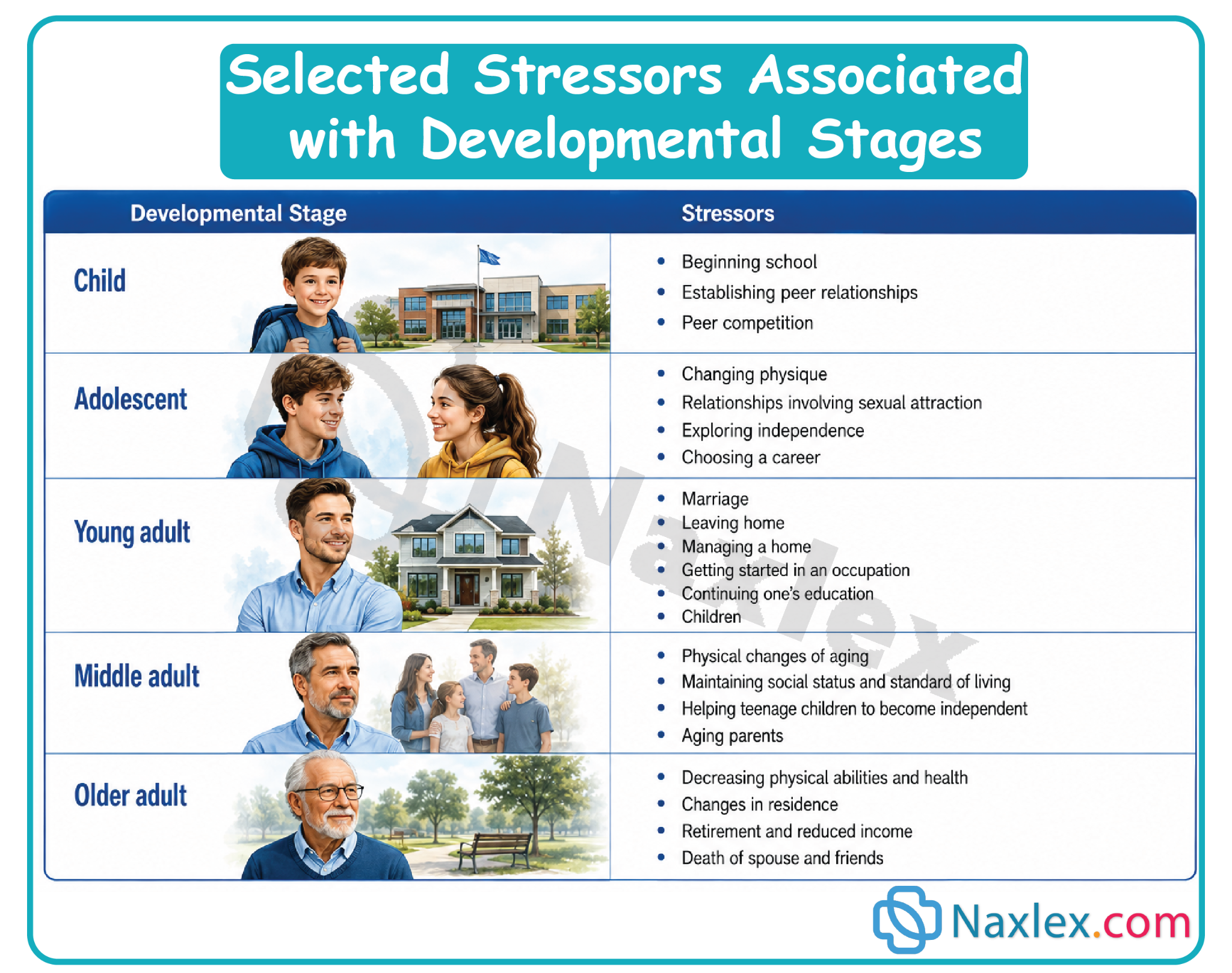
Effects of Stress
Stress can have physical, emotional, intellectual, social, and spiritual consequences.
Usually the effects are mixed, because stress affects the whole person.
- Physically, stress can threaten a person’s physiological homeostasis.
- Emotionally, stress can produce negative or nonconstructive feelings about the self.
- Intellectually, stress can influence a person’s perceptual and problem-solving abilities.
- Socially, stress can alter a person’s relationships with others.
- Spiritually, stress can challenge one’s beliefs and values.
Models of stress
Models of stress assist nurses to predict stressors in a particular situation and to understand the individual’s responses. Nurses can use these models to assist clients in strengthening healthy coping responses and in adjusting unhealthy, unproductive responses.
Three main models of stress are:
- stimulus based
- response based
- transaction based
1. Stimulus-Based Models
Defines stress as a stimulus, life event, or set of circumstances that triggers physiological/psychological reactions and increases vulnerability to illness.
- Key Theorists & Tools:
- Holmes & Rahe (1967): Developed the original scale assigning numerical stress values to 43 life events.
- Miller & Rahe (1997): Expanded the full scale to 77 items.
- Rahe & Tolles (2002): Created a shortened 54-item inventory (15-minute completion).
- Core Concepts:
- Measures recent life experiences (e.g., divorce, pregnancy, retirement).
- Considers both positive and negative life events as stressful.
- Nursing Considerations & Limitations: Use caution when interpreting scores. Scales often lack sensitivity to age, socioeconomic status, and culture, and the stress level of an event remains highly individual.
2. Response-Based Models
Defines stress as the body's nonspecific response to any demand placed upon it (Hans Selye).
- Key Terms:
- Stressor: Any factor producing stress that disrupts equilibrium.
- General Adaptation Syndrome (GAS): Systemic, chain-like physiological stress response.
- Local Adaptation Syndrome (LAS): Localized tissue response to stress (e.g., inflammation).
GAS & LAS Three-Stage Process
|
Stage |
Key Events & Mechanisms |
|
1. Alarm Reaction |
Primary, short-lived alert (1 minute to 24 hours). Composed of two phases: • Shock Phase: Hypothalamus --> Anterior Pituitary --> ACTH release; Sympathetic Nervous System stimulates Adrenal Medulla to release: - Epinephrine: Increases heart contractility, bronchodilation, cellular metabolism, fat mobilization, and blood clotting. - Norepinephrine: Decreases renal blood flow; increases renin and angiotensin to constrict arterioles and raise blood pressure ("fight or flight"). • Countershock Phase: Body attempts to reverse the changes triggered in the shock phase. |
|
2. Resistance |
Adaptation phase where the body attempts to cope with the stressor and limit its impact to the smallest localized area possible. |
|
3. Exhaustion |
Adaptive energy and resources run out. If the stressor isn't overcome, effects spread systemically. Outcomes: body rests and returns to normal, or severe consequences/death occur. |
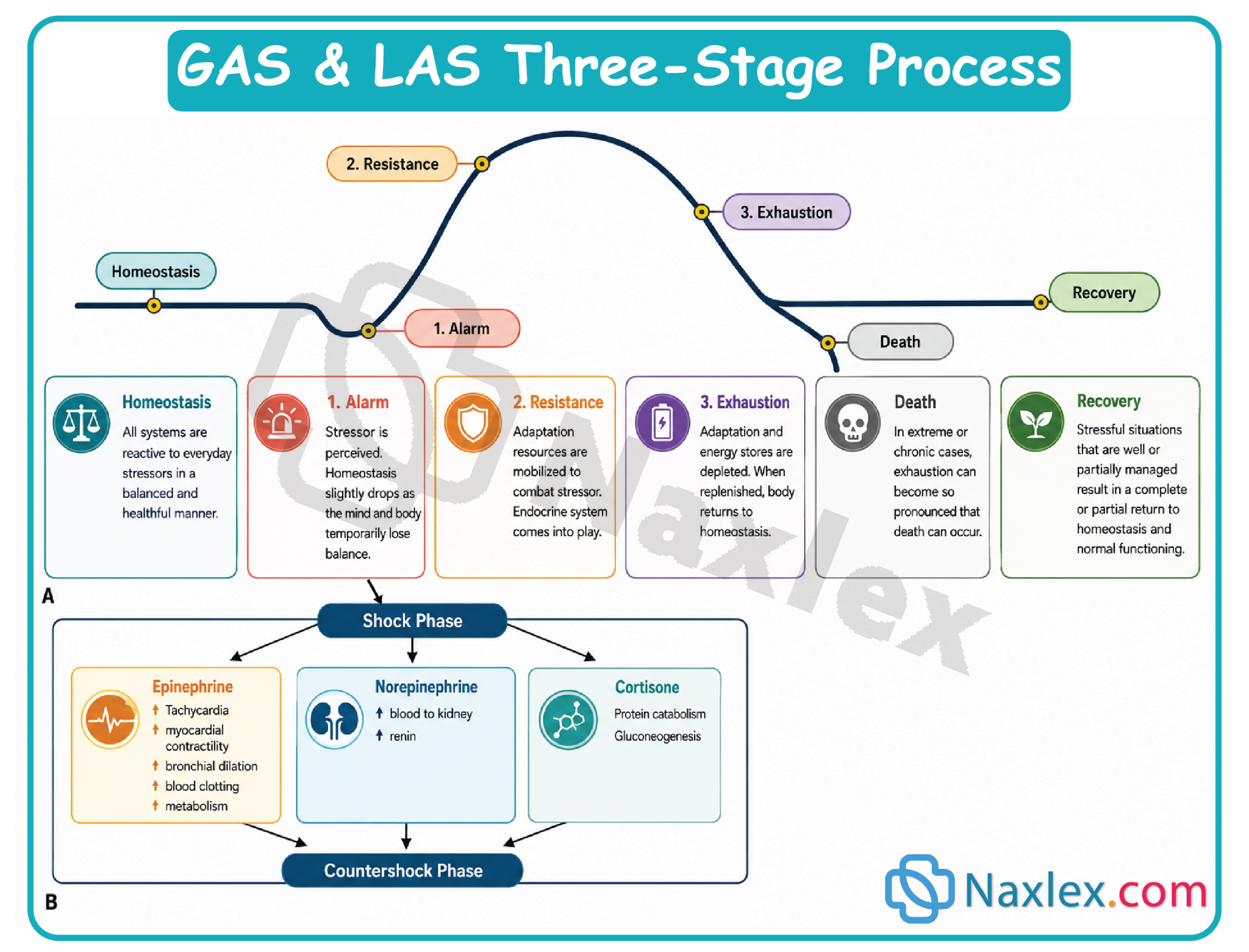
Pathological Effects of Prolonged Stress:
-
- Gastrointestinal tract: Deep stomach ulcers.
- Adrenal glands: Significant enlargement.
- Lymphatic structures (thymus, spleen, lymph nodes): Atrophy (shrinkage).
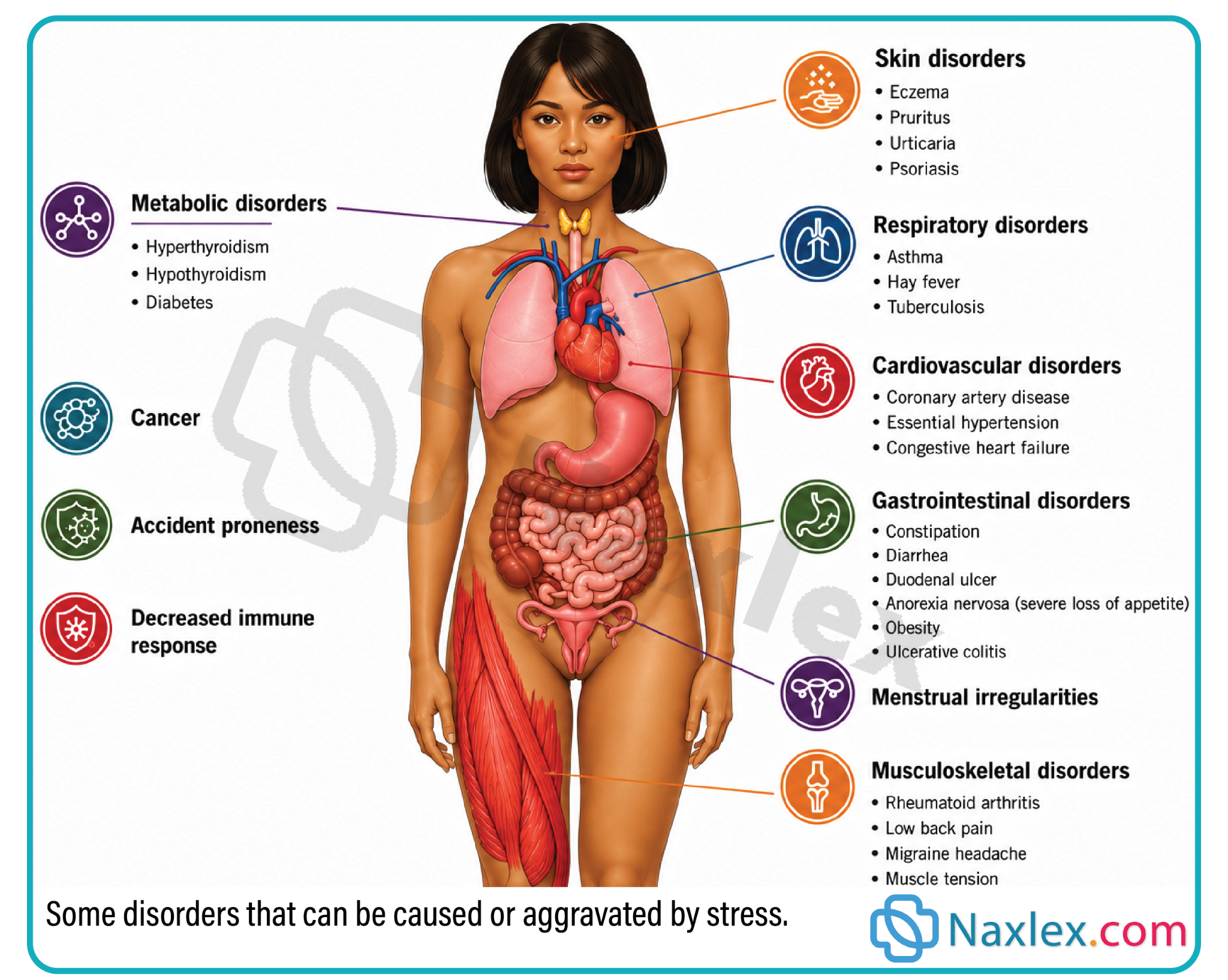
3. Transaction-Based Models
Defines stress as a set of cognitive, affective, and adaptive responses arising from dynamic person-environment transactions (Richard Lazarus).
- Core Premise:
- Addresses gaps in stimulus/response models by accounting for individual differences, perceptions, and mental/psychological factors.
- The person and environment are inseparable and continuously influence each other.
- Stress occurs when environmental or internal demands tax or exceed an individual's adaptive resources.
- Clinical Application: Explains why different individuals react to the exact same stressor (e.g., illness) in vastly different ways-such as denial, anxiety, or depression.
Indicators of stress
An individual's indicators of stress manifest through three primary domains: physiological, psychological, and cognitive.
Physiological Indicators
Physiological stress indicators result from the activation of the sympathetic nervous system and the neuroendocrine system.
- Cardiovascular & Respiratory: Increased heart rate, cardiac output, and rate/depth of respirations (bronchiole dilation/hyperventilation); elevated blood pressure driven by norepinephrine and renin-angiotensin activation.
- Neurological & Musculoskeletal: Dilation of pupils (enhanced visual perception), heightened mental alertness (for serious threats), increased muscle tension (preparing for rapid motor activity), and headache or dizziness.
- Gastrointestinal & Renal: Dry mouth, decreased intestinal peristalsis (leading to constipation or flatus), and decreased urinary output with elevated sodium/water retention to increase blood volume.
- Metabolic & Integumentary: Increased blood sugar (via glucocorticoids/gluconeogenesis), increased diaphoresis (sweating to control metabolic heat), and skin pallor from peripheral vasoconstriction.
Psychological Indicators
Anxiety vs. Fear
- Anxiety: A state of mental uneasiness or apprehension regarding an anticipated, unidentified threat. It is vague, related to future events, and stems from psychological/emotional conflict.
- Fear: An emotion of apprehension aroused by an identified, definite source of danger or threat. It can relate to the past, present, or future and stems from a specific physical or psychological entity.
Four Levels of Anxiety
|
Level |
Verbal & Behavioral Changes |
Perceptual & Learning Changes |
Physiological Signs |
|
Mild |
Mild restlessness, increased questioning, sleeplessness |
Increased arousal and alertness; enhances learning |
None (stimulates goal-directed behavior) |
|
Moderate |
Voice tremors, facial twitches, shakiness, increased muscle tension |
Narrowed focus; selective inattention; learning slightly impaired |
Slightly elevated heart/respiratory rates; mild gastric distress ("butterflies") |
|
Severe |
Communication difficult to understand; increased motor activity; inability to relax |
Inability to focus; easily distracted; learning severely impaired |
Tachycardia, hyperventilation, headache, dizziness, nausea |
|
Panic |
Communication may be unintelligible; agitation; trembling; poor coordination |
Distorted/exaggerated perception; unable to function or learn |
Dyspnea, palpitations, chest pain, feelings of impending doom, paresthesia, sweating |
Anger, Hostility, Aggression, & Violence
- Anger: Subjective feeling of animosity or strong displeasure. Constructive when expressed verbally and clearly, as it prevents emotional buildup.
- Hostility: Marked by overt antagonism and destructive behavior.
- Aggression: Unprovoked attack or hostile, destructive outlook.
- Violence: Exertion of physical force to injure or abuse.
Depression
An extreme feeling of sadness, despair, dejection, or emptiness.
- Emotional: Tiredness, sadness, numbness, or feeling empty.
- Behavioral: Irritability, poor concentration, crying, social withdrawal, loss of sexual desire, and sleep disturbances.
- Physical: Loss of appetite, weight loss, constipation, headaches, and dizziness.
Ego Defense Mechanisms
Unconscious psychological strategies used to protect the mind from anxiety and resolve inner tension.
- Denial: Blocking out painful or anxiety-inducing events or feelings.
- Displacement: Directing pent-up feelings onto a less dangerous target than the one that aroused the emotion.
- Dissociation: Temporarily altering consciousness or identity to handle emotional conflict.
- Fantasy: Symbolically satisfying wishes through nonrational thought.
- Identification: Unconsciously assuming the characteristics or similarity of another person.
- Intellectualization: Separating an emotional reaction from an idea/thought because it is too painful.
- Introjection: Accepting another person's values and opinions as one's own.
- Projection: Attributing one's own unacceptable feelings or thoughts to others.
- Rationalization: Constructing logical, socially acceptable explanations to justify behavior or experience.
- Reaction Formation: Disguising unacceptable feelings by repressing them and reinforcing the exact opposite behavior.
- Regression: Reverting to an earlier developmental stage.
- Repression: Unconsciously keeping unacceptable thoughts/feelings out of awareness.
- Suppression: Consciously pushing unacceptable thoughts or feelings out of mind.
- Undoing: Attempting to take back or negate an unacceptable/hurtful thought or behavior.
Cognitive Indicators
Cognitive indicators represent conscious thinking responses used to manage stressors.
- Problem Solving: Analyzing a threatening situation through structured steps: assessing the problem, defining it, selecting alternatives, implementing the chosen strategy, and evaluating the outcome.
- Structuring: Manipulating or arranging a situation to prevent threatening events from occurring (e.g., a nurse asking closed-ended questions to keep an interview focused, or scheduling regular dental checkups).
- Self-Control (Discipline): Maintaining composure and facial expressions to convey being in charge. Prevents panic, though extreme self-control can delay effective problem-solving or isolate a person from support.
- Suppression: Consciously putting off a thought or stressor until later ("I'll deal with that tomorrow"). Temporarily relieves anxiety but does not solve the underlying issue.
- Fantasy (Daydreaming): Imagining unfulfilled wishes as complete or replaying events with different outcomes. Helpful if it leads to constructive problem-solving; destructive if used excessively to retreat from reality.
Coping
Coping describes how an individual deals with change-either successfully or unsuccessfully. It involves the cognitive and behavioral efforts a person uses to manage internal or external demands that are evaluated as taxing or exceeding their resources (Folkman & Lazarus, 1991).
Core Coping Categorizations
1. Focus-Based Coping
- Problem-Focused Coping: Taking direct action or making structural changes to improve the situation.
- Emotion-Focused Coping: Using thoughts and behaviors to reduce emotional distress. While it does not fix the underlying problem, it helps the individual feel better.
- Note: Both problem- and emotion-focused strategies typically occur together.
2. Duration-Based Coping
- Long-Term Strategies: Constructive, practical habits that foster sustainable adaptation.
- Examples: Talking with others, seeking information, eating a healthy diet, exercising regularly, balancing work and leisure, and applying structured problem-solving instead of emotional outbursts.
- Short-Term Strategies: Provide temporary stress reduction to a tolerable limit but do not resolve the issue and can be destructive over time.
- Examples: Using alcohol or drugs, daydreaming/fantasizing, passive optimism ("everything will work out"), and giving in to others solely to avoid conflict.
3. Outcome-Based Coping
- Adaptive (Effective) Coping: Enables effective management of stressful events, minimizes distress, and leads to successful adaptation.
- Maladaptive (Ineffective) Coping: Fails to resolve the stressor, causes unnecessary distress to the individual or others, and leads to maladaptation.
- Nursing Core Principle: Coping behavior is always purposeful, even when it appears inappropriate or ineffective to an outside observer.
Key Coping Approaches & Influencing Factors
An individual typically manages stress through one of three primary approaches:
- Altering the stressor.
- Adapting to the stressor.
- Avoiding the stressor.
Factors Determining Coping Effectiveness
- Stress Characteristics: The total number, duration, and intensity of the stressors.
- Individual History: Past experiences with similar stressors.
- External Resources: Quality and availability of support systems.
- Internal Resources: Personal qualities and individual perception of the stressful event (reappraisal can change coping strategies over time).
Consequences of Prolonged Stress & Coping Failure
When stressors extend beyond an individual's coping capacity, exhaustion sets in, leading to significant health risks and interpersonal decline.
- Caregiver Burden: Chronic stress experienced by family members providing long-term home care for a loved one.
- Manifestations: Chronic fatigue, sleeping difficulties, and high blood pressure.
- Nursing Imperative: The caregiver becomes a secondary client who requires a dedicated nursing care plan.
- Mental & Functional Decline: As coping strategies fail, individuals experience interpersonal strain, work performance issues, and an inability to meet basic human needs.
Impact of stress on basic human needs
|
Need Category |
Examples of Negative Stress Effects |
|
Physiological |
Altered elimination patterns, appetite changes, and disrupted sleep patterns. |
|
Safety & Security |
Expressions of nervousness, feelings of being threatened, hyper-fixation on stressors, and inattention to physical safety measures. |
|
Love & Belonging |
Becoming isolated, withdrawn, or overly dependent; blaming others for personal problems. |
|
Self-Esteem |
Social withdrawal, becoming a "workaholic," or engaging in excessive attention-seeking behavior. |
|
Self-Actualization |
Preoccupation with personal problems, feeling a total lack of control, and an inability to accept reality. |
Nursing management
Nursing assessment evaluates a client's stress responses and coping capabilities through two primary methods:
- Nursing History: Gathering subjective data regarding perceived stressors, current manifestations of stress, past and present coping mechanisms, and unresolved developmental tasks. Unresolved tasks from earlier developmental stages (such as mistrust stemming from infancy) can carry forward, increasing stress and leading to ineffective coping later in life.
- Physical Examination: Observing objective indicators of stress. These include motor behaviors (nail biting, nervousness), physical signs (hypertension, dyspnea), and weight fluctuations. Clinical signs may be absent if the client utilizes effective cognitive coping strategies.
Home Care Assessment Domains
|
Assessment Level |
Key Evaluation Focus |
|
Client |
Understanding of stressors, effectiveness of current coping mechanisms, self-care abilities (physical, emotional, financial), and role expectations. |
|
Family |
Comprehension of client stressors, effectiveness of family coping, role expectations, and the availability/skills of support persons. |
|
Community |
Availability, accessibility, and client familiarity with external resources (support groups, therapy, spiritual centers). |
NANDA INTERNATIONAL NURSING DIAGNOSES
- Anxiety: Vague, uneasy feeling of dread or discomfort accompanied by an autonomic response; serves as an alerting signal to impending danger.
- Caregiver Role Strain: Difficulty performing the family caregiving role.
- Compromised Family Coping: Primary support person provides insufficient, ineffective, or compromised assistance to the client.
- Defensive Coping: Repeated projection of falsely positive self-evaluation to defend against perceived threats to self-regard.
- Disabled Family Coping: Behavior of a significant person that disables their own or the client's ability to adapt to health challenges.
- Ineffective Coping: Inability to assess stressors accurately, choose appropriate responses, or use available resources.
- Ineffective Denial: Conscious or unconscious attempt to disavow the meaning of an event to reduce anxiety, resulting in harm to health.
- Post-Trauma Syndrome: Sustained maladaptive response to a overwhelming, traumatic event.
- Relocation Stress Syndrome: Physiological or psychosocial disturbance following transfer from one environment to another.
PLANNING AND GOAL SETTING
Collaborative planning involves the client, support systems, and healthcare team to set actionable targets. Primary overall goals focus on:
- Decreasing or resolving anxiety.
- Increasing the ability to manage or cope with stressful events.
- Improving role performance.
IMPLEMENTATION: INTERVENTIONS & STRATEGIES
- Health Promotion Strategies
- Exercise: Promotes physical benefits (muscle tone, cardiopulmonary function) and psychological benefits (tension relief). Adults should aim for 150 minutes of moderate-intensity exercise weekly.
- Nutrition: Avoid excesses of caffeine, salt, sugar, and fat. Allow non-contraindicated "comfort foods" to support emotional well-being.
- Sleep: Essential for restoring energy; managed through comfort measures and relaxation techniques.
- Time Management: Prioritize tasks, delegate responsibilities, learn to decline unreasonable demands, set realistic self-expectations, and schedule dedicated periods for specific tasks.
- Minimizing Anxiety and Stress
- Listen attentively and maintain an atmosphere of warmth, trust, and empathy.
- Stay with the client to promote security; control the environment by reducing noise and limiting extra personnel.
- Communicate using short, clear sentences.
- Help clients identify triggers, signs of anxiety, personal strengths, and new coping mechanisms.
- Mediating Anger
- Differentiate subjective feelings of anger from harmful behaviors (aggression).
- Approach clients with a calm, reassuring manner and involve them in care to increase their sense of control.
- Prioritize safety: call for assistance or withdraw from the situation if aggression escalates or personal safety is threatened.
- Relaxation Techniques
Nurses can teach and encourage various methods to counteract the body's fight-or-flight response during stressful events (e.g., postoperatively, childbirth, procedures):
- Breathing exercises, massage, and progressive muscle relaxation.
- Guided imagery, biofeedback, and meditation.
- Yoga, therapeutic touch, music therapy, and humor/laughter.
- Crisis Intervention
A crisis is an acute, time-limited state of disequilibrium characterized by sudden onset, perceived life-threatening disruption, loss, and breakdown of normal coping mechanisms.
- Goal: Assist the client through resolution and restore pre-crisis functioning.
- Methods: Includes crisis counseling (focusing on immediate problem-solving) and telephone hotlines (24/7 anonymous assistance via structured protocols).
- Crisis Home Visits: Implemented when telephone contact is insufficient, direct observation is necessary, or high risk (e.g., suicidal intent) is identified.
- Stress Management for Nurses
Workplace stressors—such as understaffing, high client acuity, shift work, and caring for dying patients—can lead to burnout (a state of physical/emotional depletion, negative self-concept, and helplessness corresponding to the exhaustion stage of stress).
- Prevention and Coping Tactics:
- Schedule daily relaxation and establish a regular exercise routine.
- Practice assertiveness skills and learn to say no.
- Accept personal and organizational limitations while engaging in constructive change efforts.
- Form collegial support groups, participate in professional organizations, and seek professional counseling when necessary.
EVALUATION
Evaluation compares current client progress against baseline outcomes established during planning. If goals are unmet, reassess by asking:
- How does the client perceive the stressor and the effectiveness of new strategies?
- Are there unidentified underlying problems or new stressors?
- Were coping mechanisms implemented correctly and supported adequately by family and community resources?
Summary
- Stress is a state of physiological and psychological tension that affects the whole person-physically, emotionally, intellectually, socially, and spiritually.
- Models view stress as a stimulus, as a response, or as a transaction.
- General adaptation syndrome (GAS) is a multisystem response to stress and involves three steps: alarm reaction, stage of resistance, and stage of exhaustion.
- Local adaptation syndrome (LAS) is a localized physiological response that also expresses the three stages of GAS. An example of LAS is the inflammatory response.
- There are physiological, psychological, and cognitive indicators of stress. Physiological indicators result from increased activity of the sympathetic and neuroendocrine systems.
- Coping strategies to deal with stress vary significantly among individuals. Strategies may be problem focused or emotion focused, long term or short term, and effective or ineffective.
- The effectiveness of individual coping depends on the number, duration, and intensity of the stressors; past experience; support systems available; and the personal qualities of the person.
Naxlex
Videos
Login to View Video
Click here to loginTake Notes on Stress, anxiety, adaptation, and change
This filled cannot be empty
Join Naxlex Nursing for nursing questions & guides! Sign Up Now