






 Video Library


Please set your exam date
Planning and outcome identification
Study Questions
Practice Exercise 1
A 75-year-old client who had elective surgery to replace an arthritic hip was discharged from the post anesthesia recovery unit. The client has been on the orthopedic floor for several hours. Which type of planning will be least useful during the first shift on the orthopedic unit?
Explanation
Strategic planning involves long-term organizational goals and high-level resource allocation managed by administrative leadership. In contrast, clinical nursing care relies on systematic care planning divided into initial, ongoing, and discharge phases to manage acute post-operative recovery, prevent complications like deep vein thrombosis, and optimize client mobility.
Rationale for correct answer:
D. Strategic planning focuses on macro-level operations rather than individual client care. It is an administrative tool used for institutional forecasting and policy development. Because it does not address the immediate, shift-specific clinical needs of a post-operative orthopedic client, it serves no utility for the staff nurse providing direct bedside care.
Rationale for incorrect answers:
A. Initial planning is essential during admission to the orthopedic floor. It begins when the nurse conducts the first comprehensive assessment immediately following the client's transfer from the recovery unit. This process establishes the baseline care plan, identifies immediate post-surgical risks, and outlines critical nursing interventions for the upcoming shift.
B. Ongoing planning occurs continuously throughout the shift as the nurse monitors the client's responses. It allows the clinician to update nursing diagnoses, response pathways, and interventions based on new clinical data. For an post-operative arthroplasty client, this includes vital sign trends, pain scores, and neurovascular checks.
C. Discharge planning must begin at admission to anticipate the client's long-term care needs. For an elderly post-operative client, early planning prevents delays by arranging necessary home health services, physical therapy sessions, and durable medical equipment. Neglecting this phase during the first shift compromises continuity of transitional care.
Test-taking strategy
- Analyze the scenario and question: The client is an elderly post-operative hip replacement client newly admitted to the orthopedic floor. The question asks for the planning type that will be least useful during the very first clinical shift, which requires identifying the option that does not apply to immediate, individualized bedside nursing care.
- Apply nursing process and care planning concepts: Differentiate between clinical nursing care plans and broader institutional frameworks. Nursing care planning consists of three structural phases.
- Initial planning is used to create the foundational plan right after report. Rule out D.
- Ongoing planning is used to adapt to client changes during the shift. Rule out D.
- Discharge planning is integrated early to ensure a safe transition home. Rule out D.
- Eliminate non-clinical frameworks: Evaluate the outlier.
- Strategic planning is an administrative, organizational tool rather than a clinical nursing process. This makes Choice 4 the correct selection for the least useful type of planning at the bedside.
Take home points
- Strategic planning addresses long-term organizational objectives rather than shift-specific clinical interventions for individual clients.
- Initial planning must be performed by the nurse immediately upon a client's arrival to a new inclient unit to establish baseline care priorities.
- Ongoing planning is a dynamic process performed throughout the shift to modify nursing interventions based on real-time clinical reassessments.
- Discharge planning for surgical clients must be initiated during the first shift to secure necessary rehabilitative resources and prevent readmissions.
A nurse is helping a client turn in bed and notices that his heels are reddened. The nurse plans to place him on precautions for skin breakdown. This is an example of what type of planning?
Explanation
Ongoing planning is the continuous modification of the client's care plan in response to changing clinical data gathered during daily shifts. Unlike initial assessments, this dynamic process allows the bedside nurse to instantly implement preventive protocols the moment a new physical risk or physiological alteration is observed during routine care activities.
Rationale for correct answer:
C. This scenario is a prime example of ongoing planning because the nurse identifies a new physical finding (reddened heels) during routine care and immediately updates the plan. Ongoing planning allows the clinician to continuously refine nursing diagnoses and initiate immediate tissue-loading precautions to prevent further epidermal degradation based on real-time bedside observations.
Rationale for incorrect answers:
A. Initial planning is completed during admission or upon the client's initial transfer to the medical unit. It establishes the foundational care blueprint based on the primary medical diagnosis and comprehensive admission history. Because this nurse is reacting to a new physical change during an ongoing shift, it does not constitute initial planning.
B. Standardized planning refers to pre-printed clinical pathways or computerized protocols developed for broad diagnostic categories rather than individual shifts. While the skin breakdown protocol itself may be a standardized document, the act of recognizing a real-time clinical change and applying that protocol is a function of ongoing planning.
D. Discharge planning focuses entirely on anticipating long-term transitional needs and coordinating resources for the client's eventual exit from the acute care facility. Placing a client on immediate, short-term bedrest skin precautions to treat localized erythema is an acute inclient intervention rather than a discharge preparation strategy.
Test-taking strategy
- Analyze the scenario and question: The nurse observes newly reddened heels while assisting a client with repositioning and immediately initiates skin breakdown precautions. The question asks to identify the specific type of care planning demonstrated by this action.
- Differentiate between types of planning: Compare the timing and intent of each planning classification.
- Initial planning occurs at admission. Rule out C.
- Standardized planning is the generic template, not the live clinical action. Rule out C.
- Discharge planning prepares the client for transition home or to rehab. Rule out C.
- Match action to definition: The nurse is actively modifying care during a routine interaction based on an immediate, new assessment finding. This continuous, shift-specific adaptation defines ongoing planning, making Choice 3 the correct answer.
Take home points
- Ongoing planning involves making real-time adjustments to the nursing care plan based on new assessment findings during a shift.
- Early recognition of localized erythema over bony prominences requires the immediate implementation of pressure-redistribution interventions.
- Initial planning sets the baseline care blueprint at admission, whereas ongoing planning updates that blueprint as the client's status changes.
- Standardized care documents provide the structural protocols that the nurse selects and activates through ongoing clinical planning.
A nurse is differentiating between types of planning. Which of the following statements correctly describe initial, ongoing, and discharge planning? Select all that apply
Explanation
Care planning is a dynamic and continuous process divided into distinct functional phases designed to manage a client's recovery continuum. To ensure comprehensive clinical surveillance and safety, the nurse must integrate initial baseline planning with continuous shift adjustments and early transitional preparation rather than treating care planning as an isolated or episodic administrative task.
Rationale for correct answers:
A. Initial planning begins immediately after the nurse's first assessment and is essential to establish baseline care priorities. Upon admission or unit transfer, the nurse conducts a comprehensive evaluation to formulate the foundational nursing diagnoses, outline primary goals, and design the initial shift interventions.
B. Ongoing planning is used to update the care plan as client status changes and occurs continuously throughout the clinical shift. It allows the nurse to dynamically respond to new assessment data, modify outdated interventions, and re-rank care priorities to match the client's real-time physiological or psychological trajectory.
C. Discharge planning focuses on preparing the client for self-care after leaving the facility and is vital for long-term therapeutic continuity. It systematically anticipates post-hospitalization needs, manages home safety preparations, and coordinates necessary interprofessional community resources and durable medical equipment.
Rationale for incorrect answers:
D. Stating that ongoing planning is only performed at the time of admission is conceptually false and a procedural error. Admission is the exclusive window for initial planning. Ongoing planning is by definition continuous and fluid, executed by every nurse during every subsequent shift to adapt the care blueprint to live clinical developments.
E. Claiming that discharge planning is initiated only on the day of discharge is clinically dangerous and compromises client safety. Effective discharge planning must begin on the day of admission. Delaying this comprehensive process until the final day causes fragmented transitions, medication errors, and increased hospital readmission rates.
Test-taking strategy
- Analyze the scenario and question: The question asks to identify the correct descriptions of initial, ongoing, and discharge planning using a "Select all that apply" format.
- Evaluate care planning chronology: Match each type of planning to its correct operational timeline and definition.
- Choice 4 contradicts the definition of "ongoing" by limiting it to admission. Incorrect. Rule out 1, 2, C.
- Choice 5 promotes a dangerous delay in transitional care coordination. Incorrect. Rule out 1, 2, C.
- Validate the true operational phases: Options 1, 2, and 3 accurately map the starting point of initial care, the adaptive nature of ongoing shift care, and the self-care focus of discharge preparation, making Choices 1, 2, and 3 the correct selections.
Take home points
- Initial care planning establishes the baseline clinical blueprint immediately following the client's primary comprehensive admission assessment.
- Ongoing care planning occurs continuously across all shifts to adapt interventions to real-time fluctuations in the client's status.
- Discharge planning must be initiated at the time of admission to systematically prepare the client for self-care post-hospitalization.
- Restricting discharge or ongoing planning to narrow, single-day windows causes severe care fragmentation and threatens client safety.
A nurse is engaged in the planning phase of the nursing process. Which of the following activities occurs during this step?
Explanation
The planning phase of the nursing process is a systematic, deliberate decision-making stage during which the nurse establishes priorities, identifies expected client outcomes, and selects appropriate nursing interventions. It serves as the design phase of clinical care, translating validated nursing diagnoses into a highly structured, individualized blueprint of care before any direct therapeutic actions are executed.
Rationale for correct answer:
B. Establishing client goals and expected outcomes occurs strictly during the planning phase. After identifying and prioritizing the client's nursing diagnoses, the nurse must formulate specific, measurable, realistic, and time-bound outcomes. These goals define the target destination of the care pathway and serve as the standard for final evaluation.
Rationale for incorrect answers:
A. Collecting subjective and objective data is the primary activity of the assessment phase. Assessment is the foundational first step of the nursing process, during which the clinician gathers historical, physical, and psychological data points through clinical interviews, physical examinations, and chart reviews.
C. Performing nursing interventions is the core activity of the implementation phase. Implementation is the active, dynamic step where the nurse executes the specific, evidence-based independent, dependent, and collaborative clinical actions that were previously drafted during the planning phase.
D. Documenting client responses to care occurs during the implementation and evaluation phases. While interventions are documented as they are performed, recording the client's specific physiological or behavioral response to those actions is a critical requirement of clinical evaluation to determine if goals were achieved.
Test-taking strategy
- Analyze the scenario and question: The question asks to identify the specific nursing activity that occurs during the planning phase of the nursing process.
- Map the activities to the five phases of ADPIE:
- Collecting data (1): Assessment phase. Rule out B.
- Performing interventions (3): Implementation phase. Rule out B.
- Documenting responses (4): Implementation and Evaluation phases. Rule out B.
- Identify the care plan design action: Establishing goals and expected outcomes (Choice 2) is the core structural activity of the planning stage, making it the correct answer.
Take home points
- The planning phase of the nursing process focuses on establishing client priorities, goals, and evidence-based clinical interventions.
- Systematic data collection is a baseline assessment activity that must be completed before any care planning can occur.
- Executing the written care plan and performing therapeutic tasks are classified under the implementation phase of care.
- Documenting client responses to nursing actions provides the clinical data required to complete the final evaluation phase.
The client with a fractured pelvis requests that family members be allowed to stay overnight in the hospital room. Before determining whether or not this request can be honored, the nurse should consult which of the following?
Explanation
Hospital administrative regulations dictate the parameters of visitor operations and overnight accommodations within specific clinical units. While clinical judgment guides client care, institutional governance structures establish the legal and operational boundaries regarding safety, security, and space constraints that direct nursing practice.
Rationale for correct answer:
A. Hospital policies outline the governing operational guidelines for a specific facility, including visitor hours and overnight stay permissions. The nurse must consult these institutional rules to determine if the family's request complies with hospital safety and security protocols. Bedside decisions regarding non-clinical accommodations must align with these formal facility regulations.
Rationale for incorrect answers:
B. Standardized care plans provide generic clinical frameworks for managing specific client medical diagnoses across a population. They outline typical nursing interventions, expected outcomes, and assessment parameters for a given condition. Because they focus strictly on clinical path protocols, they do not contain administrative rules regarding visitor accommodations.
C. Orthopedic protocols deliver specific clinical directions for managing musculoskeletal injuries, immobilization devices, and post-operative mobility restrictions. They guide the nurse in preventing complications like compartment syndrome or deep vein thrombosis. These guidelines do not address administrative, non-clinical logistics such as overnight family visits.
D. Standards of care define the minimum professional requirements for safe, competent nursing practice as established by regulatory bodies and professional organizations. They serve as legal benchmarks for measuring clinical competence and client safety during care delivery. They do not dictate facility-specific administrative rules for visitor scheduling.
Test-taking strategy
- Analyze the scenario and question: The client has a fractured pelvis and requests that family members stay overnight in their hospital room. The question asks what the nurse should consult before honoring this request, which requires differentiating between clinical care guidelines and institutional administrative rules.
- Classify the nature of the request: Distinguish between clinical interventions and administrative accommodations. The request for an overnight family visitor is non-clinical, operational, and facility-dependent.
- Standardized care plans handle clinical nursing diagnoses. Rule out A.
- Orthopedic protocols govern musculoskeletal clinical interventions. Rule out A.
- Standards of care regulate broad professional and legal practice benchmarks. Rule out A.
- Identify the appropriate governing framework: Match the non-clinical request to the correct institutional authority. Institutional operations, visitor hours, and building security are strictly governed by facility-specific rules, making Choice 1 the correct answer.
Practice Exercise 2
A nurse is developing a plan of care for a client. From which of the following are nursing outcomes derived?
Explanation
Maslow's hierarchy of human needs provides a systematic framework for clinical prioritization, establishing that physiological survival needs must be met before addressing higher-level psychological or spiritual needs. By ranking clinical problems according to this structural hierarchy, the nurse ensures that life-threatening physiological compromises are resolved before focusing on self-esteem, social belonging, or self-actualization.
Rationale for correct answer:
A. The sequence b, d, a, c correctly prioritizes the diagnoses from highest to lowest priority. Ineffective Airway Clearance (b) is a physiological survival need, occupying the foundational tier of the hierarchy. Impaired Social Interaction (d) addresses love and belonging needs, followed by Disturbed Body Image (a) in the self-esteem tier, and finally Spiritual Distress (c) in the self-actualization tier.
Rationale for incorrect answers:
B. The sequence c, a, d, b represents the complete opposite of correct clinical prioritization. It places Spiritual Distress—a high-level self-actualization concern—as the highest priority, while designating the life-threatening physiological hazard of Ineffective Airway Clearance as the lowest priority. This ordering directly violates safety and survival principles.
C. The sequence a, d, c, b is incorrect because it places self-esteem and social belonging above physiological safety. In this order, the nurse would prioritize treating the client's psychological perception of their body image (a) over their physiological ability to clear secretions from their tracheobronchial tree (b), which poses an immediate risk of asphyxiation.
D. The sequence c, b, d, a is incorrect because it inappropriately ranks spiritual suffering above a critical airway emergency. While nursing care must address spiritual distress (c), physiological airway compromise (b) requires immediate, life-saving clinical intervention before the client has the cognitive or emotional capacity to address spiritual concerns.
Test-taking strategy
- Analyze the scenario and question: The nurse must prioritize four distinct nursing diagnoses using Maslow's hierarchy of human needs. The question asks for the correct order of clinical priority from highest to lowest.
- Classify each nursing diagnosis by hierarchy tier: Map each diagnostic label to its corresponding level of human need.
- Ineffective Airway Clearance (b): Physiological tier (survival and breathing). This must be the highest priority, ruling out 2 and C.
- Impaired Social Interaction (d): Love and belonging tier (interpersonal relationships).
- Disturbed Body Image (a): Self-esteem tier (personal perception and worth).
- Spiritual Distress (c): Self-actualization tier (meaning and purpose).
- Synthesize the sequence: Ordering these tiers from bottom to top yields physiological (b), love/belonging (d), self-esteem (a), and self-actualization (c), confirming Choice 1 as the correct sequence.
Take home points
- Physiological survival needs, such as airway patency and ventilation, must always be resolved before addressing psychosocial or spiritual concerns.
- Love and belonging needs, including social interaction, rank higher on the hierarchy than self-esteem needs such as body image.
- Spiritual distress represents a disruption in self-actualization, placing it at the highest tier of Maslow's hierarchy and the lowest relative priority.
- Prioritizing client problems systematically prevents the nurse from addressing secondary psychological distress while a physiological crisis remains untreated.
A nurse is reviewing the plan of nursing care for a client. Which of the following best describes the plan of nursing care?
Explanation
The formal plan of nursing care serves as the definitive legal and clinical blueprint that operationalizes the nursing process for an individual client. To ensure professional continuity and safe clinical practice, this structured document must encompass all five sequential components of nursing-sensitive care, systematically linking raw clinical assessments directly to individualized diagnoses, measurable goals, and actionable nursing interventions.
Rationale for correct answer:
D. Assessment data, nursing diagnoses, goals and expected outcomes, and nursing interventions best describe the comprehensive plan of nursing care. This document integrates the foundational steps of the nursing process, ensuring that every selected clinical action is driven by a validated client problem and directed toward a measurable, client-centered behavioral outcome.
Rationale for incorrect answers:
A. Client assessment data, medical treatment regimes, and diagnostic test results describe components of the medical record and general clinical history. While the nurse reviews these interprofessional data points to maintain overall clinical awareness, they represent independent medical management and diagnostic tracking rather than the dedicated, nursing-sensitive care blueprint.
B. Prescribing practitioner's orders, demographic data, and medication administration rationales describe elements found within the provider order sheet and medication administration record. These separate documents log the collaborative interventions and demographic identifiers of the client but do not outline the independent nursing diagnoses or client-centered goals.
C. The collected documentation of all team members providing care describes the complete interprofessional health record or chart. While the nursing care plan is archived within this comprehensive record, the care plan itself is a distinct, specialized document focused specifically on nursing-specific problems, outcomes, and independent clinical interventions.
Test-taking strategy
- Analyze the scenario and question: The nurse is reviewing the plan of nursing care. The question asks which option best and most comprehensively describes the true structural components of a formal nursing care plan.
- Identify the core nursing process framework: Match the choices to the established phases of the nursing process (Assessment, Diagnosis, Planning/Outcomes, Implementation, Evaluation).
- Choice 1 contains mostly medical management data. Rule out D.
- Choice 2 describes provider orders and medication tracking sheets. Rule out D.
- Choice 3 describes the overarching interprofessional medical chart. Rule out D.
- Select the comprehensive nursing sequence: Look for the option that explicitly lists the core steps of independent nursing practice. Choice 4 systematically outlines assessment, nursing diagnoses, expected outcomes, and interventions, making it the most accurate definition of the care plan.
Take home points
- The plan of nursing care is a structured, dynamic document that explicitly records the assessment, diagnoses, outcomes, and interventions for a client.
- Medical regimens, physician orders, and diagnostic test results represent collaborative tools rather than the independent nursing care blueprint.
- The nursing care plan acts as a specialized component within the larger interprofessional health record to guide shift-to-shift nursing actions.
- Every element within a well-formulated nursing care plan must be logically linked, ensuring that interventions directly solve documented nursing problems.
A nurse is using standards of care and predeveloped care plans. What is the most important reason for individualizing these plans?
Explanation
Predeveloped and standardized care plans provide an excellent, evidence-based baseline framework for broad diagnostic medical populations. However, the most important reason for individualizing these templates is to tailor care to the specific physiological variables and unique personal preferences of the client, transforming a generic protocol into a safe, client-centered care blueprint.
Rationale for correct answer:
B. Meeting the unique needs and preferences of the client is the primary objective of individualization. Standardized care plans are built for broad medical conditions rather than individual human beings. Customizing the template ensures that the client's specific co-morbidities, allergic limitations, developmental constraints, and cultural practices are directly addressed.
Rationale for incorrect answers:
A. Ensuring consistency across all clients describes the purpose of standardizing the baseline templates rather than individualizing them. While practice consistency reduces care variance across an institution, it can lead to dangerous "one-size-fits-all" care gaps if the nurse fails to alter the standard plan for the individual.
C. Reducing the workload of the nursing staff represents an operational benefit of using predeveloped templates rather than the reason for individualization. While predeveloped text saves documentation time, the act of individualizing actually requires focused cognitive energy and critical thinking to adjust parameters safely.
D. Eliminating the need for documentation is clinically inaccurate and legally impossible. Individualizing a predeveloped plan requires active, meticulous documentation to add custom client-centered goals, cross out irrelevant interventions, and record specific shift parameters, satisfying legal electronic charting mandates.
Test-taking strategy
- Analyze the scenario and question: The nurse is using standardized care plans and standards of care. The question asks for the most important reason for individualizing these predeveloped care plans.
- Apply the philosophy of patient-centered care: Evaluate the options based on client safety and individualized human responses versus institutional efficiency.
- Consistency (1) reflects standardization, not individualization. Rule out B.
- Workload reduction (3) is an administrative byproduct, not the primary clinical goal. Rule out B.
- Eliminating documentation (4) is a severe legal violation. Rule out B.
- Identify the core nursing purpose: The fundamental mandate of professional nursing care is to treat the unique human response of the individual client, making Choice 2 the definitive correct selection.
Take home points
- Individualizing standardized care plans is mandatory to address the unique physiological and psychological needs of the client.
- Standardized templates provide an excellent evidence-based baseline but can cause dangerous care gaps if left unmodified.
- The individualization process requires the nurse to integrate specific client co-morbidities, age risks, and cultural preferences.
- Tailoring care templates demands active clinical documentation rather than eliminating standard charting responsibilities.
A nurse is writing a nursing care plan. Which of the following are essential guidelines for writing care plans? Select all that apply
Explanation
A professionally compiled nursing care plan must adhere to strict documentation and clinical standards to ensure interprofessional utility. To guarantee clinical safety and professional accountability, the written care plan must utilize precise terminology, establish measurable endpoints, and incorporate validated clinical research rather than relying on unmeasured timeframes or limiting care to collaborative interventions.
Rationale for correct answers:
A. Using clear, concise language is an essential communication requirement for nursing care plans. Bedside documentation must be direct and unambiguous, utilizing standardized medical terminology. This minimizes the risk of misinterpretation during shift hand-offs, ensuring that all members of the healthcare team execute the planned clinical care consistently.
B. Writing outcomes that are observable and measurable is a non-negotiable structural standard of care planning. To determine the absolute efficacy of the care plan during the evaluation phase, every expected goal must be written as a quantifiable, client-centered behavioral milestone that can be verified objectively.
D. Ensuring interventions are evidence-based is vital to protect client safety and optimize recovery. Nursing care directives must be derived from current, peer-reviewed clinical research and validated clinical practice guidelines. This scientific grounding guarantees that bedside nursing actions are safe, effective, and clinically justified.
Rationale for incorrect answers:
C. Avoiding specifying timeframes is a severe documentation error that compromises clinical safety. Without a precise chronological target or deadline (such as "within 24 hours" or "by discharge"), a client-centered outcome cannot be evaluated objectively. Omitting timeframes leads to open-ended, unmonitored care and delays necessary modifications.
E. Including only physician-directed actions completely misrepresents the scope of nursing practice. A comprehensive care plan must incorporate a balanced combination of independent nurse-initiated actions, dependent physician-prescribed orders, and collaborative interprofessional interventions. Restricting the plan to medical orders violates the nursing process framework.
Test-taking strategy
- Analyze the scenario and question: The question asks to identify the essential, professional guidelines for writing a nursing care plan from the choices provided, using a "Select all that apply" format.
- Apply care plan design and safety rules: Evaluate each choice against the standard guidelines for professional nursing documentation.
- Choice 3 suggests removing timeframes, which destroys goal measurability. Rule out 1, 2, D.
- Choice 5 limits the plan to medical orders, ignoring independent nursing scope. Rule out 1, 2, D.
- Validate the evidenced-based choices: Options 1, 2, and 4 correctly emphasize precise language, quantifiable client outcomes, and scientifically validated clinical interventions, making Choices 1, 2, and 4 the correct selections.
Take home points
- Nursing care plans must utilize clear, concise, and standardized medical terminology to prevent communication errors during shift transitions.
- Every expected outcome must specify a clear, observable, and quantifiable client behavior bounded by a definitive target timeframe.
- Clinical interventions must be evidence-based to ensure bedside nursing actions align with current, validated clinical research.
- Comprehensive care plans must integrate independent nursing actions alongside dependent medical orders to ensure holistic client-centered care.
Practice Exercise 3
The nurse assesses a postoperative client with an abdominal wound and finds the client drowsy when not aroused. The client’s pain is ranked 2 on a scale of 0 to 10, vital signs are within preoperative range, extremities are warm with good pulses but skin is very dry. The client declines oral fluids due to nausea, and reports no bowel movement in the past 2 days. Hip dressing is dry with drains intact. Which element is most likely to be considered of high priority for a change in the current care plan?
Explanation
Nausea directly impacts immediate metabolic stability and compromises post-operative recovery by preventing adequate oral intake and increasing the risk of wound dehiscence. Effective nursing prioritization requires addressing active distressing symptoms that threaten physiological equilibrium before addressing slower-developing complications like bowel elimination delays.
Rationale for correct answer:
B. Nausea represents an active physiological disruption preventing the client from tolerating necessary oral fluids in the immediate post-operative period. If left unmanaged, persistent emesis can induce fluid volume deficit, electrolyte imbalances, and severe intra-abdominal pressure that threatens wound integrity. It requires urgent care plan modifications to implement antiemetic therapies.
Rationale for incorrect answers:
A. Pain management is currently well controlled as evidenced by the client's self-reported pain score of 2 on a 0 to 10 scale. This indicates that the current analgesic regimen is effective and meeting the client's comfort goals. Because the pain is stable and minimal, it does not require a priority care plan change.
C. Constipation is a low-priority expected finding for a post-operative client who has not had a bowel movement for 2 days. While general anesthesia and opioid analgesics slow gastrointestinal motility, acute constipation protocols are typically initiated after 3 days without elimination. It poses less immediate risk than active fluid intolerance.
D. Potential for wound infection represents a hypothetical secondary risk rather than an active, acute clinical complication at this time. The surgical assessment confirms that the client's dressing is entirely dry and the surgical drains remain fully intact. While infection prevention is a continuous nursing goal, it ranks below active symptom management.
Test-taking strategy
- Analyze the scenario and question: The client is a post-operative abdominal surgery client presenting with mild pain (2/10), dryness, nausea with oral fluid refusal, and a 2-day absence of bowel movements. The question asks for the highest priority element requiring a change in the current care plan.
- Apply prioritization frameworks (ABCs and Maslow's): Evaluate the findings based on immediate physiological impact and actual versus potential nursing diagnoses.
- Pain is controlled at 2/10. Rule out B.
- Potential for wound infection is a risk, not an actual problem. Rule out B.
- Compare Nausea and Constipation. Nausea is causing an active fluid volume threat, whereas constipation of 2 days is a standard post-operative expectation.
- Determine the most urgent threat: Address the issue causing immediate clinical compromise. Fluid refusal due to nausea can rapidly cause dehydration and vomiting-induced surgical wound stress, making Choice 2 the highest priority for intervention.
Take home points
- Active post-operative nausea must be prioritized over delayed bowel elimination to prevent dehydration and surgical wound tension.
- Pain scores that are well controlled require maintenance of the current regimen rather than an acute change in care priorities.
- Post-operative bowel elimination delays of 2 days are expected clinical findings that rank lower than active fluid intolerance.
- Actual physiological symptoms causing immediate distress always take priority over potential risk diagnoses when formulating nursing care plans.
The nurse selects the nursing diagnosis of Risk for Impaired Skin Integrity related to immobility, dry skin, and surgical incision. Which of the following represents a properly stated goal/ outcome? The client will
Explanation
A properly constructed client-centered goal must be specific, measurable, attainable, realistic, and time-bound (SMART). In the context of a risk diagnosis, the primary objective is to prevent the development of the complication, meaning the outcome must state the desired healthy state of the client rather than specifying the nursing interventions or activities used to achieve it.
Rationale for correct answer:
C. Having intact skin during hospitalization is a measurable, client-centered outcome that directly addresses the diagnostic label of Risk for Impaired Skin Integrity. It clearly defines the desired healthy state of the client within a specified timeframe (during hospitalization). This allows the nursing team to objectively evaluate whether the preventive care plan has been successful.
Rationale for incorrect answers:
A. Turning in bed every 2 hours represents a specific nursing intervention rather than a client outcome. While scheduled repositioning is an appropriate action to prevent pressure injury development, it describes the process of care rather than the measurable state of the client's skin integrity that results from that care.
B. Reporting the importance of applying daily lotion is a cognitive learning outcome rather than a physiological skin integrity goal. While educational outcomes are valuable, this statement does not measure or guarantee the physical preservation of skin barrier function or the prevention of surgical site breakdown.
D. Using a pressure-reducing mattress is an environmental intervention designed to assist with pressure redistribution. It describes a passive action and the utilization of assistive equipment rather than a measurable, physiological client response or state of the integumentary system.
Test-taking strategy
- Analyze the scenario and question: The nursing diagnosis is Risk for Impaired Skin Integrity. The question asks for a properly stated goal or outcome, which requires evaluating the choices against the formal criteria for clinical outcome identification.
- Apply the SMART and patient-centered rules: A true client outcome must describe the client's behavior or physiological state, not the nurse's actions or clinical interventions.
- Turn in bed q2h describes a task or intervention. Rule out C.
- Use a pressure-reducing mattress describes an intervention and equipment use. Rule out C.
- Differentiate between educational and physiological goals: Match the outcome to the primary problem.
- Report the importance of applying lotion measures knowledge, not physical skin barrier preservation. Rule out C.
- Have intact skin during hospitalization describes a measurable, physiological, client-centered state that directly resolves the risk diagnosis, making Choice 3 the correct answer.
Take home points
- Nursing outcomes must be written in client-centered terms that describe a measurable state or behavior of the client.
- Goals for risk diagnoses must focus on maintaining the healthy baseline state and preventing the predicted complication.
- Scheduled interventions like repositioning or using specialized equipment must not be written as client outcome statements.
- Cognitive outcomes measuring client understanding do not substitute for physiological outcomes measuring actual physical tissue integrity.
A nurse is planning care for a newly admitted client. Place the following activities of planning in the correct order of their use.
Explanation
The planning phase of the nursing process is a systematic, multi-step clinical methodology designed to design nursing actions that resolve client-specific problems. Each phase of this planning sequence relies on the logical completion of the preceding step, ensuring that clinical interventions directly target prioritized client needs and are documented accurately.
Rationale for correct answer:
The correct sequence begins with setting priorities (3) to determine which nursing diagnoses require immediate attention based on safety frameworks. Next, the nurse must establish goals and outcomes (1) to define what the client should achieve. Once outcomes are set, the nurse chooses interventions (4) designed to meet those goals, and finally writes the care plan (2) to document and communicate the complete strategy.
Test-taking strategy
- Analyze the scenario and question: The nurse is planning care for a newly admitted client. The question requires placing the four core activities of the planning phase of the nursing process in the correct chronological order of clinical execution.
- Apply logical clinical workflow: Use a structured step-by-step methodology to determine the correct order of operations.
- Step 1: The nurse must first decide what to address first. This is prioritization, meaning 3 is the first step.
- Step 2: Once priorities are clear, the nurse must establish the target goals/outcomes. This puts 1 as the second step.
- Step 3: To meet those established goals, the nurse selects specific nursing actions. This places 4 as the third step.
- Step 4: Finally, the nurse compiles and documents all these elements. This places 2 as the final step, establishing the sequence 3, 1, 4, B.
Take home points
- Prioritizing nursing diagnoses must occur before any other planning activity to ensure life-threatening issues are addressed first.
- Patient-centered goals and outcomes must be established before selecting interventions to ensure all actions are goal-directed.
- Choosing specific nursing interventions is the third step, mapping clinical actions directly to the desired client outcomes.
- Writing and documenting the care plan is the final step of the planning phase, ensuring the plan can be communicated and executed.
A nurse is completing the outcome identification and planning step of the nursing process. The nurse works in partnership with the client and family to do which of the following? Select all that apply
Explanation
The planning phase of the nursing process relies on a collaborative, client-centered partnership to establish a relevant and individualized care blueprint. While the formal formulation of a nursing diagnosis occurs during the diagnosing step, validating and prioritizing these diagnoses with the client and family is an ongoing collaborative process that directly crosses over into the planning phase to establish a mutually agreed-upon baseline for care.
Rationale for correct answers:
B. Identifying expected client outcomes must be performed in close partnership with the client and family unit. Outcomes must be realistic and meaningful to the individual's lifestyle and personal goals. Collaborating on these targets increases client motivation, compliance, and active participation in their own recovery process.
C. Selecting evidence-based nursing interventions involves consulting client preferences and capabilities alongside clinical research. An intervention cannot be successful if the client or family rejects it due to cultural barriers or financial constraints. Shared decision-making ensures the chosen actions are feasible for home execution.
D. Communicating the plan of nursing care is a joint responsibility that includes the family. Transparent communication ensures that the client, family, and interprofessional healthcare team are completely aligned on the treatment trajectory. This collaborative transparency reduces anxiety, prevents clinical errors, and facilitates smooth transitions during discharge.
Rationale for incorrect answers:
A. Formulating and validating prioritized nursing diagnoses occurs during the diagnosing step, not the planning step. At this stage, the nurse analyzes assessment data to identify client problems and validates them with the client/family. By the time planning begins, the diagnoses have already been established and prioritized.
Test-taking strategy
- Analyze the scenario and question: The nurse is completing the outcome identification and planning steps of the nursing process. The question asks for the activities that the nurse performs in partnership with the client and family, utilizing a "Select all that apply" format.
- Apply the core philosophy of patient-centered care: Evaluate each choice against the contemporary nursing framework of shared decision-making.
- Choice 2: Outcomes must be mutually agreed upon to ensure they are realistic and attainable.
- Choice 3: Interventions must account for client preferences and family caregiver capabilities.
- Choice 4: The plan must be communicated transparently to ensure continuity and collaboration.
- Formulating and validating nursing diagnoses (Choice 1) occur during the diagnosing step of the nursing process.
Take home points
- Formulating and validating nursing diagnoses with the client ensures that clinical priorities align with the client's perceived needs.
- Developing expected client outcomes in partnership with the family ensures that goals are realistic and culturally acceptable.
- Selecting evidence-based interventions requires integrating clinical research with the specific preferences of the client and family.
- Communicating the care plan transparently to the client and family reduces care fragmentation and improves post-discharge compliance.
A nurse is prioritizing client problems using Maslow’s hierarchy of human needs. For the following nursing diagnoses:
- Disturbed Body Image
- Ineffective Airway Clearance
- Spiritual Distress
- Impaired Social Interaction
Which answer choice below lists the problems in order of highest priority to lowest priority based on Maslow’s hierarchy of human needs?
Explanation
Maslow's hierarchy of human needs provides a systematic framework for clinical prioritization, establishing that physiological survival needs must be met before addressing higher-level psychological or spiritual needs. By ranking clinical problems according to this structural hierarchy, the nurse ensures that life-threatening physiological compromises are resolved before focusing on self-esteem, social belonging, or self-actualization.
Rationale for correct answer:
A. The sequence b, d, a, c correctly prioritizes the diagnoses from highest to lowest priority. Ineffective Airway Clearance (b) is a physiological survival need, occupying the foundational tier of the hierarchy. Impaired Social Interaction (d) addresses love and belonging needs, followed by Disturbed Body Image (a) in the self-esteem tier, and finally Spiritual Distress (c) in the self-actualization tier.
Rationale for incorrect answers:
B. The sequence c, a, d, b represents the complete opposite of correct clinical prioritization. It places Spiritual Distress - a high-level self-actualization concern - as the highest priority, while designating the life-threatening physiological hazard of Ineffective Airway Clearance as the lowest priority. This ordering directly violates safety and survival principles.
C. The sequence a, d, c, b is incorrect because it places self-esteem and social belonging above physiological safety. In this order, the nurse would prioritize treating the client's psychological perception of their body image (a) over their physiological ability to clear secretions from their tracheobronchial tree (b), which poses an immediate risk of asphyxiation.
D. The sequence c, b, d, a is incorrect because it inappropriately ranks spiritual suffering above a critical airway emergency. While nursing care must address spiritual distress (c), physiological airway compromise (b) requires immediate, life-saving clinical intervention before the client has the cognitive or emotional capacity to address spiritual concerns.
Test-taking strategy
- Analyze the scenario and question: The nurse must prioritize four distinct nursing diagnoses using Maslow's hierarchy of human needs. The question asks for the correct order of clinical priority from highest to lowest.
- Classify each nursing diagnosis by hierarchy tier: Map each diagnostic label to its corresponding level of human need.
- Ineffective Airway Clearance (b): Physiological tier (survival and breathing). This must be the highest priority, ruling out 2 and C.
- Impaired Social Interaction (d): Love and belonging tier (interpersonal relationships).
- Disturbed Body Image (a): Self-esteem tier (personal perception and worth).
- Spiritual Distress (c): Self-actualization tier (meaning and purpose).
- Synthesize the sequence: Ordering these tiers from bottom to top yields physiological (b), love/belonging (d), self-esteem (a), and self-actualization (c), confirming Choice 1 as the correct sequence.
Take home points
- Physiological survival needs, such as airway patency and ventilation, must always be resolved before addressing psychosocial or spiritual concerns.
- Love and belonging needs, including social interaction, rank higher on the hierarchy than self-esteem needs such as body image.
- Spiritual distress represents a disruption in self-actualization, placing it at the highest tier of Maslow's hierarchy and the lowest relative priority.
- Prioritizing client problems systematically prevents the nurse from addressing secondary psychological distress while a physiological crisis remains untreated.
A nurse is reviewing several written outcomes for clients. Which of the following outcomes are correctly written? Select all that apply
Explanation
Properly written client outcomes must be client-centered, measurable, and realistically time-bound. To achieve this standard, they must focus on the observable behavior or physiological state of the client rather than describing the nurse's shift tasks or utilizing vague cognitive terms that cannot be measured directly.
Rationale for correct answers:
B. This outcome is correctly written and fully measurable. It is strictly client-centered ("the client's fluid intake will total"), includes a precise, quantifiable performance criterion ("at least 2,000 mL"), and establishes a clear, standard evaluation timeframe ("During the next 24-hour period"). This allows for an objective, mathematical verification of success.
E. This outcome is correctly written and meets all criteria. It focuses entirely on the client's psychomotor action ("the client will correctly demonstrate"), specifies the precise criteria for success ("relaxation exercises"), and establishes a specific, dated target time for evaluation ("At the next visit, 12/23/11"). It contains no ambiguity.
Rationale for incorrect answers:
A. This statement describes a specific nursing intervention rather than a client outcome. It begins with the directive action verb "Offer," which instructs the nurse on a task to perform throughout the shift. A proper outcome must describe the resulting behavior or status of the client, not the process of care.
C. This statement is written as a nursing action rather than a client-centered goal. The phrase "Teach Mrs. Gaston" outlines a clinical instructional task that the nurse must complete by a specific date. To make this an outcome, it must describe what the client can perform after receiving the teaching.
D. This outcome is incorrect due to an unmeasurable verb. The phrase "will know how to bathe" utilizes the cognitive verb "know," which cannot be directly observed or quantified by a clinician. Measurable outcomes must replace vague verbs with observable action verbs like "demonstrate" or "verbalize" to allow objective evaluation.
Test-taking strategy
- Analyze the scenario and question: The nurse is reviewing written client outcomes. The question asks to select all the outcomes that are correctly and professionally formulated.
- Apply the core rules of outcome identification: Test each option using two primary filters: Is it client-centered? and Is it objectively measurable?
- Choice 1: Focuses on the nurse's action ("Offer"). Rule out 2, E.
- Choice 3: Focuses on the nurse's action ("Teach"). Rule out 2, E.
- Choice 4: Uses an unmeasurable cognitive verb ("know"). Rule out 2, E.
- Validate the remaining selections: Evaluate options 2 and E. Option 2 states a measurable fluid quantity within a 24-hour period. Option 5 states an observable physical demonstration by a specific date. Both are client-focused and quantifiable, making Choices 2 and 5 the correct selections.
Take home points
- Properly written outcomes must be framed around the client's behavior or physiological status rather than the nurse's clinical interventions.
- Vague cognitive verbs such as "know," "understand," or "appreciate" must be avoided because they cannot be directly measured or observed.
- Correct outcome statements require clear, non-negotiable quantitative criteria and a specific timeline to ensure objective evaluation.
- Sentences that begin with active nursing directives like "Teach," "Offer," or "Administer" represent interventions rather than client goals.
Practice Exercise 4
The nurses’ care plan includes a nursing intervention “4/2/15 Measure client’s fluid intake and output. F. Jenkins, RN.” What element of a proper nursing intervention has been omitted?
Explanation
Every complete nursing intervention must contain specific directions for execution to ensure safe, standardized care across all shifts. To achieve this, an intervention must include an action verb, detailed content, a signature, and a precise timing interval indicating when or how often the action must be performed.
Rationale for correct answer:
C. The element of time has been completely omitted from this intervention. While the directive states what to do (measure fluid intake and output), it fails to specify the frequency of the task, such as "every 8 hours," "hourly," or "each shift." Without this time parameter, clinical execution will be inconsistent.
Rationale for incorrect answers:
A. An action verb is clearly present in the intervention. The word "Measure" serves as the directing verb that instructs the clinical staff on the precise physical task they must perform. Because the action verb is included, this is not the omitted element.
B. The content is properly detailed in the directive. The phrase "client's fluid intake and output" serves as the content, specifying exactly what clinical parameters the nurse must measure and record. Because the target of the action is defined, this element is not missing.
D. A complete, legally sound nursing intervention requires all structural elements, including timing, to be documented. Because the frequency is missing, selecting "None" is clinically inaccurate.
Test-taking strategy
- Analyze the scenario and question: The written intervention is "4/2/15 Measure client’s fluid intake and output. F. Jenkins, RN." The question asks which element of a proper nursing intervention has been omitted from this entry.
- Deconstruct the nursing intervention components: Break down the written statement into its core clinical components.
- Measure is the active verb. Rule out C.
- client’s fluid intake and output is the content. Rule out C.
- 4/2/15 is the date, and F. Jenkins, RN is the signature.
- Identify the missing clinical parameter: Check for execution parameters. The intervention does not specify how often or when the measurement must take place (e.g., "every shift" or "every 4 hours"). Therefore, Choice 3 is the correct answer.
Take home points
- A clinical nursing intervention must explicitly state the frequency or timing of the ordered action to ensure consistency of care.
- Complete interventions require an active verb, precise content, a specific timing interval, and the initiating nurse's signature.
- Omitting the frequency parameter from a care plan leads to inconsistent monitoring and potential fluid balance errors.
- The date and professional signature are legal requirements that establish accountability for the initiated plan of care.
The nurse recognizes which of the following as a benefit of using a standardized care plan?
Explanation
Standardized care plans provide pre-established, evidence-based clinical frameworks for common client situations and medical diagnoses. They streamline clinical documentation and optimize decision-making efficiency by offering nurses a validated, pre-formulated list of diagnostic indicators, outcomes, and interventions that can be selected and adapted for the individual client.
Rationale for correct answer:
B. Standardized care plans allow the nurse to efficiently select appropriate interventions from a pre-established, validated list of clinical options. This clinical tool reduces the time spent drafting interventions from scratch while ensuring that the selected care pathways comply with evidence-based standards. The nurse retains clinical autonomy to choose only the actions relevant to their client.
Rationale for incorrect answers:
A. Individualization is always clinically necessary when using standardized care plans. Standardized plans serve as a baseline guide, but they must be carefully modified, added to, or deleted from to meet the unique physiological, psychological, and developmental needs of the individual client. Failing to individualize care compromises client safety.
C. Standardized care plans are not inherently shorter than nurse-authored care plans. In many cases, because they contain a comprehensive array of potential clinical interventions, assessments, and outcomes for a specific diagnosis, they can be significantly longer and more detailed than a focused, hand-written care plan.
D. Standardized care plans are not formally approved by external accrediting agencies like Joint Commission. While accrediting bodies require hospitals to utilize systematic, evidence-based care planning processes, they evaluate the clinical application and individualization of the plans rather than endorsing specific pre-written commercial templates.
Test-taking strategy
- Analyze the scenario and question: The question asks for a recognized clinical benefit of utilizing a standardized care plan in nursing practice.
- Evaluate care plan characteristics: Differentiate between the operational benefits and the clinical requirements of standardized planning.
- No individualization is needed is clinically false; individualization is always required. Rule out B.
- They are much shorter is inaccurate; pre-written plans are often highly comprehensive. Rule out B.
- Approved by accrediting agencies is incorrect because accreditation bodies do not endorse specific commercial products. Rule out B.
- Identify the core benefit: Standardized templates provide pre-written clinical pathways, allowing the nurse to select from a comprehensive, pre-approved list of interventions, making Choice 2 the correct answer.
Take home points
- Standardized care plans improve efficiency by providing a pre-formulated list of evidence-based interventions for the nurse to select.
- Individualization remains a mandatory professional requirement to tailor standardized care plans to specific client needs.
- Pre-written standardized care plans are often highly detailed and are not necessarily shorter than nurse-authored plans.
- Accrediting organizations mandate the use of systematic planning but do not directly approve or endorse specific standardized templates.
A nurse is developing a client’s plan of care. Which of the following principles does the nurse use in selecting interventions for the care plan?
Explanation
Nursing interventions are strategically designed to eliminate or modify the causative factors driving a client's clinical problem. To achieve a successful therapeutic resolution, the selected actions must directly target the etiology stated in the nursing diagnosis rather than merely managing isolated clinical signs or symptoms.
Rationale for correct answer:
A. Interventions must address the etiology of the nursing diagnosis because resolving the underlying cause is the most effective method to eliminate the problem. The diagnostic statement is structured as "Problem related to Etiology," and nursing actions must target that "related to" factor. By mitigating the cause, the nurse directly facilitates the achievement of the desired client outcomes.
Rationale for incorrect answers:
B. The nurse should not always select independent interventions exclusively. A comprehensive, safe plan of care requires a balanced combination of independent, dependent, and collaborative interventions based on client complexity. Restricting care to independent actions would inappropriately eliminate necessary physician-ordered treatments, diagnostic tests, and interprofessional therapies.
C. There is rarely one best intervention for a specific client outcome. Clinical care is highly multifaceted, and multiple distinct interventions are usually required simultaneously to achieve a single goal. For example, achieving intact skin requires a combination of scheduled repositioning, nutritional support, moisture barriers, and shear reduction.
D. Interventions must include both doing and monitoring actions to be clinically safe. Assessment and monitoring interventions (such as tracking vital signs or checking skin integrity) are critical because they provide the ongoing data necessary to evaluate treatment efficacy. A care plan lacking monitoring actions prevents the safe tracking of client status.
Test-taking strategy
- Analyze the scenario and question: The nurse is developing a client's care plan. The question asks for the fundamental principle that guides the nurse in selecting appropriate interventions for that care plan.
- Apply care planning mechanics: Deconstruct how a nursing diagnosis links to an intervention. A standard nursing diagnosis contains a problem statement and an etiology (cause).
- Always select independent interventions is too restrictive and ignores collaborative care. Rule out A.
- There is one best intervention contradicts the complex, multi-modal reality of nursing care. Rule out A.
- Interventions should be "doing," not "monitoring" is false because ongoing assessment is a foundational nursing action. Rule out A.
- Identify the primary therapeutic target: To fix a problem permanently, you must eliminate its cause. Therefore, nursing interventions must target the specific etiology of the diagnosis, making Choice 1 the correct answer.
Take home points
- Nursing interventions must target the specific etiology of the nursing diagnosis to effectively resolve the client's clinical problem.
- A balanced care plan must utilize independent, dependent, and collaborative interventions rather than prioritizing one type over another.
- Multiple interventions are typically required to achieve a single client outcome due to the complex nature of human physiological responses.
- Monitoring and assessment actions are essential components of nursing interventions that provide data to evaluate client safety.
A nurse is planning care for a client. Which of the following are examples of well-stated nursing interventions? Select all that apply
Explanation
A. This intervention is well-stated and highly precise. It includes a clear action verb ("Offer"), outlines specific fluid types based on documented client preferences ("orange or cranberry juice"), sets a precise timing frequency ("every 2 hours while awake"), and establishes a clear, measurable volumetric target ("total minimum PO intake of 500 mL").
B. This intervention is correctly formulated and comprehensive. It combines clear clinical instruction ("Teach client the necessity of carefully monitoring fluid intake") with a specific, actionable follow-up task ("remind client each shift to mark off fluid intake"), providing clear operational directions for every shift to ensure accurate input and output tracking.
C. This intervention is exceptionally well-written and precise. It utilizes an explicit action verb ("Walk with client"), details the exact clinical purpose ("for toileting"), establishes a firm safety schedule ("every 2 hours (on even hours)"), and defines the operational context ("while client is awake"), minimizing care variance.
Rationale for incorrect answers:
D. This intervention is poorly written, ambiguous, and non-specific. The phrase "Manage client's pain" fails to provide any concrete, actionable directions for the nursing staff. It does not specify what independent nursing actions to perform, what non-pharmacological adjuncts to utilize, how frequently to reassess comfort, or what specific parameters to follow, making it clinically useless.
Test-taking strategy
- Analyze the scenario and question: The nurse is evaluating care plan documentation. The question asks to identify examples of well-stated nursing interventions from the choices provided, using a "Select all that apply" format.
- Deconstruct the elements of a legal nursing intervention: Evaluate each choice against the required components: Action verb, detailed content, quantitative timing/frequency, and specificity.
- Choice 1: Contains precise fluids, preferences, hourly intervals, and a specific milliliter target. Correct.
- Choice 2: Contains explicit teaching content and a specific shift-based reminder directive. Correct.
- Choice 3: Contains a specific physical action, an explicit purpose, and precise even-hour constraints. Correct.
- Choice 4: Extremely vague. It states a generalized goal rather than a concrete nursing action. Incorrect. Rule out D.
- Synthesize the selections: Because options 1, 2, and 3 provide precise, actionable, and specific directives that satisfy all clinical documentation criteria, they represent the correct selections.
Take home points
- Well-stated nursing interventions must specify the exact clinical actions, frequencies, and parameters required to deliver consistent client care.
- Interventions should incorporate documented client preferences, such as specific fluid choices, to maximize therapeutic compliance.
- Clear timing constraints, such as specific hourly intervals, eliminate care variance and tracking errors between different nursing shifts.
- Broad phrases like "Manage pain" represent clinical goals rather than actionable nursing interventions and must be rejected from care plans.
A nurse is planning care for a client. When writing interventions, which of the following should the nurse use as a guideline?
Explanation
Nursing interventions serve as unambiguous clinical directives that must be executed consistently across changing nursing shifts. To prevent care fragmentation and ensure client safety, intervention statements must be highly specific and detailed, clearly outlining the exact parameters, frequencies, and clinical actions required to manage the client's health problems.
Rationale for correct answer:
B. Making intervention statements specific is essential to ensure continuity of care. A highly detailed intervention (such as "Ambulate client 50 feet with one-person assistance at 1000 and 1400") removes subjective interpretation, ensuring that every nurse on every shift delivers identical, safe, and coordinated clinical care.
Rationale for incorrect answers:
A. Choosing actions a nurse can perform without leaving the unit or consulting medical staff is an inappropriate and clinically unsafe restriction. While independent nursing actions are valuable, a comprehensive care plan must include dependent and collaborative interventions, which frequently require consulting physician orders, therapists, or diagnostic departments.
C. Writing interventions in general terms is clinically dangerous and a documentation error. General or vague statements (such as "force fluids" or "encourage ambulation") lack actionable parameters. They lead to inconsistent execution, as different nurses will interpret "frequent" or "encourage" in wildly variable ways, compromising care quality.
D. Ensuring nursing care activities receive priority over other aspects of the treatment regime is clinically incorrect. Safe care requires the seamless integration of interprofessional therapies. Forcing nursing tasks to take priority over physical therapy, diagnostic testing, or medical interventions disrupts the coordinated, multidisciplinary recovery plan.
Test-taking strategy
- Analyze the scenario and question: The nurse is writing clinical interventions for a client's care plan. The question asks for the primary guideline the nurse should use when formulating these statements.
- Evaluate clinical specificity versus vagueness: Compare the operational safety of detailed guidelines versus generalized instructions.
- Choice 1 inappropriately restricts care to the nursing unit and isolates the nurse from the medical team. Rule out B.
- Choice 3 advocates for "general terms," which introduces dangerous clinical ambiguity and care variance. Rule out B.
- Choice 4 suggests nursing tasks should inappropriately eclipse other vital interprofessional therapies. Rule out B.
- Select the standard for continuity: A professional nursing intervention must be precise enough to guide any healthcare provider consistently. Therefore, the nurse must write specific statements to guarantee continuity, making Choice 2 the correct answer.
Take home points
- Specific nursing interventions prevent subjective interpretation, ensuring safe and consistent clinical care across all shifts.
- Vague or generalized intervention statements introduce dangerous care variance and must be rejected from the care plan.
- A balanced care plan must integrate independent, dependent, and collaborative interventions rather than isolating the nursing unit.
- Nursing activities must be coordinated harmoniously with interprofessional therapies rather than claiming unilateral priority.
A nursing student is providing a hand-off report to the RN assuming the client’s care. The nursing student explains, “I ambulated him twice during the shift; he tolerated walking to end of hall and back each time with no shortness of breath. Heart rate was 88 and regular after exercise. The client said he slept better last night after I closed his door and gave him a chance to have some uninterrupted sleep. I changed the dressing over his intravenous (IV) site and started a new bag of D5½NS.” Which intervention is a dependent intervention?
Explanation
Dependent nursing interventions are prescriptive clinical directives that require an explicit order from a licensed healthcare practitioner. While the nurse utilizes advanced clinical judgment to execute these actions safely, they cannot be initiated independently because they involve prescriptive medication administration, invasive procedures, or complex medical fluid management.
Rationale for correct answer:
C. Administering IV fluids is a dependent nursing intervention. Prescribing intravenous solutions, including specific tonicities like dextrose 5% in 0.45% normal saline, falls strictly within the legal scope of prescriptive practitioners. The nurse requires a formal, legal order to initiate, titrate, or change intravenous fluid bags, making it a dependent action.
Rationale for incorrect answers:
A. Providing a hand-off report is an independent nursing intervention mandated by professional standards of care. It is a core administrative and clinical communication task performed autonomously by the nursing staff during shift transitions to guarantee client safety and continuity of care, requiring no physician oversight or prescriptive authorization.
B. Enhancing the client's sleep hygiene is an independent nursing intervention. Modifying the clinical environment by closing the client's door, reducing ambient noise, clustering nursing care tasks, and clustering assessments to provide uninterrupted rest periods are autonomous nursing actions executed utilizing independent clinical judgment.
D. Taking vital signs is an independent nursing assessment tool within the legal scope of nursing practice. While a physician can request specific testing frequencies, the nurse possesses the autonomous authority to measure, track, and analyze vital parameters at any time based on real-time clinical instincts and monitoring needs.
Test-taking strategy
- Analyze the scenario and question: A nursing student lists multiple care activities performed during a shift. The question asks to identify which of the described interventions is classified strictly as a dependent intervention.
- Apply scope of practice frameworks: Differentiate between autonomous nursing activities and prescriptive actions requiring provider oversight.
- Hand-off reports are standard nursing communication duties. Rule out C.
- Sleep hygiene adjustments represent independent environmental controls. Rule out C.
- Vital sign collection is an autonomous assessment power. Rule out C.
- Identify the prescriptive directive: Look for the action involving medication or controlled substance delivery. Prescribing intravenous chemistry changes requires a provider's license, meaning the nurse acts dependently when administering the fluid, making Choice 3 the correct answer.
Take home points
- Dependent nursing interventions require a direct prescriptive order from a licensed physician, advanced practice nurse, or physician assistant.
- Intravenous fluid administration is a dependent action due to the prescriptive risks of fluid overload and electrolyte imbalances.
- Independent interventions are autonomous actions that a nurse can legally initiate based solely on their professional scope of practice.
- Modifying the client's immediate physical environment to optimize sleep or comfort represents an independent, nurse-initiated intervention.
Practice Exercise 5
A nurse is reviewing the use of standardized nursing outcomes. When written properly, Nursing Outcomes Classification (NOC) outcomes and indicators:
Explanation
Standardized nursing languages are designed to systematize clinical documentation while capturing the holistic nature of client-centered care. When properly integrated into a care plan, the Nursing Outcomes Classification system provides a structured framework that incorporates collaborative care values, ensuring that the selected indicators align with both professional nursing standards and the specific preferences of the client.
Rationale for correct answer:
D. Properly formulated Nursing Outcomes Classification outcomes and indicators reflect both the nurse's and the client's values. While the language is highly standardized to facilitate electronic data collection and research, the actual selection and scaling of these outcomes require a collaborative partnership between the clinician and the client to ensure cultural, personal, and therapeutic alignment.
Rationale for incorrect answers:
A. Nursing Outcomes Classification outcomes and indicators absolutely require individual customization. Although the classification system provides a pre-established, standardized list of labels, the baseline scores and target numbers must be tailored to the individual client's specific baseline physiological function, chronic co-morbidities, and realistic recovery trajectory.
B. Standardized outcomes do not broadly address several nursing diagnoses simultaneously. To maintain clinical precision and measurability, each specific Nursing Outcomes Classification outcome is designed to align with and evaluate one particular nursing diagnosis. Using a single outcome to measure multiple unrelated client problems destroys clinical tracking accuracy.
C. Properly written outcomes are not broad statements of desired end points. Instead, they are specific, highly variable, and measurable concepts that use a standardized five-point Likert scale to measure a client's continuous state, behavior, or perception along a clear clinical continuum from least desirable to most desirable.
Test-taking strategy
- Analyze the scenario and question: The nurse is reviewing the application of standardized nursing outcomes. The question asks for the true characteristic of properly written Nursing Outcomes Classification outcomes and indicators.
- Evaluate standardized language principles: Differentiate between the rigid structure of a taxonomy and its flexible clinical application at the bedside.
- Do not require customization is false; all care plans must be individualized. Rule out D.
- Address several nursing diagnoses is false; outcomes must be specific to a single problem. Rule out D.
- Are broad statements is false; Nursing Outcomes Classification provides highly specific, granular indicators measured on a precise scale. Rule out D.
- Identify the core philosophical alignment: Standardized care must still remain client-centered. A successful care plan blends clinical expertise with client preferences, meaning the properly selected indicators reflect both parties' values, making Choice 4 the correct answer.
Take home points
- Standardized nursing outcome frameworks must always be selected and adjusted to incorporate individual client values and clinical goals.
- Individual customization of standardized indicators is mandatory to account for a client's baseline physiological status.
- Each standardized outcome must target a single, specific nursing diagnosis to maintain measurable clinical precision.
- Standardized outcomes utilize detailed, multi-point measurement scales rather than broad, vague generalized statements.
A nurse is using the Nursing Interventions Classification (NIC). What is its primary purpose in care planning?
Explanation
The Nursing Interventions Classification taxonomy is a systematized, standardized clinical vocabulary designed to describe and document the specific actions performed by nursing professionals. To facilitate advanced research and support electronic medical records, this structured framework provides neutral, standardized labels and activities to categorize care, ensuring clinical communication remains clear and consistent across different settings.
Rationale for correct answer:
A. Providing standardized language for interventions is the primary purpose of the Nursing Interventions Classification. Utilizing standardized terminology ensures that nurses across different shifts, facilities, and clinical specialties communicate and document care actions using identical clinical definitions. This precise consistency is essential for tracking nursing workloads and aggregating electronic healthcare data.
Rationale for incorrect answers:
B. Replacing individualized nursing judgment is procedurally incorrect and clinically unsafe. Standardized nomenclatures do not eliminate the nurse’s duty to apply critical thinking at the bedside. Standardized interventions must be actively customized by selecting only relevant activities and setting realistic delivery parameters based on the client's unique baseline.
C. Documenting physician-prescribed treatments describes a medical order record or collaborative care plan rather than a nursing taxonomy. Standardized nursing classification systems focus exclusively on independent, nursing-sensitive aspects of care rather than documenting prescriptive medical diagnoses or interprofessional provider-directed interventions.
D. Eliminating the need for ongoing evaluation is clinically dangerous and a violation of practice standards. Evaluation is an essential, continuous phase of the nursing process required to assess whether interventions succeeded. Standardizing the names of care tasks has no impact on the mandatory requirement to track and evaluate client progress.
Test-taking strategy
- Analyze the scenario and question: The question asks to identify the statement that best and most accurately describes the clinical purpose of the Nursing Interventions Classification system.
- Understand the role of taxonomies: Standardized nursing languages (such as NANDA-I, NIC, and NOC) are designed to formalize, measure, and document the specific domain of professional nursing practice.
- Choice 2 suggests a dangerous elimination of individualized bedside planning and judgment. Rule out A.
- Choice 3 refers to physician-led medical interventions. Rule out A.
- Choice 4 suggests a dangerous omission of the evaluation phase of care. Rule out A.
- Identify the standardized documentation tool: Standardized taxonomies provide a universal, shared language to communicate nursing-specific actions, making Choice 1 the correct selection.
Take home points
- The Nursing Interventions Classification system provides a standardized, universal vocabulary to describe and document nursing-sensitive actions.
- Standardized nursing taxonomies are independent of physician-prescribed treatment plans and medical diagnostic reporting.
- Utilizing standardized interventions facilitates precise, objective shift-to-shift tracking within electronic health record systems.
- Standardized languages are designed to structure care plan documentation rather than replacing the clinical requirement to individualize care.
A nurse is using the Nursing Outcomes Classification (NOC) while developing a plan of care. Which statement best describes the purpose of NOC?
Explanation
The Nursing Outcomes Classification (NOC) taxonomy is a systematized, standardized clinical vocabulary designed to describe, label, and measure client responses to nursing interventions. To facilitate advanced clinical research and support electronic health records, this structured framework provides neutral, standardized labels and detailed indicators to evaluate a client’s continuous physiological, cognitive, or behavioral status along a defined scale.
Rationale for correct answer:
C. Providing standardized client outcomes and measurable indicators is the primary purpose of the Nursing Outcomes Classification. Utilizing standardized terminology ensures that nurses across different shifts, facilities, and clinical specialties measure client progress using identical clinical definitions. This precise consistency is essential for tracking nursing-sensitive outcomes and aggregating electronic healthcare data.
Rationale for incorrect answers:
A. Providing standardized nursing diagnoses describes the primary purpose of NANDA International (NANDA-I). NANDA-I is a distinct, specialized taxonomy designed to define and classify the specific human responses to health conditions, establishing the initial diagnostic labels that direct the subsequent care planning process.
B. Classifying medications used during hospitalization describes a pharmacological taxonomy or formulary system managed by pharmacy and therapeutics committees. Standardized nursing classification systems focus exclusively on independent, nursing-sensitive aspects of care rather than documenting chemical classes or prescriptive medical drug actions.
D. Identifying medical treatment protocols is a collaborative function of medical practice guidelines. While evidence-based medical pathways are critical clinical resources, they represent physician-prescribed diagnostic and therapeutic regimens rather than standardized, nursing-sensitive indicators designed to measure the client's behavioral or functional response to care.
Test-taking strategy
- Analyze the scenario and question: The question asks to identify the statement that best and most accurately describes the clinical purpose of the Nursing Outcomes Classification (NOC) system.
- Understand the role of taxonomies: Standardized nursing languages (such as NANDA-I, NIC, and NOC) are designed to formalize, measure, and document the specific domain of professional nursing practice.
- Choice 1 refers to the diagnostic taxonomy (NANDA-I). Rule out C.
- Choice 2 refers to pharmacological classifications. Rule out C.
- Choice 4 refers to medical and collaborative practice protocols. Rule out C.
- Identify the standardized evaluation tool: Standardized taxonomies provide a universal, shared language to communicate nursing-sensitive outcomes and measurable indicators, making Choice 3 the correct selection.
Take home points
- The Nursing Outcomes Classification system provides a standardized, universal vocabulary to measure client responses to nursing care.
- Standardized nursing taxonomies are independent of physician-prescribed treatment plans and medical diagnostic reporting.
- Utilizing standardized outcomes facilitates precise, objective shift-to-shift tracking within electronic health record systems.
- Standardized languages are designed to structure care plan documentation rather than replacing the clinical requirement to individualize care.
A nurse is using the Nursing Outcomes Classification (NOC). Which statement best describes its purpose?
Explanation
The Nursing Outcomes Classification taxonomy is a systematized, standardized clinical vocabulary designed to describe and measure client responses to nursing interventions. To facilitate advanced clinical research and support electronic medical records, this structured framework provides neutral, standardized labels and indicators to evaluate a client’s continuous physiological or psychological status along a defined scale.
Rationale for correct answer:
A. Providing a standardized language for expected outcomes is the primary purpose of the Nursing Outcomes Classification. Utilizing standardized terminology ensures that nurses across different shifts, facilities, and clinical specialties measure client progress using the exact same clinical definitions. This precise consistency is essential for tracking nursing-sensitive outcomes and aggregating electronic healthcare data.
Rationale for incorrect answers:
B. Listing physician-prescribed treatments describes a medical order record or collaborative care plan rather than a nursing taxonomy. Standardized nursing classification systems focus exclusively on independent, nursing-sensitive aspects of care rather than documenting prescriptive medical diagnoses or interprofessional provider-directed interventions.
C. Identifying diagnostic test results is a collaborative diagnostic reporting function managed through laboratory information systems. While laboratory values are critical clinical data points, they represent independent, objective diagnostic trials rather than standardized, nursing-sensitive indicators designed to measure the client's behavioral or functional response to care.
D. Replacing individualized care planning is procedurally incorrect and clinically unsafe. Standardized nomenclatures do not eliminate the nurse’s duty to tailor care to the individual client. Standardized outcomes must be actively customized by selecting only relevant indicators and setting realistic target scores based on the client's unique baseline.
Test-taking strategy
- Analyze the scenario and question: The question asks to identify the statement that best and most accurately describes the clinical purpose of the Nursing Outcomes Classification system.
- Understand the role of taxonomies: Standardized nursing languages (such as NANDA-I, NIC, and NOC) are designed to formalize, measure, and document the specific domain of professional nursing practice.
- Choice 2 refers to physician-led medical interventions. Rule out A.
- Choice 3 refers to medical diagnostic trials. Rule out A.
- Choice 4 suggests a dangerous elimination of individualized bedside planning. Rule out A.
- Identify the standardized documentation tool: Standardized taxonomies provide a universal, shared language to communicate nursing-specific endpoints, making Choice 1 the correct selection.
Take home points
- The Nursing Outcomes Classification system provides a standardized, universal vocabulary to measure client responses to nursing care.
- Standardized nursing taxonomies are independent of physician-prescribed treatment plans and medical diagnostic reporting.
- Utilizing standardized outcomes facilitates precise, objective shift-to-shift tracking within electronic health record systems.
- Standardized languages are designed to structure care plan documentation rather than replacing the clinical requirement to individualize care.
Comprehensive Questions
A nurse is evaluating the effectiveness of care planning. Which of the following is likely to occur if a goal statement is poorly written?
Explanation
Patient-centered goals serve as the definitive clinical benchmarks used during the final evaluation phase of the nursing process to determine treatment efficacy. If an outcome statement lacks measurable, specific parameters, the nursing team cannot objectively evaluate the client's physiological progress or determine whether the initiated care plan requires modification.
Rationale for correct answer:
A. A poorly written goal statement leaves the clinical team with no objective standard against which to measure the client's actual outcomes. If a goal is ambiguous, unmeasurable, or lacks a precise time frame, the evaluating nurse cannot determine if the client has improved, remained stable, or deteriorated. This directly compromises the final, critical evaluation stage of clinical care.
Rationale for incorrect answers:
B. The prioritization of nursing diagnoses is completely independent of goal formulation. Prioritization occurs at the very beginning of the planning phase, using safety and physiological frameworks like Maslow's Hierarchy of Needs or the ABCs. A poorly constructed goal statement later in the process does not retroactively disrupt the ranking of client problems.
C. Selecting nursing interventions is guided by the diagnostic label and etiology rather than the structure of the goal statement. A poorly written outcome does not restrict a clinician to dependent nursing interventions, which require a physician's order. The nurse maintains the legal authority to implement independent nursing actions regardless of goal clarity.
D. Determining which nursing interventions can be safely delegated is governed by professional scope of practice and institutional policies. The nurse utilizes delegation principles based on the complexity of the task and the competency of the unlicensed assistive personnel. This delegation process is unaffected by how an outcome statement is written.
Test-taking strategy
- Analyze the scenario and question: The question asks for the direct consequence that is likely to occur during the evaluation of care planning if a client goal statement is poorly written.
- Link nursing process phases: Connect the planning phase (writing goals) to the evaluation phase (measuring success).
- Prioritization occurs before goals are written. Rule out A.
- Intervention types (dependent vs. independent) are dictated by scope and orders, not goals. Rule out A.
- Delegation decisions are based on task complexity and personnel competency. Rule out A.
- Identify the core function of a goal: A goal's primary clinical purpose is to serve as a measurable benchmark. If the goal is poorly constructed, it loses its measurement utility, meaning there is no standard for comparison, making Choice 1 the correct answer.
Take home points
- Well-written goal statements provide the necessary objective benchmarks required to evaluate client progress during the final phase of the care plan.
- Prioritizing client nursing diagnoses takes place prior to goal formulation and relies entirely on clinical safety frameworks.
- The selection of independent or dependent clinical interventions is driven by client needs and medical orders rather than goal formatting.
- Nursing task delegation is dictated by professional practice acts and staff competency guidelines rather than care plan goal structures.
A nurse is caring for a client who expresses fear of becoming “hooked on drugs” and therefore delays requesting his PRN analgesic until his pain becomes unbearable. The nurse plans to be more attentive and assess his pain management needs more closely. Which of the following consequences of informal planning ought to be the major concern for this nurse?
Explanation
Informal care planning occurs when a nurse prioritizes an unwritten strategy in their mind rather than formalizing it within the interprofessional care record. The primary danger of relying on this approach for critical symptoms is the fragmentation of clinical continuity, as other healthcare team members remain completely unaware of the specific intervention strategy, leading to inconsistent client care across shifts.
Rationale for correct answer:
A. The lack of a coordinated plan will result in uneven pain management across the clinical team. Because the nurse's strategy to assess the client more closely remains informal and undocumented, subsequent nursing shifts will not know to implement this proactive assessment pattern. The client will continue to delay medication requests, causing severe, cyclic pain fluctuations due to uncoordinated care.
Rationale for incorrect answers:
B. Faulty prioritization of client needs is not the primary consequence illustrated by this scenario. The nurse has accurately identified the client's severe pain and psychological fear of addiction as top priorities requiring closer clinical attention. The failure lies not in the cognitive ranking of the client's needs, but in the informal, unwritten nature of the planned strategy.
C. An inability to evaluate the client's responses is a secondary documentation issue rather than the major immediate clinical concern. While an unwritten plan makes formal evaluation more difficult, the nurse can still physically reassess the client's pain level at the bedside. The immediate threat to the client is the lack of round-the-clock intervention consistency.
D. The lack of a record for reimbursement purposes represents an administrative and financial consequence rather than a primary clinical concern. While accurate electronic documentation is mandatory to secure institutional insurance reimbursement, nursing prioritization frameworks mandate that direct client safety, comfort, and the mitigation of physiological suffering must always take precedence over financial metrics.
Test-taking strategy
- Analyze the scenario and question: The client delays taking PRN analgesics due to fear of addiction, and the nurse mentally plans to perform more frequent, attentive pain assessments without formalizing it. The question asks for the major clinical concern associated with this type of informal planning.
- Define the core concept: Informal planning involves a nurse making a mental note to alter care without updating the formal, written interprofessional care plan.
- Faulty prioritization is incorrect because the nurse correctly recognized pain as the priority. Rule out A.
- Inability to evaluate is a documentation byproduct, not the most urgent threat to immediate safety. Rule out A.
- Lack of reimbursement is an administrative issue that ranks below direct client care. Rule out A.
- Identify the impact on continuity: If an intervention is not written down, it does not exist for the rest of the healthcare team. This communication failure directly causes fragmented, uneven care between different shifts, making Choice 1 the correct answer.
Take home points
- Informal planning leads to fragmented care because the unwritten strategy cannot be communicated to or executed by the rest of the healthcare team.
- Formalizing an intervention within the written care plan ensures round-the-clock consistency and prevents cyclic undertreatment of acute symptoms.
- Patient safety and the prevention of severe pain fluctuations always take priority over administrative or financial reimbursement concerns.
- Effective pain management relies on proactive, systematic assessment rather than relying on an anxious client to request PRN medications.
A nurse is evaluating a client’s progress after teaching. Which of the following is an example of an affective outcome?
Explanation
Expected client outcomes are directly formulated from the problem statement of the nursing diagnosis. To maintain clinical logical flow within the nursing process, the outcome must directly reverse the negative health state identified in the diagnostic label, providing a clear and measurable definition of the client's desired healthy status.
Rationale for correct answer:
A. Nursing outcomes are derived from the problem statement of the nursing diagnosis because the goal of care is to resolve this specific clinical problem. The diagnostic label describes an unhealthy state, and the outcome describes the healthy, realistic status the client is expected to achieve. Formulating goals directly from the problem statement ensures that care remains outcome-directed.
Rationale for incorrect answers:
B. The etiology of the problem is used to derive the nursing interventions, not the client outcomes. The etiology represents the causative factor (the "related to" clause). Nursing interventions must target and eliminate this cause, whereas the outcome statement remains focused on the client's resulting physical or behavioral status.
C. The defining characteristics are used to verify the nursing diagnosis during the assessment and diagnostic phases. Defining characteristics represent the clinical signs, symptoms, and objective data points that prove the problem exists. While they help write the initial diagnosis, they do not serve as the primary source for deriving the broad expected outcome.
D. The evaluative statement is created during the evaluation phase, long after the outcomes have been identified and implemented. The evaluative statement documents whether the pre-established goal was met, partially met, or not met based on actual clinical findings. It is a retrospective summary rather than a prospective source for outcomes.
Test-taking strategy
- Analyze the scenario and question: The nurse is developing a plan of care. The question asks from which structural component of the nursing diagnosis the expected client outcomes are derived.
- Map the anatomy of a nursing care plan: Correlate the specific parts of a three-part diagnostic statement (PES: Problem, Etiology, Signs/Symptoms) to their respective functions in the care plan.
- Etiology (cause): Drives the selection of nursing interventions. Rule out A.
- Defining characteristics (signs/symptoms): Confirm the initial diagnosis. Rule out A.
- Evaluative statement: Created at the end of the process, not during planning. Rule out A.
- Align problem and resolution: The primary goal of any care plan is to resolve the client's main clinical problem. Therefore, the outcome statement must be a direct, measurable reversal of the diagnostic problem statement, making Choice 1 the correct answer.
Take home points
- Patient outcomes are derived directly from the problem statement of the nursing diagnosis to ensure they measure the resolution of that problem.
- Nursing interventions are derived from the etiology of the nursing diagnosis to directly target and eliminate the cause of the issue.
- Defining characteristics represent the signs and symptoms used to validate the presence of a specific nursing diagnosis.
- Evaluative statements are written during the final phase of the nursing process to document whether the pre-established outcomes were achieved.
A nurse is writing measurable outcomes for a client’s plan of care. Which of the following is considered an optional element in a measurable outcome? Select all that apply
Explanation
A comprehensive client outcome statement contains specific structural elements designed to optimize objective measurement. While the subject, action verb, performance criteria, and target timeframe are mandatory structural components, environmental conditions represent an optional descriptor element that is only included when specific auxiliary restrictions are required for the client to achieve the goal.
Rationale for correct answer:
D. Conditions represent an optional structural element in a measurable outcome statement. Conditions specify the particular circumstances, equipment, or environmental modifications necessary for the client to perform the behavior (such as "with the assistance of a walker" or "before meals"). If the client can perform the action under standard conditions, this element is omitted.
Rationale for incorrect answers:
A. The subject is a mandatory structural element that can never be omitted from a proper outcome statement. It explicitly identifies the individual who must achieve the goal, typically stated as "The client" or the client's name. Omitting the subject would make it unclear whether the goal applies to the client or the family.
B. The verb is a mandatory structural element required to create an actionable, measurable goal statement. The verb must be an objective, observable action word (such as "ambulate," "demonstrate," or "verbalize"). It defines the exact behavior the client must perform, meaning it cannot be considered an optional element.
C. Performance criteria are mandatory structural elements because they define the objective benchmark for success. They specify the exact, measurable limits, distances, weights, or percentages expected of the client (such as "50 feet" or "at least 1500 mL"). Without performance criteria, the outcome cannot be evaluated objectively.
E. The target time is a mandatory structural element that sets a definitive deadline for goal evaluation. It creates operational accountability by establishing exactly when the outcome must be reassessed (such as "by discharge" or "within 24 hours"). Without a time constraint, a care plan cannot be evaluated safely.
Test-taking strategy
- Analyze the scenario and question: The nurse is writing measurable outcomes for a care plan. The question asks to identify which of the listed options are considered optional elements in a properly written outcome statement, using a "Select all that apply" format.
- Deconstruct the components of an outcome statement: Review the formal rules of outcome identification. A complete goal statement usually requires five parts.
- Subject: Who is achieving it. Mandatory. Rule out D.
- Verb: What they are doing. Mandatory. Rule out D.
- Performance criteria: How well/how much. Mandatory. Rule out D.
- Target time: By when. Mandatory. Rule out D.
- Identify the non-essential descriptor: Look for the element that is situational. Conditions describe the specific context or environmental assistance needed to perform a task. Because a client can perform many standard actions without special equipment or environments, conditions are optional, making Choice 4 the correct selection.
Take home points
- Conditions are optional elements in an outcome statement used only when specific environmental contexts or physical tools are required.
- The subject, action verb, and performance criteria are mandatory components that establish who must perform what measurable behavior.
- A target time is a mandatory element that dictates the specific chronological deadline for clinical evaluation.
- Excluding any mandatory structural element makes a client outcome ambiguous, unmeasurable, and legally deficient.
A nurse is formulating outcomes for a client’s plan of care. Which of the following guidelines for outcome writing are correct? Select all that apply
Explanation
The formulation of client outcomes is a rigorous clinical identification process that establishes the benchmarks for evaluating nursing success. To ensure legal accountability and clinical efficacy, outcome statements must adhere to evidence-based structural guidelines that guarantee each goal is client-centered, measurable, realistic, and completely aligned with the interprofessional plan of care.
Rationale for correct answers:
A. At least one outcome must show a direct resolution of the problem statement because the ultimate purpose of the care plan is to eliminate or mitigate that specific diagnostic issue. Reframing the negative diagnostic label into a positive, healthy target state ensures that the subsequent nursing actions remain purposeful and outcome-directed.
B. The client and family must actively value the expected outcomes to ensure therapeutic compliance and motivation. In a collaborative care model, goals that conflict with a client's personal, cultural, or spiritual values will be rejected, which directly compromises the feasibility and success of the transitional care plan.
C. Expected outcomes must be supportive of the total treatment plan to prevent dangerous clinical contradictions. Nursing goals must seamlessly integrate with the therapeutic objectives established by medicine, physical therapy, and other specialties, ensuring the entire interprofessional team works toward a unified recovery trajectory.
D. Each outcome statement must be brief, specific, positively phrased, and time-bound to satisfy professional SMART criteria. It must isolate a single observable, measurable client behavior or manifestation rather than combining multiple concepts, and it must include a clear chronological deadline to facilitate objective, baseline-compared evaluation.
Test-taking strategy
- Analyze the scenario and question: The nurse is formulating client-centered outcomes for a care plan. The question asks to identify which of the listed guidelines for proper outcome writing are correct, utilizing a "Select all that apply" format.
- Apply the principles of outcome identification: Evaluate each guideline against standard nursing process taxonomies and professional care planning criteria.
- Guideline 1: True. The goal must directly solve the stated nursing problem.
- Guideline 2: True. Patient-centered care requires the client to value the target goals.
- Guideline 3: True. Nursing goals must not contradict or undermine medical or interprofessional plans.
- Guideline 4: True. This reflects the standard requirement for specific, measurable, positive, and time-bound behavioral phrasing.
- Synthesize the Selections: Because all four options outline mandatory, evidence-based rules for professional goal formulation, all four choices must be selected.
Take home points
- Expected outcomes must directly resolve the primary problem statement of the nursing diagnosis to maintain a goal-directed care plan.
- Incorporating client and family values into goal-setting is mandatory to ensure therapeutic compliance and motivation.
- Nursing outcomes must always align harmoniously with the overarching interprofessional and medical treatment plan to ensure client safety.
- Every written outcome must isolate a single, positively phrased, measurable client behavior bounded by a definitive evaluation timeline.
A nurse is developing expected outcomes for a client’s plan of care. What is the main purpose of the expected outcome?
Explanation
Expected client outcomes define the intended destination of the clinical care path by focusing entirely on the client's physiological or behavioral response. The primary objective of an outcome statement is to quantify the desired client adaptation that occurs as a direct result of successful, evidence-based nursing interventions, providing a clear benchmark for recovery.
Rationale for correct answer:
B. Describing the behavior the client is expected to achieve is the main purpose of an expected outcome. Outcomes must be entirely client-centered and express the specific, measurable, and realistic adaptations in status, knowledge, or physical capability that the client will demonstrate following the implementation of nursing care.
Rationale for incorrect answers:
A. Describing the education plans to be taught to the client outlines a specific nursing intervention or instructional strategy. While client education is a critical nursing action, the educational plan itself describes the teacher's process and methodology rather than the measurable behavioral response achieved by the learner.
C. Providing a standard for evaluating the quality of healthcare delivered during a hospital stay describes an administrative quality assurance or utilization review function. While aggregated care plan data can assist with institutional audits, the primary clinical purpose of an individual outcome statement remains focused on the client's immediate health status.
D. Ensuring that the client's treatment does not extend beyond the allowed time under the diagnosis-related group system describes a case management and financial insurance constraint. Nursing-sensitive outcome identification focuses on absolute client safety and physiological stability rather than institutional cost-containment or federal insurance reimbursement parameters.
Test-taking strategy
- Analyze the scenario and question: The nurse is developing expected outcomes for a client's plan of care. The question asks to identify the primary clinical purpose of establishing these expected outcomes.
- Apply the core definition of an outcome: An outcome must always be client-centered, measurable, and descriptive of the client's actual physical or behavioral state.
- Choice 1 describes a nursing task or intervention (teaching). Rule out B.
- Choice 3 describes macro-level healthcare quality audits and administrative tracking. Rule out B.
- Choice 4 describes institutional financial and insurance parameters (DRGs). Rule out B.
- Identify the patient-centered response: The fundamental definition of a clinical goal is the specific behavior or physiological state the client is expected to achieve due to care, making Choice 2 the correct answer.
Take home points
- The primary purpose of an expected outcome is to define the specific, measurable behavior or physiological state the client is expected to achieve.
- Educational plans represent provider-focused interventions rather than client-centered behavioral outcome targets.
- Quality assurance audits and insurance reimbursement parameters are administrative byproducts rather than the clinical purpose of client goals.
- Well-written expected outcomes provide the precise benchmarks required to determine treatment efficacy during clinical evaluation.
A nurse is writing expected outcomes for a client. Which of the following are the essential components of an expected outcome?
Explanation
A properly formulated client-centered outcome must contain standardized structural components to ensure objective measurability and clinical safety. To satisfy professional care planning criteria, a complete outcome statement must isolate the client's physical or behavioral response, defining the specific behavior, the precise measurement criteria, any necessary environmental conditions, and a definitive target evaluation date.
Rationale for correct answer:
D. Client behavior, measurement criteria, conditions under which the behavior occurs, and target date represent the essential structural components of an expected outcome. Together, these elements describe who will perform the action, what measurable behavior is expected, the context or equipment required to achieve it, and the precise chronological timeline for final clinical evaluation.
Rationale for incorrect answers:
A. The nursing diagnosis and interventions are independent phases of the care plan rather than structural components of an outcome statement. While the outcome is derived from the diagnostic label, mixing these distinct clinical elements into a single goal statement violates standard care planning taxonomies and introduces extreme documentation confusion.
B. The inclusion of a nursing action in this option is incorrect and clinically inappropriate. An expected outcome must be entirely client-centered and describe the client's physiological or behavioral response. Including a "nursing action" within the goal statement confuses a client outcome with a provider-focused nursing intervention.
C. Including a nursing action as a core component of an outcome statement is conceptually flawed. Because the outcome measures the client's recovery trajectory, it must focus exclusively on client actions. While conditions and target dates are correct, the inclusion of provider-focused "nursing actions" invalidates this structural option.
Test-taking strategy
- Analyze the scenario and question: The nurse is writing expected outcomes for a client. The question asks to identify the essential, standardized structural components of a properly written outcome statement.
- Apply the patient-centered rule: A true expected outcome must describe the client's behavior or physiological status, never the nurse's tasks or actions.
- Choice 1 contains the nursing diagnosis and interventions. Rule out D.
- Choice 2 contains a "nursing action" (provider task). Rule out D.
- Choice 3 contains a "nursing action" (provider task). Rule out D.
- Identify the standard goal-writing elements: Evaluate the remaining option. Choice 4 outlines the standard, client-focused components: client behavior (subject/verb), measurement criteria (how much/well), conditions (assistive context), and target date (timeframe), making it the correct answer.
Take home points
- Expected outcomes must focus strictly on client behavior and physiological states rather than provider-focused nursing actions.
- The essential components of an outcome include the client's behavior, quantitative measurement criteria, specific conditions, and a target date.
- Mixing diagnostic labels or nursing interventions into a client-centered goal statement violates professional documentation standards.
- A clear target date establishes critical operational accountability by dictating exactly when the outcome must be evaluated.
A nurse is writing expected outcomes for a client. Which of the following statements is correctly stated as a client expected outcome?
Explanation
A professionally drafted client outcome statement must strictly satisfy quantifiable SMART criteria to allow for an objective clinical evaluation. To achieve this structural standard, a goal cannot rely on ambiguous descriptors like safely without providing precise physical parameters, explicit assistance constraints, and a definitive chronological deadline.
Rationale for correct answer:
D. This outcome is correctly written and fully measurable. It clearly identifies the client as the subject, uses an observable action verb ("walk"), establishes precise assistance constraints ("unassisted"), sets a clear physical distance milestone ("to the end of the hallway"), and mandates a strict, non-negotiable evaluation deadline ("within 4 days").
Rationale for incorrect answers:
A. This statement is incorrect because it lacks measurement criteria. While it includes a target timeframe (on the fourth postoperative day) and a client action, it completely fails to define the expected distance, frequency, or level of physical assistance required, preventing an objective evaluation of ambulation proficiency.
B. This statement is vague, unmeasurable, and poorly formulated. The use of the subjective modifier "safely" introduces extreme clinical bias, as different evaluating nurses will interpret safety in wildly variable ways. It also completely omits a definitive target timeframe and specific physical distance parameters.
C. This statement is deficient due to an unmeasurable phrase. The inclusion of the cognitive ability clause "will be able to" shifts the focus away from a direct, observable behavioral execution. Furthermore, the goal fails to specify any chronological evaluation deadline or clear assistance constraints.
Test-taking strategy
- Analyze the scenario and question: The question asks to identify which of the listed options represents a correctly stated client expected outcome according to professional care planning guidelines.
- Apply the SMART and measurable rules: Test each option to ensure it contains a clear subject, an observable verb, explicit quantitative performance criteria, and a distinct timeframe.
- Choice 1 lacks distance and assistance parameters. Rule out D.
- Choice 2 uses a subjective word ("safely") and lacks a timeline. Rule out D.
- Choice 3 uses an indirect verb phrase ("will be able to") and lacks a timeline. Rule out D.
- Validate the Ideal Construction: Option 4 includes a specific subject, an active verb, explicit behavioral criteria (walk unassisted to the end of the hallway), and a clear time restriction (within 4 days), making Choice 4 the correct selection.
Take home points
- Well-written expected outcomes must include explicit, quantifiable performance criteria to eliminate clinical evaluation bias.
- Subjective words like "safely" or "adequately" must be avoided unless they are defined by precise physical metrics.
- Outcome statements must describe direct, observable client actions rather than passive abilities or generalized tasks.
- Every valid expected outcome requires a distinct chronological deadline to maintain operational accountability.
A nurse setting priorities for a client’s nursing diagnoses or health problems is an important step in planning client care. Which of the following statements describe elements to consider in planning care? Select all that apply
Explanation
Priority setting is a dynamic, multi-layered clinical process that structures the delivery of nursing care based on urgency and safety. Rather than merely listing isolated tasks, effective prioritization relies on the orderly ranking of client diagnoses and the careful recognition of physical symptom patterns to determine exactly when and how to implement clinical interventions.
Rationale for correct answers:
A. Priority setting establishes a preferential order for nursing interventions. By ranking nursing diagnoses from highest to lowest priority using clinical safety frameworks, the nurse ensures that life-threatening physiological crises are systematically addressed and managed before focusing on lower-priority psychosocial concerns.
C. Recognition of symptom patterns helps in understanding when to plan interventions. Identifying clusters of subjective and objective data points allows the clinician to anticipate acute physiological declines, recognize progressive disease trajectories, and plan the timing of preventive nursing actions with high precision.
Rationale for incorrect answers:
B. Wellness problems do not take priority over problem-focused problems. Problem-focused diagnoses address an active, current physiological or psychological disruption (such as Impaired Gas Exchange), which poses an immediate risk to survival. These actual problems must always eclipse predictive wellness or health promotion goals.
D. Chronic long-term needs do not take priority over short-term problems. Acute, short-term issues (such as acute post-operative hemorrhage or airway obstruction) present an immediate threat to the client's physiological stability and life safety, requiring urgent prioritization over stable, long-standing chronic conditions.
E. Priority setting does not involve creating a list of care tasks. Listing tasks describes basic time-management scheduling rather than clinical prioritization. True priority setting requires complex nursing judgment to rank the client's actual health problems and diagnostic needs based on safety, acuity, and risk.
Test-taking strategy
- Analyze the scenario and question: The question asks to select all the statements that accurately describe the core elements and principles of priority setting in care planning.
- Apply prioritization frameworks: Evaluate each choice against established safety concepts like Maslow's Hierarchy, ABCs, and actual versus potential problems.
- Choice 2: False. Actual problems always beat wellness promotion. Rule out 1, C.
- Choice 4: False. Acute, short-term threats always beat stable chronic needs. Rule out 1, C.
- Choice 5: False. Prioritization ranks client problems, not institutional task checklists. Rule out 1, C.
- Verify the correct conceptual descriptions: Option 1 correctly defines the ordering of clinical interventions, and Option 3 correctly identifies the role of symptom assessment in timing care, making Choices 1 and 3 the correct selections.
Take home points
- Priority setting structures nursing interventions in a preferential order based on the severity of the client's diagnoses.
- Analyzing clinical symptom patterns provides the necessary data to determine the optimal timing of planned interventions.
- Actual problem-focused nursing diagnoses always take precedence over secondary wellness or health promotion goals.
- Acute, short-term physiological threats require immediate intervention before addressing stable, long-term chronic needs.
A nurse is assigned to care for six clients at the beginning of the night shift. The nurse learns that the floor will be short by one registered nurse (RN) because one of the nurses called in sick. Assistive personnel (AP) from another area is coming to the nursing unit to assist. Because the unit requires hourly rounds on all clients, the nurse begins to make rounds on a client who recently asked for a pain medication. The nurse is interrupted by another registered nurse who asks about another client. Which factors in this nurse’s unit environment will affect the ability to set priorities? Select all that apply
Explanation
The setting of care priorities does not occur in a vacuum but is heavily influenced by environmental variables within the inclient unit. While clinical frameworks guide judgment, institutional constraints and workplace dynamics - including staffing shortages, mandated operational policies, peer interruptions, and the skill mix of assistive personnel - directly alter a nurse's cognitive workload and efficiency.
Rationale for correct answers:
A. The policy for conducting hourly rounds is an institutional operational mandate that directly shapes the nurse's shift workflow. This strict rule forces a structured time allocation that restricts the nurse's flexibility, forcing them to balance systematic surveillance against the urgent, unpredictable clinical needs of individual clients.
B. The staffing level represents a critical structural factor impacting prioritization. Being short by one registered nurse immediately inflates the client-to-nurse ratio and compounding individual workloads. This high-acuity staffing deficit forces the nurse to constantly re-rank interventions based on basic safety rather than holistic care.
C. Interruption by a staff nurse colleague is a situational workflow disruption that impairs clinical focus. Immediate bedside interruptions break the nurse's cognitive processing chain, delaying the delivery of critical therapies, such as pain medications, and forcing a rapid, high-stress re-evaluation of current priorities.
E. The competency of the assistive personnel directly determines the scope of safe delegation. Because the arriving aide is from a different unit, their specific skill level and familiarity with local protocols are unverified. This requires the nurse to spend additional time supervising tasks, restricting direct care availability.
Rationale for incorrect answers:
D. The type of hospital unit describes the broad clinical specialty layout rather than an immediate, fluid environmental stressor in this specific scenario. While unit types influence general client acuity baselines, the universal stressors of understaffing and workflow interruptions transcend specific departments and affect prioritization universally.
Test-taking strategy
- Analyze the scenario and question: A nurse managing six clients on a short-staffed shift faces an institutional rounding rule, a temporary aide delegation challenge, and a peer interruption while delivering pain medication. The question asks to identify the environmental factors affecting priority-setting ability using a "Select all that apply" format.
- Isolate environmental stressors from fixed classifications: Differentiate between active workplace dynamics and static structural descriptions.
- Choice 1: Mandated hourly rules restrict time. Environmental factor.
- Choice 2: Understaffing directly compounds individual care burden. Environmental factor.
- Choice 3: Colleague interruptions break clinical focus. Environmental factor.
- Choice 5: Unverified aide competency limits safe task delegation. Environmental factor.
- Choice 4: The specific department label is a fixed backdrop rather than an active shift disruptor. Rule out 1, 2, 3, E.
- Synthesize the selections: Choices 1, 2, 3, and 5 represent active, fluid workplace constraints that directly challenge cognitive focus and time allocation, making them the correct selections.
Take home points
- Institutional mandates like mandatory rounding policies place strict time constraints that complicate shift prioritization.
- Acute staffing deficits inflate individual client ratios and force nurses to prioritize basic safety over holistic interventions.
- Workplace interruptions by clinical colleagues disrupt cognitive processing and can delay the delivery of time-critical client therapies.
- The competency and familiarity of floating assistive personnel dictate delegation safety and alter the nurse's supervisory workload.
A nursing student is providing a hand-off report to a registered nurse (RN) who is assuming the client’s care at the end of the clinical day. The student states, “The client had a good day. His intravenous (IV) fluid is infusing at 124 mL/hr with D5½NS infusing in left forearm. The IV site is intact, and no complaints of tenderness. I ambulated him twice during the shift; he walked to the visitors lounge and back with no shortness of breath, respirations 14, heart rate 88 after returning to chair. He uses his walker without difficulty, gait normal. The client ate ¾ of his dinner with no gastrointestinal complaints.” Which expected outcomes aimed at improving the client’s activity tolerance were discussed in the hand-off? Select all that apply
Explanation
Expected client outcomes targeting activity tolerance must measure specific, quantifiable markers of cardiovascular and respiratory efficiency during physical exertion. In the context of mobility, well-formulated outcomes evaluate the reversal of exercise-induced intolerance by tracking progress against clear distance milestones and documenting the complete absence of distress or fatigue.
Rationale for correct answers:
D. Walked to the visitor’s lounge represents a measurable, distance-based behavioral criterion that directly relates to activity tolerance. Reaching a specific geographical milestone on the nursing unit provides an objective, reproducible physical metric that demonstrates a clear improvement in the client's functional mobility status.
E. No shortness of breath is a crucial physiological indicator of adequate activity tolerance. Shortness of breath, or dyspnea, is a primary clinical manifestation of exertion intolerance. Confirming the complete absence of respiratory distress during ambulation proves that the client's respiratory system is tolerating the workload safely.
Rationale for incorrect answers:
A. The lack of tenderness at the intravenous site represents a local tissue integrity outcome rather than a marker of activity tolerance. While an intact, non-tender IV site is an important post-operative indicator of peripheral vein safety, it provides zero data regarding the client's cardiopulmonary capacity for exercise.
B. Ambulating twice during the shift describes a process-oriented nursing intervention schedule rather than a true client expected outcome. This statement documents the execution of the care plan's mobility prescription throughout the shift rather than measuring the client's specific physiological response to that walk.
C. Using a walker to walk represents an environmental condition or assistive constraint under which the behavior occurs. While utilizing ambulatory aids improves safety, the mere use of the device does not quantify the client's internal cardiorespiratory endurance or physiological tolerance for physical exertion.
F. Tolerating the dinner meal represents an independent gastrointestinal outcome related to nutritional status and digestion. While adequate caloric intake eventually supports physical energy, a lack of nausea or abdominal pain during digestion does not measure immediate cardiopulmonary capacity during physical ambulation tasks.
G. Stating the client had a good day is a highly subjective, unmeasurable generalization that violates professional care planning rules. It fails to isolate a single, objective client behavior or physical manifestation, introducing extreme evaluator bias and providing no valid data for clinical evaluation.
Test-taking strategy
- Analyze the scenario and question: A student report includes data regarding IV fluids, walking distances, breathing patterns, walker usage, and meal consumption. The question asks to select the specific discussed findings that represent expected outcomes aimed directly at improving activity tolerance, using a "Select all that apply" format.
- Isolate the specific target diagnosis: Activity tolerance focuses strictly on cardiopulmonary endurance during movement.
- Eliminate non-endurance items: IV site tenderness (1) and meal tolerance (6).
- Eliminate interventions and conditions: Walking frequency (2) and walker usage (3).
- Eliminate subjective statements: "Good day" (7).
- Identify the physiological endpoints of exertion: Evaluate the remaining options. Reaching the visitors lounge (4) provides a clear distance parameter, and having no shortness of breath (5) documents a healthy respiratory response to exercise, confirming Choices 4 and 5 as the correct selections.
Take home points
- Outcomes for activity tolerance must utilize explicit physical or cardiorespiratory metrics to measure response to exercise.
- Geographical milestones, such as walking to a specific lounge, serve as objective distance criteria to evaluate mobility improvement.
- The absence of dyspnea during physical exertion is a primary physiological indicator of adequate activity tolerance.
- Process-oriented descriptions of scheduled shift walks represent implemented nursing interventions rather than client outcomes.
A client diagnosed with colon cancer has been receiving chemotherapy for six weeks. The client visits the outclient infusion center twice a week for infusions. The nurse assigned to the client is having difficulty accessing the client’s intravenous port used to administer the chemotherapy. Despite attempts to flush the port, it is obstructed. This occurred two weeks earlier as well. What steps should the nurse follow to make a consultation with a member of the IV infusion team? Select all that apply
Explanation
A formal clinical consultation relies on a structured, data-driven communication process to resolve complex care delivery challenges. To ensure a valuable interprofessional intervention, the nurse must provide comprehensive, objective technical data regarding the mechanical device, the immediate clinical presentation, and documented historical failure patterns, rather than deflecting accountability or disrupting shift workflows.
Rationale for correct answers:
B. Identifying the port obstruction and detailing flush attempts is a critical, objective assessment step. It gives the infusion specialist immediate data about the mechanical patency of the device and the baseline actions already taken. This allows the consultant to accurately gauge the severity of the obstruction before arriving.
C. Explaining the historical frequency of port obstructions provides essential chronological context. Documenting that this failure is a recurring pattern over a short two-week window alerts the infusion team to potential underlying complications, such as a fibrin sheath formation or catheter tip malposition.
E. Describing the current type and condition of the port delivers necessary equipment parameters. Intravenous access devices vary significantly in structural design, priming volumes, and needle requirements. Providing these exact manufacturing details allows the consultant to assemble the correct clearing agents and specialized supplies in advance.
Rationale for incorrect answers:
A. Requesting a consultation when starting care for a second client introduces unsafe workflow fragmentation and distraction. A complex port evaluation requires focused, synchronous collaboration between both clinicians. Overlapping this critical technical consultation with the initiation of care for an unrelated client compromises safety for both individuals.
D. Attributing the problem to the physician who inserted the port represents unprofessional speculation and defensive communication. Making subjective, unverified assumptions regarding a colleague's surgical competence provides zero objective diagnostic value and fails to address the immediate, mechanical clearance needs of the obstructed device.
Test-taking strategy
- Analyze the scenario and question: A client with colon cancer has an obstructed chemotherapy port that also failed two weeks ago. The nurse needs to consult the IV infusion team. The question asks for the correct, professional steps to initiate this consultation using a "Select all that apply" format.
- Apply professional consultation and communication rules: Filter the choices based on objectivity, relevance, and interprofessional safety.
- Choice 1: Creates a high-distraction, multi-tasking environment. Incorrect. Rule out 2, 3, E.
- Choice 4: Introduces non-clinical, unverified finger-pointing that does not clear the line. Incorrect. Rule out 2, 3, E.
- Validate the data-driven choices: Evaluate options 2, 3, and E. Option 2 states the active mechanical problem. Option 3 states the historical recurrence. Option 5 states the specific equipment specifications. All three provide essential, objective clinical data, making Choices 2, 3, and 5 the correct selections.
Take home points
- Clinical consultations require the delivery of objective, current assessment data regarding the specific problem and attempted remedies.
- Relaying the precise historical frequency of a mechanical complication provides vital diagnostic clues to the consulting specialist.
- Providing the exact structural specifications of a medical device allows the consultant to prepare the correct specialized tools in advance.
- Speculative statements blaming other clinicians must be completely omitted from professional interprofessional communications.
A nurse assesses a 78-year-old client who weighs 10F.9 kg (240 lb) and is partially immobilized because of a stroke. The nurse turns the client and finds that the skin over the sacrum is very red and the client does not feel sensation in the area. The client has had fecal incontinence on and off for the last two days. The nurse identifies the nursing diagnosis of Risk for Impaired Skin Integrity. Which of the following outcomes is appropriate for the client?
Explanation
Expected client outcomes for an active, localized integumentary risk must define the measurable resolution or containment of the observed tissue compromise. When early tissue damage like localized redness is already present, a properly formulated goal statement must quantify the reduction of that specific physiological impairment within a clear, realistic evaluation deadline.
Rationale for correct answer:
D. Erythema of skin will be mild to none within 48 hours is the most appropriate and measurable outcome. It directly addresses the primary physical threat (sacral redness), establishes clear, observable performance criteria (mild to none), and appends a realistic target timeline (48 hours) to evaluate whether the pressure redistribution plan has succeeded.
Rationale for incorrect answers:
A. Turning the client every two hours within 24 hours describes a process-oriented nursing intervention schedule rather than a true client expected outcome. This statement outlines a vital preventive nursing task to relieve localized capillary pressure but fails to define the resulting physiological status or tissue healing of the client's skin.
B. Having a normal formed stool within 48 hours targets a separate gastrointestinal elimination diagnosis rather than the immediate integumentary problem. While moisture from fecal incontinence degrades the epidermal barrier and compounds the risk of breakdown, resolving liquid stool consistency does not measure or guarantee the healing of the pre-existing sacral erythema.
C. Improving the ability to turn self in bed is unmeasurable, vague, and unrealistic for this client. The phrase "improves" lacks quantifiable performance metrics, violating SMART formatting rules. Furthermore, expecting an elderly, partially immobilized stroke client to independently execute self-turning tasks fails to account for their acute neurological deficits.
Test-taking strategy
- Analyze the scenario and question: An elderly, partially immobilized stroke client has sacral redness, localized sensory loss, and recurrent fecal incontinence. The nurse selects the diagnosis Risk for Impaired Skin Integrity. The question asks to identify the most appropriate expected outcome statement.
- Apply goal-formulation criteria (SMART and Patient-Centered): Screen each choice to ensure it measures a physical client response and avoids provider-focused tasks.
- Choice 1 outlines a provider intervention schedule (turning tasks). Rule out D.
- Choice 2 targets bowel elimination patterns rather than direct tissue integrity. Rule out D.
- Choice 3 is unmeasurable ("improves") and ignores the client's actual stroke-induced physical limitations. Rule out D.
- Match problem to direct resolution: Look for the option that measures the physical reversal of the current skin threat. Option 4 establishes a quantifiable reduction of the active sacral erythema within a clear 48-hour evaluative timeframe, making Choice 4 the correct answer.
Take home points
- Patient outcomes for skin integrity must prioritize the measurable reduction or resolution of active clinical tissue findings like erythema.
- Scheduled interventions like turning protocols must never be documented as client-centered outcomes within a care plan.
- Subjective, unmeasurable words like "improves" must be replaced with clear quantitative parameters to eliminate evaluation bias.
- Eliminating secondary risk factors like incontinence is important, but goals must measure the primary physiological tissue layer directly.
A student nurse is participating in a post clinical conference with the other students in the clinical group and an instructor. The student nurse states, “My client has two nursing diagnoses I chose to focus on, Risk for Impaired Skin Integrity and Lack of Knowledge regarding diabetic diet restrictions. I observed no pressure areas this morning. Because of her weight (100 kg; 220 lb), I turned her every two hours, and we put her on a pressure-relieving surface. We discussed how diabetes mellitus affects her circulation. During the day she had a glucose tolerance test that was normal. We discussed her diet during lunchtime. She completed a menu for a day with food choices that fit her diet. Before the shift was over, I talked with her physician about the client’s medication plan; her blood glucose levels have been higher than desired.” Which of the following taken from the student’s summary is a nurse-sensitive outcome?
Explanation
A nurse-sensitive outcome is a measurable client state, behavior, or perception that is directly influenced by and sensitive to independent nursing interventions. To qualify under this clinical standard, the outcome must evaluate the client's direct response to nursing care - such as demonstrated knowledge acquisition or symptom control - rather than representing a diagnostic medical test, a collaborative medical finding, or a process-oriented provider task.
Rationale for correct answer:
D. Menu completion with food choices fitting the diet is a valid nurse-sensitive outcome. It represents a measurable, observable client behavior that directly demonstrates the successful resolution of the nursing diagnosis "Lack of Knowledge." This outcome is highly sensitive to independent nursing education and proves that the client has actively acquired the necessary dietary skills.
Rationale for incorrect answers:
A. A normal glucose tolerance test is a diagnostic medical finding rather than a nurse-sensitive outcome. This laboratory test is ordered by a physician to evaluate systemic carbohydrate metabolism and endocrine function. While nursing care supports client preparation, the biochemical result is an objective diagnostic value independent of nursing-specific interventions.
B. Discussion of diet restrictions describes a process-oriented nursing intervention rather than a client outcome. Discussing the diet is the educational action performed by the nurse to facilitate learning. It does not measure or prove whether the client has actually understood, retained, or successfully applied the dietary information.
C. The use of turning and pressure relief represents a set of physical nursing interventions designed to preserve skin barrier function. Repositioning and utilizing specialized surfaces outline the process of preventative care executed by the healthcare team rather than measuring the resulting physiological status of the client's integumentary tissue.
E. An elevated blood glucose level is a complex pathophysiological client state primarily managed through collaborative medical therapy. While nursing surveillance tracks these fluctuations, glycemic levels are highly dependent on medical prescriptions, pancreatic endocrine function, and insulin therapies rather than independent nursing-sensitive actions alone.
F. Discussion of the influence diabetes has on circulation is a provider-focused instructional intervention. This describes the educational dialogue initiated by the nurse to address tissue perfusion risks. It represents the clinical process of delivering information rather than measuring the client's actual behavioral or cognitive response.
Test-taking strategy
- Analyze the scenario and question: A student nurse presents a clinical summary covering diagnostic tests, nursing discussions, turning interventions, dietary choices, and elevated glucose levels. The question asks to identify the finding that represents a true nurse-sensitive outcome.
- Apply the definition of nurse-sensitive outcomes: The selected option must be a measurable client state or behavior, not a nursing action (intervention) or a doctor-controlled medical finding.
- Choices 2, 3, and 6 describe nursing interventions (discussing, turning, teaching). Rule out D.
- Choices 1 and 5 represent medical diagnostic tests and complex physiological values. Rule out D.
- Identify the patient-centered behavioral milestone: Evaluate the remaining option. Menu completion with correct food choices (Choice 4) is a measurable, behavioral client action that directly reflects the success of independent nursing instruction, making it the correct answer.
Take home points
- Nurse-sensitive outcomes must measure the client's direct behavioral or physiological response to independent nursing care.
- Written actions performed by the healthcare team, such as turning or teaching, are interventions and must not be confused with client outcomes.
- Medical diagnostic test results and complex endocrine trends represent collaborative medical outcomes rather than nursing-sensitive markers.
- Successful demonstration of a learned skill, like choosing an appropriate menu, is a classic cognitive and behavioral nurse-sensitive outcome.
A nurse is caring for a client with multiple nursing diagnoses. Which factor should be considered first when setting priorities?
Explanation
Clinical prioritization requires the nurse to systematically evaluate immediate threats to life safety and physiological stability. When managing a client presenting with multiple nursing diagnoses, the nurse must first assess the potential for physical harm and the severity of the health problems, ensuring that life-threatening compromises are stabilized before addressing lower-priority needs.
Rationale for correct answer:
B. The severity of the health problem and its potential for harm must always be considered first when setting priorities. Clinical priority-setting frameworks, such as the ABCs (Airway, Breathing, Circulation) and Maslow's Hierarchy of Needs, dictate that immediate, life-threatening physiological threats must be resolved first to prevent sudden clinical deterioration or mortality.
Rationale for incorrect answers:
A. Client preferences and values are important collaborative factors in care planning but cannot take absolute priority over a life-threatening crisis. While a nurse must integrate client preferences to maximize therapeutic compliance, these considerations must be deferred during an acute physiological emergency (such as severe respiratory depression).
C. The availability of resources is an operational constraint that influences the feasibility and timing of certain clinical interventions. While the nurse must work within the limits of the institution's staffing and equipment, this administrative factor is a secondary consideration that does not override the primary clinical assessment of client harm.
D. The time required to perform interventions describes a basic time-management factor rather than a safety prioritization principle. Although a nurse must organize their shift workflow efficiently, selecting which client problem to address first must be driven by the clinical severity of the condition rather than the duration of the task.
Test-taking strategy
- Analyze the scenario and question: The client presents with multiple nursing diagnoses. The question asks to identify which factor the nurse must consider first when establishing clinical priorities.
- Apply safety and prioritization frameworks: Utilize standard clinical hierarchies (ABCs, Maslow's, stability vs. instability).
- Preferences (1) are secondary to immediate safety and survival. Rule out B.
- Resource availability (3) is an administrative constraint, not a client-centered safety priority. Rule out B.
- Time required (4) represents personal time management rather than clinical triage. Rule out B.
- Identify the primary physiological threat: The nurse's first professional duty is to maintain life and prevent injury. Therefore, evaluating the severity of the illness and its immediate potential to cause physical harm is the first consideration, making Choice 2 the correct answer.
Take home points
- The clinical severity of a health problem and its potential to cause physical harm must be evaluated first when setting care priorities.
- Physiological survival needs, including airway patency and ventilation, must always be stabilized before integrating client preferences.
- Administrative factors like resource availability must never override the immediate triage of an unstable, deteriorating client.
- Clinical priority-setting is driven by client-centered safety and physiological urgency rather than provider-centered time management.
A nurse explains the purposes of establishing client goals/desired outcomes. Which of the following are correct? Select all that apply
Explanation
Establishing client-centered goals and expected outcomes is a foundational step of the care planning process that determines the trajectory of nursing care. To ensure therapeutic success and clinical safety, these target milestones must provide clear direction for selecting interventions, serve as the objective criteria for final clinical evaluation, and actively engage and motivate the client toward healthier behavioral habits.
Rationale for correct answers:
A. Providing direction for planning nursing interventions is a primary structural function of expected outcomes. To be purposeful and clinical, nursing actions must be designed to achieve a specific target. Defining the expected outcome first allows the nurse to select interventions directly calculated to guide the client to that designated healthy baseline.
B. Serving as criteria for evaluating client progress is essential for the evaluation phase of care. Expected outcomes establish the exact, measurable benchmarks against which the nurse compares the client's actual, real-time responses. If the client achieves the target criteria within the specified timeline, the nursing diagnosis is successfully resolved.
D. Motivating the client toward improved health behaviors is a crucial psychological benefit of goal-setting. Involving the client and family in formulating realistic, valued milestones fosters a therapeutic alliance. Clear, attainable targets give the client a sense of purpose, boosting compliance and active participation in their own rehabilitation.
Rationale for incorrect answers:
C. Eliminating the need for collaboration with the client is clinically incorrect and a violation of client-centered care. Expected outcomes must be developed in close partnership with the client and family to ensure the goals are realistic, attainable, and culturally appropriate. Paternalistic, isolated goal-setting leads to poor compliance.
E. Ensuring reimbursement from insurance providers describes an administrative and financial billing outcome rather than a clinical purpose. While accurate care plan documentation supports institutional billing and compliance audits, the primary, bedside clinical purpose of setting client goals is to guide immediate recovery and ensure safety.
Test-taking strategy
- Analyze the scenario and question: The nurse explains the purposes of establishing client goals and desired outcomes. The question asks to select all the options that correctly represent these clinical purposes, utilizing a "Select all that apply" format.
- Evaluate goal-formulation principles: Analyze each choice based on safety, client-centered care, and the nursing process sequence.
- Choice 3 advocates for a paternalistic approach that excludes the client. Incorrect. Rule out 1, 2, D.
- Choice 5 focuses on administrative, financial reimbursement rather than direct, bedside client care. Incorrect. Rule out 1, 2, D.
- Identify the core clinical drivers: Options 1, 2, and 4 correctly emphasize that goals direct nursing actions, provide the criteria for progress evaluation, and serve to motivate the client, making Choices 1, 2, and 4 the correct selections.
Take home points
- Well-stated client goals serve as the primary clinical guide for selecting specific, evidence-based nursing interventions.
- Expected outcomes provide the precise, measurable benchmarks required to evaluate client progress during the final phase of care.
- Mutually formulated outcomes motivate the client, reinforcing therapeutic compliance and active engagement in recovery.
- Care planning must remain a collaborative partnership that rejects paternalistic, isolated decision-making models.
A nurse is writing a client goal. Which of the following is the best example of a correctly written goal?
Explanation
A professionally drafted client goal statement must strictly satisfy quantifiable SMART criteria to allow for an objective clinical evaluation. To achieve this structural standard, a goal cannot rely on ambiguous descriptors like safely or vague attempts at movement, but must specify a precise physical distance, explicit assistance constraints, and a definitive chronological deadline.
Rationale for correct answer:
B. This goal is correctly written and fully measurable. It clearly identifies the client as the subject, uses an observable physical action verb ("walk"), establishes precise assistance constraints ("unassisted"), sets a clear physical distance milestone ("to the end of the hallway"), and mandates a strict, non-negotiable evaluation deadline ("within 3 days").
Rationale for incorrect answers:
A. This statement is vague, unmeasurable, and poorly formulated. The use of the subjective modifier "safely" introduces extreme clinical bias, as different evaluating nurses will interpret safety in wildly variable ways. It also completely omits a definitive target timeframe and specific physical distance parameters.
C. This statement is unmeasurable, subjective, and clinically deficient. The phrase "improve mobility" lacks quantifiable performance metrics, violating SMART formatting rules. It fails to define how improvement will be physically demonstrated or measured, and it provides no chronological deadline for evaluation.
D. This statement is incorrect because it lacks measurement criteria. The verb "attempt" is subjective and cannot be objectively quantified; an attempt does not define a measurable level of physiological success. Furthermore, the goal fails to specify any clear assistance constraints or a definitive distance milestone.
Test-taking strategy
- Analyze the scenario and question: The question asks to identify which of the listed options represents the best example of a correctly written client goal according to professional care planning guidelines.
- Apply the SMART and measurable rules: Test each option to ensure it contains a clear subject, an observable verb, explicit quantitative performance criteria, and a distinct timeframe.
- Choice 1 uses a subjective word ("safely") and lacks a timeline. Rule out B.
- Choice 3 is unmeasurable ("improve") and lacks physical parameters and a timeline. Rule out B.
- Choice 4 uses an unmeasurable verb ("attempt") and lacks a clear distance target. Rule out B.
- Validate the ideal construction: Option 2 includes a specific subject, an active verb, explicit behavioral criteria (walk unassisted to the end of the hallway), and a clear time restriction (within 3 days), making Choice 2 the correct selection.
Take home points
- Well-written expected outcomes must include explicit, quantifiable performance criteria to eliminate clinical evaluation bias.
- Subjective words like "safely" or "improve" must be avoided unless they are defined by precise physical metrics.
- Goal statements must describe direct, observable client actions rather than passive attempts or generalized tasks.
- Every valid expected outcome requires a distinct chronological deadline to maintain operational accountability.
A nurse is selecting nursing interventions for a client care plan. Which guidelines should be followed? Select all that apply
Explanation
The selection of nursing interventions is a strategic, decision-making clinical activity that designs direct and indirect care actions to resolve client problems. To ensure therapeutic safety and efficacy, interventions must directly address the causative etiology, be tailored to individual client needs and resource limits, and be grounded in validated clinical research rather than restricting care to collaborative orders.
Rationale for correct answers:
A. Interventions should be individualized to the client's needs because personalized care prevents clinical omissions. Every client possesses unique physiological baselines, cultural values, and chronic co-morbidities that require the nurse to adapt generic clinical guidelines to fit the individual client's context.
B. Interventions must be realistic and achievable to ensure safe and feasible execution. If a nursing action requires specialized equipment or staffing resources that are unavailable, or if it exceeds the client's current physiological tolerance, the care plan is fundamentally flawed and cannot be completed.
C. Interventions should address the etiology of the nursing diagnosis because resolving the underlying cause resolves the problem. Since a nursing diagnosis is written as "Problem related to Etiology," nursing actions must target the "related to" factor to permanently eliminate or manage the client's health issue.
E. Interventions should be evidence-based whenever possible to guarantee scientific justification and safety. Grounding nursing actions in current, peer-reviewed clinical research and consensus practice standards ensures that bedside care is highly effective and minimizes the risk of clinical errors.
Rationale for incorrect answers:
D. Stating that interventions should always be dependent on physician orders is conceptually false and violates scope of practice. A comprehensive care plan must include a balanced combination of independent nurse-initiated actions, dependent medical orders, and collaborative interprofessional therapies. Restricting care to dependent orders eliminates nursing autonomy.
Test-taking strategy
- Analyze the scenario and question: The nurse is selecting clinical interventions for a client's care plan. The question asks to identify the guidelines that must be followed when choosing these actions using a "Select all that apply" format.
- Apply professional care planning principles: Evaluate each choice against the nursing process framework and scope of practice guidelines.
- Choice 4 suggests nursing interventions are exclusively dependent on physician orders, which denies the nurse's independent, autonomous scope of practice. Rule out 1, 2, 3, E.
- Validate the evidenced-based choices: Options 1, 2, 3, and 5 correctly emphasize individualization, feasibility, targeting the clinical etiology, and utilizing evidence-based scientific rationales, making Choices 1, 2, 3, and 5 the correct selections.
Take home points
- Nursing interventions must target the specific etiology of the nursing diagnosis to permanently resolve the client's clinical problem.
- Individualizing standardized interventions ensures that care is tailored to the client's unique physiological limits and personal preferences.
- Selected nursing actions must be realistic and feasible given the client's health status and the facility's available resources.
- Interventions must be grounded in evidence-based research to ensure bedside clinical decisions are safe and scientifically justified.
A nurse is developing a plan of care for a client admitted with heart failure. Which action is part of the planning phase of the nursing process?
Explanation
The planning phase of the nursing process is a systematic, deliberate decision-making stage during which the nurse establishes priorities, identifies expected client outcomes, and selects appropriate nursing interventions. It serves as the design phase of clinical care, translating validated nursing diagnoses into a highly structured, individualized blueprint of care before any direct therapeutic actions are executed.
Rationale for correct answer:
C. Prioritizing nursing diagnoses and selecting interventions occurs strictly during the planning phase. After identifying and validating the client's nursing diagnoses, the nurse must establish a preferential order of care and select specific, evidence-based actions. These choices define the strategy of the care pathway and serve as the standard for implementation.
Rationale for incorrect answers:
A. Collecting lung sounds and oxygen saturation is the primary activity of the assessment phase. Assessment is the foundational first step of the nursing process, during which the clinician gathers historical, physical, and physiological data points through clinical interviews, physical examinations, and chart reviews.
B. Identifying nursing diagnoses based on findings is the core activity of the diagnosing phase. Diagnosing is the step where the nurse analyzes assessment data to identify actual or potential health problems, formulating clear diagnostic statements that direct the subsequent planning phase of care.
D. Documenting the client's response to treatment occurs during the implementation and evaluation phases. While interventions are documented as they are performed, recording the client's specific physiological or behavioral response to those actions is a critical requirement of clinical evaluation to determine if goals were achieved.
Test-taking strategy
- Analyze the scenario and question: The question asks to identify the specific nursing activity that occurs during the planning phase of the nursing process for a client with heart failure.
- Map the activities to the five phases of ADPIE:
- Collecting data (1): Assessment phase. Rule out C.
- Identifying diagnoses (2): Diagnosing phase. Rule out C.
- Documenting responses (4): Implementation and Evaluation phases. Rule out C.
- Identify the care plan design action: Prioritizing nursing diagnoses and selecting interventions (Choice 3) is the core structural activity of the planning stage, making it the correct answer.
Take home points
- The planning phase of the nursing process focuses on establishing client priorities, goals, and evidence-based clinical interventions.
- Systematic data collection is a baseline assessment activity that must be completed before any care planning can occur.
- Executing the written care plan and performing therapeutic tasks are classified under the implementation phase of care.
- Documenting client responses to nursing actions provides the clinical data required to complete the final evaluation phase.
A nurse is caring for four clients. Which client should the nurse prioritize when developing the plan of care?
Explanation
Clinical prioritization dictates that immediate threats to physiological stability and life safety must take absolute precedence over stable clinical states or administrative routines. Utilizing established triage frameworks such as the Airway, Breathing, and Circulation (ABCs) model ensures that a client experiencing an acute, life-threatening hemodynamical collapse receives immediate intervention to prevent irreversible organ hypoperfusion and shock.
Rationale for correct answer:
B. The client whose blood pressure decreased from 128/78 mmHg to 78/42 mmHg represents an acute, life-threatening circulatory emergency. This profound drop in blood pressure (hypotension) indicates critical cardiovascular instability and impending hypovolemic, cardiogenic, or distributive shock. Immediate nursing action is required to restore perfusion pressure and prevent multi-organ failure, placing this client at the absolute highest priority.
Rationale for incorrect answers:
A. A client awaiting discharge instructions tomorrow represents a stable, low-acuity administrative need. While coordinating transitional care is a vital nursing responsibility, this client is clinically stable and scheduled for discharge the following day, meaning their planning needs are deferred during an acute physiological crisis.
C. A client requesting additional education about diet represents a stable, cognitive learning need. Educational interventions are classified as low-priority wellness or health promotion tasks. They must only be addressed once all immediate physiological and safety threats on the unit have been fully stabilized.
D. A client whose dressing change is scheduled in 2 hours represents a routine, time-flexible clinical task. While wound care is necessary to prevent infection, a 2-hour buffer provides significant operational flexibility, and performing a routine dressing change must never delay the management of an active hemodynamic emergency.
Test-taking strategy
- Analyze the scenario and question: The nurse is managing four clients with varying needs. The question asks to identify which client must be prioritized first when developing and executing the plan of care.
- Apply prioritization frameworks (ABCs and Stability): Evaluate each client based on physiological urgency, actual versus potential threats, and stability.
- Discharge instructions (1): Stable, administrative. Rule out B.
- Diet education (3): Stable, educational. Rule out B.
- Dressing change (4): Stable, routine task with a flexible timeline. Rule out B.
- Identify the physiological emergency: The client in choice 2 is experiencing an acute, severe drop in blood pressure (hemodynamic collapse), which directly threatens circulation (the "C" in the ABCs), making Choice 2 the correct answer.
Take home points
- Acute hemodynamic instability, such as sudden, severe hypotension, requires immediate prioritization to prevent systemic hypoperfusion and shock.
- Physiological survival needs (ABCs) must always be stabilized before addressing educational, routine, or administrative client demands.
- Stable, routine tasks with flexible scheduling parameters must be deferred during active, acute client emergencies.
- Prioritizing care dynamically ensures that clients experiencing sudden, unexpected clinical deterioration receive immediate life-saving interventions.
A nurse is reviewing nursing care plans written by newly hired nurses. Which documentation follows recommended guidelines? Select all that apply
Explanation
A professionally formulated nursing care plan must adhere to strict, evidence-based documentation guidelines to serve as a legal and clinical standard of care. To prevent care gaps and ensure professional accountability, the written blueprint must utilize clear, quantifiable client-centered outcomes and specific, individualized interventions that dynamically adapt to the client's changing physiological status.
Rationale for correct answers:
A. Including measurable client goals is an essential outcome identification standard. Quantifiable goals (such as "maintain a pain score ≤ 3" or "ambulate 50 feet") remove subjective interpretation, providing the exact objective benchmarks required to evaluate the efficacy of the care plan.
B. Basing interventions on assessment data and nursing diagnoses ensures clinical alignment and safety. This guideline guarantees that every selected nursing action is logically connected to a verified client problem, ensuring care is purposeful, targeted, and clinically justified.
C. Writing interventions that are specific and individualized is vital to ensure continuity of care. Detailed instructions (such as "turn client every 2 hours on even hours") eliminate care variance across shifts and ensure the plan directly accounts for the client's unique physical limits and preferences.
E. Including timeframes for expected outcomes is a non-negotiable SMART goal requirement. Appending a clear chronological deadline (such as "within 24 hours" or "by discharge") establishes operational accountability and tells the clinical team exactly when to evaluate progress.
F. Revising the care plan when the client's condition changes is mandatory to maintain clinical safety. The care plan is a dynamic, living document that must be continuously updated via ongoing planning to reflect the client's real-time physiological and psychological improvements or declines.
Rationale for incorrect answers:
D. Utilizing vague statements such as "Client will feel better" represents a severe documentation error. Subjective, non-quantifiable terms like "feel better," "know," or "understand" cannot be directly observed or measured. They introduce extreme evaluator bias and leave the nursing team with no objective standard to measure recovery.
Test-taking strategy
- Analyze the scenario and question: The nurse is reviewing newly written care plans against recommended documentation guidelines. The question asks to select all the options that represent correct, professional guidelines using a "Select all that apply" format.
- Apply care plan design and SMART Criteria: Evaluate each choice against the standard rules for professional clinical charting.
- Choice 4 advocates for a vague, unmeasurable outcome statement ("feel better"). Incorrect. Rule out 1, 2, 3, 5, F.
- Validate the evidence-based guidelines: Options 1, 2, 3, 5, and 6 correctly outline the requirements for quantifiable goals, diagnostic alignment, individualized actions, clear time limits, and dynamic revisions, making Choices 1, 2, 3, 5, and 6 the correct selections.
Take home points
- Patient outcome statements must utilize specific, quantifiable metrics and clear chronological deadlines to ensure objective evaluation.
- Nursing interventions must be derived directly from validated diagnostic statements and tailored to the individual client's needs.
- Highly specific care directives prevent subjective interpretation and guarantee consistent clinical care across all nursing shifts.
- Care plans must be treated as dynamic documents that require immediate revision whenever the client's physiological baseline shifts.
A nurse is caring for a client with chronic obstructive pulmonary disease (COPD), diabetes, and a stage 2 pressure injury. Which nursing problem should receive the highest priority?
Explanation
Clinical prioritization dictates that immediate threats to physiological ventilation and oxygenation must take absolute precedence over stable complications or chronic risk states. Utilizing the Airway, Breathing, and Circulation (ABCs) framework, the nurse must establish that any compromise to pulmonary gas exchange represents an immediate, life-threatening hazard that must be stabilized before addressing metabolic imbalances, tissue breakdown, or cognitive knowledge deficits.
Rationale for correct answer:
C. Impaired gas exchange represents an immediate, life-threatening physiological priority for a client with chronic obstructive pulmonary disease. According to the ABCs prioritization hierarchy, breathing (gas exchange) occupies the highest level of survival needs. Inadequate oxygenation or carbon dioxide retention can rapidly induce acute respiratory failure, myocardial hypoxia, and systemic acid-base imbalances, necessitating urgent nursing surveillance and intervention.
Rationale for incorrect answers:
A. Risk for unstable blood glucose level is a preventive or potential risk diagnosis rather than an active, life-threatening emergency. While managing diabetes and maintaining glycemic control is vital to support wound healing and prevent acute metabolic crises, a potential risk statement always ranks below an actual, active physiological breathing compromise.
B. Impaired skin integrity describes an active, localized integumentary problem (stage 2 pressure injury). While a stage 2 pressure injury requires meticulous nursing interventions to facilitate dermal healing and prevent localized infection, it does not pose an immediate threat to the client's systemic survival in the same manner as a cardiorespiratory gas exchange compromise.
D. Knowledge deficit regarding diet is a low-priority cognitive learning need. Educational deficiencies represent health promotion and psychosocial parameters that occupy the lowest tier of priority frameworks like Maslow's Hierarchy of Needs. The nurse must defer educational interventions until all active physiological and safety threats are fully resolved.
Test-taking strategy
- Analyze the scenario and question: The client has chronic obstructive pulmonary disease, diabetes, and a stage 2 pressure injury. The question asks to identify which of the listed nursing problems should receive the highest clinical priority.
- Apply prioritization frameworks (ABCs and Maslow's): Classify and rank each diagnosis based on physiological survival needs.
- Knowledge deficit (4): Lowest tier (psychosocial/educational). Rule out C.
- Risk for unstable blood glucose (1): Potential risk diagnosis, not an actual active problem. Rule out C.
- Impaired skin integrity (2): Actual physiological problem, but localized and non-life-threatening. Rule out C.
- Identify the core respiratory hazard: "Impaired gas exchange" directly threatens breathing (the "B" in the ABCs), which is an immediate, systemic requirement for physical life, making Choice 3 the correct answer.
Take home points
- Physiological survival needs addressing airway, breathing, and circulation (ABCs) must always receive the highest priority in clinical care.
- Impaired gas exchange is an active cardiorespiratory compromise that must be stabilized before managing localized tissue or skin breakdown.
- Actual physiological problems always take precedence over potential risks or "Risk for" diagnoses when establishing care priorities.
- Cognitive and educational diagnoses, such as knowledge deficits, represent low-priority needs that are only addressed once safety is secured.
Exams on Planning and outcome identification
Custom Exams
Login to Create a Quiz
Click here to loginLessons
 Naxlex
Just Now
Naxlex
Just Now
Notes Highlighting is available once you sign in. Login Here.
Introduction
- Identify activities that occur in the planning process.
- Compare and contrast initial planning, ongoing planning, and discharge planning.
- Explain how standards of care and predeveloped care plans can be individualized and used in creating a comprehensive nursing care plan.
- Identify essential guidelines for writing nursing care plans.
- Identify factors that the nurse must consider when setting priorities.
- Discuss the Nursing Outcomes Classification, including an explanation of how to use the outcomes and indicators in care planning.
- State the purposes of establishing client goals/desired outcomes.
- Identify guidelines for writing goals/desired outcomes.
- Describe the process of selecting and choosing nursing interventions.
- Discuss the Nursing Interventions Classification, including an explanation of how to use the interventions and activities in care planning.
Introduction
Planning is a deliberative, systematic phase of the nursing process that involves decision making and problem solving.
A nursing intervention is “any treatment, based upon clinical judgment and knowledge, that a nurse performs to enhance client/client outcomes.”
The end product of the planning phase is a client care plan.
Types of Planning
Planning begins with the first client contact and continues until the nurse–client relationship ends, usually when the client is discharged from the health care agency.
- Initial Planning:
The nurse who performs the admission assessment usually develops the initial comprehensive plan of care.
- This nurse has the benefit of seeing the client’s body language and can also gather some intuitive kinds of information that are not available solely from the written database.
- Planning should be initiated as soon as possible after the initial assessment.
- Ongoing Planning:
All nurses who work with the client do ongoing planning. As nurses obtain new information and evaluate the client’s responses to care, they can individualize the initial care plan further.
Ongoing planning also occurs at the beginning of a shift as the nurse plans the care to be given that day.
Using ongoing assessment data, the nurse carries out daily planning for the following purposes:
- To determine whether the client’s health status has changed
- To set priorities for the client’s care during the shift
- To decide which problems to focus on during the shift
- To coordinate the nurse’s activities so that more than one problem can be addressed at each client contact.
- Discharge Planning:
Discharge planning, the process of anticipating and planning for needs after discharge, is a crucial part of a comprehensive health care plan and should be addressed in each client’s care plan.
Effective discharge planning begins at first client contact and involves comprehensive and ongoing assessment to obtain information about the client’s ongoing needs.
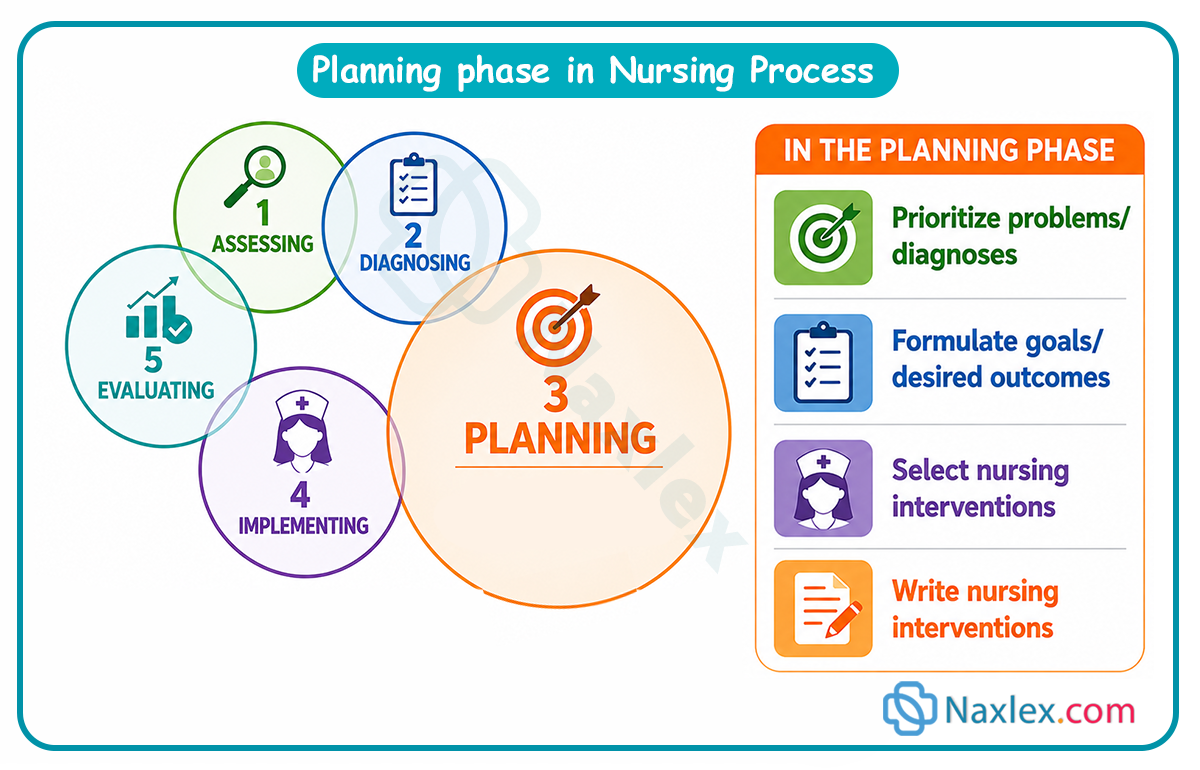
Developing Nursing Care Plans
In nursing, the planning phase is where the magic of coordination happens. The final product of this phase is the Nursing Care Plan (NCP) - a roadmap that ensures every clinician is moving the client toward the same therapeutic goals.
1. Core Types of Nursing Care Plans
At its heart, a care plan can be informal or formal, standardized or highly customized.
|
Care Plan Type |
Definition |
Core Purpose & Characteristics |
|
Informal Care Plan |
An unwritten strategy that exists solely in the nurse’s mind. |
Example: "Mrs. Phan is exhausted. I'll delay reinforcing her discharge teaching until she has rested." |
|
Formal Care Plan |
A written or computerized guide organizing client care details. |
Primary Benefit: Provides continuity of care so all shifts work toward the exact same outcomes. |
|
Standardized Care Plan |
A pre-made plan specifying care for a group of clients with common needs. |
Used for predictable, common conditions (e.g., all clients admitted with a myocardial infarction). |
|
Individualized Care Plan |
A customized plan tailored to a specific client’s unique, atypical needs. |
Focuses on issues not addressed by standard protocols (e.g., specific family dynamics or unique coping challenges). |
2. Standardized Tools & Agency Resources
Health agencies use several standardized tools to streamline documentation, protect clinical safety, and save nurses time.
Standards of Care vs. Standardized Care Plans
These two terms sound similar but have distinct differences:
- Standards of Care: Define the interventions for which nurses are held accountable (minimum acceptable criteria). They are written from the perspective of nursing responsibilities and are usually agency records rather than part of the client's active chart.
- Standardized Care Plans: Pre-developed guides written from the perspective of what care the client can expect. They are kept in the active chart and are formatted using the nursing process.
Other Standardized Protocols
- Protocols: Pre-developed plans for specific clinical situations (e.g., admitting an ICU client or managing continuous epidural analgesia). They can blend primary provider orders with nursing interventions.
- Policies and Procedures: Institutional rules governing general operations (e.g., visitor limits or cardiac arrest response). They do not become part of the permanent client chart.
- Standing Orders: Written documents giving nurses the authority to execute specific actions (like administering emergency cardiac drugs or ordering lab tests) under defined circumstances without waiting for a doctor to arrive.
3. Care Plan Formats & Variations
Care plans are typically structured around the core phases of the nursing process:
Problem/Nursing Diagnosis 🡪 Goals/Outcomes 🡪 Interventions 🡪Evaluation.
Student Care Plans
Because student care plans are learning tools, they are much more detailed than those used in hospital units.
- The Key Difference: They often require an original, evidence-based rationale (the scientific principle explaining why an intervention is chosen) along with citations from professional literature.
Concept Maps & Mind Maps
- A visual representation of the care plan where data, diagnoses, and interventions are enclosed in shapes and linked with arrows.
- Shows the logical flow of clinical reasoning and complex relationships (e.g., how pathophysiology, lab values, and symptoms connect).
Computerized Care Plans
- Integrated into Electronic Health Records (EHR).
- The nurse selects a nursing diagnosis from a digital menu, and the computer suggests corresponding goals and interventions. The nurse then customizes these to suit the client's individual needs.
Multidisciplinary (Collaborative) Care Plans
- Also known as critical pathways or collaborative care plans.
- These are structured timelines mapping out the daily, sequenced care required for predictable medical conditions over a projected length of stay.
- They integrate both nursing interventions and medical treatments from other disciplines (PT, OT, Medicine) but do not contain highly detailed, day-to-day nursing tasks.
4. Professional Guidelines for Writing Care Plans
When drafting or updating an individualized care plan, follow these ten professional standards:
- Date and sign the plan: Essential for tracking the timeline of evaluations and establishing professional accountability.
- Use clear category headings: Use standardized labels such as Nursing Diagnoses, Goals/Desired Outcomes, Nursing Interventions, and Evaluation (including target dates).
- Use approved symbols & abbreviations: Keep notes concise. Write "Turn q2h" instead of "Turn the client every two hours."
- Be ultra-specific with timing: Avoid vague phrases like "q shift" (which can mean 8 hours or 12 hours depending on the unit). Specify exact times or intervals to avoid medication and treatment errors.
- Reference procedure manuals: Do not write out every single step of a common procedure on the care plan. Instead, note: "See unit procedure book for tracheostomy care."
- Tailor to client preferences: Build in client choices to support autonomy (e.g., "Provide prune juice at breakfast per client preference").
- Balance restorative with preventive care: Ensure interventions prevent complications while restoring health (e.g., adding Range-of-Motion exercises to prevent joint contractures).
- Include continuous assessment: Always plan to monitor the client (e.g., "Inspect incision site q8h").
- Incorporate collaborative activities: Formally note when you need to coordinate with specialists like physical therapists or dietitians.
- Begin discharge planning immediately: Discharge planning starts on admission. Note any coordination needs with social work, home health, or community resources right away.
The Planning Process
In nursing, the planning phase is where the magic of coordination happens. The final product of this phase is the Nursing Care Plan (NCP) - a roadmap that ensures every clinician is moving the client toward the same therapeutic goals.
1. Core Types of Nursing Care Plans
At its heart, a care plan can be informal or formal, standardized or highly customized.
|
Developing an effective client care plan is a collaborative, dynamic, and highly structured step of the nursing process. Core Planning Activities The planning phase consists of four sequential, interconnected activities:
1. Setting Priorities Priority setting is the process of establishing a preferential sequence for addressing nursing diagnoses and interventions. Rather than strictly rank-ordering every diagnosis from 1 to 10, nurses typically group problems into three tiers:
Maslow’s Hierarchy of Needs Nurses routinely rely on Maslow’s Hierarchy to categorize priorities. Under this framework, physiological needs must be addressed before safety, belonging, or self-esteem needs. For example, a life-threatening physiological diagnosis like Impaired Gas Exchange takes immediate priority over a psychological diagnosis like Anxiety. You do not have to fully resolve a high-priority diagnosis before moving to others. You can partially address a high-priority issue and work on medium- or low-priority goals simultaneously. Factors influencing priority changes Priorities are not static; they shift as client responses, therapies, and resources evolve. Consider the following:
2. Establishing Client Goals & Desired Outcomes After setting priorities, the nurse and client set goals to map out what successful care looks like.
Traditional vs. NOC (Nursing Outcomes Classification) Standardized Language Standardized languages like NOC are critical for electronic health record databases.
To write a NOC outcome, the nurse documents:
Four Essential Components of an Outcome Statement When writing a traditional, measurable outcome statement, ensure it contains these four pieces: [Subject] + [Verb] + [Conditions/Modifiers] + [Criterion of Performance]
Guidelines for Writing Outcomes Keep these six rules of thumb in mind to write perfect exam-ready goals:
|
||||||||||||||
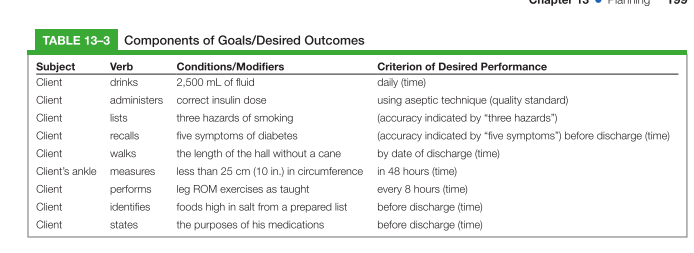
2. Standardized Tools & Agency Resources
Health agencies use several standardized tools to streamline documentation, protect clinical safety, and save nurses time.
Standards of Care vs. Standardized Care Plans
These two terms sound similar but have distinct differences:
- Standards of Care: Define the interventions for which nurses are held accountable (minimum acceptable criteria). They are written from the perspective of nursing responsibilities and are usually agency records rather than part of the client's active chart.
- Standardized Care Plans: Pre-developed guides written from the perspective of what care the client can expect. They are kept in the active chart and are formatted using the nursing process.
Other Standardized Protocols
- Protocols: Pre-developed plans for specific clinical situations (e.g., admitting an ICU client or managing continuous epidural analgesia). They can blend primary provider orders with nursing interventions.
- Policies and Procedures: Institutional rules governing general operations (e.g., visitor limits or cardiac arrest response). They do not become part of the permanent client chart.
- Standing Orders: Written documents giving nurses the authority to execute specific actions (like administering emergency cardiac drugs or ordering lab tests) under defined circumstances without waiting for a doctor to arrive.
3. Care Plan Formats & Variations
Care plans are typically structured around the core phases of the nursing process:
Problem/Nursing Diagnosis 🡪 Goals/Outcomes 🡪 Interventions 🡪Evaluation.
Student Care Plans
Because student care plans are learning tools, they are much more detailed than those used in hospital units.
- The Key Difference: They often require an original, evidence-based rationale (the scientific principle explaining why an intervention is chosen) along with citations from professional literature.
Concept Maps & Mind Maps
- A visual representation of the care plan where data, diagnoses, and interventions are enclosed in shapes and linked with arrows.
- Shows the logical flow of clinical reasoning and complex relationships (e.g., how pathophysiology, lab values, and symptoms connect).
Computerized Care Plans
- Integrated into Electronic Health Records (EHR).
- The nurse selects a nursing diagnosis from a digital menu, and the computer suggests corresponding goals and interventions. The nurse then customizes these to suit the client's individual needs.
Multidisciplinary (Collaborative) Care Plans
- Also known as critical pathways or collaborative care plans.
- These are structured timelines mapping out the daily, sequenced care required for predictable medical conditions over a projected length of stay.
- They integrate both nursing interventions and medical treatments from other disciplines (PT, OT, Medicine) but do not contain highly detailed, day-to-day nursing tasks.
4. Professional Guidelines for Writing Care Plans
When drafting or updating an individualized care plan, follow these ten professional standards:
- Date and sign the plan: Essential for tracking the timeline of evaluations and establishing professional accountability.
- Use clear category headings: Use standardized labels such as Nursing Diagnoses, Goals/Desired Outcomes, Nursing Interventions, and Evaluation (including target dates).
- Use approved symbols & abbreviations: Keep notes concise. Write "Turn q2h" instead of "Turn the client every two hours."
- Be ultra-specific with timing: Avoid vague phrases like "q shift" (which can mean 8 hours or 12 hours depending on the unit). Specify exact times or intervals to avoid medication and treatment errors.
- Reference procedure manuals: Do not write out every single step of a common procedure on the care plan. Instead, note: "See unit procedure book for tracheostomy care."
- Tailor to client preferences: Build in client choices to support autonomy (e.g., "Provide prune juice at breakfast per client preference").
- Balance restorative with preventive care: Ensure interventions prevent complications while restoring health (e.g., adding Range-of-Motion exercises to prevent joint contractures).
- Include continuous assessment: Always plan to monitor the client (e.g., "Inspect incision site q8h").
- Incorporate collaborative activities: Formally note when you need to coordinate with specialists like physical therapists or dietitians.
- Begin discharge planning immediately: Discharge planning starts on admission. Note any coordination needs with social work, home health, or community resources right away.
Nursing Interventions
In nursing, the planning phase is where the magic of coordination happens. The final product of this phase is the Nursing Care Plan (NCP) - a roadmap that ensures every clinician is moving the client toward the same therapeutic goals.
1. Core Types of Nursing Care Plans
At its heart, a care plan can be informal or formal, standardized or highly customized.
|
Selecting Nursing Interventions Nursing interventions are the specific actions designed to help the client achieve their goals.
Nursing interventions are identified and written during the planning step of the nursing process, but they are actually performed during the implementing step. This guide outlines the categories of interventions, selection criteria, professional delegation, and standard taxonomy. Categories of Nursing Interventions Interventions fall into different categories based on how they are delivered (direct vs. indirect) and the level of autonomy the nurse has in initiating them (independent, dependent, or collaborative).
Direct vs. Indirect Care
Independent, Dependent, and Collaborative Interventions
Choosing and Writing Interventions Considering the Consequences An intervention can have multiple consequences (some positive, some negative). For example, providing detailed surgery information the night before a procedure might decrease anxiety for one client, but spike anxiety and disrupt sleep for another. Nurses must use clinical judgment and prior experience to choose the right timing and approach. Criteria for Selection To be included in a care plan, an intervention must be:
Formatting Written Interventions Written interventions must be precise, dated, and signed (confirming legal accountability). Every written intervention should include: Action Verb + Conditions/Modifiers + Time Element
Intervention Focus vs. Problem Status Nurses align their interventions with the specific status of the client's nursing diagnosis:
Delegating Implementation Delegation is the process of a registered nurse (RN) directing another team member (such as a Licensed Practical Nurse [LPN] or Unlicensed Assistive Personnel [UAP]) to perform specific nursing tasks and activities. The Golden Rule of Delegation: "The RN can delegate certain clinical tasks to an unlicensed person, but cannot delegate accountability for total nursing care or the nursing process itself."
|
||||||||||||||||||
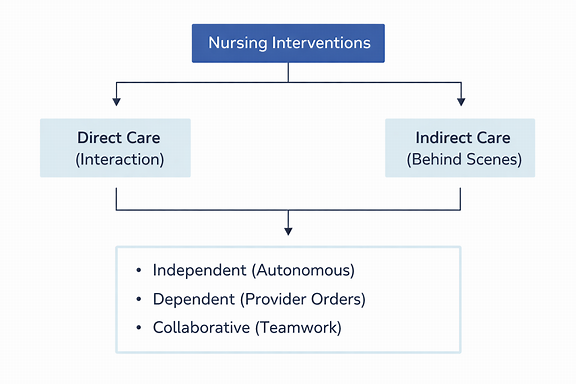
2. Standardized Tools & Agency Resources
Health agencies use several standardized tools to streamline documentation, protect clinical safety, and save nurses time.
Standards of Care vs. Standardized Care Plans
These two terms sound similar but have distinct differences:
- Standards of Care: Define the interventions for which nurses are held accountable (minimum acceptable criteria). They are written from the perspective of nursing responsibilities and are usually agency records rather than part of the client's active chart.
- Standardized Care Plans: Pre-developed guides written from the perspective of what care the client can expect. They are kept in the active chart and are formatted using the nursing process.
Other Standardized Protocols
- Protocols: Pre-developed plans for specific clinical situations (e.g., admitting an ICU client or managing continuous epidural analgesia). They can blend primary provider orders with nursing interventions.
- Policies and Procedures: Institutional rules governing general operations (e.g., visitor limits or cardiac arrest response). They do not become part of the permanent client chart.
- Standing Orders: Written documents giving nurses the authority to execute specific actions (like administering emergency cardiac drugs or ordering lab tests) under defined circumstances without waiting for a doctor to arrive.
3. Care Plan Formats & Variations
Care plans are typically structured around the core phases of the nursing process:
Problem/Nursing Diagnosis 🡪 Goals/Outcomes 🡪 Interventions 🡪Evaluation.
Student Care Plans
Because student care plans are learning tools, they are much more detailed than those used in hospital units.
- The Key Difference: They often require an original, evidence-based rationale (the scientific principle explaining why an intervention is chosen) along with citations from professional literature.
Concept Maps & Mind Maps
- A visual representation of the care plan where data, diagnoses, and interventions are enclosed in shapes and linked with arrows.
- Shows the logical flow of clinical reasoning and complex relationships (e.g., how pathophysiology, lab values, and symptoms connect).
Computerized Care Plans
- Integrated into Electronic Health Records (EHR).
- The nurse selects a nursing diagnosis from a digital menu, and the computer suggests corresponding goals and interventions. The nurse then customizes these to suit the client's individual needs.
Multidisciplinary (Collaborative) Care Plans
- Also known as critical pathways or collaborative care plans.
- These are structured timelines mapping out the daily, sequenced care required for predictable medical conditions over a projected length of stay.
- They integrate both nursing interventions and medical treatments from other disciplines (PT, OT, Medicine) but do not contain highly detailed, day-to-day nursing tasks.
4. Professional Guidelines for Writing Care Plans
When drafting or updating an individualized care plan, follow these ten professional standards:
- Date and sign the plan: Essential for tracking the timeline of evaluations and establishing professional accountability.
- Use clear category headings: Use standardized labels such as Nursing Diagnoses, Goals/Desired Outcomes, Nursing Interventions, and Evaluation (including target dates).
- Use approved symbols & abbreviations: Keep notes concise. Write "Turn q2h" instead of "Turn the client every two hours."
- Be ultra-specific with timing: Avoid vague phrases like "q shift" (which can mean 8 hours or 12 hours depending on the unit). Specify exact times or intervals to avoid medication and treatment errors.
- Reference procedure manuals: Do not write out every single step of a common procedure on the care plan. Instead, note: "See unit procedure book for tracheostomy care."
- Tailor to client preferences: Build in client choices to support autonomy (e.g., "Provide prune juice at breakfast per client preference").
- Balance restorative with preventive care: Ensure interventions prevent complications while restoring health (e.g., adding Range-of-Motion exercises to prevent joint contractures).
- Include continuous assessment: Always plan to monitor the client (e.g., "Inspect incision site q8h").
- Incorporate collaborative activities: Formally note when you need to coordinate with specialists like physical therapists or dietitians.
- Begin discharge planning immediately: Discharge planning starts on admission. Note any coordination needs with social work, home health, or community resources right away.
The Nursing Interventions Classification
In nursing, the planning phase is where the magic of coordination happens. The final product of this phase is the Nursing Care Plan (NCP) - a roadmap that ensures every clinician is moving the client toward the same therapeutic goals.
1. Core Types of Nursing Care Plans
At its heart, a care plan can be informal or formal, standardized or highly customized.
|
Similar to NANDA for diagnoses and NOC for outcomes, the Nursing Interventions Classification (NIC) is a standardized taxonomy used to describe the treatments that nurses perform.
A nurse-sensitive patient outcome is a measurable patient, family, or community behavior or perception that is measured in response to nursing interventions. Nurse sensitive outcomes are a valid and reliable means to support nursing care quality and performance measurement in health care settings. This includes the evaluation of nursing clinical practice improvement
Benefits of Standardized Interventions
|
||
2. Standardized Tools & Agency Resources
Health agencies use several standardized tools to streamline documentation, protect clinical safety, and save nurses time.
Standards of Care vs. Standardized Care Plans
These two terms sound similar but have distinct differences:
- Standards of Care: Define the interventions for which nurses are held accountable (minimum acceptable criteria). They are written from the perspective of nursing responsibilities and are usually agency records rather than part of the client's active chart.
- Standardized Care Plans: Pre-developed guides written from the perspective of what care the client can expect. They are kept in the active chart and are formatted using the nursing process.
Other Standardized Protocols
- Protocols: Pre-developed plans for specific clinical situations (e.g., admitting an ICU client or managing continuous epidural analgesia). They can blend primary provider orders with nursing interventions.
- Policies and Procedures: Institutional rules governing general operations (e.g., visitor limits or cardiac arrest response). They do not become part of the permanent client chart.
- Standing Orders: Written documents giving nurses the authority to execute specific actions (like administering emergency cardiac drugs or ordering lab tests) under defined circumstances without waiting for a doctor to arrive.
3. Care Plan Formats & Variations
Care plans are typically structured around the core phases of the nursing process:
Problem/Nursing Diagnosis 🡪 Goals/Outcomes 🡪 Interventions 🡪Evaluation.
Student Care Plans
Because student care plans are learning tools, they are much more detailed than those used in hospital units.
- The Key Difference: They often require an original, evidence-based rationale (the scientific principle explaining why an intervention is chosen) along with citations from professional literature.
Concept Maps & Mind Maps
- A visual representation of the care plan where data, diagnoses, and interventions are enclosed in shapes and linked with arrows.
- Shows the logical flow of clinical reasoning and complex relationships (e.g., how pathophysiology, lab values, and symptoms connect).
Computerized Care Plans
- Integrated into Electronic Health Records (EHR).
- The nurse selects a nursing diagnosis from a digital menu, and the computer suggests corresponding goals and interventions. The nurse then customizes these to suit the client's individual needs.
Multidisciplinary (Collaborative) Care Plans
- Also known as critical pathways or collaborative care plans.
- These are structured timelines mapping out the daily, sequenced care required for predictable medical conditions over a projected length of stay.
- They integrate both nursing interventions and medical treatments from other disciplines (PT, OT, Medicine) but do not contain highly detailed, day-to-day nursing tasks.
4. Professional Guidelines for Writing Care Plans
When drafting or updating an individualized care plan, follow these ten professional standards:
- Date and sign the plan: Essential for tracking the timeline of evaluations and establishing professional accountability.
- Use clear category headings: Use standardized labels such as Nursing Diagnoses, Goals/Desired Outcomes, Nursing Interventions, and Evaluation (including target dates).
- Use approved symbols & abbreviations: Keep notes concise. Write "Turn q2h" instead of "Turn the client every two hours."
- Be ultra-specific with timing: Avoid vague phrases like "q shift" (which can mean 8 hours or 12 hours depending on the unit). Specify exact times or intervals to avoid medication and treatment errors.
- Reference procedure manuals: Do not write out every single step of a common procedure on the care plan. Instead, note: "See unit procedure book for tracheostomy care."
- Tailor to client preferences: Build in client choices to support autonomy (e.g., "Provide prune juice at breakfast per client preference").
- Balance restorative with preventive care: Ensure interventions prevent complications while restoring health (e.g., adding Range-of-Motion exercises to prevent joint contractures).
- Include continuous assessment: Always plan to monitor the client (e.g., "Inspect incision site q8h").
- Incorporate collaborative activities: Formally note when you need to coordinate with specialists like physical therapists or dietitians.
- Begin discharge planning immediately: Discharge planning starts on admission. Note any coordination needs with social work, home health, or community resources right away.
Summary
In nursing, the planning phase is where the magic of coordination happens. The final product of this phase is the Nursing Care Plan (NCP) - a roadmap that ensures every clinician is moving the client toward the same therapeutic goals.
1. Core Types of Nursing Care Plans
At its heart, a care plan can be informal or formal, standardized or highly customized.
|
||
2. Standardized Tools & Agency Resources
Health agencies use several standardized tools to streamline documentation, protect clinical safety, and save nurses time.
Standards of Care vs. Standardized Care Plans
These two terms sound similar but have distinct differences:
- Standards of Care: Define the interventions for which nurses are held accountable (minimum acceptable criteria). They are written from the perspective of nursing responsibilities and are usually agency records rather than part of the client's active chart.
- Standardized Care Plans: Pre-developed guides written from the perspective of what care the client can expect. They are kept in the active chart and are formatted using the nursing process.
Other Standardized Protocols
- Protocols: Pre-developed plans for specific clinical situations (e.g., admitting an ICU client or managing continuous epidural analgesia). They can blend primary provider orders with nursing interventions.
- Policies and Procedures: Institutional rules governing general operations (e.g., visitor limits or cardiac arrest response). They do not become part of the permanent client chart.
- Standing Orders: Written documents giving nurses the authority to execute specific actions (like administering emergency cardiac drugs or ordering lab tests) under defined circumstances without waiting for a doctor to arrive.
3. Care Plan Formats & Variations
Care plans are typically structured around the core phases of the nursing process:
Problem/Nursing Diagnosis 🡪 Goals/Outcomes 🡪 Interventions 🡪Evaluation.
Student Care Plans
Because student care plans are learning tools, they are much more detailed than those used in hospital units.
- The Key Difference: They often require an original, evidence-based rationale (the scientific principle explaining why an intervention is chosen) along with citations from professional literature.
Concept Maps & Mind Maps
- A visual representation of the care plan where data, diagnoses, and interventions are enclosed in shapes and linked with arrows.
- Shows the logical flow of clinical reasoning and complex relationships (e.g., how pathophysiology, lab values, and symptoms connect).
Computerized Care Plans
- Integrated into Electronic Health Records (EHR).
- The nurse selects a nursing diagnosis from a digital menu, and the computer suggests corresponding goals and interventions. The nurse then customizes these to suit the client's individual needs.
Multidisciplinary (Collaborative) Care Plans
- Also known as critical pathways or collaborative care plans.
- These are structured timelines mapping out the daily, sequenced care required for predictable medical conditions over a projected length of stay.
- They integrate both nursing interventions and medical treatments from other disciplines (PT, OT, Medicine) but do not contain highly detailed, day-to-day nursing tasks.
4. Professional Guidelines for Writing Care Plans
When drafting or updating an individualized care plan, follow these ten professional standards:
- Date and sign the plan: Essential for tracking the timeline of evaluations and establishing professional accountability.
- Use clear category headings: Use standardized labels such as Nursing Diagnoses, Goals/Desired Outcomes, Nursing Interventions, and Evaluation (including target dates).
- Use approved symbols & abbreviations: Keep notes concise. Write "Turn q2h" instead of "Turn the client every two hours."
- Be ultra-specific with timing: Avoid vague phrases like "q shift" (which can mean 8 hours or 12 hours depending on the unit). Specify exact times or intervals to avoid medication and treatment errors.
- Reference procedure manuals: Do not write out every single step of a common procedure on the care plan. Instead, note: "See unit procedure book for tracheostomy care."
- Tailor to client preferences: Build in client choices to support autonomy (e.g., "Provide prune juice at breakfast per client preference").
- Balance restorative with preventive care: Ensure interventions prevent complications while restoring health (e.g., adding Range-of-Motion exercises to prevent joint contractures).
- Include continuous assessment: Always plan to monitor the client (e.g., "Inspect incision site q8h").
- Incorporate collaborative activities: Formally note when you need to coordinate with specialists like physical therapists or dietitians.
- Begin discharge planning immediately: Discharge planning starts on admission. Note any coordination needs with social work, home health, or community resources right away.
Naxlex
Videos
Login to View Video
Click here to loginTake Notes on Planning and outcome identification
This filled cannot be empty
Join Naxlex Nursing for nursing questions & guides! Sign Up Now