






 Video Library


Please set your exam date
Implementation
Study Questions
Practice Exercise 3
A nurse is documenting evaluation findings. Which of the following is the correct example of an evaluative statement?
Explanation
A complete evaluative statement must contain two essential components: a decision regarding whether the outcome was met, partially met, or unmet, followed by the supporting subjective or objective clinical evidence. Furthermore, all legal nursing documentation must be accurately dated and signed to establish a verifiable medical record timeline.
Rationale for correct answer:
D. 1/21/09-Outcome not met. Client reports no change in tobacco use is correct because it includes the date, a clear judgment on goal attainment, and specific evaluative data to support the conclusion. Complete documentation ensures accountability, legal compliance, and clear interprofessional communication regarding client care outcomes.
Rationale for incorrect answers:
A. Outcome not met is incorrect because it lacks the date and supporting evaluative evidence. Stating only the outcome status fails legal documentation standards and does not provide clinical justification for why the goal was not achieved.
B. 1/21/09-Client reports no change in tobacco use is incorrect because it provides data without documenting a formal evaluative judgment. Clinical data alone fails to state whether the outcome was met, partially met, or unmet.
C. Outcome not met. Client reports no change in tobacco use is incorrect because it lacks a date stamp. Omitting entry dates violates fundamental legal documentation guidelines required for medical records.
Test-taking strategy
- Analyze the scenario and question: The nurse is documenting evaluation findings. The question asks for the option that represents a complete and legally sound evaluative statement.
- Identify essential elements of an evaluative statement:
- Element 1: Date (and time) of entry for legal documentation.
- Element 2: Evaluative judgment (outcome met, partially met, or unmet).
- Element 3: Supporting data (subjective or objective evidence explaining the judgment).
- Evaluate choices:
- Select Choice 4: Contains the date, evaluative conclusion, and supporting client statement.
- Rule out Choice 1: Omits date and supporting data.
- Rule out Choice 2: Omits the formal evaluative conclusion.
- Rule out Choice 3: Omits the required date stamp.
Take home points
- A complete evaluative statement requires the date of entry, outcome status judgment, and supporting subjective or objective data.
- Evaluative judgment categories include outcome met, outcome partially met, or outcome unmet.
- Medical record entries must always include proper temporal markers (date and time) to meet legal and institutional standards.
- Supporting data justifies the clinical judgment and provides context for care plan continuation, modification, or termination.
A nurse is assessing the purposes of the evaluation phase in the nursing process. Which of the following accurately describes the purposes of evaluation? Select all that apply
Explanation
The evaluation phase is a systematic, continuous clinical inquiry determining patient progress toward health goals, measuring nursing care effectiveness, supporting professional healthcare accountability, and directing dynamic care plan modifications or termination.
Rationale for correct answers:
A. Determining client progress toward achievement of expected outcomes is a primary objective of evaluation. The nurse systematically compares post-intervention physiological and behavioral patient data against established baseline indicators. This continuous assessment verifies whether clinical goals are met, partially met, or unmet.
B. Determining effectiveness of nursing care reflects the core evaluative purpose within clinical practice. The nurse analyzes whether targeted therapeutic interventions successfully produced desired health responses or resolved nursing diagnoses. This appraisal guides necessary modifications, continuation, or total revision of clinical care plans.
E. Promoting nursing accountability represents a fundamental professional purpose of the evaluation step. Systematic outcome measurement holds clinicians responsible for delivering evidence-based interventions and meeting established standards of practice. It ensures quality healthcare delivery and justifies professional nursing clinical decision-making.
Rationale for incorrect answers:
C. Establishing client expected outcomes occurs during the planning phase of the nursing process rather than evaluation. During planning, the nurse formulates specific, measurable, short-term, and long-term goal criteria based on identified nursing diagnoses. Evaluation subsequently measures progress against these predetermined metrics later. It does not initially create them.
D. Establishing priorities for nursing interventions is an integral component of the planning step. Nurses prioritize patient needs using clinical frameworks such as Maslow's hierarchy and acute physiological urgency. This prioritization organizes therapeutic actions before implementation occurs in practice. Evaluation subsequently analyzes the outcomes of those prioritized actions.
F. Writing the plan of care, including specific measurable goals is completed in the planning phase. Documenting target goals and prescribing individualized nursing activities establishes the clinical blueprint before implementation. Evaluation occurs after implementation to judge goal achievement and plan efficacy. It does not draft the initial plan.
Test-taking strategy
- Analyze the scenario/question: The question asks the nurse to select all options that accurately describe the purposes of the evaluation phase in the nursing process. This requires differentiating evaluative activities from planning or assessment steps using systematic clinical judgement.
- Categorize nursing process phases:
- Select Choice 1: Evaluation compares client status against expected goals to measure outcome achievement.
- Select Choice 2: Evaluation analyzes nursing interventions to verify intervention effectiveness.
- Rule out Choice 3: Establishing expected outcomes is an action performed during the planning phase.
- Rule out Choice 4: Prioritizing nursing interventions is an essential component of the planning phase.
- Select Choice 5: Evaluation ensures quality practice standards to uphold professional accountability.
- Rule out Choice 6: Writing care plans with measurable goals belongs exclusively to the planning phase.
Take home points
- The evaluation phase measures client progress toward expected outcomes and determines the overall effectiveness of nursing interventions.
- Evaluation promotes professional nursing accountability by holding clinicians responsible for outcomes and quality of care delivered.
- Formulating measurable goals, establishing priorities, and writing the initial care plan occur during the planning phase, not evaluation.
- Evaluation is a continuous process that dictates whether the care plan should be continued, modified, or discontinued.
A nurse is caring for a client with acute pain. In which of the following situations is the nurse performing evaluation?
Explanation
The evaluation phase involves measuring the patient’s response to administered interventions, comparing post-treatment findings against expected outcomes, and making necessary care plan adjustments. This systematic appraisal determines whether therapeutic strategies successfully restored physiological comfort, achieved pain control targets, and advanced overall patient wellness.
Rationale for correct answer:
C. Asking a client if pain is relieved after administration of analgesics accurately reflects the evaluation step of the nursing process. Evaluation assesses the clinical effectiveness of a previously implemented nursing intervention. By obtaining a post-analgesic pain rating, the nurse measures whether the medication successfully achieved the desired therapeutic effect.
Rationale for incorrect answers:
A. Determining a client’s baseline temperature represents the assessment phase of the nursing process. Assessment involves systematically gathering, verifying, and documenting primary clinical data, such as vital signs, before implementing care. Baseline data collection identifies patient needs but does not measure the outcome of a specific intervention.
B. Developing expected client outcomes is an essential step within the planning phase of the nursing process. During planning, the nurse formulates measurable, short-term, and long-term goals that serve as benchmarks for future evaluation. Establishing goals occurs prior to performing interventions, making it distinct from measuring their actual results.
D. Writing an individualized plan of care for a client is completed during the planning phase. Documenting nursing diagnoses, client goals, and prescribed nursing actions creates the structural roadmap for delivery of care. Writing the plan prepares the nurse for implementation and precedes the evaluative measurement of care outcomes.
Test-taking strategy
- Analyze the scenario/question: The question asks the nurse to identify which scenario demonstrates the evaluation phase of the nursing process for a client experiencing acute pain. This requires distinguishing outcome measurement from assessment or planning activities.
- Apply nursing process principles:
- Rule out Choice 1: Gathering baseline vital signs represents data collection during the assessment phase.
- Rule out Choice 2: Establishing target clinical goals occurs during the planning phase.
- Select Choice 3: Reassessing pain post-medication measures intervention efficacy during the evaluation phase.
- Rule out Choice 4: Drafting the formal nursing care plan is an action completed in the planning phase.
Take home points
- Evaluation requires reassessing the client following an intervention to determine if the expected outcome was achieved.
- Assessing baseline vital signs represents the initial assessment phase, which occurs prior to intervention selection.
- Developing goals, setting expected outcomes, and writing the care plan are actions performed during the planning phase.
- For acute pain management, evaluation specifically involves measuring post-analgesic pain levels against pre-treatment baselines.
A nurse enters a client’s room and begins a conversation. During this time the nurse evaluates how a client is tolerating a new diet plan. The nurse decides to also evaluate the client’s expectations of care. Which of the following is appropriate for evaluating a client’s expectations of care?
Explanation
Evaluating client expectations assesses the client's perception of healthcare quality, educational satisfaction, and whether care delivery met their personal goals. In dietary management, open communication determines if the nurse successfully met patient expectations, delivered effective patient education, and supported the client's transition toward dietary adherence.
Rationale for correct answer:
C. Asking, “Do you believe that you received the information you needed to follow your diet?” is an appropriate measure for evaluating a client's expectations of care. Evaluating expectations focuses on assessing whether the client feels their informational needs, care goals, and personal preferences were adequately met by the healthcare team. Eliciting client feedback regarding information delivery measures satisfaction with care delivery.
Rationale for incorrect answers:
A. Asking the client, "On a scale of 0 to 10 rate your level of nausea," is an evaluation of physical symptom severity rather than care expectations. Rating nausea on a numerical scale gathers quantitative clinical data regarding gastrointestinal tolerance to the new diet. It measures physiological response rather than the client's perception of care quality.
B. The nurse weighing the client is an objective physical evaluation of nutritional status and fluid balance. Obtaining a physical weight provides measurable physiological data to determine whether the diet plan is achieving weight management goals. Physical measurements do not measure subjective expectations of care.
D. The statement, “Tell me four different foods included in your diet,” evaluates cognitive learning comprehension rather than expectations of care. Directing the client to list permitted food items assesses retention of dietary education. Verifying knowledge evaluates educational outcomes rather than client satisfaction with care delivery.
Test-taking strategy
- Analyze the scenario and question: A nurse converses with a client to evaluate tolerance to a new diet plan and decides to also evaluate the client's expectations of care. The question asks to select the specific statement or action that evaluates expectations of care.
- Differentiate care evaluation types:
- Evaluating expectations of care: Eliciting client feedback on whether their personal goals, informational needs, and satisfaction standards were met (e.g., asking if they received adequate information).
- Evaluating physical response: Assessing physiological symptoms or physical metrics (e.g., measuring nausea scales, weighing the client).
- Evaluating learning/knowledge: Testing cognitive understanding and retention of health teaching (e.g., asking the client to list allowed foods).
- Evaluate options:
- Rule out Choice 1: Rating nausea measures symptom severity, not care expectations.
- Rule out Choice 2: Measuring weight gathers objective physiological data, not care expectations.
- Select Choice 3: Asking if informational needs were met evaluates client expectations of care.
- Rule out Choice 4: Listing specific foods tests cognitive knowledge retention, not care expectations.
Take home points
- Evaluating expectations of care focuses on assessing whether the client's self-defined needs, preferences, and satisfaction standards were fulfilled.
- Inquiries regarding whether adequate information and support were provided measure the client's perception of healthcare quality and communication.
- Physiological metrics like body weight and numerical symptom scales evaluate physical responses to therapy rather than care expectations.
- Asking clients to recite educational content evaluates cognitive learning comprehension rather than personal satisfaction with care delivery.
Practice Exercise 4
A nurse is aware that the primary purpose of the evaluation phase of the care planning process is to determine whether:
Explanation
The evaluation phase is the final, systematic step of the nursing process. It involves measuring client progress against predefined goal indicators to judge whether the planned nursing strategy successfully resolved or improved the identified health problem.
Rationale for correct answer:
A. Determining whether desired outcomes have been met is the core purpose of evaluation. The nurse compares baseline and current data against measurable outcome criteria. This judgment dictates whether to terminate, continue, or modify the plan. Goal attainment validates effective nursing care.
Rationale for incorrect answers:
B. Determining whether nursing activities were carried out assesses implementation fidelity rather than clinical efficacy. Executing interventions does not guarantee therapeutic success. Process compliance must not be confused with outcome achievement. Implementation tracks action, whereas evaluation measures results.
C. Evaluating whether nursing activities were effective is a partial aspect secondary to overall goal achievement. Interventions are merely means to an end. Effectiveness is judged strictly by outcome achievement rather than isolated activity performance. Measuring goal resolution remains the ultimate objective.
D. Monitoring whether the client’s condition has changed represents continuous reassessment during care delivery. Reassessment identifies clinical trajectory but does not evaluate plan success. Change alone lacks alignment with specific goal criteria. Evaluation requires direct comparison against predetermined benchmarks.
Test-taking strategy
- Analyze the scenario and question: The question asks for the primary purpose of the evaluation phase in the nursing process.
- Apply nursing process evaluation rules: Differentiate between implementation monitoring, ongoing assessment, and true outcome evaluation.
- Select Choice 1 (Goal attainment): Determining whether desired outcomes have been met directly evaluates the success of the care plan.
- Rule out Choice 2 (Task completion): Verifying if nursing activities were carried out evaluates implementation adherence, not evaluation metrics.
- Rule out Choice 3 (Intervention efficacy): Assessing if nursing activities were effective is secondary to evaluating specific client outcome criteria.
- Rule out Choice 4 (Status changes): Observing if the client’s condition has changed reflects reassessment rather than target outcome judgment.
Take home points
- The primary purpose of evaluation is determining if client-centered goals and desired outcomes were achieved.
- Evaluation compares current client health status directly against predefined, measurable criteria established in planning.
- Outcome attainment dictates whether the care plan should be terminated, maintained, or comprehensively revised.
- Measuring intervention execution or general clinical changes does not replace formal outcome evaluation.
A nurse is evaluating the effectiveness of a nursing care plan. Which of the following represents application of the components of evaluating?
Explanation
The evaluating phase requires systematically collecting objective and subjective data directly related to the expected outcomes established during the planning phase. Evaluation is a multi-step process where gathered clinical data is compared against target indicators to judge client progress and determine the care plan's effectiveness.
Rationale for correct answer:
B. Data related to expected outcomes must be collected. Collecting targeted evaluative data is an essential initial step in the evaluation process. The nurse cannot evaluate goal attainment without first gathering current clinical measurements and client responses specific to the outcome criteria.
Rationale for incorrect answers:
A. Goal achievement is categorized into three potential outcomes: met, partially met, or unmet. Excluding partially met ignores partial clinical progress. Recognizing partial achievement is essential for making appropriate care plan revisions.
C. An achieved outcome does not automatically prove the nursing interventions were the cause. External variables, medical therapies, or natural disease resolution may have driven improvement. Evaluation requires analyzing causality before declaring the plan effective.
D. Unmet goals require modifying the existing plan rather than discarding it completely. The nurse reassesses, re-evaluates diagnoses, and adjusts specific interventions or target timelines. Complete plan replacement is inefficient and clinically unnecessary.
Test-taking strategy
- Analyze the scenario and question: The question asks to identify the application of the components of evaluating within the nursing process framework.
- Apply evaluation phase components: Recall the systematic steps: data collection, comparison against outcomes, outcome judgment, and plan modification.
- Rule out Choice 1 (Rigid categorization): Goal achievement must be written as either completely met or unmet ignores the standard category of "partially met."
- Select Choice 2 (Data collection): Data related to expected outcomes must be collected reflects the mandatory first action of evaluative assessment.
- Rule out Choice 3 (Presumptive efficacy): If the outcome was achieved, conclude that the plan was effective oversimplifies causality without analyzing contributing factors.
- Rule out Choice 4 (Extreme action): After determining that the outcome was not met, start over with a new nursing care plan inappropriately discards the whole plan instead of revising specific components.
Take home points
- Evaluating requires collecting specific clinical data directly aligned with the expected outcome criteria.
- Goal achievement is documented using three standardized categories: goal met, goal partially met, or goal unmet.
- Achieving an outcome does not automatically demonstrate that the specific nursing interventions were responsible for the change.
- Unmet outcomes indicate a need to reassess and revise specific care plan components rather than starting a completely new plan.
A nurse is participating in a quality improvement initiative on the unit. Which of the following reflects an element of quality improvement rather than quality assurance?
Explanation
Quality improvement is a continuous and systematic process optimizing healthcare frameworks. It identifies root causes of inefficiencies using proactive data analysis, enhancing clinical outcomes, and establishing operational excellence.
Rationale for correct answer:
B. Evaluates organizational structures accurately reflects quality improvement because this initiative focuses on systemic workflows and environmental processes rather than isolated performance. By analyzing how structural factors influence delivery systems, interdisciplinary teams can continuously enhance clinical outcomes and long-term healthcare safety.
Rationale for incorrect answers:
A. Focus is on individual outcomes reflects quality assurance instead of quality improvement. Quality assurance typically targets specific practitioner performance, individual patient events, or retrospective compliance audits. Quality improvement strictly emphasizes cross-functional process optimization rather than isolating single clinical metrics.
C. Aiming to confirm that quality exists describes the primary objective of quality assurance. Quality assurance seeks to verify that established baseline standards are consistently met through periodic inspections. Conversely, quality improvement assumes processes can always be systematically enhanced continuously.
D. Planning corrective actions for problems is a traditional reactive feature of quality assurance operating after detecting standard deviations. Quality assurance implements targeted corrective measures resolving identified deficiencies, whereas quality improvement proactively analyzes systemic processes preventing errors before they occur.
Test-taking strategy
- Analyze the scenario/question: The question asks the nurse to identify an element characteristic of a quality improvement initiative as opposed to quality assurance. This requires contrasting continuous, system-wide healthcare enhancement with reactive, compliance-based monitoring.
- Apply continuous management principles:
- Rule out Choice 1: Quality assurance concentrates on individual performance, whereas quality improvement examines broader systemic processes.
- Select Choice 2: Quality improvement evaluates organizational structures to foster proactive healthcare delivery optimization.
- Rule out Choice 3: Quality assurance aims to confirm baseline compliance, while quality improvement focuses on ongoing multidisciplinary enhancement.
- Rule out Choice 4: Quality assurance is typically reactive, planning corrective measures after a problem arises, whereas quality improvement emphasizes preventative system design.
Take home points
- Quality improvement focuses on continuous and proactive refinement of systems and organizational structures rather than individual clinical performance.
- Quality assurance operates primarily as a reactive mechanism focusing on individual outcomes and meeting minimum baseline standards.
- Quality improvement employs process-oriented methodologies to analyze systemic workflows to prevent clinical errors before they reach the patient.
- Healthcare safety initiatives succeed when facilities transition from punitive individual inspections to collaborative system-level process optimization.
A nursing manager of a nursing unit with an excellent safety record meets to review the findings of the audit. The nurse manager states, “We’re doing well, but we can do better! Who’s got an idea to foster increased client well-being and satisfaction?” This is an example of leadership that values which of the following?
Explanation
Quality improvement focuses on continuous, proactive enhancements in care delivery regardless of current performance benchmarks. By seeking new strategies to elevate client satisfaction despite maintaining an excellent safety record, the nurse manager demonstrates a commitment to continuous quality improvement, which strives to exceed baseline standards through ongoing organizational innovation.
Rationale for correct answer:
B. Quality improvement represents a continuous, proactive commitment to optimizing healthcare processes, safety, and satisfaction even when current outcomes meet established standards. Rather than settling for adequate baseline metrics, quality improvement encourages continuous innovation, system refinements, and ongoing process enhancement.
Rationale for incorrect answers:
A. Quality assurance focuses primarily on maintaining minimum established standards, inspecting care outcomes, and ensuring compliance with existing safety benchmarks. Once standards are achieved, traditional quality assurance programs maintain compliance rather than actively driving continuous, forward-thinking innovation.
C. Process evaluation focuses specifically on assessing how clinical care is delivered and whether staff adhere to established procedural steps. While process evaluation serves as a tool within quality programs, seeking creative ideas to elevate overall satisfaction reflects a broader quality improvement philosophy.
D. Outcome evaluation measures the end results of nursing interventions against predetermined criteria. While audit findings evaluate existing outcomes, the manager's proactive push to further enhance satisfaction and well-being moves beyond mere outcome measurement into active continuous quality improvement.
Test-taking strategy
- Analyze the scenario and question: A nurse manager on a high-performing unit reviews positive audit findings and encourages staff to generate new ideas for further improving client care and satisfaction. The question asks to identify the leadership philosophy demonstrated.
- Differentiate quality management philosophies:
- Quality Assurance (QA): Reactive or maintenance-focused; ensures performance meets minimum established standards and guidelines.
- Quality Improvement (QI / CQI): Proactive and continuous; seeks ongoing enhancement of care processes and outcomes regardless of current high performance.
- Process Evaluation: Focuses on analyzing procedural execution and nursing workflows.
- Outcome Evaluation: Focuses on measuring final client health results against target benchmarks.
- Evaluate choices:
- Select Choice 2: Accurately identifies the proactive drive for continuous enhancement as quality improvement.
- Rule out Choice 1: Confuses ongoing innovation with baseline compliance and standard maintenance.
- Rule out Choice 3: Misinterprets a broad continuous improvement culture as a specific workflow evaluation tool.
- Rule out Choice 4: Erroneously limits a forward-looking strategy to retrospective outcome measurement.
Take home points
- Quality improvement is an ongoing, continuous process aimed at enhancing healthcare delivery, safety, and client satisfaction.
- Continuous quality improvement seeks continuous progress even when clinical units already meet or exceed baseline standards.
- Quality assurance focuses on compliance, maintaining minimal standards, and identifying failure points within existing workflows.
- Innovative leadership fosters a culture where staff are empowered to analyze systems and propose proactive care enhancements.
A nurse is reviewing the evaluation of quality care in a healthcare setting. Which of the following statements best describes the evaluation of quality care?
Explanation
Quality care evaluation is a multidisciplinary continuous methodology that evaluates clinical outcomes, optimizes operational workflows, and improves system processes. Broad interprofessional collaboration integrates dynamic clinical perspectives, ensures evidence-based standards, enhances safety, and elevates institutional healthcare excellence.
Rationale for correct answer:
D. Achieving and evaluating high-quality healthcare requires coordinated contributions from nurses, physicians, pharmacists, therapists, quality managers, and administrative staff. Evaluating care through an interprofessional framework ensures comprehensive system analysis, drives holistic process improvements, and enhances overall patient safety.
Rationale for incorrect answers:
A. While subjective client satisfaction and comfort are valuable clinical components, quality evaluation relies primarily on objective data, standardized performance benchmarks, clinical safety indicators, and evidence-based health outcomes.
B. Quality evaluation is a continuous, ongoing, and dynamic process that includes prospective, concurrent, and retrospective assessments to enable real-time adjustments and ongoing system optimization.
C. Quality care spans complex healthcare environments involving multiple medical, allied health, and administrative departments. Isolating quality evaluation to nursing neglects interdisciplinary contributions and hinders systemic healthcare quality improvement.
Test-taking strategy
- Analyze the scenario/question: The question asks the nurse to select the statement that best describes the evaluation of quality care in a healthcare setting. This requires identifying broad, multidisciplinary quality management principles.
- Apply quality evaluation principles:
- Rule out Choice 1: Evaluating quality care goes beyond subjective feelings, requiring objective metrics and clinical outcome data.
- Rule out Choice 2: Quality evaluation is an ongoing process, not an assessment limited to project completion.
- Rule out Choice 3: Quality improvement requires broad collaboration rather than being nursing-exclusive.
- Select Choice 4: High-quality healthcare delivery is a shared responsibility across the entire interprofessional team.
Take home points
- Evaluation of quality care is an interprofessional responsibility involving nurses, physicians, pharmacists, and allied healthcare professionals.
- Quality care assessment relies on objective clinical metrics, standardized benchmarks, and evidence-based outcomes rather than subjective impressions alone.
- Quality evaluation is a continuous, dynamic process that occurs before, during, and after care delivery to promote constant improvement.
- Systemic healthcare improvement succeeds when all members of the multidisciplinary team actively participate in quality initiatives.
Practice Exercise 5
The nurse is planning to evaluate the length of time clients must wait for a nurse to respond to a client need reported over the inter com system on each shift. Which process does this reflect?
Explanation
Quality improvement in nursing utilizes Donabedian's framework to evaluate healthcare delivery across structure, process, and outcome domains. Evaluating response times measures the delivery of care and nursing activities, focusing directly on how care is performed rather than organizational setup or patient health status.
Rationale for correct answer:
B. Process evaluation focuses on how care is delivered and whether clinical activities are performed correctly and promptly. Measuring the length of time clients wait for a nurse to respond evaluates workflow execution and nursing timeliness. It assesses the actual delivery process of care against operational standards.
Rationale for incorrect answers:
A. Structure evaluation focuses on the organizational framework, physical facilities, staffing ratios, equipment, and administrative policies supporting care. Assessing response times measures active care delivery rather than physical or organizational infrastructure. System availability is structural, but response speed reflects operational performance.
C. Outcome evaluation measures the end result of healthcare interventions on client health status, satisfaction, or safety metrics. Response duration measures staff performance rather than direct clinical results like fall rates or pressure injury incidence. While process affects outcome, wait time remains a direct operational process metric.
D. Audit represents a broader retrospective or concurrent review method used to examine records or processes rather than a specific quality evaluation domain. An audit can examine structure, process, or outcome elements. It names the evaluation tool rather than the specific quality dimension measured.
Test-taking strategy
- Analyze the scenario and question: The nurse measures intercom response times per shift. The question asks to identify which specific quality evaluation domain this measurement represents.
- Apply Donabedian's Quality Evaluation Framework: Categorize quality metrics into Structure (resources/environment), Process (care activities/actions), or Outcome (patient health results).
- Rule out Choice 1 (Structure): Structure evaluation assesses physical resources, equipment, and organizational framework rather than active staff responsiveness.
- Select Choice 2 (Process): Process evaluation directly measures the efficiency, timeliness, and execution of nursing care delivery activities.
- Rule out Choice 3 (Outcome): Outcome evaluation measures end-result health status changes or clinical consequences rather than operational workflow times.
- Rule out Choice 4 (Methodology): Audit describes an overarching inspection or review technique rather than a specific quality evaluation classification.
Take home points
- Process evaluation assesses how care is delivered, focusing on timeliness, workflow efficiency, and nursing actions.
- Structure evaluation measures the environment, facilities, staffing ratios, policies, and equipment available to deliver care.
- Outcome evaluation assesses the end results of nursing care on client health status, complications, and satisfaction.
- Response times to call lights or intercom requests represent process metrics within healthcare quality improvement programs.
A nurse is participating in a professional practice review. Which of the following mechanisms is based on honest confrontation and open communication?
Explanation
Peer review is a collegial, professional mechanism rooted in honest confrontation and open communication, allowing practicing nurses to evaluate one another's clinical competence against established practice standards, foster professional growth, and uphold institutional nursing excellence.
Rationale for correct answer:
C. Peer review accurately describes the professional evaluation mechanism dependent on honest confrontation and direct, open communication. It provides a formal framework where colleagues systematically assess a peer's clinical practice, professional conduct, and therapeutic outcomes. Constructive feedback and professional dialogue drive personal accountability, skill refinement, and practice standard optimization.
Rationale for incorrect answers:
A. Establishing standards represents the foundational, normative phase of quality management where benchmark criteria, clinical guidelines, and practice protocols are defined. Setting performance expectations provides the objective baseline against which practice is evaluated. However, standard creation itself is a policy development process rather than an evaluative mechanism relying on interpersonal confrontation.
B. Outcome evaluation focuses on assessing the measurable end results of client care interventions, such as readmission rates, clinical recovery metrics, or complication incidence. It relies primarily on quantitative patient data and statistical health trends. While outcome tracking identifies care efficacy, it does not center on direct, open interpersonal communication between practicing colleagues.
D. Structure evaluation analyzes the organizational environment, physical resources, operational facilities, staffing ratios, and administrative equipment supporting care delivery. This structural audit evaluates institutional capacity and operational infrastructure. It assesses the system framework rather than facilitating honest interpersonal dialogue and professional peer feedback regarding individual clinical practice.
Test-taking strategy
- Analyze the scenario/question: The question asks the nurse to identify the professional practice review mechanism based on honest confrontation and open communication. This requires recognizing interpersonal evaluative processes among nursing colleagues.
- Evaluate professional review mechanisms:
- Rule out Choice 1: Establishing standards sets objective benchmarks rather than conducting interpersonal evaluations.
- Rule out Choice 2: Outcome evaluation measures client clinical results and objective statistical data.
- Select Choice 3: Peer review relies on direct interpersonal communication and constructive feedback between colleagues.
- Rule out Choice 4: Structure evaluation assesses facility resources and organizational infrastructure.
Take home points
- Peer review is a professional practice mechanism based on direct, open communication and honest, constructive feedback between nursing colleagues.
- Establishing standards defines the objective benchmark criteria required to measure quality nursing practice.
- Outcome evaluation analyzes client health results and clinical metrics to judge intervention effectiveness.
- Structure evaluation examines physical, organizational, and resource-based components of healthcare delivery systems.
A nurse is weighing a client during the fifth step of the nursing process. What is the nurse doing?
Explanation
The fifth step of the nursing process is evaluation, which involves gathering specific data to measure whether expected outcomes have been achieved. Obtaining a physical measurement, such as a weight, during this phase serves as evaluative data collection to compare the client's current status against baseline parameters and pre-established outcome goals.
Rationale for correct answer:
D. Collecting evaluative data to measure outcome achievement is correct because weighing a client during the fifth step directly assesses progress toward established health targets. Obtaining objective measurements during evaluation allows the nurse to compare current findings against baseline metrics and determine whether plan-of-care goals were achieved.
Rationale for incorrect answers:
A. Collecting assessment data to identify health problems is incorrect because identifying initial health problems occurs during the first step of the nursing process, assessment. Performing measurements during the fifth step focuses on evaluating the effectiveness of implemented nursing actions rather than gathering initial diagnostic information.
B. Collecting assessment data to identify client strengths is incorrect because identifying client strengths is part of the initial assessment and diagnostic phases. Gathering data during the fifth step evaluates the client's physiological response to nursing interventions rather than categorizing baseline personal or coping strengths.
C. Collecting evaluative data to justify terminating the plan of care is incorrect because data collection during evaluation precedes decision-making regarding care plan modification. Weighing the client measures goal attainment first; deciding to terminate, continue, or revise the plan occurs only after data analysis is complete.
Test-taking strategy
- Analyze the scenario and question: The nurse is weighing a client during the fifth step of the nursing process. The question asks to identify the specific clinical purpose of performing an objective measurement during this stage.
- Identify the steps of the nursing process (ADPIE):
- Step 1: Assessment (initial data collection)
- Step 2: Diagnosis (problem identification)
- Step 3: Planning (outcome identification)
- Step 4: Implementation (executing interventions)
- Step 5: Evaluation (measuring outcome achievement)
- Evaluate choices:
- Select Choice 4: Accurately identifies gathering measurements in step five as collecting evaluative data to evaluate outcome achievement.
- Rule out Choice 1: Misattributes step-five data collection to step-one initial problem identification.
- Rule out Choice 2: Confuses evaluation data gathering with step-one baseline strength identification.
- Rule out Choice 3: Prematurely assumes plan termination before analyzing whether the measured outcome was met, unmet, or partially met.
Take home points
- The fifth step of the nursing process is evaluation, which focuses on determining client progress toward pre-established outcome goals.
- Data collected during the evaluation phase is termed evaluative data and serves to measure actual client responses against expected outcomes.
- Clinical measurements taken during evaluation must be compared directly against initial baseline assessment data to quantify progress.
- Decisions to modify, continue, or terminate a care plan occur only after evaluative data has been collected and analyzed.
The nurse to documenting a nursing activity before it is carried out is considered acceptable under what circumstances?
Explanation
Documentation in nursing serves as a legal, financial, and clinical record of care delivered. Documenting a nursing action before execution violates medico-legal standards, introduces documentation errors, and jeopardizes client safety if the intended care is delayed, omitted, or refused.
Rationale for correct answer:
D. It is never acceptable to document nursing activities prior to performance. Advance entry constitutes falsification of medical records. Unforeseen events may prevent execution, rendering charts inaccurate. Timely record-keeping mandates post-intervention entry only.
Rationale for incorrect answers:
A. Routine interventions require post-execution charting. Unanticipated client refusal or clinical emergencies can prevent completion. Documenting early creates false legal records. Practice standards prohibit pre-charting routine care.
B. Scheduled care carries inherent execution variables. Interventions must occur prior to recording. Client status changes can delay scheduled positioning. Pre-documentation violates fundamental legal charting protocols.
C. Urgent interventions carry high risk. Unintended adverse reactions or administration delays render prior entries false. Immediate actions require rapid post-administration documentation. Premature charting compromises emergency clinical communication.
Test-taking strategy
- Analyze the scenario and question: The question asks under what circumstances a nurse may document an activity before carrying it out.
- Apply legal and professional documentation standards: Recognize the absolute prohibition against advance charting in clinical practice.
- Rule out Choice 1 (Routine care): When the activity is routine (e.g., raising the bed rails) does not permit pre-documentation due to legal risks.
- Rule out Choice 2 (Scheduled care): When the activity occurs at regular intervals (e.g., turning the client in bed) requires verification of actual completion first.
- Rule out Choice 3 (Urgent care): When the activity is to be carried out immediately (e.g., a stat medication) requires immediate administration followed by documentation.
- Select Choice 4 (Absolute prohibition): It is never acceptable aligns with strict medico-legal standards forbidding advance charting.
Take home points
- Pre-charting or documenting nursing care prior to execution is never acceptable under any clinical circumstance.
- Charting before intervention execution constitutes falsification of health record documentation with serious medico-legal consequences.
- Interventions may be omitted, refused, or delayed; thus, documentation must reflect only delivered care.
- Documentation must occur as soon as possible after care delivery to maintain clinical record integrity.
The client has a high-priority nursing diagnosis of Risk for Impaired Skin Integrity related to the need for several weeks of imposed bed rest. The nurse evaluates the client after 1 week and finds the skin integrity is not impaired. When the care plan is reviewed, the nurse should perform which of the following?
Explanation
A risk nursing diagnosis identifies a client's clinical vulnerability to developing a problem when specific risk factors are present. Unlike actual diagnoses, a risk diagnosis remains active on the care plan as long as the underlying etiological risk factors persist, regardless of current skin intactness.
Rationale for correct answer:
B. The nurse should keep the diagnosis since the risk factors are still present. Intact skin after 1 week indicates that preventive interventions are working, not that the risk has resolved. Because several weeks of bed rest remain, the vulnerability continues, requiring ongoing protective care.
Rationale for incorrect answers:
A. Choosing to delete the diagnosis since the problem has not occurred is incorrect because risk diagnoses exist specifically before the problem occurs. Removing it prematurely discontinues essential preventive nursing actions. Discontinuing care while prolonged bed rest persists exposes the client to pressure injury development.
C. Deciding to modify the nursing diagnosis to Impaired Mobility is incorrect because impaired mobility is an etiology or related factor, not a replacement for skin vulnerability. The primary clinical concern remains preventing dermal breakdown. Changing the label obscures the specific focus of preventive tissue care.
D. Deciding to demote the nursing diagnosis to a lower priority is incorrect because prolonged immobility poses a continuous high-level threat to skin integrity. Intact skin demonstrates effective current interventions, not a decrease in client vulnerability. The diagnosis must maintain its high priority to ensure continuous execution of preventive measures.
Test-taking strategy
- Analyze the scenario and question: The client has a risk diagnosis of Risk for Impaired Skin Integrity due to multi-week bed rest. After 1 week, skin remains intact. The question asks for the correct modification action during care plan review.
- Apply care plan evaluation principles for risk diagnoses: Differentiate between actual problem resolution and ongoing risk management.
- Rule out Choice 1 (Deletion): Delete the diagnosis since the problem has not occurred would inappropriately stop preventive interventions while risk factors remain active.
- Select Choice 2 (Maintenance): Keep the diagnosis since the risk factors are still present ensures continued preventive care throughout the entire period of immobility.
- Rule out Choice 3 (Modification): Modify the nursing diagnosis to Impaired Mobility shifts focus away from tissue integrity to physical mobility without addressing skin protection.
- Rule out Choice 4 (Prioritization): Demote the nursing diagnosis to a lower priority ignores the persistent severe risk associated with long-term bed rest.
Take home points
- A risk nursing diagnosis must remain active on the care plan as long as the causative risk factors persist.
- Maintained skin integrity after an evaluation period indicates successful preventive interventions, not that the risk diagnosis is resolved.
- Discontinuing a risk diagnosis while risk factors remain removes essential preventive interventions and increases patient vulnerability.
- Care plan revision for risk diagnoses occurs only when the underlying risk factors are completely eliminated.
Comprehensive Questions
A client is discussing personal circumstances with the nurse. Which of the following client statements are indicators of client strengths? Select all that apply
Explanation
Identifying client strengths involves recognizing internal resilience, supportive social networks, functional coping mechanisms, financial resources, and positive environmental factors. Recognizing these elements enables nurses to leverage personal and structural assets, facilitating effective health promotion, optimized self-management, and enhanced therapeutic outcomes.
Rationale for correct answers:
D. “My company pays for my health insurance,” accurately identifies a major financial strength. Secure employer-sponsored health insurance ensures reliable financial access to necessary healthcare services, diagnostic evaluations, and prescribed pharmaceuticals. Financial stability reduces care barriers, enabling continuous therapeutic adherence and comprehensive wellness maintenance.
E. “My family is willing to change their eating habits since I am on a diet,” demonstrates a strong interpersonal support system. Active family participation in lifestyle modifications fosters an encouraging home environment, enhancing dietary compliance and behavioral change sustainability. Social support serves as a key external strength in long-term health maintenance.
F. “My wife and I are both employed as school teachers,” reflects both financial stability and strong educational background. Dual stable employment provides household income security, while working in education implies baseline health literacy and structured problem-solving skills. These combined socio-economic assets optimize client engagement with complex healthcare plans.
Rationale for incorrect answers:
A. “I don’t think that I’ll be able to stop smoking,” expresses low self-efficacy and perceived powerlessness regarding substance cessation. This statement highlights a behavioral challenge and barrier to health rather than an internal strength. It indicates a need for motivational interviewing, smoking cessation education, and targeted behavioral counseling.
B. “I dropped out of school in the eighth grade to go to work,” indicates educational disruption and potential literacy limitations. While early employment demonstrates past work ethic, incomplete formal education often correlates with limited health literacy and socioeconomic vulnerability. This historical circumstance represents a potential barrier requiring tailored patient education.
C. “I have no relatives to bother me,” reflects social isolation and a lack of interpersonal support mechanisms. Social isolation impairs emotional coping and deprives the client of assistance during acute health crises or prolonged recovery periods. The absence of family connections represents a psychosocial risk factor rather than a strength.
Test-taking strategy
- Analyze the scenario/question: The question asks the nurse to select statements that serve as indicators of client strengths. This requires evaluating subjective patient statements to differentiate supportive socio-economic, interpersonal, and internal resources from health barriers.
- Evaluate client statements:
- Rule out Choice 1: Expressing inability to quit smoking reflects low self-efficacy, representing a behavioral risk factor.
- Rule out Choice 2: Early school drop-out signals potential educational barriers and reduced health literacy.
- Rule out Choice 3: Lack of relatives indicates social isolation, removing key emotional and physical support systems.
- Select Choice 4: Employer-paid health insurance provides financial security, ensuring uninterrupted access to medical care.
- Select Choice 5: Family willingness to alter habits demonstrates interpersonal support, driving positive lifestyle modifications.
- Select Choice 6: Dual stable employment reflects socio-economic resilience, supporting health literacy and care adherence.
Take home points
- Client strengths include strong social support systems, financial stability, adequate health insurance, positive coping strategies, and high health literacy.
- Behavioral barriers such as low self-efficacy, substance dependence, and perceived powerlessness require active nursing intervention rather than strength identification.
- Socioeconomic vulnerabilities, including incomplete education and lack of supportive family networks, represent risk factors that complicate health management.
- Leveraging identified client strengths allows nurses to design realistic, individualized care plans that improve therapeutic compliance and clinical outcomes.
A nurse helps reposition a client who has difficulty breathing. Which of the following nursing actions, when performed after the intervention, demonstrates evaluation?
Explanation
Evaluation requires systematic clinical reassessment following a therapeutic intervention to measure patient response, compare findings against baseline data, verify outcome achievement, and determine whether respiratory comfort and optimal physiological oxygenation have been successfully restored.
Rationale for correct answer:
C. Checking the client’s respiratory status accurately demonstrates evaluation because it reassesses the client's physiological condition following positioning. The nurse gathers new objective data, such as respiratory rate, oxygen saturation, and lung sounds, to determine if repositioning improved breathing. Measuring the client's post-intervention clinical response determines whether the initial nursing goal was met.
Rationale for incorrect answers:
A. Arranging pillows behind the client’s back represents the implementation phase of the nursing process. Placing supportive pillows is a direct physical nursing intervention designed to elevate the head and expand chest capacity. Performing this physical comfort action executes the planned care rather than measuring its clinical effectiveness.
B. Changing the rate of flow for oxygen delivery is a secondary implementation action based on a new clinical judgment. Adjusting oxygen therapy alters the therapeutic treatment plan to address persistent hypoxemia. While this action may follow an unsatisfactory evaluation, modifying a treatment constitutes care implementation rather than the evaluative assessment itself.
D. Instructing the client on the importance of mobility describes patient teaching within the implementation phase. Delivering health education equips the client with knowledge to improve respiratory function and prevent complications. Client instruction executes a planned educational intervention rather than measuring physiological improvement post-repositioning.
Test-taking strategy
- Analyze the scenario/question: The scenario describes repositioning a client with dyspnea. The question asks which action performed after the intervention demonstrates the evaluation phase of the nursing process.
- Apply nursing process principles:
- Rule out Choice 1: Arranging pillows is a physical action belonging to the implementation phase.
- Rule out Choice 2: Adjusting oxygen flow is a secondary therapeutic action within the implementation phase.
- Select Choice 3: Checking respiratory status gathers post-intervention data to perform outcome evaluation.
- Rule out Choice 4: Instructing the client on mobility represents patient teaching during the implementation phase.
Take home points
- Evaluation requires reassessing the client's physical condition after an intervention to measure its clinical efficacy.
- Checking respiratory status post-repositioning gathers objective data to verify if dyspnea has resolved.
- Arranging pillows, modifying oxygen flow rates, and providing patient education represent nursing implementation activities.
- Reassessment data collected during evaluation determines whether the care plan should be maintained, modified, or discontinued.
A nurse is reviewing different approaches to care delivery. Which of the following is an example of the functional nursing approach to care delivery?
Explanation
Functional nursing is a task-oriented care delivery model that divides patient care into specific, repetitive tasks assigned to individual staff members according to their skill level. This model emphasizes operational efficiency, division of labor, centralized task execution, and high-volume clinical workflow management.
Rationale for correct answer:
A. Team members having an assigned task to perform for the client accurately illustrates functional nursing. In this model, staff members are assigned specific tasks for all clients on a unit rather than caring for individual patients comprehensively. For example, one nurse administers all medications, another performs all wound dressings, and assistive personnel take all vital signs.
Rationale for incorrect answers:
B. Full responsibility for total client care resting upon the registered nurse describes the total patient care model, also known as case nursing. In this model, a single registered nurse assumes total responsibility for planning and providing all aspects of direct care for an assigned group of patients during a single shift, without delegating core tasks.
C. The registered nurse coordinating care for the client across the entire care continuum describes case management or primary nursing models. Case management focuses on coordinating care, managing resource utilization, and streamlining transitions across the continuum of health services. Primary nursing assigns a single nurse comprehensive responsibility for a client's care plan from admission to discharge.
D. The registered nurse working with licensed practical/vocational nurses and unlicensed assistive personnel to deliver care describes team nursing. In team nursing, a registered nurse leads an interprofessional group of healthcare workers to collectively deliver comprehensive care to a assigned group of patients, utilizing delegation and group collaboration.
Test-taking strategy
- Analyze the scenario/question: The question asks the nurse to select the statement that serves as an example of the functional nursing approach to care delivery. This requires identifying the key defining characteristic of functional nursing.
- Categorize nursing care delivery models:
- Select Choice 1: Functional nursing is characterized by assigning specific tasks (e.g., medication administration, vital signs) across a unit.
- Rule out Choice 2: Total responsibility for one patient describes total patient care.
- Rule out Choice 3: Coordinating care across the entire continuum describes case management.
- Rule out Choice 4: Leading a small group of mixed staff to care for a patient group describes team nursing.
Take home points
- Functional nursing is a task-oriented model where staff members are assigned specific, repetitive tasks for a group of patients.
- Total patient care assigns a single registered nurse full responsibility for all care of specific clients during a shift.
- Team nursing utilizes a registered nurse team leader to coordinate a group of diverse healthcare personnel caring for an assigned patient load.
- Case management focuses on managing care coordination, outcomes, and resource utilization across the healthcare continuum.
A nurse is giving a change-of-shift report. Which of the following statements made by a new nurse indicates a need for further guidance?
Explanation
Handoff communication requires precise, objective, and measurable data to ensure continuity of care and client safety. Subjective generalizations lack clinical utility, masking acute changes in status, whereas structured techniques like SBAR mandate standardized, quantifiable clinical observations during shift exchanges.
Rationale for correct answer:
A. “The client had a good night,” requires immediate nursing intervention because it relies on vague, subjective reporting. Effective handoff requires measurable observations, objective vital sign trends, and quantifiable responses to interventions rather than ambiguous general assessments.
Rationale for incorrect answers:
B. “The client is scheduled to have a CT scan this morning,” represents appropriate handoff reporting because it explicitly states pending diagnostic procedures. Clear communication regarding upcoming diagnostic tests ensures seamless interprofessional coordination, appropriate NPO status maintenance, and timely client preparation.
C. “The client slept 5 uninterrupted hours after receiving Demerol,” is an effective handoff statement because it provides objective data regarding medication efficacy. It quantifies the duration of sleep following analgesic administration, allowing the oncoming nurse to evaluate pain management outcomes accurately.
D. “The client did not get all the blood glucose levels drawn this morning,” appropriately highlights an incomplete nursing task and potential care omission. Identifying pending laboratory draws alerts the oncoming shift to prioritize glucose monitoring and maintain therapeutic glycemic management.
Test-taking strategy
- Analyze the scenario and question: The nurse is evaluating change-of-shift report communication. The question asks for a statement indicating a need for further guidance, meaning the correct option will be an subjective, non-specific, or unsafe reporting practice.
- Apply effective handoff communication principles: Evaluate each option for objective data, measurable outcomes, and clinical specificity.
- Select Choice 1: Vague statements like "had a good night" fail to convey measurable clinical parameters, requiring clarification and guidance.
- Rule out Choice 2: Communicating scheduled diagnostic imaging ensures proper care coordination and client preparation.
- Rule out Choice 3: Reporting specific rest duration following opioid administration provides clear, quantifiable outcome evaluation.
- Rule out Choice 4: Clearly identifying uncollected laboratory specimens prevents missed diagnostic monitoring and prompts timely follow-up.
Take home points
- Change-of-shift reports must contain objective, measurable, and accurate clinical data rather than vague subjective conclusions.
- Effective handoffs detail current client status, quantifiable responses to interventions, pending diagnostic tests, and uncompleted care tasks.
- Subjective terminology such as "good night" or "tolerated well" provides no clinical value and can obscure subtle physical deterioration.
- Standardized communication tools, such as SBAR, should be utilized to maintain structured, consistent, and concise shift handovers.
A school nurse notices that a student is losing weight and wants to perform a focused assessment on their nutritional status, fearing that they might have an eating disorder. How should the nurse proceed?
Explanation
A focused assessment is an independent nursing intervention that healthcare professionals perform autonomously without requiring a provider order. Nurses continuously collect physical data, identify altered physiological trends, and evaluate nutritional status to formulate appropriate clinical interventions within their designated legal scope of practice.
Rationale for correct answer:
A. Performing a clinical assessment falls strictly within autonomous nursing scope. Nurses possess the legal authority to gather physical objective data, evaluate clinical changes, and investigate potential health risks without requiring a prescription or external authorization.
Rationale for incorrect answers:
B. Physical assessment does not require medical prescription. Dependent interventions encompass diagnostic testing or medication administration, whereas physical assessment and data collection remain autonomous nursing actions executed independently upon identifying potential clinical alterations.
C. Obtaining diagnostic assessment data precedes collaborative referrals. While multidisciplinary management for eating disorders requires collaboration, initiating a focused physical and nutritional assessment is an independent nursing function that requires no prior physician order.
D. Nutritionists cannot issue orders for nursing assessments. Although interprofessional referral to a dietitian represents a collaborative intervention, obtaining primary clinical assessment data remains an independent nursing responsibility that must be completed before multidisciplinary care begins.
Test-taking strategy
- Analyze the scenario and question: The school nurse observes unexplained weight loss in a student and plans a focused nutritional assessment. The question asks for the correct operational procedure based on professional nursing intervention classifications.
- Categorize types of nursing interventions:
- Independent interventions: Autonomous actions initiated by the nurse based on clinical judgment and scope of practice (e.g., physical assessment, client teaching, skin elevation).
- Dependent interventions: Actions requiring a written order or prescription from a licensed provider (e.g., administering medications, ordering laboratory tests).
- Collaborative interventions: Actions carried out in cooperation with other health team members (e.g., physical therapy protocols, multidisciplinary care planning).
- Evaluate choices:
- Select Choice 1: Conducting a focused physical assessment is an independent nurse-initiated intervention requiring no external authorization.
- Rule out Choice 2: Erroneously classifies assessment as a physician-initiated intervention requiring an explicit order.
- Rule out Choice 3: Incorrectly categorizes initial clinical assessment as a collaborative action dependent on physician orders.
- Rule out Choice 4: Improperly assigns order-writing authority to a nutritionist while misclassifying standard assessment protocols.
Take home points
- Physical assessments, focused nutritional evaluations, and data collection are independent nursing interventions requiring no provider prescription.
- Independent nursing actions are autonomous interventions derived from clinical judgment, scientific knowledge, and defined professional scope of practice.
- Dependent interventions require explicit prescriptions from an authorized provider, such as administering medications or performing invasive procedures.
- Collaborative interventions involve interprofessional teamwork with dietitians, physicians, or therapists to execute complex, multidisciplinary care plans.
A nurse is a brand-new RN orienting to a unit that is currently understaffed. During orientation, the nurse is told that unlicensed assistive personnel (UAPs) have been trained to obtain the initial nursing assessment. What is the nurse’s best response?
Explanation
The initial nursing assessment requires specialized clinical judgment, analysis, and diagnostic reasoning that cannot be delegated. Professional state practice acts mandate that RNs perform comprehensive assessments independently; delegating core assessment responsibilities violates professional legal boundaries and compromises client safety standards.
Rationale for correct answer:
C. Telling the charge nurse that you are choosing not to delegate the admission assessment at this time until you can get further clarification from admission is correct because initial clinical assessments fall strictly within the non-delegable scope of professional nursing practice. Communicating directly with unit leadership upholds ethical standards while maintaining compliance with state board regulations.
Rationale for incorrect answers:
A. Allowing the UAPs to do the admission assessment and report the findings to you is incorrect because initial physical and admission assessments require advanced clinical judgment, diagnostic reasoning, and comprehensive health evaluation. Unlicensed assistive personnel lack the required professional licensure and education, making delegation of comprehensive assessments unsafe and illegal.
B. Doing your own admission assessments but not interfering with the practice if other professional RNs seem comfortable with the practice is incorrect because ignoring illegal or unsafe delegation practices violates professional accountability and patient advocacy standards. Nurses must actively address unit-level policy violations that compromise client safety rather than passively accepting improper delegation workflows.
D. Contacting your labor representative and complaining is incorrect because jumping immediately to union or external complaints bypasses administrative resolution pathways. The nurse must first communicate directly with unit leadership, nursing management, or clinical educators to clarify policies and address scope of practice concerns internally.
Test-taking strategy
- Analyze the scenario and question: A newly licensed RN learns that unlicensed assistive personnel (UAPs) perform initial admission assessments due to unit understaffing. The question asks for the nurse's best response regarding this delegation conflict.
- Apply delegation guidelines and legal scope of practice:
- Five Rights of Delegation: Ensure right task, right circumstance, right person, right direction/communication, and right supervision/evaluation.
- Non-delegable RN duties (EAT): Evaluate, Assess, Teach. These core responsibilities require professional clinical judgment and cannot be assigned to UAPs or LPN/LVNs.
- Evaluate choices:
- Select Choice 3: Refuses inappropriate delegation while appropriately seeking administrative clarification through proper chain of command.
- Rule out Choice 1: Endorses illegal delegation of a core nursing assessment to unlicensed personnel.
- Rule out Choice 2: Advocates passive compliance with unsafe clinical practices despite personal adherence to standards.
- Rule out Choice 4: Prematurely escalates the issue externally before attempting internal communication through supervisory channels.
Take home points
- Initial comprehensive nursing assessments, clinical evaluations, and discharge teaching cannot be delegated to unlicensed assistive personnel (UAPs).
- The registered nurse retains total accountability and legal liability for tasks delegated to assistive personnel within the clinical setting.
- Understaffing or high unit workload never justifies delegating core nursing responsibilities outside an employee's legal scope of practice.
- Practice concerns regarding scope violations should be addressed directly with unit leadership using the established institutional chain of command.
A client is a college student who wants to lose 20 pounds. She meets with the student health nurse and develops a plan to increase her activity level and decrease the consumption of excess calories. The nurse plans to evaluate her weight loss monthly. At the first weigh-in, the client has lost only 1 pound instead of the projected 5 pounds. Which is the best nursing response?
Explanation
Evaluating client progress involves analyzing outcome achievement, identifying contributing factors to partial success, and modifying interventions collaboratively. The evaluation phase of the nursing process requires continuous reassessment to address unmet clinical goals, optimize strategy, and maintain collaborative goal-setting practices.
Rationale for correct answer:
D. Modifying the plan of care after discussing possible reasons for the partial success is correct because evaluation requires identifying barriers to progress before revising interventions. Collaborating with the client to analyze dietary and activity behaviors allows the nurse to identify causes for slow weight loss and adjust the plan appropriately to foster realistic, sustainable outcomes.
Rationale for incorrect answers:
A. Congratulating the client and continuing the plan of care is incorrect because continuing an unchanged regimen despite failing to meet projected goals ignores clinical evaluation principles. While acknowledging progress builds rapport, failing to reassess and adjust interventions when outcome benchmarks are missed prevents the client from achieving safe, long-term weight management objectives.
B. Terminating a care plan for partial goal achievement is premature and counterproductive. A 1-pound weight loss represents initial progress rather than total treatment failure, requiring modification and supportive problem-solving rather than complete abandonment of health promotion efforts.
C. Allowing additional time without analyzing potential barriers delays effective intervention. Simply extending the timeframe without investigating daily caloric intake, exercise adherence, or underlying physiological factors misses the opportunity to refine strategies for optimal progress.
Test-taking strategy
- Analyze the scenario and question: A college student attempting a 20-pound weight loss achieved 1 pound instead of the projected 5 pounds at her monthly weigh-in. The question asks for the best nursing response based on nursing process evaluation concepts.
- Apply the nursing process (Evaluation phase):
- Compare current status with projected outcomes.
- Identify factors supporting or hindering goal achievement.
- Revise care plans collaboratively when outcomes are partially met or unmet.
- Evaluate choices:
- Select Choice 4: Analyzes barriers to partial success and revises interventions collaboratively with the client.
- Rule out Choice 1: Ignores the gap between projected and actual outcomes by maintaining an unmodified plan.
- Rule out Choice 2: Erroneously terminates health promotion interventions following minor progress.
- Rule out Choice 3: Passively extends timeframes without reassessing baseline habits or identifying underlying clinical barriers.
Take home points
- The evaluation phase of the nursing process requires assessing progress, identifying barriers to goal attainment, and modifying care plans accordingly.
- Partial success indicates progress toward goals but warrants reassessment of dietary, activity, or behavioral adherence factors.
- Care plans should never be terminated prematurely when positive changes occur; instead, interventions should be refined to align with client progress.
- Collaborative communication empowers clients to identify personal obstacles and actively participate in modifying lifestyle interventions.
A nurse and a client plan the outcome: “The client appreciates or values a healthy body sufficiently to try new behaviors.” Which of the following best describes this type of outcome?
Explanation
Client outcomes are classified into cognitive, psychomotor, affective, and physical domains. Outcomes that involve personal beliefs, emotional growth, personal values, and changes in attitudes are categorized as affective learning outcomes, which reflect internal shifts in how a client values health-related behavior.
Rationale for correct answer:
C. Affective is correct because this domain encompasses internal values, attitudes, appreciations, and emotional responses. Expressing value or appreciation for a healthy body to motivate lifestyle changes represents a fundamental shift in perspective and personal values, which defines affective learning and behavior modification.
Rationale for incorrect answers:
A. Cognitive outcomes focus on intellectual learning, knowledge acquisition, recall, and critical thinking. Demonstrating understanding of nutritional principles or explaining disease pathophysiology represents cognitive achievement rather than developing an emotional valuation or appreciation.
B. Psychomotor outcomes involve the mastery of motor skills, physical tasks, and technical procedures. Demonstrating self-injection techniques, performing wound care dressings, or executing physical therapy exercises represent psychomotor accomplishments rather than internal value changes.
D. Physical changes describe direct physiological or anatomical adaptations. Physiological markers like weight reduction, improved serum blood glucose levels, or enhanced joint range of motion represent physical changes rather than internal value shifts.
Test-taking strategy
- Analyze the scenario and question: The nurse and client set an outcome stating: "The client appreciates or values a healthy body sufficiently to try new behaviors." The question asks to identify the correct domain classification for this outcome.
- Categorize domain classifications:
- Cognitive domain: Knowledge, thinking, comprehension, recall, and intellectual understanding.
- Psychomotor domain: Physical performance, motor skills, manual dexterity, and technical tasks.
- Affective domain: Values, attitudes, feelings, appreciations, and emotional acceptance.
- Physical changes: Observable physiological adaptations and bodily measurements.
- Evaluate choices:
- Select Choice 3: Accurately identifies "appreciating" and "valuing" as core components of the affective domain.
- Rule out Choice 1: Incorrectly classifies an emotional valuation as an intellectual or cognitive knowledge outcome.
- Rule out Choice 2: Erroneously identifies an internal attitude shift as a physical motor skill execution.
- Rule out Choice 4: Misinterprets an internal valuation process as a direct physical or physiological measurement.
Take home points
- Affective outcomes focus on changes in client attitudes, values, emotional appreciation, and motivation regarding health.
- Cognitive outcomes measure knowledge retention, clinical understanding, recall, and intellectual decision-making.
- Psychomotor outcomes evaluate the physical performance of technical skills, manual tasks, and bodily movements.
- Outcome domain identification guides nurses in selecting appropriate evaluation methods, such as direct observation for psychomotor skills or open discussion for affective shifts.
A nurse and a client plan the outcome: “The client can explain the relationship between weight loss, increased exercise, and decreased calorie intake.” Which of the following best describes this type of outcome?
Explanation
Understanding relationships between health behaviors and physiological outcomes involves intellectual learning, information processing, and recall. Client outcomes that require synthesizing information and demonstrating comprehension are categorized as cognitive learning outcomes, which reflect knowledge acquisition and critical thinking.
Rationale for correct answer:
A. Cognitive domain encompasses intellectual abilities, knowledge acquisition, comprehension, and critical thinking. Explaining the conceptual relationship between energy balance, physical exertion, and weight reduction requires cognitive processing, information recall, and verbalizing health concepts.
Rationale for incorrect answers:
B. Psychomotor outcomes involve physical movement, motor skill execution, and manual dexterity. Explaining an intellectual concept differs from physically performing an exercise routine or measuring food portions, which represent psychomotor actions.
C. Affective outcomes focus on internal values, emotional growth, personal beliefs, and attitudes toward health. While valuing physical fitness represents an affective outcome, explaining physiological mechanisms reflects intellectual understanding rather than emotional orientation.
D. Physical changes describe direct physiological modifications and anatomical measurements. Observed weight reduction or improved cardiovascular endurance represent physical changes, whereas explaining the underlying mechanisms represents a cognitive process.
Test-taking strategy
- Analyze the scenario and question: The nurse and client establish an outcome stating: "The client can explain the relationship between weight loss, increased exercise, and decreased calorie intake." The question asks to identify the correct domain classification for this outcome.
- Categorize domain classifications:
- Cognitive domain: Knowledge acquisition, intellectual understanding, recall, and verbal explanation.
- Psychomotor domain: Physical performance, motor skills, return demonstrations, and manual execution.
- Affective domain: Internal values, emotional growth, appreciations, and behavioral motivation.
- Physical changes: Measurable physiological adaptations, anatomical findings, and clinical parameters.
- Evaluate choices:
- Select Choice 1: Accurately identifies "explaining a relationship" as an intellectual achievement within the cognitive domain.
- Rule out Choice 2: Erroneously classifies verbal conceptual explanation as a physical motor skill.
- Rule out Choice 3: Misinterprets an intellectual explanation as an emotional valuation or attitude shift.
- Rule out Choice 4: Confuses cognitive understanding of weight loss mechanisms with actual physical weight loss.
Take home points
- Cognitive outcomes evaluate knowledge acquisition, intellectual comprehension, and the ability to explain health concepts.
- Psychomotor outcomes measure physical skill performance, movement execution, and manual dexterity.
- Affective outcomes evaluate changes in attitudes, personal values, emotional acceptance, and motivation.
- Action verbs such as explain, describe, list, identify, and state signify cognitive domain outcomes.
A nurse manager in a quality-assurance program notes a higher incidence of falls and other safety violations on a particular unit. The nurse manager states, “We’d better find the folks responsible for these errors and see if we can’t replace them.” This is an example of which of the following?
Explanation
Focusing on finding and replacing individuals responsible for errors reflects quality by inspection, an traditional quality assurance approach that targets individual blame. Modern healthcare quality management has shifted toward quality by opportunity (Continuous Quality Improvement), which analyzes system-level flaws and process breakdowns rather than attributing failures solely to individual performance deficits.
Rationale for correct answer:
A. Quality by inspection focuses on identifying existing errors, detecting failures, and singling out individual staff members for corrective action or replacement. It views quality control through a punitive, inspection-based lens rather than analyzing underlying system defects or process vulnerabilities.
Rationale for incorrect answers:
B. Quality by punishment is not a recognized formal quality management or healthcare evaluation term. While the manager's statement expresses a punitive attitude, the established historical concept defining error detection and individual fault-finding is termed quality by inspection.
C. Quality by surveillance it does not represent a standard quality management model taxonomy. Continuous monitoring and clinical surveillance serve as components of safety programs, but the manager's approach reflects an inspection-based fault-finding philosophy.
D. Quality by opportunity (also known as continuous quality improvement or total quality management) focuses on system processes and views errors as opportunities to improve workflow systems. It avoids individual blame and seeks to redesign clinical processes to prevent future human error.
Test-taking strategy
- Analyze the scenario and question: The nurse manager responds to increased unit falls and safety violations by seeking to identify and replace the specific staff members responsible. The question asks to identify the quality management approach illustrated by this statement.
- Compare quality management frameworks:
- Quality by Inspection: Focuses on detecting errors, inspecting outcomes, attributing blame to individuals, and removing low-performing personnel.
- Quality by Opportunity (CQI/TQM): Focuses on continuous process improvement, analyzing systemic root causes, and creating safer healthcare delivery systems.
- Evaluate choices:
- Select Choice 1: Accurately identifies the historical, fault-finding approach as quality by inspection.
- Rule out Choice 2: Uses an informal descriptive word ("punishment") rather than established quality terminology.
- Rule out Choice 3: Distorts general surveillance concepts into an unrecognized quality model title.
- Rule out Choice 4: Describes the opposite, modern approach that analyzes systems rather than blaming individuals.
Take home points
- Quality by inspection focuses on finding errors and penalizing or replacing individuals after safety failures occur.
- Quality by opportunity (Continuous Quality Improvement) views errors as system failures and opportunities to enhance clinical processes.
- Modern healthcare safety emphasizes a "Just Culture," distinguishing between human error, risky behavior, and reckless conduct.
- Effective quality programs analyze root causes and system flaws rather than relying on punitive individual fault-finding.
An 80-year-old female client is admitted to the hospital through the emergency room with acute chest pain. Initial testing shows that the client had a myocardial infarction. Her current vital signs are BP 156/90; HR 88; respirations 20; she is afebrile. The client has osteoarthritis, causing chronic pain in both knees. She also has glaucoma. The client is Bosnian and has been in the United States for 3 years. She requires a professional interpreter at bedside when explanations of treatment are provided. Which of the following factors might require the nurse to adapt the way they assist this client with ambulation? Select all that apply
Explanation
Modifying assistance with ambulation requires recognizing clinical factors that directly compromise cardiovascular stability, musculoskeletal integrity, or mobility mechanics. In an older adult client, a recent myocardial infarction and chronic bilateral knee osteoarthritis alter physiological reserve, mandate strict energy conservation, and demand specialized physical support to prevent adverse cardiorespiratory events or joint trauma during physical exertion.
Rationale for correct answers:
B. A recent history of myocardial infarction requires modifying ambulation assistance because acute myocardial tissue ischemia severely compromises cardiac reserve. Physical exertion increases myocardial oxygen demand, necessitating gradual progressive activity, continuous cardiac monitoring, and pacing to prevent acute complications such as dysrhythmias, anginal pain, or hemodynamic collapse.
D. Osteoarthritis of both knees requires adapting ambulation assistance because joint degeneration produces chronic pain, articular stiffness, and mechanical instability. The nurse must incorporate supportive mobility aids, provide physical alignment assistance, and assess pain levels to ensure safe weight-bearing and prevent falls.
Rationale for incorrect answers:
A. Cultural or national origin does not directly alter physiological mobility, physical mechanics, or cardiovascular endurance during ambulation. While cultural sensitivity guides general therapeutic communication, it does not dictate specific biomechanical modifications for assisting a client with walking.
C. A respiratory rate of 20 breaths per minute represents a normal physiological adult baseline. Normal resting respiratory parameters indicate adequate ventilatory status and do not require specific adaptations to standard ambulation protocols.
E. Requiring language interpretation affects verbal communication and client teaching rather than the physical mechanics or physiological adaptation of ambulation assistance. Physical assistance adaptations focus on physiological tolerance, musculoskeletal stability, and physical safety devices.
F. A normal body temperature indicates the absence of fever or hypermetabolic infectious stress. An afebrile status represents a stable baseline parameter that does not mandate alterations to physical mobility protocols.
Test-taking strategy
- Analyze the scenario and question: An 80-year-old female client with a recent myocardial infarction, osteoarthritis of both knees, and glaucoma is admitted. The question asks to select all factors that require the nurse to adapt how they physically assist the client with ambulation.
- Filter for direct factors impacting physical mobility and exertion safety:
- Cardiovascular factor: Recent myocardial infarction (risk of increased myocardial oxygen demand and hemodynamic instability during physical activity).
- Musculoskeletal factor: Bilateral knee osteoarthritis (joint pain, weakness, and mechanical instability affecting weight-bearing).
- Evaluate choices:
- Select Choice 2: Accurately identifies recent myocardial infarction as a critical physiological factor requiring modified activity pacing and cardiac surveillance.
- Select Choice 4: Correctly selects bilateral knee osteoarthritis as a physical structural impairment altering gait, stability, and assistance needs.
- Rule out Choice 1: Identifies cultural background, which does not change physiological ambulation mechanics.
- Rule out Choice 3: Identifies normal resting respiratory rate (20 breaths/min), requiring no clinical adaptation.
- Rule out Choice 5: Confuses verbal communication barriers with physical mobility and activity tolerance factors.
- Rule out Choice 6: Identifies normal temperature status, which does not necessitate modified physical exertion protocols.
Take home points
- Physical ambulation adaptations are driven by physiological instability, structural musculoskeletal impairments, and exertion intolerance.
- Recent myocardial infarction mandates progressive, monitored activity to balance physical mobilization with limited myocardial oxygen supply.
- Osteoarthritis of weight-bearing joints requires gait assessment, pain management, and appropriate assistive devices to ensure safe ambulation.
- Communication needs and cultural backgrounds require tailored educational approaches but do not alter biomechanical ambulation protocols.
A nurse is assigned to five clients, including one who was recently admitted and one returning from a diagnostic procedure. It is currently mealtime. The other three clients are stable, but one has just requested a pain medication. The nurse is working with an assistive personnel. Which of the following are appropriate delegation actions on the part of the nurse? Select all that apply
Explanation
Effective clinical delegation allows registered nurses to optimize patient outcomes by assigning non-complex, non-invasive tasks to unlicensed assistive personnel. The five rights of delegation framework requires assessing task complexity, patient stability, necessary supervision, and staff competence.
Rationale for correct answers:
B. Directing the assistive personnel to go to the client in pain and to reposition and offer comfort measures until the nurse can bring an ordered analgesic to the client is an appropriate delegation action. Repositioning and non-pharmacological comfort strategies fall within the standard scope of unlicensed staff. The nurse retains responsibility for pain assessment and medication administration. This action ensures timely basic care while preserving patient safety.
C. Directing the assistive personnel to set up meal trays for clients is an appropriate delegation action. Meal preparation and setup represent routine, non-invasive daily living activities suitable for delegation. Stable clients without complex swallowing risks require basic nutritional support that assistive personnel can safely provide. This delegatory choice optimizes workflow without compromising clinical oversight.
E. Directing the assistive personnel to assist one of the stable clients to sit up in a chair for his meal is an appropriate delegation action. Assisting stable clients with basic mobility and positioning for meals is a core skill for unlicensed staff. Because the client is stable, this transfer does not require advanced clinical judgment. The task supports client independence while maintaining safety.
Rationale for incorrect answers:
A. Directing the assistive personnel to obtain a set of vital signs on the client returning from the diagnostic procedure requires immediate nursing intervention and assessment. Clients returning from invasive diagnostic procedures are considered clinically unstable until a comprehensive initial assessment is completed. Registered nurses must perform the baseline post-procedure physiological evaluation. Delegating vital sign measurement at this critical juncture is unsafe.
D. Directing the assistive personnel to gather a history from the newly admitted client about his medications is an inappropriate delegatory action. Conducting admission assessments and gathering comprehensive medication histories require professional clinical judgment and diagnostic reasoning. These components of the nursing process cannot be delegated to unlicensed personnel. The registered nurse must perform all initial admission data collection.
Test-taking strategy
- Analyze the scenario and question: The nurse is managing five clients with competing demands during mealtime. The question asks to select all appropriate delegation actions involving an assistive personnel, requiring application of delegation principles and scope of practice rules.
- Apply the Five rights of delegation:
- Right task: Non-invasive, routine, predictable tasks without clinical evaluation needs.
- Right circumstance: Client must be clinically stable.
- Right person: Within the assistive personnel's job description.
- Right direction: Clear instructions provided.
- Right supervision: Evaluation and feedback maintained by the nurse.
- Evaluate each choice:
- Rule out Choice 1 (Post-procedure vitals): Post-procedure monitoring requires professional assessment of potential complications before delegating routine measurements.
- Select Choice 2 (Comfort measures): Non-pharmacological positioning is a basic nursing assistant task while the nurse prepares analgesics.
- Select Choice 3 (Meal setup): Setting up trays is a standard non-clinical task appropriate for unlicensed staff.
- Rule out Choice 4 (Medication history): Obtaining health histories involves clinical assessment, which is non-delegable.
- Select Choice 5 (Assisting stable client to sit): Mobilizing a stable client for meals falls directly within unlicensed personnel scope.
Take home points
- Tasks requiring nursing assessment, clinical judgment, diagnostic reasoning, or patient evaluation can never be delegated to assistive personnel.
- Assistive personnel may perform non-invasive, routine daily living activities such as feeding setup, hygiene, positioning, and basic mobility for stable clients.
- Clients returning from invasive procedures or recent admissions require direct assessment by the registered nurse before assigning routine tasks to unlicensed staff.
- Comfort measures and non-pharmacological pain relief interventions are within the scope of assistive personnel, provided the nurse performs the formal pain assessment and medication delivery.
A nurse is caring for a client who is expressing pain. The client has two analgesics ordered prn for pain and has been using cold applications on his surgical site for pain relief. The last time an analgesic was given was 4 hours ago. The client is scheduled for a physical therapy visit in 2 hours. Which of the following demonstrate good clinical decision-making during intervention? Select all that apply
Explanation
Effective pain management requires continuous clinical reasoning, individualized assessment, and preemptive planning. Optimizing relief involves evaluating non-pharmacological modalities alongside pharmacological orders, anticipating future therapy demands, and preventing therapeutic gaps through accurate multimodal analgesia.
Rationale for correct answers:
A. The nurse reviewing the options for pain relief for the client is an appropriate clinical decision-making action. Reviewing all available pain management interventions—including both PRN analgesic orders and complementary non-pharmacological modalities—allows the nurse to tailor care to current pain intensity. This comprehensive approach promotes effective individualized pain management strategies.
B. The nurse assessing whether the prn medication, ordered every 4 to 6 hours and last given 4 hours ago, is effective and whether a new type of medication is needed demonstrates sound clinical reasoning. Evaluating previous analgesic efficacy and timing ensures the current pain regimen adequately addresses the client's needs before escalating or altering therapy. Reassessment is a crucial component of safe medication administration.
D. The nurse considering how the client might react if the pain medication is held until an hour before physical therapy reflects proactive clinical decision-making. Administering analgesics prior to painful procedures or physical therapy sessions ensures peak drug concentration during activity, optimizing participation and functional outcomes. Anticipating therapeutic timing prevents breakthrough pain during rehabilitation.
Rationale for incorrect answers:
C. The nurse reviewing the policy and procedure for the cold application does not demonstrate good clinical decision-making during the intervention phase of this scenario. The client is actively using cold therapy, making routine policy review unnecessary unless a complication or unfamiliar equipment issue arises. Clinical focus must remain on direct patient assessment and pain relief strategies.
E. The nurse delegating the assistive personnel to prepare the client's medication represents unsafe delegatory practice and violates basic scope of practice rules. Medication preparation and administration require complex clinical judgment, pharmacological calculation, and continuous evaluation, which cannot be delegated to unlicensed staff. The registered nurse must retain full accountability for medication safety.
Test-taking strategy
- Analyze the scenario and question: The client is experiencing pain, has two PRN analgesics ordered, uses cold applications, was medicated 4 hours ago, and has physical therapy in 2 hours. The question asks to identify actions demonstrating sound clinical decision-making during intervention.
- Apply clinical decision-making principles:
- Prioritize direct assessment and intervention: Actions must address immediate pain relief, medication evaluation, and procedural timing.
- Proactive scheduling: Anticipate painful activities (physical therapy) to align peak drug onset.
- Scope of practice rules: Maintain non-delegable responsibilities like medication administration.
- Evaluate each choice:
- Select Choice 1 (Reviewing pain relief options): Evaluating all modalities ensures comprehensive, individualized care.
- Select Choice 2 (Assessing PRN effectiveness): Reassessing previous drug efficacy guides whether to readminister or request order changes.
- Rule out Choice 3 (Reviewing cold policy): Reviewing routine procedure manuals during acute care delays direct patient interventions.
- Select Choice 4 (Timing medication before therapy): Pre-medicating 1 hour before therapy optimizes peak efficacy during painful movement.
- Rule out Choice 5 (Delegating medication preparation): Medication handling is strictly non-delegable to unlicensed personnel.
Take home points
- Effective acute pain management combines pharmacological interventions with non-pharmacological modalities under a comprehensive care plan.
- Preemptive analgesia timing aligns peak drug action with painful events like physical therapy to maximize functional rehabilitation outcomes.
- Ongoing evaluation of PRN medication effectiveness determines whether current dosage schedules are sufficient or require physician escalation.
- Medication preparation, calculation, and administration are strictly non-delegable nursing tasks that require professional clinical judgment.
A nurse working the evening shift has five clients and is teamed up with an assistive personnel. One of the assigned clients has just returned from surgery, one is newly admitted, and one has requested a pain medication. The client who has returned from surgery just minutes ago has a large abdominal dressing, is still on oxygen by nasal cannula, and has an intravenous line. One of the other clients has just called out for assistance in setting up a meal tray. Another client is stable and resting comfortably. Which client is the nurse’s current greatest priority?
Explanation
Postoperative patient management requires immediate physiological stabilization and frequent baseline assessments to prevent acute surgical complications. Applying prioritization frameworks—such as airway, breathing, and circulation alongside stability guidelines—ensures that critically vulnerable post-anesthesia clients receive immediate nursing evaluation over less urgent or delegable clinical needs.
Rationale for correct answers:
C. Client who returned from surgery is the nurse's current greatest priority. A patient returning immediately post-anesthesia with supplemental oxygen, an active surgical dressing, and intravenous access represents the highest risk for respiratory depression, hemorrhage, and hemodynamic instability. Conducting an immediate postoperative baseline assessment is non-delegable and takes precedence over all other client needs.
Rationale for incorrect answers:
A. Client in pain requires prompt nursing intervention, but acute pain management is secondary to airway, breathing, and circulation monitoring in an immediate post-anesthesia patient. While the nurse should address pain efficiently, acute physiological destabilization from recent surgery poses a more immediate life threat.
B. Client newly admitted requires a comprehensive initial assessment, but this client is physiologically stable compared to an immediate post-anesthesia surgical return. The newly admitted client can safely wait a brief period while the nurse stabilizes the client returning from surgery.
D. Client requesting assistance with meal tray represents a non-urgent daily living activity. This task can be safely delegated to the assigned assistive personnel, making it the lowest clinical priority for the registered nurse.
Test-taking strategy
- Analyze the scenario and question: The nurse has five clients with competing demands (immediate postoperative return, new admission, acute pain request, meal tray setup, stable resting). The question asks to identify the nurse's highest priority client.
- Apply prioritization principles:
- Airway, Breathing, Circulation (ABCs): Immediate post-procedure return on oxygen presents potential airway and hemodynamic risks.
- Maslow's Hierarchy of Needs: Physiological stability precedes comfort (pain) and routine nutrition (meal tray).
- Patient Stability (Unstable vs. Stable): A client returning minutes ago from surgery is acutely unstable until baseline status is confirmed.
- Delegation Framework: Meal tray assistance can be delegated to assistive personnel to free the nurse for high-acuity care.
- Evaluate each choice:
- Rule out Choice 1 (Client in pain): Pain is an urgent physiological need, but it is secondary to potential airway or circulatory compromise in an immediate postoperative client.
- Rule out Choice 2 (Newly admitted client): Initial admission assessment is essential, but a stable admission is lower priority than immediate post-anesthesia stabilization.
- Select Choice 3 (Client returning from surgery): Immediate postoperative status presents acute risks involving oxygenation, bleeding, and anesthetic recovery.
- Rule out Choice 4 (Client requesting meal tray assistance): Routine nutrition setup is non-urgent and delegable to unlicensed staff.
Take home points
- Clients returning immediately from surgery represent the highest clinical priority due to acute risks of respiratory depression, airway obstruction, and hemorrhage.
- Initial postoperative assessments must be performed directly by the registered nurse to establish baseline stability before delegating routine measurements.
- Systemic prioritization frameworks (ABCs and instability over stability) dictate that life-threatening physiological risks take precedence over pain management and routine tasks.
- Non-urgent activities of daily living, such as setting up meal trays for stable clients, should be delegated to assistive personnel to maintain focus on high-acuity clients.
The nurse is caring for a client with an abdominal obstruction. The nurse irrigates the client’s nasogastric tube and reports the amount of fluid aspirated from the client’s stomach to the health care provider. The client has an IV infusing; the nurse changes the transparent dressing over the IV site and instructs the client to report any tenderness at the site. Which of these interventions is an indirect care measure?
Explanation
Nursing interventions are categorized into direct and indirect care measures based on whether the action involves direct interaction with the client. Delivering safe patient care requires balancing hands-on clinical procedures with essential indirect care activities like interprofessional communication, documentation, and care coordination to optimize outcomes.
Rationale for correct answers:
D. Report of the amount of fluid aspirated is an indirect care measure. Indirect care interventions are performed away from the client on their behalf to support overall care management. Reporting fluid balances to the healthcare provider constitutes interprofessional communication and collaborative care, which takes place without direct physical client contact.
Rationale for incorrect answers:
A. Irrigation of nasogastric tube represents a direct care measure. Irrigating a nasogastric tube requires hands-on physical interaction with the client and their medical equipment at the bedside. Procedures involving direct physical contact and invasive equipment management are classified as direct care interventions.
B. Changing of transparent dressing constitutes a direct care measure. Performing an intravenous dressing change involves direct physical contact with the client's skin and venous access device. Sterile or aseptic wound care techniques executed at the bedside fall under direct nursing care.
C. Instructing client to report tenderness at IV site is a direct care measure. Patient education and health teaching delivered face-to-face require direct interpersonal interaction between the nurse and the client. Direct communication focused on safety instructions represents a core direct care activity.
Test-taking strategy
- Analyze the scenario and question: The client has an abdominal obstruction, a nasogastric tube, and an IV line. The nurse performs four distinct actions: tube irrigation, fluid output reporting, dressing replacement, and safety instruction. The question asks to identify which action is an indirect care measure.
- Differentiate Direct vs. Indirect Care:
- Direct Care: Hands-on procedures, physical care, face-to-face client teaching, and bedside monitoring performed directly with or on the client.
- Indirect Care: Actions executed away from the client on their behalf, including documentation, interprofessional communication, care coordination, delegation, and managing the care environment.
- Evaluate each choice:
- Rule out Choice 1 (Irrigation of nasogastric tube): Hands-on procedural contact at the bedside is direct care.
- Rule out Choice 2 (Changing of transparent dressing): Physical wound care and skin contact represents direct care.
- Rule out Choice 3 (Instructing client): Face-to-face patient education is a direct care activity.
- Select Choice 4 (Report of fluid aspirated): Communicating clinical data to the healthcare provider away from the bedside is an indirect care measure.
Take home points
- Direct care measures involve direct physical contact, bedside procedural execution, or face-to-face communication with the client.
- Indirect care measures are actions performed away from the client on their behalf, such as reporting status, charting, and interprofessional consultation.
- Patient education and safety instructions delivered directly to the client are classified as direct care interventions.
- Effective nursing practice requires combining direct bedside care with indirect coordination measures to ensure comprehensive patient management.
The nurse is visiting a client who lives alone at home. While talking with the client’s family caregiver, the nurse learns that the client has been missing doses of medications. The client currently self-medicates. The nurse wants to perform interventions to improve the client’s adherence. Which of the following will affect how this nurse will make clinical decisions about how to help the client improve adherence? Select all that apply
Explanation
Improving medication adherence in community-dwelling clients requires a comprehensive, multidimensional assessment of cognitive, behavioral, socioeconomic, and regimen-related factors. Evaluating client beliefs, regimen complexity, caregiver support networks, and perceived disease severity guides targeted interventions through patient-centered clinical decision-making.
Rationale for correct answers:
A. Reviewing the family caregiver’s understanding of purpose of medications directly affects clinical decision-making regarding adherence interventions. In home care settings where family members provide informal oversight, caregiver health literacy and understanding determine their ability to assist effectively. Identifying caregiver knowledge gaps allows the nurse to structure targeted education and support strategies.
B. Determining the value the client places on taking medications is an essential determinant of health behavior and adherence decision-making. According to health belief principles, individual health values and perceived necessity strongly drive medication-taking behavior. If a client perceives little value in therapy, the nurse must focus clinical decision-making on motivational interviewing and health belief modification.
C. Reviewing the number of medications and time each is to be taken provides essential data on regimen complexity, a primary contributor to missed doses. High pill burden, frequent dosing intervals, and complicated administration schedules increase cognitive load and non-adherence risks. Assessing schedule feasibility allows the nurse to collaborate with prescribers to simplify regimens or introduce pill organizers.
D. Determining client’s perceptions of consequences associated with missing specific medicines evaluates perceived severity and susceptibility regarding disease progression. Clients who do not recognize the immediate or long-term risks of non-adherence are significantly more likely to omit doses. Understanding these perceptions enables the nurse to deliver tailored education regarding disease management and drug efficacy.
Rationale for incorrect answers:
E. Reviewing the therapeutic actions of the medications is a standard nursing knowledge prerequisite, not a variable that alters clinical decision-making regarding the client's adherence barriers. While the nurse must understand drug mechanisms, simply reviewing drug actions independently does not assess or address why the client misses doses. Clinical decisions must focus on client-specific and systemic adherence barriers.
Test-taking strategy
- Analyze the scenario and question: A client living alone is missing medication doses during self-administration. The nurse seeks to perform interventions to improve adherence. The question asks which factors will affect the nurse's clinical decision-making process.
- Apply clinical decision-making and health belief principles:
- Focus on factors influencing adherence: Behavioral beliefs, regimen complexity, support systems, and risk perception directly shape nursing decisions.
- Distinguish nurse knowledge from client assessment: Nursing knowledge of pharmacology is constant; decision-making for a specific client depends on assessing client-centered barriers.
- Evaluate each choice:
- Select Choice 1 (Caregiver understanding): Informal caregiver support significantly impacts medication safety and home oversight.
- Select Choice 2 (Client health values): Personal values and beliefs drive motivation and self-management behaviors.
- Select Choice 3 (Regimen complexity): Dosing frequency and total pill count dictate practical adherence barriers.
- Select Choice 4 (Perceived consequences): Understanding risk perception guides educational and behavioral strategies.
- Rule out Choice 5 (Therapeutic actions): Reviewing drug mechanisms is general background knowledge, not a client-specific factor influencing adherence strategy selection.
Take home points
- Medication adherence in home settings is shaped by client health beliefs, perceived disease severity, regimen complexity, and informal caregiver support.
- Regimen simplification-such as consolidating dosing times or reducing pill burden-is a primary nursing strategy to overcome cognitive and logistical barriers.
- Assessing caregiver health literacy and involvement helps determine whether delegation, supervised administration, or independent pill organizers are required.
- Effective clinical decision-making relies on evaluating client-specific behavioral barriers rather than relying solely on standard pharmacological knowledge.
The nurse enters a client’s room and finds that the client was incontinent of liquid stool. Because the client has recurrent redness in the perineal area, the nurse worries about the risk of the client developing a pressure injury. The nurse cleanses the client, inspects the skin, and applies a skin barrier ointment to the perineal area. The nurse consults the wound and ostomy care nurse specialist for recommended skin care measures. Which of the following correctly describe the nurse’s actions? Select all that apply
Explanation
Incontinence-associated dermatitis (IAD) represents an inflammatory skin condition caused by prolonged contact with moisture and fecal enzymes. Nursing interventions focus on skin integrity, employing barrier ointments, prompt hygiene, and interprofessional consultation to prevent stageable pressure injury development.
Rationale for correct answers:
B. Making a call to the wound and ostomy care nurse specialist is an indirect care measure. Indirect care interventions are actions performed away from the client but on their behalf to support overall health outcomes. Interprofessional collaboration and care coordination fall within this nursing domain.
C. The cleansing of the skin is a direct care measure. Direct care measures are hands-on personal interventions performed through physical interaction with the client. Hygienic care directly addresses skin integrity and prevents enzymatic degradation from liquid stool.
E. Inspecting the skin is a direct care activity. Physical assessment requires direct physical contact and observation of the client's perineal region. Early identification of non-blanchable erythema allows for immediate initiation of preventive skin barrier protocols.
Rationale for incorrect answers:
A. The application of the skin barrier is an independent care measure rather than a dependent care measure. Nurses autonomously implement protective barrier ointments as part of standard preventive skin hygiene protocols. Dependent measures require a healthcare provider's prescriptive order.
D. The application of the skin barrier is a direct nursing care intervention rather than an instrumental activity of daily living. Instrumental activities of daily living encompass complex self-care skills like shopping or managing finances. Moisture barrier application addresses immediate tissue perfusion and protection.
Test-taking strategy
- Analyze the scenario and question: The client experiences liquid stool incontinence and has pre-existing perineal erythema. The nurse cleanses, inspects, applies a barrier ointment, and consults a specialist. The question asks to categorize these specific nursing actions correctly.
- Differentiate nursing care categories:
- Direct care: Hands-on activities performed directly with or on the client (e.g., hygiene, physical assessment, medication administration).
- Indirect care: Actions performed away from the client on their behalf (e.g., documentation, interprofessional consultation, care coordination).
- Independent interventions: Autonomous actions initiated by the nurse without a provider order based on nursing knowledge and protocols.
- Instrumental activities of daily living (IADLs): Complex daily living tasks (e.g., cooking, managing money, using the telephone).
- Evaluate options:
- Rule out Choice 1: Barrier application is an autonomous, independent nursing intervention to preserve skin integrity.
- Select Choice 2: Consulting a specialist is performed away from the client, representing an indirect care measure.
- Select Choice 3: Skin hygiene involves direct physical interaction, making it a direct care measure.
- Rule out Choice 4: Barrier application is a clinical preventive task, not a complex community living skill.
- Select Choice 5: Physical assessment involves direct physical interaction, qualifying as a direct care activity.
Take home points
- Direct care interventions involve physical, hands-on interactions performed directly on or with the client to restore or maintain health.
- Indirect care interventions are activities performed away from the client's bedside that support safety, interprofessional coordination, and care planning.
- Preventive skin barrier application is an independent nursing action aimed at reducing moisture-associated skin damage and pressure injury risk.
- Instrumental activities of daily living refer to complex self-maintenance tasks required for independent living, distinct from basic clinical skin care.
A nurse is conferring with another nurse about the care of a client with a Stage 2 pressure injury. The two decide to review the clinical practice guideline of the hospital for pressure injury care. The use of a clinical practice guideline achieves which of the following? Select all that apply
Explanation
Clinical practice guidelines translate evidence-based practice into systematic recommendations for specific clinical circumstances. In Stage 2 pressure injury management, guidelines streamline nursing workflows, establish standard quality benchmarks, and optimize tissue perfusion and healing outcomes.
Rationale for correct answers:
A. The guideline allows nurses to act more quickly and appropriately. Systematically synthesized recommendations streamline decision-making at the bedside by providing immediate guidance on standard interventions. This rapid response prevents delays in initiating appropriate barrier and wound care.
B. The guideline sets a level of clinical excellence for practice. Establishing standardized, high-quality protocols minimizes practice variation across clinical staff. This consistency ensures that nursing care consistently meets established institutional benchmarks for safety and efficacy.
D. The guideline incorporates evidence-based interventions for stage II pressure injury. Recommendations within clinical guidelines derive from rigorous research synthesis, clinical trials, and expert consensus. Utilizing these validated interventions ensures that nursing care aligns with current scientific evidence.
Rationale for incorrect answers:
C. The guideline does not eliminate the need to create an individualized care plan for the client. Guidelines provide general clinical recommendations, but nursing care must always be tailored to specific client needs, comorbidities, and preferences. Standardized guidelines complement but never replace individualized nursing care planning.
E. The guideline does not provide for access to client care information within the electronic health record. Access to client data is a function of the electronic health record infrastructure and health information technology. Practice guidelines dictate clinical care processes rather than administrative data access capabilities.
Test-taking strategy
- Analyze the scenario and question: Two nurses review a hospital's clinical practice guideline for Stage 2 pressure injury management. The question asks for the specific advantages and purpose of using clinical practice guidelines in nursing care.
- Define clinical practice guidelines:
- Systematically developed statements to assist clinician decision-making.
- Grounded in evidence-based research and clinical best practices.
- Designed to standardize care, reduce clinical variance, and promote safety.
- Intended to guide, not replace, clinical judgment or individualized planning.
- Evaluate options:
- Select Choice 1: Guidelines streamline decisions, enabling prompt and appropriate clinical action.
- Select Choice 2: Standardized protocols set benchmarks for clinical excellence.
- Rule out Choice 3: Guidelines serve as foundation, but individualized care plans remain mandatory.
- Select Choice 4: Practice guidelines directly operationalize evidence-based interventions.
- Rule out Choice 5: Guidelines reflect practice standards, not electronic health record data systems.
Take home points
- Clinical practice guidelines systematically synthesize current evidence-based research to standardize and improve nursing care quality.
- Standardized practice guidelines support efficient nursing decision-making and establish organizational benchmarks for clinical excellence.
- Clinical practice guidelines serve as foundational care frameworks but never replace the requirement for an individualized client plan of care.
- Data access and documentation functionality remain features of health information technology rather than clinical practice guidelines.
A nurse is caring for a 58-year-old client who had a stroke, causing loss of function of the left leg and reduced movement in the left hand and arm. The client is alert and able to follow instructions. The client’s dominant side is left. While observing the client attempt to eat, the nurse notes the client is unable to use utensils easily in the right hand. The client is able to lift a glass with the right hand but has trouble opening food containers. Because of weakness on the left side, the client has limitations in chewing. The nurse identifies a nursing diagnosis of Self Care Deficit: Impaired Self Feeding. Which of the following are appropriate nurse-sensitive outcomes for this client?
Explanation
A nurse-sensitive outcome reflects a measurable client state, behavior, or perception directly influenced by nursing interventions. In stroke recovery, addressing self-feeding deficits involves establishing specific functional goals that measure the client's progress in neurological recovery, motor skills, and chewing ability.
Rationale for correct answers:
C. The client opening the food container is an appropriate nurse-sensitive outcome. This statement measures a specific, achievable, client-centered action directly related to self-feeding performance. Nursing interventions, such as adaptive task training, directly impact the client's functional independence in opening containers.
E. The client getting food onto utensil is an appropriate nurse-sensitive outcome. This reflects a measurable, client-centered motor task that evaluates self-feeding ability. Targeted nursing support, including hand placement and adaptive equipment instruction, directly facilitates the client's ability to manipulate food items.
F. The client being able to chew food is an appropriate nurse-sensitive outcome. Chewing is a vital component of the safe eating and self-feeding process. Nursing interventions, such as positioning, mealtime supervision, and diet texture management, directly monitor and support the client's oral motor mechanics and safety.
Rationale for incorrect answers:
A. The client being provided left-handed assist device is a nursing intervention rather than an outcome. Supplying adaptive equipment describes an action performed by the nurse to facilitate independence. An outcome must evaluate the client's functional behavior or response resulting from that intervention.
B. The range of movement in left arm being 20 degrees flexion represents a general physical assessment finding rather than a self-feeding outcome. While range of motion reflects physical impairment, it does not directly measure functional performance or progress toward the specific nursing diagnosis of self-feeding deficit.
D. The client being provided soft diet describes a nursing intervention or medical order rather than a nurse-sensitive outcome. Provision of modified food textures represents a supportive strategy implemented by staff. Outcomes must focus on the client's measurable functional capability or response to the diet.
Test-taking strategy
- Analyze the scenario and question: A 58-year-old client with left-sided hemiparesis following a stroke has a nursing diagnosis of Self Care Deficit: Impaired Self Feeding. The question asks to identify appropriate nurse-sensitive outcomes for this specific nursing diagnosis.
- Differentiate outcomes from interventions:
- Nurse-sensitive outcome: A measurable, quantifiable client state, behavior, or perception that directly responds to nursing interventions (what the client achieves or demonstrates).
- Nursing intervention: An action, treatment, or strategy implemented by the nurse to help the client achieve a goal (what the nurse provides or does).
- Evaluate options:
- Rule out Choice 1: Providing an adaptive device is a nursing intervention, not a client outcome.
- Rule out Choice 2: Measuring joint range of motion is a physical assessment metric, not a functional self-feeding outcome.
- Select Choice 3: Opening containers is a measurable, client-centered functional self-feeding outcome.
- Rule out Choice 4: Providing a soft diet is a nursing intervention/order, not a client outcome.
- Select Choice 5: Loading food onto utensils evaluates specific client motor performance.
- Select Choice 6: Demonstrating adequate chewing ability evaluates a critical oral motor self-feeding behavior.
Take home points
- Nurse-sensitive outcomes measure specific client states, behaviors, or functional improvements directly influenced by nursing care.
- Statements describing staff actions, device provisions, or diet modifications represent nursing interventions, not client outcomes.
- Self-feeding outcomes focus on measurable client actions, such as opening packages, loading utensils, bringing food to the mouth, and chewing safely.
- Objective clinical measurements like joint range of motion assess physical impairment but do not directly measure functional self-care achievement.
A nurse who has worked on a cardiac step-down unit for 4 years receives a new client from the intensive care unit following a 3-day stay for post myocardial infarction (MI). The nurse knows that the client is at risk for a recurrent MI, heart failure, arrhythmias, or a stroke. The client has stable vital signs when arriving at the new unit: pulse 82 and regular, blood pressure (BP) between 120 and 130 over 80 to 90, and denial of chest pain. The nurse checks the client’s IV for proper function, positions the client comfortably, and explains that the client will be checked frequently. Sixty minutes after the initial assessment, the nurse responds to the client’s call light. The client states, “I am not feeling well.” Which of the following are evaluative measures the nurse should perform in this situation?
Explanation
Evaluative measures assess client clinical responses following a status change or intervention. In post-myocardial infarction care, a vague complaint warrants rapid reassessment of hemodynamic stability, perfusion, myocardial ischemia, neurological status, and cardiac output to detect complications promptly.
Rationale for correct answers:
A. The measurement of BP is an appropriate evaluative measure. Re-evaluating blood pressure detects acute hemodynamic changes, cardiogenic shock, or hypotension secondary to myocardial ischemia or heart failure. Serial vital sign reassessment directly measures physiological stability following clinical changes.
B. Asking client to self-report location and severity of pain is an appropriate evaluative measure. Reassessing pain allows immediate detection of recurrent myocardial ischemia, extension of the infarction, or pericarditis. Quantitative and qualitative pain ratings provide objective parameters to evaluate cardiac perfusion.
C. Asking client to move both arms and legs is an appropriate evaluative measure. Motor assessment screens for acute neurological deficits, evaluating potential embolic stroke secondary to left ventricular mural thrombi. Prompt physical reassessment identifies stroke complications common in post-infarction care.
D. The measurement of heart rate rhythm is an appropriate evaluative measure. Continuous telemetry or manual rhythm assessment detects acute post-infarction dysrhythmias, such as ventricular tachycardia or atrial fibrillation. Cardiac electrical instability directly affects systemic perfusion and warrants immediate evaluation.
F. Asking client, “Tell me what you mean by not feeling well” is an appropriate evaluative measure. Open-ended questioning clarifies vague non-specific complaints and elicits atypical ischemic symptoms like shortness of breath, nausea, or impending doom. Open inquiry directs targeted physical assessment.
Rationale for incorrect answers:
E. Questioning client about risks following an MI is an educational assessment rather than an urgent evaluative measure. Testing the client's knowledge during an acute change in clinical status is inappropriate and delays necessary physiological assessment. Immediate focus must remain on clinical evaluation.
Test-taking strategy
- Analyze the scenario and question: A post-myocardial infarction client transferred from the ICU suddenly reports "not feeling well" 60 minutes after arrival. The nurse must identify appropriate evaluative measures to assess this acute change in status.
- Apply clinical evaluation and prioritization principles:
- Evaluative measures focus on gathering objective and subjective clinical data to assess physiological status and detect post-MI complications (re-infarction, heart failure, arrhythmias, stroke).
- Prioritize rapid physical reassessment, symptom clarification, and vital sign evaluation over client education or knowledge checks.
- Evaluate options:
- Select Choice 1: Blood pressure measurement evaluates hemodynamic stability.
- Select Choice 2: Pain self-report assesses potential recurrent myocardial ischemia.
- Select Choice 3: Motor evaluation screens for embolic stroke complications.
- Select Choice 4: Rhythm analysis detects dangerous cardiac dysrhythmias.
- Rule out Choice 5: Knowledge testing is an educational intervention, not acute evaluation.
- Select Choice 6: Open-ended clarification gathers vital subjective clinical data.
Take home points
- Evaluative measures in acute care involve collecting immediate subjective and objective physiological data to identify clinical deterioration.
- Vague post-MI complaints require prompt reassessment of vital signs, cardiac rhythm, chest discomfort, and focal neurological deficits.
- Cardiogenic shock, recurrent ischemia, lethal dysrhythmias, and embolic stroke represent major life-threatening complications following an acute infarction.
- Client health education and knowledge assessments must be deferred during acute status changes to prioritize emergency physiological evaluation.
A nurse admits a 32-year-old client for treatment of acute asthma. The client has labored breathing, a respiratory rate of 28 per minute, and lung sounds with bilateral wheezing. The nurse makes the client comfortable and starts an ordered intravenous infusion to administer medication that will relax the client’s airways. The client tells the nurse after the first medication infusion, “I feel as if I can breathe better.” The nurse auscultates the client’s lungs and notes decreased wheezing with a respiratory rate of 22 per minute. Which of the following is an evaluative measure? Select all that apply
Explanation
Evaluative measures are clinical assessment activities performed after nursing or medical interventions to determine a client's response to treatment. In acute asthma management, re-evaluating objective respiratory parameters and subjective dyspnea helps determine whether bronchodilators have successfully improved airway resistance, reduced bronchospasm, and enhanced pulmonary ventilation.
Rationale for correct answers:
B. Counting respirations per minute is an appropriate evaluative measure. Quantifying the respiratory rate provides objective physiological data to measure response to therapy. A decrease from 28 to 22 breaths per minute directly demonstrates improved ventilatory status following bronchodilator administration.
C. Asking the client to describe how his breathing feels is an appropriate evaluative measure. Eliciting subjective self-reported data evaluates the client's perception of dyspnea and ease of breathing. The client's statement of feeling able to breathe better confirms functional clinical improvement.
E. Auscultating lung sounds is an appropriate evaluative measure. Re-assessing adventitious breath sounds provides objective physical evidence of airway patency. Detecting decreased wheezing confirms reduced bronchoconstriction and improved airflow in the bronchial tree.
Rationale for incorrect answers:
A. Asking client to breathe deeply during auscultation is an instructional technique rather than an evaluative measure. Directing the client's breathing technique facilitates accurate physical assessment execution. The evaluative measure itself is the nurse's clinical assessment of the resulting lung sounds.
D. Starting the intravenous infusion is a direct nursing intervention rather than an evaluative measure. Initiating ordered pharmacological therapy represents the implementation phase of the nursing process. Evaluative measures assess the client's response after the intervention has been implemented.
Test-taking strategy
- Analyze the scenario and question: A 32-year-old client admitted for acute asthma receives an intravenous bronchodilator infusion. Following the infusion, the nurse measures respiratory rate, asks about breathing ease, and auscultates lungs. The question asks to identify the specific evaluative measures in this scenario.
- Differentiate evaluation from implementation and technique:
- Evaluative measure: An assessment activity performed to gather objective or subjective data to judge the effectiveness of an intervention (e.g., re-assessing vitals, gathering symptom self-reports, reassessing physical findings).
- Nursing intervention: An action performed to treat, prevent, or manage a condition (e.g., initiating IV fluids, administering medications).
- Assessment technique/instruction: Directions given to facilitate the assessment process (e.g., instructing the client to breathe deeply).
- Evaluate options:
- Rule out Choice 1: Instructing the client to breathe deeply is an assessment instruction, not the evaluation itself.
- Select Choice 2: Respiratory rate measurement provides an objective evaluative metric.
- Select Choice 3: Gathering dyspnea descriptions provides a subjective evaluative metric.
- Rule out Choice 4: Starting the IV line represents nursing implementation.
- Select Choice 5: Auscultation of breath sounds delivers an objective physical evaluation.
Take home points
- Evaluative measures assess the effectiveness of nursing interventions by gathering post-treatment subjective and objective clinical data.
- Objective evaluative measures in asthma include measuring respiratory rate, assessing pulse oximetry, and auscultating breath sounds.
- Subjective evaluative measures involve obtaining the client's self-reported rating or description of dyspnea and breathing comfort.
- Implementation of therapies (such as initiating IV infusions) and procedural client instructions are distinct from the evaluation phase of the nursing process.
A client has labored breathing, a respiratory rate of 28 per minute, and lung sounds that reveal wheezing bilaterally. The nurse starts an ordered intravenous infusion to administer medication that will relax the client’s airways. When the nurse asks how the client feels, he responds by saying, “I feel as if I can breathe better.” The nurse auscultates the client’s lungs and notes decreased wheezing with a respiratory rate of 22 per minute. Which of the following is a subjective evaluative measure?
Explanation
Subjective evaluative measures gather client-reported perceptions, feelings, and self-described symptoms following an intervention. In acute asthma, eliciting the client's self-reported ease of breathing evaluates the subjective response to bronchodilators aimed at relieving bronchospasm, reducing airway resistance, and improving overall pulmonary ventilation.
Rationale for correct answer:
B. Asking the client to describe how his breathing feels is a subjective evaluative measure. Subjective data represent information provided directly by the client that cannot be independently measured or observed by the clinician. The client's self-reported statement regarding breathing comfort directly evaluates symptom relief following therapy.
Rationale for incorrect answers:
A. Counting respirations per minute is an objective evaluative measure rather than a subjective one. Quantifying the respiratory rate yields observable, measurable numerical data collected directly through clinician observation. Objective physical metrics evaluate physiological responses to treatment.
C. Observing breathing pattern is an objective evaluative measure rather than a subjective one. Visual assessment of chest expansion, retractions, and accessory muscle use represents clinician-observed clinical data. Objective inspection identifies physical signs of respiratory distress.
D. Auscultating lung sounds is an objective evaluative measure rather than a subjective one. Physical examination using a stethoscope allows the clinician to directly hear and assess adventitious breath sounds like wheezing. Objective auscultatory findings verify physical airflow improvements.
E. Having the client explain purpose of the IV infusion is an evaluation of client knowledge rather than a subjective measure of respiratory status. Testing educational comprehension assesses learning outcomes rather than the immediate physiological or symptomatic response to bronchodilator therapy.
Test-taking strategy
- Analyze the scenario and question: A client with bronchospasm receives an intravenous airway-relaxing medication. The nurse measures respiratory rate, asks how breathing feels, observes breathing patterns, and auscultates lungs. The question asks to identify the specific subjective evaluative measure.
- Differentiate subjective from objective data:
- Subjective data: Information described or expressed directly by the client (symptoms, feelings, personal perceptions, pain ratings).
- Objective data: Measurable, observable facts gathered through clinician inspection, physical assessment, auscultation, or diagnostic equipment.
- Evaluate options:
- Rule out Choice 1: Counting respiratory rate provides objective numerical data.
- Select Choice 2: Asking the client to describe breathing yields subjective self-reported data.
- Rule out Choice 3: Observing breathing mechanics represents objective clinical inspection.
- Rule out Choice 4: Auscultating breath sounds yields objective physical assessment findings.
- Rule out Choice 5: Assessing understanding evaluates educational outcomes, not subjective symptom relief.
Take home points
- Subjective evaluative measures rely on client self-reports regarding perceptions, symptom severity, and comfort levels following care.
- Objective evaluative measures consist of quantifiable, observable data gathered by clinicians through physical assessment, vital signs, and diagnostic testing.
- In respiratory care, subjective evaluation measures the client's perceived dyspnea, while objective evaluation measures parameters like respiratory rate and breath sounds.
- Client health teaching assessments evaluate cognitive understanding rather than direct physical or symptomatic treatment responses.
A nurse in a community health clinic has been caring for a young female teenager with Type 1 diabetes mellitus for several months. The expected outcome for this client is to achieve self-management of insulin administration by discharge. Identify appropriate evaluative measures for self-management for this client. Select all that apply
Explanation
Evaluating self-management in adolescent Type 1 diabetes mellitus focuses on verifying independent clinical competencies, proper pharmacological execution, and routine monitoring behavior. Effective evaluative measures directly gauge the client's practical skills in maintaining glycemic control, preventing acute complications like diabetic ketoacidosis, and demonstrating essential self-administration procedures.
Rationale for correct answers:
D. Adherence to self-administration of insulin is an appropriate evaluative measure. Verifying that the adolescent consistently and correctly performs insulin injection protocols directly measures functional self-management competence. Observed compliance and technique validation confirm independent mastery of essential daily pharmacotherapy.
E. Description of side effects of medications is an appropriate evaluative measure. Assessing the client's ability to articulate key adverse effects, such as signs of hypoglycemia, demonstrates essential cognitive knowledge required for safe self-management. Understanding medication risks enables timely recognition and immediate self-treatment.
F. Client report of blood glucose level is an appropriate evaluative measure. Self-monitoring and accurate reporting of home blood glucose readings reflect active engagement in daily disease management. Tracking glycemic trends provides necessary objective data to guide ongoing insulin dosage adjustments.
Rationale for incorrect answers:
A. Quality of life is a broad, long-term health outcome rather than a direct evaluative measure of insulin self-management skills. While effective diabetes control eventually supports overall well-being, general quality of life metrics do not specifically measure technical competence in administering insulin.
B. Client satisfaction reflects personal perceptions of healthcare delivery and clinical interactions rather than functional self-care performance. High satisfaction scores do not confirm that the adolescent possesses the technical skill or knowledge needed to manage insulin safely.
C. Clinic follow-up visits represent health system utilization and attendance metrics rather than direct measures of clinical self-management. Attending an appointment demonstrates healthcare access compliance but does not evaluate the client's home insulin administration technique or glucose monitoring competence.
Test-taking strategy
- Analyze the scenario and question: A young female teenager with Type 1 diabetes mellitus has an expected outcome of achieving self-management of insulin administration. The question asks to select the specific evaluative measures that assess self-management.
- Differentiate core self-management evaluative measures from general healthcare outcomes:
- Self-management evaluative measures: Direct indicators of the client's functional skills, cognitive understanding, adherence, and daily monitoring activities related to their condition (e.g., injection technique, symptom recognition, glucose tracking).
- Broad/System outcomes: Global indicators, service utilization, or satisfaction metrics that do not measure direct procedural or cognitive self-care skill (e.g., quality of life, clinic attendance, customer satisfaction).
- Evaluate options:
- Rule out Choice 1: Quality of life is a broad global outcome, not a direct measure of insulin self-administration skill.
- Rule out Choice 2: Client satisfaction measures perceptions of care, not functional self-care competence.
- Rule out Choice 3: Clinic attendance reflects healthcare utilization, not home self-management execution.
- Select Choice 4: Adherence to insulin therapy directly measures functional self-management behavior.
- Select Choice 5: Describing medication side effects confirms essential cognitive knowledge for safe administration.
- Select Choice 6: Reporting blood glucose levels reflects active self-monitoring performance.
Take home points
- Evaluative measures for self-management must directly assess the client's practical skills, cognitive understanding, and daily behavioral adherence to prescribed regimens.
- Adherence to insulin self-administration, knowledge of adverse effects, and self-monitoring of blood glucose represent primary indicators of diabetes self-management competency.
- General metrics like quality of life and client satisfaction evaluate overall perception and long-term health, not specific procedural self-care skills.
- Clinic appointment attendance measures healthcare utilization compliance rather than home-based technical proficiency or self-care mastery.
A nurse has been caring for a client over 2 consecutive days. During that time the client had an intravenous (IV) catheter in the right forearm. At the end of shift on the second day the nurse inspects the catheter site, observes for redness, and asks whether the client feels tenderness when the site is palpated. The nurse reviews the medical record from 24 hours ago and finds the catheter site was without redness or tenderness. Which of the activities below reflect the nurse’s ability to perform client evaluation? Select all that apply
Explanation
Performing clinical evaluation involves examining post-intervention client responses, reviewing objective clinical data, and comparing current findings against established baselines. In peripheral intravenous line monitoring, evaluating the site for localized erythema and tenderness helps detect early complications such as phlebitis, extravasation, and localized catheter-related infection.
Rationale for correct answers:
A. Comparing client response with previous response reflects the nurse's ability to perform client evaluation. Evaluation requires comparing the client's current physiological status against baseline findings documented 24 hours prior. Identifying changes in tenderness or skin condition determines whether the client's status remains stable or is deteriorating.
B. Examining results of clinical data reflects the nurse's ability to perform client evaluation. The nurse systematically inspects the physical insertion site, gathers subjective feedback during palpation, and analyzes historical medical record entries. Synthesizing these physical assessment findings and chart data allows the nurse to evaluate the outcome of ongoing IV therapy.
Rationale for incorrect answers:
C. Recognizing error is a clinical reasoning skill associated with safety management and quality improvement rather than routine client evaluation in this scenario. The scenario describes standard monitoring of an uncomplicated IV site where no nursing or medical error was committed or identified.
D. Self-reflection is a reflective practice technique used by clinicians to analyze their own clinical thinking, personal biases, and performance after a care event. While self-reflection improves critical thinking skills over time, it does not represent the direct physical assessment and comparative clinical evaluation described in this situation.
E. Checking medical record for when IV was inserted is an assessment or verification activity rather than a direct evaluative measure of current site status. Obtaining baseline procedural facts provides historical background information, but it does not evaluate the physiological response or clinical condition of the insertion site.
Test-taking strategy
- Analyze the scenario and question: A nurse assesses a peripheral IV site for redness and tenderness, then compares these current findings to the medical record entry from 24 hours prior. The question asks to select the specific activities that demonstrate the nurse's ability to perform client evaluation.
- Define the evaluation phase of the nursing process:
- Gathering current objective and subjective clinical data regarding client responses to interventions.
- Comparing present findings against baseline parameters, previous responses, or expected outcomes.
- Determining whether the client's clinical status is stable, improved, or deteriorating.
- Evaluate options:
- Select Choice 1: Comparing current tenderness and skin findings to prior chart entries directly demonstrates comparative client evaluation.
- Select Choice 2: Gathering and interpreting physical assessment findings and record data represents examining clinical data results.
- Rule out Choice 3: Identifying clinical missteps is a safety/quality skill, not routine evaluative assessment of an intact IV site.
- Rule out Choice 4: Professional self-analysis is reflective practice, not direct client status evaluation.
- Rule out Choice 5: Checking insertion timestamps is a procedural history assessment, not a direct evaluation of physical site response.
Take home points
- Client evaluation requires systematic gathering of current clinical data and comparative analysis against established baseline findings.
- Evaluating peripheral intravenous sites involves assessing for signs of phlebitis, infiltration, and infection, such as redness, warmth, swelling, and tenderness.
- Comparing present assessment data with entries from previous shifts determines the effectiveness and safety of ongoing clinical therapy.
- Self-reflection and error recognition represent critical thinking and quality assurance processes, distinct from direct physical client evaluation.
A nurse in the recovery room is monitoring a client who had a left knee replacement. The client arrived in recovery 1 hour ago. The nurse observes the client to be restless, turning frequently, and groaning; the client’s heart rate is 92 compared with 76 immediately postoperatively. Blood pressure is stable since admission to the recovery room. The nurse reviews the medical orders for analgesic therapy. The nurse notes that the postoperative dose of an ordered analgesic has not yet been given. Which of the following factors is most likely to cause the nurse to reflect on the client’s situation?
Explanation
The delay in administration of ordered analgesic therapy is the primary factor prompting critical nurse reflection. Recognizing unmanaged pain and comparing current clinical signs against missed pharmacological orders allows the nurse to identify analgesic administration, address elevated sympathetic response, and manage acute postoperative pain effectively.
Rationale for correct answer:
D. The delay in administration of the analgesic is the key factor causing the nurse to reflect on the situation. Reviewing the medical record and realizing the ordered pain medication has not been given connects the client's clinical presentation with a gap in care. This reflection prompts immediate intervention to manage unaddressed acute pain.
Rationale for incorrect answers:
A. The assumption that the client is recovering normally represents a misinterpretation of acute clinical distress. Restlessness, frequent turning, groaning, and a rising heart rate signify active pain or distress rather than expected post-anesthesia recovery. Normal recovery implies physical comfort and physiological stability.
B. The observation that the nurse observes symptoms of restlessness describes an initial clinical assessment finding rather than the specific trigger for nurse reflection on the underlying cause. Observing physical agitation identifies the outward symptom, but reflecting on the missed analgesic explains why the client is exhibiting these distress behaviors.
C. The client’s blood pressure trend does not prompt reflection regarding the unmanaged pain in this situation. The scenario notes that blood pressure has remained stable since admission to recovery. A stable vital sign trend would not highlight an unmet clinical need as directly as discovering an unadministered medication order.
Test-taking strategy
- Analyze the scenario and question: A post-knee replacement client in the PACU exhibits restlessness, groaning, and tachycardia (HR increased from 76 to 92). The nurse checks orders and finds the ordered postoperative analgesic has not been administered. The question asks which factor causes the nurse to reflect on the client's situation (i.e., recognize the root problem).
- Differentiate assessment observations from reflective recognition:
- Assessment observation: Gathering physical data and noticing outward symptoms (e.g., observing restlessness or checking blood pressure).
- Reflective recognition: Connecting clinical findings with underlying causes, system factors, or care gaps (e.g., identifying that delayed pain medication explains the physiological distress).
- Evaluate options:
- Rule out Choice 1: The client exhibits clear signs of acute pain, not normal recovery.
- Rule out Choice 2: Observing restlessness is a primary physical observation, not the reflective insight into why it is occurring.
- Rule out Choice 3: Blood pressure is stable, so it does not trigger reflection on clinical deterioration.
- Select Choice 4: Identifying the delay in analgesic administration provides the crucial reflective connection explaining the client's distress.
Take home points
- Reflecting on client care involves connecting clinical assessment findings with care delivery, orders, and underlying pathophysiology.
- Unmanaged acute postoperative pain manifests as restlessness, groaning, physical agitation, and sympathetic nervous system activation (tachycardia).
- Identifying missed or delayed pharmacological interventions is essential for resolving acute physiological distress in the recovery room.
- Observing outward symptoms identifies the presence of a problem, but reflective reasoning determines the underlying cause to direct appropriate nursing action.
Practice Exercise 1
The nurse finds a client’s blood pressure extremely elevated. The client is very distressed with this finding. The care plan calls for administration of a medication plus client education on diet and exercise for high blood pressure. Which nursing skill of implementing would be needed most?
Explanation
The implementing phase requires a combination of cognitive, interpersonal, and psychomotor skills. When a client experiences severe emotional distress regarding a clinical finding, the nurse must prioritize interpersonal skills-including therapeutic communication, active listening, and empathy - to calm the client before effective education or therapeutic interventions can occur.
Rationale for correct answer:
C. Interpersonal skills are needed most in this scenario. The client is experiencing acute emotional distress over the elevated blood pressure. The nurse must establish rapport, provide reassurance, and use therapeutic communication to alleviate anxiety before the client can absorb diet and exercise education.
Rationale for incorrect answers:
A. Cognitive skills involve critical thinking, clinical reasoning, and problem-solving to synthesize medical knowledge. While the nurse uses cognitive skills to understand blood pressure pathophysiology, addressing the client's immediate distress requires direct interpersonal engagement. Emotional stabilization must precede complex health teaching.
B. Intellectual skills are synonymous with cognitive skills in the nursing process framework and focus on theoretical knowledge and analysis. While necessary for understanding hypertension management, intellectual processing alone cannot soothe an anxious client. The priority response must address the client's emotional state through communication.
D. Psychomotor skills involve physical actions, technical tasks, and hands-on psychomotor performance, such as administering oral or intravenous medications. While administering the antihypertensive drug requires basic psychomotor execution, the overarching challenge in this scenario is managing severe client distress to facilitate cooperation and teaching.
Test-taking strategy
- Analyze the scenario and question: The client has severely elevated blood pressure and is very distressed. The care plan includes medication administration and lifestyle education. The question asks for the primary nursing implementation skill needed most.
- Apply implementation skill classifications: Categorize skills into Cognitive (thinking/reasoning), Interpersonal (communication/empathy), and Psychomotor (doing/hands-on tasks).
- Rule out Choice 1 (Thinking): Cognitive skills enable clinical decision-making, but do not directly manage acute patient anxiety.
- Rule out Choice 2 (Intellectual): Intellectual skills reflect theoretical knowledge, which is secondary to emotional stabilization in a distressed client.
- Select Choice 3 (Communication/Empathy): Interpersonal skills are essential to calm the distressed client, enabling effective education and therapeutic rapport.
- Rule out Choice 4 (Technical/Physical): Psychomotor skills cover physical tasks like medication administration, which are secondary to managing the client's emotional crisis.
Take home points
- Interpersonal skills encompass therapeutic communication, active listening, and emotional support required to manage client distress.
- Client anxiety directly impairs cognitive processing and learning, making emotional reassurance a prerequisite for effective education.
- Implementation skills are categorized into cognitive (thinking), interpersonal (communicating), and psychomotor (performing physical actions).
- Effective nursing implementation requires matching the predominant skill type to the client's immediate primary need.
The nurse is preparing a staff education program on the nursing process. Which of the following is true regarding the relationship of implementing to the other phases of the nursing process?
Explanation
The implementing phase is directly interdependent with all other phases of the nursing process. During implementation, the nurse continuously performs client reassessment to reconfirm initial assessment findings, validate current baseline stability, and ensure that planned interventions remain safe and clinically appropriate prior to execution.
Rationale for correct answer:
A. The findings from the assessing phase being reconfirmed in the implementing phase accurately describes the relationship between phases. Before carrying out any planned nursing intervention, the nurse must reassess the client to verify that data remains accurate. Reconfirmation prevents delivering care that is no longer indicated or safe.
Rationale for incorrect answers:
B. After implementing, the nurse moving to the diagnosing phase is incorrect because the nursing process follows a sequential order where implementation is directly followed by the evaluating phase. The nurse evaluates client responses to interventions to determine goal achievement. Diagnosing precedes planning and implementation.
C. Determining the immediate need for assistance occurs at the start of the implementing phase upon client reassessment. While general delegation is planned, real-time assistance needs depend on actual client status at the moment of care delivery.
D. Evaluation is an ongoing, dynamic process rather than an event that waits for complete intervention completion. The nurse evaluates client responses continuously after each individual intervention. Delaying evaluation until all actions finish compromises real-time outcome tracking.
Test-taking strategy
- Analyze the scenario and question: The nurse is preparing an educational program on the nursing process. The question asks for the true statement regarding how implementation relates to assessing, diagnosing, planning, and evaluating.
- Apply nursing process sequence and dynamics: Recognize that assessment is continuous and immediately precedes implementation actions.
- Select Choice 1 (Reassessment link): The findings from the assessing phase are reconfirmed in the implementing phase accurately reflects the requirement to validate client status before executing care.
- Rule out Choice 2 (Sequential error): After implementing, the nurse moves to the diagnosing phase misorders the process; evaluation immediately follows implementation.
- Rule out Choice 3 (Timing of assistance): The nurse’s need for involvement of other health care team members in implementing occurs during the planning phase confuses baseline planning with real-time assistance determination during implementation.
- Rule out Choice 4 (Continuous evaluation): Once all interventions have been completed, evaluating can begin incorrectly implies evaluation is delayed rather than continuous after each intervention.
Take home points
- Initial assessment findings must be reconfirmed through reassessment at the start of the implementation phase.
- The sequential progression of the nursing process moves from implementation directly into evaluation.
- Immediate needs for assistance or equipment are finalized during the implementation phase based on real-time client status.
- Evaluation occurs continuously after individual interventions rather than waiting until all planned care is finished.
A nurse is reviewing the Nursing Interventions Classification (NIC) taxonomy. Which of the following would the nurse expect to find in this taxonomy?
Explanation
The Nursing Interventions Classification (NIC) taxonomy is a standardized, comprehensive categorization of treatments that nurses perform. It provides a normalized language to describe treatments, enhance clinical documentation, and support research by establishing standardized nursing terminologies across diverse healthcare settings.
Rationale for correct answer:
B. Each entry in NIC contains a label name, a clinical definition, a list of specific nursing activities, and foundational references. Standardized clinical structure ensures consistency across documentation systems.
Rationale for incorrect answers:
A. The taxonomy does not contain narrative case studies. NIC is a structured, standardized classification system rather than an instructional textbook or repository of exemplar clinical case scenarios.
C. Nursing diagnoses belong to NANDA-I and outcomes belong to NOC. Although linkages exist between NANDA-I, NOC, and NIC, the NIC taxonomy itself focuses explicitly on intervention categories rather than housing all three frameworks.
D. NIC does not provide financial billing codes or monetary charge values. Reimbursable healthcare billing relies on specialized coding systems like CPT or ICD, whereas NIC functions primarily as a clinical standardization framework.
Test-taking strategy
- Analyze the scenario and question: The nurse is evaluating the structure and components of the Nursing Interventions Classification (NIC) taxonomy. The question asks what specific elements are contained within this professional standardized system.
- Understand the NIC framework structure:
- Intervention entry components: Label (name), definition, detailed activities list, and supporting reference readings.
- Categorical organization: Organized hierarchically into domains and classes for standardized documentation.
- Evaluate choices:
- Select Choice 2: Accurately outlines the core structural components included for every individual intervention listed in the taxonomy.
- Rule out Choice 1: Incorrectly asserts that narrative case studies form the core structure of the classification system.
- Rule out Choice 3: Conflates NIC with separate standardized taxonomies, specifically NANDA-I (diagnoses) and NOC (outcomes).
- Rule out Choice 4: Erroneously attributes financial billing, monetary coding, and insurance reimbursement schedules to a clinical taxonomy.
Take home points
- The Nursing Interventions Classification (NIC) taxonomy contains standardized labels, definitions, actionable nursing activities, and background references for each intervention.
- NIC covers direct and indirect care interventions across autonomous, dependent, and collaborative nursing roles.
- NANDA-I governs nursing diagnoses, NOC governs client outcomes, and NIC governs nursing interventions (NNN linkages).
- NIC standardized terminology facilitates clinical documentation in electronic health records, nursing research, and care continuity without providing monetary reimbursement schedules.
A nurse is implementing nursing activities for a client. Which of the following best describes the purpose of ongoing evaluation when implementing nursing activities?
Explanation
Ongoing evaluation is a continuous, dynamic clinical assessment that monitors a patient's immediate response to interventions, verifies therapeutic efficacy, guides real-time care plan modifications, and determines overall client progress toward achieving pre-established expected health outcomes.
Rationale for correct answer:
B. To determine client progress toward expected outcomes accurately describes the primary purpose of ongoing evaluation during nursing implementation. As nursing interventions are performed, the nurse continuously observes and reassesses the client's physiological and psychological responses. Comparing these real-time responses to established baseline data determines whether the patient is advancing toward target health goals or requires care plan adjustments.
Rationale for incorrect answers:
A. Being sure the activities performed are independent activities incorrectly focuses on the classification of nursing interventions rather than patient outcomes. Nursing care includes independent, dependent, and interdependent interventions. The evaluation phase measures patient responses and goal achievement across all intervention categories rather than verifying the autonomy or scope of the performed action.
C. Ensuring compliance with agency protocols describes an administrative or institutional quality assurance function rather than a patient-centered evaluative purpose. While nurses must adhere to clinical guidelines and agency policies, ongoing clinical evaluation primarily assesses patient safety, therapeutic response, and clinical progress toward individualized health goals.
D. Establishing a nursing diagnosis describes an activity belonging to the diagnosis phase of the nursing process. Formulating nursing diagnoses occurs after analyzing initial assessment data to identify actual or potential health problems. Ongoing evaluation measures the outcomes of interventions implemented for those established diagnoses rather than creating them initially.
Test-taking strategy
- Analyze the scenario/question: The question asks the nurse to identify the main purpose of ongoing evaluation during the implementation of nursing activities. This requires selecting the option that centers on monitoring clinical goal achievement.
- Apply nursing process principles:
- Rule out Choice 1: Evaluation assesses patient response across all intervention types, not whether actions are independent activities.
- Select Choice 2: Evaluation continuously measures client progress toward achieving expected outcomes.
- Rule out Choice 3: Ensuring agency protocol compliance is an administrative task rather than direct clinical evaluation.
- Rule out Choice 4: Establishing a nursing diagnosis occurs during the diagnostic phase preceding implementation.
Take home points
- Ongoing evaluation continuously assesses client responses during intervention delivery to measure progress toward expected outcomes.
- The evaluative process guides clinical decision-making regarding whether to continue, modify, or terminate specific nursing interventions.
- Evaluation focuses on individualized client goals rather than institutional compliance or intervention classification.
- Nursing diagnoses are established during the diagnostic phase after initial data analysis, prior to implementation and evaluation.
A nurse is working in a system where a group of care providers (RN, LPN, and UAP) coordinates activities to deliver care. This is defined as which nursing approach?
Explanation
Team nursing is a collaborative care delivery framework where an interprofessional group, led by a registered nurse, coordinates to deliver comprehensive care to an assigned patient population. This model relies on effective delegation, open communication, shared workload distribution, and dynamic clinical team leadership.
Rationale for correct answer:
C. Team nursing accurately describes the scenario. In team nursing, a registered nurse acts as a team leader, coordinating a diverse group of personnel, including licensed practical/vocational nurses and unlicensed assistive personnel. The team works collectively to provide holistic, coordinated care for a designated group of clients during a shift.
Rationale for incorrect answers:
A. Functional nursing focuses on task-based assignments rather than group coordination around a specific client load. Staff members perform specific, repetitive tasks (such as taking all vital signs or administering all oral medications) across an entire unit, which can result in fragmented care delivery.
B. Primary nursing assigns a single registered nurse 24-hour accountability for planning, directing, and evaluating a client's care from admission through discharge. Associate nurses execute the primary nurse's plan on off-shifts, rather than using a team-based group delivery model.
D. Case management focuses on coordinating care, managing healthcare resources, and streamlining transitions across the health continuum for clients with complex needs. It is an administrative and supervisory framework rather than a shift-level bedside team delivery system.
Test-taking strategy
- Analyze the scenario/question: The question describes a care delivery system where a group of providers (RN, LPN, UAP) coordinates activities to deliver care to clients, asking to identify the specific nursing approach.
- Categorize care delivery models:
- Rule out Choice 1: Functional nursing distributes staff by unit tasks rather than coordinated group care.
- Rule out Choice 2: Primary nursing relies on one primary nurse managing 24-hour individual care.
- Select Choice 3: Team nursing utilizes an interprofessional group (RN, LPN, UAP) led by an RN to coordinate patient care.
- Rule out Choice 4: Case management coordinates care across the entire continuum of healthcare.
Take home points
- Team nursing involves a registered nurse leading a team of LPNs and UAPs to deliver coordinated care to an assigned group of clients.
- Functional nursing assigns specific, repetitive tasks to staff members across a unit rather than utilizing team care for specific patient groups.
- Primary nursing establishes 24-hour accountability for a single registered nurse overseeing a client's care plan from admission to discharge.
- Case management manages patient care transitions, cost efficiency, and resource utilization across the healthcare continuum.
Practice Exercise 2
A nurse is initiating the implementation phase of the nursing process. The nurse should perform which of the following phases first?
Explanation
begins with reassessing the client to ensure safety, validate current baseline status, and confirm that the planned actions remain clinically appropriate.
Rationale for correct answer::
C. Reassessing the client is the immediate initial step of implementation. The nurse must evaluate current physiological status before action. Initial baseline data may change rapidly. Pre-intervention assessment prevents adverse patient events.
Rationale for incorrect answers::
A. Carrying out nursing interventions occurs only after performing a client reassessment. Executing actions without assessing current status risks patient harm. Interventions must align with real-time clinical needs. This step prematurely executes care.
B. Determining the need for assistance is evaluated during or after reassessment. The nurse identifies required personnel based on the client's immediate status. Safety and equipment needs stem from fresh assessment data. This step precedes action but follows reassessment.
D. Documenting interventions represents the final step of the implementation phase. Record-keeping occurs after executing planned clinical care. Timely documentation ensures legal and interprofessional continuity. This action cannot occur prior to direct care delivery.
Test-taking strategy
- Analyze the scenario and question: The nurse is initiating the implementation phase of the nursing process. The question asks for the first action required within this specific phase.
- Apply nursing process principles: Recognize that assessment continuously precedes action, even within sub-phases of care delivery.
- Rule out Choice 1 (Action): Carrying out nursing interventions is safe only after validating current client stability.
- Rule out Choice 2 (Preparation): Determining the need for assistance depends entirely on findings gathered during reassessment.
- Select Choice 3 (Assessment): Reassessing the client ensures patient safety and confirms appropriateness before delivering care.
- Rule out Choice 4 (Documentation): Documenting interventions is the terminal step completed after care delivery.
Take home points
- Reassessment is always the initial step of the implementation phase to confirm safety and appropriateness of care.
- Execution of nursing interventions must never precede real-time evaluation of the client's current physiological status.
- Determining the need for assistance and preparing equipment occur after reassessment but before executing interventions.
- Documentation is the final step of the implementation phase, completed immediately after interventions are performed.
The nurse is preparing a staff education program on nursing interventions. Which of the following demonstrates appropriate use of guidelines in implementing nursing interventions? Select all that apply
Explanation
Implementing nursing interventions requires a foundation of evidence-based practice, client-centered care, and continuous patient education. Safe practice mandates understanding the scientific rationale behind every clinical action while actively engaging the client to promote autonomy and comprehension.
Rationale for correct answers:
A. No interventions should be carried out without the nurse having clear rationales: Knowing the scientific basis for every action ensures patient safety and prevents clinical errors. The nurse must understand why an intervention is ordered, how it works, and potential adverse effects. Independent clinical judgment is required before executing any care.
D. When possible, give the client options in how interventions will be implemented: Offering choices fosters patient autonomy, enhances cooperation, and adheres to principles of individualized, patient-centered care. Respecting client preferences within safe boundaries improves outcomes and satisfaction. Empowering patients reduces feelings of helplessness during care delivery.
E. Each intervention should be accompanied by client teaching: Explanation of procedures, rationale, and expected sensations empowers the client and reduces anxiety. Education is an integral component of every nursing interaction rather than an isolated event. Continuous patient instruction promotes health literacy and self-care management.
Rationale for incorrect answers:
B. Always follow the primary care provider’s orders exactly, without variation: Nurses must critically evaluate all orders for appropriateness, accuracy, and safety. Blindly following orders without considering changes in client status or potential contraindications violates professional nursing standards and patient advocacy. The nurse must question unclear or unsafe orders.
C. Encourage all clients to be as dependent as desired and allow the nurse to perform care for them: Nursing interventions should promote independence and self-care whenever possible. Encouraging unnecessary dependence leads to regression, muscle atrophy, and loss of functional autonomy. Nurses assist only with activities the client cannot safely perform.
Test-taking strategy
- Analyze the scenario and question: The question asks to select all guidelines that demonstrate appropriate implementation of nursing interventions in a staff education setting.
- Apply implementation guidelines and patient-centered care principles: Evaluate each option against safety standards, patient autonomy, critical thinking, and independence.
- Select Choice 1 (Scientific rationale): No interventions should be carried out without the nurse having clear rationales ensures critical thinking and patient safety.
- Rule out Choice 2 (Blind compliance): Always follow the primary care provider’s orders exactly, without variation ignores nursing judgment and the duty to question unsafe orders.
- Rule out Choice 3 (Promoting dependence): Encourage all clients to be as dependent as desired and allow the nurse to perform care for them contradicts health promotion and autonomy.
- Select Choice 4 (Patient autonomy): When possible, give the client options in how interventions will be implemented aligns with patient-centered care principles.
- Select Choice 5 (Continuous teaching): Each intervention should be accompanied by client teaching ensures integrated patient education with all care delivery.
Take home points
- Every nursing intervention must be backed by a sound scientific rationale to ensure safe and effective clinical practice.
- Nurses must never blindly follow provider orders; critical evaluation of safety and client status is mandatory.
- Interventions should foster client independence, self-care ability, and active participation in care decisions.
- Patient education and offering personal choices should be integrated into every nursing care interaction.
A nurse is establishing priorities among several nursing interventions for a client. Which of the following factors should be considered? Select all that apply
Explanation
Establishing nursing priorities involves a dynamic clinical judgment process that evaluates physiological urgency, resource availability, time constraints, and patient-centered preferences. Integrating clinical expertise with client values optimizes plan feasibility, promotes mutual goal alignment, and ensures efficient, safe, and high-quality healthcare delivery.
Rationale for correct answers:
A. Availability of resources is a crucial structural factor when establishing intervention priorities. A nurse must determine whether necessary medical equipment, adequate staffing, financial means, and facility support exist before prioritizing specific clinical actions. Lack of immediate resources requires prioritizing alternative safety measures or securing supplies prior to care delivery.
B. Client perception reflects the essential framework of patient-centered nursing care. Understanding what the client views as their most urgent need or concern fosters therapeutic rapport and cooperation. Incorporating client priorities alongside physiological stability ensures holistic care alignment and improves active patient engagement during treatment.
C. Client’s willingness to comply directly influences the feasibility and success of prioritized nursing activities. Interventions requiring active client participation, such as post-operative ambulation or dietary modifications, cannot be successfully implemented without client readiness and motivation. Assessing willingness helps nurses prioritize foundational education and motivational support first.
E. Length of time necessary for the intervention is an essential time-management consideration in clinical prioritization. Nurses manage multiple client needs within strict shift schedules, requiring strategic sequencing of brief urgent tasks alongside time-intensive procedures. Efficient scheduling prevents delays in critical treatments and maintains overall workflow safety.
F. Nurse determination of importance represents professional clinical judgment based on established prioritization frameworks, such as Maslow's hierarchy of needs and airway, breathing, circulation principles. The nurse analyzes assessment data to identify life-threatening risks and urgent physiological needs, establishing a safe, evidence-based order of care delivery.
Rationale for incorrect answers:
D. Education level of nurse is an incorrect consideration for establishing client-specific care priorities. While educational background defines scope of practice and clinical licensure, all registered nurses are expected to apply standard clinical reasoning and prioritization principles. Individual educational credentials do not alter the inherent urgency or priority ranking of a client's physiological needs.
Test-taking strategy
- Analyze the scenario/question: The question asks the nurse to select all factors that must be considered when establishing priorities among nursing interventions. This requires distinguishing client-centered, practical, and clinical decision-making factors from irrelevant personnel attributes.
- Evaluate prioritization factors:
- Select Choice 1: Evaluating resource availability ensures the planned intervention can actually be performed safely.
- Select Choice 2: Incorporating client perception upholds patient-centered care and addresses perceived urgent needs.
- Select Choice 3: Assessing willingness to comply determines client readiness for active intervention participation.
- Rule out Choice 4: The education level of nurse does not change a client's clinical priorities or physiological needs.
- Select Choice 5: Accounting for time requirements allows efficient clinical scheduling and workload management.
- Select Choice 6: Applying nurse determination utilizes clinical reasoning frameworks like Maslow's hierarchy and ABCs.
Take home points
- Prioritization of nursing interventions balances clinical urgency (ABCs, Maslow's hierarchy) with client-centered preferences and perceptions.
- Practical constraints, including time required, staffing, and equipment availability, directly influence how interventions are sequenced.
- Client willingness and readiness to participate determine the feasibility and timing of cooperative care activities.
- Personal nurse characteristics, such as educational level, do not dictate or alter patient care priorities.
A nurse is asked to perform a procedure they have never done before. Which of the following actions should the nurse take initially?
Explanation
When tasked with an unfamiliar clinical procedure, the nurse must prioritize patient safety, professional competence, and evidence-based practice standards. Seeking immediate supervision, guidance, or assistance from a proficient colleague ensures the procedure is executed correctly while maintaining standard protocols and mitigating operational risk.
Rationale for correct answer:
B. Seek help from another nurse who is proficient in performing the procedure is the correct initial action. Nurses have a professional responsibility to recognize their clinical limitations. Partnering with an experienced peer allows for direct supervision, expert demonstration, and safe execution, ensuring patient safety while facilitating professional competency development.
Rationale for incorrect answers:
A. Double-check the prescribing order is a standard safety measure before carrying out any intervention, but it does not address the nurse's lack of procedural skill. Verifying the medical prescription confirms what needs to be done, but it does not prepare the nurse to safely perform an unfamiliar task.
C. Inform the nursing supervisor that they are unwilling to do the procedure because it is a new skill for them is an inappropriate initial response. Refusing a task outright without seeking educational support or clinical supervision hinders skill acquisition. The nurse should actively seek learning opportunities through proper supervision rather than declining assigned care.
D. Try to remember all the steps of the procedure they learned in nursing school relies on potentially inaccurate memory and poses significant patient safety risks. Executing an unfamiliar procedure without reviewing current evidence-based unit policies or securing supervision can result in procedural errors and patient harm.
Test-taking strategy
- Analyze the scenario/question: The question asks for the nurse's initial action when asked to perform a procedure they have never done before. This requires applying principles of patient safety, professional scope, and competency development.
- Evaluate the clinical actions:
- Rule out Choice 1: Re-verifying the order confirms authorization but does not provide procedural competence.
- Select Choice 2: Obtaining guidance from a proficient peer ensures safe execution and clinical learning.
- Rule out Choice 3: Refusing a new task outright is inappropriate when supervisory support is available.
- Rule out Choice 4: Relying on distant memory introduces safety risks and procedural errors.
Take home points
- Nurses are ethically and legally bound to recognize their personal limitations and seek assistance for unfamiliar skills.
- Seeking direct supervision from a proficient peer protects patient safety while supporting clinical learning.
- Relying on memory or guessing procedural steps violates professional safety standards and increases risk of harm.
- Refusing care tasks is unnecessary when appropriate educational support and supervision are available on the unit.
A nurse is oriented to a subacute unit where each nurse is expected to observe clients at least every hour, and more often if their condition warrants extra monitoring. This expectation is best termed:
Explanation
A standard represents an established institutional, legal, or professional expectation defining the acceptable level of nursing care. Standardized hourly rounding protocols establish mandatory baseline practices to ensure consistent client surveillance, promote early recognition of clinical status changes, and optimize safety outcomes across subacute units.
Rationale for correct answer:
A. Standard is correct because an hourly rounding policy represents a formal institutional guideline defining expected nursing performance and care quality. Standards establish baseline accountability, clinical expectations, and unit operational protocols to ensure safe, high-quality client care.
Rationale for incorrect answers:
B. Criteria represent specific, measurable elements or behavioral markers used to evaluate whether a standard has been met. While hourly checks serve as observable evidence of quality care, the overall practice mandate itself constitutes an institutional standard.
C. A custom reflects an informal, unwritten traditional practice or cultural habit within a unit. Standardized hourly client observations represent a formal, evidence-based institutional care policy rather than an informal workplace routine.
D. An order specifies a direct prescription issued by an authorized healthcare provider for a specific client. Routine hourly monitoring represents a unit-wide administrative and nursing care standard rather than an individualized medical order.
Test-taking strategy
- Analyze the scenario and question: A unit policy mandates that nurses observe clients at least hourly, with increased frequency based on client acuity. The question asks for the correct professional term defining this baseline operational expectation.
- Define nursing quality and administrative terminology:
- Standard: Established rule, policy, or baseline expectation defining acceptable performance quality.
- Criteria: Specific measurable metrics used to evaluate adherence to a standard.
- Custom: Informal, traditional practice lacking formal policy backing.
- Order: Specific prescription written by a licensed provider for an individual client.
- Evaluate choices:
- Select Choice 1: Accurately classifies the unit-wide monitoring policy as an established nursing standard.
- Rule out Choice 2: Confuses the overarching performance policy with the specific evaluation metrics used to measure it.
- Rule out Choice 3: Erroneously frames a formal policy directive as an informal workplace habit or custom.
- Rule out Choice 4: Misidentifies a nursing care administrative expectation as an individualized provider order.
Take home points
- Standards of care define the minimum acceptable level of professional nursing performance and institutional quality.
- Institutional standards ensure uniform care delivery, risk reduction, and consistent client surveillance across clinical units.
- Criteria serve as the measurable standards or benchmarks used during quality assurance audits to evaluate compliance.
- Standardized hourly rounding protocols significantly reduce falls, pressure injuries, and unaddressed client call lights.
Exams on Implementation
Custom Exams
Login to Create a Quiz
Click here to loginLessons
 Naxlex
Just Now
Naxlex
Just Now
Notes Highlighting is available once you sign in. Login Here.
Evaluating
To evaluate is to judge or to appraise. Evaluating is the fifth phase of the nursing process.
Evaluating is a planned, ongoing, purposeful activity in which clients and health care professionals determine:
(a) the client’s progress toward achievement of goals/ outcomes
(b) the effectiveness of the nursing care plan.
Evaluation is an important aspect of the nursing process because conclusions drawn from the evaluation determine whether the nursing interventions should be terminated, continued, or changed.
Evaluation is continuous. Evaluation done while or immediately after implementing a nursing order enables the nurse to make on the-spot modifications in an intervention.
Evaluation continues until the client achieves the health goals or is discharged from nursing care. Evaluation at discharge includes the status of goal achievement and the client’s self-care abilities with regard to follow-up care.
Relationship of Evaluating to Other Nursing Process Phases
Successful evaluation depends on the effectiveness of the steps that precede it.
- Assessment data must be accurate and complete so that the nurse can formulate appropriate nursing diagnoses and desired outcomes.
- The desired outcomes must be stated concretely in behavioral terms if they are to be useful for evaluating client responses.
- Finally, without the implementing phase in which the plan is put into action, there would be nothing to evaluate.
The evaluating and assessing phases overlap. During the assessment phase the nurse collects data for the purpose of making diagnoses. During the evaluation step the nurse collects data for the purpose of comparing it to preselected goals/outcomes and judging the effectiveness of the nursing care.
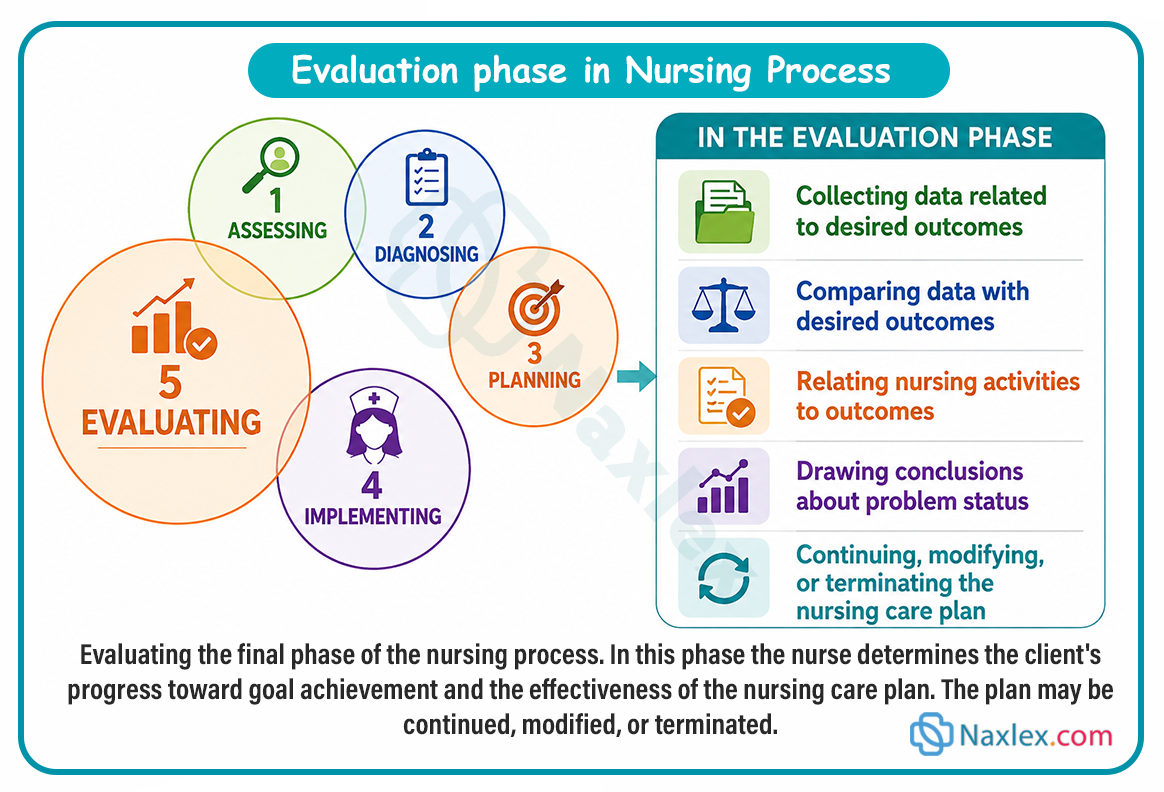
Process of Evaluating Client Responses
Prerequisites: Identifying Desired outcomes
Before evaluation occurs, desired outcomes (NOC indicators) are set during the Planning Step.
- Two core purposes of desired outcomes:
- Establish what evaluative data must be collected.
- Provide a standard/benchmark against which client responses are judged.
- Key Characteristic: Outcomes must be clear, precise, and measurable (e.g., "Daily fluid intake ≥ 2,500 mL" or "Residual urine < 100 mL").
Key components of the evaluation phase
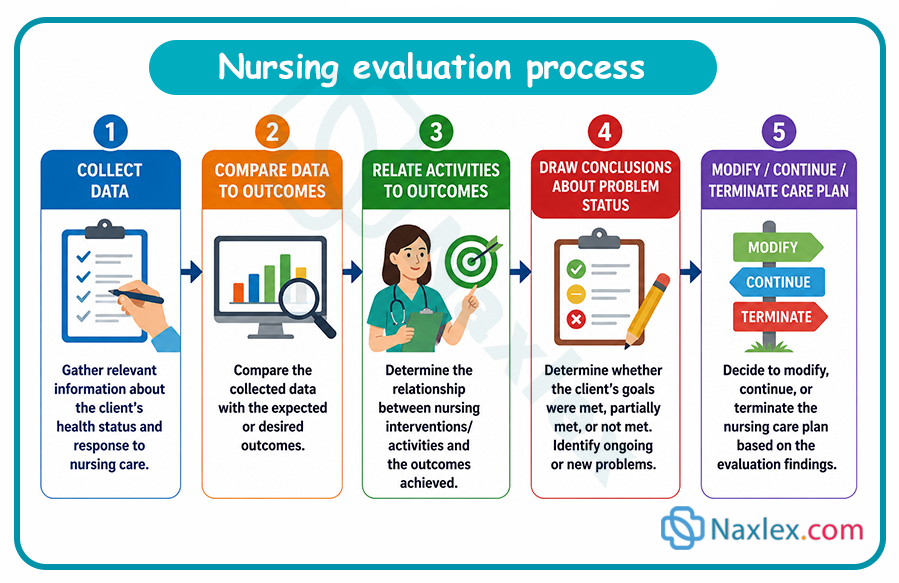
Step 1: Collecting Data
- Guided by precise, measurable indicators.
- Types of Data Needed:
- Objective Data requiring interpretation: Tissue turgor degree, restlessness level.
- Subjective Data requiring interpretation: Nausea complaints, pain ratings.
- Methods for Interpreting Subjective Data:
- Direct client statements (e.g., "My pain is worse than earlier").
- Objective indicators of subjective states (e.g., decreased heart rate and relaxed facial muscles as indicators of pain relief).
- Requirement: Must be recorded concisely and accurately.
Step 2: Comparing data with desired outcomes
Both the nurse and client play an active role in comparing actual responses against planned indicators.
Three possible conclusions:
- Goal Met: Client response matches desired outcome exactly.
- Goal Partially Met: Short-term goal achieved but long-term goal not, or outcome incompletely attained.
- Goal Not Met: Client response has not satisfied the desired outcome.
The evaluation statement
Recorded in the nurse's notes (or care plan) and consists of two parts:
Evaluation Statement = Conclusion (Met / Partially Met / Not Met) + Supporting Data
- Example:
"Goal met: Oral intake 300 mL more than output; skin turgor resilient; mucous membranes moist."
Step 3: Relating nursing activities to outcomes
Determines if nursing actions actually caused or contributed to the outcome.
Key Concept: Never assume a nursing action was the direct cause of a met or unmet goal without further investigation.
- Example Scenario: A client loses 4 lbs after receiving instructions on a 1,200-calorie diet.
- Case A: Client followed the diet - Nursing strategy was effective.
- Case B: Client ignored the diet and engaged in severe fasting - Nursing strategy was ineffective (outcome met independently).
Step 4: Drawing conclusions about problem status
When goals are met:
- Problem Resolved: Actual problem is gone or risk factors no longer exist - Discontinue care for this problem.
- Risk Prevails: Potential problem is prevented, but risk factors remain - Keep problem on care plan.
- Problem Persists: Specific outcome achieved, but overall problem remains (e.g., fluid target met, but oral membranes remain dry) - Continue interventions.
When goals are partially met or not met:
- Care plan revision needed: Re-evaluate assessing, diagnosing, planning, or implementing phases.
- More time needed: Goal was realistic, but evaluation was performed too early. No immediate plan revision needed.
Step 5: Continuing, modifying, or terminating the care plan
Requires a full critique of every preceding step of the Nursing Process:
|
Phase |
What to re-evaluate |
Action needed if deficient |
|
Assessing |
Completeness and accuracy of data. |
Reassess client, update database, establish new baselines. |
|
Diagnosing |
Relevance and accuracy of nursing diagnoses based on current data. |
Revise existing diagnoses or add new diagnostic statements. |
|
Planning Outcomes |
Priority alignment and realistic timelines/goals. |
Revise goals; extend timeframes or set manageable milestones. |
|
Planning Interventions |
Selection of best evidence-based nursing strategies. |
Update, reschedule, or change interventions (e.g., adding behavioral support). |
|
Implementing |
Whether interventions were actually carried out correctly by staff. |
Clarify unclear instructions or address external constraints (time, staff, equipment). |
Documentation Rules for Revisions:
- Write "Discontinued" ("dc'd"), "Goal Met", or "Problem Resolved" with the date.
- Modify text according to agency protocols (e.g., striking through, highlighting, or updating electronic records).
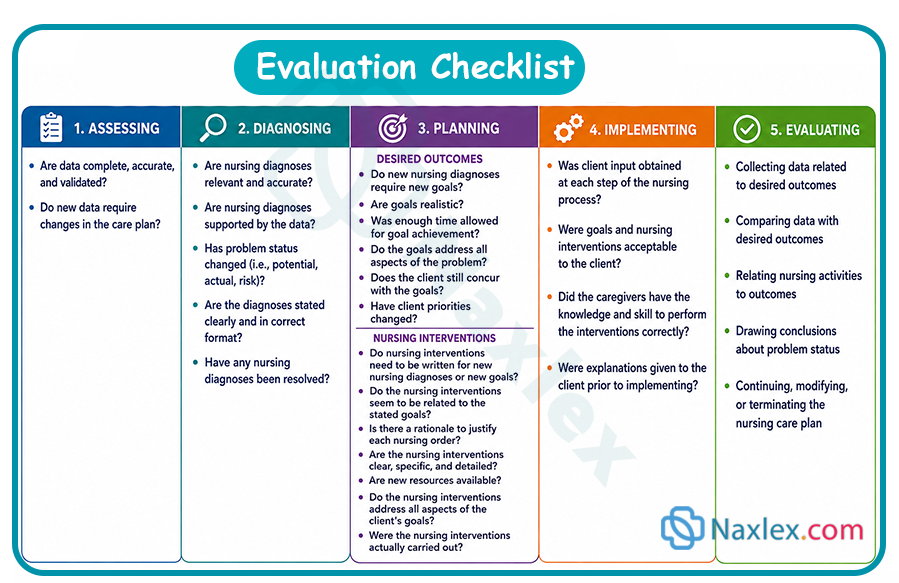
Evaluating the Quality of Nursing Care
In addition to evaluating goal achievement for individual clients, nurses are also involved in evaluating and modifying the overall quality of care given to groups of clients. This is an essential part of professional accountability.
A quality assurance (QA) program is an ongoing, systematic process designed to evaluate and promote excellence in the health care provided to clients.
Quality assurance frequently refers to evaluation of the level of care provided in a health care agency, but it may be limited to the evaluation of the performance of one nurse or more broadly involve the evaluation of the quality of the care in an agency, or even in a country.
Quality assurance requires evaluation of three components of care:
- Structure
- Process
- Outcome
Each type of evaluation requires different criteria and methods, and each has a different focus
Structure evaluation
- Focuses on the setting in which care is given.
- It answers this question: What effect does the setting have on the quality of care?
- Structural standards describe desirable environmental and organizational characteristics that influence care, such as equipment and staffing.
Process evaluation
- Focuses on how the care was given.
- It answers questions such as these: Is the care relevant to the client’s needs? Is the care appropriate, complete, and timely? Process standards focus on the manner in which the nurse uses the nursing process.
- Some examples of process criteria are “Checks client’s identification band before giving medication” and “Performs and records chest assessment, including auscultation, once per shift.”
Outcome evaluation
- Focuses on demonstrable changes in the client’s health status as a result of nursing care.
- Outcome criteria are written in terms of client responses or health status, just as they are for evaluation within the nursing process.
- For example, “How many clients undergoing hip repairs develop pneumonia?” or “How many clients who have a colostomy experience an infection that delays discharge?”
Key Concepts & Foundational Reports
- Core Philosophy: Bad systems-not bad people-lead to most errors.
- Institute of medicine (IOM) reports:
- To Err Is Human: Building a Safer Health System (2000): Highlighted the high prevalence and mortality of medical errors; emphasized building systems for safer care.
- Crossing the Quality Chasm (2001): Outlined the 6 domains of quality care:
- Safe
- Effective
- Client-centered
- Timely
- Efficient
- Equitable
Key Organizations & Initiatives
- CQuIPS (Center for Quality Improvement and Patient Safety within AHRQ): Conducts research, publishes reports, collaborates with stakeholders to implement evidence-based practices, and performs internal continuous learning.
- IHI (Institute for Healthcare Improvement): Independent non-profit accelerating improvement. Houses Transforming Care at the Bedside (collaboration with RWJF and AONE), focusing on safety, team vitality, client-centered care, and value-added processes.
- The Joint Commission: Evaluates and accredits healthcare organizations to improve safety and quality.
- QSEN (Quality and Safety Education for Nurses): Includes Quality Improvement and Safety as core competencies required for registered nurses.
Sentinel Events & Root Cause Analysis
- Sentinel Event: An unexpected occurrence involving death, serious physical/psychological injury (including loss of limb or function), or the risk thereof.
- Why "Sentinel"? Signals the need for immediate investigation and response.
- Examples: Wrong-site surgery (historically the most common), "do-not-use" abbreviations, look-alike/sound-alike medications.
- Volume: Over 800 reported annually.
- Root Cause Analysis (RCA):
- A structured process used to investigate a sentinel event.
- Identifies underlying system and process factors rather than individual blame.
- Goal: Prevent future recurrences by making organizational system improvements.
Quality Improvement (QI) vs. Quality Assurance (QA)
QI is also referred to as Continuous Quality Improvement (CQI), Total Quality Management (TQM), Performance Improvement (PI), or Persistent Quality Improvement (PQI).
Measuring Quality: Nursing-sensitive indicators & Never events
- Nursing-sensitive care indicators: Standardized performance measures that specifically evaluate the impact of nursing care on patient outcomes.
- National Quality Forum (NQF): Endorsed evidence-based standards; The Joint Commission established 12 primary measures based on these (e.g., hospital-acquired pressure ulcer prevalence, patient falls).
- NDNQI® (National Database of Nursing Quality Indicators): ANA database collecting unit-specific nurse-sensitive data across nearly 1,900 US hospitals, along with annual nurse satisfaction and work environment surveys.
- Serious Reportable Events (SREs / "Never Events"):
- 28 specific adverse events identified by NQF that should never happen if proper protocols are followed.
- Categorized into 6 areas: Surgical, Product/Device, Client Protection, Care Management, Environmental, and Criminal.
- Financial & Legal Impact: Mandated state reporting; insurance providers often refuse reimbursement for care associated with never events.
An audit refers to the examination or review of records.
- A retrospective audit is the evaluation of a client’s record after discharge from an agency. Retrospective means “relating to past events.”
- A concurrent audit is the evaluation of a client’s health care while the client is still receiving care from the agency. These evaluations use interviewing, direct observation of nursing care, and review of clinical records to determine whether specific evaluative criteria have been met.
Another type of evaluation of care is the peer review.
In a nurse peer review, nurses functioning in the same capacity, that is, peers, appraise the quality of care or practice performed by other equally qualified nurses. The peer review is based on preestablished standards or criteria.
There are two types of peer reviews: individual and nursing audits.
- The individual peer review focuses on the performance of an individual nurse.
- The nursing audit focuses on evaluating nursing care through the review of records. The success of these audits depends on accurate documentation.
Lifespan Considerations in Nursing Evaluation
Evaluation of goals, outcomes, and interventions must be a continuous, dynamic process involving constant assessment and reassessment. Patient needs can change rapidly, requiring immediate reprioritization of care plans.
Special Population Considerations
1. Infants & Young Children
- Physiological Vulnerability: High risk for rapid clinical deterioration due to:
- Small body size.
- Disproportionately sized organs.
- Immature body systems.
- Communication Barrier: Limited or no ability to verbally communicate symptoms or changes in how they feel.
- Nursing Action: Requires frequent physical monitoring and objective assessment to spot subtle physiological changes early.
2. Older Adults
- Communication Impairments: Often present with conditions that hinder verbal communication, including:
- Cerebrovascular Accident (CVA): Aphasia / speech deficits.
- Neurologic / Cognitive Conditions: Dementia, Multiple Sclerosis (MS), etc.
- Nursing Action: Nurses must rely heavily on astute nonverbal assessments, keen observation for potential complications, and proactive detection of status changes.
Essential Nursing Competencies
|
Competency |
Clinical Application in Evaluation |
|
Frequent & Thorough Evaluation |
Allows for rapid intervention adjustments, leading to significantly improved patient outcomes. |
|
Nonverbal Assessment |
Critical for interpreting physiological signs and body language when verbal communication is absent or impaired. |
|
Interpersonal & Communication Skills |
Equally essential during the final evaluation phase as they are during the initial assessment phase. |
Summary
- Implementing is putting planned nursing interventions into action.
- Successful implementing and evaluating depend in part on the quality of the preceding phases of assessing, diagnosing, and planning.
- Reassessing occurs simultaneously with the implementing phase of the nursing process.
- Cognitive, interpersonal, and technical skills are used to implement nursing strategies.
- Before implementing an order, the nurse reassesses the client to be sure that the order is still appropriate.
- Professional standards of care hold that nurses are responsible and accountable for implementing and evaluating the plan of care.
- Quality assurance evaluation includes consideration of the structures, processes, and outcomes of nursing care.
- Quality improvement is a philosophy and process internal to the institution, and does not rely on inspections by an external agency.
Objectives
- Explain how implementing relates to other phases of the nursing process.
- Describe three categories of skills used to implement nursing interventions.
- Discuss the five activities of the implementing phase.
- Identify guidelines for implementing nursing interventions.
- Explain how evaluating relates to other phases of the nursing process.
- Describe five components of the evaluation process.
- Describe the steps involved in reviewing and modifying the client’ s care plan.
- Describe three components of quality evaluation: structure, process, and outcomes.
- Differentiate quality improvement from quality assurance.
Introduction
-
The nursing process is action oriented, client centered, and outcome directed.
After developing a plan of care based on the assessing and diagnosing phases, the nurse implements the interventions and evaluates the desired outcomes.
On the basis of this evaluation, the plan of care is either continued, modified, or terminated.
Implementing
Implementing is the action phase in which the nurse performs the nursing interventions.
Using Nursing Interventions Classification (NIC) terminology, implementing consists of doing and documenting the activities that are the specific nursing actions needed to carry out the interventions.
The nurse performs or delegates the nursing activities for the interventions that were developed in the planning step and then concludes the implementing step by recording nursing activities and the resulting client responses.
Relationship of Implementing to Other Nursing Process Phases
The first three nursing process phases—assessing, diagnosing, and planning—provide the basis for the nursing actions performed during the implementing step.
In turn, the implementing phase provides the actual nursing activities and client responses that are examined in the final phase, the evaluating phase.
Using data acquired during assessment, the nurse can individualize the care given in the implementing phase, tailoring the interventions to fit a specific client rather than applying them routinely to categories of clients (e.g., all clients with pneumonia).
While implementing nursing care, the nurse continues to reassess the client at every contact, gathering data about the client’s responses to the nursing activities and about any new problems that may develop.
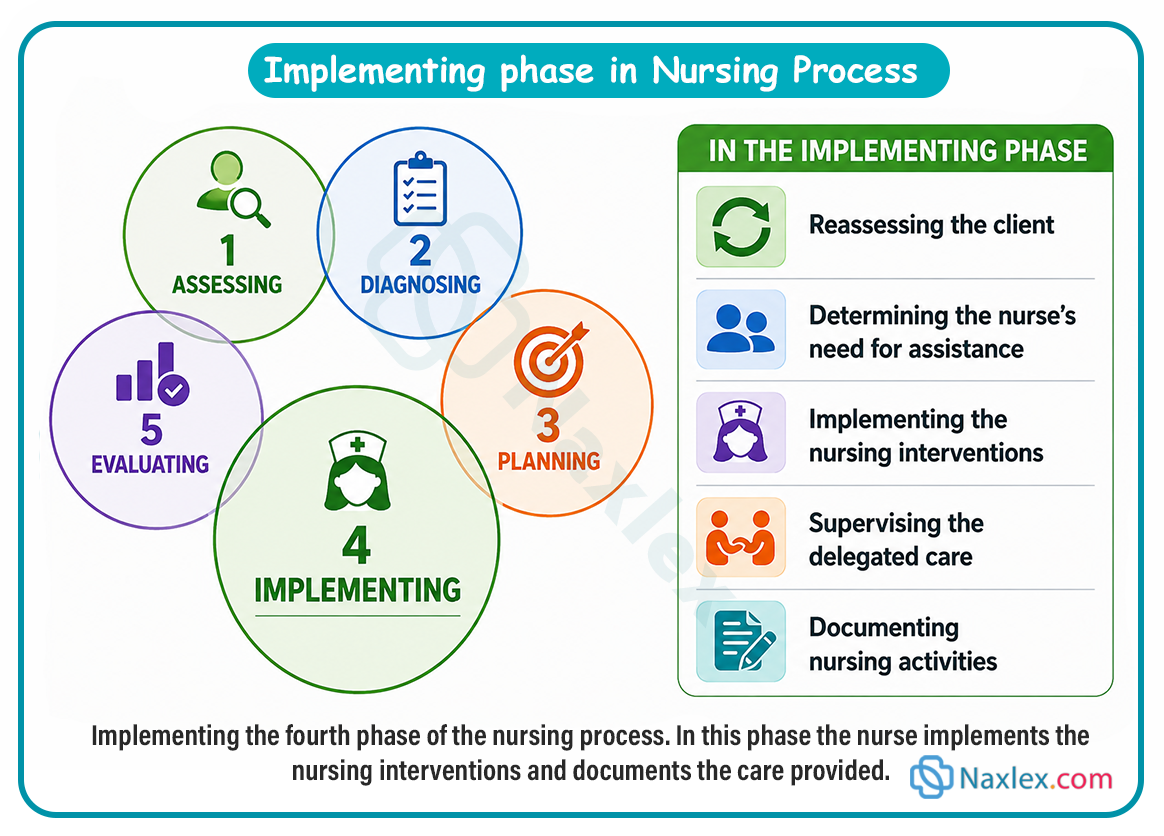
Implementing Skills
To implement the care plan successfully, nurses need cognitive, interpersonal, and technical skills.
These skills are distinct from one another; in practice, however, nurses use them in various combinations and with different emphasis, depending on the activity.
Cognitive skills (intellectual skills):
Include problem solving, decision making, critical thinking, clinical reasoning, and creativity.
Interpersonal skills:
Are all of the activities, verbal and nonverbal, people use when interacting directly with one another. The nurse uses therapeutic communication to understand the client and in turn be understood.
Interpersonal skills are necessary for all nursing activities: caring, comforting, advocating, referring, counseling, and supporting are just a few.
Technical skills:
Are purposeful “hands-on” skills such as manipulating equipment, giving injections, bandaging, moving, lifting, and repositioning clients. These skills are also called tasks, procedures, or psychomotor skills.
Types of Nursing Management Systems
- Core principle: Resources are used most efficiently when tasks are assigned to the most cost-effective level of personnel who can perform them safely and proficiently.
- Primary driver for change: Evolving healthcare delivery and an increasing emphasis on cost containment have driven workplace redesign.
- Cross-training: Modern workplace redesign often involves cross-training, where nurses take on tasks previously performed by other departments (e.g., drawing blood, performing ECGs, or administering respiratory treatments) to keep care centered around the client.
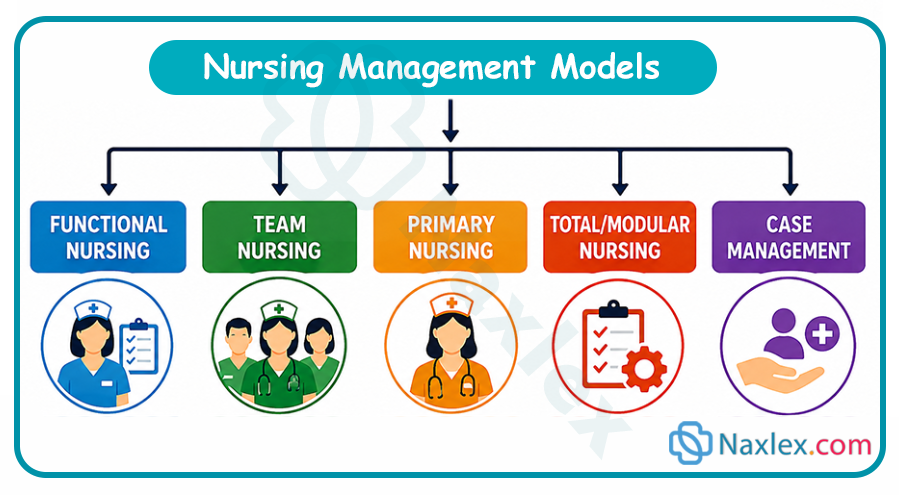
1. Functional Nursing
- Care is broken down into specific tasks distributed among staff based on their skill level and complexity.
- Example Workload: One nurse performs all assessments/documentation, another administers all medications/treatments, and nursing assistants handle meals or vital signs.
- Pros: Highly cost-effective; allows a small staff to care for a large number of clients; maximizes specialized skills or lower-cost personnel.
- Cons: Leads to fragmented and depersonalized care; increases the risk of omissions because no single person oversees total client care.
2. Team Nursing
- A multi-disciplinary group (RNs, LPNs, and unlicensed assistive personnel) delivers care under the leadership of a Registered Nurse (RN).
- Role Distribution:
- RN (Team Leader): Directs, supervises, plans, evaluates, and provides direct care to acutely ill clients.
- LPN: Cares for less acutely ill clients.
- Assistive Personnel: Handles basic care, bed-making, tray distribution, and assisting nurses.
- Pros: Cost-effective while offering more individualized care than the functional approach.
3. Primary nursing
- A single professional nurse assumes 24-hour accountability for total client care throughout their stay, setting health goals and creating care plans. Associate nurses carry out the plan when the primary nurse is off duty.
- Pros: Exceptional continuity of care.
- Cons: Very expensive to maintain; requires a staff composed primarily of RNs.
- Current status: Rarely used outside of critical care areas due to high cost and RN shortages.
4. Total client care & modular nursing
- Total Client Care: A variation of primary nursing where one nurse handles all client needs, but responsibility transfers shift-to-shift rather than staying with one nurse for 24 hours.
- Modular nursing: Divides a unit into smaller "modules" or geographic segments so that clients are consistently cared for by the same small team of caregivers.
- Key traits: Uses both RNs and LPNs (RNs take complex cases); unit managers or charge nurses coordinate overall care.
5. Case Management
- A nurse acts as a case manager to coordinate, plan, implement, and evaluate care for clients with complex needs across the entire continuum of care, regardless of location.
- Key Tools:
- Critical pathways / care maps: Frameworks based on expected clinical progress and timelines to measure client outcomes.
- Variance tracking: Investigating any deviation from the expected timeline or level of recovery.
- Goals: Achieve optimal client health with minimal unnecessary intervention, enhance cross-departmental collaboration, evaluate cost-effectiveness, and maintain quality care.
- Pros: High continuity and reduced care fragmentation.
- Cons: High cost due to smaller caseloads per case manager.
|
Management System |
Staffing Structure |
Primary Advantage |
Main Limitation |
Primary Setting/Usage |
|
Functional Nursing |
Divided by task among various skill levels |
Maximizes efficiency with fewer/less-skilled staff |
Care is fragmented and depersonalized |
Units needing high task output with lower staffing |
|
Team Nursing |
RN lead, LPNs, and Unlicensed Assistive Personnel |
Cost-effective with better individualized care than Functional |
Requires strong leadership and supervisory skills |
Broad clinical settings |
|
Primary Nursing |
Primarily RNs (24-hour accountability per client) |
Maximum continuity of care |
High operational cost |
Critical care units |
|
Total / Modular Nursing |
Mixed RNs and LPNs; assigned to specific unit "modules" |
Better consistency of caregivers shift-to-shift |
Responsibility transfers each shift |
Inpatient units |
|
Case Management |
RN Case Manager overseeing multidisciplinary care |
Seamless care continuity across treatment settings |
Higher cost due to smaller individual caseloads |
Complex multi-system cases |
Process of Implementing
The process of implementing normally includes the following:
• Reassessing the client
• Determining the nurse’s need for assistance
• Implementing the nursing interventions
• Supervising the delegated care
• Documenting nursing activities.
1. Reassessing the Client
- Performed immediately before carrying out an intervention to confirm it is still appropriate and safe.
- Key Concept: A client’s condition changes dynamically; prior orders on a care plan must always be validated against current real-time data.
- Clinical Application:
- Deferring Care: If a back massage is planned for anxiety-related sleep issues, but the nurse finds the client already asleep, the intervention is deferred.
- Reprioritizing Care: If a teaching session on insulin administration causes a diabetic client distress because they fear going blind, the nurse shifts priorities: ends the teaching, offers emotional support, and arranges an eye exam.
2. Determining the Nurse’s Need for Assistance
A nurse requires assistance during implementation for three primary reasons:
|
Reason for Assistance |
Clinical Example |
|
Safety / Efficiency |
Ambulate an unsteady or obese client safely. |
|
Client Comfort / Stress Reduction |
Turn a client experiencing severe acute pain. |
|
Skill / Knowledge Gap |
Apply unfamiliar specialized medical equipment (e.g., traction device) for the first time. |
3. Guidelines for Implementing Nursing Interventions
Preparation & Communication
- Client Preparation: Always inform the client about what interventions will be performed, expected sensations, their role, and the intended outcome.
- Privacy & Dignity: Ensure physical privacy (close doors, pull curtains, drape appropriately).
- Care Coordination: Schedule appointments with other services (lab, x-ray, physical/respiratory therapy) and act as a liaison across the interprofessional team.
8 Essential Practice Guidelines
- Evidence-Based Practice: Ground actions in scientific rationale, research, and professional standards. Be aware of expected outcomes, side effects, and potential complications (e.g., altering medication timing if food inhibits absorption).
- Understand & Question: Know the clear purpose, contraindications, and precautions for every action. Question any order that is unclear or potentially unsafe.
- Individualize / Adapt Care: Modify actions according to age, health status, environment, beliefs, and values (e.g., changing swallowed pills to liquid form for dysphagia, or providing hot water instead of ice water for Asian cultural preferences).
- Maintain Safety: Adhere strictly to protocols (e.g., sterile technique during dressing changes; double-checking the "rights" of medication administration).
- Incorporate Teaching, Support, & Comfort: Educate clients about their care to foster self-management and informed consent.
- Holistic Perspective: View the client as a whole person; respect daily schedules (meals, rest, visitor preferences) when timing care.
- Respect Dignity & Self-Esteem: Support autonomy by encouraging clients to make decisions regarding their care.
- Promote Active Client Participation: Involve clients based on their personal desire, capability, cultural background, and illness severity to foster independence.
4. Supervising Delegated Care
- Responsibility: The primary nurse maintains overall accountability for client outcomes, even when specific care tasks are delegated to other team members.
- Process:
- Verify that delegated tasks are performed according to the established care plan.
- Review feedback provided via client records, verbal handoffs, or written forms.
- Validate findings, address any adverse reactions or changes, and adjust the nursing care plan as needed.
5. Documenting Nursing Activities
- Timing: Record activities after execution—never in advance. Pre-documenting risks error if a reassessment leads to withholding an action (e.g., withholding morphine because the client's respiratory rate dropped to 8 breaths/min).
- Immediate Recording: High-risk actions (such as medication administration and invasive treatments) must be documented immediately to avoid duplicate dosing or safety lapses.
- Routine Recording: Minor routine activities (e.g., hygiene/mouth care) may be logged on worksheets during the shift and officially entered into progress notes at shift's end.
- Verbal Handoffs: Rapidly changing conditions require immediate verbal updates to primary care providers or charge nurses, alongside structured end-of-shift/transfer reports.
Naxlex
Videos
Login to View Video
Click here to loginTake Notes on Implementation
This filled cannot be empty
Join Naxlex Nursing for nursing questions & guides! Sign Up Now