






 Video Library


Please set your exam date
The Experience of Loss, Death, and Grief
Study Questions
Practice Exercise 1
A nurse is teaching a group about normal grief responses. Which of the following may be considered normal or healthy types of grief? Select all that apply
Explanation
Grief is a normal, complex, multidimensional response to loss that encompasses emotional, cognitive, physical, and behavioral manifestations. Healthy or adaptive grief allows individuals to process distress, adapt to changed circumstances, and eventually integrate the loss into their daily lives without long-term functional impairment.
Rationale for correct answers:
A. Abbreviated grief is a genuine, normal grief reaction that is brief in duration. It occurs when the lost object or person is immediately replaced, or when substantial emotional re-categorization and grieving occurred prior to the actual loss. This response remains non-pathological because emotional resolution is successfully achieved without functional impairment.
B. Anticipatory grief is experienced prior to an impending loss or terminal event. Individuals engage in preliminary emotional processing, role realignment, and detachment before the actual death occurs. This adaptive mechanism frequently facilitates healthier post-loss coping and reduces acute emotional trauma upon the event's occurrence.
C. Disenfranchised grief occurs when a loss cannot be openly acknowledged, socially sanctioned, or publicly mourned. Although social support is lacking, the individual's internal emotional processing remains a normal, healthy psychological response to a real loss. The grief itself is non-pathological despite society failing to validate the relationship.
Rationale for incorrect answers:
D. Complicated grief represents a maladaptive response where intense sorrow, intrusive thoughts, and emotional detachment persist beyond expected cultural norms. Individuals remain functionally impaired and locked in acute mourning without progression toward resolution. This chronic, debilitating condition requires specialized therapeutic intervention and is considered pathological.
E. Unresolved grief occurs when emotional distress remains extended in duration and lacks functional resolution over time. Individuals demonstrate persistent denial, severe depressive symptoms, or an inability to process the loss. This non-adaptive, prolonged state prevents healthy psychological recovery and indicates a pathological mourning process.
F. Inhibited grief involves the conscious or unconscious suppression of normal grief manifestations. Individuals intentionally suppress emotional expression, which often leads to somatic complaints, anxiety, or delayed psychological distress. Because emotional processing is avoided rather than integrated, this mechanism is classified as an unhealthy coping strategy.
Test-taking strategy
- Analyze the scenario and question: The question asks the nurse to identify normal or healthy types of grief from a provided list. The goal is to differentiate adaptive, healthy grief reactions from maladaptive or pathological grief responses.
- Categorize types of grief:
- Normal/Adaptive grief: Responses that facilitate psychological adaptation, even if brief or socially unacknowledged.
- Maladaptive/Pathological grief: Responses characterized by prolonged dysfunction, complete suppression, or chronic emotional fixation.
- Evaluate individual options:
- Rule in Choice 1 (Abbreviated grief): Represents a short-lived but healthy emotional resolution.
- Rule in Choice 2 (Anticipatory grief): Represents an adaptive, pre-loss emotional preparation.
- Rule in Choice 3 (Disenfranchised grief): Represents a normal internal emotional response to an unvalidated loss.
- Rule out Choice 4 (Complicated grief): Indicates chronic, debilitating, non-resolving pathological grief.
- Rule out Choice 5 (Unresolved grief): Indicates persistent failure to process or integrate the loss.
- Rule out Choice 6 (Inhibited grief): Indicates unhealthy emotional suppression leading to somatic or psychological sequelae.
Take home points
- Normal or healthy grief forms include uncomplicated, abbreviated, anticipatory, and disenfranchised grief, all of which permit emotional processing and integration.
- Anticipatory grief allows individuals to process an impending loss beforehand, often softening the acute impact of the actual death.
- Disenfranchised grief occurs when a loss cannot be publicly acknowledged or socially validated, yet the individual's internal grief response remains normal.
- Complicated, unresolved, and inhibited grief are maladaptive, pathological responses characterized by chronic dysfunction, severe distress, or complete suppression of emotion.
A client begins to cry when asked to sign the permission form for surgical removal of a large but noncancerous lesion on her face. Which of the following is the most appropriate nursing response?
Explanation
Therapeutic communication during preoperative procedures requires open-ended exploration of client concerns, active listening, and validation of underlying anxiety. Face or head lesions hold deep psychological significance regarding body image disturbance, self-concept, and social identity. Asking open-ended questions allows the nurse to explore client feelings rather than making assumptions of relief or offering false reassurance.
Rationale for correct answer:
A. "Tell me what it means to you to have this surgery" is the most appropriate response because it utilizes an open-ended therapeutic technique to explore the client's internal frame of reference. Surgical procedures on visually prominent body parts like the face frequently trigger intense fear of scarring, disfigurement, or altered self-perception. Facilitating open expression helps the nurse identify specific psychological barriers and provide tailored emotional support before informed consent execution.
Rationale for incorrect answers:
B. "You must be very glad to be having this lesion removed" imposes an unverified assumption of joy onto a client who is actively weeping. Presuming emotional states dismisses the client's genuine distress and shuts down therapeutic dialogue. The nurse must validate tears as a sign of anxiety or grief rather than assuming positive emotions.
C. "I cry when I am happy or relieved sometimes, too" shifts the focus of care onto the nurse and minimizes the client's emotional experience. Normalizing or projecting personal behaviors invalidates the client's acute distress during a critical consent process. Non-therapeutic communication avoids self-centering statements that distract from client-centered needs.
D. "Isn't it wonderful that the lesion is not cancer?" offers false reassurance and minimizes the client's fear regarding facial surgery. While a benign pathology diagnosis is positive clinical news, surgical excision still presents real risks of altered facial appearance and surgical scarring. Minimizing client concerns prevents effective exploration of anxiety related to altered body image.
Test-taking strategy
- Analyze the scenario and question: The client cries when asked to sign an informed consent form for facial lesion removal. The question asks for the most appropriate therapeutic nursing response.
- Apply therapeutic communication and body image concepts:
- Identify open-ended techniques: Look for responses that encourage elaboration, exploration, and validation of feelings.
- Eliminate non-therapeutic barriers: Reject options that assume emotional states, minimize feelings, offer false reassurance, or shift focus to the nurse.
- Evaluate choices:
- Select Choice 1: Uses an open-ended exploration technique to evaluate the psychological meaning of surgery.
- Rule out Choice 2: Makes an unsupported assumption regarding client relief.
- Rule out Choice 3: Uses self-centering communication that shifts focus onto the nurse.
- Rule out Choice 4: Offers false reassurance and minimizes concerns regarding facial alteration.
Take home points
- Preoperative crying or distress requires immediate exploration using open-ended communication techniques.
- Facial surgeries carry high risks for body image disturbance and anxiety, regardless of whether the pathology is benign or malignant.
- Avoid assuming emotional states, offering false reassurance, or projecting personal feelings when clients demonstrate non-verbal distress.
- Informed consent must involve thorough psychological readiness and understanding of procedural impacts on body image.
An 82-year-old client has been told by his primary care provider that it is no longer safe for him to drive a car. Which statement by the client would indicate beginning positive adaptation to this loss?
Explanation
Loss of driving privileges in older adults represents a major threat to autonomy, self-esteem, and social connectivity. Successful psychological processing follows Kübler-Ross grief stages, progressing from initial denial or anger toward constructive positive adaptation, problem-solving, and acceptance of alternative transportation options.
Rationale for correct answer:
D. "Well, at least I have friends and family who can take me places." indicates positive adaptation because the client acknowledges the reality of the loss and actively identifies compensatory resources. Re framing the situation around support systems demonstrates constructive coping, problem-solving, and acceptance of functional limitations. This proactive outlook preserves social engagement while adhering to safety recommendations.
Rationale for incorrect answers:
A. "I told the doctor I would stop driving, but I am not going to yet" reflects open non-compliance, defiance, and denial regarding functional decline. Refusing to cease driving places the client and community at immediate risk for motor vehicle collisions. This statement demonstrates zero adaptation to the loss of driving privileges.
B. "I always knew this day would come, but I hoped it wouldn't be now" represents grief, sadness, and initial acknowledgment of loss without active adaptation. While expressing realistic sorrow is a normal intermediate step in the grieving process, it does not yet demonstrate constructive adaptation or alternative problem-solving. True adaptation moves beyond passive sadness into practical coping mechanisms.
C. "What does he know? I'm a better driver than he will ever be" exemplifies anger, defensiveness, and projection of frustration onto the healthcare provider. Rejecting the clinical assessment reveals resistance to accepting age-related functional changes. Defensive displacement is a classic maladaptive response during early grief stages.
Test-taking strategy
- Analyze the scenario and question: An 82-year-old client is losing driving privileges due to safety concerns. The question asks which client statement indicates beginning positive adaptation to the loss.
- Apply adaptation and grief concepts:
- Maladaptive/Denial responses: Refusal to follow advice, anger, or blaming providers.
- Passive awareness: Expressing sadness without taking action or finding alternatives.
- Positive adaptation: Accepting the limitation and identifying practical solutions or social resources.
- Evaluate choices:
- Rule out Choice 1: Non-compliance and active denial.
- Rule out Choice 2: Passive sadness/grief without positive coping mechanisms.
- Rule out Choice 3: Defensive anger and projection.
- Select Choice 4: Active problem-solving and acceptance of support systems.
Take home points
- Relinquishing a driver's license in older adulthood triggers significant grief over lost independence, control, and mobility.
- Positive adaptation is characterized by accepting functional limitations and identifying alternative coping mechanisms or community support.
- Expressions of anger, denial, and provider displacement reflect early maladaptive responses in the grief process.
- Nurses should assist older adults facing driving cessation by identifying community transit, family support, and local mobility resources.
A client who was firmly committed to natural childbirth and attended each class in preparation for labor undergoes a cesarean delivery when her fetus displays signs of distress. Inconsolable, she cries and calls herself a failure as a mother. What type of loss is she experiencing? Select all that apply
Explanation
A birth trauma experience involves unexpected deviations from a client's ideal birthing plan. When an emergency surgical intervention occurs, the client may internalize a perceived loss of her ideal labor experience and an ideal self-image, triggering a psychological loss characterized by severe guilt, inadequate coping, and self-blame.
Rationale for correct answers:
B. Perceived loss is correct because this loss is uniquely defined and experienced by the client, though it cannot be verified or measured by others. While the physical outcome resulted in a healthy delivery, the client internalizes the inability to complete natural childbirth as a personal failure.
C. Psychological loss is correct because the client experiences an internal blow to her self-esteem, self-concept, and identity as a mother. The inability to fulfill her natural childbirth expectations creates severe emotional distress and altered self-perception without a physical loss of a body part.
Rationale for incorrect answers:
A. Actual loss is incorrect because an actual loss involves the tangible, objective loss of a person, object, or physical body part that can be recognized and verified by outside observers. In this scenario, both the mother and infant survived without physical loss of life or limb.
D. Anticipatory loss is incorrect because anticipatory loss occurs prior to an impending loss, allowing individuals to process grief before the event actually takes place. The client in this scenario is experiencing an acute, reactive emotional response following an unexpected emergency cesarean delivery.
E. Physical loss is incorrect because physical loss pertains to the direct removal, destruction, or impairment of a physical organ, body part, or tangible bodily function. An emergency cesarean delivery is a surgical procedure rather than a permanent loss of physical anatomy or function.
Test-taking strategy
- Analyze the scenario and question: A client committed to natural childbirth undergoes an emergency cesarean delivery and experiences intense guilt, calling herself a failure. The question asks to identify the types of loss she is experiencing (Select all that apply).
- Classify loss types:
- Actual vs. Perceived: The loss is intangible and felt internally (Perceived), not an externally measurable loss (Actual).
- Psychological vs. Physical: The damage is to her self-esteem and identity (Psychological), not loss of an anatomical organ or body part (Physical).
- Timing: The event has already occurred, ruling out Anticipatory loss.
- Evaluate choices:
- Rule out Choice 1: Not an externally verified, tangible loss (Actual).
- Select Choice 2: The client experiences an internal loss of her ideal expectation (Perceived).
- Select Choice 3: The loss damages her personal self-concept and self-esteem (Psychological).
- Rule out Choice 4: Grief occurs after the event, not before (Anticipatory).
- Rule out Choice 5: No physical body part or organ was lost (Physical).
Take home points
- Perceived loss is uniquely defined by the individual and cannot be objectively measured or seen by outside observers.
- Psychological loss impacts a person's self-esteem, self-concept, and perceived identity without physical anatomical loss.
- Actual and physical losses involve tangible, visible loss of people, body parts, or external possessions.
- Emergency medical deviations from ideal birth plans can trigger severe perceived and psychological grief responses.
A nurse is teaching a group about grief. What term describes the period of acceptance of loss and grief during which the person learns to deal with loss through actions and expressions of grief?
Explanation
Grief processes encompass distinct psychological, social, and behavioral components following a loss. While bereavement represents the total state of experiencing a loss, mourning specifically defines the outward, active period of acceptance of loss where individuals engage in cultural, behavioral, and social expressions to process their grief.
Rationale for correct answer:
C. Mourning is the correct term because it specifically describes the active behavioral process and period through which a person learns to accept and integrate a loss through external actions, rituals, and expressions of grief. Mourning includes cultural practices, funeral traditions, and personal behaviors that facilitate adaptation to loss.
Rationale for incorrect answers:
A. Anticipatory grieving describes emotional processing, intellectual preparation, and grieving behaviors that occur before an expected loss actually takes place. It does not represent the post-loss period of active social and behavioral acceptance described in the question stem.
B. Bereavement defines the subjective state of deprivation or being deprived caused by a loss, encompassing the entire emotional, physical, and social experience of losing a loved one. Bereavement is the state of having suffered a loss rather than the specific process of learning to deal with it through actions.
D. Stages of death and dying refers to conceptual frameworks, such as the Kübler-Ross model (denial, anger, bargaining, depression, acceptance), that describe the emotional progression individuals pass through when facing personal mortality or catastrophic loss, rather than the active period of social mourning.
Test-taking strategy
- Analyze the scenario and question: The question asks for the specific term describing the period of acceptance where a person learns to deal with loss through actions and expressions.
- Differentiate grief terminology:
- Bereavement: The overall state of suffering a loss.
- Grief: The internal emotional and psychological reaction to loss.
- Mourning: The active, external behavioral actions and expressions during the period of acceptance.
- Anticipatory grieving: Grief occurring prior to the actual loss event.
- Evaluate choices:
- Rule out Choice 1: Grief experienced prior to loss occurrence (Anticipatory grieving).
- Rule out Choice 2: The overarching state of deprivation caused by loss (Bereavement).
- Select Choice 3: The active period of behavioral integration and expressions of grief (Mourning).
- Rule out Choice 4: The psychological stages experienced during dying (Stages of death and dying).
Take home points
- Mourning is the active period and process of learning to deal with loss through behavioral, social, and cultural expressions.
- Bereavement is the subjective state of sadness and deprivation resulting from experiencing a loss.
- Grief represents the internal emotional, cognitive, and affective response to loss.
- Anticipatory grieving occurs before an actual loss takes place.
A nurse interviews an 82-year-old resident of a nursing home who says she has never gotten over the death of her son 20 years ago. She reports that her life fell apart after that and she never again felt like herself or was able to enjoy life. What type of grief is this woman experiencing?
Explanation
Dysfunctional grief (also referred to as complicated, prolonged, or unresolved grief) occurs when an individual experiences an extended, disabling emotional response to loss. When grief persists unresolved over decades and severely impairs daily life, social engagement, and personal identity, the client experiences maladaptive grief processing requiring specialized psychiatric and nursing support.
Rationale for correct answer:
C. Dysfunctional grief is correct because the client reports an inability to process or integrate her son's death 20 years after the event. Her statement that her life fell apart and that she never again felt like herself or enjoyed life reflects chronic, disabling distress that severely impairs normal functional recovery and long-term psychological adaptation.
Rationale for incorrect answers:
A. Abbreviated grief describes a short-lived but genuine grief reaction that resolves quickly. Abbreviated grief typically occurs when the loss is minor, replaced rapidly, or processed early through anticipatory grieving mechanisms, which directly contradicts this client's 20-year struggle.
B. Anticipatory grief occurs prior to an actual loss event, allowing individuals to process emotional reactions before death occurs. The loss in this scenario occurred 20 years in the past, making the grief post-occurrence rather than anticipatory.
D. Inhibited grief occurs when an individual suppresses or suppresses emotional expressions of grief, often manifesting as somatic symptoms or physical illness instead. This client clearly verbalizes her emotional devastation and ongoing sorrow rather than suppressing her emotional pain.
Test-taking strategy
- Analyze the scenario and question: An 82-year-old resident reports that her life fell apart and she never recovered after her son's death 20 years ago. The question asks to identify the type of grief she is experiencing.
- Classify grief patterns:
- Normal (Uncomplicated): Gradually resolves over time, allowing return to daily functioning.
- Abbreviated: Short duration, resolves quickly.
- Anticipatory: Begins before the loss occurs.
- Inhibited: Emotionally suppressed or converted into physical symptoms.
- Dysfunctional (Complicated): Prolonged, unresolved, severe functional impairment lasting years or decades.
- Evaluate choices:
- Rule out Choice 1: Grief has lasted 20 years, not a short duration (Abbreviated).
- Rule out Choice 2: Grief occurred long after the loss, not before (Anticipatory).
- Select Choice 3: Grief is long-standing, unresolved, and life-impairing (Dysfunctional).
- Rule out Choice 4: Client openly shares feelings rather than suppressing them (Inhibited).
Take home points
- Dysfunctional (complicated) grief is characterized by prolonged, unresolving distress that impairs long-term functional recovery.
- Abbreviated grief is brief and resolves quickly, often when emotional preparation occurs prior to the loss.
- Inhibited grief involves suppressing emotional pain, which often manifests through unexplained somatic complaints.
- Persistent inability to experience joy or restore daily functioning decades after a loss indicates complicated grief.
A home health nurse visits a client with AIDS who says, “I’m no longer afraid of dying. I think I’ve made my peace with everyone, and I’m actually ready to move on.” This reflects progress to which stage of death and dying?
Explanation
Kübler-Ross stages of dying delineate the psychological trajectory individuals often experience when facing personal mortality. When a client expresses peace, lack of fear regarding death, and resolution of interpersonal relationships, the client demonstrates progress to the stage of acceptance, characterized by quiet tranquility and emotional readiness.
Rationale for correct answer:
A. Acceptance is correct because the client's statements reflect a peaceful resolution and readiness for death. In the acceptance stage, the client comes to terms with mortality, resolves personal conflicts, and experiences decreased fear and emotional struggle regarding impending death.
Rationale for incorrect answers:
B. Anger stage is characterized by feelings of rage, resentment, envy, and questioning why the loss is occurring ("Why me?"). This client expresses peaceful resolution rather than hostility, frustration, or emotional turbulence.
C. Bargaining involves attempting to postpone death or negotiate for more time, often with a higher power or medical team in exchange for reformed behavior ("If I can just live to see my daughter get married..."). This client is ready to move on rather than negotiating for time.
D. Denial represents initial refusal to accept the reality of a terminal diagnosis or loss ("This can't be happening to me"). The client explicitly acknowledges impending death and states readiness, which directly contradicts denial behaviors.
Test-taking strategy
- Analyze the scenario and question: A client with AIDS states he is no longer afraid of dying, has made peace with everyone, and is ready to move on. The question asks to identify the stage of death and dying.
- Apply Kübler-Ross stages framework (DABDA):
- Denial: Refusal to accept reality ("No, not me").
- Anger: Hostility and resentment ("Why me?").
- Bargaining: Negotiating for time ("Yes, me, but...").
- Depression: Severe sadness and withdrawal ("Yes, me").
- Acceptance: Peace, tranquility, and readiness ("I am ready").
- Evaluate choices:
- Select Choice 1: Reflects emotional peace, resolution, and readiness (Acceptance).
- Rule out Choice 2: Lacks hostility, resentment, or frustration (Anger).
- Rule out Choice 3: Lacks attempts to negotiate or delay death (Bargaining).
- Rule out Choice 4: Fully acknowledges mortality and peaceful readiness (Denial).
Take home points
- The acceptance stage of Kübler-Ross is marked by peace, absence of fear, and emotional readiness for death.
- Denial involves initial shock and refusal to accept a terminal prognosis.
- Anger manifests as resentment, hostility, and questioning the fairness of the situation.
- Bargaining involves attempts to negotiate for additional time or altered outcomes.
A client who has just learned that she is terminally ill with breast cancer says, ‘‘Not me. This can’t be happening to me!’’ Which stage of death and dying as described by Kubler-Ross is this client exhibiting?
Explanation
Kübler-Ross stages of grief describe the psychological responses individuals experience when confronting terminal illness or severe loss. The initial response to receiving a terminal prognosis is characterized by shock, disbelief, and direct refusal to accept reality - a psychological coping mechanism known as denial.
Rationale for correct answer:
C. Denial is correct because the statement "Not me. This can't be happening to me!" is a classic verbalization of disbelief and refusal to accept a terminal diagnosis. Denial serves as an immediate protective defense mechanism that buffers the client against acute emotional shock and trauma upon learning devastating medical news.
Rationale for incorrect answers:
A. Anger stage manifests as resentment, hostility, rage, and questioning the perceived unfairness of the situation (e.g., "Why me? It isn't fair!"). The client's statement demonstrates disbelief rather than outward hostility or displaced anger toward others.
B. Bargaining involves attempting to negotiate for extended life or delayed mortality, often with a higher power or healthcare team in exchange for changed behavior (e.g., "If I can just live to see my grandchild born, I'll go to church every week").
D. Depression manifests as deep sadness, mourning impending losses, emotional withdrawal, and quiet despair (e.g., "What's the point of fighting this? I'm going to die anyway"). The client is actively rejecting the diagnosis rather than expressing deep sorrow or quiet withdrawal.
Test-taking strategy
- Analyze the scenario and question: A client diagnosed with terminal breast cancer states, "Not me. This can't be happening to me!" The question asks which Kübler-Ross stage this statement reflects.
- Map statements to Kübler-Ross stages:
- Denial: "Not me! This can't be true." (Disbelief)
- Anger: "Why me? It's unfair!" (Resentment)
- Bargaining: "Yes me, but if I can just..." (Negotiation)
- Depression: "Yes me..." (Sadness/Grief)
- Acceptance: "I am ready." (Peace/Tranquility)
- Evaluate choices:
- Rule out Choice 1: Lacks hostility or resentment (Anger).
- Rule out Choice 2: Lacks attempts to negotiate time (Bargaining).
- Select Choice 3: Directly expresses shock and disbelief (Denial).
- Rule out Choice 4: Lacks signs of grief or emotional withdrawal (Depression).
Take home points
- Denial is the initial stage of Kübler-Ross grief, characterized by disbelief, shock, and refusal to accept reality.
- Rejection of a terminal prognosis acts as a psychological defense mechanism buffering against acute shock.
- Nurses should support clients in denial without forcing reality prematurely or validating false medical hopes.
- Recognize classic stage verbalizations: Denial ("Not me!"), Anger ("Why me?"), Bargaining ("If only..."), Depression ("What's the use?"), Acceptance ("I'm ready").
Practice Exercise 2
A nursing care plan includes the desired outcome of “quality of life” for a client with a chronic degenerative illness who is likely to live for many more years. Which of the following is one example that would indicate the outcome has been met?
Explanation
Quality of life is a subjective, multidimensional construct that encompasses physical, psychological, social, and spiritual well-being. For a client managing a chronic degenerative condition over an extended period, subjective satisfaction with interpersonal relationships and social support networks serves as a primary indicator of overall life satisfaction and psychosocial adaptation.
Rationale for correct answer:
D. The client verbalizes satisfaction with current relationships with other people indicates that the desired outcome of quality of life has been met. Quality of life is defined by the client's personal, subjective perception of satisfaction across core life domains, particularly social connectedness and meaningful relationships. Positive social interactions buffer against the psychological burden of chronic illness, reducing isolation and enhancing overall life satisfaction.
Rationale for incorrect answers:
A. The client demonstrates having adequate financial resources to pay for health care for many more years reflects financial stability and health care access rather than personal quality of life. While financial security can reduce stress and facilitate access to necessary medical resources, material wealth alone does not guarantee psychological satisfaction, emotional well-being, or high quality of life.
B. The client spends the majority of his or her time in spiritual reflection describes a specific behavioral practice that may or may not align with an individual's personal definition of life quality. While spiritual engagement supports coping for some individuals, devoting the majority of time to solitary reflection does not inherently demonstrate overall quality of life and could even signify social withdrawal or emotional distress.
C. The client has no signs or symptoms of preventive complications of the illness reflects successful clinical disease management and physical health maintenance rather than holistic quality of life. In chronic degenerative conditions, physical decline is often expected; quality of life measures how well the client lives with the disease, focusing on subjective satisfaction rather than the mere absence of physical complications.
Test-taking strategy
- Analyze the scenario and question: A care plan lists "quality of life" as the outcome for a client with a chronic degenerative illness. The question asks for an example that indicates this subjective outcome has been met.
- Apply quality of life and holistic nursing principles:
- Define Quality of life: Recognize that quality of life is inherently subjective and heavily driven by meaningful social connections, emotional well-being, and personal satisfaction.
- Distinguish physical/financial parameters from holistic satisfaction: Objective clinical findings, financial assets, or specific solitary activities do not directly measure personal life satisfaction.
- Evaluate choices:
- Rule out Choice 1: Measures financial solvency, not subjective life satisfaction.
- Rule out Choice 2: Describes a single spiritual behavior that does not inherently reflect overall well-being.
- Rule out Choice 3: Measures physical disease prevention, whereas quality of life focuses on holistic, subjective perception.
- Select Choice 4: Captures subjective satisfaction within the critical domain of interpersonal relationships.
Take home points
- Quality of life is a subjective, multidimensional evaluation made by the client regarding their physical, social, psychological, and spiritual well-being.
- Verbalizing satisfaction with personal relationships and social support systems is a key indicator of high quality of life in chronic illness.
- Clinical indicators such as absence of complications measure physical status and disease management rather than holistic quality of life.
- Financial adequacy and specific daily routines provide support mechanisms but do not independently define quality of life.
The nurse is caring for a family in a shelter 2 days after the loss of their home due to a fire. The fire caused minor burns to several members of the family but no life-threatening conditions. Which of the following is the most important assessment data for the nurse to gather at this time?
Explanation
Crisis intervention principles prioritize immediate psychological safety, trauma assessment, and coping evaluation following catastrophic environmental disasters. In the acute post-disaster phase (48 to 72 hours post-event), assessing grief responses and adaptive coping mechanisms takes precedence to prevent acute stress disorder, post-traumatic stress reactions, and psychological decompensation.
Rationale for correct answer:
D. Family members' grief responses and coping behaviors is the most important assessment data to gather at this time because 2 days after a devastating house fire, the family is in the acute phase of crisis and bereavement. Evaluating how individual family members process trauma and utilize coping strategies allows the nurse to identify acute crisis states, risk for self-harm, or maladaptive grief. Gathering this psychosocial data guides immediate, individualized crisis intervention strategies.
Rationale for incorrect answers:
A. Availability of insurance coverage for rebuilding the house assesses financial and long-term structural recovery resources rather than immediate psychological survival needs. While financial and housing restoration become important during the resolution stage of crisis recovery, long-term financial logistics are not the primary nursing assessment priority 48 hours post-trauma. The nurse prioritizes human psychological stability over financial planning during initial crisis care.
B. Family members' understanding of the extent of their physical injuries evaluates health literacy regarding non-life-threatening medical conditions. The scenario explicitly establishes that the family sustained only minor burns with no life-threatening conditions present. Because acute physical safety has already been established and treated, assessing injury perception is secondary to evaluating severe emotional trauma and crisis coping capabilities.
C. Psychological support resources available from friends or other sources identifies external support networks, which is a secondary component of crisis management. While identifying social support systems is essential for long-term recovery planning, the nurse must first assess the family's internal psychological status, grief severity, and immediate coping behaviors to determine if external support systems can be safely and effectively utilized.
Test-taking strategy
- Analyze the scenario and question: The family lost their home to a fire 2 days ago (acute crisis phase) and sustained minor non-life-threatening burns. The question asks for the most important assessment data for the nurse to gather at this time.
- Apply crisis intervention and prioritization frameworks:
- Establish physical stability: The scenario notes physical injuries are minor and non-life-threatening.
- Prioritize immediate psychological safety: In the acute crisis window (48 hours), direct assessment of psychological coping and emotional response takes precedence over secondary or financial factors.
- Evaluate choices:
- Rule out Choice 1: Focuses on financial logistics, which are secondary during the acute phase of crisis.
- Rule out Choice 2: Focuses on minor injury perception, which is secondary since physical safety is already established.
- Rule out Choice 3: Evaluates external social support, which comes after assessing the primary coping state of the victims.
- Select Choice 4: Directly assesses immediate emotional trauma and coping behaviors during the acute crisis phase.
Take home points
- Immediate post-disaster nursing interventions focus on physical safety, emotional stabilization, and assessing acute coping mechanisms.
- Evaluating individual grief responses and coping behaviors helps nurses identify risk for acute stress disorder and crisis decompensation.
- Assessment of financial assets, insurance, and long-term housing restoration is deferred until immediate psychological stability is achieved.
- Internal psychological coping capacities must be evaluated prior to mobilizing external community or social support systems.
A nurse is caring for a young couple whose premature infant with serious respiratory problems has been in the neonatal intensive care unit for 3 months. The couple also has a 22-month-old son at home. Assessment data include chronic fatigue, guilt about neglecting their son, shortness of temper with one another, and apprehension about their ability to continue coping. Which nursing diagnosis would be most appropriate?
Explanation
Caregiver role strain describes a state in which an individual experiences physical, emotional, social, or financial difficulties in meeting the demands of providing care to a family member or dependent. When parents manage a chronically ill, hospitalized infant over an extended duration while balancing competing family responsibilities, they experience chronic caregiver fatigue, marital tension, and emotional exhaustion characteristic of family caregiver strain.
Rationale for correct answer:
C. Caregiver role strain is correct because the nursing diagnosis definition directly matches the client presentation: chronic physical fatigue, guilt regarding neglecting another child, interpersonal conflict between spouses, and self-doubt regarding sustained coping capacities over a 3-month hospitalization. Providing continuous parental care and emotional presence for a high-acuity infant while managing household duties generates substantial role strain.
Rationale for incorrect answers:
A. Grieving focuses primarily on emotional, cognitive, and social responses to an actual, perceived, or impending loss. While these parents experience stress, their primary clinical problem centers on operational exhaustion and role overload rather than acute loss processing.
B. Ineffective coping is a broader diagnosis indicating an inability to manage stressors or adapt to lifestyle changes. Caregiver role strain is a far more specific, targeted diagnosis that addresses the unique multi-faceted burden, fatigue, and role conflict experienced by family members providing extended care to a ill dependent.
D. Powerlessness describes the perception that one's own actions will not significantly affect an outcome, leading to passivity or lack of control. These parents remain actively engaged in visiting and caring for their infant, but they are overwhelmed by physical fatigue and competing family obligations.
Test-taking strategy
- Analyze the scenario and question: A couple with a premature infant in the NICU for 3 months displays chronic fatigue, guilt regarding their toddler at home, marital irritability, and fear of coping failure. The question asks for the most appropriate nursing diagnosis.
- Apply NANDA nursing diagnosis criteria:
- Identify defining characteristics: Chronic fatigue + guilt over family neglect + spousal tension + extended care duration = caregiver burden.
- Select the most specific diagnosis: Distinguish between broad diagnoses (Ineffective Coping) and specific etiology-based diagnoses (Caregiver Role Strain).
- Evaluate choices:
- Rule out Choice 1: Focuses on grief processing, not extended operational burnout (Grieving).
- Rule out Choice 2: Too broad; does not capture the specific caregiver burden (Ineffective Coping).
- Select Choice 3: Directly captures fatigue, guilt, and role conflict associated with long-term dependent care.
- Rule out Choice 4: Describes passivity/lack of control, which is not demonstrated here (Powerlessness).
Take home points
- Caregiver role strain manifests through chronic fatigue, guilt, interpersonal tension, and apprehension regarding ongoing care demands.
- Select the most specific nursing diagnosis over broad labels when specific defining characteristics are present.
- Extended hospitalizations of infants generate severe stress that impacts the entire family unit and spousal dynamics.
- Nursing interventions for caregiver role strain focus on mobilizing support systems, facilitating respite care, and providing coping resources.
A nurse is caring for a client who recently lost her job and reports feeling hopeless and anxious. Which of the following best describes the type and source of this loss?
Explanation
Loss is categorized into distinct types based on its objective visibility, personal perception, and temporal occurrence. An actual loss occurs when a valued person, object, or status can no longer be felt, heard, known, or experienced by the individual and is easily recognized and verified by others. Losing employment represents a tangible, objective loss of role, income, and structure, generating profound grief responses and adaptive strain.
Rationale for correct answer:
A. Actual loss describes an objective, tangible loss that can be identified, recognized, and verified by others outside the individual. The termination of employment represents a clear, real-world loss of job position, income, and professional status that fits the standard definition of an actual loss.
Rationale for incorrect answers:
B. Perceived loss refers to an intangible loss defined uniquely by the grieving individual that cannot be verified or seen by others (e.g., loss of self-esteem, loss of youth, or loss of control). While losing a job can cause internal perceived losses, the loss of employment itself is an objective, external actual loss.
C. Psychological loss is a descriptive term describing emotional or internal losses (such as loss of hope or loss of identity) rather than a primary formal classification of loss type in standard fundamental nursing frameworks.
D. Anticipatory loss occurs before an actual loss takes place, such as grieving a terminally ill family member prior to death. In this scenario, the job loss has already occurred, making anticipatory loss incorrect.
Test-taking strategy
- Analyze the scenario and question: The client lost her job and experiences emotional distress. The question asks to identify the correct category describing the type and source of this loss.
- Categorize types of loss:
- Select Choice 1 (Actual loss): Objective, real-world loss (job loss) that is recognized and verified by others.
- Rule out Choice 2 (Perceived loss): Intangible, subjective loss internal to the person (e.g., loss of confidence).
- Rule out Choice 3 (Psychological loss): Descriptive term rather than a primary formal loss classification.
- Rule out Choice 4 (Anticipatory loss): Grief occurring in advance of a future impending loss.
Take home points
- Actual loss is an objective, tangible loss that can be recognized and verified by external observers (e.g., loss of job, limb, or spouse).
- Perceived loss is internal and subjective, experienced by the individual but not visible to others (e.g., loss of financial independence or self-worth).
- Anticipatory loss involves emotional grieving prior to an impending future loss.
- Identifying the specific loss type assists nurses in tailored grief counseling and resource mobilization.
A nurse is planning interventions to facilitate the grieving process for a client who lost a parent. Which measures would be most appropriate? Select all that apply
Explanation
Facilitating the grieving process requires person-centered nursing interventions designed to support emotional expression, promote adaptive coping, and integrate supportive resources. Bereavement following the loss of a parent requires validating emotional pain while preventing isolation. Effective nursing measures focus on encouraging emotional expression, connecting clients with peer support networks, facilitating access to spiritual care, and reinforcing healthy coping mechanisms.
Rationale for correct answers:
A. Encourage expression of feelings validates the client's emotional experience and prevents internalizing distress. Verbalizing feelings of sadness, anger, guilt, or confusion promotes healthy psychological processing and prevents emotional suppression.
B. Provide opportunities for support groups connects the grieving client with peers experiencing similar losses. Peer support groups reduce feelings of isolation, offer mutual validation, and provide practical coping insights from individuals at different stages of bereavement.
D. Offer spiritual care resources if desired respects and supports the client's spiritual needs during bereavement. Connecting the client with chaplains, spiritual leaders, or faith-based resources provides existential comfort, prayer, and culturally aligned spiritual support.
E. Promote healthy coping strategies assists the client in developing positive mechanisms to manage acute grief. Encouraging adequate rest, balanced nutrition, physical activity, journaling, and stress management prevents reliance on maladaptive behaviors like substance misuse.
Rationale for incorrect answers:
C. Discourage discussion of the deceased is an inappropriate, non-therapeutic intervention that suppresses natural grief processing. Reminiscing, sharing memories, and speaking open-heartedly about the deceased parent are essential components of healthy mourning and integrating the loss into one's life.
Test-taking strategy
- Analyze the scenario and question: The nurse is planning interventions to facilitate grief for a client who lost a parent. The question requires selecting evidence-based nursing measures that support healthy bereavement adaptation.
- Apply therapeutic communication and bereavement care principles: Evaluate each choice based on whether it facilitates or hinders emotional processing.
- Select Choice 1 (Encourage emotional expression): Promotes healthy release of psychological pain and validates distress.
- Select Choice 2 (Provide support group access): Reduces isolation through shared peer experiences and mutual support.
- Rule out Choice 3 (Discourage discussion): Non-therapeutic action that suppresses grief and blocks life review.
- Select Choice 4 (Offer spiritual resources): Honors spiritual needs and provides existential comfort when requested.
- Select Choice 5 (Promote healthy coping): Encourages positive physical and emotional coping habits.
Take home points
- Facilitating healthy grief requires encouraging open emotional expression and active discussion of the deceased.
- Peer support groups reduce isolation by providing mutual understanding and shared coping experiences.
- Spiritual care resources offer existential support and should be offered based on client preferences and beliefs.
- Promoting healthy coping strategies—such as adequate rest, nutrition, and stress management—prevents maladaptive behaviors.
A nurse is supporting grieving families. Which actions help grieving families? Select all that apply
Explanation
Supporting grieving families requires a proactive, holistic nursing approach that combines compassionate guidance, open communication, continuous assessment, and community support integration. Bereavement places severe emotional, psychological, and physical demands on survivors, increasing their vulnerability to complicated grief and substance misuse. Helpful nursing interventions focus on providing ongoing communication, educating about grief triggers, fostering adaptive social engagement, and monitoring for maladaptive coping.
Rationale for correct answers:
A. Encouraging involvement in nonthreatening group social activities helps survivors gradually rebuild social connections and prevents severe isolation without placing overwhelming emotional demands on them. Low-stress social engagement provides gentle distraction, emotional support, and opportunities for healthy social interaction during mourning.
B. Following up with the family to make sure all their questions are answered provides essential continuity of care and ensures family members have clear understanding regarding the illness, cause of death, or post-death processes. Ongoing communication resolves lingering uncertainties, alleviates misinformed guilt, and establishes a trusted support avenue during acute bereavement.
C. Reminding them that feelings of sadness or pain can return around anniversaries provides crucial psychoeducation regarding the non-linear nature of grief. Anticipating the "anniversary reaction" normalizes intense surges of grief during milestones, holidays, or significant dates, reducing anxiety and helping families plan proactive coping strategies.
D. Encourage survivors to ask for help empowers grieving individuals to utilize external support systems rather than attempting to process overwhelming loss in isolation. Normalizing help-seeking behaviors encourages engagement with family, faith networks, community grief support groups, or professional counseling services.
E. Looking for overuse of alcohol, sleeping aids, or street drugs is an essential assessment responsibility to screen for maladaptive coping mechanisms. Emotional distress and insomnia during acute bereavement heighten the risk of substance misuse, requiring early nursing identification and targeted intervention to prevent chemical dependency.
Test-taking strategy
- Analyze the scenario and question: The nurse is supporting grieving families during bereavement. The question asks to select all supportive actions that help families navigate the grieving process effectively and safely.
- Apply family-centered bereavement care principles: Evaluate each option to determine its therapeutic value in promoting healthy coping, safety, and emotional processing.
- Select Choice 1 (Social engagement): Promotes gradual social reintegration without overwhelming emotional pressure.
- Select Choice 2 (Follow-up communication): Resolves lingering questions and provides ongoing institutional support.
- Select Choice 3 (Anniversary education): Prepares families for expected grief surges during milestone events.
- Select Choice 4 (Help-seeking promotion): Encourages utilization of community and personal support networks.
- Select Choice 5 (Substance screening): Identifies dangerous, maladaptive coping behaviors early for prompt intervention.
Take home points
- Bereavement support involves psychoeducation, emotional encouragement, continuity of care, and safety monitoring.
- Educating families about anniversary reactions normalizes emotional surges during significant dates and holidays.
- Encouraging help-seeking and low-stress social participation prevents severe isolation and fosters adaptive coping.
- Nurses must actively screen grieving individuals for substance misuse and overuse of sedatives to prevent maladaptive dependencies.
A nurse is assessing a client who is grieving the death of a spouse. Which clinical symptoms of grief would the nurse expect to find? Select all that apply
Explanation
Grief following the loss of a spouse is a multidimensional experience affecting physical, cognitive, emotional, and social functioning. During acute bereavement, the body and mind undergo intense stress responses, manifesting as somatic complaints and cognitive disruption. Normal (uncomplicated) grief manifests through profound somatic exhaustion, executive decision-making impairment, severe sleep pattern disruption, and transient cognitive deficits.
Rationale for correct answers:
A. Fatigue is a classic somatic manifestation of normal grief. The immense emotional, psychological, and physiological strain of mourning depletes energy reserves, resulting in persistent tiredness, muscle weakness, and generalized physical exhaustion.
B. Difficulty making decisions is an expected cognitive feature of acute grief. Executive cognitive function declines under severe emotional stress and preoccupation with the loss, causing temporary indecisiveness, mental clouding, and difficulty prioritizing routine tasks.
D. Sleep disturbances are among the most frequent physical responses to bereavement. Grief alters circadian rhythms and elevated stress hormones (cortisol, adrenaline) trigger insomnia, frequent nocturnal awakenings, night sweats, or distressing dreams regarding the deceased.
E. Impaired concentration represents a transient cognitive disruption commonly termed "grief brain." Preoccupation with thoughts of the loss, emotional distress, and elevated stress levels impair short-term memory, attention span, and processing speed.
Rationale for incorrect answers:
C. Increased appetite is incorrect because acute grief typically suppresses autonomic digestive function and reduces hunger cues. Bereavement loss commonly presents with anorexia, early satiety, nausea, and unintended weight loss rather than increased hyperphagia or heightened appetite.
Test-taking strategy
- Analyze the scenario and question: The nurse is assessing a client grieving the death of a spouse. The question asks to select expected clinical symptoms of normal, uncomplicated grief.
- Apply holistic grief assessment principles: Evaluate each choice based on common physiological and cognitive stress responses to loss.
- Select Choice 1 (Fatigue): Expected somatic reaction to heavy psychological stress.
- Select Choice 2 (Indecisiveness): Typical executive cognitive dysfunction under acute emotional burden.
- Rule out Choice 3 (Increased appetite): Acute grief suppresses appetite, causing anorexia rather than hyperphagia.
- Select Choice 4 (Sleep disturbances): Classic somatic response driven by stress hormone elevation and circadian disruption.
- Select Choice 5 (Impaired concentration): Expected cognitive manifestation resulting from preoccupation with loss.
Take home points
- Normal grief causes profound physical manifestations, including fatigue, severe insomnia, and appetite suppression.
- Cognitive symptoms of acute bereavement include impaired concentration, short-term memory lapses, and difficulty making decisions.
- Gastrointestinal responses to acute grief typically manifest as anorexia and weight loss rather than increased appetite.
- Recognizing normal grief symptoms helps nurses differentiate uncomplicated bereavement from major depressive disorder or complicated grief.
A nurse recognizes that several factors influence a client’s grief response. Which of the following are examples of such factors? Select all that apply
Explanation
The grief response is a complex, multidimensional reaction to loss that varies significantly among individuals based on intrinsic personal, social, cultural, and developmental determinants. Comprehensive assessment requires evaluating how core background variables shape coping mechanisms, emotional expression, and bereavement outcomes. Key primary influencing factors include cultural traditions, spiritual practices, loss history, and developmental stage, which directly govern how individuals process and adapt to mortality.
Rationale for correct answers:
A. Culture dictates acceptable expressions of mourning, public versus private emotional display, family roles, and specific post-loss rituals. Cultural background shapes whether grief is expressed openly through lamentation or quietly through stoic restraint, directly influencing the individual's bereavement process.
B. Spiritual beliefs offer a foundational framework for understanding death, finding existential meaning, and gaining emotional comfort. Religious and spiritual practices provide coping rituals, community support networks, and views on an afterlife that significantly affect how individuals process loss.
C. Previous experiences with loss directly shape an individual's current coping capacity and emotional resilience. Successfully resolved past losses provide adaptive coping strategies, whereas unresolved past grief or accumulated losses increase vulnerability to complicated grieving.
E. Age determines cognitive comprehension of loss, emotional maturity, and the developmental context of bereavement. Children, young adults, and older adults process death differently based on their cognitive stage, life experience, and social support structures.
Rationale for incorrect answers:
D. Financial status is classified as an extrinsic, situational stressor rather than a primary determinant of the intrinsic grief response pattern itself within core nursing frameworks. While economic hardship can create secondary life stress, financial standing does not define the underlying psychological mechanism of processing loss or the primary emotional framework of mourning.
Test-taking strategy
- Analyze the scenario and question: The question asks to identify the primary factors that influence a client's intrinsic grief response, requiring differentiation between core psychosocial determinants and secondary situational stressors.
- Categorize primary vs. secondary determinants: Focus on core emotional, spiritual, cultural, and developmental frameworks that directly drive grief processing.
- Select Choice 1 (Culture): Governs mourning rituals and social expectations surrounding emotional expression.
- Select Choice 2 (Spiritual beliefs): Provides existential meaning, hope, and community support.
- Select Choice 3 (Previous loss history): Establishes baseline coping strategies and risk for complicated grief.
- Rule out Choice 4 (Financial status): Represents an extrinsic situational stressor rather than a primary determinant of internal grief patterns.
- Select Choice 5 (Age): Dictates cognitive understanding of death and developmental coping mechanisms.
Take home points
- Primary factors influencing a client's grief response include culture, spiritual beliefs, prior loss history, and age.
- Cultural background and spiritual practices dictate mourning rituals, emotional expression, and existential coping.
- Prior unresolved losses increase the risk of complicated grief, whereas successful past adaptation provides effective coping mechanisms.
- Secondary situational stressors (financial status) add practical life stress but do not serve as core determinants of intrinsic grief processing patterns.
The nurse should undertake which of the following interventions to promote a dying client’s dignity?
Explanation
Promoting dignity in end-of-life care involves providing compassionate, person-centered nursing interventions that uphold individual worth and autonomy. Dying clients experience profound emotional, existential, and interpersonal changes, requiring holistic support to preserve self-esteem and peace. Essential interventions include demonstrating unconditional respect, maintaining active personal presence, recognizing the client as a unique, whole individual, and showing genuine personal engagement in their lived experience.
Rationale for correct answers:
A. Providing respect honors the intrinsic worth, personal values, cultural background, and privacy of the dying client. Treating clients with honor, speaking directly to them regardless of their level of consciousness, and preserving modesty directly foster a dignified end-of-life experience.
B. Viewing the client as a whole embodies holistic nursing care by addressing interconnected physical, psychological, social, and spiritual dimensions. Recognizing the individual beyond their physical disease validates personhood, supports existential coping, and preserves human dignity during terminal decline.
D. Showing interest in the client's life history, preferences, concerns, and personal goals demonstrates authentic caring and compassion. Active listening and personal engagement build therapeutic rapport, validate individual identity, and affirm that the client's lived experience remains valuable.
E. Being present offers therapeutic quietude, active listening, and emotional availability, reassuring the client that they will not face dying alone. Physical and emotional presence reduces feelings of isolation, alleviates existential fear, and communicates deep respect for the individual's journey.
Rationale for incorrect answers:
C. Providing symptom management is a standard clinical and physiological intervention focused on physical comfort, but it is classified separately from core psychosocial, relational, and dignity-conserving principles. While symptom relief supports physical ease, standard physiological care alone does not define the direct interpersonal and existential interventions that directly uphold client dignity.
F. Inserting a straight catheter when the client has difficulty voiding is an invasive procedure that causes unnecessary physical discomfort, trauma, and disruption to a dying client. In end-of-life care, non-invasive strategies or an indwelling Foley catheter are preferred if urinary retention causes severe distress, whereas repetitive intermittent straight catheterization violates physical comfort and compromises dignity.
Test-taking strategy
- Analyze the scenario and question: The nurse is caring for a dying client in an end-of-life setting. The question asks to select all direct psychosocial and relational interventions that specifically promote client dignity.
- Apply dignity-conserving care principles: Differentiate core interpersonal/existential values from routine physical symptom protocols and invasive interventions.
- Select Choice 1 (Respect): Core ethical mandate that honors personal worth and dignity.
- Select Choice 2 (Holistic view): Addresses multidimensional human needs and validates personhood.
- Rule out Choice 3 (Symptom management): Primary physical/physiological intervention rather than a direct relational dignity-conserving strategy.
- Select Choice 4 (Authentic interest): Validates individual identity and builds therapeutic trust.
- Select Choice 5 (Therapeutic presence): Mitigates isolation and communicates deep compassionate support.
- Rule out Choice 6 (Invasive catheterization): Causes physical discomfort and trauma; non-invasive comfort measures are preferred.
Take home points
- Core dignity-conserving interventions focus on respectful, person-centered, and relational care that honors client worth and identity.
- Viewing the client holistically and showing genuine interest validate personhood and build therapeutic rapport during end-of-life care.
- Therapeutic presence and active listening reduce existential fear, alleviate isolation, and communicate compassionate support.
- Invasive physical procedures should be minimized at the end of life to prevent unnecessary discomfort and physical trauma.
Practice Exercise 3
A nurse is assessing a child’s understanding of death. At which age does a child begin to accept that he or she will someday die?
Explanation
Childhood developmental concepts of death evolve systematically according to cognitive maturation and age. While children between 5 and 9 years recognize death as irreversible, the personal realization of inevitable personal mortality - understanding that oneself will eventually die - typically develops between 9 and 12 years old, coinciding with Piaget's concrete operational stage.
Rationale for correct answer:
C. 9–12 years old is the age range where children develop an adult-like understanding of death. Children in this age bracket grasp all core components of death, including universality, irreversibility, and non-functionality. Most importantly, they recognize that death is inevitable for every living organism, including themselves.
Rationale for incorrect answers:
A. Less than 5 years old describes the developmental stage where children view death as temporary, reversible, and non-permanent. Toddlers and preschoolers perceive death as sleep or separation, lacking the cognitive capacity to understand cessation of biological functions or personal mortality.
B. 5–9 years old represents the stage where children understand that death is permanent and irreversible. However, children in this age group typically personify death as a monster or phantom and believe that death only happens to older adults or through special avoidance, excluding themselves from mortality.
D. 12–18 years old characterizes adolescents who already fully comprehend personal mortality and death's inevitability. Adolescents process death on an abstract, philosophical level, though they may display a sense of invulnerability or risk-taking behavior despite knowing they will eventually die.
Test-taking strategy
- Analyze the scenario and question: The question asks for the specific developmental age at which a child begins to accept that he or she will personal die (inevitability of personal mortality).
- Apply Piagetian developmental and death concept stages:
- Under 5 years: Reversible, temporary (like sleep).
- 5–9 years: Irreversible, but personally avoidable (personified).
- 9–12 years: Universal, irreversible, and personally inevitable.
- Adolescence (12+ years): Abstract, logical, fully adult concept.
- Evaluate choices:
- Rule out Choice 1: Views death as reversible.
- Rule out Choice 2: Views death as irreversible but not personally applicable.
- Select Choice 3: Grasps personal mortality and universality.
- Rule out Choice 4: Already established abstract understanding of death.
Take home points
- Children under 5 years view death as a temporary, reversible separation similar to sleeping.
- Children aged 5 to 9 understand that death is permanent, but believe it only happens to others or can be outsmarted.
- Children aged 9 to 12 achieve a mature understanding of death, recognizing it as universal, inevitable, and personally applicable.
- Adolescents possess an adult-level understanding of death and explore abstract philosophical questions surrounding mortality.
The client has been close to death for some time and the family asks how the nurse will know when the client has actually died. Which of the following would be the most accurate response from the nurse?
Explanation
Clinical death determination relies on verifying the irreversible cessation of circulatory and respiratory functions. While peripheral hypoperfusion, loss of brainstem reflexes, and unmeasurable blood pressure occur during the actively dying phase, the definitive clinical indicator of death is the complete absence of cardiac activity, confirmed by apical pulse auscultation.
Rationale for correct answer:
C. When there is no apical pulse is the most accurate response because the absence of an apical pulse for 1 full minute confirms total circulatory arrest and clinical death. Auscultating the apical heart sound is the definitive clinical procedure used by nurses to confirm cardiac cessation. Unambiguous loss of central cardiac function directly precedes somatic death declaration.
Rationale for incorrect answers:
A. When the blood pressure can no longer be measured describes severe peripheral vascular collapse and profound hypotension, which frequently occur hours before death. Unmeasurable blood pressure indicates impending circulatory failure during the active dying process, but it does not independently define clinical death. A client may still maintain a palpable pulse and spontaneous respirations despite unmeasurable blood pressure.
B. When the gag reflex is no longer present reflects loss of brainstem reflex function, which occurs as a client transitions into deep coma or pre-active dying stages. A client can lose protective airway reflexes, including swallowing and gagging, days or hours before cardiac arrest occurs. Loss of a single cranial nerve reflex is not a definitive clinical indicator of somatic death.
D. When the extremities are cool and dark in color describes mottling and peripheral cyanosis caused by severe vasoconstriction and blood pooling during the dying process. Extremity cooling and mottling begin peripherally and progress proximally days or hours before death occurs. While these represent classic signs of impending death, they do not indicate that actual death has taken place.
Test-taking strategy
- Analyze the scenario and question: The family of a dying client asks how the nurse will confirm that death has actually occurred. The question asks for the most accurate response defining actual death.
- Apply physiological principles of death determination:
- Signs of impending death: Mottling, unmeasurable blood pressure, and loss of reflexes occur during the active dying process while the client is still alive.
- Definitive sign of death: Complete, irreversible absence of central circulatory function (apical pulse) and respiration.
- Evaluate choices:
- Rule out Choice 1: Indicates profound hypotension, not clinical death.
- Rule out Choice 2: Indicates neurological decline, which occurs before death.
- Select Choice 3: Confirms complete absence of cardiac activity and clinical death.
- Rule out Choice 4: Describes mottling/hypoperfusion, a sign of impending, not actual, death.
Take home points
- Clinical death is definitively confirmed by the absence of an apical pulse and spontaneous respirations upon clinical assessment.
- Auscultation of the apical heart sound for 1 full minute is the standard nursing intervention to verify cardiac cessation.
- Signs like unmeasurable blood pressure, absent gag reflex, and mottled extremities indicate impending death rather than actual death.
- Peripheral cyanosis and extremity cooling occur due to central blood shunting during the active dying phase.
The family of a client who has just died asks to be alone with the body and requests supplies to wash the body. The nurse knows that the mortician usually performs this task. Which response would be most appropriate?
Explanation
Culturally congruent postmortem care requires nurses to respect, accommodate, and facilitate diverse religious and cultural practices surrounding death. Many religious traditions (such as Islam, Judaism, and Hinduism) mandate that family members perform ritual cleansing of the deceased's body before burial. The nurse must support these sacred customs by providing requested supplies while maintaining a collaborative approach and inquiring about additional cultural needs.
Rationale for correct answer:
D. Provide the requested supplies, checking if this request is linked to their religious or cultural customs and asking if there is anything else you can do to help is the most appropriate response because it demonstrates cultural competence, respect, and holistic care. Facilitating ritual cleansing honors the family's spiritual needs during acute bereavement while creating a supportive environment for cultural expression.
Rationale for incorrect answers:
A. Inform the family that there is no need for them to wash the body since the mortician typically does this dismisses the family's spiritual, cultural, or personal motives for caring for their loved one. Denying the request based on routine mortuary practices reflects cultural insensitivity and shuts down family-centered postmortem care.
B. Explain that hospital policy forbids their being alone with the deceased client and that hospital supplies are to be used only by hospital personnel uses rigid, punitive administrative barriers to deny a reasonable, culturally significant request. Facilities do not forbid families from being alone with deceased relatives, and withholding basic hygiene supplies creates unnecessary conflict and emotional distress.
C. Give the supplies to the family but maintain a watchful eye to make sure that nothing unusual happens communicates distrust, suspicion, and surveillance during a sacred family ritual. Watching the family to prevent "unusual" events undermines therapeutic rapport and displays cultural prejudice. The nurse should offer privacy while remaining accessible for support.
Test-taking strategy
- Analyze the scenario and question: The family of a newly deceased client requests supplies to wash the body themselves. The question asks for the most appropriate nursing response.
- Apply cultural competence and family-centered care principles:
- Recognize cultural rituals: Washing the body is a fundamental religious requirement in many faiths (e.g., Ghusl in Islam, Taharah in Judaism).
- Support autonomy and accommodation: Provide supplies, offer privacy, and inquire about additional cultural or spiritual needs without judgment or rigid policy barriers.
- Evaluate choices:
- Rule out Choice 1: Dismisses the request based on routine mortuary tasks.
- Rule out Choice 2: Uses false, rigid policy arguments to deny support.
- Rule out Choice 3: Shows suspicion and surveillance during a private family custom.
- Select Choice 4: Demonstrates cultural competence, provides supplies, and offers holistic assistance.
Take home points
- Accommodate family requests for ritual body cleansing, as this is a central postmortem requirement in many religious and cultural traditions.
- Provide requested supplies and offer quiet privacy while remaining available for family support.
- Avoid imposing routine hospital schedules or mortuary assumptions over client and family cultural customs.
- Practice non-judgmental cultural inquiry by asking families how the nursing staff can best honor their specific postmortem rituals.
A nurse is caring for a dying client. Which of the following nursing actions is therapeutic?
Explanation
Therapeutic nursing presence at the end of life involves being fully present, attentive, and emotionally available to a dying client. Providing an empathetic physical and psychological presence reassures the client, mitigates fear of isolation, and fosters a comforting environment during the final stages of life.
Rationale for correct answer:
A. Apply nursing presence is correct because "being with" the client - offering attentive, quiet, and compassionate physical availability - is a proven therapeutic nursing intervention in palliative care. Nursing presence helps alleviate anxiety, validates human dignity, and ensures the dying client feels supported rather than abandoned.
Rationale for incorrect answers:
B. Non-procedural, therapeutic touch (such as holding a hand or gently resting a hand on the shoulder) is one of the most powerful forms of non-verbal communication for dying clients, providing comfort, warmth, and human connection when words are insufficient.
C. Restricting conversation to controllable topics is non-therapeutic and overly rigid. Dying clients often need to process feelings about uncontrollable losses, existential fears, and the dying process itself through open, unconstrained dialogue.
D. Restricting family access can heighten isolation and emotional distress for both the client and loved ones. Family presence provides essential emotional comfort, and visits should be tailored to client preferences rather than restricted arbitrarily by staff routines.
Test-taking strategy
- Analyze the scenario and question: A nurse is providing end-of-life care to a dying client. The question asks which nursing action is therapeutic.
- Apply therapeutic communication and end-of-life care concepts:
- Core therapeutic behaviors: Physical presence, non-verbal warmth/touch, open communication, and supporting family togetherness.
- Eliminate barriers: Reject choices that isolate the client, restrict family connection, or avoid therapeutic touch.
- Evaluate choices:
- Select Choice 1: Employs compassionate nursing presence to comfort the dying client.
- Rule out Choice 2: Avoids therapeutic touch, which is a key comfort intervention.
- Rule out Choice 3: Imposes rigid conversational limits, preventing open emotional processing.
- Rule out Choice 4: Restricts family connection, increasing emotional distress and isolation.
Take home points
- Therapeutic presence ("being with") provides comfort, security, and emotional reassurance to dying clients.
- Gentle, non-procedural touch is a fundamental form of non-verbal communication that reduces anxiety in end-of-life care.
- Avoid imposing rigid topic restrictions; allow dying clients to express fears and process uncontrollable losses freely.
- Facilitate open family visitation according to client preferences to maintain social connection and prevent isolation.
A nurse is caring for a client who is near death. Which nursing action is the priority when supporting the family or caregivers?
Explanation
Supporting families of dying clients requires honest, compassionate, and continuous communication to alleviate severe anxiety and fear of the unknown. Providing clear, transparent explanations about physical changes accompanying terminal decline serves as the priority nursing intervention. Establishing clear communication relieves fear, demystifies physical changes (e.g., Cheyne-Stokes breathing, mottling), promotes crisis resolution, and establishes a foundation of family trust.
Rationale for correct answer:
A. Providing clear explanations about the dying process is the priority nursing action because fear of the unknown creates overwhelming anxiety for family members. Educating caregivers about expected physiological changes-such as breathing pattern alterations, cooling extremities, and decreased responsiveness-prepares them emotionally, prevents unnecessary panic, and empowers them to make informed end-of-life choices.
Rationale for incorrect answers:
B. Offering opportunities for family participation in care promotes family closeness and therapeutic involvement, but it is secondary to providing clear communication. Caregivers cannot participate comfortably or meaningfully in physical care if they remain terrified or confused by the physical manifestations of the active dying process.
C. Referring to bereavement and counseling services is an important supportive intervention for long-term emotional recovery, but it is not the immediate priority during the active dying phase. Addressing acute emotional distress and immediate informational needs takes precedence over post-death referral planning.
D. Encouraging family members to rest and care for themselves supports caregiver stamina and prevents burnout, but it remains secondary to providing clear information. Family members are often unable to rest or leave the bedside until they understand what is happening to their loved one and feel reassured by the healthcare team.
Test-taking strategy
- Analyze the scenario and question: The client is near death. The question asks for the priority nursing action when supporting the family or caregivers at the bedside.
- Apply Maslow's Hierarchy and communication prioritization: Identify that reducing anxiety through knowledge and information precedes secondary supportive tasks or referrals.
- Select Choice 1 (Clear explanations): Priority intervention that alleviates fear of the unknown, builds trust, and prepares the family emotionally.
- Rule out Choice 2 (Care participation): Supportive action that requires prior understanding of the dying process to be effective.
- Rule out Choice 3 (Bereavement referrals): Future-oriented intervention appropriate for post-loss or discharge planning rather than acute bedside support.
- Rule out Choice 4 (Encouraging rest): Secondary advice that families cannot implement until their acute anxiety and informational needs are addressed.
Take home points
- Providing clear, honest explanations about physical changes during the active dying process is the priority nursing intervention for supporting families.
- Education regarding expected terminal signs (e.g., altered breathing, mottling, sleepiness) reduces acute panic and emotional trauma.
- Caregiver participation in care and self-care encouragement are secondary to meeting immediate informational and reassurance needs.
- Long-term bereavement referrals should be integrated into care planning but do not take priority during acute end-of-life bedside management.
A nurse observes a nursing assistant providing care. Which of the following actions would the nurse correct?
Explanation
Promoting client independence and preserving self-esteem are essential components of dignified nursing care. Even during end-of-life care, healthcare personnel must encourage clients to participate in their self-care to the extent physically possible, rather than taking over tasks for staff convenience or speed, which promotes learned helplessness and strips the client of autonomy.
Rationale for correct answer:
D. Telling a dying client to sit back and relax and that he will wash him because it's easier that way is the action the nurse would correct because it prioritizes staff efficiency over client autonomy and independence. Forcing dependency when a client is capable of partial self-care diminishes self-worth and dignity. The nursing assistant should encourage and assist the client to perform as much hygiene care as comfortably possible.
Rationale for incorrect answers:
A. Talking to a comatose client, explaining what is happening at each step along the way when providing care is a correct, compassionate nursing action that requires no intervention. Hearing is widely considered the last sense lost in unconscious or comatose clients; assuming awareness and explaining care maintains dignity and reduces potential sensory disorientation.
B. Sitting on the side of the bed of a dying client, holding her hand and crying with her is an acceptable, empathetic human interaction during end-of-life care that requires no correction. Expressing genuine emotional presence, touch, and shared empathy demonstrates compassionate care without breaching professional boundaries.
C. Listening to the daughter of a dying client about the demands of care associated with artificially feeding her father is an appropriate therapeutic intervention that requires no correction. Providing an empathetic, listening ear to family members managing complex decisions surrounding artificial nutrition supports family coping and addresses caregiver distress.
Test-taking strategy
- Analyze the scenario and question: The nurse observes a nursing assistant providing care. The question asks which action the nurse needs to correct (negative stem / identifying inappropriate care).
- Apply fundamental principles of delegation and end-of-life care:
- Appropriate behaviors: Communicating with comatose clients (hearing is retained), showing human empathy, listening to family concerns.
- Inappropriate behaviors: Removing client independence for staff convenience ("it's easier that way").
- Evaluate choices:
- Rule out Choice 1: Appropriate because hearing persists in comatose clients.
- Rule out Choice 2: Appropriate therapeutic presence and empathy at the end of life.
- Rule out Choice 3: Appropriate active listening regarding family caregiving burdens.
- Select Choice 4: Inappropriate because taking over self-care for staff convenience destroys client autonomy.
Take home points
- Encourage clients to participate in self-care to their maximum capacity to maintain autonomy, dignity, and self-esteem.
- Never usurp a client's functional independence merely to save time or make nursing care easier for staff.
- Hearing is often the last sense lost; staff should always talk to and explain procedures to comatose or unresponsive clients.
- Empathetic touch, shared emotion, and active listening are fundamental, appropriate components of compassionate end-of-life care.
The nurse should undertake which of the following interventions to promote a dying client’s dignity?
Explanation
Promoting dignity in end-of-life care involves providing compassionate, person-centered nursing interventions that uphold individual worth and autonomy. Dying clients experience profound emotional, existential, and interpersonal changes, requiring holistic support to preserve self-esteem and peace. Essential interventions include demonstrating unconditional respect, maintaining active personal presence, recognizing the client as a unique, whole individual, and showing genuine personal engagement in their lived experience.
Rationale for correct answers:
A. Providing respect honors the intrinsic worth, personal values, cultural background, and privacy of the dying client. Treating clients with honor, speaking directly to them regardless of their level of consciousness, and preserving modesty directly foster a dignified end-of-life experience.
B. Viewing the client as a whole embodies holistic nursing care by addressing interconnected physical, psychological, social, and spiritual dimensions. Recognizing the individual beyond their physical disease validates personhood, supports existential coping, and preserves human dignity during terminal decline.
D. Showing interest in the client's life history, preferences, concerns, and personal goals demonstrates authentic caring and compassion. Active listening and personal engagement build therapeutic rapport, validate individual identity, and affirm that the client's lived experience remains valuable.
E. Being present offers therapeutic quietude, active listening, and emotional availability, reassuring the client that they will not face dying alone. Physical and emotional presence reduces feelings of isolation, alleviates existential fear, and communicates deep respect for the individual's journey.
Rationale for incorrect answers:
C. Providing symptom management is a standard clinical and physiological intervention focused on physical comfort, but it is classified separately from core psychosocial, relational, and dignity-conserving principles. While symptom relief supports physical ease, standard physiological care alone does not define the direct interpersonal and existential interventions that directly uphold client dignity.
F. Inserting a straight catheter when the client has difficulty voiding is an invasive procedure that causes unnecessary physical discomfort, trauma, and disruption to a dying client. In end-of-life care, non-invasive strategies or an indwelling Foley catheter are preferred if urinary retention causes severe distress, whereas repetitive intermittent straight catheterization violates physical comfort and compromises dignity.
Test-taking strategy
- Analyze the scenario and question: The nurse is caring for a dying client in an end-of-life setting. The question asks to select all direct psychosocial and relational interventions that specifically promote client dignity.
- Apply dignity-conserving care principles: Differentiate core interpersonal/existential values from routine physical symptom protocols and invasive interventions.
- Select Choice 1 (Respect): Core ethical mandate that honors personal worth and dignity.
- Select Choice 2 (Holistic view): Addresses multidimensional human needs and validates personhood.
- Rule out Choice 3 (Symptom management): Primary physical/physiological intervention rather than a direct relational dignity-conserving strategy.
- Select Choice 4 (Authentic interest): Validates individual identity and builds therapeutic trust.
- Select Choice 5 (Therapeutic presence): Mitigates isolation and communicates deep compassionate support.
- Rule out Choice 6 (Invasive catheterization): Causes physical discomfort and trauma; non-invasive comfort measures are preferred.
Take home points
- Core dignity-conserving interventions focus on respectful, person-centered, and relational care that honors client worth and identity.
- Viewing the client holistically and showing genuine interest validate personhood and build therapeutic rapport during end-of-life care.
- Therapeutic presence and active listening reduce existential fear, alleviate isolation, and communicate compassionate support.
- Invasive physical procedures should be minimized at the end of life to prevent unnecessary discomfort and physical trauma.
Practice Exercise 4
A nurse is assuming care after shift change while waiting for the adult children of a deceased client to arrive. The oncoming nurse has never met the family. Which of the following initial greetings is most appropriate?
Explanation
Therapeutic communication during sudden or postmortem encounters requires immediate empathy, active listening, and validation of grief. When initiating contact with newly arrived surviving family members, the nurse must prioritize empathetic presence, establish rapport, and avoid presumptive language or task-oriented demands that rush the family's grieving process.
Rationale for correct answer:
A. "I'm very sorry for your loss" is the most appropriate greeting because it offers immediate, non-intrusive condolences while establishing therapeutic rapport. Expressing genuine sympathy validates the family's grief without making assumptions about their emotional state or family dynamics. This opening statement opens communication, allowing surviving relatives to respond at their own pace.
Rationale for incorrect answers:
B. "I'll take you in to view the body" utilizes insensitive terminology and forces an immediate task onto grieving family members. Referring to the deceased as "the body" creates emotional distance and can worsen acute distress. The nurse should assess readiness and ask if the family feels prepared to enter the room first.
C. "I didn't know your father but I am sure he was a wonderful person" relies on empty cliches and insincere assumptions regarding the deceased's character and family relationships. Making assumptions about family dynamics can feel disingenuous to relatives who had complex or strained relationships with the client. Therapeutic communication avoids false praise and personal conjectures.
D. "How long will you want to stay with your father?" creates unnecessary temporal pressure and implies that the family's presence is an inconvenience to unit workflow. Imposing implicit time constraints during acute grief impairs therapeutic support and heightens distress. The nurse should allow grieving relatives time to spend with the deceased without immediate interrogation.
Test-taking strategy
- Analyze the scenario and question: The nurse is meeting the adult children of a deceased client for the first time following a shift change. The question asks for the most appropriate initial therapeutic greeting upon arrival.
- Apply therapeutic communication principles:
- Assess emotional needs: Prioritize immediate empathetic expression, validation, and open-ended rapport building.
- Identify non-therapeutic traps: Avoid cold technical language, premature task direction, insincere cliches, or time pressure.
- Evaluate choices:
- Select Choice 1: Expresses sincere condolences and opens therapeutic communication without pressure.
- Rule out Choice 2: Uses cold terminology ("view the body") and forces an action before assessing readiness.
- Rule out Choice 3: Uses insincere cliches regarding a person the nurse never cared for.
- Rule out Choice 4: Imposes time constraints on grieving family members.
Take home points
- Initial postmortem interactions must prioritize non-judgmental empathy, open-ended support, and active listening.
- Avoid objectifying language like "the body" when speaking with grieving family members about their deceased loved one.
- Do not offer insincere cliches or assumptions regarding family relationships or the character of the deceased.
- Allow grieving families sufficient time with the deceased without imposing explicit or implicit time limits.
A client’s family tells the nurse that their culture does not permit a dead person to be left alone before burial. Hospital policy states that after 6:00 pm when mortuaries are closed, bodies are to be stored in the hospital morgue refrigerator until the next day. How would the nurse best manage this situation?
Explanation
Culturally competent care requires nurses to advocate for client and family beliefs while navigating institutional guidelines. When administrative policies conflict with cultural practices, the nurse acts as a liaison to facilitate policy exceptions through administrative channels rather than compromising cultural safety or violating protocols unilaterally.
Rationale for correct answer:
B. Inquiring of the nursing supervisor how an exception to the policy could be made is the most appropriate action because the nurse serves as an advocate for culturally congruent postmortem care. Nursing supervisors possess administrative authority to approve institutional policy variances or coordinate alternative accommodations. Collaborating with leadership respects the family's traditional customs while maintaining professional chain of command and organizational compliance. This proactive advocacy ensures ethical care without breaching administrative boundary protocols.
Rationale for incorrect answers:
A. Gently explaining the policy to the family and then implementing it dismisses the family's deeply rooted cultural and religious values regarding death. Enforcing rigid administrative regulations without exploring accommodations fails to provide culturally competent care. This non-collaborative approach creates unnecessary distress for grieving relatives during postmortem care.
C. Calling the client's primary care provider for advice is inappropriate because the primary care provider does not govern administrative hospital policies or facility operations. The provider cannot grant facility policy exceptions or manage morgue staffing and protocol adjustments. Administrative leadership is responsible for institutional policy oversight rather than attending physicians.
D. Moving the deceased to an empty room and assigning an aide to stay with the body violates facility resource allocation guidelines and establishes unsanctioned practices without administrative authorization. Unilateral deviation from established hospital protocols creates staffing deficits and liability concerns for the nursing unit. Formal supervisory approval must precede any policy variance.
Test-taking strategy
- Analyze the scenario and question: The client's family requests postmortem cultural accommodations that conflict with institutional morgue policies after hours. The question asks for the best nursing management strategy to resolve this cultural-administrative conflict.
- Apply principles of cultural competence and administrative advocacy:
- Assess cultural needs: Recognize that cultural and religious postmortem rituals hold significant psychological and spiritual value for grieving families.
- Evaluate chain of command: Identify the appropriate administrative channel capable of modifying institutional policy or authorizing facility exceptions.
- Evaluate choices:
- Rule out Choice 1: Enforcing policy without exploring accommodations fails culturally congruent care.
- Select Choice 2: Consulting the nursing supervisor follows the formal chain of command to advocate for a policy exception.
- Rule out Choice 3: The primary care provider lacks authority over hospital administrative guidelines.
- Rule out Choice 4: Allocating staff and rooms independently without authorization breaches facility protocol.
Take home points
- Culturally competent postmortem care requires advocating for patient and family spiritual beliefs while adhering to institutional structures.
- Nursing supervisors hold the administrative authority to evaluate and grant policy exceptions for specific cultural or religious needs.
- Primary care providers do not possess jurisdiction over facility operational policies or unit staffing allocations.
- Nurses must never unilaterally breach hospital protocols or reallocate staff resources without proper administrative authorization.
A nurse is caring for a dying client. Which of the following actions best demonstrates assisting the client to die with dignity?
Explanation
Clinical death determination relies on verifying the irreversible cessation of circulatory and respiratory functions. While peripheral hypoperfusion, loss of brainstem reflexes, and unmeasurable blood pressure occur during the actively dying phase, the definitive clinical indicator of death is the complete absence of cardiac activity, confirmed by apical pulse auscultation.
Rationale for correct answer:
C. When there is no apical pulse is the most accurate response because the absence of an apical pulse for 1 full minute confirms total circulatory arrest and clinical death. Auscultating the apical heart sound is the definitive clinical procedure used by nurses to confirm cardiac cessation. Unambiguous loss of central cardiac function directly precedes somatic death declaration.
Rationale for incorrect answers:
A. When the blood pressure can no longer be measured describes severe peripheral vascular collapse and profound hypotension, which frequently occur hours before death. Unmeasurable blood pressure indicates impending circulatory failure during the active dying process, but it does not independently define clinical death. A client may still maintain a palpable pulse and spontaneous respirations despite unmeasurable blood pressure.
B. When the gag reflex is no longer present reflects loss of brainstem reflex function, which occurs as a client transitions into deep coma or pre-active dying stages. A client can lose protective airway reflexes, including swallowing and gagging, days or hours before cardiac arrest occurs. Loss of a single cranial nerve reflex is not a definitive clinical indicator of somatic death.
D. When the extremities are cool and dark in color describes mottling and peripheral cyanosis caused by severe vasoconstriction and blood pooling during the dying process. Extremity cooling and mottling begin peripherally and progress proximally days or hours before death occurs. While these represent classic signs of impending death, they do not indicate that actual death has taken place.
Test-taking strategy
- Analyze the scenario and question: The family of a dying client asks how the nurse will confirm that death has actually occurred. The question asks for the most accurate response defining actual death.
- Apply physiological principles of death determination:
- Signs of impending death: Mottling, unmeasurable blood pressure, and loss of reflexes occur during the active dying process while the client is still alive.
- Definitive sign of death: Complete, irreversible absence of central circulatory function (apical pulse) and respiration.
- Evaluate choices:
- Rule out Choice 1: Indicates profound hypotension, not clinical death.
- Rule out Choice 2: Indicates neurological decline, which occurs before death.
- Select Choice 3: Confirms complete absence of cardiac activity and clinical death.
- Rule out Choice 4: Describes mottling/hypoperfusion, a sign of impending, not actual, death.
Take home points
- Clinical death is definitively confirmed by the absence of an apical pulse and spontaneous respirations upon clinical assessment.
- Auscultation of the apical heart sound for 1 full minute is the standard nursing intervention to verify cardiac cessation.
- Signs like unmeasurable blood pressure, absent gag reflex, and mottled extremities indicate impending death rather than actual death.
- Peripheral cyanosis and extremity cooling occur due to central blood shunting during the active dying phase.
A nurse is visiting a client with AIDS who is dying at home. During the visit, he breaks down and cries and tells the nurse that it is unfair that he should have to die now when he’s finally made peace with his family and wants to live. Which response by the nurse would be most appropriate?
Explanation
Therapeutic communication during terminal care requires empathetic reflection, active listening, and validation of raw emotional pain. When a terminally ill client expresses anger, frustration, or despair over impending death, the nurse must validate those feelings and offer an open-ended invitation to explore emotional distress rather than offering false reassurance, argument, or topic deflection.
Rationale for correct answer:
B. "It does seem unfair. Tell me more about how you are feeling." is the most appropriate response because it directly validates the client's emotional experience and uses an open-ended communication technique to encourage deeper expression. Empathizing with the client's sense of unfairness demonstrates non-judgmental presence and therapeutic support during acute emotional distress.
Rationale for incorrect answers:
A. "You can't be feeling this way. You know you are going to die." is argumentative, confrontational, and dismissive of the client's genuine emotions. Telling a client how they should or should not feel shuts down therapeutic communication and damages trust. The nurse must accept and support emotional reactions without challenging or lecturing the client.
C. "You'll be all right; who knows how much time any of us has." offers false reassurance and minimizes the reality of a terminal diagnosis. Using generic cliches invalidates the client's specific grief regarding his shortened lifespan and newly reconciled family relationships. Therapeutic care avoids superficial platitudes that dismiss personal suffering.
D. "Tell me about your pain. Did it keep you awake last night?" shifts the conversation abruptly to physical symptoms, deflecting away from the client's acute emotional and spiritual distress. While physical pain management is critical in end-of-life care, changing the subject when a client is crying communicates emotional unavailability and invalidates psychological needs.
Test-taking strategy
- Analyze the scenario and question: A terminally ill client with AIDS breaks down crying, stating it is unfair that he has to die now after reconciling with his family. The question asks for the most appropriate therapeutic nursing response.
- Apply therapeutic communication rules:
- Validate and explore: Look for responses that reflect feelings and use open-ended prompts ("Tell me more...").
- Eliminate non-therapeutic responses: Reject options that argue, offer false reassurance, minimize feelings, or change the subject.
- Evaluate choices:
- Rule out Choice 1: Confrontational and dismisses emotions ("You can't be feeling this way").
- Select Choice 2: Validates feelings and uses an open-ended prompt to explore grief.
- Rule out Choice 3: Offers false reassurance and uses cliches.
- Rule out Choice 4: Changes the topic from emotional pain to physical pain.
Take home points
- Validate emotional expressions of anger and unfairness in terminally ill clients without judgement or confrontation.
- Use open-ended phrases to encourage clients to elaborate on feelings of grief, loss, and existential distress.
- Avoid offering false reassurance, empty cliches, or superficial platitudes during acute emotional crisis.
- Do not deflect or change the subject to physical complaints when a client expresses intense emotional pain.
A nurse is caring for a terminally ill client during the 11 PM to 7 AM shift. The client says, “I just can’t sleep. I keep thinking about what my family will do when I am gone.” What response by the nurse would be most appropriate?
Explanation
Pre-sleep anxiety in terminally ill clients often stems from unresolved fears regarding family well-being, financial stability, or impending death. When a client expresses nighttime distress, the nurse must employ open-ended therapeutic communication to identify specific concerns rather than offering false reassurance or dismissing the client's anxieties to complete routine tasks.
Rationale for correct answer:
B. "What seems to be concerning you the most?" is the most appropriate response because it uses an open-ended therapeutic prompt to clarify and explore the client's specific worries. Asking the client to define their primary concern helps the nurse understand the underlying source of anxiety, facilitating targeted emotional support and appropriate problem-solving during nighttime hours.
Rationale for incorrect answers:
A. "Oh, don't worry about that now. You need to sleep" dismisses the client's legitimate emotional concerns and gives a directive that invalidates their anxiety. Telling an anxious client not to worry is ineffective, non-therapeutic, and closes the door to open dialogue. Sleep cannot occur until underlying psychological distress is acknowledged and supported.
C. "I have talked to your wife and she told me she will be fine" offers false reassurance and presumes to speak for family members without addressing the client's internal processing. Dismissing the client's concern by proxy invalidates their personal need to express fear and concern for loved ones.
D. "I have to go and give medicines now" places task-oriented nursing duties above client-centered emotional needs and signals rejection. Abruptly leaving an anxious, terminally ill client to administer routine medications breaks therapeutic rapport and leaves the client feeling isolated during nighttime hours.
Test-taking strategy
- Analyze the scenario and question: A terminally ill client cannot sleep at night due to anxiety about how his family will manage after his death. The question asks for the most appropriate therapeutic response.
- Apply therapeutic communication principles:
- Focus on client feelings: Seek to clarify and explore underlying anxiety using open-ended questions.
- Eliminate non-therapeutic responses: Reject choices that minimize concerns, dismiss anxiety, offer false reassurance, or prioritize tasks over client needs.
- Evaluate choices:
- Rule out Choice 1: Minimizes feelings and gives an unhelpful directive ("don't worry... sleep").
- Select Choice 2: Uses an open-ended prompt to explore specific concerns.
- Rule out Choice 3: Offers false reassurance regarding family well-being.
- Rule out Choice 4: Rejects the client by prioritizing routine tasks ("give medicines now").
Take home points
- Nighttime anxiety in terminal illness often highlights acute fears regarding family coping, legacy, or death.
- Use open-ended questions to clarify specific concerns before attempting to offer solutions or support.
- Avoid dismissing fears, ordering sleep, or giving false reassurance about family members' future well-being.
- Prioritize immediate emotional support during acute anxiety rather than abruptly deflecting to routine administrative tasks.
A nurse is caring for a dying client. Which of the following responses would best reflect adherence to the position of the American Nurses Association?
Explanation
Ethical nursing practice at the end of life requires prioritizing aggressive symptom management and palliative measures while upholding absolute prohibitions against ending life intentionally. The American Nurses Association (ANA) position statement explicitly forbids nurses from participating in assisted suicide or euthanasia, maintaining that nurses must manage pain and suffering compassionately while allowing natural death to occur.
Rationale for correct answer:
A. A nurse promises a dying client that he/she will do everything possible to keep the client comfortable but that he/she cannot administer an injection or overdose to cause the client's death is correct because it directly aligns with the ANA position statement on end-of-life care. The ANA mandates that nurses have an ethical duty to provide compassionate end-of-life care and aggressive pain relief, but strictly prohibits nurses from administering lethal doses, participating in assisted suicide, or performing voluntary euthanasia.
Rationale for incorrect answers:
B. A nurse tells a dying client who is on a ventilator that under no condition can he be removed from the ventilator because this is active euthanasia and is expressly forbidden by the Code for Nurses is incorrect because withholding or withdrawing life-sustaining therapy (such as removing a ventilator) at the request of a competent client or authorized proxy is ethically and legally distinct from active euthanasia. The ANA supports a client's right to forego unwanted life-sustaining treatment, which does not constitute euthanasia.
C. After exhausting every intervention to keep a dying client comfortable, the nurse says, "I think you are now at a point where I'm prepared to do what you've been asking me. Let's talk about when and how you want to die" is incorrect because offering to plan or execute active termination of life directly violates the ANA Code of Ethics for Nurses and state nursing practice acts. Nurses are strictly prohibited from participating in active euthanasia or assisting in suicide under any circumstances.
D. In response to a client who asks for assistance in committing suicide, a nurse replies, "I'm personally opposed to assisted suicide, but I'll find you a colleague who can help you" is incorrect because referring a client to another healthcare provider for assisted suicide still constitutes facilitating the act, violating ANA ethical standards. The nurse must address the client's underlying distress and manage suffering without facilitating or arranging assisted suicide.
Test-taking strategy
- Analyze the scenario and question: The question asks for the response that reflects adherence to the American Nurses Association (ANA) position on end-of-life care, assisted suicide, and euthanasia.
- Apply ethical and professional nursing standards:
- ANA Position: Promote comfort and palliative care; strictly prohibit participation in active euthanasia or assisted suicide.
- Withdrawal of care vs. Active Euthanasia: Withdrawing unwanted life support is ethically permissible and respects autonomy; active execution of death is prohibited.
- Evaluate choices:
- Select Choice 1: Commits to aggressive pain/symptom control while upholding prohibition against lethal administration.
- Rule out Choice 2: Falsely equates withdrawing life support with active euthanasia.
- Rule out Choice 3: Agrees to participate in active euthanasia, violating the Code of Ethics.
- Rule out Choice 4: Facilitates assisted suicide via referral, violating professional ethical duty.
Take home points
- The ANA strictly prohibits nurses from participating in assisted suicide, active euthanasia, or administering lethal injections.
- Nurses are ethically obligated to provide aggressive symptom management, pain relief, and compassionate end-of-life care.
- Withholding or withdrawing life-sustaining treatment at a client's or surrogate's request is ethically permissible and distinct from active euthanasia.
- When clients request assistance in ending life, nurses must explore underlying physical, emotional, or spiritual distress and optimize palliative interventions.
A nurse is providing postmortem care. Which of the following nursing actions violates standards of caring for the body after a client has been pronounced dead and is not scheduled for an autopsy?
Explanation
Postmortem care standards require placing the deceased in a supine position immediately following pronouncement of death. Because rigor mortis (stiffening of the body joints and muscles) begins within 2 to 4 hours post-mortem, maintaining a body in a sitting position causes permanent contraction and disfigurement, which prevents proper alignment for burial, causes blood pooling, and violates basic postmortem preparation standards.
Rationale for correct answer:
A. Maintaining the client in a comfortable sitting position until the family has arrived to say good-bye violates postmortem standards of care. After death, the body must be placed flat in a supine position with the head slightly elevated on a pillow to prevent facial discoloration from venous stasis. Placing or leaving a body in a sitting position leads to irreversible postural fixation once rigor mortis sets in, complicating subsequent preparation by the mortician.
Rationale for incorrect answers:
B. Placing identification tags on both the shroud and the ankle is a standard legal and institutional safety procedure for postmortem care. Proper dual identification ensures accurate client tracking before transfer to the morgue or funeral home. This correct practice does not violate standards.
C. Removing soiled dressings and tubes is standard postmortem practice when an autopsy is not scheduled. Removing invasive lines, urinary catheters, intravenous sites, and soiled wound dressings restores a natural, clean appearance for family viewing. This appropriate nursing intervention does not violate standards.
D. Preparing to transfer the body to the morgue represents a necessary, standard nursing responsibility following completion of postmortem hygiene, family viewing, and legal documentation. Facilitating respectful transfer to the facility morgue aligns fully with institutional standards.
Test-taking strategy
- Analyze the scenario and question: The nurse is performing postmortem care on a deceased client who is not scheduled for an autopsy. The question asks for the action that violates postmortem standards of care (negative stem).
- Apply postmortem physiology and procedural standards:
- Positioning: Supine with head elevated (prevents pooling and accommodates rigor mortis).
- Lines/Dressing: Removed if NO autopsy; left in place if an autopsy IS required.
- Identification: Dual tags required (body/ankle and outer shroud).
- Evaluate choices:
- Select Choice 1: Leaving the body sitting violates standards because rigor mortis will fix the body in a disfigured position.
- Rule out Choice 2: Correct practice of placing dual identification tags.
- Rule out Choice 3: Correct practice of removing tubes and soiled dressings when no autopsy is planned.
- Rule out Choice 4: Correct practice of preparing for morgue transfer.
Take home points
- Place the deceased in a flat, supine position with the head slightly elevated on a single pillow immediately following pronouncement.
- Rigor mortis develops within 2 to 4 hours post-death, making proper early anatomical alignment essential for burial prep.
- Remove invasive lines, catheters, and soiled dressings during postmortem care only when no autopsy is scheduled.
- Apply dual identification tags (on the client's body/ankle and the outer shroud/body bag) to maintain legal identification.
A nurse is providing postmortem care. Which of the following nursing actions helps decrease the effects of rigor mortis?
Explanation
Postmortem physical changes begin immediately following death as cellular respiration ceases and ATP stores deplete. Rigor mortis - the chemical stiffening of body joints and muscles - typically begins within 2 to 4 hours post-death, starting in the small muscles of the face, jaw, and neck. Performing early postmortem care to close the eyelids and mouth ensures proper anatomical alignment and a natural facial appearance before muscular contraction locks the features permanently.
Rationale for correct answer:
A. Rigor mortis stiffens the small facial muscles first. Closing the eyelids and gently closing the jaw (using a rolled towel under the chin if necessary) before rigor mortis sets in prevents permanent anatomical displacement, facial distortion, and an open-mouthed appearance, ensuring a dignified appearance for family viewing.
Rationale for incorrect answers:
B. Placing the client completely flat without head elevation causes blood to pool in the head and facial tissues due to gravity (livor mortis), leading to facial discoloration and congestion. The head of the bed should be slightly elevated (15 to 30 degrees) or a pillow placed under the head to maintain a natural appearance.
C. Placing a deceased body in a steep sitting position causes severe blood pooling in lower extremities and dependent areas, while rigor mortis would permanently lock the hips, spine, and knees in a bent position. This severe distortion complicates subsequent mortuary preparation and shroud placement.
D. While removing tape carefully prevents epidermal tearing during skin care, it has no physiological effect on rigor mortis. Skin care protects tissue integrity rather than managing muscular stiffening.
Test-taking strategy
- Analyze the scenario and question: The nurse is performing postmortem care. The question asks which action helps decrease or manage the effects of rigor mortis.
- Apply postmortem physiology:
- Rigor mortis: Starts in small facial muscles (jaw/eyelids) within 2 to 4 hours.
- Intervention: Gently close facial features immediately post-death so muscles lock in a natural, dignified position.
- Head position: Slightly elevated on a pillow to prevent livor mortis (discoloration), not placed completely flat or in high-Fowler's.
- Evaluate choices:
- Select Choice 1: Directly manages facial rigor mortis before jaw and eyelid muscles stiffen.
- Rule out Choice 2: Promotes facial blood pooling (livor mortis).
- Rule out Choice 3: Causes severe body distortion once rigor mortis sets in.
- Rule out Choice 4: Protects skin integrity, unrelated to muscle stiffening.
Take home points
- Rigor mortis develops 2 to 4 hours after death, affecting the small muscles of the face, jaw, and neck first.
- Close the eyelids and mouth immediately following death to ensure a natural, peaceful appearance before stiffening occurs.
- Elevate the head slightly on a pillow to prevent blood pooling and facial discoloration (livor mortis).
- Perform all positioning interventions promptly post-death to prevent permanent anatomical distortion.
Comprehensive Questions
A client tells a nurse that he has no one he trusts to make healthcare decisions for him should he become incapacitated. What should the nurse suggest he prepare?
Explanation
Advance directives enable individuals to outline their healthcare preferences prior to losing decision-making capacity. When a client lacks a trusted surrogate, surrogate-based instruments like a durable power of attorney for healthcare or a healthcare proxy cannot be utilized. Instead, the nurse should recommend a living will, an instructional advance directive that explicitly details the client's treatment desires directly to medical providers.
Rationale for correct answer:
C. Living will is correct because a living will is an instructional directive that specifies the client's wishes regarding life-sustaining treatment and medical interventions in the event of terminal illness or incapacitation. Because the client explicitly states that he has no trusted individual to serve as a decision-maker, a living will allows his personal medical preferences to be legally documented and followed without designating a surrogate.
Rationale for incorrect answers:
A. Combination advance medical directive is incorrect because combination directives merge instructional wishes (living will) with designated legal proxies (durable power of attorney). Because this client lacks a trusted individual to appoint as his healthcare proxy, recommending a combination instrument that includes proxy designation is inappropriate.
B. Durable power of attorney for healthcare is incorrect because this legal document specifically designates a designated surrogate (agent) to make medical decisions on the client's behalf during incapacity. This instrument requires a trusted individual to act as the agent, making it unsuitable for a client who explicitly states he has no trusted person to appoint.
D. Proxy for healthcare is incorrect because a healthcare proxy (or healthcare surrogate) is the specific individual appointed to make medical choices when a client cannot. Recommending a proxy assignment directly contradicts the client's statement that he has no trusted person to fulfill this role.
Test-taking strategy
- Analyze the scenario and question: The client needs an advance directive but explicitly states he has no trusted person to make healthcare decisions for him. The question asks what directive instrument the nurse should suggest.
- Distinguish types of advance directives:
- Surrogate-based directives: Designate a person to decide (Durable power of attorney for healthcare, Proxy for healthcare).
- Instructional directives: Document specific treatment wishes directly (Living will).
- Evaluate choices:
- Rule out Choice 1: Combines proxy designation with instructional preferences (Combination advance medical directive).
- Rule out Choice 2: Appoints a surrogate decision-maker (Durable power of attorney for healthcare).
- Select Choice 3: Outlines direct treatment preferences without requiring a surrogate decision-maker (Living will).
- Rule out Choice 4: Refers to the appointed person, which the client lacks (Proxy for healthcare).
Take home points
- A living will is an instructional document outlining specific healthcare preferences when a client cannot speak for themselves.
- Durable power of attorney for healthcare and healthcare proxy documents require appointing a trusted legal surrogate decision-maker.
- Clients without a trusted surrogate should document treatment preferences in a living will to guide medical teams during incapacity.
- Advance directives ensure client autonomy and self-determination regarding end-of-life care and life-sustaining interventions.
A client diagnosed with breast cancer who is not in the end stages of her illness has been in the medical intensive care unit for 3 weeks. Her husband tells the nurse that his wife was very clear about not wanting aggressive treatment that would merely prolong her dying. The nurse and husband both agree that this seems to be all that therapy is now doing for her. The nurse would suggest that the husband speak to his wife’s physician about which type of order?
Explanation
Palliative care transition in critical care focuses on shifting treatment goals from futile physiological preservation to comprehensive symptom relief. When aggressive medical interventions merely prolong the dying process without therapeutic benefit, the nurse advocates for establishing a comfort-measures-only order, redirecting medical care toward symptom control, dignity, and quality of life.
Rationale for correct answer:
A. Comfort-measures-only explicitly directs the medical team to cease aggressive, invasive interventions that prolong dying and focus entirely on providing physical, emotional, and spiritual comfort. Recommending this order aligns directly with the client's documented wishes against unwanted, aggressive end-of-life treatments in the intensive care unit.
Rationale for incorrect answers:
B. Do-not-hospitalize orders are typically utilized in long-term care or outpatient settings to prevent transfer to an acute care facility during acute declines. This client is already admitted to an intensive care unit, making a do-not-hospitalize directive inappropriate for her current inpatient care management.
C. Do-not-resuscitate (DNR) order specifically applies to withholding cardiopulmonary resuscitation (CPR) and advanced cardiac life support during cardiac or respiratory arrest. A DNR order does not withhold ongoing aggressive medical therapies, invasive monitoring, or mechanical ventilation while the client is alive.
D. Slow-code-only (deliberately delaying or performing superficial resuscitation) is an unethical, illegal, and medically fraudulent practice that violates professional nursing standards. Nurses must never suggest, order, or participate in slow codes under any circumstances.
Test-taking strategy
- Analyze the scenario and question: The client is receiving aggressive ICU treatment that is merely prolonging her dying process, which conflicts with her clear wishes. The nurse needs to recommend the appropriate medical order type to the husband.
- Distinguish order types:
- DNR: Applies only when cardiac/respiratory arrest occurs.
- Comfort-measures-only: Stops all non-palliative, aggressive treatments and focuses exclusively on comfort.
- Do-not-hospitalize: Applies to community/long-term care residents to avoid hospital transfers.
- Slow code: Unethical and prohibited practice.
- Evaluate choices:
- Select Choice 1: Ceases aggressive ICU interventions and focuses exclusively on palliative care and comfort.
- Rule out Choice 2: Inapplicable since the client is already in the intensive care unit.
- Rule out Choice 3: Only applies during cardiopulmonary arrest, not ongoing care goals.
- Rule out Choice 4: An unethical practice that violates nursing standards.
Take home points
- Comfort-measures-only orders redirect clinical goals from aggressive medical preservation to total physical and emotional comfort.
- A Do-Not-Resuscitate (DNR) order only applies to withholding CPR during cardiac or respiratory arrest.
- Do-not-hospitalize orders prevent acute care facility transfers for long-term care residents.
- Slow codes are unethical, illegal practices that breach professional codes of nursing conduct.
A nurse is involved in the terminal weaning of a client. Which of the following would be least appropriate for the nurse to do?
Explanation
Terminal weaning represents the planned withdrawal of mechanical ventilatory support from a terminally ill client when curative treatment is futile. When preparing families for terminal weaning, the nurse must provide honest, empathetic education regarding unpredictable physiological timelines, ensuring that expectations regarding respiratory cessation, comfort management, and physiological responses remain realistic.
Rationale for correct answer:
D. Tell the family that death will occur almost immediately after the client is removed from the ventilator is the least appropriate action because predicting the exact timing of death post-extubation is clinically impossible and inaccurate. Depending on underlying respiratory drive and organ function, clients may survive for minutes, hours, or even days after mechanical ventilation is withdrawn. Providing inaccurate timelines creates unnecessary shock and distrust for families.
Rationale for incorrect answers:
A. Participate in the decision-making process by offering the family information about the advantages and disadvantages of continued ventilatory support is an appropriate nursing action. The nurse serves as an advocate and educator, providing objective, compassionate information regarding treatment futility and palliative options to help families make informed choices.
B. Explain to the family what will happen at each phase of the weaning and offer support is an appropriate nursing action. Preparing the family for the physical process of extubation, gasping, or changes in breathing patterns reduces anxiety and emotional trauma during the terminal weaning procedure.
C. Check the orders for sedation and analgesia, making sure that the anticipated death is comfortable and dignified is an appropriate nursing action. Ensuring that adequate continuous opioid analgesics (e.g., morphine) and sedatives (e.g., midazolam) are prescribed and administered prior to extubation prevents dyspnea, pain, and respiratory distress.
Test-taking strategy
- Analyze the scenario and question: The nurse is involved in terminal weaning of a ventilator-dependent client. The question asks for the least appropriate nursing action (negative stem).
- Evaluate terminal weaning principles:
- Appropriate actions: Educate families, explain procedures, advocate for adequate analgesia/sedation, provide support.
- Inappropriate actions: Making definitive predictions about exact timing of death.
- Evaluate choices:
- Rule out Choice 1: Appropriate family education and decision-making support.
- Rule out Choice 2: Appropriate preparation regarding the weaning process.
- Rule out Choice 3: Appropriate verification of analgesia and sedation orders.
- Select Choice 4: Inappropriate because predicting immediate death post-extubation is clinically inaccurate.
Take home points
- Predicting the exact time of death following terminal extubation is clinically impossible; survival varies from minutes to days.
- Pre-medication with sedatives and opioid analgesics is mandatory during terminal weaning to prevent dyspnea and distress.
- Nurses must educate families on physical changes during extubation to alleviate fear and emotional trauma.
- Terminal weaning focuses on comfort, dignity, and allowing natural death without prolonged mechanical support.
A 70-year-old client who has had multiple strokes refuses further life-sustaining interventions, including artificial nutrition and hydration. She is competent, understands the consequences of her actions, is not depressed, and persists in refusing treatment. Her doctor insists she cannot be allowed to die this way, and her daughter agrees. An ethics consult has been initiated. Who is the appropriate decision maker?
Explanation
Autonomy guarantees a competent adult the absolute legal and ethical right to accept or refuse any medical treatment, including life-sustaining measures like artificial nutrition and hydration. When a client possesses decision-making capacity, understands procedural risks, and demonstrates no clinical depression, her explicit medical choices supersede the opinions of her physician, family members, or the hospital ethics committee.
Rationale for correct answer:
A. A competent adult client holds ultimate legal and ethical authority over her own body and healthcare choices under the principle of autonomy. Because she is explicitly assessed as competent, understands the consequences of refusing artificial nutrition and hydration, and is not clinically depressed, her self-determination overrides the conflicting wishes of her doctor, daughter, and ethics committee.
Rationale for incorrect answers:
B. Daughter is incorrect because surrogate decision-makers (family members) only obtain legal authority to make medical choices when the client lacks decision-making capacity or is declared legally incompetent. Because this client remains competent and capable of expressing her own choices, her daughter has no legal authority to overrule her wishes.
C. Doctors provide medical recommendations, prognoses, and information, but they do not possess the legal authority to force unwanted invasive treatments onto a competent adult. Overriding a competent client's refusal of care violates ethical standards and constitutes civil battery.
D. Ethics consult team serves an advisory role to clarify ethical dilemmas, facilitate communication, and provide moral guidance. An ethics consult team does not hold legal authority to make binding medical decisions or strip a competent individual of her decision-making rights.
Test-taking strategy
- Analyze the scenario and question: A competent 70-year-old client refuses life-sustaining artificial nutrition and hydration. Her doctor, daughter, and an ethics team are involved. The question asks who is the appropriate decision maker.
- Apply ethical and legal principles:
- Core Principle: A competent adult client always holds final decision-making authority regarding their own healthcare (autonomy).
- Surrogate/Provider role: Family, doctors, and ethics teams only step in when the client lacks capacity.
- Evaluate choices:
- Select Choice 1: The competent client holds absolute authority over her own medical care.
- Rule out Choice 2: The daughter only makes decisions if the client is incapacitated.
- Rule out Choice 3: The doctor cannot force treatment on a competent client.
- Rule out Choice 4: The ethics team acts purely in an advisory capacity.
Take home points
- Autonomy gives every competent adult the right to refuse any medical intervention, including life-sustaining measures.
- Decision-making capacity belongs strictly to the client; family members cannot override a competent adult's choices.
- Physicians cannot force unwanted treatments on competent clients, as doing so violates autonomy and legal battery laws.
- Ethics consult committees provide advisory recommendations and mediation, not binding clinical decisions.
A client is admitted to the hospital and is in the terminal stage of cancer. The nurse enters the client’s room to administer some medicine and finds the client crying. Which of the following is the most therapeutic nursing action?
Explanation
Therapeutic presence at the end of life involves being physically and emotionally available to a dying client experiencing acute grief. When a terminally ill client is found crying, offering silent presence and non-verbal touch provides immediate comfort, validates emotional pain, and communicates that the client is not alone in their suffering.
Rationale for correct answer:
C. Sitting down and holding the client's hand is the most therapeutic nursing action because it provides an immediate, unhurried physical presence and non-verbal empathy. Sitting at eye level demonstrates that the nurse is emotionally available, while gentle touch offers human connection and comfort to a crying client without forcing conversation or deflecting away from their emotional grief.
Rationale for incorrect answers:
A. Administering the client's medication and leaving so the client can cry in private represents emotional abandonment and task-oriented nursing care. Administering drugs and abruptly leaving a crying client communicates that the nurse is uncomfortable with emotional distress and isolates the client when human support is needed most.
B. Calling the family to come to the hospital to stay with the client deflects the nurse's immediate therapeutic responsibility onto the family. While family support is essential, calling relatives during an acute moment of crying delays immediate comfort and fails to establish a supportive nurse-client relationship.
D. Telling the client that you will call the client's minister assumes spiritual distress without assessing the client's actual needs or religious preferences. Abruptly offering a minister shifts focus away from the nurse's immediate empathetic presence and deflections away from the client's present emotional expression.
Test-taking strategy
- Analyze the scenario and question: A terminally ill client with cancer is crying in her room when the nurse enters to give medication. The question asks for the most therapeutic nursing action.
- Apply therapeutic communication and palliative principles:
- Core Action: Provide immediate, empathetic presence and non-verbal comfort (touch).
- Avoid non-therapeutic traps: Do not abandon the client, shift responsibility to family/clergy, or prioritize routine tasks over emotional needs.
- Evaluate choices:
- Rule out Choice 1: Abruptly leaves the client (emotional abandonment).
- Rule out Choice 2: Shifts immediate care responsibilities onto family members.
- Select Choice 3: Demonstrates therapeutic presence and compassionate non-verbal touch.
- Rule out Choice 4: Presumes a spiritual need and deflects immediate support.
Take home points
- Sitting down and holding a crying client's hand provides immediate therapeutic presence and validates emotional pain.
- Never leave an acutely distressed or crying client to complete routine tasks or to offer superficial "privacy."
- Do not immediately delegate emotional support to family members or ministers without assessing the client's needs first.
- Non-verbal communication like gentle touch is often more comforting to a dying client than forced words or quick solutions.
A terminally ill client has been referred to hospice care. Which of the following information should a nurse give this client and family?
Explanation
Hospice care is a specialized model of palliative care designed for clients with a life expectancy of 6 months or less. The primary philosophy of hospice care shifts away from disease-modifying or curative interventions, focusing entirely on symptom control, pain management, physical comfort, and holistic support for both the client and family throughout the dying process.
Rationale for correct answer:
C. "The focus of hospice is to make you more comfortable" is correct because it accurately summarizes the core philosophy of hospice care. Hospice emphasizes quality of life, comprehensive pain and symptom management, and psychological comfort rather than disease cure or invasive life-prolonging treatments.
Rationale for incorrect answers:
A. Hospice care utilizes aggressive, uninhibited pain management to achieve total comfort. Restricting or minimizing pain medication impairs quality of life and directly contradicts hospice philosophy, which prioritizes pain relief without fear of addiction or respiratory depression.
B. Hospice care does not force clients or families into psychological acceptance. While hospice interprofessional teams support emotional processing, they respect individual coping timelines and support clients wherever they are in their grief trajectory.
D. While bereavement support for families post-death is a component of hospice care, the primary, overarching focus remains managing the client's comfort, symptoms, and quality of life during their terminal illness.
Test-taking strategy
- Analyze the scenario and question: A terminally ill client is referred to hospice care. The question asks what accurate information the nurse should provide to the client and family regarding hospice goals.
- Define hospice care principles:
- Core Focus: Comprehensive symptom management, pain relief, and comfort to maximize quality of life.
- Curative vs. Palliative: Ceases curative treatments; focuses on physical, emotional, and spiritual comfort for client and family.
- Evaluate choices:
- Rule out Choice 1: Falsely states that hospice restricts pain medication.
- Rule out Choice 2: Falsely claims hospice forces acceptance of death.
- Select Choice 3: Accurately identifies comfort and quality of life as the primary focus.
- Rule out Choice 4: Identifies a secondary service (bereavement care) rather than the primary focus.
Take home points
- The primary goal of hospice care is to maximize comfort and quality of life for terminally ill clients.
- Hospice provides aggressive, uninhibited pain and symptom management tailored to client goals.
- Hospice care supports both the client and family unit throughout the terminal illness and during post-death bereavement.
- Curative and life-prolonging treatments are discontinued upon entering hospice, shifting focus entirely to palliative comfort.
A recently widowed client describes how she is having difficulty sleeping. She states that last night she woke up because she heard the voice of her husband calling her name. Which nursing response is most therapeutic?
Explanation
Acute grief reaction following bereavement manifests with emotional distress, insomnia, and transient auditory illusions or hallucinations. Bereaved individuals frequently experience sensory perceptions of the deceased spouse during early mourning stages. These perceptual phenomena represent a normal physiological response rather than underlying primary psychosis or decompensated major depressive disorder.
Rationale for correct answer:
B. Reassuring the client that these behaviors are a normal part of grieving validates the experienced perceptual phenomena within bereavement. Auditory hallucinations of a deceased loved one represent non-pathological mourning responses. Normalizing these sensory manifestations relieves severe anxiety. Patient education regarding expected psychological stages facilitates healthy coping mechanisms.
Rationale for incorrect answers:
A. Informing the prescribing practitioner that the client needs a prescription for sleeping pills promotes unnecessary pharmacological dependency. Hypnotic agents mask underlying distress without addressing normal bereavement processes. Non-pharmacological sleep hygiene interventions remain preferred first-line strategies. Sedative administration should be reserved only for severe refractory functional impairment.
C. Referring the client to a mental health clinic for immediate assessment pathologizes expected grief reactions unnecessarily. Transient auditory hallucinations of the deceased during early bereavement do not indicate acute psychiatric crisis. Premature psychiatric referral increases patient anxiety regarding baseline mental stability. Comprehensive clinical monitoring within primary care remains the initial priority.
D. Telling the client that she will feel better soon offers false reassurance and minimizes distress. Generic cliches dismiss valid emotional pain and undermine therapeutic rapport. Effective communication requires active listening and empathetic validation of feelings. Unrealistic timelines fail to support individualized psychological processing of loss.
Test-taking strategy
- Analyze the scenario and question: The client is a recently widowed individual experiencing insomnia and transient auditory hallucinations of her deceased husband. The question asks for the most therapeutic nursing response, requiring differentiation between normal bereavement and pathological psychosis.
- Apply therapeutic communication principles: Evaluate responses based on validation, empathetic communication, and non-judgmental support.
- Rule out Choice 1 (Pharmacological reliance): Requesting hypnotic prescriptions inappropriately medicalizes normal mourning and risks adverse drug events without resolving underlying distress.
- Select Choice 2 (Normalization and validation): Identifying auditory manifestations as normal grieving responses relieves severe anxiety and validates the client's lived experience.
- Rule out Choice 3 (Pathologizing normal behavior): Immediate psychiatric referral falsely implies mental illness for non-pathological bereavement manifestations.
- Rule out Choice 4 (False reassurance): Offering automatic cliches invalidates feelings and blocks open nurse-patient communication.
Take home points
- Transient auditory or visual hallucinations of a deceased spouse are normal, non-pathological manifestations of acute bereavement.
- Therapeutic nursing interventions focus on empathetic listening, validation of feelings, and psychoeducation regarding normal grief processing.
- False reassurance and premature psychiatric referrals undermine therapeutic rapport and pathologize healthy mourning responses.
- Pharmacological sleep aids should be avoided as first-line therapy during acute grief to prevent delayed psychological processing.
The nurse is providing postmortem care for a client. Which of the following interventions would be appropriate prior to allowing the family to visit?
Explanation
Postmortem care encompasses the physical preparation of a deceased client's body and emotional support for grieving family members. Immediate nursing actions focus on maintaining dignity, preventing tissue damage, and ensuring a peaceful presentation. Proper positioning, cleansing, and environmental preparation facilitate grief processing while adhering to standard precautions and religious or cultural preferences regarding death rites.
Rationale for correct answer:
C. Preparing the body to look as clean and natural as possible promotes a peaceful final appearance for grieving family members. Cleansing body fluids, closing eyes, positioning the head on a pillow, and placing clean linens over the torso demonstrate respect and dignity. Creating a restful presentation provides comfort and aids family members in accepting the reality of loss during initial bereavement viewing.
Rationale for incorrect answers:
A. Calling the prescribing practitioner to verify the time of death before allowing the family to see the body unnecessarily delays family visitation and grief processing. Time of death verification occurs at the time of pronouncement and is documented immediately in the clinical record. Delaying family access to perform administrative checks creates distress and breaches compassionate nursing care standards during acute bereavement.
B. Keeping the sheet over the client's face until the family is comfortably seated in the room causes severe psychological shock and emotional distress for visiting family members. The bed sheet should be neatly positioned over the body up to the chest level, leaving the head and face uncovered. Covering the face completely creates a stark, alarming visual presentation that hinders compassionate viewing.
D. Wearing sterile gloves to pack the anal canal with gauze represents an obsolete, unnecessary practice during routine postmortem preparation. Routine packing of body orifices is not performed unless explicitly required by institutional policy, organ donation protocol, or medical examiner directive. Standard clean gloves are sufficient for postmortem care, making sterile glove usage and aggressive orifice packing inappropriate.
Test-taking strategy
- Analyze the scenario and question: The nurse is performing postmortem preparation prior to family viewing. The question asks for the most appropriate nursing intervention, requiring knowledge of postmortem dignity, infection control, and family-centered care.
- Apply family-centered and dignity principles: Evaluate interventions based on client respect, compassionate presentation, and safety.
- Rule out Choice 1 (Administrative delay): Verifying documented time of death before allowing family entry inappropriately delays grief support and creates unnecessary administrative barriers.
- Rule out Choice 2 (Distressing visual presentation): Covering the deceased client's face with a sheet induces anxiety and shock rather than promoting a peaceful viewing environment.
- Select Choice 3 (Dignified preparation): Presenting the body in a clean, natural, and peaceful manner respects client dignity and supports family grieving processes.
- Rule out Choice 4 (Inappropriate procedure and sterile technique): Packing body orifices is not a routine postmortem action, and sterile gloves are unnecessary since standard precautions with clean gloves apply.
Take home points
- Postmortem preparation focuses on presenting the deceased client in a clean, dignified, and natural manner to support family grieving.
- The bed linen should cover the client up to the chest level; the face and head must remain exposed during family visitation.
- Standard precautions using clean gloves-rather than sterile gloves-are maintained during all postmortem care procedures.
- Routine packing of body orifices with gauze is avoided unless specifically dictated by medical examiner guidelines or agency policy.
A nurse is assisting a client in the grieving process. Which factors are most important for the nurse to assess? Select all that apply
Explanation
Supporting grieving families requires a proactive, holistic nursing approach that combines compassionate guidance, open communication, continuous assessment, and community support integration. Bereavement places severe emotional, psychological, and physical demands on survivors, increasing their vulnerability to complicated grief and substance misuse. Helpful nursing interventions focus on providing ongoing communication, educating about grief triggers, fostering adaptive social engagement, and monitoring for maladaptive coping.
Rationale for correct answers:
A. Encouraging involvement in nonthreatening group social activities helps survivors gradually rebuild social connections and prevents severe isolation without placing overwhelming emotional demands on them. Low-stress social engagement provides gentle distraction, emotional support, and opportunities for healthy social interaction during mourning.
B. Following up with the family to make sure all their questions are answered provides essential continuity of care and ensures family members have clear understanding regarding the illness, cause of death, or post-death processes. Ongoing communication resolves lingering uncertainties, alleviates misinformed guilt, and establishes a trusted support avenue during acute bereavement.
C. Reminding them that feelings of sadness or pain can return around anniversaries provides crucial psychoeducation regarding the non-linear nature of grief. Anticipating the "anniversary reaction" normalizes intense surges of grief during milestones, holidays, or significant dates, reducing anxiety and helping families plan proactive coping strategies.
D. Encourage survivors to ask for help empowers grieving individuals to utilize external support systems rather than attempting to process overwhelming loss in isolation. Normalizing help-seeking behaviors encourages engagement with family, faith networks, community grief support groups, or professional counseling services.
E. Looking for overuse of alcohol, sleeping aids, or street drugs is an essential assessment responsibility to screen for maladaptive coping mechanisms. Emotional distress and insomnia during acute bereavement heighten the risk of substance misuse, requiring early nursing identification and targeted intervention to prevent chemical dependency.
Test-taking strategy
- Analyze the scenario and question: The nurse is supporting grieving families during bereavement. The question asks to select all supportive actions that help families navigate the grieving process effectively and safely.
- Apply family-centered bereavement care principles: Evaluate each option to determine its therapeutic value in promoting healthy coping, safety, and emotional processing.
- Select Choice 1 (Social engagement): Promotes gradual social reintegration without overwhelming emotional pressure.
- Select Choice 2 (Follow-up communication): Resolves lingering questions and provides ongoing institutional support.
- Select Choice 3 (Anniversary education): Prepares families for expected grief surges during milestone events.
- Select Choice 4 (Help-seeking promotion): Encourages utilization of community and personal support networks.
- Select Choice 5 (Substance screening): Identifies dangerous, maladaptive coping behaviors early for prompt intervention.
Take home points
- Bereavement support involves psychoeducation, emotional encouragement, continuity of care, and safety monitoring.
- Educating families about anniversary reactions normalizes emotional surges during significant dates and holidays.
- Encouraging help-seeking and low-stress social participation prevents severe isolation and fosters adaptive coping.
- Nurses must actively screen grieving individuals for substance misuse and overuse of sedatives to prevent maladaptive dependencies.
A nurse is caring for a client at the end of life in a hospital setting. Which interventions help the client maintain autonomy? Select all that apply
Explanation
Autonomy refers to an individual's right to self-determination, independence, and personal control over healthcare decisions and daily activities. In end-of-life care, promoting autonomy empowers clients to maintain control over their remaining time. Nursing interventions that respect client preferences, flex routine schedules, and honor individual choices directly preserve human dignity and support self-determination.
Rationale for correct answers:
B. Allowing the client to determine timing and scheduling of interventions directly honors self-determination and personal control. Nursing care routines should flex around client preferences rather than rigid institutional schedules. Empowering clients to dictate when care occurs respects personal pacing and maximizes periods of comfort and rest.
C. Allowing the client to have visitors at any time preserves social autonomy and personal choice regarding support systems. Strict visiting hours restrict client control over relationships during terminal stages. Enabling flexible visitation allows clients to choose when and with whom they spend their remaining time.
E. Encouraging the client to eat when hungry respects bodily autonomy and personal preference regarding nutritional intake. Appetite naturally declines near the end of life due to metabolic slowing. Allowing clients to eat according to preference and internal hunger cues avoids forced intake and supports individual comfort.
Rationale for incorrect answers:
A. Using therapeutic techniques when communicating with the client supports emotional processing and rapport building, but it does not directly promote autonomy. Effective communication facilitates trust and expression of feelings, but therapeutic dialogue itself does not grant control or decision-making power over daily activities to the client.
D. Providing the client with a private room close to the nurses' station represents a clinical intervention focused on safety, monitoring, and privacy rather than client self-determination. Room assignment is determined by facility logistics and nursing assessment rather than an exercise of the client's autonomous choice.
Test-taking strategy
- Analyze the scenario and question: The client is receiving end-of-life care in a hospital setting. The question asks to select interventions that specifically promote and maintain client autonomy (self-determination and control).
- Apply ethical principles (Autonomy vs. General Care/Safety): Evaluate each choice to determine if it grants decision-making power or personal control to the client.
- Rule out Choice 1 (Therapeutic communication): Promotes emotional expression and therapeutic rapport, but does not directly confer decision-making control to the client.
- Select Choice 2 (Scheduling control): Empowers the client to direct the timing of nursing interventions, directly promoting self-determination.
- Select Choice 3 (Unrestricted visitation): Allows the client control over personal social interactions and support networks.
- Rule out Choice 4 (Room placement): Focuses on environmental safety, privacy, and clinical monitoring rather than client-driven decision-making.
- Select Choice 5 (Dietary choice): Respects physical cues and personal choices regarding meal timing and nutrition.
Take home points
- Client autonomy in end-of-life care involves empowering self-determination and personal control over daily decisions.
- Flexible scheduling of nursing interventions and visitation hours directly supports client choice and dignity.
- Honoring physical preferences, such as eating only when hungry, preserves personal control over bodily needs.
- Environmental management (room location) and therapeutic communication are essential care components but do not directly confer autonomy.
A nurse recognizes that which factors influence a person’s approach to death? Select all that apply
Explanation
A person's approach to death and dying is a complex, highly individualized process shaped primarily by psychosocial, cultural, and spiritual determinants. Comprehensive nursing care requires assessing how core background variables influence coping mechanisms, end-of-life choices, and emotional processing. Key influencing factors include cultural traditions, spiritual practices, personal values, and historical loss exposures, which directly govern how individuals perceive and navigate mortality.
Rationale for correct answers:
A. Culture dictates acceptable mourning behaviors, family roles, communication preferences regarding terminal diagnoses, and postmortem rituals. Cultural norms heavily influence whether death is viewed as a natural transition, an enemy to be fought, or a taboo topic, directly shaping how an individual approaches end-of-life decisions.
B. Spirituality provides a framework for meaning-making, coping, and understanding the purpose of life and existence beyond death. Spiritual beliefs offer comfort, influence views on suffering, and shape specific rituals or prayers that individuals rely upon when facing terminal illness.
C. Personal beliefs reflect an individual's internal values, ethics, and philosophy of life. Personal beliefs govern preferences regarding quality of life versus length of life, medical interventions, advanced directives, and personal goals during the dying process.
D. Previous experiences with death significantly impact how an individual anticipates and copes with their own mortality. Positive or peaceful past end-of-life experiences can foster acceptance, whereas unresolved trauma or distressing past deaths increase fear, anxiety, and risk for complicated grieving.
Rationale for incorrect answers:
E. Gender is not a primary, direct determinant of an individual's personal philosophy or approach to death. While sociocultural gender roles may subtly influence outward expressions of emotion, gender does not inherently define a person's core values, spiritual beliefs, or coping choices regarding mortality.
F. Level of education does not dictate an individual's emotional, spiritual, or psychological processing of death. Although educational background may affect general health literacy and medical comprehension, it does not fundamentally alter a person's intrinsic views, cultural orientation, or personal beliefs regarding life and death.
Test-taking strategy
- Analyze the scenario and question: The question asks to identify the primary factors that influence how a person approaches death and dying, requiring differentiation between core psychosocial determinants and non-defining demographic traits.
- Categorize primary vs. secondary determinants: Focus on core emotional, spiritual, and cultural frameworks that directly drive end-of-life attitudes.
- Select Choice 1 (Culture): Governs social norms, rituals, and communication preferences surrounding death.
- Select Choice 2 (Spirituality): Provides existential meaning, hope, and coping mechanisms.
- Select Choice 3 (Personal beliefs): Shapes individual values regarding quality of life and autonomy.
- Select Choice 4 (Previous experiences): Historical exposure to loss determines anxiety levels and coping strategies.
- Rule out Choice 5 (Gender): Represents a demographic variable rather than a core determinant of death philosophy.
- Rule out Choice 6 (Level of education): Reflects formal learning status rather than intrinsic emotional or spiritual approaches to dying.
Take home points
- Primary factors influencing an individual's approach to death include culture, spirituality, personal values, and past experiences with loss.
- Culture and spirituality dictate mourning rites, existential meaning, and end-of-life communication preferences.
- Past experiences with death shape emotional anxiety levels and coping strategies during terminal illness.
- General demographic variables such as gender and level of education do not serve as core determinants of personal death philosophies.
A nurse has the responsibility of managing a client’s postmortem care. What is the proper order for completing postmortem care when there is no autopsy ordered?
Explanation
Postmortem care requires a systematic approach to honor the deceased client, protect healthcare personnel, and support grieving family members. When no autopsy is ordered, care proceeds from legal administrative verifications to body preparation, family viewing, and final identification tagging. Following a standardized sequence preserves client dignity, maintains standard precautions, ensures legal compliance regarding organ donation, and facilitates compassionate bereavement support.
Rationale for correct answer:
F. Ensuring that the request for organ/tissue donation and/or autopsy was completed must be performed first to fulfill legal mandates before any body preparation or line removal begins.
I. Elevating the head of the bed is performed immediately after administrative checks to prevent discoloration of facial tissues caused by postmortem blood pooling.
B. Collecting any needed specimens occurs prior to cleansing or family interactions to prevent contamination and ensure accurate laboratory processing.
E. Speaking to the family members about their possible participation honors cultural or religious preferences regarding bathing or dressing the deceased.
G. Notifying a support person for the family ensures spiritual care or bereavement support is mobilized to assist the family during viewing preparation.
C. Removing all tubes and indwelling lines is appropriate only when no autopsy is ordered, allowing invasive devices to be safely discarded.
A. Bathing the body of the deceased removes body fluids, soiling, and drainage to present a clean appearance.
D. Positioning the body for family viewing includes placing clean linens up to chest height and placing a pillow under the head for a peaceful presentation.
H. Accurately tagging the body, including identity and safety issues regarding infection control is the final step prior to transfer to the morgue.
Test-taking strategy
- Analyze the scenario and question: The nurse is performing postmortem care for a client with no ordered autopsy. The question requires placing the interventions in the correct sequential order.
- Apply procedural prioritization principles:
- Administrative/Legal checks first: Identify Choice 6 (Organ donation/autopsy status) as the initial mandatory step.
- Anatomical preservation second: Identify Choice 9 (Elevate head of bed) to prevent blood pooling and discoloration.
- Specimen collection third: Identify Choice 2 (Collect specimens) before bathing or disturbing the body.
- Support and collaboration fourth: Identify Choice 5 (Family participation) and Choice 7 (Support person) to incorporate cultural/spiritual desires.
- Physical preparation fifth: Order Choice 3 (Remove lines), Choice 1 (Bathe), and Choice 4 (Position for viewing).
- Final identification sixth: End with Choice 8 (Tagging body) for safe transfer to the morgue.
Take home points
- Legal and administrative mandates regarding organ donation and autopsy status must be verified before performing physical postmortem care.
- Elevating the head of the bed early prevents facial discoloration caused by postmortem lividity.
- Invasive lines and tubes are removed only when no autopsy is ordered; if an autopsy is required, all lines remain intact.
- Final steps of postmortem care involve positioning for family viewing followed by placement of accurate identification and infection tags.
A nurse is teaching a client about palliative care. Which comments show an understanding of the teaching? Select all that apply.
Explanation
Palliative care is a specialized interdisciplinary approach focused on optimizing quality of life and alleviating physical, emotional, and spiritual suffering for individuals facing serious, life-altering illnesses. Unlike hospice care, palliative care is appropriate at any stage of illness, can be delivered alongside curative treatments, and is applicable across all age demographics, including pediatric populations.
Rationale for correct answers:
A. "Even though I'm continuing treatment, palliative care can help manage my symptoms and improve my quality of life" demonstrates a correct understanding that palliative care integrates with disease-modifying or curative therapies. Symptom management occurs concurrently with active medical treatments to optimize functional status and quality of life.
B. "Palliative care is appropriate for people with any diagnosis" accurately reflects that eligibility is based on disease burden and symptom distress rather than a specific medical condition. Serious illnesses such as heart failure, chronic obstructive pulmonary disease, renal disease, and neurological disorders benefit from palliative support alongside oncologic conditions.
D. "Children are able to receive palliative care" correctly recognizes that pediatric palliative care addresses complex medical conditions, severe congenital disorders, and life-limiting illnesses in young patients. Specialized interdisciplinary teams provide physical, emotional, and family-centered support tailored specifically to pediatric developmental needs.
Rationale for incorrect answers:
C. "Only people who are dying can receive palliative care" reflects a common misconception confusing palliative care with hospice care. Hospice is reserved specifically for terminally ill individuals with a life expectancy of six months or less, whereas palliative care is initiated at any point following the diagnosis of a serious illness.
E. "Palliative care is only for people with uncontrolled pain" incorrectly restricts the scope of palliative services to physical pain management. Palliative care provides holistic support encompassing diverse physical symptoms like fatigue or dyspnea, psychological distress, spiritual guidance, and advance care planning assistance.
Test-taking strategy
- Analyze the scenario and question: The nurse is assessing client understanding of palliative care concepts. The question requires selecting all client statements that accurately reflect the scope, timing, and eligibility of palliative services.
- Differentiate Palliative Care from Hospice Care:
- Select Choice 1 (Concurrent with treatment): Validates that palliative care operates alongside active, disease-modifying, or curative care.
- Select Choice 2 (Diagnosis non-specific): Recognizes that palliative care applies to any serious medical condition with high symptom burden.
- Rule out Choice 3 (Terminal stage restriction): Confuses palliative care with end-of-life hospice care.
- Select Choice 4 (Pediatric inclusion): Correctly identifies that palliative care services extend across all age groups, including pediatrics.
- Rule out Choice 5 (Symptom restriction): Fails to recognize the comprehensive, holistic, multidimensional scope of palliative care beyond pain control.
Take home points
- Palliative care is appropriate at any age and at any stage of a serious illness, and it can be provided concurrently with curative treatments.
- Palliative care differs from hospice care, which is specifically designated for terminal conditions with a prognosis of six months or less.
- Services address holistic needs including physical symptom control, emotional processing, spiritual support, and family care planning.
- Pediatric populations facing complex or life-limiting illnesses are fully eligible for specialized palliative care interventions.
A client is receiving palliative care for symptom management related to anxiety and pain. A family member asks whether the client is dying and now in “hospice.” What should the nurse explain about palliative care? Select all that apply
Explanation
Palliative care is a specialized interdisciplinary approach focused on optimizing quality of life and alleviating physical, emotional, and spiritual suffering for individuals facing serious, life-altering illnesses. Unlike hospice care, palliative care is appropriate at any stage of illness, can be delivered alongside curative treatments, and focuses on comprehensive symptom relief rather than solely end-of-life care.
Rationale for correct answers:
B. Palliative care is for any client, at any time, with any disease, in any setting accurately reflects the broad scope and accessibility of palliative care services. Eligibility is based on disease burden and symptom distress rather than a terminal prognosis, allowing clients at any disease stage across various care settings to receive specialized support.
D. Palliative care relieves the symptoms of illness and treatment correctly describes the primary focus of palliative interventions. Palliative teams manage distressing physical symptoms such as pain, dyspnea, nausea, and anxiety, as well as treatment-related side effects, to enhance functional status and overall well-being.
Rationale for incorrect answers:
A. Palliative care and hospice are the same thing represents a common misconception that confuses these two distinct levels of care. While hospice is a specific model of palliative care reserved for terminally ill clients, general palliative care can be provided at any disease stage alongside active treatment.
C. Palliative care strategies are primarily designed to treat the client's illness incorrectly identifies the goal of palliative interventions. Disease-modifying or curative therapies treat the underlying illness, whereas palliative care strategies specifically target symptom management, comfort, stress reduction, and quality of life enhancement.
E. Palliative care is started at the end of life falsely restricts palliative care to the terminal phase of disease. End-of-life care is the domain of hospice, whereas palliative care is ideally initiated early in the trajectory of a serious illness, often at the time of initial diagnosis.
Test-taking strategy
- Analyze the scenario and question: A family member inquires whether a client receiving palliative care for anxiety and pain is dying and in hospice. The question requires selecting all statements that accurately describe the principles and scope of palliative care.
- Differentiate Palliative Care from Hospice Care:
- Rule out Choice 1 (Equating terms): Conflates general palliative care with terminal hospice care.
- Select Choice 2 (Universal applicability): Correctly identifies that palliative care is non-restrictive regarding diagnosis, timing, or setting.
- Rule out Choice 3 (Disease cure focus): Misinterprets palliative care as curative disease treatment rather than symptom management.
- Select Choice 4 (Symptom relief focus): Accurately defines the core therapeutic goal of relieving illness and treatment burden.
- Rule out Choice 5 (End-of-life restriction): Fails to recognize that palliative care is initiated early in serious illness trajectories.
Take home points
- Palliative care is appropriate for any client, with any diagnosis, at any stage of illness, and in any care setting.
- Palliative care focuses on relieving distressing physical and psychological symptoms caused by illness or medical treatments.
- Palliative care differs from hospice care, which is reserved specifically for end-of-life care when curative treatments have ceased.
- Disease-modifying or curative therapies focus on treating the underlying illness, while palliative care focuses on optimizing quality of life.
A nurse is caring for a client who is near death. Which assessment finding cues the nurse that death is approaching?
Explanation
Mottling represents a characteristic late clinical sign indicating that death is imminent. As cardiac output declines during the active dying process, sympathetic nervous system activity triggers severe peripheral vasoconstriction, leading to impaired tissue perfusion. This reduction in cutaneous circulation causes a distinctive patchy, purplish-red discoloration on the extremities, signaling circulatory failure and impending cardiovascular collapse.
Rationale for correct answer:
B. Mottling is caused by profound peripheral vasoconstriction and severe reduction in cutaneous blood flow as cardiac output drops precipitously near death. The skin develops a blotchy, marble-like, purplish discoloration, typically beginning in the feet and knees before progressing proximally up the limbs. This assessment finding serves as a classic clinical indicator that death is imminent, usually occurring within hours to days.
Rationale for incorrect answers:
A. Skin irritation is a non-specific localized integumentary finding caused by friction, moisture, incontinence, or pressure rather than an acute sign of impending mortality. While bedbound terminal clients are at risk for breakdown, skin irritation does not serve as a physiological cue indicating that the active dying phase has begun.
C. Increased urine output is incorrect because renal perfusion decreases dramatically during the terminal stage of life as cardiac output drops. Impaired renal perfusion leads to progressive oliguria or anuria rather than increased diuresis. Urine output becomes extremely sparse and concentrated prior to death.
D. Weakness is a generalized, chronic symptom present throughout many stages of serious illness and palliative care. While progressive debility accompanies terminal decline, generalized weakness lacks the specificity required to cue the nurse that death is imminently approaching within hours or days.
Test-taking strategy
- Analyze the scenario and question: The client is near death. The question asks for the specific assessment finding that cues the nurse that death is imminently approaching, requiring identification of late physiological dying signs.
- Apply physiological principles of active dying: Evaluate each choice based on cardiovascular and perfusion changes during the dying process.
- Rule out Choice 1 (Skin irritation): Localized integumentary issue, not an acute systemic indicator of imminent death.
- Select Choice 2 (Mottling): Distinctive vascular discoloration resulting from severe peripheral perfusion failure in active dying.
- Rule out Choice 3 (Increased urine output): Inaccurate physiological response; renal failure in dying causes oliguria or anuria.
- Rule out Choice 4 (Weakness): Non-specific, chronic manifestation present long before the final active dying phase.
Take home points
- Mottling (blotchy, purplish skin discoloration) is a late sign of imminent death caused by severe peripheral vasoconstriction and falling cardiac output.
- Cutaneous mottling typically begins in the lower extremities (feet and knees) and spreads proximally as circulatory failure worsens.
- Renal perfusion decreases during the active dying phase, resulting in severe oliguria or anuria rather than increased urine output.
- Specific signs of imminent death include mottling, Cheyne-Stokes respirations, terminal secretions ("death rattle"), and unresponsiveness.
A nurse is assessing an older adult who is grieving after the loss of a spouse. Which are normal signs of grief the nurse would expect to find? Select all that apply
Explanation
Grief following the loss of a spouse is a comprehensive, multidimensional experience that affects physical, cognitive, emotional, and social functioning. In older adults, normal (uncomplicated) grief manifests across various body systems as the individual adapts to the profound psychological and environmental loss. Expected manifestations include temporary social withdrawal, pervasive somatic fatigue, transient cognitive dysfunction, memory lapses, and altered nutritional intake.
Rationale for correct answers:
A. Loss of interest in attending outside activities represents a normal, temporary social withdrawal during early bereavement. Grieving individuals often experience a decline in social motivation and energy, choosing to turn inward or restrict activities while processing emotional distress.
B. Feeling fatigued is a classic somatic manifestation of normal grief. The immense emotional and psychological toll of mourning depletes physical energy reserves, leading to persistent tiredness, weakness, and generalized exhaustion even without physical exertion.
C. Difficulty making decisions is an expected cognitive feature of acute grief. The overwhelming emotional burden and preoccupation with the loss consume executive cognitive resources, causing temporary indecisiveness, mental clouding, and difficulty focusing on routine tasks.
D. Problems with remembering things represent transient cognitive impairment commonly termed "grief brain." Heightened stress hormones, emotional distress, and preoccupation with the deceased disrupt short-term memory, concentration, and information processing during acute mourning.
E. Change in appetite and eating patterns is a well-documented physiological response to bereavement loss. Disruption of autonomic nervous system regulation and emotional distress frequently lead to anorexia, unintended weight loss, or occasionally emotional overeating.
Test-taking strategy
- Analyze the scenario and question: The nurse is assessing an older adult experiencing normal grief after losing a spouse. The question requires selecting all expected physical, cognitive, and psychosocial manifestations of uncomplicated bereavement.
- Apply holistic grief assessment principles: Evaluate each option to determine if it falls within the spectrum of typical, acute grieving behaviors.
- Select Choice 1 (Social withdrawal): Normal temporary loss of interest in external social activities.
- Select Choice 2 (Physical fatigue): Expected somatic reaction to heavy emotional stress.
- Select Choice 3 (Indecisiveness): Typical cognitive slowing and executive dysfunction under emotional burden.
- Select Choice 4 (Memory lapses): Common transient disruption of concentration and short-term memory.
- Select Choice 5 (Appetite alterations): Classic physiological response affecting gastrointestinal and nutritional status.
Take home points
- Normal (uncomplicated) grief encompasses physical, cognitive, emotional, and social manifestations following a significant loss.
- Cognitive symptoms such as memory lapses, indecisiveness, and difficulty focusing are expected during acute mourning.
- Somatic responses include fatigue, sleep disturbances, altered appetite, and general malaise.
- Psychosocial withdrawal from social activities is typical during early bereavement as individuals process grief internally.
A nurse is teaching a group of nursing students about frameworks for grieving. Which of the following stages are included in Kübler-Ross’s stages of grief? Select all that apply
Explanation
Elisabeth Kübler-Ross conceptualized the five-stage model of grief, outlining the emotional trajectory experienced by individuals facing terminal illness or profound loss. This theoretical framework describes five distinct psychological coping mechanisms: denial, anger, bargaining, depression, and acceptance. Understanding these stages assists nurses in delivering empathetic, individualized psychosocial care while recognizing that grief progression is non-linear and highly variable across individuals.
Rationale for correct answers:
A. Denial represents the initial stage of Kübler-Ross's grief framework, serving as a temporary defense mechanism against overwhelming emotional shock. The individual consciously or unconsciously refuses to accept the reality of the loss, which protects the mind from immediate psychological trauma.
B. Anger emerges as the initial protective denial fades and the reality of the loss surfaces. The individual projects emotional pain outward, directing frustration, resentment, and hostility toward healthcare providers, family members, self, or a higher power as a natural expression of vulnerability.
C. Bargaining involves negotiating in an attempt to postpone the loss or alter the outcome. The individual bargains with a higher power or medical team, promising behavioral changes or devotion in exchange for extended life or relief from emotional suffering.
D. Acceptance is the final stage of the Kübler-Ross model, characterized by coming to terms with the inevitability of the loss. The individual reaches a state of emotional stability, quiet expectation, and peace, moving forward with reduced acute emotional turmoil.
Rationale for incorrect answers:
E. Shock is not one of the official five stages defined in Kübler-Ross's original five-stage model (Denial, Anger, Bargaining, Depression, Acceptance). While emotional shock and numbness occur commonly during acute bereavement, shock is classified as an initial phase within alternative grief theories, such as Parkes's or Engel's models.
Test-taking strategy
- Analyze the scenario and question: The question asks to identify the specific stages included within Kübler-Ross's five-stage theoretical model of grief.
- Recall theoretical models of grief:
- Select Choice 1 (Denial): Core stage 1 of Kübler-Ross's model.
- Select Choice 2 (Anger): Core stage 2 of Kübler-Ross's model.
- Select Choice 3 (Bargaining): Core stage 3 of Kübler-Ross's model.
- Select Choice 4 (Acceptance): Core stage 5 of Kübler-Ross's model (Depression being stage 4).
- Rule out Choice 5 (Shock): Component of other grief models (e.g., Engel, Parkes) rather than Kübler-Ross's primary taxonomy.
Take home points
- Kübler-Ross's five stages of grief are Denial, Anger, Bargaining, Depression, and Acceptance (DABDA).
- Progression through Kübler-Ross's stages is individual, non-linear, and may involve skipping or repeating stages.
- Denial serves as a protective psychological buffer against sudden, overwhelming emotional trauma.
- Concepts like shock or numbness describe acute grief reactions found in other grief models but are not formal Kübler-Ross stages.
A nurse is caring for a client who is near death. Which clinical sign should the nurse recognize as the priority indicator that death is approaching?
Explanation
Mottling represents a characteristic late clinical sign indicating that death is imminent. As cardiac output declines during the active dying process, sympathetic nervous system activity triggers severe peripheral vasoconstriction, leading to impaired tissue perfusion. This reduction in cutaneous circulation causes a distinctive patchy, purplish-red discoloration on the extremities, signaling circulatory failure and impending cardiovascular collapse.
Rationale for correct answer:
B. Mottling is caused by profound peripheral vasoconstriction and severe reduction in cutaneous blood flow as cardiac output drops precipitously near death. The skin develops a blotchy, marble-like, purplish discoloration, typically beginning in the feet and knees before progressing proximally up the limbs. This assessment finding serves as a classic clinical indicator that death is imminent, usually occurring within hours to days.
Rationale for incorrect answers:
A. Skin irritation is a non-specific localized integumentary finding caused by friction, moisture, incontinence, or pressure rather than an acute sign of impending mortality. While bedbound terminal clients are at risk for breakdown, skin irritation does not serve as a physiological cue indicating that the active dying phase has begun.
C. Increased urine output is incorrect because renal perfusion decreases dramatically during the terminal stage of life as cardiac output drops. Impaired renal perfusion leads to progressive oliguria or anuria rather than increased diuresis. Urine output becomes extremely sparse and concentrated prior to death.
D. Weakness is a generalized, chronic symptom present throughout many stages of serious illness and palliative care. While progressive debility accompanies terminal decline, generalized weakness lacks the specificity required to cue the nurse that death is imminently approaching within hours or days.
Test-taking strategy
- Analyze the scenario and question: The client is near death. The question asks for the priority assessment finding that cues the nurse that death is imminently approaching, requiring identification of late physiological dying signs.
- Apply physiological principles of active dying: Evaluate each choice based on cardiovascular and perfusion changes during the dying process.
- Rule out Choice 1 (Skin irritation): Localized integumentary issue, not an acute systemic indicator of imminent death.
- Select Choice 2 (Mottling): Distinctive vascular discoloration resulting from severe peripheral perfusion failure in active dying.
- Rule out Choice 3 (Increased urine output): Inaccurate physiological response; renal failure in dying causes oliguria or anuria.
- Rule out Choice 4 (Weakness): Non-specific, chronic manifestation present long before the final active dying phase.
Take home points
- Mottling (blotchy, purplish skin discoloration) is a late sign of imminent death caused by severe peripheral vasoconstriction and falling cardiac output.
- Cutaneous mottling typically begins in the lower extremities (feet and knees) and spreads proximally as circulatory failure worsens.
- Renal perfusion decreases during the active dying phase, resulting in severe oliguria or anuria rather than increased urine output.
- Specific signs of imminent death include mottling, Cheyne-Stokes respirations, terminal secretions ("death rattle"), and unresponsiveness.
A nurse is providing postmortem care for a client who has died and is not scheduled for autopsy. Which measure should the nurse perform first?
Explanation
Postmortem care requires a systematic approach to honor the deceased client, preserve anatomical appearance, and prepare the body for family viewing. Immediately following death pronouncement, physiological changes alter body tissues. Elevating the head of the bed serves as the immediate anatomical priority to prevent postmortem lividity, minimize facial discoloration, and ensure a peaceful presentation before proceeding with hygiene measures or invasive line removal.
Rationale for correct answer:
D. Elevating the head of the bed (15 to 30 degrees) must be performed first to prevent postmortem blood pooling (lividity) in facial tissues, which causes dark, irreversible discoloration. Raising the head immediately preserves natural skin tone and facial appearance, ensuring a dignified presentation for family viewing.
Rationale for incorrect answers:
A. Removing tubes and indwelling lines is performed after elevating the head of the bed and completing administrative checks. While removing invasive lines is appropriate when no autopsy is ordered, it is secondary to immediate positioning interventions that prevent facial discoloration.
B. Bathing and positioning the body occurs after initial head elevation, administrative verifications, and line removal. Hygiene care removes fluids and soiling to ensure cleanliness, but it is not the initial anatomical priority.
C. Placing identification tags on the body is the final procedural step of postmortem care. Identification and biohazard tags are secured to the toe/ankle, shroud, and belongings just prior to transfer to the morgue.
Test-taking strategy
- Analyze the scenario and question: The nurse is performing postmortem care for a client with no autopsy ordered. The question asks for the measure that should be performed first.
- Apply anatomical preservation priorities: Evaluate interventions based on time-sensitive physical changes following death.
- Rule out Choice 1 (Remove lines): Necessary step, but performed after initial anatomical positioning.
- Rule out Choice 2 (Bathe/position body): Physical hygiene step performed after initial head elevation and device removal.
- Rule out Choice 3 (Place identification tags): Final step of postmortem care prior to morgue transport.
- Select Choice 4 (Elevate head of bed): First physical action required to prevent blood pooling and facial lividity.
Take home points
- Elevating the head of the bed is the immediate physical priority in postmortem care to prevent facial lividity and discoloration.
- Invasive tubes and lines are removed prior to family viewing only when no autopsy is ordered.
- Bathing and hygiene care ensure client cleanliness and dignity prior to family visitation.
- Identification tagging is the final step of postmortem care completed prior to morgue transfer.
Exams on The Experience of Loss, Death, and Grief
Custom Exams
Login to Create a Quiz
Click here to loginLessons
 Naxlex
Just Now
Naxlex
Just Now
Notes Highlighting is available once you sign in. Login Here.
Objectives
- Describe types and sources of losses.
- Discuss selected frameworks for identifying stages of grieving.
- Identify clinical symptoms of grief.
- Discuss factors affecting a grief response.
- Identify measures that facilitate the grieving process.
- List clinical signs of impending and actual death.
- Describe the process of helping clients die with dignity.
- Describe the role of the nurse in working with families or caregivers of dying clients.
- Describe nursing measures for care of the body after death.
Introduction
-
Everyone experiences loss, grieving, and death during his or her life.
People may suffer the loss of valued relationships through life changes, such as moving from one city to another; separation or divorce; or the death of a parent, spouse, or friend.
Losing valued material objects through theft or natural disaster can evoke feelings of grief and loss. When people’s lives are affected by civil or national strife, they may grieve the loss of valued ideals such as safety, freedom, or democracy.
In the clinical setting, the nurse encounters clients who may experience grief related to declining health, loss of a body part, terminal illness, or the impending death of self or a significant other.
Nurses may interact with dying clients and their families or caregivers in a variety of settings, from a fetal demise (death of an unborn child), to the adolescent victim of an accident, to the older client who finally succumbs to a chronic illness.
Loss and grief
-
Loss is an actual or potential situation in which something that is valued is changed or no longer available.
People can experience the loss of body image, a significant other, a sense of well-being, a job, personal possessions, or beliefs.
Death is a loss both for the dying person and for those who survive.
People experiencing loss often search for the meaning of the event, and it is generally accepted that finding meaning is needed in order for healing to occur.
3.1 Types and Sources of Loss
There are two general types of loss, actual and perceived.
- An actual loss can be recognized by others.
- A perceived loss is experienced by one person but cannot be verified by others. Psychological losses are often perceived losses because they are not directly verifiable.
-
Both losses can be anticipatory. An anticipatory loss is experienced before the loss actually occurs.
Loss can be viewed as situational or developmental.
- Losing one’s job, the death of a child, and losing functional ability because of acute illness or injury are situational losses.
- Losses that occur in normal development—such as the departure of grown children from the home, retirement from a career, and the death of aged parents—are developmental losses that can, to some extent, be anticipated and prepared for.
-
There are many sources of loss:
- loss of an aspect of oneself - a body part, a physiological function, or a psychological attribute.
- loss of an object external to oneself.
- separation from an accustomed environment
- loss of a loved or valued person.
-
- ASPECT OF SELF
-
Losing an aspect of self-changes a person’s body image, even though the loss may not be obvious.
The degree to which these losses affect a person largely depends on the integrity of the person’s body image. E.g., burns, Old age is the stage when people may experience many losses: of employment, of usual activities, of independence, of health, of friends, and of family.
- EXTERNAL OBJECTS
-
Loss of external objects includes:
- Loss of inanimate objects that have importance to the person, such as losing money or the burning down of a family’s house.
- Loss of animate (live) objects such as pets that provide love and companionship.
- FAMILIAR ENVIRONMENT
-
Separation from an environment and people who provide security can cause a sense of loss.
The 6-year-old is likely to feel loss when first leaving the home environment to attend school. The university student who moves away from home for the first time also experiences a sense of loss.
- LOVED ONES
-
Losing a loved one or valued person through illness, divorce, separation, or death can be very disturbing.
In some illnesses (such as Alzheimer’s dementia), a person may undergo personality changes that make friends and family feel they have lost that person. The death of a loved one is a permanent and complete loss.
3.2 Grief, Bereavement, and Mourning
Understanding the distinction between grief, bereavement, and mourning is foundational:
- Grief: The total emotional response to loss, manifested through distressful thoughts, feelings, and behaviors. It is a social process best shared with others, allowing individuals to accept reality gradually.
- Bereavement: The subjective experience felt by surviving loved ones following a loss.
- Mourning: The behavioral process through which grief is processed or resolved. It is deeply influenced by cultural norms, customs, and spiritual beliefs.
-
Grief and mourning apply not only to death, but to any significant life loss (e.g., loss of health, physical alteration, or relationship loss).
Clinical Manifestations & Health Impact
Grief significantly impacts both physical and psychological well-being. Unaddressed bereavement can lead to severe health deterioration.
Physical & Somatic Symptoms
- Cardiovascular & Respiratory: Palpitations, chest pain, dyspnea (shortness of breath).
- Gastrointestinal: Vomiting, swallowing difficulties, weight loss, altered eating patterns.
- Neurological & Sensory: Headaches, dizziness, fainting, blurred vision, fatigue.
- Dermatological & Systemic: Skin rashes, excessive sweating, menstrual disturbances.
-
Behavioral & Psychological Alterations
- Anxiety and depression
- Changes in concentration, sleep patterns, activity levels, and communication
- Alterations in libido
-
Long-Term Potential
- Negative Impact: Chronic health risks if grief is suppressed or unresolved.
- Positive Resolution: Can lead to personal growth, new values, heightened empathy, and emotional resilience (though mild recurrent pain may persist throughout life).
-
Types of Grief Responses
Grief reactions range from normal, healthy responses to pathological conditions:
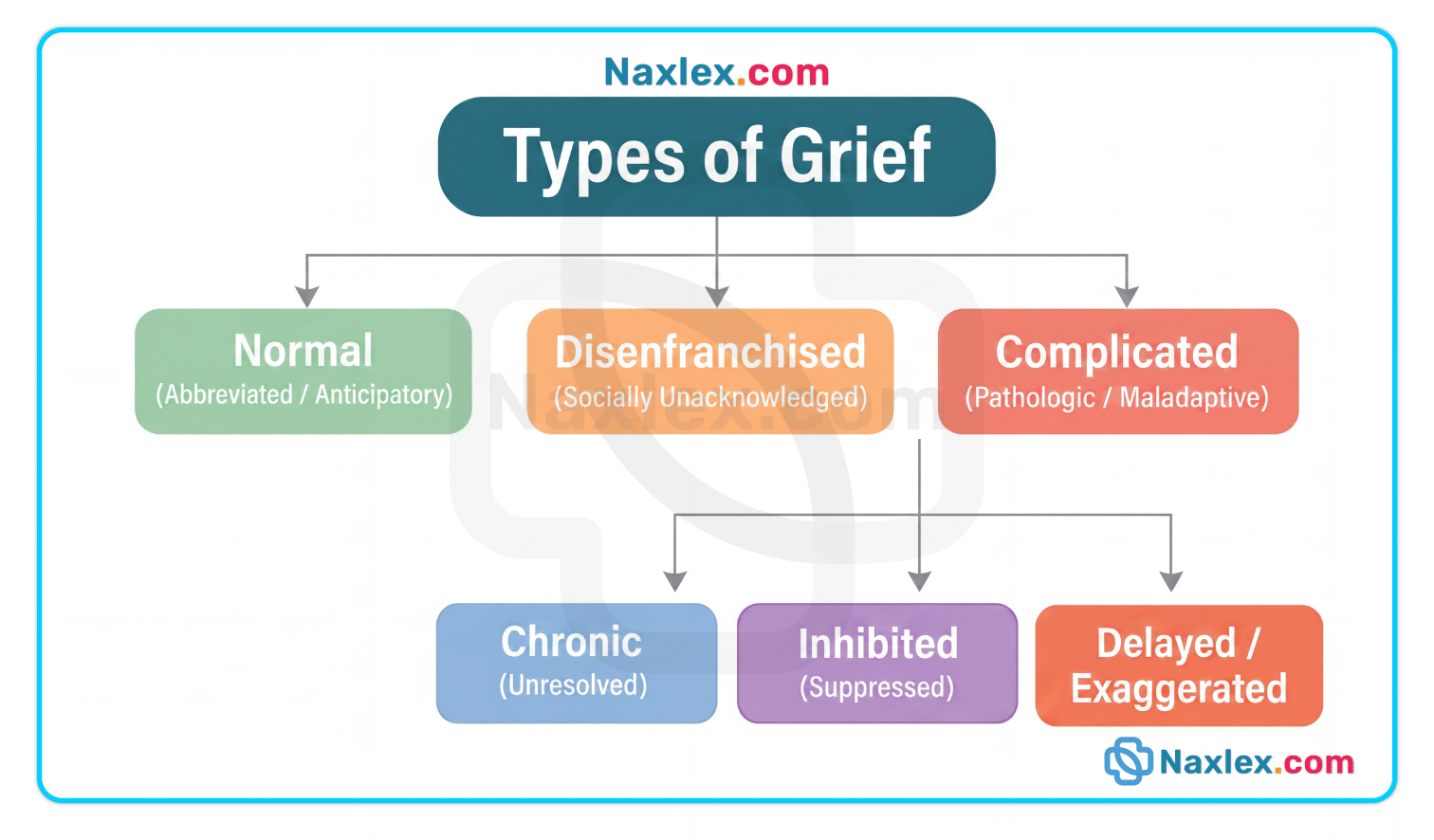
A. Normal grief responses
- Abbreviated Grief: Brief but genuine emotional response. Occurs when the lost item/person was not central, or was quickly replaced.
- Anticipatory Grief: Experienced prior to the actual loss (e.g., grieving an ailing spouse before death or grieving an upcoming surgery). It often shortens the grief reaction once the actual loss occurs.
-
B. Disenfranchised grief
Occurs when a loss cannot be publicly acknowledged, socially sanctioned, or openly discussed.
- Examples: Death by suicide, abortion, adoption loss, extramarital relationships, or unsanctioned romantic partnerships.
-
C. Complicated / Pathologic grief
Occurs when coping mechanisms are maladaptive, out of proportion, or breach cultural norms. Medical diagnosis: Persistent Complex Bereavement Disorder (preoccupation lasting > 6 months causing significant functional impairment).
- Unresolved / Chronic Grief: Extended length and severity; the individual may deny loss or struggle to express emotion.
- Inhibited Grief: Normal emotional symptoms are suppressed, manifesting instead as physical (somatic) illness.
- Delayed Grief: Emotional reaction is consciously or subconsciously delayed until a much later time.
- Exaggerated Grief: The survivor engages in dangerous or high-risk behaviors to numb or lessen the emotional pain.
-
Diagnostic indicators & Risk factors
Clinical indicators of complicated grief
Watch for these key behavioral and emotional red flags:
- Absence/Avoidance: Failure to grieve (e.g., missing a funeral), avoiding the grave site, or refusing participation in cultural memorial services.
- Fixation & searching: Persistent searching for the deceased, lingering guilt, low self-esteem, or suicidal ideation to affect a reunion.
- Somatic mimicry: Developing physical symptoms identical to those the deceased experienced prior to death.
- Emotional reactivity: Inability to speak of the deceased with composure after prolonged time, or severe grief triggered by minor events.
- Anniversary reactions: Recurrent physical or emotional distress strictly tied to holidays or loss anniversaries.
- Social decline: Deterioration of relationships with friends and family members.
-
Risk factors contributing to unresolved grief
Category
Risk Factors
Relationship Dynamics
• Ambivalence (mixed love/hate feelings toward deceased)
• Strained relationship prior to death
• Extremely high emotional dependence/value placed on deceased
Nature of Loss
• Sudden, traumatic, or unexpected death
• Uncertainty (e.g., Missing in Action)
• Multiple cumulative losses
Personal & Social Factors
• Perceived need to stay in control / fear of breaking down
• Lack of social or cultural support systems
• Cultural/family taboos against showing emotion
3.3 Stages of Grieving
While multiple theorists have defined stages or phases of grief, there is no single correct path or timetable. Integration of loss depends on an individual’s developmental level, personal makeup, and unique coping mechanisms
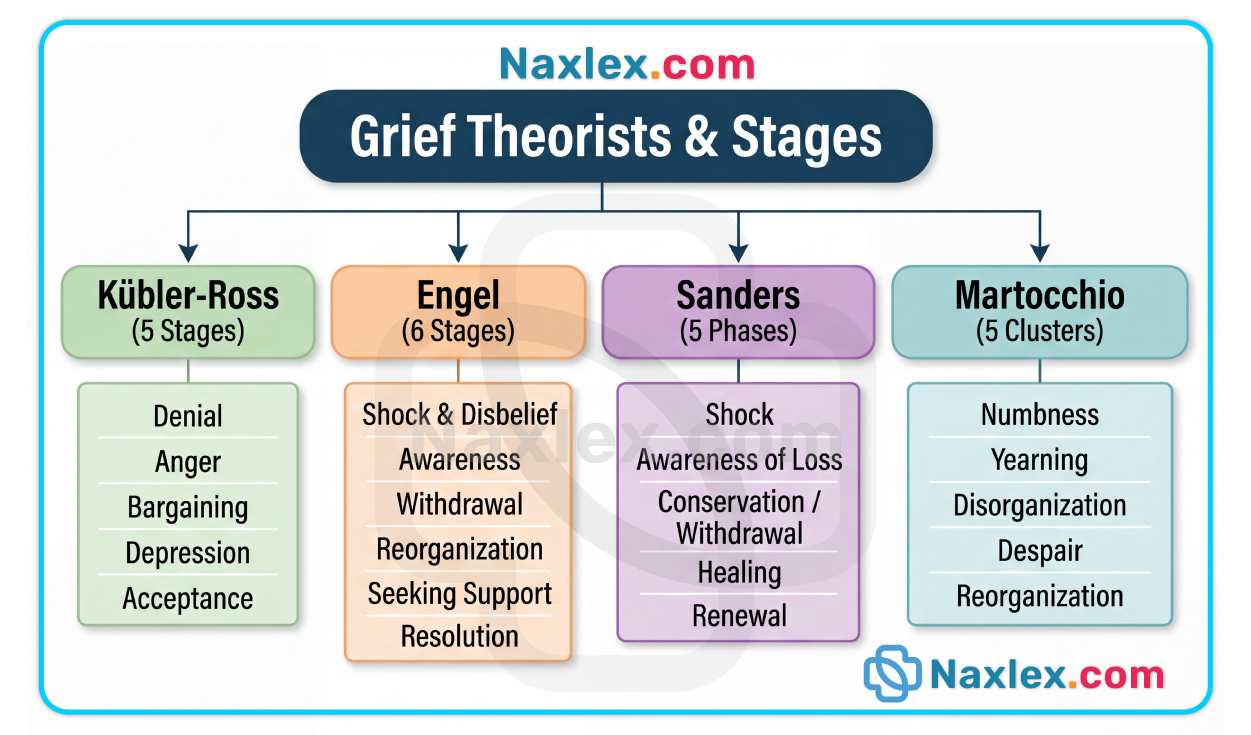
Key Frameworks
- Kübler-Ross (1969): Identifies 5 Stages: Denial, Anger, Bargaining, Depression, and Acceptance.
- Engel (1964): Identifies 6 Stages: Shock and disbelief, Developing awareness, Restitution, Resolving the loss, Idealization, and Outcome.
- Sanders (1998): Identifies 5 Phases: Shock, Awareness of loss, Conservation/withdrawal, Healing, and Renewal.
-
Core Clinical Principle: Individuals responding to the exact same loss will not follow identical patterns or schedules. Nurses must assess the client without expecting rigid progression through these phases.
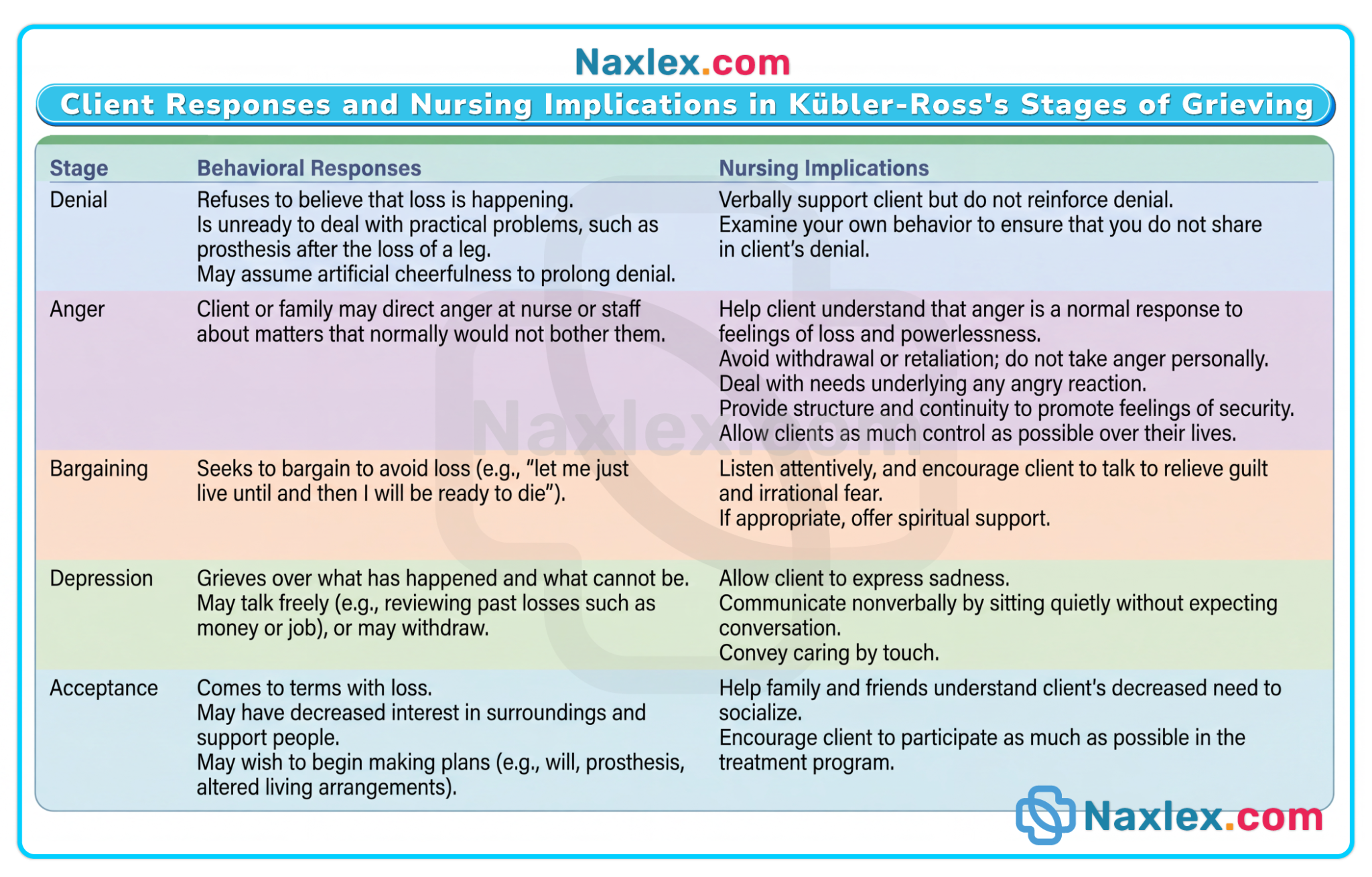
Manifestations of Grief & Assessment
The body responds to real or anticipated loss with a physiological stress reaction. Nurses must differentiate between expected grieving and complicated/maladaptive grief responses.
Assessment Category
Normal Manifestations
Complicated Grieving Indicators
Behavioral & Emotional
• Verbalization of the loss
• Crying
• Difficulty concentrating
• Extended period of denial
• Severe, non-resolving depression
• Suicidal ideation
Physiological
• Sleep disturbances
• Loss of appetite
• Baseline stress response
• Severe or persistent physiological symptoms
• Exaggerated somatic responses
Factors Influencing Loss & Grief Responses
Grief responses are shaped by a complex interplay of personal, social, and situational variables.
A. Age & Developmental Stage
- Childhood:
- Children experience grief as intensely as adults but process and understand death differently.
- Loss of a primary caregiver threatens emotional development and may cause regression.
- Nursing Consideration: Avoid pushing children aside or "protecting" them to the point of isolation; failing to support childhood grief can cause severe psychological effects later in life.
- Early & Middle Adulthood:
- Loss becomes a recognized part of normal development (e.g., losing an aging parent is an expected developmental task).
- Losses may also stem from impaired health, reduced body function, or loss of role functions.
- Late Adulthood:
- Losses accumulate (health, mobility, independence, income, housing, and longtime spouses).
- Spousal death significantly increases health risks and mortality for widows and widowers.
- Older adults may fear loss of control or becoming a burden more than death itself.
- Nursing Consideration: Older clients may lack peer support networks due to deaths among their age group; nurses may need to help fill this emotional gap.
-
B. Significance of the Loss
Perception determines impact. Significance is dictated by:
- Importance of the lost person, object, or role.
- Degree of lifestyle change required by the loss.
- Values and beliefs of the individual.
-
C. Cultural & Kinship Factors
- Nuclear vs. Extended Families: In nuclear family structures, a member's death leaves major unfilled role voids. In extended family households, role transitions are often absorbed faster by living relatives.
- Expression Norms: Cultural norms dictate whether grief is expressed publicly (e.g., wailing, prostration) or kept private/stoic ("being strong").
-
D. Gender Socialization
- Cultural gender expectations influence emotional expression (e.g., men are often expected to repress grief and act as the strong caregiver, while crying is socially acceptable for women).
- Gender impacts body image perceptions (e.g., a facial scar might be viewed as a disfiguring loss by one individual, but acceptable or "macho" by another).
-
E. Additional Factors
Factor
Primary Impact on Grief
Spiritual Beliefs
Religious rituals and beliefs surrounding death provide comfort; nurses must understand and accommodate specific practices.
Socioeconomic Status
Financial security (pensions, insurance) provides choices and safety nets during loss, whereas economic hardship severely impairs coping ability.
Support Systems
Initial support may dissipate quickly as loved ones return to routines, leaving the grieving individual without long-term assistance.
Cause of Loss/Death
Preventable, illicit, or stigmatized deaths engender less societal compassion; unexpected or tragic deaths are harder to accept than anticipated or honorable ones (e.g., line-of-duty).
- Martocchio (1985): Identifies 5 Clusters: Shock and disbelief; Yearning and protest; Anguish, disorganization, and despair; Identification in bereavement; and Reorganization and restitution.
Nursing Management of Loss & Grief
5.1 Assessment
Nursing assessment of a client experiencing loss focuses on three primary components: Nursing History, Personal Coping Resources, and Physical Assessment.
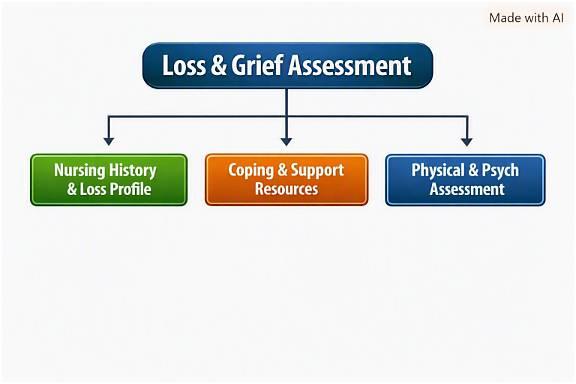
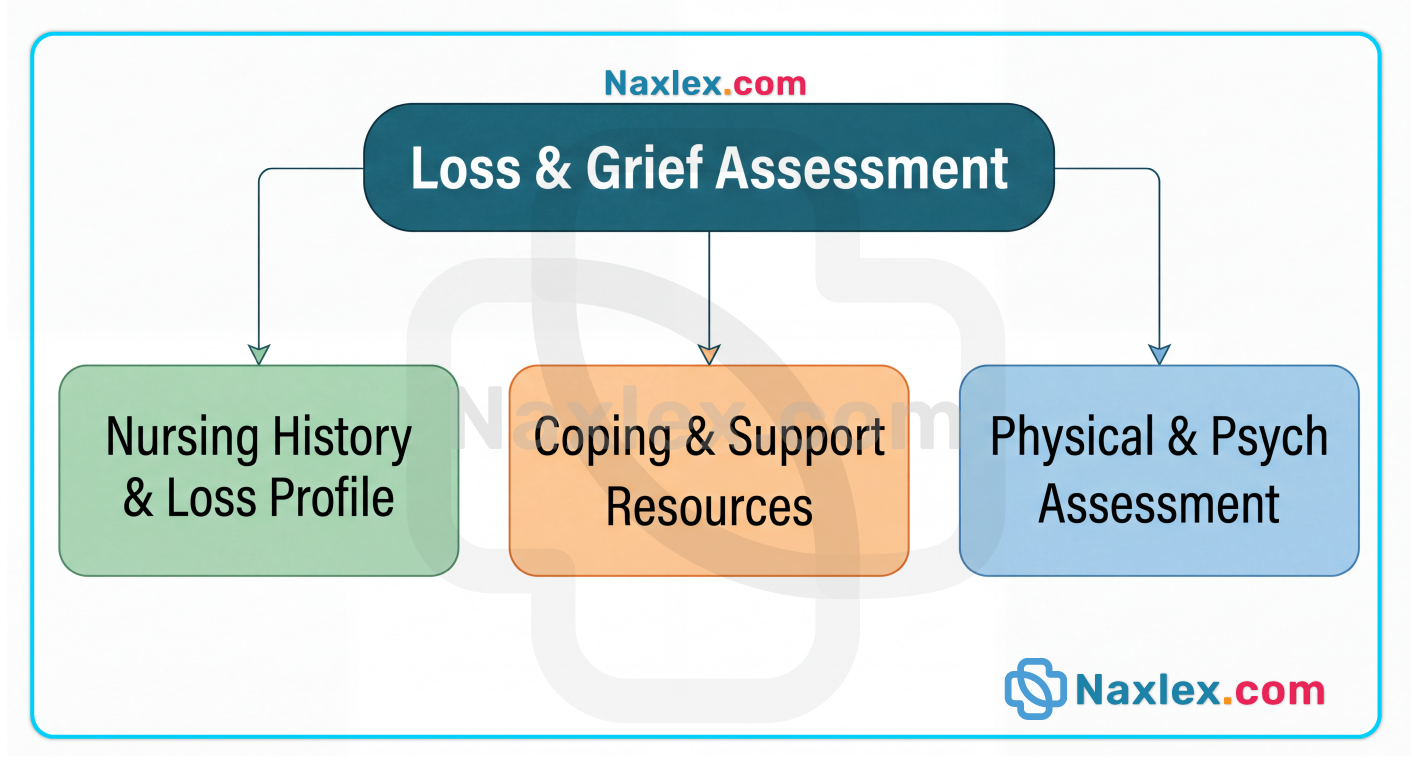
A. Nursing History
- Routine screening: Pose screening questions during health assessments to identify past, current, or anticipated losses (e.g., death of a loved one, job loss, relocation, reduced physical functioning).
- Exploring significance: Evaluate the nature of the loss and what it means to the client emotionally, socially, and functionally.
- Probing physical complaints: Identify loss-related stressors when clients present with somatic issues (trouble sleeping, appetite changes, lack of concentration), as they may not link physical ailments to grief.
B. Coping resources & Contextual factors
- General health & stressors: Review current health status and co-occurring personal stressors.
- Culture & spirituality: Identify traditions, rituals, and beliefs regarding loss and mourning.
- Support system: Identify available family, friends, and community networks.
C. Interview questions
|
Assessment Focus |
Sample Questions |
|
Past Losses & Coping |
• "What was losing like for you?" • "What did you do to feel better when that happened?" • "Whom did you turn to if you were very upset?" |
|
Current Loss Impact |
• "What changes do you think this [illness/loss] will cause in your life?" • "Are you having trouble sleeping, eating, concentrating, or breathing?" • "Are you taking any drugs or medications to help you cope?" |
|
Support & Needs |
• "What kind of help do you think you will need?" • "Are there people or organizations in your community that might be able to help?" |
D. Red flags & Referrals
- Complicated grief / severe symptoms: If assessment uncovers severe physical or psychological signs (or dysfunction that fails to follow normative expectations), refer the client to a specialist trained in grief counseling.
5.2 Nursing Diagnoses (NANDA-I)
Primary grief diagnoses
- Grieving: A normal, complex process involving emotional, physical, spiritual, social, and intellectual responses by which individuals/families incorporate an actual, anticipated, or perceived loss into daily life.
- Complicated Grieving / Risk for Complicated Grieving: A disorder occurring after the death of a significant other where distress and bereavement fail to follow normative expectations, resulting in functional impairment.
Secondary/Related Diagnoses
- Interrupted Family Processes: When loss negatively alters usual family roles and interactions.
- Risk-Prone Health Behavior: Difficulty placing the loss into appropriate perspective alongside other life activities.
- Risk for Loneliness: Related to the loss of relationships and social connections.
5.3 Planning & Goal Setting
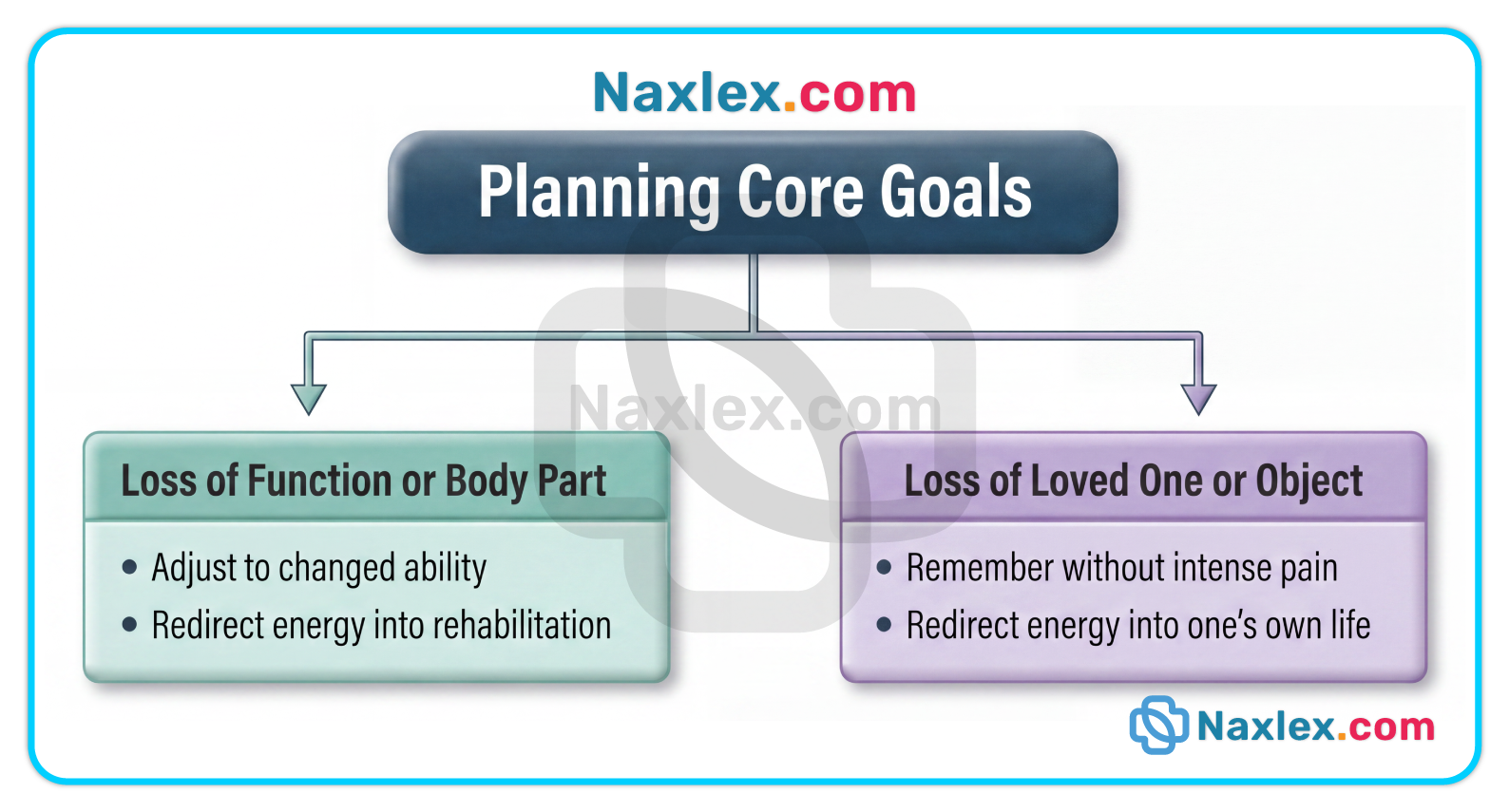
Planning for Home Care
- Reassessment: Continually reassess client abilities, support, and adaptation needs prior to discharge.
- Tailored Follow-Up: Base home care intensity on how the client and family have historically coped with loss.
5.4 Implementation
A. Communication Techniques
Therapeutic Communication Skills:
- Attentive listening
- Silence
- Open and closed questions
- Paraphrasing
- Clarifying and reflecting feelings
- Summarizing.
Non-Therapeutic (Avoid):
- Giving unsolicited advice/evaluation
- Interpreting/analyzing
- Offering unwarranted reassurance.
- Align with grief stage: Tailor communication to the client's current emotional state (e.g., anger vs. depression), keeping in mind that emotional states alter how messages are heard and interpreted.
B. Facilitating Grief Work
- Respect cultural & personal values: Honor diverse religious, ethnic, and personal expressions of grief.
- Provide psychoeducation: Reassure the client/family that labile emotions, guilt, anger, and sadness are normal and will generally stabilize over time.
- Encourage expression: Support the client in sharing feelings with their support system; advise families not to rush the client's grief trajectory.
- Support children: Maintain truthfulness and invite children to participate in family grieving activities at an age-appropriate level.
- Schedule activity resumption: Encourage a gradual return to normal routines. Watch for both premature returns (denial) and prolonged delays (potential complicated grief).
C. Emotional Support & Resources
- Presence & autonomy: Use silence and physical presence. Offer meaningful daily choices to help restore a sense of control.
- Support services: Refer clients to community resources, including clergy, support groups, and counseling.
- Key organizations:
- American Association of Retired Persons (AARP)
- Caring Connections
- Compassionate Friends (support for loss of a child)
- Grief Recovery Institute
5. Evaluation
Evaluating grief care is challenging due to the long-term, non-linear nature of loss transitions. Evaluation criteria must be aligned with individual goals established by the client and family.
Reassessment framework for unmet goals
If desired outcomes are not met, systematically investigate potential causes:
- Diagnostic accuracy: Do client behaviors point to dysfunctional/complicated grieving or a different nursing diagnosis?
- Timeline realism: Is the expected outcome timeline overly aggressive for this stage of grief?
- Unidentified stressors: Are there additional, unaddressed personal or social stressors interfering with grief resolution?
- Intervention consistency: Have nursing interventions been delivered consistently, compassionately, and genuinely?
Dying, Death, and Bereavement Care
5.1 Assessment
Nursing assessment of a client experiencing loss focuses on three primary components: Nursing History, Personal Coping Resources, and Physical Assessment.
A. Nursing History
- Routine screening: Pose screening questions during health assessments to identify past, current, or anticipated losses (e.g., death of a loved one, job loss, relocation, reduced physical functioning).
- Exploring significance: Evaluate the nature of the loss and what it means to the client emotionally, socially, and functionally.
- Probing physical complaints: Identify loss-related stressors when clients present with somatic issues (trouble sleeping, appetite changes, lack of concentration), as they may not link physical ailments to grief.
B. Coping resources & Contextual factors
- General health & stressors: Review current health status and co-occurring personal stressors.
- Culture & spirituality: Identify traditions, rituals, and beliefs regarding loss and mourning.
- Support system: Identify available family, friends, and community networks.
C. Interview questions
|
1. Developmental concepts & Responses to death
2. Psychosocial responses & Nursing diagnoses
SAFETY ALERT: Suicide rates increase after age 65 and are highest among White men over age 85.
3. Caregiver role strain & Self-care Caregiver stress
Healthcare professional strain
Self-Care & Barriers to care Nurses must examine their personal feelings toward death. Uncomfortable nurses may inadvertently impede client communication by:
4. Clinical definitions and indicators of death
Traditional heart-lung death:
World Medical Assembly guidelines (with artificial support):
Cerebral (Higher brain) death:
5. Religious and cultural variations in death practices Disclosure & Location preferences
Rituals & Care of the deceased
Specific Religious Stances
|
||||||||||||||||||||||||||||||||||||||||||||||||||||||||||||||||||||
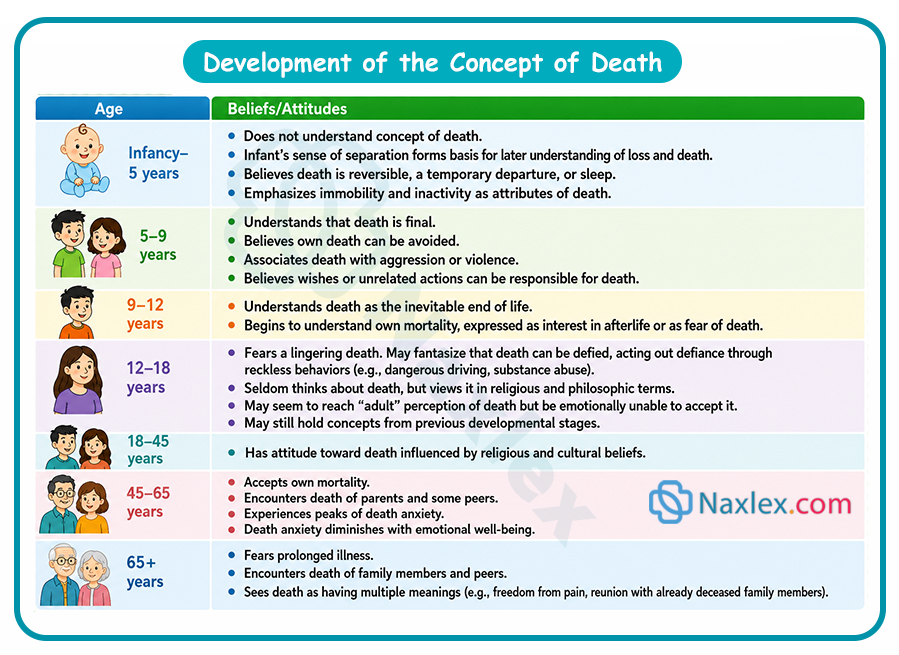
D. Red flags & Referrals
- Complicated grief / severe symptoms: If assessment uncovers severe physical or psychological signs (or dysfunction that fails to follow normative expectations), refer the client to a specialist trained in grief counseling.
5.2 Nursing Diagnoses (NANDA-I)
Primary grief diagnoses
- Grieving: A normal, complex process involving emotional, physical, spiritual, social, and intellectual responses by which individuals/families incorporate an actual, anticipated, or perceived loss into daily life.
- Complicated Grieving / Risk for Complicated Grieving: A disorder occurring after the death of a significant other where distress and bereavement fail to follow normative expectations, resulting in functional impairment.
Secondary/Related Diagnoses
- Interrupted Family Processes: When loss negatively alters usual family roles and interactions.
- Risk-Prone Health Behavior: Difficulty placing the loss into appropriate perspective alongside other life activities.
- Risk for Loneliness: Related to the loss of relationships and social connections.
5.3 Planning & Goal Setting
Planning for Home Care
- Reassessment: Continually reassess client abilities, support, and adaptation needs prior to discharge.
- Tailored Follow-Up: Base home care intensity on how the client and family have historically coped with loss.
5.4 Implementation
A. Communication Techniques
Therapeutic Communication Skills:
- Attentive listening
- Silence
- Open and closed questions
- Paraphrasing
- Clarifying and reflecting feelings
- Summarizing.
Non-Therapeutic (Avoid):
- Giving unsolicited advice/evaluation
- Interpreting/analyzing
- Offering unwarranted reassurance.
- Align with grief stage: Tailor communication to the client's current emotional state (e.g., anger vs. depression), keeping in mind that emotional states alter how messages are heard and interpreted.
B. Facilitating Grief Work
- Respect cultural & personal values: Honor diverse religious, ethnic, and personal expressions of grief.
- Provide psychoeducation: Reassure the client/family that labile emotions, guilt, anger, and sadness are normal and will generally stabilize over time.
- Encourage expression: Support the client in sharing feelings with their support system; advise families not to rush the client's grief trajectory.
- Support children: Maintain truthfulness and invite children to participate in family grieving activities at an age-appropriate level.
- Schedule activity resumption: Encourage a gradual return to normal routines. Watch for both premature returns (denial) and prolonged delays (potential complicated grief).
C. Emotional Support & Resources
- Presence & autonomy: Use silence and physical presence. Offer meaningful daily choices to help restore a sense of control.
- Support services: Refer clients to community resources, including clergy, support groups, and counseling.
- Key organizations:
- American Association of Retired Persons (AARP)
- Caring Connections
- Compassionate Friends (support for loss of a child)
- Grief Recovery Institute
5. Evaluation
Evaluating grief care is challenging due to the long-term, non-linear nature of loss transitions. Evaluation criteria must be aligned with individual goals established by the client and family.
Reassessment framework for unmet goals
If desired outcomes are not met, systematically investigate potential causes:
- Diagnostic accuracy: Do client behaviors point to dysfunctional/complicated grieving or a different nursing diagnosis?
- Timeline realism: Is the expected outcome timeline overly aggressive for this stage of grief?
- Unidentified stressors: Are there additional, unaddressed personal or social stressors interfering with grief resolution?
- Intervention consistency: Have nursing interventions been delivered consistently, compassionately, and genuinely?
Nursing Management of the Dying Client
Assessment & Awareness of death
States of awareness (Glaser & Strauss, 1965)
The shared awareness between the client, family, and healthcare team dictates open communication and grieving support:
- Closed awareness: The client is unaware of impending death.
- Causes: Family lacks understanding or believes recovery is possible; primary care provider chooses not to disclose diagnosis/prognosis.
- Nursing Impact: Frequently triggers ethical dilemmas regarding truth-telling versus non-maleficence.
- Mutual pretense: All parties (client, family, healthcare team) know the prognosis is terminal but choose not to discuss it explicitly.
- Purpose: Protects family from distress; avoids healthcare worker discomfort; maintains client privacy/dignity.
- Burden: Places an immense emotional strain on the client, who lacks a confidant.
- Open awareness: Everyone acknowledges and openly discusses the impending death.
- Benefits: Enables the client to finalize personal affairs, express preferences, and participate in funeral/end-of-life planning.
- Note: Not all individuals are comfortable with this approach.
Legal & Advance care planning instruments
- Advance health care directive: Mandated by federal law; records a client's general end-of-life care preferences regardless of current health status.
- Physician orders for life-sustaining treatment (POLST):
- Designed for individuals with serious, progressive, or chronic illnesses.
- Must be signed by both the client (or designated decision-maker) and the primary care provider.
- Translates patient preferences into actionable medical orders regarding resuscitation, medical interventions (comfort measures, IV meds, noninvasive airway support), and artificial nutrition.
- Remains with the client across care setting transfers.
Assessment of the Family
Conduct interviews to gauge expectations, past experiences, and coping mechanisms:
- Assess prior experiences with death and current understanding of what will happen.
- Identify preferred ways of saying goodbye and who needs to be contacted.
- Evaluate self-care practices and available support networks.
9.1 Clinical manifestations of Impending death
|
Category |
Physiological sign & Manifestation |
|
Loss of Muscle Tone |
• Facial muscle relaxation (e.g., sagging jaw) • Difficulty speaking and swallowing; gradual loss of gag reflex • Decreased GI motility (nausea, flatus accumulation, abdominal distention, fecal retention - exacerbated by narcotics/sedatives) • Urinary and rectal incontinence (decreased sphincter control) • Diminished voluntary body movement |
|
Slowing of Circulation |
• Diminished peripheral sensation • Mottling and cyanosis of extremities • Cold extremities (feet first, then hands, ears, nose; core may feel warm if febrile) • Slower, weaker pulse • Progressive decrease in blood pressure |
|
Changes in Respirations |
• Rapid, shallow, irregular, or abnormally slow breathing • "Death Rattle": Noisy breathing caused by mucus accumulation in the throat • Mouth breathing resulting in dry oral mucous membranes |
|
Sensory Impairment |
• Blurred vision and impaired taste/smell • Note: Hearing is widely considered the last sense lost. Consciousness varies (alert, drowsy, stuporous, or comatose). |
9.2 Nursing Diagnoses, Planning & The Dying Person's Bill of Rights
Common nursing diagnoses
- Client-Focused: Fear, Hopelessness, Powerlessness.
- Family/Caregiver-Focused: Risk for Caregiver Role Strain, Interrupted Family Processes.
Major planning goals
- Maintaining physiological and psychological comfort.
- Achieving a dignified, peaceful death (preserving personal control and accepting declining health status).
Core rights from The Dying Person’s Bill of Rights (Barbus, 1975)
- Right to be treated as a living human being until death and maintain a sense of hopefulness (even if its focus changes).
- Right to express emotions/feelings about death in one's own way.
- Right to participate in care decisions and expect continuing medical/nursing attention (shifting from cure to comfort).
- Right to be free from pain, not die alone, and have questions answered honestly without deception.
- Right to retain individuality without judgment and die in peace and dignity.
9.3 Implementation & Interventions
PALLIATIVE CARE
• Applicable at ANY stage of serious illness.
• Combined with curative / life-prolonging care.
• Focus: Relief of suffering, symptom control, holistic support.
WHO approach focused on preventing and relieving suffering through early identification, assessment, and treatment of pain, physical, psychosocial, and spiritual issues. Integrates psychological/spiritual care and facilitates cultural rituals. Can run alongside curative treatment (e.g., chemotherapy).
HOSPICE CARE
• Subset of palliative care for the TERMINALLY ILL.
• Eligibility: Certified prognosis of ≤ 6 months to live.
• Goal: Quality of life & peaceful death; non-curative.
Founded by Dr. Cicely Saunders (London, 1967). Holistic, team-based care for clients with a prognosis of 6 months or less. Common non-cancer primary diagnoses include debility, dementia, heart disease, and lung disease.
Home care considerations: Most individuals prefer dying at home, but availability of capable caregivers is the primary determining factor. Outpatient hospice conducts formal home/caregiver evaluations.
Therapeutic communication & emotional support
- Self-awareness: Identify personal fears and feelings regarding death to avoid imposing them on clients.
- Coping strategies: Recognize that clients utilize their baseline coping mechanisms (e.g., quiet clients become more reflective).
- Communication techniques:
- Describe observations: "You seem sad. Would you like to talk about what's happening?"
- Clarify concern: "I'd like to know better how you feel and how I may help."
- Acknowledge struggle: "It must be difficult... I would like to help you be more comfortable."
- Therapeutic touch: Holding a hand or providing a comforting massage to encourage verbalization.
- Honesty: Respond to direct questions about prognosis with directness and truthfulness.
Physiological & Spiritual management
- Pain control: Essential for quality of life. Administer prescribed analgesics (e.g., morphine).
- Route: Avoid SC or IM injections due to impaired peripheral circulation; use oral, sublingual, topical, IV, or rectal routes.
- Bowel Protocol: Always implement an aggressive bowel regimen for opioid-induced constipation.
- Spiritual support: Respect individual beliefs; facilitate access to clergy/chaplains, prayer, meditation, or religious reading without imposing personal religious views.
Family care & Caregiver guidance
- Education: Re-explain clinical progression repeatedly due to grief-induced cognitive overload.
- Participation: Encourage family participation in physical care (bathing, holding hands, reading) based on their comfort level - do not force involvement.
- "Permission to Let Go": When a client appears to be "holding on," facilitate a therapeutic interaction where family members give verbal permission for the client to pass peacefully.
9.4 Postmortem Care & Postmortem Changes
Postmortem Changes
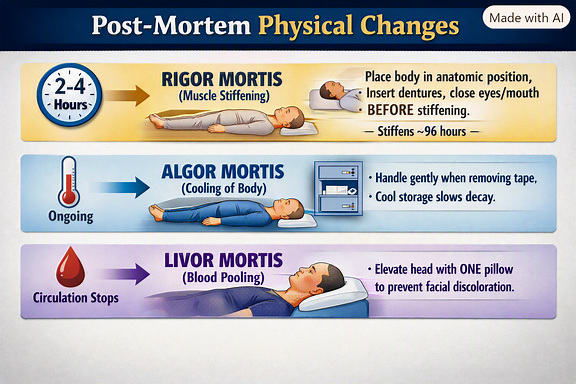
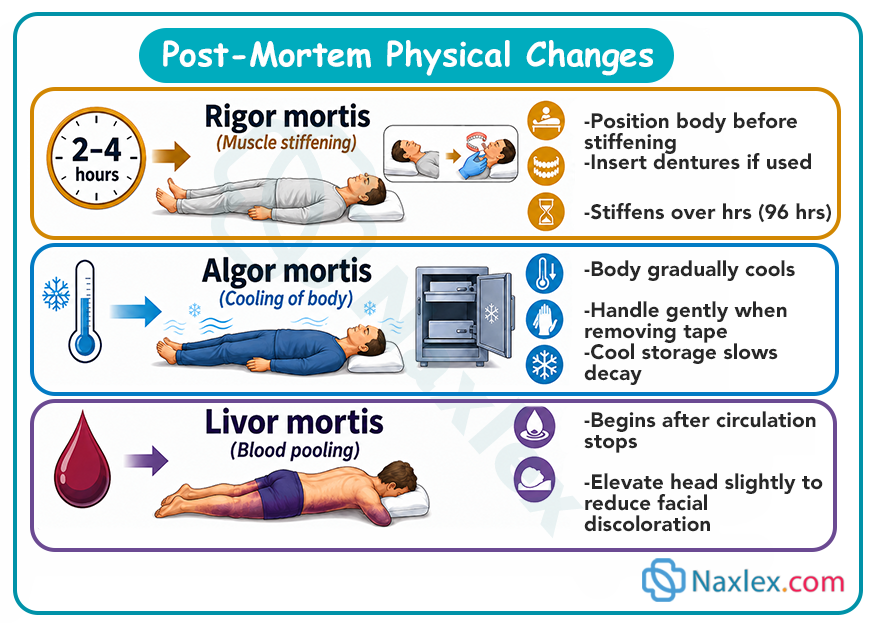
Postmortem nursing procedure
- Compliance: Verify religious/cultural practices regarding body handling.
- Positioning: Place body supine with head and shoulders elevated on one pillow (prevents facial discoloration from livor mortis). Arms placed at sides (palms down) or across the abdomen.
- Facial preparation: Insert dentures immediately to maintain natural facial contour. Close eyes and hold shut for a few seconds. Close the mouth.
- Hygiene & lines: Wash soiled areas (full bath performed by undertaker). Place absorbent pads under buttocks to catch involuntary sphincter release. Handle tubes according to agency protocol (leave in place, trim to 2.5 cm / 1 in., or remove entirely).
- Personal effects & environment: Clean the room, remove soiled linens/equipment. Remove jewelry except wedding bands (tape securely to finger if retained). Place clean gown, arrange hair, adjust top bed linen to shoulders, and arrange soft lighting/chairs for family viewing.
- Identification: Ensure wrist ID tag remains on. Apply additional ID tags to the outside of the shroud (body wrap) before transfer to the morgue.
Clinical warning: Mishandling or mislabeling a corpse causes extreme emotional distress to survivors and creates significant legal liabilities.
NURSING INSIGHT: Lifespan Considerations
Children
- Understanding of death varies by developmental stage; responses heavily mirror adult coping behaviors.
- Reprocessing grief: Children reprocess a past loss as they achieve higher cognitive and emotional milestones (e.g., a child who lost a parent at preschool age will re-experience grief upon reaching adolescence). Parents losing a child experience similar secondary grief milestones as the child would have reached major life events.
Older Adults
- Life review: Older adults need confirmation that their lives had meaning and value.
- Intervention: Encourage life review activities, such as making audio/video recordings of life stories for children and grandchildren. This fosters a sense of worth and eases family communication.
- Caregiver support: Educate family caregivers continuously on safe transfer techniques, feeding methods during dysphagia, alternative communication, nonpharmacological pain strategies, and specific indicators for when to call for help.
9.5 Evaluation
Evaluate intervention success by monitoring:
- Client's reported sense of control over environment (pain management, visitor timing, care decisions).
- Quality of client's interactions and relationships with significant others.
- Client's verbalized thoughts regarding dignity, powerlessness, or fear.
Summary
- Nurses help clients deal with many losses, including loss of body image, a loved one, a sense of well-being, or a job.
- Loss, especially loss of a loved one or a valued body part, can be viewed as either a situational or a developmental loss and as either an actual or a perceived loss (both of which can be anticipatory).
- Grieving is a normal, subjective emotional response to loss; it is essential for mental and physical health. Grieving allows the bereaved person to cope with loss gradually and to accept it as part of reality.
- Knowledge of different stages or phases of grieving and factors that influence the loss reaction can help the nurse understand the responses and needs of clients.
Naxlex
Videos
Login to View Video
Click here to loginTake Notes on The Experience of Loss, Death, and Grief
This filled cannot be empty
Join Naxlex Nursing for nursing questions & guides! Sign Up Now