






 Video Library


Please set your exam date
Self-concept
Study Questions
Practice Exercise 1
An adult client who has failed to satisfactorily resolve the developmental task of adolescence-identity versus role confusion-is most likely to demonstrate which behavior?
Explanation
Erikson's psychosocial stage of identity versus role confusion occurs during adolescence, where individuals integrate self-concept and core values. Unresolved resolution manifests as conformity, persistent directionlessness, or self-doubt during adulthood, often leading individuals to rely heavily on peer validation.
Rationale for correct answer:
D. Going along with the crowd in all activities is the correct response. Failure to establish a firm personal identity leads an individual to rely on peer group values and behaviors rather than internal principles. Going along with the crowd reflects persistent role confusion, where self-concept is dictated entirely by external social validation rather than autonomous personal convictions.
Rationale for incorrect answers:
A. Asserting independence indicates successful resolution of the adolescent developmental crisis. Establishing an autonomous identity allows an individual to confidently state personal values and assert independence. This behavior demonstrates healthy psychosocial development rather than role confusion.
B. Being unable to express personal desires relates primarily to the resolution of earlier developmental stages, specifically autonomy versus shame and doubt or initiative versus guilt. Unresolved struggles in early childhood impede self-expression, whereas adolescent role confusion typically manifests as mimicking external expectations.
C. Having difficulty working as a member of a team aligns more closely with unresolved issues during the industry versus inferiority stage. Failure in school-age development hinders cooperative efforts and collaboration within structured groups, whereas identity issues affect personal self-definition and peer dependence.
Test-taking strategy
- Analyze the scenario and question: The client is an adult struggling with unresolved Eriksonian development from adolescence (identity versus role confusion). The question asks to identify the behavior most characteristic of this failure.
- Apply developmental theory (Erikson): Adolescence centers on forming a coherent self-concept. Successful resolution yields a clear identity; failure results in role confusion, dependence on group consensus, and inability to define personal goals.
- Rule out Choice 1 (Successful resolution): Asserting independence represents successful identity formation and self-governance.
- Rule out Choice 2 (Toddler/Early childhood task): Being unable to express personal desires relates to earlier stages like autonomy vs. shame and doubt.
- Rule out Choice 3 (School-age task): Having difficulty working as a member of a team stems from industry vs. inferiority.
- Select Choice 4 (Role confusion): Going along with the crowd in all activities directly reflects an absence of independent self-identity and high reliance on peer direction.
Take home points
- Identity versus role confusion focuses on establishing a clear sense of self, personal goals, and values during adolescence (ages 12–18).
- Unresolved role confusion in adulthood leads to excessive reliance on peer validation, lack of direction, and blind conformity.
- Successful identity formation fosters autonomy, self-confidence, and the capacity to assert personal boundaries without fear of peer rejection.
- Nursing assessment must differentiate adolescent identity conflicts from earlier childhood developmental failures involving autonomy or industry.
A nurse is participating in an annual performance review. Which statement by the nurse indicates the area of self-awareness?
Explanation
Self-awareness involves an accurate, objective recognition of one's own traits, behaviors, and performance by evaluating external feedback against personal reflection. Demonstrating self-awareness requires recognizing how personal actions align with verified external appraisals, such as client feedback reports, rather than relying solely on subjective self-assessments or absolute claims.
Rationale for correct answer:
C. This statement demonstrates self-awareness by comparing internal self-perception with objective, external feedback. Recognizing that client satisfaction reports validate personal behavior reflects a realistic, reflective evaluation of interpersonal performance during an annual review.
Rationale for incorrect answers:
A. "I rarely make any medication errors" reflects a basic statement of clinical tracking or self-reported performance rather than reflective insight. Stating medication error frequency lacks the reflective component necessary to assess deep self-awareness regarding clinical strengths, growth areas, or interpersonal dynamics.
B. "I am willing to mentor new nurses" indicates professional interest, leadership readiness, and organizational commitment. Expressing willingness to mentor peers demonstrates motivation to take on new role responsibilities, but it does not represent an evaluation of self-awareness regarding current performance traits.
D. "All of my clients have recovered quickly from their health problems" represents an unrealistic generalization and external outcome. Attributing rapid client recovery entirely to nursing care ignores complex pathophysiology, interprofessional contributions, and disease prognosis, reflecting a lack of objective, critical self-evaluation.
Test-taking strategy
- Analyze the scenario and question: A nurse is participating in a performance review. The question asks to identify the statement demonstrating self-awareness, which requires objective self-evaluation and integration of external feedback.
- Apply self-awareness and reflective practice principles: Self-awareness combines internal insight with external validation, avoiding absolute statements or unverified claims.
- Rule out Choice 1 (Simple self-report): States a clinical tracking metric without reflective personal evaluation.
- Rule out Choice 2 (Future role interest): Expresses leadership willingness rather than self-appraisal.
- Select Choice 3 (External validation & insight): Integrates objective external data with self-appraisal.
- Rule out Choice 4 (Unrealistic generalization): Makes an absolute, ungrounded claim regarding clinical outcomes.
Take home points
- Self-awareness involves evaluating personal strengths and limitations by correlating self-perception with objective feedback.
- Reflective nursing practice integrates client feedback reports to validate communication style and professional presence.
- Absolute claims regarding client outcomes or flawless performance reflect poor critical insight and unrealistic self-evaluation.
- Distinguishing self-awareness from leadership readiness requires identifying statements that evaluate existing traits rather than future tasks.
A nurse is assessing an adolescent client. Which of the following client statements indicates a high degree of self-esteem?
Explanation
A high degree of self-esteem in an adolescent is demonstrated through self-efficacy, problem-solving confidence, and resilience derived from past accomplishments. Believing in one's capability to overcome current challenges reflects an internal locus of control and a healthy self-concept.
Rationale for correct answer:
B. This statement demonstrates high self-esteem by drawing upon past successes to build self-efficacy and current coping confidence. Recognizing past problem-solving capability reflects an internal locus of control, emotional resilience, and positive self-worth.
Rationale for incorrect answers:
A. "I am so tired of failing" reflects chronic feelings of incompetence, defeat, and persistent frustration. Expressing exhaustion over repeated failure demonstrates low self-efficacy and a negative self-appraisal characteristic of low self-esteem. Verbalizing fatigue regarding repeated failure signals emotional distress and self-doubt.
C. "There’s no use in trying because nothing will change" indicates learned helplessness, fatalism, and passive resignation. Believing that personal effort produces no meaningful outcome reflects a complete lack of self-confidence and severe self-concept disruption. Expressing hopelessness regarding personal effort is a classic sign of low self-worth and potential depression.
D. "Why bother! Everything I do turns out wrong anyway" exemplifies global negative self-evaluation and cognitive distortion. Generalizing that all personal actions result in failure reflects internalized worthlessness and catastrophic thinking. Stating that all efforts yield negative outcomes confirms low self-esteem and poor coping capability.
Test-taking strategy
- Analyze the scenario and question: The nurse is assessing an adolescent client. The question asks to identify the statement indicating a high degree of self-esteem.
- Apply psychosocial assessment principles: High self-esteem is characterized by self-efficacy, positive self-talk, internal locus of control, and resilience; low self-esteem manifests as helplessness, hopelessness, and global self-criticism.
- Rule out Choice 1 (Defeat and failure): Reflects low self-worth and chronic defeat.
- Select Choice 2 (Resilience and self-efficacy): Demonstrates confidence based on past success.
- Rule out Choice 3 (Learned helplessness): Signals hopelessness and low self-esteem.
- Rule out Choice 4 (Global self-criticism): Demonstrates catastrophic negative self-talk.
Take home points
- High self-esteem in adolescents is characterized by self-efficacy, emotional resilience, and belief in problem-solving abilities.
- Statements reflecting learned helplessness, fatalism, or global self-criticism indicate low self-worth and poor coping mechanisms.
- Past achievements serve as the foundation for building self-confidence when tackling new developmental stressors.
- Assessing adolescent verbalizations for cognitive distortions helps identify clients requiring supportive counseling or cognitive reframing.
A client is asked to make a list of 20 words that describe self. After 15 minutes, the client lists: 25 years old, male, named, then declares they cannot think of anything else. The client has demonstrated which of the following?
Explanation
Self-knowledge represents the basic cognitive inventory of information an individual possesses regarding personal traits, beliefs, values, physical characteristics, and social roles. An inability to generate more than basic demographic descriptors (age, gender, name) demonstrates a significant deficiency in personal self-knowledge.
Rationale for correct answer:
B. The client can only state fundamental demographic facts and fails to identify personal values, character traits, strengths, or interests. Lacking descriptive personal information directly indicates an underdeveloped or deficient self-knowledge base.
Rationale for incorrect answers:
A. Demonstrating a lack of self-esteem relates to how an individual evaluates personal worth rather than the breadth of self-descriptors. While poor self-esteem can limit self-expression, failing to list personal descriptors specifically demonstrates an absence of self-information rather than an explicit negative self-evaluation.
C. Demonstrating an unrealistic self-expectation involves setting unachievable goals or holding perfectionist standards for personal performance. Listing basic demographic details reflects limited self-insight rather than setting excessive or unrealistic self-expectations.
D. Demonstrating an inability to evaluate self involves struggling to judge the quality or success of personal actions and behaviors. Failing to recall personal traits represents a deficit in retrieving self-descriptive knowledge rather than an inability to evaluate performance outcomes.
Test-taking strategy
- Analyze the scenario and question: The client is asked to list 20 self-descriptive words but stops after naming basic demographics (age, male, name). The question asks to identify the specific self-concept deficit.
- Apply components of self-concept: Differentiate between self-knowledge (data about oneself), self-esteem (feelings of worth), self-expectation (ideal self-goals), and self-evaluation (judgment of actions).
- Rule out Choice 1 (Affective evaluation): Demonstrating a lack of self-esteem pertains to feelings of personal worth rather than descriptive facts.
- Select Choice 2 (Cognitive inventory deficit): Deficient self-knowledge directly describes the inability to identify personal traits, capabilities, or values.
- Rule out Choice 3 (Goal-setting deficit): Demonstrating an unrealistic self-expectation involves setting unreachable personal standards.
- Rule out Choice 4 (Performance judgment deficit): Demonstrating an inability to evaluate self pertains to judging personal behaviors rather than knowing personal traits.
Take home points
- Self-knowledge includes the comprehensive cognitive inventory of personal traits, strengths, weaknesses, values, and social roles.
- Inability to describe oneself beyond basic demographic data indicates deficient self-knowledge or impaired self-awareness.
- Differentiating self-knowledge from self-esteem requires identifying whether the deficit involves data retrieval or affective self-worth.
- Nursing assessment of self-concept utilizes open-ended exploration to assist clients in expanding their self-knowledge base.
A client is able to list only three facts, traits, or qualities to describe self. When asked to list facts, traits, or qualities they would like to have, the client quickly lists 25, all characteristic of a successful person. When asked if they know anyone like this, the client replies, “My father.” This discrepancy between the client’s description of self as they are and as they would like to be indicates which of the following?
Explanation
The ideal self represents the qualities, values, and achievements an individual aspires to possess, whereas the real self reflects their current self-perception. A profound disparity between the real self and an idealized benchmark creates significant incongruence, directly precipitating low self-esteem and feelings of personal inadequacy.
Rationale for correct answer:
D. A significant discrepancy between the perceived real self (listing only three traits) and an idealized self-expectation (listing 25 idealized traits modeled after the father) demonstrates high self-incongruence. Experiencing a large gap between real and ideal self-perceptions directly generates feelings of worthlessness, self-dissatisfaction, and diminished self-esteem.
Rationale for incorrect answers:
A. Having a negative self-concept refers broadly to holding distorted, negative views across all dimensions of self-identity. While low self-worth contributes to self-concept disturbances, identifying a marked discrepancy between real and ideal selves specifically measures affective self-evaluation and self-worth deficits rather than a complete absence of positive self-knowledge.
B. Demonstrating modesty (lack of conceit) describes a socially acceptable downplaying of personal accomplishments. Failing to identify personal traits while idealizing another individual reflects internalized self-dissatisfaction and a perceived lack of personal worth rather than healthy humility.
C. Experiencing a body image disturbance involves holding an altered, negative, or distorted perception of physical appearance or bodily functioning. Comparing general character traits against an ideal standard pertains to overall identity and emotional self-appraisal rather than physical body structure or appearance.
Test-taking strategy
- Analyze the scenario and question: The client lists very few current personal traits (real self) but lists numerous idealized traits modeled after their father (ideal self). The question asks what this wide gap signifies.
- Apply self-concept theory (Carl Rogers): A large discrepancy between the real self (who one is) and the ideal self (who one wants to be) indicates incongruence, leading directly to low self-esteem.
- Rule out Choice 1 (Broad self-identity measure): Having a negative self-concept is a broad term, whereas the specific gap between real and ideal selves directly defines low self-esteem.
- Rule out Choice 2 (Social humility): Demonstrating modesty misinterprets self-worth deficits as healthy humility.
- Rule out Choice 3 (Physical self-perception): Experiencing a body image disturbance pertains strictly to physical self-perception.
- Select Choice 4 (Real vs. ideal discrepancy): Low self-esteem directly results from severe incongruence between the real self and an unreachable ideal self.
Take home points
- Low self-esteem arises when a large discrepancy exists between an individual's real self-perception and their ideal self-expectations.
- The ideal self is often influenced by parental models or unrealistic perfectionist standards.
- Incongruence between actual capabilities and idealized expectations fosters chronic feelings of failure and self-dissatisfaction.
- Nursing interventions focus on closing the real-ideal self gap by assisting clients to adopt realistic self-expectations and recognize existing strengths.
A client, age 36, entered the emergency department with severe burns and cuts on the face after an auto accident. Three weeks later, the client’s fiancé has not contacted her. The client states that he is busy and she is too tired to have visitors anyway. The client frequently lies with eyes closed and head turned away. These data suggest which of the following?
Explanation
Severe physical disfigurement combined with social withdrawal and rationalization indicates compound disruptions across multiple domains of self-concept. Disturbances in self-esteem and body image frequently co-occur following sudden traumatic facial injuries, manifesting as avoidance behaviors, defense mechanisms (rationalizing visitor absence), and physical turning away.
Rationale for correct answer:
D. Facial disfigurement threatens body image, while the fiancé's absence and the client's withdrawn posture (closing eyes, turning head away) reflect underlying feelings of rejection, embarrassment, and diminished self-worth. Demonstrating physical withdrawal and rationalization confirms multidimensional self-concept distress.
Rationale for incorrect answers:
A. Stating there is no disturbance in self-concept ignores significant clinical cues. Lies with eyes closed, turns head away, and rationalizes a partner's prolonged absence are classic behavioral indicators of severe psychosocial distress and altered self-concept following disfiguring trauma.
B. Claiming the client has ego strength and high self-esteem but may have a disturbance of body image misinterprets defensive rationalization as psychological resilience. Excusing the fiancé's absence and physically withdrawing reflects defensive coping and low self-worth rather than high ego strength.
C. Asserting that the area of self-esteem has very low priority at this time and should be ignored until much later violates holistic nursing principles. Psychosocial assessment and support must occur concurrently with physical healing, as unaddressed self-concept distress severely hinders overall recovery and rehabilitation.
Test-taking strategy
- Analyze the scenario and question: A client with facial burns and cuts rationalizes her fiancé's 3-week absence and demonstrates physical withdrawal (closing eyes, turning away). The question asks for the accurate assessment interpretation.
- Apply psychosocial assessment principles: Physical trauma to high-identity body parts (face) combined with emotional withdrawal and rationalization signals disruptions in both body image and self-esteem.
- Rule out Choice 1 (Ignoring symptoms): Misses explicit behavioral cues of withdrawal and distress.
- Rule out Choice 2 (Misinterpreting defenses): Misinterprets rationalization as high self-worth.
- Rule out Choice 3 (Delaying psychosocial care): Inappropriately defers essential psychosocial care.
- Select Choice 4 (Multidimensional disruption): Correctly identifies compound self-concept distress.
Take home points
- Traumatic facial injuries pose severe threats to both body image and overall self-esteem due to visible altered appearance.
- Behavioral cues like closing eyes, turning away from visitors, and rationalizing social abandonment signal profound self-concept disruption.
- Psychosocial nursing interventions must be integrated into early care rather than delayed, as emotional recovery directly influences physical healing.
- Effective assessment evaluates non-verbal behaviors and coping mechanisms to identify underlying feelings of rejection and worthlessness.
A client who is a high school sophomore has missed a lot of school this year because of leukemia. The client states feeling like they are falling behind in everything and misses “hanging out at the mall” with friends most of all. This data most likely suggests which nursing diagnosis?
Explanation
Chronic illness disrupts normal developmental tasks in adolescents, leading to social isolation and an inability to fulfill customary student and peer group expectations. Altered Role Performance occurs when an individual experiences difficulty, disruption, or insufficiency in meeting expected social, academic, or interpersonal roles due to health-related limitations.
Rationale for correct answer:
D. Missing significant school time and social activities directly impairs the adolescent's ability to fulfill standard expectations as a student and peer. Expressing distress over falling behind in school and missing social activities validates a disruption in functional role execution during a critical developmental phase.
Rationale for incorrect answers:
A. Personal Identity Disturbance involves a fundamental inability to distinguish or maintain an integrated perception of self. Missing school and peer social events reflects external disruption of functional life routines rather than a complete collapse of personal self-definition or internal identity.
B. Body Image Disturbance centers on a negative, distorted, or altered perception of one's physical appearance or bodily function. Verbalizing frustration about academic and social delays involves no expressed dissatisfaction or distress regarding physical appearance or bodily changes caused by leukemia.
C. Self-Esteem Disturbance involves an explicit negative self-evaluation and pervasive feelings of worthlessness or personal inadequacy. Feeling behind in school work and missing friends reflects situational frustration with missing normal life activities rather than internalized self-dislike or feeling inadequate as a person.
Test-taking strategy
- Analyze the scenario and question: The client is an adolescent missing school and peer activities due to leukemia treatments. The question asks for the most accurate nursing diagnosis for this situational disruption.
- Differentiate self-concept diagnoses: Match the client's explicit statements (falling behind, missing friends) to functional role deficits rather than core identity collapse, body image changes, or low self-worth.
- Rule out Choice 1 (Core identity crisis): Personal Identity Disturbance pertains to a loss of internal self-definition.
- Rule out Choice 2 (Physical self-perception): Body Image Disturbance relates strictly to physical appearance or bodily changes.
- Rule out Choice 3 (Self-worth evaluation): Self-Esteem Disturbance involves negative self-appraisal and feelings of worthlessness.
- Select Choice 4 (Social/academic disruption): Altered Role Performance directly captures the inability to fulfill standard student and peer roles due to chronic illness.
Take home points
- Altered Role Performance occurs when health conditions prevent an individual from fulfilling social, familial, academic, or vocational expectations.
- Adolescents face unique role performance threats when chronic illness disrupts school attendance and peer group socialization.
- Distinguishing role performance alterations from self-esteem issues requires evaluating whether distress stems from situational limitations or self-dislike.
- Nursing interventions for ill adolescents focus on maintaining academic continuity and facilitating peer connections during hospitalizations.
A nurse is assessing a client’s self-esteem. Which of the following are indicators that a person has a high degree of self-esteem? Select all that apply
Explanation
High self-esteem reflects a positive self-evaluation, confidence in decision-making, and an assertive, composed physical and verbal presence. Individuals with strong self-worth demonstrate open body posture, clear communication, and the capacity to make autonomous choices without excessive self-doubt or defensiveness.
Rationale for correct answers:
A. Appropriate decision-making skills indicate high self-esteem. Confidence in personal knowledge and judgment allows individuals to evaluate options, solve problems autonomously, and accept accountability. Demonstrating effective decision-making skills reflects self-efficacy and trust in one's cognitive capabilities.
B. Assertive communication is a key indicator of high self-esteem. Assertiveness allows individuals to express needs, opinions, and boundaries clearly and respectfully without resorting to aggression or passive submission. Utilizing assertive communication techniques confirms a balanced sense of personal worth and respect for others.
D. Erect posture represents physical non-verbal alignment with high self-esteem. Open, upright body posture communicates confidence, self-assurance, and comfort within social environments. Maintaining an erect posture correlates strongly with positive self-concept and emotional security.
Rationale for incorrect answers:
C. Disheveled clothing indicates self-neglect, severe depression, situational crisis, or low self-esteem. Individuals with low self-worth frequently lack motivation or interest in personal grooming. Wearing disheveled clothing reflects poor self-regard or impaired ability to execute personal care routines.
E. Intrusive staring reflects aggressive, dominant, or boundary-violating behavior rather than high self-esteem. Healthy self-esteem is demonstrated by balanced, natural eye contact. Engaging in intrusive staring signals interpersonal hostility, social anxiety compensation, or poor boundary recognition.
F. Mumbling, hesitant speech is characteristic of low self-esteem, extreme self-doubt, or heightened social anxiety. Inability to speak clearly and confidently stems from fear of judgment or rejection. Exhibiting mumbling speech patterns reflects a lack of confidence and feeling inadequate.
Test-taking strategy
- Analyze the scenario and question: The nurse is assessing a client's self-esteem. The question asks to select all indicators associated with a high degree of self-esteem.
- Apply self-concept and physical assessment principles: High self-esteem manifests as confidence, assertive self-expression, erect body posture, and autonomous decision-making.
- Select Choice 1 (Cognitive indicator): Appropriate decision-making skills demonstrate self-efficacy and confidence in judgment.
- Select Choice 2 (Verbal indicator): Assertive communication reflects healthy self-worth and clear boundary setting.
- Rule out Choice 3 (Neglect indicator): Disheveled clothing aligns with low self-regard or depression.
- Select Choice 4 (Non-verbal indicator): Erect posture signals physical openness and social confidence.
- Rule out Choice 5 (Aggressive behavior): Intrusive staring represents hostile or boundary-violating interaction.
- Rule out Choice 6 (Low confidence indicator): Mumbling, hesitant speech indicates anxiety and low self-esteem.
Take home points
- High self-esteem manifests through assertive communication, erect posture, and effective decision-making abilities.
- Non-verbal behaviors like direct (non-intrusive) eye contact and erect stance indicate emotional security and positive self-concept.
- Mumbling speech, disheveled appearance, and hesitant responses are hallmark signs of low self-esteem or self-doubt.
- Intrusive staring reflects interpersonal aggression or poor boundary recognition rather than healthy self-worth.
Practice Exercise 2
A nursing student is juggling the responsibilities of work, school, and family. They are most likely to experience which of the following?
Explanation
Role conflict occurs when competing demands from multiple separate roles, such as occupational, academic, and domestic responsibilities, create incompatible expectations. Individuals experience significant psychosocial stress when fulfilling expectations of one role hinders success in another. Interrole friction impairs coping mechanisms and elevates stress levels.
Rationale for correct answer:
C. Role conflict occurs when a student experiences competing expectations across multiple distinct positions. Fulfilling the obligations of work, school, and family simultaneously creates opposing demands. Time constraints and incompatible responsibilities lead to acute stress. Fulfilling the requirements of one role directly interferes with meeting the expectations of another.
Rationale for incorrect answers:
A. Role ambiguity arises when an individual lacks clarity regarding the specific expectations or boundaries of a position. Unclear job descriptions or vague performance metrics typically trigger this experience. The nursing student faces well-defined expectations across all domains rather than unclear expectations. The primary issue stems from conflicting role demands rather than a lack of role definition.
B. Role strain develops when an individual experiences stress or difficulty meeting the conflicting demands within a single role. A nursing student overwhelmed solely by clinical coursework, exams, and skills lab practice exhibits role strain. The student in the scenario experiences friction originating from separate external positions rather than within a single role. Interrole friction is classified as role conflict rather than intrarole strain.
D. Role enhancement refers to the positive psychological outcome or expansion of personal identity gained through managing multiple positions. Fulfilling diverse responsibilities can boost self-esteem and foster social connectivity. The student in the scenario experiences acute stress from competing demands rather than identity growth. Managing opposing obligations leads to distress rather than enhancement.
Test-taking strategy
- Analyze the scenario and question: The client is a nursing student managing work, school, and family responsibilities. The question asks for the specific sociological stressor the student is most likely experiencing.
- Apply role theory concepts: Differentiate between intrarole tension, interrole tension, unformed expectations, and positive identity expansion.
- Rule out Choice 1 (Role ambiguity): Lacks clarity in job expectations; the scenario describes clear but competing obligations.
- Rule out Choice 2 (Role strain): Involves difficulty managing stress within a single role, not across separate domains.
- Select Choice 3 (Role conflict): Occurs when expectations from multiple distinct roles conflict directly with one another.
- Rule out Choice 4 (Role enhancement): Represents positive growth and psychological satisfaction from holding multiple positions, which contradicts the stressful juggle described.
Take home points
- Sealed internal radiation therapy (brachytherapy) emits gamma rays, but bodily fluids, waste, and bed linens are not radioactive.
- Radiation protection protocols mandate strict adherence to time (30 minutes per visitor daily), distance (6 feet away), and shielding.
- Lead-lined containers and long-handled forceps must remain in the patient room at all times in case of accidental implant dislodgement.
- Dislodged radioactive sources must never be touched directly with hands; they must be manipulated only with long-handled forceps.
A nursing student is juggling the responsibilities of work, school, and family. They are most likely to experience which of the following?
Explanation
Role conflict occurs when competing demands from multiple separate roles, such as occupational, academic, and domestic responsibilities, create incompatible expectations. Individuals experience significant psychosocial stress when fulfilling expectations of one role hinders success in another. Interrole friction impairs coping mechanisms and elevates stress levels.
Rationale for correct answer:
C. Role conflict occurs when a student experiences competing expectations across multiple distinct positions. Fulfilling the obligations of work, school, and family simultaneously creates opposing demands. Time constraints and incompatible responsibilities lead to acute stress. Fulfilling the requirements of one role directly interferes with meeting the expectations of another.
Rationale for incorrect answers:
A. Role ambiguity arises when an individual lacks clarity regarding the specific expectations or boundaries of a position. Unclear job descriptions or vague performance metrics typically trigger this experience. The nursing student faces well-defined expectations across all domains rather than unclear expectations. The primary issue stems from conflicting role demands rather than a lack of role definition.
B. Role strain develops when an individual experiences stress or difficulty meeting the conflicting demands within a single role. A nursing student overwhelmed solely by clinical coursework, exams, and skills lab practice exhibits role strain. The student in the scenario experiences friction originating from separate external positions rather than within a single role. Interrole friction is classified as role conflict rather than intrarole strain.
D. Role enhancement refers to the positive psychological outcome or expansion of personal identity gained through managing multiple positions. Fulfilling diverse responsibilities can boost self-esteem and foster social connectivity. The student in the scenario experiences acute stress from competing demands rather than identity growth. Managing opposing obligations leads to distress rather than enhancement.
Test-taking strategy
- Analyze the scenario and question: The client is a nursing student managing work, school, and family responsibilities. The question asks for the specific sociological stressor the student is most likely experiencing.
- Apply role theory concepts: Differentiate between intrarole tension, interrole tension, unformed expectations, and positive identity expansion.
- Rule out Choice 1 (Role ambiguity): Lacks clarity in job expectations; the scenario describes clear but competing obligations.
- Rule out Choice 2 (Role strain): Involves difficulty managing stress within a single role, not across separate domains.
- Select Choice 3 (Role conflict): Occurs when expectations from multiple distinct roles conflict directly with one another.
- Rule out Choice 4 (Role enhancement): Represents positive growth and psychological satisfaction from holding multiple positions, which contradicts the stressful juggle described.
Take home points
- Sealed internal radiation therapy (brachytherapy) emits gamma rays, but bodily fluids, waste, and bed linens are not radioactive.
- Radiation protection protocols mandate strict adherence to time (30 minutes per visitor daily), distance (6 feet away), and shielding.
- Lead-lined containers and long-handled forceps must remain in the patient room at all times in case of accidental implant dislodgement.
- Dislodged radioactive sources must never be touched directly with hands; they must be manipulated only with long-handled forceps.
A nurse recognizes that self-concept may vary according to a variety of conditions affecting the individual. Even appropriate nursing interventions are least likely to alter which of the following?
Explanation
The core self-concept consists of deeply ingrained beliefs, values, and self-perceptions formed early in life that remain stable across time. While nursing interventions effectively modify immediate self-knowledge, social interactions, and coping resources, the central core self-identity remains highly resistant to rapid or short-term change.
Rationale for correct answer:
C. Core self-concept is the structure least likely to be altered by nursing interventions. The core self-concept represents the foundational, persistent sense of self that develops over a lifetime. Because it is deeply rooted in an individual's baseline personality, altering the core self-concept requires prolonged, intensive therapeutic effort rather than brief nursing care.
Rationale for incorrect answers:
A. Resources are readily modified through comprehensive nursing care plans. Nurses directly alter internal and external support by connecting clients with community services, educational materials, and healthcare networks. Enhancing access to social and material resources is a standard and easily achievable nursing outcome.
B. Self-knowledge is highly amenable to nursing educational interventions. Providing structured health teaching, self-assessment guidance, and feedback directly expands a client's awareness of personal health needs. Increasing client functional self-knowledge represents a primary goal of nursing care.
D. Social self changes dynamically in response to supportive nursing strategies. Guided interpersonal interactions, communication training, and family involvement directly modify how a client relates to others. Enhancing social self-performance is a responsive target of therapeutic nursing care.
Test-taking strategy
- Analyze the scenario and question: The question asks to identify the aspect of self-concept that nursing interventions are least likely to alter, indicating a structure resistant to short-term change.
- Differentiate self-concept components: Core self-concept is stable and foundational, whereas self-knowledge, social interaction, and resources are adaptable and fluid.
- Rule out Choice 1 (Modifiable factor): Resources are easily provided, accessed, or expanded through nursing referrals.
- Rule out Choice 2 (Modifiable factor): Self-knowledge is directly increased through health teaching and client education.
- Select Choice 3 (Stable foundational structure): Core self-concept is deeply internalized and resistant to rapid external intervention.
- Rule out Choice 4 (Modifiable factor): Social self responds readily to interpersonal support and role adaptations.
Take home points
- Core self-concept is the deeply ingrained, central belief system regarding self-identity that resists rapid external modification.
- Nursing interventions rapidly influence self-knowledge through health teaching and education.
- Social self and role performance adapt dynamically to supportive interpersonal interventions and environmental adjustments.
- Client resources are directly expandable through nursing advocacy, care coordination, and community referrals.
A student nurse has clinical scheduled at the same time as his child’s parent-teacher conference. Which of the following is the student nurse experiencing?
Explanation
Role conflict occurs when an individual simultaneously occupies two or more social or professional roles that demand opposing or incompatible expectations. When time commitments or expectations between separate roles-such as being a nursing student and a parent-compete directly, the individual experiences inter-role conflict.
Rationale for correct answer:
- Role conflict is the correct response. The student nurse simultaneously occupies the distinct roles of student and parent. Having clinical scheduled at the exact same time as a parent-teacher conference creates competing role expectations that cannot be satisfied at the same time.
Rationale for incorrect answers:
- Body image disturbance involves a negative, distorted, or altered perception of one's physical appearance, structure, or function. Experiencing schedule overlap between personal and educational duties involves no physical self-concept disruption.
- Person-role conflict arises when an assigned role requires behaviors that violate an individual's internal values, moral standards, or personal beliefs. Managing conflicting schedule commitments reflects competing external demands rather than a fundamental clash with personal ethics.
- Role overload occurs when an individual is assigned more expectations or tasks within roles than can be reasonably accomplished within a given timeframe, leading to feeling overwhelmed. Experiencing a specific time collision between two distinct events exemplifies direct role conflict rather than general volume overload.
Test-taking strategy
- Analyze the scenario and question: The student nurse faces two events scheduled at the exact same time arising from two different roles (student vs. parent). The question asks to identify the specific type of role disruption.
- Apply psychosocial role theory: Differentiate between competing roles (role conflict), excessive role demands (role overload), value mismatches (person-role conflict), and body perception issues (body image disturbance).
- Rule out Choice 1 (Physical self-concept): Body image disturbance pertains to physical self-perception.
- Rule out Choice 2 (Ethical/value mismatch): Person-role conflict involves performing tasks that clash with personal values.
- Select Choice 3 (Competing external roles): Role conflict accurately describes the direct schedule clash between parent and student duties.
- Rule out Choice 4 (Excessive task volume): Role overload refers to having too many tasks rather than mutually exclusive schedule commitments.
Take home points
- Role conflict happens when two or more occupied roles demand mutually exclusive actions or conflicting time commitments.
- Person-role conflict occurs when role expectations violate an individual's personal morals, values, or beliefs.
- Role overload results from having too many responsibilities across roles to manage effectively, causing severe stress.
- Identifying specific role stressors enables nurses and students to implement targeted time-management and problem-solving strategies.
A nurse is identifying client strengths that may be used in health promotion. Which of the following are considered client strengths?
Explanation
Client strengths represent internal capabilities, positive health behaviors, psychological resilience, and resources that foster wellness and self-efficacy. Demonstrating the ability to perform self-care serves as a foundational strength for health promotion, enabling individuals to adopt healthy behaviors and maintain personal autonomy.
Rationale for correct answer:
- Ability to perform self-care is a major client strength. Possessing the physical, cognitive, and functional capacity to carry out activities of daily living supports health maintenance and self-management. Performing self-care independently enhances self-efficacy and provides a strong foundation for health promotion activities.
Rationale for incorrect answers:
- History of multiple job changes typically indicates career instability, financial insecurity, or difficulty maintaining interpersonal relationships. While diverse experience can occasionally reflect adaptability, a pattern of frequent job changes generally represents a potential stressor or social determinant challenge rather than an established health strength.
- Relying on others for assistance with activities of daily living reflects functional dependency or physical limitations. While accepting support when needed is an adaptive coping mechanism, depending on others for basic daily care indicates a vulnerability or care deficit rather than an intrinsic client strength.
- Role overload is a significant psychosocial stressor characterized by excessive demands and responsibilities. Experiencing overwhelming role expectations leads to anxiety, chronic fatigue, and burnout. Facing role overload acts as a barrier to health promotion rather than a supportive client strength.
Test-taking strategy
- Analyze the scenario and question: The nurse is identifying client strengths to use in a health promotion plan. The question asks to select the item that represents a true client strength.
- Apply health promotion and self-care principles: Strengths are internal capacities, autonomous skills, or positive resources that facilitate wellness, whereas dependencies, instability, and overload are barriers or risk factors.
- Select Choice 1 (Functional autonomy): Ability to perform self-care represents independence, self-efficacy, and functional capacity.
- Rule out Choice 2 (Employment instability): History of multiple job changes reflects social instability or potential chronic stress.
- Rule out Choice 3 (Functional dependence): Relying on others for assistance with activities of daily living indicates physical or cognitive limitation.
- Rule out Choice 4 (Psychosocial stressor): Role overload is a known risk factor for burnout and impaired health maintenance.
Take home points
- Ability to perform self-care is a primary client strength that fosters autonomy, self-efficacy, and engagement in health promotion.
- Strengths include internal coping skills, functional independence, supportive social networks, and positive health beliefs.
- Role overload, functional dependency, and employment instability are psychosocial stressors or barriers to wellness.
- Incorporating client strengths into nursing care plans enhances motivation, adherence, and long-term health outcomes.
A nurse is assessing factors that influence the development of an adolescent’s body image. Which of the following is most influential?
Explanation
Adolescence is defined by Erikson's developmental stage of identity versus role confusion, during which the focus shifts away from parental influence toward socialization with peers. Consequently, peer approval becomes the primary factor shaping an adolescent's body image, self-esteem, and physical self-perception.
Rationale for correct answer:
- Peer approval is the most influential factor in adolescent body image development. During adolescence, individuals seek acceptance within social groups and evaluate physical appearance against peer standards. Receiving peer validation strongly drives physical self-appraisal and identity formation during this developmental period.
Rationale for incorrect answers:
- Life experiences shape overall self-concept and worldview over time. However, cumulative life history lacks the specific, immediate intensity that peer dynamics exert on adolescent physical self-perception. Reflecting on general life experiences is less influential than current social group feedback.
- Parental feedback strongly governs self-worth during early and middle childhood. As adolescents transition toward independence, the relative impact of parental opinion declines sharply compared to social group acceptance. Relying on parental feedback becomes secondary to peer evaluation during teen years.
- The need for modesty relates to cultural standards, personal boundaries, and privacy preferences. While modesty influences clothing choices and personal expression, desiring physical modesty does not serve as the primary driver shaping an adolescent's internal body image.
Test-taking strategy
- Analyze the scenario and question: The nurse is assessing factors that influence an adolescent's body image. The question asks to identify the most influential factor during adolescence.
- Apply adolescent growth and development principles: Adolescence centers on peer relationships, social group acceptance, and independence from parents.
- Rule out Choice 1 (General factor): Life experiences contribute to overall identity but lack the immediate impact of peer dynamics.
- Rule out Choice 2 (Childhood driver): Parental feedback is primary in younger children but wanes during adolescence.
- Select Choice 3 (Primary adolescent driver): Peer approval represents the most powerful influence on adolescent body image and self-concept.
- Rule out Choice 4 (Behavioral preference): The need for modesty reflects personal privacy rather than internal body image formation.
Take home points
- Peer approval is the primary influence on adolescent body image, self-concept, and social identity formation.
- The developmental task of adolescence (Identity vs. Role Confusion) involves shifting focus from family dependence toward peer group integration.
- While parental influence remains important for core values, peer feedback dictates immediate perceptions of physical appearance and popularity.
- Body image dissatisfaction during adolescence increases the risk for eating disorders, low self-esteem, and social withdrawal.
A nurse is assessing factors that influence the development of an adolescent’s body image. Which of the following is most influential?
Explanation
Adolescence is defined by Erikson's developmental stage of identity versus role confusion, during which the focus shifts away from parental influence toward socialization with peers. Consequently, peer approval becomes the primary factor shaping an adolescent's body image, self-esteem, and physical self-perception.
Rationale for correct answer:
- Peer approval is the most influential factor in adolescent body image development. During adolescence, individuals seek acceptance within social groups and evaluate physical appearance against peer standards. Receiving peer validation strongly drives physical self-appraisal and identity formation during this developmental period.
Rationale for incorrect answers:
- Life experiences shape overall self-concept and worldview over time. However, cumulative life history lacks the specific, immediate intensity that peer dynamics exert on adolescent physical self-perception. Reflecting on general life experiences is less influential than current social group feedback.
- Parental feedback strongly governs self-worth during early and middle childhood. As adolescents transition toward independence, the relative impact of parental opinion declines sharply compared to social group acceptance. Relying on parental feedback becomes secondary to peer evaluation during teen years.
- The need for modesty relates to cultural standards, personal boundaries, and privacy preferences. While modesty influences clothing choices and personal expression, desiring physical modesty does not serve as the primary driver shaping an adolescent's internal body image.
Test-taking strategy
- Analyze the scenario and question: The nurse is assessing factors that influence an adolescent's body image. The question asks to identify the most influential factor during adolescence.
- Apply adolescent growth and development principles: Adolescence centers on peer relationships, social group acceptance, and independence from parents.
- Rule out Choice 1 (General factor): Life experiences contribute to overall identity but lack the immediate impact of peer dynamics.
- Rule out Choice 2 (Childhood driver): Parental feedback is primary in younger children but wanes during adolescence.
- Select Choice 3 (Primary adolescent driver): Peer approval represents the most powerful influence on adolescent body image and self-concept.
- Rule out Choice 4 (Behavioral preference): The need for modesty reflects personal privacy rather than internal body image formation.
Take home points
- Peer approval is the primary influence on adolescent body image, self-concept, and social identity formation.
- The developmental task of adolescence (Identity vs. Role Confusion) involves shifting focus from family dependence toward peer group integration.
- While parental influence remains important for core values, peer feedback dictates immediate perceptions of physical appearance and popularity.
- Body image dissatisfaction during adolescence increases the risk for eating disorders, low self-esteem, and social withdrawal.
The nurse is aware that which of the following clients is least likely to develop problems related to self-concept?
Explanation
Self-concept threats occur when an illness, injury, or procedure directly compromises an individual's primary source of identity, body image, or vocational role. A client whose functional capacity and occupational self-concept remain intact after a medical event is significantly less vulnerable to profound self-concept disruption.
Rationale for correct answer:
C. A 32-year-old accountant who survives a massive heart attack is the correct response. While a cardiac event poses significant physical health risks, accounting as a profession does not rely heavily on physical appearance or vocal performance. Maintaining professional role function without physical disfigurement minimizes the immediate threat to the accountant's core self-concept compared to the other scenarios.
Rationale for incorrect answers:
- A 55-year-old woman television news reporter undergoing a hysterectomy faces severe self-concept threats. Combining a high-profile visual media career with surgical removal of reproductive organs threatens both occupational body image and perceived femininity. This dual impact creates a high risk for altered self-concept.
- A young clergyperson whose vocal cords are paralyzed after a motorbike accident experiences a direct loss of primary vocal function essential for public speaking and spiritual leadership. Losing the ability to communicate vocally directly undermines their core professional role, spiritual identity, and public presence.
D.A 23-year-old model who just learned that she has breast cancer faces an immediate threat to physical appearance, body integrity, and primary vocational identity. Receiving a cancer diagnosis while working in modeling compromises bodily aesthetics and career viability, making severe self-concept disturbance highly likely.
Test-taking strategy
- Analyze the scenario and question: The nurse is evaluating four client scenarios to determine who is least likely to experience a self-concept disruption.
- Apply self-concept threat principles: Evaluate how directly the illness or injury destroys the client's primary career identity, body image, or essential physical tools.
- Rule out Choice 1 (High body image/role threat): A television news reporter undergoing a hysterectomy faces visual identity and reproductive self-concept threats.
- Rule out Choice 2 (High vocational threat): A clergyperson with paralyzed vocal cords loses the core tool needed to perform their vocational role.
- Select Choice 3 (Lowest relative identity threat): A 32-year-old accountant who survives a massive heart attack retains cognitive function and primary job capabilities despite physical illness.
- Rule out Choice 4 (High physical/career threat): A model diagnosed with breast cancer faces catastrophic threats to body image and professional livelihood.
Take home points
- Self-concept disturbances occur when a health crisis directly threatens an individual's primary vocational role, body image, or essential functional capabilities.
- Occupations reliant on physical appearance or specific organ functions (e.g., voice, body shape) carry higher self-concept vulnerability when those attributes are compromised.
- Cognitive-based professions (e.g., accounting) generally experience less immediate role identity disruption during physical health crises that spare cognitive function.
- Comprehensive nursing assessment evaluates how an illness affects the specific attributes that define a client's personal identity.
A client recently lost his job and reports feeling “worthless.” Which of the following stressors most likely contributed to this change in self-concept?
Explanation
Loss of employment directly compromises an individual's ability to fulfill occupational, financial, and societal obligations, creating a severe role performance stressor. When an individual defines personal value through vocational success, job loss strips away primary functional responsibilities, directly precipitating feelings of worthlessness and role strain.
Rationale for correct answer:
- Role performance stressor is the correct response. Employment represents a major adult role that provides social status, daily structure, and financial independence. Losing primary occupational employment directly impairs the client's ability to execute expected vocational roles, resulting in acute role conflict, role strain, and feelings of worthlessness.
Rationale for incorrect answers:
- Body image stressor involves physical alterations resulting from disease, trauma, surgery, or developmental aging. Experiencing sudden job loss involves no physical changes, disfigurement, or structural alterations to the client's physical body.
c. Identity stressor involves confusion regarding internal self-definition, core values, or existential direction (e.g., adolescence, severe cultural disorientation). While role loss can secondarily threaten identity over time, attributing worthlessness directly to job loss stems primarily from a failure in external role execution.
d. Spiritual stressor involves disruptions in beliefs, loss of faith, or questioning existential meaning and connection with a higher power. Expressing worthlessness following unemployment reflects a social and economic role disruption rather than a primary spiritual crisis.
Test-taking strategy
- Analyze the scenario and question: A client recently lost his job and reports feeling "worthless." The question asks to identify the specific category of stressor affecting his self-concept.
- Differentiate self-concept stressors: Differentiate between role performance (job, parent, spouse), body image (physical body), identity (internal self-definition), and spiritual (beliefs/meaning) stressors.
- Select Choice 1 (Occupational/Societal role): Role performance stressor directly addresses the loss of job duties, societal expectations, and financial support roles.
- Rule out Choice 2 (Physical body): Body image stressor pertains strictly to physical bodily changes.
- Rule out Choice 3 (Internal self-definition): Identity stressor centers on existential confusion rather than specific functional role loss.
- Rule out Choice 4 (Belief system): Spiritual stressor relates to faith and spiritual disconnection.
Take home points
- Role performance stressors result from job loss, retirement, divorce, chronic illness, or sudden changes in family structure.
- Employment provides primary adult identity, social status, and financial independence; its loss frequently triggers acute role strain.
- Distinguishing role performance stressors from identity stressors depends on whether the trigger involves external task execution versus internal self-definition.
Nursing interventions for role performance stressors focus on problem-solving, identifying alternative strengths, and career counseling referrals.
Practice Exercise 3
A client is 5′7″, weighs 105 lb, and states, “I believe that I am fat.” Which of the following most represents this perception?
Explanation
Anorexia nervosa and related eating disorders are characterized by severe body image distortion, where cognitive perception conflicts with objective physical dimensions. Individuals process body size through distorted neural pathways in the parietal cortex, leading to persistent misperceptions. A body mass index (BMI) below 1G.5 kg/m2 defines significant underweight status, yet perceptual distortion maintains the irrational belief of being overweight.
Rationale for correct answer:
A. Stating "I believe that I am fat" despite a height of 5′7″ and weight of 105 lb represents altered body image. Body image is the cognitive and affective perception of one's physical appearance. This perceptual distortion occurs when an underweight individual views themselves as overweight. It is a core diagnostic feature of eating disorders like anorexia nervosa.
Rationale for incorrect answers:
B. Perceiving oneself as fat when underweight does not primarily indicate an altered personal identity. Personal identity refers to the explicit sense of self-definition, individuality, and continuous temporal awareness across lifetime experiences. While identity can be influenced by chronic illness, it does not specifically describe cognitive misperceptions of physical size.
C. Believing one is fat when objectively underweight is not classified as an excessive self-expectation. Self-expectations relate to personal goals, standards, and performance benchmarks established by an individual. Unrealistic goals may drive disordered behavior, but the statement reflects a distorted current perceptual reality rather than a targeted performance expectation.
D. Believing oneself to be fat when underweight does not specifically denote an altered core self-concept. Core self-concept is a broad, overarching construct encompassing self-esteem, self-identity, and role performance. While body image is a component of self-concept, the client's statement directly targets physical body perception rather than overall self-worth.
Test-taking strategy
- Analyze the scenario and question: The client has a height of 5′7″ and a weight of 105 lb (calculating to a low BMI of 1F.4 kg/m2). The client states, "I believe that I am fat." The question asks for the concept that best represents this specific perception.
- Apply self-concept domain principles: Evaluate choices based on psychiatric-mental health nursing definitions of self-perception and self-concept components.
- Select Choice 1 (Altered body image): The statement directly reflects a misperception of physical size and structure despite objective evidence of severe underweight status.
- Rule out Choice 2 (Personal identity): Refers to uniqueness, gender, and personal goals, not the physical perception of body shape.
- Rule out Choice 3 (Self-expectation): Refers to internal standards of achievements or behavior, not current physical appearance perception.
- Rule out Choice 4 (Core self-concept): Represents the overall umbrella term combining identity, body image, and self-esteem, making it less specific than body image.
Take home points
- Body image is the visual, mental, and emotional perception of one's physical body shape, size, and appearance.
- A client who perceives themselves as fat despite being severely underweight demonstrates a altered body image, a primary diagnostic criterion for anorexia nervosa.
- Self-concept includes four main components: body image, personal identity, self-esteem, and role performance.
- Interventions should focus on cognitive restructuring, supporting realistic body awareness, and addressing underlying perceptual distortions rather than arguing about body weight.
A nurse is planning care for a client with Situational Low Self-Esteem. Which of the following is an appropriate desired outcome?
Explanation
Situational Low Self-Esteem involves developing a temporary negative perception of self-worth in response to a specific current loss, trauma, or life event. Expected client outcomes must be client-centered, measurable, realistic, and focused on demonstrating adaptive cognitive and behavioral responses. Fostering self-acceptance aids psychological recovery and improves functional coping responses.
Rationale for correct answer:
B. Consistently verbalizing self-acceptance is a client-centered, measurable outcome that demonstrates positive self-appraisal. The client actively acknowledges their personal worth despite the current stressful situation or loss. Expressing self-acceptance indicates progress toward emotional healing and psychological adaptation. Clear behavioral metrics allow nursing staff to evaluate therapeutic effectiveness accurately.
Rationale for incorrect answers:
A. Restored self-esteem is too broad, non-specific, and unmeasurable to serve as a standardized nursing outcome. Nursing goals must describe specific, observable behaviors rather than general psychological states. Broad statements prevent effective evaluation of incremental client progress during therapy. Outcome criteria require measurable parameters rather than vague descriptive concepts.
C. Teaching adaptive skills represents an action performed by the nurse rather than a client-centered outcome. Goals must focus on the actions, behaviors, or verbalizations of the client. Nurse-focused interventions should not be confused with client responses or desired health outcomes. The client learns or demonstrates coping mechanisms rather than teaching them.
D. Describing preoccupation with altered self indicates continuation of maladaptive focus and persistent low self-worth. Preoccupation with functional loss or altered self-concept reflects ongoing distress rather than positive adaptation. Desired outcomes must reflect resolution of the nursing diagnosis rather than persistent dysfunction. Continuing negative fixations highlights a need for ongoing therapeutic support.
Test-taking strategy
- Analyze the scenario and question: The client has a nursing diagnosis of Situational Low Self-Esteem. The question asks for an appropriate desired outcome statement, requiring knowledge of nursing outcome criteria (SMART goals).
- Apply outcome statement guidelines: Ensure the goal is client-centered, measurable, realistic, specific, and indicates positive progress rather than nurse actions or persistent symptoms.
- Rule out Choice 1 (Restored self-esteem): Non-specific and unmeasurable global statement; lacks behavioral indicators.
- Select Choice 2 (Consistently verbalizes self-acceptance): Specific, observable client-centered behavioral outcome that directly addresses self-esteem.
- Rule out Choice 3 (Teaches adaptive skills): Focuses on a nursing intervention rather than a client-focused goal.
- Rule out Choice 4 (Describes preoccupation with altered self): Reflects persistent maladaptive behavior rather than positive progress toward recovery.
Take home points
- Desired client outcomes must be SMART: Specific, Measurable, Attainable, Relevant, and Time-bound.
- Outcomes must always be client-centered, describing observable behaviors, statements, or physiological responses rather than nursing actions.
- Situational Low Self-Esteem stems from a specific external event or change, whereas Chronic Low Self-Esteem involves long-standing negative self-evaluations.
- Positive verbalization of self-worth and self-acceptance directly indicates progress toward resolving low self-esteem diagnoses.
A client newly diagnosed with a chronic illness describes herself only in terms of roles involving others (e.g., wife, mother, medical assistant) and does not mention personal hobbies or interests. What should the nurse include when planning her care?
Explanation
Chronic illness alters self-concept and daily functioning, frequently disrupting established relational and professional roles. Effective nursing care plans must integrate the client's current self-identity priorities, aligning therapeutic strategies with the daily responsibilities that define their sense of purpose and personal value.
Rationale for correct answer:
A. How her treatment will affect her ability to perform those roles is the most essential element to include in the care plan. The client defines her primary self-concept through relational and occupational responsibilities. Addressing role performance disruptions validates her immediate concerns, optimizes treatment adherence, and reduces psychosocial distress related to functional losses.
Rationale for incorrect answers:
B. How to set goals for her to develop personal hobbies or interests imposes external values rather than prioritizing the client's expressed identity. Forcing new leisure pursuits during initial disease adaptation bypasses established personal values. Patient-centered care requires supporting existing meaningful roles before introducing non-essential lifestyle changes.
C. Requiring that the family must be present while the treatment plan is being developed violates client autonomy and decision-making rights. While family involvement is often beneficial, mandating their presence for plan creation disregards individual patient preferences. Client consent and personal agency must remain central to all care planning processes.
D. Stating that she will need psychological counseling for role performance in addition to her medical treatment inappropriately pathologizes normal self-concept organization. Defining oneself through familial and vocational relationships is a common human experience rather than a psychological disorder. Automatic psychiatric referral without demonstrated dysfunction is unnecessary and non-therapeutic.
Test-taking strategy
- Analyze the scenario and question: The client is newly diagnosed with a chronic illness and defines herself solely through relational and occupational roles. The question asks for the most appropriate inclusion in her nursing care plan.
- Apply patient-centered care and self-concept principles: Effective nursing interventions must align with the client's current priorities, values, and primary sources of identity.
- Select Choice 1 (Role maintenance): How her treatment will affect her ability to perform those roles addresses her primary self-identity and operational needs directly.
- Rule out Choice 2 (Imposing values): How to set goals for her to develop personal hobbies or interests ignores her expressed priorities to impose unrequested goals.
- Rule out Choice 3 (Violating autonomy): That the family must be present while the treatment plan is being developed breaches client rights regarding autonomous decision-making.
- Rule out Choice 4 (Pathologizing normal behavior): That she will need psychological counseling for role performance assumes pathology where none exists.
Take home points
- Self-concept assessment involves evaluating how individuals define their personal worth, roles, and functional identity.
- Nursing interventions for newly diagnosed chronic illness must prioritize maintaining client-identified essential roles.
- Imposing non-essential goals or unwanted counseling during initial coping disrupts the therapeutic relationship.
- Client autonomy and personal preferences dictate family involvement in care planning, rather than rigid mandates.
A nurse is caring for a client with a nursing diagnosis of Chronic Low Self-Esteem. Which behaviors are consistent with this diagnosis? Select all that apply
Explanation
Chronic Low Self-Esteem is characterized by a long-standing, negative self-evaluation and feelings of worthlessness or inadequacy. Individuals experiencing this condition typically display persistent self-deprecating statements, distorted self-expectations, and an inability to recognize personal strengths or achievements.
Rationale for correct answers:
B. Verbalizing own weaknesses is consistent with Chronic Low Self-Esteem. Individuals with persistent low self-worth exhibit excessive focus on personal perceived flaws, shortcomings, and failures. Verbalizing own weaknesses reflects an internalized negative self-evaluation and ongoing self-critical thought patterns.
D. Setting unrealistically high goals aligns with Chronic Low Self-Esteem. Attempting to achieve perfectionist standards serves as a defensive mechanism to prove worth, which inevitably leads to failure. Setting unrealistically high goals perpetuates a cycle of defeat and reinforces deep-seated feelings of inadequacy.
E. Having difficulty making positive observations about self is a hallmark behavior of Chronic Low Self-Esteem. Internalized negative self-perception prevents the recognition or acceptance of personal strengths and achievements. Having difficulty making positive observations about self demonstrates cognitive distortion that discounts personal value.
Rationale for incorrect answers:
A. Confronting authority is not a primary defining characteristic of Chronic Low Self-Esteem. Aggressive or argumentative behaviors typically relate to oppositional defiance, impulse control issues, or frustration tolerance rather than pervasive negative self-evaluation. While low self-worth can sometimes manifest as passive-aggressiveness, overtly confronting authority is non-specific.
C. Being unable to perform consistent with family role describes the nursing diagnosis of Ineffective Role Performance rather than Chronic Low Self-Esteem. While low self-worth can influence interpersonal functioning, failing to perform family roles specifically indicates difficulty fulfilling expected social, familial, or occupational responsibilities.
F. Having difficulty sleeping is a generalized physiological symptom that indicates sleep deprivation, insomnia, or situational anxiety rather than self-concept disturbance. While emotional distress may affect sleep, having difficulty sleeping lacks the specificity required to validate a diagnosis centered on negative self-worth.
Test-taking strategy
- Analyze the scenario and question: The client has a diagnosis of Chronic Low Self-Esteem. The question asks to select all behaviors consistent with this specific self-concept disruption.
- Apply self-concept and diagnostic criteria principles: Chronic Low Self-Esteem involves ongoing negative self-appraisal, hypersensitivity to failure, inability to recognize strengths, and perfectionist goal-setting.
- Rule out Choice 1 (Interpersonal conflict): Confronting authority reflects behavioral opposition rather than internal self-appraisal.
- Select Choice 2 (Negative self-appraisal): Verbalizing own weaknesses demonstrates explicit expression of low self-worth.
- Rule out Choice 3 (Role impairment): Being unable to perform consistent with family role aligns with Ineffective Role Performance.
- Select Choice 4 (Defensive perfectionism): Setting unrealistically high goals reflects setting oneself up for expected failure.
- Select Choice 5 (Cognitive distortion): Having difficulty making positive observations about self confirms an inability to recognize personal strengths.
- Rule out Choice 6 (Physiological symptom): Having difficulty sleeping represents a non-specific somatic concern.
Take home points
- Chronic Low Self-Esteem involves a long-standing pattern of negative self-evaluations, persistent feelings of worthlessness, and self-deprecation.
- Key behavioral indicators include dwelling on personal weaknesses, discounting strengths, and setting unreachable standards that guarantee failure.
- Differentiating Chronic Low Self-Esteem from Ineffective Role Performance requires focusing on self-perception versus functional role execution.
- Somatic symptoms like insomnia are non-specific and do not independently establish a nursing diagnosis of self-concept disturbance.
A student nurse is teaching a group of clients how to improve self-esteem. Which of the following client statements indicates that further teaching is needed?
Explanation
Improving self-esteem requires active, intentional engagement in cognitive reframing, behavioral activation, and self-affirmation. Passive waiting perpetuates feelings of helplessness and fails to interrupt negative cognitive loops that reinforce low self-worth.
Rationale for correct answer:
B. Passive waiting fosters helplessness and prevents the active cognitive or behavioral changes needed to improve self-worth. Waiting passively for mood improvement fails to address underlying negative thought patterns.
Rationale for incorrect answers:
A. "I will do something, like take a walk, the next time I feel down" demonstrates an accurate understanding of behavioral activation. Engaging in physical activity releases endorphins and interrupts negative rumination. Taking a walk during emotional distress is an effective, active strategy for improving self-esteem and mood.
C. "When I feel bad, I should think of something positive" reflects successful cognitive reframing. Replacing negative self-talk with positive affirmations disrupts self-critical thought patterns. Thinking of positive aspects during low periods directly supports healthy self-appraisal and emotional resilience.
D. "When I feel good about myself, I have good self-esteem" accurately defines the basic relationship between self-evaluation and self-esteem. Positive emotional states and self-appraisal directly reflect a healthy self-concept. Recognizing that positive self-feelings align with good self-esteem shows correct comprehension of the concept.
Test-taking strategy
- Analyze the scenario and question: A student nurse is teaching self-esteem enhancement strategies. The question asks to identify the client statement indicating further teaching is needed (an incorrect or passive approach).
- Apply self-esteem enhancement principles: Effective strategies require active participation-such as cognitive reframing and physical activity-rather than passive avoidance or waiting.
- Rule out Choice 1 (Active behavioral strategy): Reflects healthy behavioral activation.
- Select Choice 2 (Passive/Ineffective approach): Demonstrates passive helplessness that requires correction.
- Rule out Choice 3 (Active cognitive strategy): Reflects effective cognitive restructuring.
- Rule out Choice 4 (Accurate definition): Correctly links positive self-appraisal to self-esteem.
Take home points
- Enhancing self-esteem requires active behavioral activation and cognitive reframing rather than passive waiting.
- Passive waiting reinforces feelings of powerlessness and delays emotional recovery.
- Physical activity and positive self-talk serve as immediate, effective strategies to disrupt negative cognitive cycles.
- Client education must emphasize personal agency and proactive coping mechanisms to rebuild self-worth.
A nurse is working with a client who has anorexia nervosa. Which of the following nursing diagnoses is most applicable?
Explanation
Anorexia nervosa is an eating disorder characterized by severe restriction of energy intake, an intense fear of gaining weight, and a profound disturbance in how one's body weight or shape is experienced. The core psychopathology revolves around a distorted perception of physical appearance, making body image disturbance the most specific and applicable diagnosis.
Rationale for correct answer:
C. Disturbed body image is the most applicable nursing diagnosis for a client with anorexia nervosa. The disorder is fundamentally driven by a distorted cognitive perception where clients perceive themselves as overweight despite severe emaciation. Addressing disturbed body image targets the primary cognitive distortion sustaining the illness.
Rationale for incorrect answers:
A. Anxiety is commonly comorbid in clients with anorexia nervosa, particularly regarding meal times and weight gain. However, general anxiety is a secondary feature rather than the primary diagnostic core of the eating disorder. Experiencing anxiety does not capture the specific body perception pathology defining anorexia nervosa.
B. Chronic low self-esteem frequently coexists with eating disorders and contributes to vulnerability. However, low self-worth is a broad, non-specific diagnosis seen across numerous psychiatric conditions. Demonstrating chronic low self-esteem does not address the specific body size distortion central to anorexia nervosa.
D. Social isolation often occurs as a consequence of rigid eating behaviors, secrecy, and starvation-induced withdrawal. While social withdrawal requires intervention, engaging in social isolation represents a secondary outcome rather than the core etiology or defining feature of anorexia nervosa.
Test-taking strategy
- Analyze the scenario and question: The nurse is caring for a client with anorexia nervosa. The question asks for the most applicable nursing diagnosis, requiring identification of the core pathology of the disorder.
- Apply psychiatric-mental health diagnostic principles: Anorexia nervosa is defined by weight restriction, intense fear of weight gain, and a severe perceptual distortion of body size and shape.
- Rule out Choice 1 (Secondary symptom): Anxiety is present but secondary to the core weight/body image pathology.
- Rule out Choice 2 (Broad underlying factor): Chronic low self-esteem is a contributing factor but lacks specificity to eating disorders.
- Select Choice 3 (Core disorder pathology): Disturbed body image addresses the fundamental cognitive and perceptual distortion of anorexia nervosa.
- Rule out Choice 4 (Consequential behavior): Social isolation is a outcome of the illness rather than its primary driving feature.
Take home points
- Disturbed body image is the primary, core psychopathology of anorexia nervosa, characterized by severe perceptual distortions of body size and shape.
- Anorexia nervosa involves intense fear of weight gain and severe calorie restriction leading to significantly low body weight.
- While anxiety, low self-esteem, and social isolation are common, they are secondary features compared to body image disturbance.
- Nursing care plans for anorexia nervosa must prioritize physical refeeding while simultaneously addressing body image distortion through psychotherapy.
A nurse is planning a parenting class on building self-esteem in children. Which of the following topics are important for the nurse to include when teaching parenting skills classes? Select all that apply
Explanation
Building self-esteem in children requires an environment grounded in unconditional acceptance, positive reinforcement, and consistent parental modeling. Effective parenting strategies focus on validating the child's unique identity while fostering security, realistic self-evaluation, and emotional growth.
Rationale for correct answers:
A. Accepting the child's limitations and strengths is a fundamental parenting strategy for building self-esteem. Validating a child's unique traits prevents feelings of inferiority and fosters self-worth. Accepting limitations alongside strengths teaches children self-acceptance and emotional resilience.
D. Role-modeling expected behaviors is essential for positive childhood development. Children learn coping strategies, social communication, and emotional regulation primarily by observing parental actions. Modeling prosocial and confident behavior provides a clear, reliable template for children to internalize.
Rationale for incorrect answers:
B. Comparing younger siblings to older ones to encourage competition damages self-esteem and fosters sibling rivalry. Direct comparison generates feelings of inadequacy, resentment, and rejection. Comparing siblings against one another undermines individual self-worth and leads to maladaptive competition.
C. Providing conditional love to children severely undermines emotional security and personal worth. Making affection contingent on performance or behavior creates anxiety and fear of abandonment. Offering conditional love instills the belief that self-worth depends entirely on external approval.
E. Talking to children in adult terms so they will develop language skills quickly causes cognitive overload and communication barriers. Effective communication requires matching language to the child's developmental stage. Using complex adult terminology leads to frustration and hinders emotional connection.
F. Using abstract terms when talking to young children violates developmental principles of cognitive growth. Young children process information through concrete operational thinking rather than abstract reasoning. Communicating with abstract language impedes comprehension and creates confusion during learning interactions.
Test-taking strategy
- Analyze the scenario and question: The nurse is planning a class on building self-esteem in children. The question asks to select all appropriate parenting interventions that foster positive self-worth.
- Apply pediatric growth and development principles: Strategies must align with developmental capabilities, offer unconditional acceptance, and utilize positive modeling while avoiding conditional approval or comparative evaluation.
- Select Choice 1 (Unconditional acceptance): Accepting the child's limitations and strengths supports self-worth and realistic self-appraisal.
- Rule out Choice 2 (Sibling comparison): Comparing younger siblings to older ones creates feelings of inadequacy and resentment.
- Rule out Choice 3 (Conditional affection): Providing conditional love instills anxiety and damages foundational self-esteem.
- Select Choice 4 (Observational learning): Role-modeling expected behaviors utilizes observational learning to teach adaptive skills.
- Rule out Choice 5 (Developmental mismatch): Talking to children in adult terms creates cognitive confusion and communication gaps.
- Rule out Choice 6 (Cognitive mismatch): Using abstract terms when talking to young children fails because young children require concrete language.
Take home points
- Building self-esteem in children relies on unconditional love, positive role-modeling, and acceptance of individual strengths and limitations.
- Sibling comparisons and conditional affection foster anxiety, resentment, and profound feelings of inadequacy.
- Parental communication must match the child's cognitive stage using clear, concrete language rather than abstract or adult terms.
- Modeling desired social and emotional behaviors is one of the most effective strategies for teaching self-efficacy to children.
A nurse is caring for older clients and wants to improve their self-concept. Which of the following actions can be implemented?
Explanation
Therapeutic touch communicates warmth, caring, and acceptance, serving as a powerful non-verbal intervention to enhance self-concept in older adults. Touch combats feelings of isolation, restores personal connection, and validates the client's intrinsic worth within healthcare settings.
Rationale for correct answer:
D. Using touch to promote feelings of acceptance is the most effective nursing intervention to improve self-concept. Non-verbal touch conveys empathy, respect, and human value, which directly counters the social isolation and loss of affection often experienced by older adults. Utilizing appropriate therapeutic touch reinforces emotional connection and validates self-worth.
Rationale for incorrect answers:
A. Decreasing socialization in order to lower anxiety level promotes social isolation and worsens feelings of rejection or uselessness. While managing environmental stimulation is important for sensory overload, restricting social interactions deprives older adults of meaningful relationships that sustain positive self-esteem and emotional health.
B. Encouraging the client to talk about current events instead of those in the past suppresses reminiscence therapy, a vital developmental tool for older adults. Reminiscence and life review allow clients to process past accomplishments, maintain identity continuity, and reinforce self-worth. Discouraging reflection on past experiences hinders healthy ego integrity.
C. Removing personal items to keep the health care environment free of clutter deprives older adults of familiar objects that reinforce identity, personal history, and orientation. Personal belongings foster a sense of security and continuity in unfamiliar environments. Stripping the client's space of personal possessions depersonalizes the care environment and lowers self-concept.
Test-taking strategy
- Analyze the scenario and question: The nurse is planning interventions to improve self-concept in older adult clients. The question asks to identify the intervention that actively promotes self-worth.
- Apply gerontological nursing principles: Interventions must foster connection, honor life history (reminiscence), preserve identity (personal items), and communicate value (therapeutic touch).
- Rule out Choice 1 (Promotes isolation): Decreasing socialization increases isolation and damages self-esteem.
- Rule out Choice 2 (Suppresses identity continuity): Encouraging focus on current events over past events blocks therapeutic reminiscence.
- Rule out Choice 3 (Depersonalization): Removing personal items strips the client of familiar identity markers.
- Select Choice 4 (Conveys warmth and value): Using touch to promote feelings of acceptance provides immediate non-verbal validation and emotional security.
Take home points
- Therapeutic touch is a powerful non-verbal nursing intervention that communicates empathy, warmth, and acceptance to older adults.
- Reminiscence therapy (recalling past life events) is essential for older adults to achieve Erikson's stage of ego integrity and maintain self-concept.
- Preserving personal items in the client's environment maintains familiarity, personal identity, and continuity of self.
- Socialization should be encouraged rather than restricted, as social engagement maintains self-worth and cognitive vitality.
A nurse is seeing a child in clinic. Which of the following statements made by the parent needs to be followed up with teaching about how to foster healthy development of the self in children?
Explanation
Permissive parenting that lacks structured boundaries and consistent guidelines hinders a child's moral development, emotional self-regulation, and stable sense of self. Children require reasonable limits, clear expectations, and structure from primary caregivers to feel secure and develop adaptive coping mechanisms.
Rationale for correct answer:
C. Permissive parenting without rules or consistent boundaries fosters impulsivity, poor self-regulation, and anxiety in children. Allowing children to do whatever they want deprives them of the essential structure required to develop healthy self-control and personal security.
Rationale for incorrect answers:
A. "I love my child so much I ‘hug him to death’ every day" expresses warmth, affection, and emotional availability using a common figure of speech. Demonstrating physical affection and emotional closeness supports secure attachment and positive self-worth. Expressing affectionate feelings toward a child represents a healthy parenting practice that requires no correction.
B. "I think children need challenges, don’t you?" aligns with developmental principles that foster mastery, competence, and self-efficacy. Providing age-appropriate obstacles encourages problem-solving skills and resilience. Exposing children to age-appropriate challenges promotes healthy growth within Erikson's developmental frameworks without causing harm.
D. "My spouse and I have different ideas about discipline, but we’re talking this out because we know it’s important for our child that we be consistent" demonstrates proactive parental collaboration and communication. Establishing consistent rules across caregivers provides predictable boundaries that make children feel secure. Working toward consistent disciplinary approaches supports optimal behavioral and emotional development.
Test-taking strategy
- Analyze the scenario and question: The nurse is assessing parent statements to identify an unhealthy parenting approach regarding childhood self-development. The question asks for the statement requiring nursing follow-up and instruction.
- Apply parenting styles and child development principles: Authoritative parenting (warmth combined with firm, consistent boundaries) fosters optimal development, whereas permissive parenting (unlimited freedom without boundaries) harms self-regulation and security.
- Rule out Choice 1 (Warmth and affection): Reflects emotional warmth and secure attachment.
- Rule out Choice 2 (Promotes mastery): Encourages competence and self-efficacy.
- Select Choice 3 (Permissive lack of boundaries): Describes permissive parenting without rules, requiring instruction.
- Rule out Choice 4 (Caregiver consistency): Demonstrates positive communication and boundary consistency.
Take home points
- Children require clear, consistent boundaries paired with parental warmth (authoritative parenting) to develop healthy self-regulation and self-esteem.
- Permissive parenting without rules leads to poor impulse control, anxiety, and difficulty with social boundaries.
- Expressing physical affection and providing age-appropriate challenges foster secure attachment and self-efficacy.
- Parental consistency in discipline provides a predictable environment essential for emotional security and healthy identity development.
Comprehensive Questions
An 89-year-old client states, “I’m a lost cause. I can’t even stand long enough to cook my own meals anymore.” Which is the most appropriate nursing response?
Explanation
Geriatric functional decline often triggers profound loss of autonomy and secondary depression. Therapeutic communication requires validating emotional distress while refocusing the client on existing functional capabilities to promote self-efficacy and active coping strategies.
Rationale for correct answer:
A. "That must be difficult. What things are you still able to do?" is the most appropriate response. This statement validates the emotional distress associated with lost functional independence. Empathy is established before shifting the focus toward preserved capabilities. Constructive exploration of remaining autonomy is facilitated effectively.
Rationale for incorrect answers:
B. This statement dismisses the client's emotional experience through normalisation. Ageist assumptions regarding functional decline are reinforced inappropriately. Therapeutic rapport is compromised by dismissing expressed feelings. Further open communication regarding functional limitations is discouraged.
C. "Do you have someone else who can cook for you?" focuses prematurely on logistical problem-solving. Emotional validation of the client's distress is entirely bypassed. Dependence on external support systems is emphasized over personal agency. The opportunity to assess emotional coping and remaining functional strengths is missed.
D. "Are you a good cook?" shifts the conversation toward irrelevant history. The immediate emotional pain regarding functional decline is ignored completely. Deflection away from current feelings hinders therapeutic communication. Assessment of psychological well-being and active functional capacity is deferred inappropriately.
Test-taking strategy
- Analyze the scenario and question: The client is an 89-year-old experiencing feelings of worthlessness and loss of independence due to functional limitations. The question asks for the most appropriate therapeutic nursing response.
- Apply therapeutic communication principles: Prioritize responses that offer empathy, validate feelings, and empower the client without minimizing distress or offering premature solutions.
- Select Choice 1 (Empathy and empowerment): Acknowledges distress while assessing preserved functional abilities.
- Rule out Choice 2 (False reassurance/Minimization): Dismisses feelings by framing functional decline as an inevitable part of aging.
- Rule out Choice 3 (Premature problem-solving): Bypasses the emotional component to focus immediately on task delegation.
- Rule out Choice 4 (Changing the subject): Ignores the expressed emotion entirely with an irrelevant query.
Take home points
- Therapeutic communication with older adults requires initial validation of emotional distress regarding functional decline.
- Open-ended questions that focus on remaining capabilities foster self-efficacy and support autonomy.
- Stereotyping functional decline as an inevitable aspect of aging hinders holistic assessment and therapeutic rapport.
- Premature problem-solving should be avoided until the client's feelings and preserved strengths are fully explored.
A client, age 19, is mildly developmentally disabled with an IQ of 8B. The client tells the nurse, “I’m a good helper. You see I can carry these trays because I’m so strong. But I’m not very smart, so I have just learned to help with the things I know how to do.” The client most likely has which of the following?
Explanation
Self-concept encompasses an individual's realistic appraisal of personal strengths and limitations, whereas self-esteem reflects overall self-acceptance and feelings of personal worth. A client who accurately acknowledges cognitive deficits while taking pride in functional capabilities demonstrates a well-integrated, positive self-concept combined with healthy self-esteem.
Rationale for correct answer:
C. The client demonstrates a realistic awareness of intellectual boundaries while simultaneously taking genuine pride in physical capabilities and helpful behaviors. Accepting personal limitations while valuing contributions reflects a balanced self-concept and a healthy level of self-respect.
Rationale for incorrect answers:
A. Having a negative self-concept and low self-esteem is inaccurate because the client expresses high self-worth regarding physical abilities and helpfulness. Expressing pride in carrying trays demonstrates a positive self-appraisal rather than self-deprecating thoughts or pervasive feelings of inadequacy.
B. Having a negative self-concept and high self-esteem represents a contradictory statement. A negative self-concept involves fragmented or distorted self-perceptions, which prevents the formation of genuine self-worth. Acknowledging intellectual limits objectively reflects a realistic self-awareness rather than a negative self-concept.
D. Having a positive self-concept and low self-esteem is incorrect because the client does not display self-worth deficits. Expressing satisfaction with personal capabilities ("I'm a good helper") confirms that self-acceptance accompanies accurate self-knowledge, ruling out low self-esteem.
Test-taking strategy
- Analyze the scenario and question: The client acknowledges intellectual limitations ("not very smart") while taking pride in personal strengths ("good helper", "strong"). The question asks to identify the client's self-concept and self-esteem status.
- Apply self-concept and self-esteem appraisal principles: A realistic appraisal of both strengths and limitations indicates a healthy, positive self-concept; taking satisfaction in personal usefulness indicates high self-esteem.
- Rule out Choice 1 (Pervasive negativity): Having a negative self-concept and low self-esteem ignores the client's positive self-statements regarding strength and helpfulness.
- Rule out Choice 2 (Contradictory state): Having a negative self-concept and high self-esteem misinterprets realistic self-knowledge as negative self-perception.
- Select Choice 3 (Balanced self-appraisal): Having a positive self-concept and fairly high self-esteem correctly identifies realistic self-knowledge paired with personal pride.
- Rule out Choice 4 (Ungrounded low self-worth): Having a positive self-concept and low self-esteem fails to account for the client's expressed self-satisfaction.
Take home points
- A positive self-concept involves a realistic, objective awareness of both personal strengths and intellectual or physical limitations.
- Self-esteem reflects the degree of self-acceptance and personal worth derived from recognized capabilities and positive behaviors.
- Intellectual deficits do not preclude an individual from developing healthy self-worth when personal contributions are valued.
- Effective nursing assessment distinguishes between objective self-awareness of limitations and internalized negative self-evaluation.
A client and spouse decide that the spouse will get a job so the client can attend pharmacy school. Their three teenagers, who were involved in the decision, are also getting jobs to buy their own clothes. The client plans to work 12 to 16 hours weekly and states, “I was always an A student, but I may have to settle for Bs now because I don’t want to neglect my family, and I need to work a few hours so that my spouse won’t have to work overtime.” The client’s self-expectations are:
Explanation
Self-expectations dictate the goals, standards, and values an individual sets for personal performance across life roles. Adjusting personal academic standards from perfectionist goals (A grades) to achievable targets (B grades) to protect family wellbeing and balance financial demands demonstrates realistic self-expectations that foster adaptive, positive development.
Rationale for correct answer:
A. The client demonstrates cognitive flexibility by adjusting academic performance expectations to accommodate family and financial responsibilities. Re-evaluating self-expectations to maintain family balance reflects realistic appraisal, stress reduction, and healthy psychosocial adaptation across multiple roles.
Rationale for incorrect answers:
B. Unrealistic and negatively motivating development is incorrect because the client avoids rigid perfectionism. Modifying academic expectations to accommodate family roles prevents role overload and burnout, demonstrating an adaptive coping strategy rather than an unrealistic or negative pattern.
C. Unrealistic but positively motivating development misidentifies the client's goal alignment. Expecting to earn B grades while working part-time and supporting a family represents an achievable and well-balanced plan rather than an unreachable or unrealistic expectation.
D. Realistic but negatively motivating development incorrectly classifies the client's psychological motivation. Earning passing, high-level grades while supporting family members represents a constructive and growth-oriented outcome rather than a demotivating or maladaptive development.
Test-taking strategy
- Analyze the scenario and question: The client adjusts personal academic goals (accepting B grades instead of A grades) to balance nursing/pharmacy school, part-time work, and family responsibilities. The question asks to evaluate the nature of these self-expectations.
- Apply role balance and goal-setting principles: Realistic self-expectations adjust perfectionist standards to fit competing life demands, promoting stress reduction, role balance, and positive personal growth.
- Select Choice 1 (Adaptive flexibility): Realistic and positively motivating development accurately describes adjusting goals to maintain healthy family balance and personal success.
- Rule out Choice 2 (Rigid perfectionism): Unrealistic and negatively motivating development fails to recognize the adaptive nature of the client's plan.
- Rule out Choice 3 (Unreachable goals): Unrealistic but positively motivating development incorrectly labels achievable academic compromises as unrealistic.
- Rule out Choice 4 (Demotivating outcome): Realistic but negatively motivating development mischaracterizes a healthy coping adjustment as demotivating.
Take home points
- Realistic self-expectations involve flexible goal-setting that balances personal ambitions with family, financial, and social responsibilities.
- Relinquishing perfectionism (e.g., accepting B grades instead of straight As) prevents role overload, chronic stress, and burnout.
- Positively motivating development occurs when individuals modify standards to preserve essential relationships and self-care routines.
- Effective nursing assessment evaluates whether a client's life goals are attainable given their current environmental and role demands.
A nurse is assisting a woman who states that she feels incompetent as the mother of a teenage daughter. Which intervention should the nurse take first?
Explanation
The nursing process mandates that assessment and collaborative problem-solving occur before implementing specific interventions. When a client expresses feelings of maternal incompetence, the nurse's first action must be to assess the mother's perception of barriers and guide her to identify personal strengths and realistic solutions.
Rationale for correct answer:
C. Assisting the mother to identify both what she believes is preventing her success and what she can do to improve is the correct first action. Assessing the mother's internal perceptions respects her autonomy and identifies specific cognitive barriers. Guiding the mother to evaluate her capabilities promotes self-efficacy, facilitates active problem-solving, and follows the assessment phase of the nursing process.
Rationale for incorrect answers:
A. Recommending that she discipline her daughter more strictly and consistently provides premature advice before assessing the underlying family dynamics or the mother's specific concerns. Prescribing rigid disciplinary actions ignores patient-centered problem identification and may exacerbate mother-daughter conflicts.
B. Making a list of things her spouse can do to help her improve bypasses the mother's personal agency and focuses externally. Redirecting responsibility onto the spouse invalidates the mother's need to rebuild her own maternal confidence and fails to assess her personal capabilities.
D. Exploring with the mother what the daughter can do to improve her behavior shifts focus onto the child's actions rather than addressing the mother's internal feelings of incompetence. Focusing on the adolescent's behavior delays evaluating the mother's self-concept and maternal coping strategies.
Test-taking strategy
- Analyze the scenario and question: A mother expresses feeling incompetent parenting her teenage daughter. The question asks which intervention the nurse should take first.
- Apply the nursing process and therapeutic communication principles: Always assess before intervening. Focus on empowering the client, exploring personal perceptions, and promoting internal self-efficacy before offering advice or involving others.
- Rule out Choice 1 (Premature advice): Recommending that she discipline her daughter more strictly jumps to intervention before performing an assessment.
- Rule out Choice 2 (Externalizing control): Making a list of things her spouse can do bypasses the mother's agency and internal coping.
- Select Choice 3 (Assessment and empowerment): Assisting the mother to identify both what she believes is preventing her success and what she can do to improve assesses perceptions and fosters internal self-efficacy first.
- Rule out Choice 4 (Misplaced focus): Exploring with the mother what the daughter can do redirects focus away from the mother's immediate feeling of incompetence.
Take home points
- The nurse's initial action when addressing subjective feelings of incompetence is to assess the client's perceptions and self-identified barriers.
- Effective nursing interventions empower clients to identify personal strengths and formulate autonomous strategies for improvement.
- Avoid offering premature advice, imposing external control, or shifting focus away from the client's expressed emotional concerns.
- Rebuilding parental self-efficacy requires collaborative exploration of past successes and realistic goal-setting.
A client has been in the United States only 3 months and has recently suffered the loss of a spouse and job. The client states, “Nothing feels familiar. I don’t know who I am supposed to be here,” and misses home terribly. This data most likely suggests which nursing diagnosis?
Explanation
Personal Identity Disturbance is defined as an inability to distinguish or maintain an integrated perception of self-amidst major life shifts, cultural dislocation, or compound losses. Experiencing immigration, sudden job loss, and spousal bereavement simultaneously strips away essential identity markers, leading to severe existential disorientation.
Rationale for correct answer:
A. Personal Identity Disturbance is the most accurate nursing diagnosis. Relocating to a new country while losing primary relational (spouse) and vocational (job) anchors destroys the client's established framework of self. Expressing a complete loss of self-definition directly validates a disruption in personal identity.
Rationale for incorrect answers:
B. Body Image Disturbance involves a negative or distorted perception of one's physical appearance, bodily functioning, or structural integrity. Verbalizing cultural disorientation and personal grief involves no expressed dissatisfaction or alteration regarding physical body structure.
C. Self-Esteem Disturbance centers on evaluating personal worth, value, or capability negatively. While the client experiences profound grief, stating "I don't know who I am" reflects an existential identity crisis rather than an explicit expression of internalized self-dislike or feelings of worthlessness.
D. Altered Role Performance addresses difficulty fulfilling specific social, familial, or occupational expectations. While role losses have occurred, expressing a fundamental loss of personal identity represents a broader, deeper self-concept crisis that encompasses overall identity rather than isolated role execution.
Test-taking strategy
- Analyze the scenario and question: The client immigrated 3 months ago, lost a spouse and job, and states, "I don't know who I am supposed to be here." The question asks for the most appropriate nursing diagnosis.
- Differentiate self-concept diagnoses: Focus on the client's explicit statement ("don't know who I am"), which points to personal identity confusion rather than body image, self-worth, or role performance alone.
- Select Choice 1 (Core identity crisis): Personal Identity Disturbance directly captures the client's loss of self-definition and cultural disorientation.
- Rule out Choice 2 (Physical self-perception): Body Image Disturbance relates strictly to physical bodily changes.
- Rule out Choice 3 (Self-worth evaluation): Self-Esteem Disturbance involves feeling worthless or inadequate rather than directionless.
- Rule out Choice 4 (Isolated role deficit): Altered Role Performance is too narrow for a global identity collapse across all life domains.
Take home points
- Personal Identity Disturbance reflects an inability to maintain an integrated sense of self following major life, cultural, or relational losses.
- Relocation across cultures combined with compound loss (spousal death, job loss) creates severe existential disorientation and culture shock.
- Distinguishing personal identity disturbance from low self-esteem relies on identifying whether the client expresses loss of self-definition versus low self-worth.
- Nursing care for identity disturbance focuses on establishing stability, acknowledging grief, and reconstructing personal identity within a new cultural context.
A client in a college away from home for the first time says, “Why did I have to be born into a family of big bottoms and short fat legs! No one will ever ask me out for a date. Oh, why can’t I have long thin legs like everyone else in my class? What a frump I am.” This data most likely suggests which nursing diagnosis?
Explanation
Body Image Disturbance is characterized by negative, distorted, or unrealistic self-perceptions regarding physical appearance, bodily structure, or physical functioning. Expressing extreme dissatisfaction with specific body parts and attributing social rejections to physical traits explicitly demonstrates a disturbed body image.
Rationale for correct answer:
B. The client expresses explicit negative self-appraisal directed specifically at physical features ("big bottoms and short fat legs") and idealizes unrealistic physical traits ("long thin legs"). Focusing on perceived physical flaws and labeling oneself a "frump" directly validates a disruption in physical self-perception.
Rationale for incorrect answers:
A. Personal Identity Disturbance involves a global confusion regarding one's self-definition, values, or life direction. Focusing on physical features and dating concerns represents a localized distress regarding bodily appearance rather than a complete loss of internal identity.
C. Self-Esteem Disturbance involves a broad, generalized evaluation of personal worthlessness across all life domains. While physical dissatisfaction can lower overall self-esteem, attributing distress specifically to physical body structure identifies body image as the primary, origin-level nursing diagnosis.
D. Altered Role Performance addresses difficulty satisfying specific academic, occupational, or social role expectations. Complaining about body shape and physical dating attractiveness reflects physical self-perception concerns rather than an inability to execute functional role duties as a student.
Test-taking strategy
- Analyze the scenario and question: The client expresses deep distress over body structure ("big bottoms and short fat legs") and compares physical traits to peers. The question asks for the primary nursing diagnosis.
- Apply self-concept diagnostic criteria: Select the diagnosis that directly targets the client's primary source of distress-dissatisfaction with physical appearance and body structure.
- Rule out Choice 1 (Core identity crisis): Personal Identity Disturbance pertains to existential confusion rather than physical traits.
- Select Choice 2 (Physical self-perception): Body Image Disturbance directly addresses explicit dissatisfaction with body structure and physical appearance.
- Rule out Choice 3 (Broad self-worth): Self-Esteem Disturbance is secondary to the primary body image distortion expressed by the client.
- Rule out Choice 4 (Functional role deficit): Altered Role Performance relates to functional task execution rather than physical aesthetics.
Take home points
- Body Image Disturbance involves negative self-appraisal of physical appearance, bodily structure, or physical capabilities.
- Unrealistic social comparisons regarding physical features frequently precipitate acute body dissatisfaction in young adults.
- Differentiating body image disturbance from self-esteem disturbance requires identifying whether distress originates specifically from physical aesthetics.
- Nursing interventions focus on cognitive reframing of body perception, promoting health over appearance, and building self-worth.
A client, age 33, is in counseling attempting to deal with a long-repressed history of sexual abuse. The client states, “I guess I should feel satisfied with what I’ve achieved in life, but I’m never content, and nothing I achieve makes me feel good about myself. I hate my father for making me feel like I’m no good. This is an awful way to live.” This data most likely suggests which nursing diagnosis?
Explanation
Childhood trauma and sexual abuse frequently compromise foundational self-worth, instilling internalized feelings of inadequacy that persist into adulthood. Self-Esteem Disturbance occurs when an individual maintains long-standing, negative evaluations of self-worth, making them unable to feel satisfaction or pride in personal achievements regardless of actual success.
Rationale for correct answer:
C. The client explicitly expresses chronic feelings of worthlessness ("nothing I achieve makes me feel good about myself") rooted in past paternal abuse. Pervasive self-dissatisfaction and internalized worthlessness directly validate a diagnosis of Chronic or Situational Low Self-Esteem.
Rationale for incorrect answers:
A. Personal Identity Disturbance involves a fundamental inability to distinguish or maintain an integrated perception of self. Expressing persistent self-dislike and dissatisfaction with accomplishments reflects a negative evaluation of personal worth rather than a complete loss of self-definition or existential confusion.
B. Body Image Disturbance centers on a negative, distorted, or altered perception of one's physical appearance or bodily function. Verbalizing emotional pain related to past trauma and personal achievements involves no expressed dissatisfaction or distress regarding physical appearance or body structure.
D. Altered Role Performance addresses difficulty fulfilling specific social, familial, or occupational expectations. Describing chronic feelings of inadequacy and emotional suffering reflects an affective evaluation of personal value rather than an inability to execute functional role duties in daily life.
Test-taking strategy
- Analyze the scenario and question: The client is dealing with past abuse and states that nothing achieved makes them feel good about themselves. The question asks for the primary nursing diagnosis.
- Differentiate self-concept diagnoses: Match the client's explicit statement of persistent worthlessness and lack of self-satisfaction to self-esteem disruption rather than identity, body image, or role execution.
- Rule out Choice 1 (Core identity crisis): Personal Identity Disturbance pertains to existential confusion rather than self-worth evaluation.
- Rule out Choice 2 (Physical self-perception): Body Image Disturbance relates strictly to physical appearance or bodily changes.
- Select Choice 3 (Self-worth evaluation): Self-Esteem Disturbance directly captures chronic feelings of worthlessness and inability to experience personal pride.
- Rule out Choice 4 (Functional role deficit): Altered Role Performance pertains to task execution rather than internal self-appraisal.
Take home points
- Self-Esteem Disturbance involves chronic or situational negative self-evaluation and feelings of personal inadequacy.
- Childhood trauma and abuse frequently cause long-term disruptions in self-worth that impair an individual's ability to take pride in personal accomplishments.
- Distinguishing self-esteem disturbance from role performance issues relies on identifying internal self-appraisal versus external functional capability.
- Nursing interventions for trauma-related low self-esteem focus on cognitive reframing, processing past trauma, and building internal self-acceptance.
A nurse is caring for a client who is severely ill with cancer. Which of the following nursing interventions is least likely to assist the client to maintain a positive sense of self?
Explanation
Maintaining a client's positive sense of self during severe illness requires ongoing human connection, personal validation, and clear communication. Performing procedures in silence depersonalizes the care environment, conveys emotional coldness, and fosters feelings of isolation, making it the least effective strategy for supporting self-concept.
Rationale for correct answer:
B. Fatiguing the client as little as possible by performing all procedures in silence is the correct response, as it is least likely to assist the client. Silent execution of procedures strips away therapeutic communication and depersonalizes the care interaction. Performing nursing procedures in complete silence conveys detachment and increases feelings of isolation during severe illness.
Rationale for incorrect answers:
A. Making it a point to address the client by name each time you enter the room validates individual identity and personal worth. Using the client's preferred name humanizes the healthcare experience and combats depersonalization. Addressing the client directly by name reinforces personal dignity and maintains positive self-concept.
C. Continuing to respect the client's privacy and sensibilities preserves personal autonomy and bodily integrity. Protecting modesty during intimate nursing procedures maintains self-respect and boundaries. Maintaining client privacy standards safeguards self-esteem and emotional security during severe illness.
D. Offering the client a simple explanation before moving them in any way demonstrates respect and preserves personal agency. Explaining physical movements reduces anxiety, prevents surprise, and involves the client in care. Providing clear explanations prior to physical care upholds human dignity and supports self-worth.
Test-taking strategy
- Analyze the scenario and question: The nurse is caring for a severely ill cancer client. The question asks to identify the intervention least likely to assist the client in maintaining a positive sense of self (a negative stem).
- Apply therapeutic communication and human dignity principles: Interventions that validate identity, explain procedures, and respect privacy enhance self-concept; non-communicative or silent interactions undermine dignity.
- Rule out Choice 1 (Validates identity): Addressing the client by name personalizes care and reinforces personal worth.
- Select Choice 2 (Depersonalizes interaction): Performing procedures in silence depersonalizes care and increases feelings of isolation, requiring selection.
- Rule out Choice 3 (Preserves dignity): Respecting client privacy protects personal integrity and self-esteem.
- Rule out Choice 4 (Supports agency): Offering explanations before moving demonstrates respect and reduces anxiety.
Take home points
- Silent care delivery depersonalizes interactions and damages the client's sense of self and dignity.
- Addressing clients by name, respecting privacy, and explaining care before touch reinforce personal worth.
- Therapeutic communication must be maintained even when clients are severely ill or fatigued.
- Preserving autonomy and human dignity is central to supporting self-concept in oncology nursing.
A client, age 16, has a nursing diagnosis of Body Image Disturbance related to severe acne. In planning nursing care, which of the following is an appropriate goal for this nursing diagnosis?
Explanation
A measurable, achievable goal for Body Image Disturbance caused by severe acne focuses on active engagement in therapeutic self-care routines. Demonstrating interest in skin care and diet control reflects behavioral acceptance, personal agency, and proactive adaptation toward physical self-concept improvement.
Rationale for correct answer:
B. Demonstrating by diet control and skin care increased interest in control of acne is the correct goal. Active participation in skin care regimens indicates that the adolescent is confronting physical concerns constructively. Engaging directly in therapeutic skin management demonstrates self-efficacy and proactive coping with altered body image.
Rationale for incorrect answers:
A. Making above-B grades in all tests at school focuses on academic performance rather than addressing the core diagnosis of body image disturbance. While academic success supports overall self-esteem, achieving high test scores does not measure adaptation to physical appearance concerns caused by acne.
C. Reporting feeling more self-confidence in music and art reflects general self-esteem enhancement through leisure interests. However, building confidence in artistic hobbies serves as a secondary coping mechanism rather than directly evaluating progress regarding skin care and body image adaptation.
D. Expressing that the client is very smart in school relies on intellectual compensation to bypass physical self-concept concerns. While recognizing intellectual strengths is positive, focusing solely on academic intelligence fails to measure direct behavioral adaptation to facial body image disruption.
Test-taking strategy
- Analyze the scenario and question: A 16-year-old client has a nursing diagnosis of Body Image Disturbance related to severe acne. The question asks for the most appropriate, direct goal for this diagnosis.
- Apply goal-setting and nursing process principles: Goals must directly measure progress toward resolving the specific etiology and human response identified in the nursing diagnosis (acne and physical appearance).
- Rule out Choice 1 (Unrelated academic goal): Making above-B grades measures academic performance, not body image.
- Select Choice 2 (Directly targeted goal): Demonstrating interest in skin care and diet control directly addresses the physical etiology and coping behaviors.
- Rule out Choice 3 (Indirect secondary coping): Reporting self-confidence in music and art measures leisure self-esteem rather than body image adaptation.
- Rule out Choice 4 (Intellectual compensation): Expressing that the client is very smart uses intellectualization without addressing skin care.
Take home points
- Goals for Body Image Disturbance must directly measure active coping, self-care involvement, or verbal acceptance of physical changes.
- Severe adolescent acne directly threatens physical self-concept due to peer focus on physical appearance.
- Active participation in prescribed dermatological regimens indicates developing self-efficacy and positive adaptation.
- Academic or artistic achievements support general self-worth but do not replace targeted body image interventions.
A 4½-year-old child required stitches for a laceration on the eyebrow. After the physician explained the procedure and reassured the child that the eye would look the same afterward, the child quietly permitted the procedure and then expressed pride in self. Evaluation of the effect of this healthcare experience is best expressed in which of the following?
Explanation
Preschoolers naturally experience intense developmental fears regarding bodily mutilation, disfigurement, and physical integrity during invasive medical procedures. Clear developmentally appropriate explanations reduce catastrophic fantasy, foster self-efficacy, and enhance childhood self-esteem by transforming a frightening experience into a successful mastery event.
Rationale for correct answer:
B. Reassuring a preschooler that physical structure and appearance will remain intact directly addresses childhood fears of bodily mutilation. Successfully enduring a procedure builds self-confidence, while providing parents with an effective template for therapeutic communication.
Rationale for incorrect answers:
A. Stating that the physician did an excellent job evaluates practitioner technical skill rather than analyzing the client's psychological outcome. Focusing solely on physician performance ignores the pediatric developmental impact regarding coping mechanisms, bodily integrity, and emotional growth.
C. Asserting that the child was made the center of attention and the situation exaggerated, thus encouraging the child to become self-centered misinterprets supportive pediatric communication as pampering. Providing developmentally appropriate preparation builds emotional resilience rather than fostering selfish behavioral traits in young children.
D. Claiming these interventions consumed too much physician time to be evaluated positively prioritizes administrative efficiency over clinical care standards. Investing time in pediatric preparation prevents psychological trauma, reduces procedural resistance, and supports positive self-concept development.
Test-taking strategy
- Analyze the scenario and question: A D.5-year-old child receives pre-procedural reassurance regarding an eyebrow laceration, cooperates, and expresses pride. The question asks for the best evaluation of this healthcare experience.
- Apply pediatric growth and development principles: Preschoolers (ages 3–5) fear bodily injury and mutilation. Clear explanations mitigate fear, foster a sense of mastery (industry/initiative), and enhance self-esteem.
- Rule out Choice 1 (Provider-centered focus): Stating the physician did an excellent job evaluates provider performance rather than child developmental outcome.
- Select Choice 2 (Developmental mastery and safety): Correctly identifies preschool fears and psychological growth.
- Rule out Choice 3 (Misinterpreting support): Mischaracterizes trauma-informed pediatric communication as pampering.
- Rule out Choice 4 (Efficiency over quality): Inappropriately prioritizes speed over developmental care.
Take home points
- Preschool-aged children (ages 3–5) possess an intense developmental fear of bodily injury, disfigurement, and mutilation.
- Preparing young children for procedures by reassuring them about physical preservation reduces anxiety and prevents psychological trauma.
- Successfully mastering a feared medical event enhances childhood self-esteem, self-efficacy, and positive coping capacity.
- Demonstrating effective pediatric communication models supportive parenting strategies for family members present during care.
A 50-year-old client is recovering from a bilateral mastectomy. She refuses to eat, discourages visitors, and pays little attention to her appearance. One morning the nurse enters the room to see the client with her hair combed and makeup applied. Which of the following is the best response from the nurse?
Explanation
Effective nursing communication for clients recovering from altered body image acknowledges positive self-care behaviors through objective, neutral observations. Stating specific observations avoids judgmental evaluation, eliminates backhanded compliments, and encourages the client to explore personal feelings without feeling pressured.
Rationale for correct answer:
D. Offering an objective observation validates the client's positive self-care efforts without imposing subjective judgment. Observing personal grooming efforts neutrally opens therapeutic communication, acknowledges behavioral progress, and respects client autonomy.
Rationale for incorrect answers:
A. "What’s the special occasion?" utilizes sarcasm and trivializes the client's emotional effort. Asking about a special occasion implies that personal grooming is unnatural or surprising for the client, which can induce feelings of embarrassment or defensiveness.
B. "You must be feeling better today" makes an ungrounded assumption regarding the client's internal emotional state based entirely on external appearance. Assuming improved emotional state invalidates ongoing internal grief and may force the client to hide persistent depressive feelings.
C. "This is the first time I’ve seen you look this good" carries a negative backhanded implication regarding the client's past appearance. Highlighting previous poor appearance reinforces past self-neglect and shifts focus toward external judgment rather than personal progress.
Test-taking strategy
- Analyze the scenario and question: A post-mastectomy client who previously exhibited self-neglect applies makeup and combs her hair. The question asks for the nurse's best response.
- Apply therapeutic communication principles: Utilize objective observation ("I notice...") to acknowledge positive behavioral changes without judging, assuming, or making backhanded comparisons.
- Rule out Choice 1 (Trivializing/Sarcastic): Trivializes emotional recovery with sarcasm.
- Rule out Choice 2 (Unfounded assumption): Assumes internal mood from physical appearance.
- Rule out Choice 3 (Backhanded compliment): Criticizes past appearance.
- Select Choice 4 (Objective observation): Neutrally acknowledges self-care effort to invite further dialogue.
Take home points
- Objective observation is a therapeutic communication technique that acknowledges client behaviors without imposing judgment.
- Clients adapting to major body image changes (such as post-mastectomy) benefit from neutral validation of personal grooming efforts.
- Avoid making assumptions about internal emotional states based solely on external appearance or personal makeup application.
- Sarcasm, backhanded compliments, and unsolicited judgments damage therapeutic rapport and impede self-concept recovery.
A 30-year-old client diagnosed with major depressive disorder has a nursing diagnosis of Situational Low Self-Esteem related to negative view of self. Which of the following are appropriate interventions by the nurse? Select all that apply
Explanation
Situational Low Self-Esteem in major depressive disorder stems from cognitive distortions, automatic negative thoughts, and perceived personal failure. Nursing interventions focus on cognitive restructuring, developing assertive communication, identifying personal strengths, and facilitating expressive outlets like journaling to reframe self-deprecating beliefs.
Rationale for correct answers:
B. Role-playing to increase assertiveness skills is an appropriate nursing intervention. Assertiveness training builds self-efficacy, helps clients set healthy interpersonal boundaries, and reduces passive behaviors that reinforce feelings of inadequacy. Practicing assertiveness skills through role-play empowers the client and enhances personal confidence.
C. Focusing on identifying strengths and accomplishments directly targets negative self-appraisal. Depression causes cognitive filtering that discounts past achievements and highlights perceived flaws. Identifying personal strengths and past successes provides objective evidence that challenges automatic negative thoughts and rebuilds self-worth.
D. Providing time for journaling to explore underlying thoughts and feelings promotes emotional expression and self-awareness. Journaling allows clients to externalize negative self-talk and identify recurring cognitive distortions. Utilizing therapeutic journaling for thought exploration facilitates cognitive reframing and emotional processing.
Rationale for incorrect answers:
A. Encouraging reconnecting with high school friends is inappropriate during acute depressive episodes with low self-esteem. Social interactions requiring energy or comparing present status to past peers can increase social anxiety and trigger negative self-evaluations. Reconnecting with distant social networks prematurely risks overwhelming the client.
E. Exploring new job opportunities imposes major lifestyle stressors during acute psychiatric distress. Major life decisions, such as career changes, should be deferred until depressive symptoms lift and cognitive clarity improves. Initiating career searches during acute depression heightens pressure and increases vulnerability to perceived failure.
Test-taking strategy
- Analyze the scenario and question: A 30-year-old client with major depressive disorder has Situational Low Self-Esteem. The question asks to select all appropriate, evidence-based nursing interventions.
- Apply psychiatric nursing and cognitive therapy principles: Interventions should focus on internal thought reframing, skill-building, and emotional expression while avoiding major life changes or overwhelming social demands.
- Rule out Choice 1 (Premature social demand): Encouraging reconnecting with high school friends risks social comparison and cognitive overload.
- Select Choice 2 (Behavioral skill-building): Role-playing to increase assertiveness skills builds self-efficacy and active coping.
- Select Choice 3 (Cognitive reframing): Focusing on identifying strengths and accomplishments directly counteracts negative self-appraisal.
- Select Choice 4 (Expressive cognitive outlet): Providing time for journaling to explore underlying thoughts facilitates self-reflection and emotional processing.
- Rule out Choice 5 (Major life stressor): Exploring new job opportunities introduces high stress during acute illness recovery.
Take home points
- Interventions for Situational Low Self-Esteem focus on identifying personal strengths, practicing assertiveness, and utilizing therapeutic journaling.
- Major life changes (such as career changes) should be avoided during acute depressive episodes to prevent overwhelming stress.
- Reconnecting with distant social circles should be deferred until the client develops stable self-efficacy and coping skills.
- Cognitive restructuring challenges automatic negative self-talk by highlighting objective personal accomplishments.
A client who is depressed is crying and verbalizes feelings of low self-esteem and self-worth, such as “I’m such a failure. I can’t do anything right.” What is the nurse’s best response?
Explanation
The immediate priority for a client experiencing severe depressive crying and acute feelings of worthlessness is presences and safety. Remaining with the client communicates unconditional acceptance, provides emotional containment, and validates their immediate distress without imposing premature advice or false reassurance.
Rationale for correct answer:
A. Remaining with the client until the client validates feeling more stable is the best response. Offering therapeutic presence communicates worth, safety, and nonjudgmental acceptance during acute distress. Staying physically present with a crying, depressed client establishes rapport and provides essential emotional support during severe self-worth crises.
Rationale for incorrect answers:
B. Telling the client that this is not true and that every person has a purpose in life offers false reassurance and argues with the client's emotional state. Contradicting expressed feelings of failure directly invalidates the client's emotional pain and shuts down therapeutic communication.
C. Reviewing recent behaviors or accomplishments that demonstrate skill ability is inappropriately timed during acute crying and emotional breakdown. Attempting logic-based cognitive reviews during acute distress overwhelms the client, as emotional processing must precede rational cognitive reframing.
D. Reassuring the client that you know how he or she is feeling and that things will get better utilizes non-therapeutic clichés and false empathy. Claiming to know the client's exact internal feelings diminishes their unique experience and dismisses their current suffering.
Test-taking strategy
- Analyze the scenario and question: A depressed client is crying and expressing severe thoughts of failure and worthlessness ("I can't do anything right"). The question asks for the nurse's best initial response.
- Apply psychiatric nursing and therapeutic presence principles: Prioritize presence, safety, and emotional validation during acute crying episodes before attempting logical reasoning or cognitive reframing.
- Select Choice 1 (Therapeutic presence): Remaining with the client until feeling stable offers non-verbal acceptance and safety during acute emotional pain.
- Rule out Choice 2 (Arguing/Minimizing): Telling the client that this is not true invalidates feelings through direct contradiction.
- Rule out Choice 3 (Premature cognitive reframing): Reviewing recent behaviors or accomplishments attempts logic during acute emotional overwhelming.
- Rule out Choice 4 (False empathy/Clichés): Reassuring the client that you know how they feel uses non-therapeutic clichés and false empathy.
Take home points
- Therapeutic presence (being with the client) is the highest priority intervention during acute emotional breakdown and crying.
- Directly arguing with depressed clients regarding their feelings of worthlessness invalidates their emotional suffering.
- Cognitive reframing and reviewing accomplishments should be deferred until the client achieves emotional stability.
- Avoid non-therapeutic clichés such as "everything will be fine" or "I know exactly how you feel."
A 20-year-old client diagnosed with an eating disorder has a nursing diagnosis of Situational Low Self-Esteem. Which of the following nursing interventions are appropriate to address self-esteem? Select all that apply
Explanation
Situational Low Self-Esteem in eating disorders stems from impaired self-efficacy, negative cognitive evaluations, and feeling a loss of personal control. Nursing interventions targeting self-esteem focus on empowering the client through autonomous decision-making and reinforcing established adaptive coping strategies to rebuild personal worth.
Rationale for correct answers:
A. Offering independent decision-making opportunities is an appropriate nursing intervention. Providing controlled autonomy allows the client to regain a sense of personal agency and self-efficacy. Fostering independent decision-making capabilities counteracts feelings of helplessness and directly enhances self-worth.
B. Reviewing previously successful coping strategies supports self-esteem enhancement. Re-evaluating past achievements reminds the client of personal resilience and functional problem-solving skills. Utilizing historical positive coping mechanisms provides concrete evidence that strengthens current confidence during crisis recovery.
Rationale for incorrect answers:
C. Providing a quiet environment with minimal stimuli represents an environmental intervention appropriate for sensory overload, mania, or severe anxiety. While reducing environmental noise promotes calmness, limiting sensory stimulation in the room lacks the specificity required to target underlying negative self-evaluation.
D. Supporting a dependent role throughout treatment fosters helplessness and damages self-esteem development. Encouraging prolonged reliance on healthcare personnel deprives the client of autonomy and master experiences. Promoting client dependence on nursing staff reinforces feelings of inadequacy and hinders recovery.
E. Increasing calorie intake to promote weight stabilization addresses the physiological diagnosis of Imbalanced Nutrition: Less Than Body Requirements. While nutritional restoration is essential for medical safety, improving dietary caloric consumption represents a physical intervention rather than a direct psychosocial strategy for self-esteem.
Test-taking strategy
- Analyze the scenario and question: A 20-year-old client with an eating disorder has Situational Low Self-Esteem. The question asks to select all interventions that specifically target self-esteem.
- Apply self-concept and eating disorder management principles: Differentiate between physical interventions (nutrition), general environmental controls (low stimuli), and targeted self-esteem interventions (autonomy, coping skills).
- Select Choice 1 (Empowerment/Autonomy): Offering independent decision-making opportunities fosters self-efficacy and personal agency.
- Select Choice 2 (Cognitive reinforcement): Reviewing previously successful coping strategies highlights personal strengths and past mastery.
- Rule out Choice 3 (Environmental control): Providing a quiet environment with minimal stimuli targets sensory overload rather than self-worth.
- Rule out Choice 4 (Promotes helplessness): Supporting a dependent role throughout treatment damages self-esteem by preventing autonomy.
- Rule out Choice 5 (Physiological target): Increasing calorie intake to promote weight stabilization treats nutritional deficits rather than self-concept.
Take home points
- Interventions for Situational Low Self-Esteem focus on offering independent decision-making and reviewing past successful coping strategies.
- Promoting dependency on healthcare providers damages self-esteem and hinders long-term psychological recovery.
- Distinguishing psychosocial self-esteem interventions from physical nutritional restoration requires identifying the specific human response addressed.
- Restoring personal agency through controlled autonomy is critical for eating disorder clients who feel a profound loss of personal control.
A nurse in an outpatient setting is performing an admission assessment on a 77-year-old client who was suddenly widowed 3 weeks ago. During the health history the client tells the nurse that at times she “feels lost and isolated” and says she “does not feel like participating in previous social or hobby activities.” She says she “just doesn’t feel like her usual self.” The nurse needs to understand that which of the following most directly influences the client’s current self-concept?
Explanation
A recent bereavement combined with aging causes profound disruptions to established life roles, emotional support networks, and physical vitality. An older adult's current self-concept is most directly altered by their capacity to adjust to major role losses, process grief from losing a spouse, and manage age-related changes in physical energy.
Rationale for correct answer:
D. The sudden death of a spouse strips away a primary spousal role, damages the client's social identity, and precipitates acute grief. Adapting to profound role changes and spousal loss directly dictates the client's immediate self-perception, emotional stability, and overall self-concept.
Rationale for incorrect answers:
A. Attitude and behaviors of relatives providing care represents an external social support factor. While family dynamics influence emotional wellbeing, evaluating relative behaviors is secondary compared to the client's internal psychological struggle to process spousal bereavement and role transition.
B. Caring behaviors of the nurse and health care team provides essential therapeutic support during healthcare encounters. However, receiving healthcare team empathy represents an external, situational factor rather than the primary driver causing the client's internal feeling of being "lost and isolated."
C. Level of education, economic status, and living conditions form baseline social determinants of health established over a lifetime. While socio-economic factors shape general resources, baseline socio-economic parameters do not account for the acute, sudden collapse in self-concept triggered by recent spousal death.
Test-taking strategy
- Analyze the scenario and question: A 77-year-old client lost her spouse 3 weeks ago and reports feeling "lost," "isolated," and "not her usual self." The question asks what most directly influences her current self-concept.
- Apply developmental and self-concept principles: Sudden loss of a primary relationship directly disrupts role performance, identity, and self-worth in older adulthood.
- Rule out Choice 1 (Secondary support factor): Attitude and behaviors of relatives provides external support but is not the primary driver of acute bereavement distress.
- Rule out Choice 2 (Situational healthcare factor): Caring behaviors of the nurse supports care delivery but does not cause the core identity disruption.
- Rule out Choice 3 (Baseline status): Level of education and economic status represents stable baseline factors rather than the acute trigger.
- Select Choice 4 (Primary acute driver): Adjustment to role change, loss of loved ones, and physical energy directly targets the sudden spousal loss and resulting role collapse.
Take home points
- Spousal bereavement in older adulthood directly alters self-concept by disrupting established life roles and social identity.
- Grief reactions frequently present as social withdrawal, loss of interest in hobbies, and feeling disconnected from one's usual self.
- Adjusting to major role changes and loss of significant others requires targeted nursing assessment and grief support.
- Baseline socio-economic status and external caregiving attitudes are secondary to internal grief adaptation following acute bereavement.
A nurse is working with an older adult who recently moved to an assisted-living center because of declining physical capabilities and socialization. Which nursing interventions are directed at promoting self-esteem in this patient? Select all that apply
Explanation
Promoting self-esteem in older adults transitioning to assisted living requires fostering independence, preserving personal identity, encouraging decision-making, and validating daily accomplishments. Respecting client autonomy and maintaining personal identity markers directly combat helplessness and rebuild self-worth in new environments.
Rationale for correct answers:
A. Commending the client’s efforts at completing self-care tasks reinforces self-efficacy and functional independence. Positive reinforcement validates personal effort and counteracts feelings of helplessness. Praising self-care accomplishments builds self-worth and encourages ongoing functional autonomy.
C. Encouraging the client to add personal items to the residence preserves personal identity, history, and environmental continuity. Displaying familiar personal belongings transforms an institutional space into a personalized home. Decorating with personal possessions maintains identity and enhances self-esteem.
E. Providing decision-making opportunities to join the center’s daily activities program respects client autonomy and personal agency. Offering choices allows the client to maintain control over daily routines. Offering autonomous activity choices strengthens self-worth and prevents learned helplessness.
Rationale for incorrect answers:
B. Assuming that the client’s physical complaints are attention-seeking measures invalidates the client's physical concerns and damages therapeutic trust. Dismissing physical symptoms as manipulation reflects ageist bias. Dismissing client physical complaints lowers self-esteem and risks missing acute medical issues.
D. Minimizing time discussing memories and past achievements with the client suppresses therapeutic reminiscence. Recalling past accomplishments helps older adults maintain ego integrity and self-worth. Restricting discussion of past achievements deprives the client of a primary intervention used to sustain positive self-concept.
Test-taking strategy
- Analyze the scenario and question: An older adult moved to an assisted-living facility due to physical and social declines. The question asks to select all interventions that promote self-esteem.
- Apply gerontological nursing and self-esteem principles: Select interventions that build autonomy, preserve identity, praise effort, and encourage reminiscence; reject actions that dismiss concerns or restrict choice.
- Select Choice 1 (Positive reinforcement): Commending the client's efforts at completing self-care tasks builds self-efficacy and self-worth.
- Rule out Choice 2 (Dismissive approach): Assuming physical complaints are attention-seeking damages trust and lowers self-esteem.
- Select Choice 3 (Preserves identity): Encouraging personal items in the residence maintains continuity of self and personal identity.
- Rule out Choice 4 (Suppresses reminiscence): Minimizing time discussing memories blocks ego integrity and identity validation.
- Select Choice 5 (Fosters autonomy): Providing decision-making opportunities for activities promotes personal agency and self-esteem.
Take home points
- Self-esteem in older adults is promoted through positive reinforcement of self-care, preservation of personal identity, and autonomous decision-making.
- Decorating living spaces with personal belongings maintains identity continuity and eases relocation trauma.
- Dismissing physical complaints as attention-seeking behaviors violates nursing standards and damages client self-worth.
- Reminiscence therapy (discussing past achievements) is an essential nursing intervention to validate life meaning and ego integrity.
A nurse is caring for a 40-year-old client who was diagnosed with Crohn’s disease several years ago, resulting in numerous hospitalizations each year for the past 3 years. Which of the following behaviors interfere with the developmental tasks of middle adulthood? Select all that apply
Explanation
Middle adulthood focuses on Erikson's developmental stage of generativity versus stagnation, characterized by contributing to society, nurturing relationships, and maintaining active family and community roles. Recurrent hospitalizations for chronic illness can induce stagnation and self-absorption, disrupting social connections and eroding personal confidence.
Rationale for correct answers:
B. Refusing visitors while hospitalized interferes with middle adulthood developmental tasks. Middle adults maintain generativity by nurturing social networks and family bonds. Isolating oneself from social visitors breaks social support connections and fosters social withdrawal.
C. Being self-absorbed in physical and psychological issues directly reflects Erikson's concept of stagnation. Focusing exclusively on personal health struggles limits the capacity to contribute to others. Exhibiting excessive self-absorption prevents the fulfillment of generative societal and familial responsibilities.
E. Communicating feelings of inadequacy indicates compromised self-concept and developmental struggle. Middle adulthood requires establishing confidence in occupational and personal roles. Verbalizing pervasive feelings of inadequacy reflects role strain and difficulty achieving generative self-efficacy.
Rationale for incorrect answers:
A. Sending birthday cards to friends and family represents adaptive, generative behavior. Maintaining social connections and expressing care for others aligns with middle adulthood tasks. Nurturing interpersonal relationships through birthday greetings demonstrates positive psychosocial functioning.
D. Performing self-care activities demonstrates functional independence and adaptive coping. Maintaining personal autonomy despite chronic illness supports self-esteem and identity. Executing independent self-care routines aligns with healthy adult developmental functioning.
Test-taking strategy
- Analyze the scenario and question: A 40-year-old client with chronic Crohn's disease experiences frequent hospitalizations. The question asks to select all behaviors that interfere with middle adulthood developmental tasks (generativity vs. stagnation).
- Apply Eriksonian developmental theory: Middle adulthood centers on generativity (caring for others, social contribution). Behaviors reflecting isolation, self-absorption, and feelings of inadequacy signal stagnation and hinder development.
- Rule out Choice 1 (Adaptive social behavior): Sending birthday cards maintains social connections and nurtures relationships.
- Select Choice 2 (Social isolation): Refusing visitors while hospitalized disrupts social support and fosters withdrawal.
- Select Choice 3 (Core stagnation feature): Being self-absorbed in physical and psychological issues directly defines stagnation over generativity.
- Rule out Choice 4 (Functional autonomy): Performing self-care activities supports independence and positive self-concept.
- Select Choice 5 (Role confidence failure): Communicating feelings of inadequacy signals impaired role confidence and developmental struggle.
Take home points
- Middle adulthood development centers on generativity (contributing to family, workplace, and community) versus stagnation.
- Chronic illness and frequent hospitalizations increase vulnerability to self-absorption, social isolation, and role stagnation.
- Refusing visitors, focusing exclusively on self-issues, and expressing inadequacy interfere with generative adult development.
- Performing self-care and maintaining social connections serve as protective factors that support developmental progression.
A nurse is assessing a client for altered self-concept. Which of the following assessment findings support this nursing diagnosis? Select all that apply
Explanation
An altered self-concept manifests through objective non-verbal cues, poor physical presentation, and avoidance behaviors that reflect low self-worth, depression, or identity disruption. Key physical indicators include slumped posture, avoiding eye contact, and neglecting personal hygiene and grooming routines.
Rationale for correct answers:
B. Slumped posture is a classic non-verbal indicator of an altered self-concept. Drooping body posture reflects low self-esteem, fatigue, or depressive mood. Demonstrating a slumped physical posture communicates a lack of confidence and feeling inadequate.
C. Avoidance of eye contact signals diminished self-worth, shame, or social anxiety. Hesitating to make direct eye contact during interpersonal interactions reflects negative self-appraisal. Averting direct eye contact indicates an altered self-concept and poor self-esteem.
E. Poor personal hygiene reflects self-neglect and low self-regard. Individuals with compromised self-concept frequently lack motivation to perform daily grooming and hygiene routines. Exhibiting poor personal hygiene serves as an objective marker of self-concept disruption.
Rationale for incorrect answers:
A. Uneven gait represents a neurological, musculoskeletal, or mechanical mobility impairment rather than a primary self-concept disturbance. While physical disability can influence body image over time, presenting with an uneven gait indicates a physical gait abnormality rather than a direct psychosocial finding.
D. Frequent use of the call light typically reflects heightened anxiety, unmanaged pain, fear of abandonment, or unaddressed physical needs. While dependent behaviors occur in severe illness, utilizing the call button frequently is a non-specific behavioral request for care rather than a direct marker of altered self-concept.
Test-taking strategy
- Analyze the scenario and question: The nurse is assessing a client for altered self-concept. The question asks to select all physical and behavioral assessment findings that support this diagnosis.
- Apply physical assessment and self-concept principles: Select non-verbal and physical presentation cues directly tied to low self-esteem and self-neglect (posture, eye contact, hygiene); reject physical mobility issues or call-light usage patterns.
- Rule out Choice 1 (Physical/Musculoskeletal): Uneven gait indicates a physical mobility defect.
- Select Choice 2 (Non-verbal posture): Slumped posture reflects low self-esteem and depressive affect.
- Select Choice 3 (Non-verbal communication): Avoidance of eye contact indicates shame, low confidence, or negative self-worth.
- Rule out Choice 4 (Non-specific care request): Frequent use of the call light indicates anxiety, pain, or fear rather than self-concept disruption.
- Select Choice 5 (Physical self-neglect): Poor personal hygiene validates self-neglect and diminished self-regard.
Take home points
- Non-verbal cues such as slumped posture and averted eye contact are primary indicators of altered self-concept and low self-esteem.
- Poor personal hygiene reflects self-neglect and internalized loss of self-worth.
- Gait abnormalities represent physical/neurological impairments rather than direct psychosocial self-concept findings.
- Frequent call-light usage signals anxiety, pain, or safety needs rather than specifically validating altered self-concept.
A nurse is assessing a client’s adjustment to role changes brought about by a medical condition such as a stroke. Which of the following are critical assessment questions? Select all that apply
Explanation
Assessing a client's adjustment to role changes requires evaluating how a medical condition impacts vocational responsibilities, family dynamics, and interpersonal relationships. Critical assessment questions target the client's ability to fulfill occupational duties and maintain primary relational connections following functional impairments.
Rationale for correct answers:
A. "What are your thoughts about returning to work?" is a critical assessment question for role changes. Vocational function represents a primary adult life role that defines social identity and financial stability. Evaluating expectations regarding returning to work directly assesses occupational role performance and potential career identity disruptions.
C. "How has your health affected your relationship with your partner?" directly targets relational role adaptations. Chronic illness or neurological deficits frequently alter intimacy, communication, and shared domestic responsibilities. Assessing health impacts on spousal relationships evaluates core familial and marital role performance.
Rationale for incorrect answers:
B. "What questions do you have about your medications?" evaluates health literacy, pharmacological understanding, and discharge education needs. While medication adherence is essential for medical safety, inquiring about medication knowledge assesses cognitive comprehension rather than social or interpersonal role adjustment.
D. "What level of physical activity are you able to perform?" evaluates physical functional capacity and motor mobility. Assessing physical endurance measures physiological capabilities, whereas evaluating motor activity levels measures functional independence rather than the psychosocial adaptation to altered life roles.
E. "What concerns do you have about another stroke?" assesses health anxiety, disease recurrence fear, and psychological coping with medical risk. While identifying fears is valuable, exploring anxiety regarding recurrent stroke addresses disease-related stress rather than the behavioral execution of societal roles.
Test-taking strategy
- Analyze the scenario and question: A nurse is assessing a client's adjustment to role changes following a stroke. The question asks to select all critical assessment questions targeting role performance.
- Apply psychosocial role theory: Differentiate between questions evaluating social/vocational roles (work, relationships) and those measuring physical function, health literacy, or disease anxiety.
- Select Choice 1 (Vocational role): Directly assesses occupational role performance.
- Rule out Choice 2 (Cognitive/Pharmacological): Evaluates medication education needs.
- Select Choice 3 (Relational/Marital role): Directly evaluates interpersonal role dynamics.
- Rule out Choice 4 (Physiological/Functional): Measures physical endurance rather than role adaptation.
- Rule out Choice 5 (Psychological anxiety): Assesses fear of recurrence rather than role performance.
Take home points
- Assessing role changes requires evaluating occupational, relational, and familial expectations.
- Inquiries regarding returning to work and partner relationships directly target primary adult social roles.
- Assessing physical activity levels or medication knowledge evaluates functional mobility and education rather than role adjustment.
- Stroke recovery demands early assessment of role strain to guide rehabilitation and family coping support.
A nurse is caring for an adolescent client who is struggling with peer pressure and states, “I don’t know who I really am.” Which developmental task, according to Erikson, is most relevant to this client’s self-concept?
Explanation
Erikson's psychosocial stage of identity versus role confusion is the primary developmental crisis during adolescence (ages 12 to 18). Adolescents must synthesize personal values, career goals, and peer experiences into a coherent self-concept, avoiding role confusion and excessive susceptibility to peer pressure.
Rationale for correct answer:
C. Identity vs. role confusion is the correct response. The adolescent explicitly states, "I don't know who I really am," while struggling with peer pressure. Experiencing uncertainty regarding identity formation directly exemplifies Erikson's adolescent developmental conflict between establishing personal identity and succumbing to role confusion.
Rationale for incorrect answers:
A. Trust vs. mistrust represents Erikson's first stage during infancy (birth to 18 months). Developing trust relies on consistent, nurturing caregiver support. Establishing basic trust in caregivers centers on foundational security rather than adolescent identity formation or peer group pressures.
B. Autonomy vs. shame and doubt occurs during toddlerhood (ages A.5 to 3 years). Toddlers focus on achieving physical control, toilet training, and independence. Developing personal autonomy over bodily functions represents early childhood motor and behavioral control rather than adolescent self-definition.
D. Integrity vs. despair represents Erikson's final stage during older adulthood (65+ years). Older adults reflect upon life accomplishments to achieve ego integrity. Evaluating life meaning and past achievements centers on late-life reflection rather than the adolescent task of identity consolidation.
Test-taking strategy
- Analyze the scenario and question: An adolescent struggles with peer pressure and states, "I don't know who I really am." The question asks to identify the relevant Eriksonian developmental task.
- Apply developmental theory (Erikson): Match age groups to developmental stages: Infancy = Trust vs. Mistrust; Toddler = Autonomy vs. Shame/Doubt; Adolescence = Identity vs. Role Confusion; Older Adult = Integrity vs. Despair.
- Rule out Choice 1 (Infancy stage): Trust vs. mistrust applies to infants developing basic security.
- Rule out Choice 2 (Toddler stage): Autonomy vs. shame and doubt applies to toddlers mastering physical control.
- Select Choice 3 (Adolescent stage): Identity vs. role confusion directly addresses adolescent self-definition and peer pressure struggles.
- Rule out Choice 4 (Older adult stage): Integrity vs. despair applies to late-life reflection.
Take home points
- Identity versus role confusion is the core Eriksonian developmental task during adolescence (ages 12–18).
- Adolescents struggle with peer pressure and directionlessness when attempting to establish an autonomous self-concept.
- Successful resolution yields fidelity and a stable sense of personal values, whereas failure results in role confusion and peer dependency.
- Differentiating Eriksonian stages requires matching the client's developmental age and expressed psychosocial struggle to the correct theoretical framework.
A nurse is assessing a client’s self-concept. Which of the following dimensions are components of self-concept? Select all that apply
Explanation
Self-concept is a multidimensional construct that reflects how individuals perceive, evaluate, and understand themselves. According to established nursing frameworks (such as Kozier & Erb), self-concept is composed of distinct core dimensions: self-knowledge, self-expectation, self-evaluation, and self-esteem.
Rationale for correct answers:
A. Self-knowledge is a primary dimension of self-concept. It represents the basic cognitive inventory of information an individual holds about themselves, including demographic facts, personal traits, physical characteristics, and social roles. Possessing an inventory of personal data forms the baseline informational structure of self-concept.
B. Self-expectation is a primary dimension of self-concept. It involves the ideals, goals, moral standards, and expectations an individual sets for who they want to be or become. Establishing personal goals and ideal standards defines the directional aspect of self-concept.
D. Self-esteem is a primary dimension of self-concept. It represents the affective evaluation of one's own worth, value, and dignity derived from comparing the actual self against self-expectations. Evaluating overall personal worth constitutes the emotional component of self-concept.
Rationale for incorrect answers:
C. Self-efficacy refers to an individual's belief in their specific capability to execute tasks or succeed in specific situations (Bandura's cognitive theory). While self-efficacy influences performance confidence, evaluating task-specific confidence serves as a specific psychological mechanism rather than one of the four foundational structural dimensions of global self-concept.
E. Self-awareness is the ongoing cognitive process of recognizing one's own character, feelings, motivations, and impact on others. While self-awareness is an active practice that enhances self-understanding, engaging in continuous self-reflection represents a process or skill rather than a distinct structural dimension of self-concept.
Test-taking strategy
- Analyze the scenario and question: The nurse is assessing a client's self-concept. The question asks to select all components that constitute the primary dimensions of self-concept based on nursing theory.
- Apply self-concept theoretical frameworks: Recall the four classic dimensions of self-concept: self-knowledge ("who am I?"), self-expectation ("who do I want to be?"), self-evaluation ("how well do I perform?"), and self-esteem ("how much do I value myself?").
- Select Choice 1 (Core dimension): Self-knowledge represents the cognitive facts known about the self.
- Select Choice 2 (Core dimension): Self-expectation represents the ideal goals and personal standards.
- Rule out Choice 3 (Task-specific belief): Self-efficacy measures task-specific confidence rather than a primary self-concept dimension.
- Select Choice 4 (Core dimension): Self-esteem measures overall affective personal worth.
- Rule out Choice 5 (Reflective process): Self-awareness is a cognitive process rather than a structural dimension.
Take home points
- Self-concept consists of four primary theoretical dimensions: self-knowledge, self-expectation, self-evaluation, and self-esteem.
- Self-knowledge provides the cognitive baseline information regarding who an individual is.
- Self-expectation encompasses the goals, moral standards, and ideals of the ideal self.
- Self-esteem represents the overall emotional evaluation of personal worth and self-acceptance.
A nurse is assessing a client’s role relationships. Which of the following aspects should the nurse prioritize during assessment?
Explanation
Assessing a client's role relationships requires evaluating how effectively and comfortably the individual fulfills expected familial, occupational, and social positions. Prioritizing the client's internal satisfaction with their active roles helps identify underlying role strain, role conflict, or role ambiguity before functional breakdown occurs.
Rationale for correct answer:
B. The client’s satisfaction with current roles and responsibilities is the priority assessment finding. Role performance is defined not only by external execution but also by subjective satisfaction and perceived competence. Evaluating the client's satisfaction with existing roles directly identifies role strain, role conflict, and psychosocial adaptation issues.
Rationale for incorrect answers:
A. Evaluating the client’s ability to perform self-care independently measures functional physical independence and basic activities of daily living. While self-care capabilities influence general autonomy, assessing physical self-care performance targets functional independence rather than the subjective quality of social and interpersonal role relationships.
C. Assessing the client’s nutritional intake and exercise habits evaluates physical health maintenance and physiological lifestyle choices. While physical health supports daily functioning, monitoring dietary and exercise routines gathers data on lifestyle choices rather than assessing interpersonal role dynamics or role satisfaction.
D. Inquiring about the client’s financial resources and housing situation assesses social determinants of health and environmental security. While socio-economic stability impacts general role execution, evaluating material assets and living conditions measures external resources rather than the client's psychological satisfaction within role relationships.
Test-taking strategy
- Analyze the scenario and question: The nurse is assessing a client's role relationships. The question asks to identify the aspect that should be prioritized during assessment.
- Apply role theory principles: Prioritize assessment parameters that measure subjective satisfaction, role strain, and relationship harmony over physical, environmental, or material parameters.
- Rule out Choice 1 (Functional physical performance): Evaluating the client's ability to perform self-care measures physical capabilities rather than role relationship quality.
- Select Choice 2 (Subjective role evaluation): The client's satisfaction with current roles and responsibilities directly assesses role strain, role performance, and relationship quality.
- Rule out Choice 3 (Physiological habit): Assessing nutritional intake and exercise habits targets physical health choices rather than social roles.
- Rule out Choice 4 (Material/Environmental resource): Inquiring about financial resources and housing measures socio-economic security rather than interpersonal role satisfaction.
Take home points
- Assessing role relationships requires evaluating subjective satisfaction alongside external role execution.
- Role strain occurs when an individual feels dissatisfied or overwhelmed by the expectations of occupied roles.
- Physical self-care skills, nutrition, and financial stability represent distinct assessment domains separate from role satisfaction.
- Identifying role dissatisfaction allows nurses to intervene early with counseling, role negotiation, and coping support.
A nurse is caring for a client who verbalizes feelings of worthlessness and avoids social interaction. Which nursing diagnosis is most appropriate?
Explanation
Chronic Low Self-Esteem is characterized by long-standing, negative self-evaluations, persistent feelings of worthlessness, and defensive social withdrawal. While social isolation frequently accompanies low self-worth, the client's explicit verbalization of worthlessness identifies the underlying self-worth deficit as the primary, core nursing diagnosis.
Rationale for correct answer:
B. Chronic Low Self-Esteem is the most appropriate nursing diagnosis. Expressing persistent feelings of worthlessness addresses the affective core of self-concept disturbance. Verbalizing pervasive self-worth deficits directly validates Chronic Low Self-Esteem, which subsequently drives secondary behaviors like social withdrawal.
Rationale for incorrect answers:
A. Disturbed body image involves negative or distorted self-perceptions regarding physical appearance, body shape, or bodily function. Verbalizing feelings of worthlessness and avoiding social contact contains no expressed dissatisfaction or alteration regarding physical body structure.
C. Social isolation describes an objective or subjective state of lacking connected relationships or social contact. While avoiding social interaction is present, social withdrawal in this scenario represents a secondary behavioral symptom resulting from the primary underlying feeling of worthlessness.
E. Ineffective coping represents a broad, generalized diagnosis describing an inability to form a valid appraisal of stressors or make adequate choices. Identifying explicit self-worth deficits provides the diagnostic specificity required to select Chronic Low Self-Esteem over a general coping deficit.
Test-taking strategy
- Analyze the scenario and question: The client verbalizes feeling "worthless" and avoids social interaction. The question asks for the most appropriate nursing diagnosis.
- Differentiate primary pathology from secondary symptoms: The core internal problem is the feeling of worthlessness (Chronic Low Self-Esteem); avoiding social interaction (Social Isolation) is the behavioral consequence.
- Rule out Choice 1 (Physical appearance focus): Disturbed body image relates strictly to physical bodily perceptions.
- Select Choice 2 (Core internal pathology): Chronic Low Self-Esteem directly captures the core feeling of worthlessness that drives secondary behaviors.
- Rule out Choice 3 (Secondary behavioral outcome): Social isolation represents the outward symptom caused by low self-worth.
- Rule out Choice 4 (Broad generalized category): Ineffective coping lacks the specific self-worth focus demonstrated in the client's statement.
Take home points
- Chronic Low Self-Esteem is defined by persistent feelings of worthlessness, inadequacy, and self-deprecation.
- Social isolation often functions as a secondary coping behavior to protect the client from perceived social judgment or rejection.
- Distinguishing core diagnoses from secondary symptoms requires prioritizing internal emotional pathology over outward behavioral choices.
- Nursing care plans for Chronic Low Self-Esteem focus on cognitive restructuring, validating self-worth, and building self-efficacy.
A nurse is planning care for a client with altered self-concept. Which intervention should be given highest priority?
Explanation
Establishing a therapeutic nurse-client relationship serves as the foundational prerequisite for all subsequent self-concept interventions. A secure, trusting, and nonjudgmental relationship provides the psychological safety required for a client to explore painful emotions, challenge negative self-appraisals, and engage in goal-setting.
Rationale for correct answer:
C. Establishing a therapeutic relationship with the client is the highest priority intervention. Trust, nonjudgmental acceptance, and active listening form the essential foundation of psychiatric nursing care. Building therapeutic trust and rapport must precede goal-setting, cognitive restructuring, or group therapy suggestions.
Rationale for incorrect answers:
A. Encouraging the client to verbalize positive self-statements represents a specific cognitive reframing intervention. However, forcing positive self-affirmations before establishing trust or exploring feelings can feel invalidating or superficial to a client experiencing acute self-concept disruption.
B. Providing opportunities for the client to set realistic goals supports self-efficacy and personal agency. While goal-setting is vital during the planning and intervention phases, facilitating goal creation cannot occur effectively until a secure therapeutic relationship is established.
D. Suggesting participation in group therapy sessions introduces a complex social intervention that requires emotional readiness. Recommending group interactions prematurely can heighten social anxiety and defensiveness in a client struggling with severe self-concept alterations.
Test-taking strategy
- Analyze the scenario and question: The nurse is planning care for a client with an altered self-concept. The question asks to identify the intervention given the highest priority.
- Apply Maslow's hierarchy and nursing process priorities: Establishing safety, trust, and a therapeutic relationship forms the essential foundation that must occur before implementing specific cognitive, behavioral, or group interventions.
- Rule out Choice 1 (Specific cognitive intervention): Encouraging positive self-statements requires prior therapeutic trust to be effective.
- Rule out Choice 2 (Planning phase intervention): Providing opportunities to set realistic goals occurs after therapeutic rapport is established.
- Select Choice 3 (Foundational priority intervention): Establishing a therapeutic relationship provides the essential security and rapport required for all care.
- Rule out Choice 4 (Advanced social intervention): Suggesting group therapy participation requires emotional readiness and prior therapeutic support.
Take home points
- Establishing a therapeutic relationship is the foundational priority intervention when caring for clients with altered self-concept.
- Trust, active listening, and nonjudgmental acceptance provide the psychological safety needed for emotional recovery.
- Cognitive reframing, goal-setting, and group therapy require prior therapeutic rapport to be effective.
- Prematurely forcing positive self-statements or group interactions can cause defensiveness and invalidate client distress.
Exams on Self-concept
Custom Exams
Login to Create a Quiz
Click here to loginLessons
 Naxlex
Just Now
Naxlex
Just Now
Notes Highlighting is available once you sign in. Login Here.
Objectives
- Summarize the development of self-concept and self-esteem, including the framework described by Erikson.
- Describe the dimensions and components of self-concept.
- Identify common stressors affecting self-concept and coping strategies.
- Describe the essential aspects of assessing role relationships.
- Identify nursing diagnoses related to altered self-concept.
- Describe nursing interventions designed to achieve identified outcomes for clients with altered self-concept.
- Describe ways to enhance client self-esteem.
Introduction
Self-concept is one’s mental image of oneself.
A positive self-concept is essential to a person’s mental and physical health.
Individuals with a positive self-concept are better able to develop and maintain interpersonal relationships and resist psychological and physical illness.
Nurses have a responsibility to assess clients for a negative self-concept and to identify the possible causes in order to help them develop a more positive view of themselves.
Individuals who have a poor self-concept may express feelings of worthlessness, self-dislike, or even self-hatred.
Self concept
Self-concept involves all of the self-perceptions—appearance, values, and beliefs—that influence behavior and are referred to when using the words I or me. Self-concept influences the following:
• How one thinks, talks, and acts
• How one sees and treats another person
• Choices one makes
• Ability to give and receive love
• Ability to take action and to change things.
There are four dimensions of self-concept:
• Self-knowledge: insight into one’s own abilities, nature, and limitations
• Self-expectation: what one expects of oneself; may be realistic or unrealistic expectations
• Social self: how a person is perceived by others and society
• Social evaluation: the appraisal of oneself in relationship to others, events, or situations.
People who value “how I perceive me” above “how others perceive me” can be termed me-centered. They try hard to live up to their own expectations and compete only with themselves, not others.
In contrast, strongly other-centered people have a high need for approval from others and try hard to live up to the expectations of others, comparing, competing, and evaluating themselves in relation to others. They tend to have difficulty asserting themselves, and fear disapproval.
The positive self-concept, therefore, is me-centered and is formed with limited reference to others’ opinions.
Self-awareness refers to the relationship between one’s perception of himself or herself and others’ perceptions of him or her.
- Becoming more self-aware is a process that requires time and energy and is never complete.
- One important component of the process is introspection, which involves the nurse reflecting on his or her own beliefs, attitudes, motivations, strengths, and limitations.
- The nurse also gains insight into the self through working with other nurses who serve as mentors and by taking feedback obtained during regular performance reviews seriously and acting on it.
While in the caregiver role, the self-aware nurse is able to suspend judgment and focus on the needs of the client, even if they differ from those of the nurse. When conflicts arise, the nurse can analyze his or her reactions through introspection and by asking these questions:
• “Why do I react this way (fear, anger, anxiety, annoyance, worry)?”
• “Can I change the way I respond to this situation to affect the client’s reaction in a helpful way?”
Formation of Self-Concept
Self-concept is not innate; it develops gradually through social interactions and life experiences. It serves as an individual’s internal frame of reference for viewing themselves and experiencing the world.
Core Principles & Stages of Development
The development of self-concept progresses through three primary steps throughout a person's lifetime:
- Infancy: Learning that the physical self is distinct and separate from the surrounding environment.
- Childhood: Internalizing the attitudes, reactions, and views of others toward oneself.
- Adulthood: Internalizing the overarching standards, values, and expectations of society.
Key Components of Self-Concept
- Global Self: The collective set of all beliefs and images an individual holds about themselves at any given time.
- Core Self-Concept: Central, vital beliefs and identities that form the foundation of a person's self-image (e.g., gender, core intelligence).
- Peripheral Self-Concept: Less critical or peripheral traits (e.g., being left-handed, athletic preference).
- Ideal Self vs. Perceived Self:
- Ideal Self: Who a person aspires or feels they should be based on standards, goals, and values.
- Perceived Self: How a person currently sees themselves.
- Impact: A minor gap between ideal and perceived self drives positive self-improvement. A large gap can lead to low self-esteem.
Key Areas of Self-Evaluation
Individuals continually evaluate their self-concept across several specific functional domains:
- Intellectual functioning & problem-solving abilities
- Vocational performance & level of independence
- Personal appearance, physical attractiveness, and sexual performance
- Social acceptance (being liked by others) and particular talents
Health Connection: A strong, positive self-concept directly correlates with health-promoting behaviors and proactive self-care.
Erikson’s Psychosocial Developmental Tasks
Development of self-concept is heavily influenced by how successfully an individual resolves Erikson’s eight developmental stages.
|
Developmental Stage |
Positive Resolution Behaviors |
Negative Resolution Behaviors |
|
Infancy
(Trust vs. Mistrust) |
Requests and expects assistance; shares time/opinions; expresses trust in others. |
Restricts conversations to superficialities; refuses to share personal information; unable to accept help. |
|
Toddlerhood
(Autonomy vs. Shame/Doubt) |
Expresses own opinions; accepts group rules while voicing disagreement appropriately. |
Fails to express needs; avoids sharing opinions when opposed; overly preoccupied with cleanliness. |
|
Early Childhood
(Initiative vs. Guilt) |
Eagerly starts projects; demonstrates curiosity and original thought; accepts delayed gratification. |
Imitates others; overly embarrassed by minor mistakes; fears starting new projects. |
|
Early School Years
(Industry vs. Inferiority) |
Completes started tasks; works well with others; uses time effectively. |
Leaves tasks unfinished; fails to assist others; disorganized work habits. |
|
Adolescence
(Identity vs. Role Confusion) |
Asserts independence; sets realistic future plans; forms close relationships. |
Fails to direct own behavior; blindly accepts values of others; lacks clear life goals. |
|
Early Adulthood
(Intimacy vs. Isolation) |
Establishes and commits to close, intimate relationships; views sexual behavior positively. |
Remains isolated; avoids close interpersonal relationships. |
|
Middle-Aged Adults
(Generativity vs. Stagnation) |
Shares with others; guides younger generations; balances personal needs with others' needs. |
Talks excessively about self without listening; shows self-concern despite others' needs; resists interdependence. |
|
Older Adults
(Integrity vs. Despair) |
Uses life experience to assist others; maintains productivity; accepts physical/personal limitations. |
Crying and apathy; non-acceptance of age-related changes; demands unnecessary assistance. |
Components of Self-Concept
Self-concept is structured around four interconnected components: Personal Identity, Body Image, Role Performance, and Self-Esteem. Integrating these components creates a complete, unified self-concept and a clear sense of personal continuity.
1. Personal Identity
Personal identity is the conscious, evolving sense of individuality and uniqueness that distinguishes a person from others.
- Factual Traits: Name, sex, age, race, culture, marital status, education, and occupation.
- Intangible Traits: Beliefs, values, personality features (e.g., friendly vs. reserved), and character traits (e.g., generous vs. selfish).
- Function: Integrates body image, role performance, and self-esteem to provide a feeling of personality unity and continuity over time.
2. Body Image
Body image encompasses the cognitive knowledge and affective attitudes (conscious and unconscious) a person holds toward their physical self, its size, appearance, and overall functioning.
- Components:
- Cognitive: Objective awareness and knowledge of the physical body.
- Affective: Subjective sensations including pain, pleasure, fatigue, and movement.
- External Additions: Clothing, makeup, hairstyle, jewelry, prostheses (artificial limbs, dentures), and adaptive devices (wheelchairs, canes, eyeglasses).
- Developmental Influences: Formed through bodily exploration starting in infancy, caregiver feedback (holding, smiling), media, and cultural standards (e.g., the emphasis on fitness in North American culture).
- The Body Ideal: The mental image of how a person wants their body to look or function.
- High alignment between physical self and body ideal leads to positive self-appraisal.
- Discrepancy can lead to distress, as different body parts carry varying values for different individuals.
- Health Behaviors:
- Healthy Body Image: Promotes health-seeking behaviors, appropriate daily care (diet, sleep), and medical consultation when ill.
- Unhealthy Body Image / Disturbance: Can cause hyper-fixation on minor ailments, neglect of basic self-care, hiding/avoiding altered body parts, feelings of helplessness, and self-destructive actions (eating disorders, suicide attempts).
3. Role Performance
A role is a set of social expectations governing how a person in a specific position should behave. Role performance measures how closely an individual's behavior aligns with these expectations.
- Role Mastery: Achieving standard behaviors expected by society or specific groups.
- Role Socialization: The process of acquiring a role through exposure, instruction, and modeling (e.g., nursing students learning through simulation, labs, and clinical practice).
- Common Role Stressors:
- Role Ambiguity: Unclear expectations that prevent a person from knowing how to act or predicting others' reactions.
- Role Strain: Frustration arising from feeling inadequate or unsuited for a role, often exacerbated by stereotypes (e.g., women in male-dominated professions facing competency bias).
- Role Conflict: Tension generated by opposing or incompatible expectations:
- Interpersonal Conflict: Different individuals hold conflicting expectations for one person's role (e.g., a grandmother vs. mother on child-rearing).
- Competing Demands: Outside constraints prevent fulfilling multiple roles simultaneously (e.g., rigid work schedules vs. childcare obligations).
- Value Incompatibility: Role requirements contradict personal belief systems (e.g., a nurse asked to provide birth control guidance that conflicts with personal values).
4. Self-Esteem
Self-esteem represents an individual’s subjective evaluation of their own worth by comparing their real-world performance against personal standards and their ideal self.
- Types of Self-Esteem:
- Global Self-Esteem: The overall degree to which a person likes themselves as a whole.
- Specific Self-Esteem: Approval of a targeted trait or domain (e.g., appearance, cooking).
- Note: Specific areas only impact global self-esteem if the individual assigns high personal value to those specific traits.
- Origins & Determinants:
- Rooted in early family interactions and caregiver acceptance during infancy.
- Later shaped by personal achievement, social comparison, and feelings of competence, control, and significance.
- Fluctuations: While grounded in early life, adult self-esteem shifts based on daily experiences. Major external stressors (e.g., chronic illness, job loss, perceived social stigma) can temporarily or persistently reduce self-esteem.
Self-Care Alert (Maslow's Hierarchy): Once love and belonging needs are adequately fulfilled, self-esteem needs become the primary driver before an individual can progress toward self-actualization.
Factors That Affect Self-Concept
Self-concept is dynamic and continually shaped by internal and external influences throughout life. The primary factors impacting its development and maintenance are stage of development, family and culture, stressors, resources, history of success/failure, and illness.
Key Influencing Factors
1. Stage of Development
Self-concept evolves as individual developmental needs shift across the lifespan:
- Infancy: Relies heavily on a warm, supportive, and caring environment to establish basic trust.
- Childhood: Requires safety and the freedom to explore, learn, and master new skills.
- Older Adulthood: Grounded in a retrospective reflection on past life experiences and successful navigation of earlier life stages.
2. Family, Culture, and Peers
- Early Childhood: Primary values, self-beliefs, and cultural identity are shaped predominantly by the family unit.
- Later Childhood & Adolescence: Peer influence expands significantly, impacting self-perception.
- Role/Value Confusion: Arises when an individual faces conflicting expectations from family, cultural norms, and peer groups (e.g., family expectations to attend religious services vs. peer pressure to engage in social drinking).
3. Stressors
- Adaptive Response: Successfully coping with life challenges strengthens self-concept, resilience, and personal identity.
- Maladaptive Response: Overwhelming stressors without adequate coping mechanisms can lead to self-concept breakdown, anxiety, withdrawal, or substance abuse.
- Nursing Application: Identifying specific stressors early helps identify clients at risk for impaired self-concept.
4. Available Resources
The quantity and quality of a person's resources directly correlate with a positive, resilient self-concept:
- Internal Resources: Self-confidence, core personal values, coping mechanisms, and emotional strength.
- External Resources: Strong social support networks, financial stability, community organizations, and healthcare access.
5. History of Success and Failure
- Pattern of Failure: Repeated negative outcomes can lead an individual to internalize a identity of being a "failure."
- Pattern of Success: Past achievements foster a higher self-worth and a resilient positive self-concept.
- Perceptual Lens: People with positive self-concepts tend to frame life outcomes contentedly, whereas those with negative self-concepts tend to perceive their situations through a negative lens.
6. Illness and Trauma
Physical health changes, major procedures, or age-related decline directly alter self-perception, functional capacity, and personal value:
- Body Image & Worth: Surgeries or trauma (e.g., a mastectomy) can disrupt a person's sense of physical attractiveness, alter behavior, and reduce perceived self-worth.
- Emotional Reactions to Physical Decline: Common emotional and psychological responses to illness or functional loss include acceptance, denial, withdrawal, and depression.
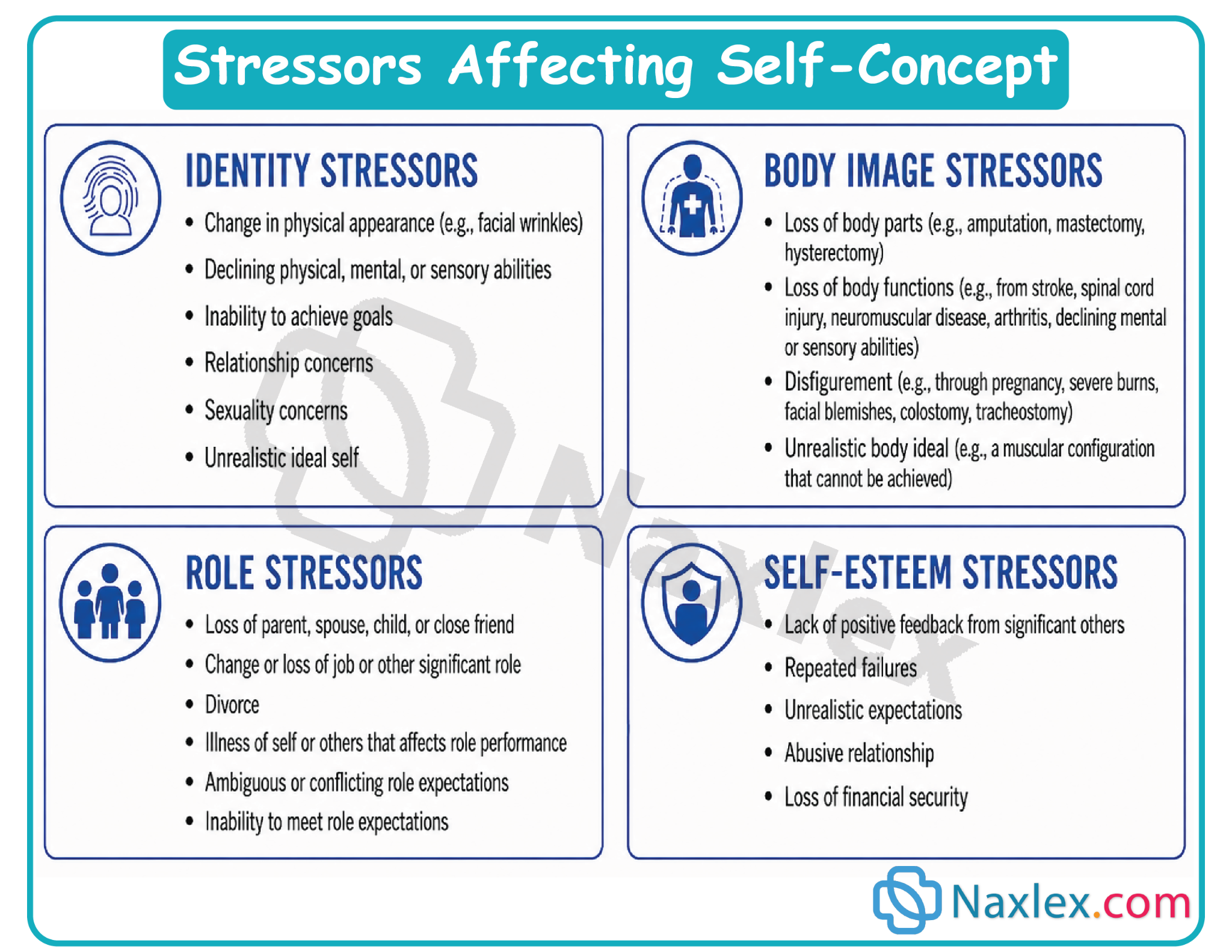
Nursing Management of Self-Concept
Nurses play a critical role in evaluating and promoting a client's self-concept. Effective care relies on establishing trust, evaluating personal perceptions across four primary domains, recognizing cultural nuances, and applying targeted interventions to build self-worth.
1. Assessment Guidelines & Considerations
Establishing the Environment & Relationship
Before conducting a psychosocial assessment, the nurse must build trust while adhering to key principles:
- Environment: Create a quiet, private setting and minimize interruptions.
- Nurse Demeanor: Sit at eye level, maintain eye contact, show interest, and avoid expressing shock, frowning, or criticizing.
- Communication: Use open-ended questions; avoid unnecessary personal questions.
- Documentation: Minimize active note-writing during the interview to prevent client concern over confidentiality and maintain focus on the client.
- Information Sources: Involve family when appropriate, protect confidentiality, and remain aware of personal biases.
Culturally Responsive Care & Cultural Dissonance
- Culture vs. Low Self-Esteem: Behaviors like avoiding eye contact or hesitant speech may reflect cultural norms rather than low self-esteem.
- Cultural Dissonance: Occurs when a client experiences conflicting beliefs between their native culture and the culture in which they currently live.
Stressors and Coping
- Perception Matters: The impact of a stressor depends on how the client interprets it. A growth-oriented perception builds self-worth; a defeatist view lowers self-esteem.
- Coping Style Evaluation: Assess effectiveness by asking how clients handle stress and whether their methods yield positive outcomes.
2. Assessment Interviews Across the Four Domains
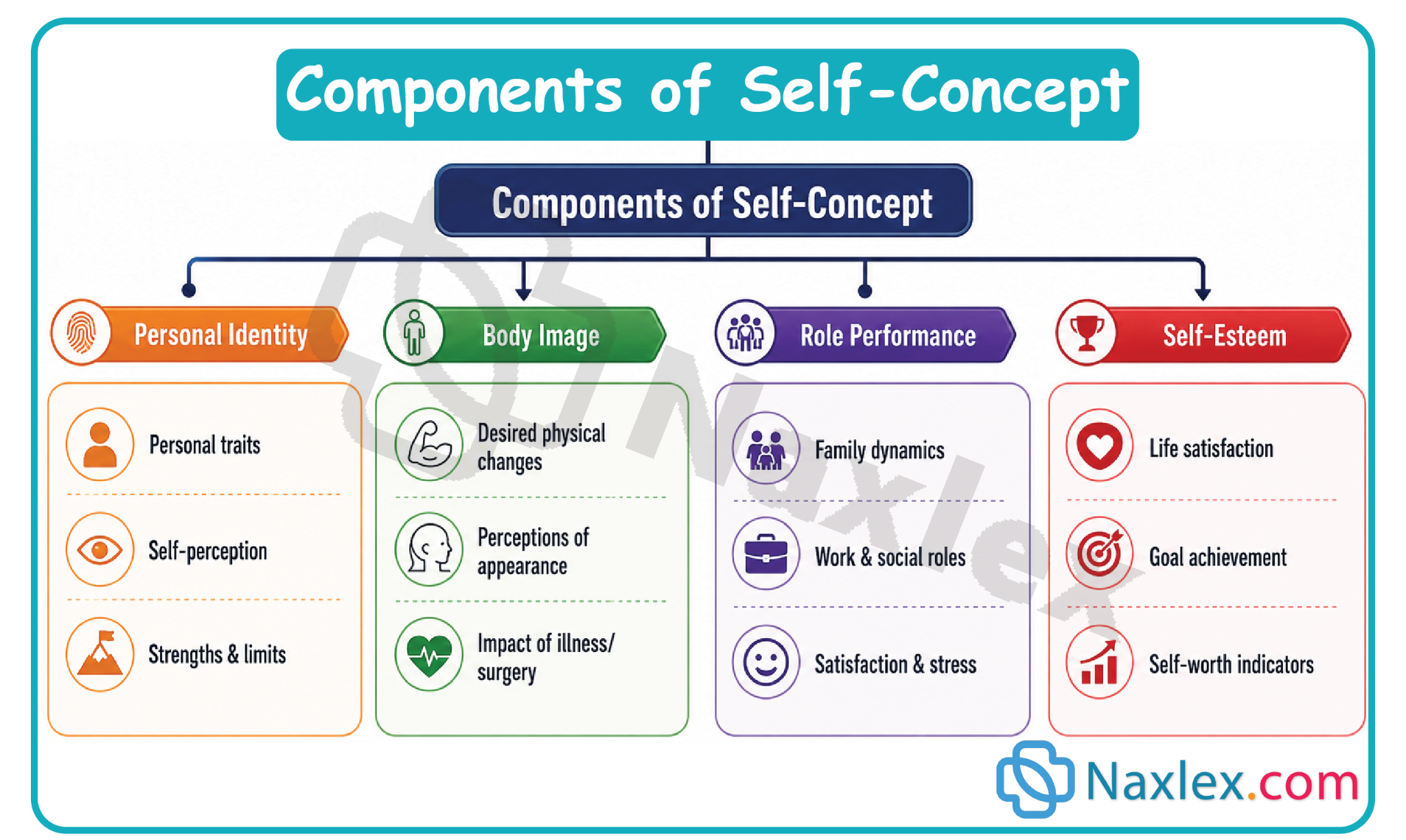
Personal Identity
Focuses on how clients define themselves:
- "How would you describe your personal characteristics?"
- "What do you like about yourself? What do you do well?"
- "What would you change about yourself if you could?"
Body Image
Focuses on perceptions of appearance, function, and changes due to illness or surgery:
- "Is there any part of your body you would like to change?"
- "What changes in your body do you expect following treatment/surgery?"
- "How have significant others reacted to changes in your body?"
Role Performance
Evaluates satisfaction with family, occupational, and social roles:
- Family Roles: Ask about home life, decision-making, responsibilities, and relationships ("Are you proud of your family members? Do you feel they are proud of you?").
- Work & Social Roles: Assess work satisfaction, social preferences (alone vs. groups), and support systems ("Whom do you seek out for help?").
Self-Esteem & Behavioral Indicators
Evaluates overall life satisfaction ("Are you satisfied with your life? Are you accomplishing what you want?").
Behaviors Indicating Potential Low Self-Esteem:
- Poor grooming, stooped posture, slow movement.
- Hesitant speech, frequent apologizing, inability to accept compliments.
- Excessive self-criticism ("I'm no good") or criticism of others.
- Expressing hopelessness, helplessness, or powerlessness.
3. Nursing Diagnoses
Primary NANDA Diagnoses
- Disturbed Body Image
- Ineffective Role Performance
- Chronic Low Self-Esteem (or Risk for)
Related Diagnoses
- Disturbed Personal Identity (or Risk for)
- Anxiety (related to physical changes)
- Ineffective Coping / Parental Role Conflict
- Grieving / Complicated Grieving
- Hopelessness / Powerlessness
- Social Isolation / Spiritual Distress
4. Implementation & Interventions
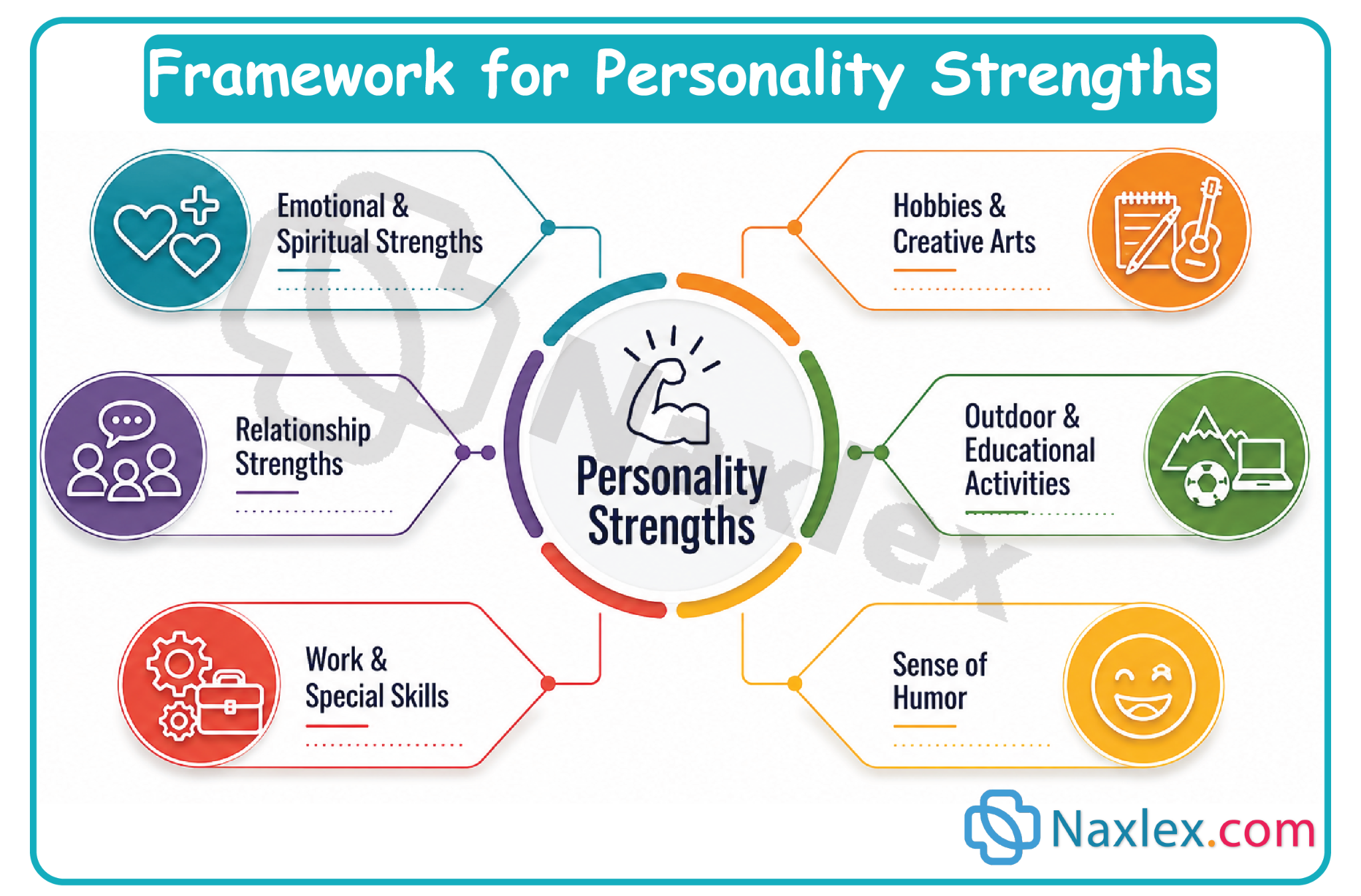
Framework for Personality Strengths
│ • Hobbies, crafts, and expressive arts (writing, music, painting)
│ • Outdoor activities, sports, technology, reading, and education
│ • Work/vocation achievements and special aptitudes (problem-solving, mechanics)
│ • Humor: Ability to laugh at oneself and take light kidding
│ • Relationship strengths: Listening, making others comfortable, empathy
│ • Emotional & Spiritual strengths: Expressing warmth, faith, church participation
Identifying Strengths & Enhancing Self-Esteem
Nurses must actively assist clients in recognizing assets, as individuals with low self-esteem fixate heavily on limitations.
- Reinforcing Strengths: Emphasize positive thinking, verbally acknowledge client strengths, assist in setting attainable goals, and celebrate goal achievement.
- Reframing Negative Self-Talk: Teach clients to substitute negative statements with constructive alternatives (e.g., replace "I can't walk to the store anymore" with "I can walk half a block each morning").
- Therapeutic Techniques: Encourage expression of feelings, address distorted or unrealistic standards, avoid criticism, and provide honest feedback.
5. Evaluation
If client outcomes are not achieved, evaluate the underlying causes:
- Have old triggers or new, unmanageable stressors recurred?
- Are new roles creating excessive strain?
- Are support systems/significant others providing adequate backing?
- Did the client access and receive appropriate community agency referrals?
- Were initial expectations unrealistic regarding the time needed for recovery?
Lifespan Considerations for Enhancing Self-Esteem
Self-esteem strategies must be tailored to an individual's developmental stage. Across the lifespan, fostering self-worth involves shifting support mechanisms from building foundational trust in childhood to maintaining autonomy, purpose, and dignity in older adulthood.
1. Children
Children develop strong self-esteem by cultivating five foundational attitudes: Security and Trust, Identity, Belonging, Purpose, and Personal Competence.
- Key Environmental Ingredients: Love, acceptance, firmness, consistency, and clear, predictable expectations.
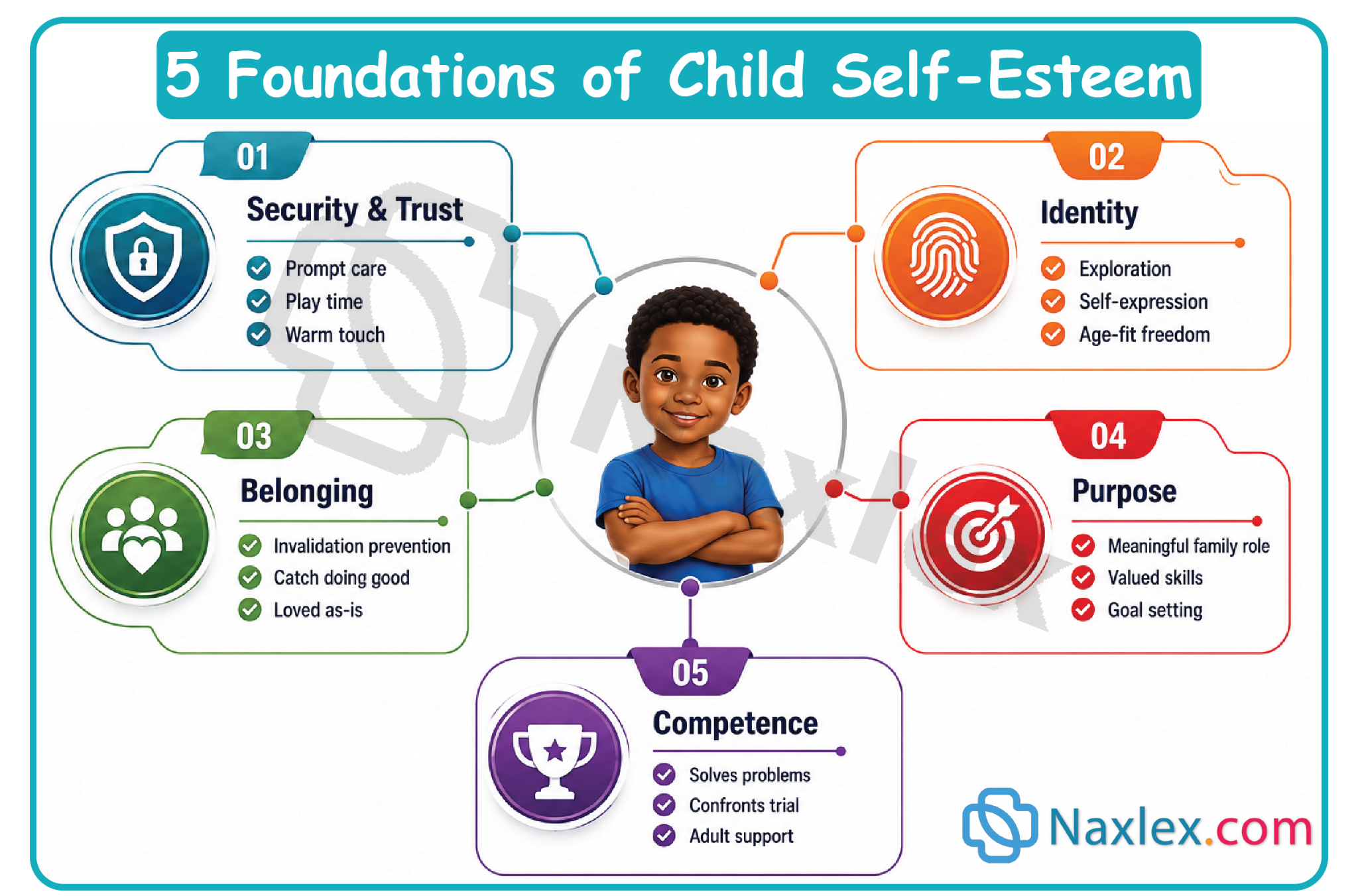
Detailed Breakdown
- Security & Trust: Formed early through prompt caregiving. Strengthened in older kids via focused time (playing, reading, listening) and physical warmth (hugs).
- Identity: Fostered by allowing safe exploration and self-expression (e.g., preschoolers choosing outfits; adolescents trying new hairstyles).
- Belonging: Developed by including children in activities, praising efforts ("catching them doing well"), and affirming intrinsic worth ("loved for just being themselves").
- Purpose: Built by assigning meaningful roles within the family/community that leverage their unique strengths (e.g., bringing joy/humor to the family).
- Personal Competence: Grows when solving problems and facing challenges with adult guidance.
- Warning: Overwhelming frustration without support can cause avoidance, lying, bullying, or giving up.
2. Adolescents
Fostering self-esteem during adolescence centers on promoting autonomy, developing purpose, and respecting burgeoning independence.
- Responsibility & Consequences: Allow teens to experience both successes and failures, as well as the natural consequences of their choices.
- Process Focus: Appreciate effort, problem-solving, and contributions rather than outcome alone.
- Shared Decision-Making: Ask for opinions, encourage input in personal matters, and express trust in their judgment.
- Constructive Communication: Openly discuss mistakes and problems; avoid public ridicule, comparison, or punishment in front of peers.
- Realistic Goals & Community: Help establish realistic standards. Participation in volunteer activities helps teens identify strengths and gain a sense of purpose.
3. Adults
Strategies for adults focus on cognitive reframing, positive reinforcement, and self-reflection.
- Self-Reflection: Explore past influences on self-esteem and analyze internal/external factors affecting current confidence.
- Reframing & Affirmations:
- Discourage negative self-talk.
- Promote positive affirmations (e.g., "I like myself," "I am a valuable person").
- Encourage clients to list and frequently review their positive qualities.
- Supportive Environment: Discourage comparisons with others; advocate for relationships with positive, supportive individuals.
- Constructive Actions: Highlight past achievements and suggest altruistic tasks or helping others to boost feelings of self-worth.
4. Older Adults
Older adults face threats to self-esteem due to age-related changes, including reduced income, health decline, retirement, loss of loved ones, and increasing dependence.
- Autonomy & Respect:
- Involve clients directly in care planning and establish goals in small, achievable steps.
- Listen actively, ask for advice, address them by name, and maintain utmost dignity and privacy (especially in long-term care or hospital settings).
- Reminiscence & Storytelling: Encourage connection with past memories through writing autobiographies, recording stories, or sharing recollections.
- Creative Expression: Engage clients in resource-tapping activities like music, art, quilting, photography, and storytelling.
- Strengths & Purpose: Encourage participation in achievable activities to maintain a sense of productivity, contribution, and personal value.
Nursing Insight: "The Tapestry of Life"
The overarching model envisions life as an evolving tapestry:
- Mainstays (Core Foundation): Personal power derived from self-esteem, love of humanity, and spiritual connection.
- Weavings (Patterns): Individual experiences, knowledge, and life dreams.
- Aging Effect: Though physical body structures may become fragile, the overall fabric grows stronger and more beautiful through the integration of lifetime experiences, resilience, and personal worth.
Summary
- A positive self-concept is essential to a person’s mental and physical health.
- A person’s self-perception can differ from the person’s perception of how others see him or her and from the ideal self, that is, how the person would like to be.
- Factors affecting self-concept include stage of development, family and culture, stressors, resources, history of success and failure, and illnesses that affect role performance.
- The nurse assesses four areas of self-concept: personal identity, body image, role performance and relationships, and self-esteem.
- Because a positive self-concept is basic to health, one of the nurse’s major responsibilities is to assist clients whose self-concept is disturbed to develop a more positive and realistic image of themselves.
- A trusting client–nurse relationship is essential for the effective assessment of a client’s self-concept, for providing help and support, and for motivating client behavior change.
Naxlex
Videos
Login to View Video
Click here to loginTake Notes on Self-concept
This filled cannot be empty
Join Naxlex Nursing for nursing questions & guides! Sign Up Now