






 Video Library


Please set your exam date
Nursing diagnosis
Study Questions
Practice Exercise 1
A client is identified as being vulnerable to developing a health problem. The nurse should select which type of nursing diagnosis status?
Explanation
A clinical determination of vulnerability indicates that a client is at an increased risk for developing an adverse human response compared to the general population. This status indicates that while the problem is not yet present, specific environmental hazards, physiological vulnerabilities, or risk factors exist. The nurse must implement preemptive monitoring and preventative protocols to avert the transition into an active disease state.
Rationale for correct answer:
A. A risk nursing diagnosis is selected for vulnerable individuals. This diagnostic status applies when clinical validation confirms that specific predisposing factors are present, requiring preventative intervention targeting the identified vulnerability factors before an actual problem manifests.
Rationale for incorrect answers:
B. A syndrome nursing diagnosis comprises a highly specific cluster of multiple related diagnoses. It is reserved for complex, multi-system clinical scenarios that occur together due to a singular event or situation, rather than representing an individual, isolated vulnerability projection or single risk manifestation.
C. A health promotion nursing diagnosis focuses entirely on an active desire to increase well-being. This diagnostic category is initiated when a client or community expresses a motivated readiness to enhance their current health status, rather than being framed around avoiding a specific pathological vulnerability or clinical risk.
D. An actual nursing diagnosis requires active, empirically verifiable clinical evidence. This status is completely inappropriate for a vulnerable client because it can only be formulated when diagnostic signs and symptoms are currently observable during physical or subjective assessment, indicating a present problem.
Test-taking strategy
- Analyze the scenario and question: The question asks which type of nursing diagnosis status should be selected when a client is identified as being "vulnerable to developing a health problem."
- Evaluate diagnostic categories based on clinical state:
- Actual/Problem-focused: Problem is present now (validated by signs/symptoms).
- Risk: Problem is not present yet, but vulnerability exists (validated by risk factors).
- Health Promotion: Client wishes to improve an already stable health state.
- Syndrome: A cluster of diagnoses predicted by a single situation.
- Select the matching status: The keyword "vulnerable to developing" directly indicates a future-oriented problem that has not occurred yet. This maps precisely to a Risk nursing diagnosis (choice 1).
Take home points
- Risk nursing diagnoses are formulated based on a client's specific vulnerability rather than active clinical signs.
- Actual nursing diagnoses require the presence of validating defining characteristics during patient assessment.
- Health promotion statements reflect a motivation to enhance wellness rather than a defense against health risks.
- Syndrome diagnoses represent a predictive cluster of multiple separate nursing diagnoses that occur concurrently.
A nurse is explaining the purposes of nursing diagnosis. The purpose of diagnosing is to identify which of the following?
a) How an individual, group, or community responds to actual or potential health and life processes
b) Factors that contribute to or cause health problems (etiologies)
c) Strengths the client can draw on to prevent or resolve problems
d) Nursing interventions to resolve health problems
Explanation
The diagnostic phase of the nursing process serves to clarify the precise nature of a client's health experience. Its purpose extends beyond merely naming an illness; it encompasses analyzing how individuals or communities interact with their health environments. By identifying human responses, contributing factors, and internal resources, the nurse builds a diagnostic synthesis that preserves client safety and maximizes care customization.
Rationale for correct answer:
C. This option correctly encompasses items a, b, and c. The purpose of diagnosing is to identify the client's human response (a), isolate the specific etiology driving that response (b), and uncover internal strengths (c) to formulate a structurally complete, legally valid three-part statement and direct holistic planning.
Rationale for incorrect answers:
A. This combination is incorrect because it completely omits item c. Identifying a client's strengths is an indispensable component of the diagnosing phase, meaning that excluding it creates an incomplete representation of diagnostic synthesis and overlooks crucial client resources.
B. This grouping is incorrect because it excludes items a and b while erroneously including item d. Determining nursing interventions (d) is the primary objective of the subsequent planning phase, meaning its inclusion here represents a chronological error that violates phase boundaries.
D. The choice all of the above is incorrect because item d is a planning activity. Including the selection of nursing interventions incorrectly blends the distinct diagnostic phase with the subsequent implementation design phase, undermining the systematic procedural sequencing of clinical reasoning.
Test-taking strategy
- Analyze the scenario and question: The question requires identifying the true purposes of the diagnosing phase within the nursing process based on Taylor and Lillis frameworks.
- Differentiate diagnosis from planning: Recall the specific objectives of the Diagnosis phase versus the Planning phase.
- Diagnosis aims to identify: Human responses (a), Etiologies/causes (b), and Client strengths (c).
- Planning aims to identify: Specific nursing interventions (d) and outcomes.
- Evaluate the combinations: Because item d is explicitly a planning activity, any option containing it must be eliminated. This rules out choices 2 and D. Choice 1 is missing the strengths component. Therefore, choice 3 is the only logical and taxonomically accurate combination.
Take home points
- The primary purpose of nursing diagnosis is to identify human responses to actual or potential health problems.
- Identifying etiologies during the diagnostic phase is essential for selecting appropriate, targeted nursing interventions.
- Assessing and documenting client strengths during diagnosis provides a foundation for resource-supported care planning.
- Selecting specific nursing interventions belongs exclusively to the planning phase, not the diagnosing phase.
A nurse is reviewing professional organizations related to nursing diagnoses. Which group is responsible for the promotion and organization of activities to continue the development, classification, and scientific testing of nursing diagnoses?
Explanation
The refinement of standard nursing terminology is managed by a dedicated international authority. To ensure safety, consistency, and validity across healthcare systems, a specialized body oversees the submission, review, and taxonomy updates for nursing diagnoses. This organization facilitates continuous clinical research and global taxonomy development, ensuring that diagnostic categories are grounded in rigorous scientific testing and peer-reviewed empirical evidence.
Rationale for correct answer:
C. The North American Nursing Diagnosis Association is the primary body responsible. Established formally to standardize terminology, this professional organization directs the continuous global evolution, classification taxonomy, and clinical empirical validation of recognized human response labels.
Rationale for incorrect answers:
A. The American Nurses Association is not the specific body managing the diagnostic taxonomy. While it broadly advocates for the nursing profession and establishes general standards of practice, it delegates the precise maintenance of diagnostic classifications to specialized taxonomy groups rather than managing label taxonomy directly.
B. The National Nursing Diagnosis Association does not exist as an official taxonomy body. While the name sounds plausible, it is a distractor that does not represent the actual historical or contemporary organization chartered with overseeing professional diagnostic development or evidence review.
D. The Clearinghouse for Nursing Diagnoses was an early informational repository rather than a development body. It served a historical data-sharing function during the infancy of the movement but lacks the organizational authority to formally approve, classify, or coordinate scientific testing for new diagnostic labels.
Test-taking strategy
- Analyze the scenario and question: The question asks for the specific professional organization responsible for the development, classification, and scientific testing of nursing diagnoses.
- Recall professional nursing bodies:
- Rule out choice 1: The ANA represents all registered nurses broadly but does not specialize exclusively in diagnostic taxonomy creation.
- Rule out choice 2: This is a fabricated name designed to mimic the correct answer.
- Rule out choice 4: This refers to early information-clearing efforts but is not the governing association.
- Identify the core authority: The North American Nursing Diagnosis Association, known universally as NANDA (now NANDA International or NANDA-I), is explicitly recognized in historical nursing textbooks (Taylor, Lillis) as the governing body for this specific taxonomy, confirming choice 3 as correct.
Take home points
- The North American Nursing Diagnosis Association is the official governing body for developing and classifying nursing diagnoses.
- Standardizing nursing language is essential for integrating clinical documentation into modern electronic health records globally.
- The development of nursing taxonomy relies on continuous scientific field testing and multi-tiered expert committee reviews.
- Broad organizations like the American Nurses Association endorse but do not directly author or manage specialized diagnostic nomenclatures.
A nurse makes a clinical judgment that a client, family, or community is more vulnerable to develop a problem than others in the same or similar situation. This represents which type of nursing diagnosis?
Explanation
A clinical determination that an individual, family, or community possesses a heightened susceptibility to an adverse condition indicates an elevated state of vulnerability. This diagnostic status signifies that while the pathological process or health alteration is not yet present, underlying predisposing factors or environmental exposures are actively working against the client. The nurse prioritizes this category to execute targeted preventative strategies that eliminate or mitigate specific risk exposures before clinical manifestations develop.
Rationale for correct answer:
B. A risk nursing diagnosis precisely represents this clinical scenario. By definition, a risk diagnosis identifies a distinct vulnerability in a client or group, indicating that predisposing vulnerability variables are present and require prophylactic intervention despite the absence of active signs or symptoms.
Rationale for incorrect answers:
A. An actual nursing diagnosis is inappropriate for this situation. Actual diagnoses describe real, currently existing human responses that are actively validated by empirical clinical evidence during assessment, rather than describing a future-oriented potential vulnerability or a projected risk state.
C. A possible nursing diagnosis is used when evidence is incomplete. This status indicates that a problem may be present but the nurse requires additional assessment data to confirm or rule it out, which differs from knowing a specific vulnerability exists based on clear risk factor verification.
C. A wellness nursing diagnosis focuses on health optimization. Also classified as a health promotion diagnosis, this label tracks a client's expressed motivation and readiness to enhance an already stable health state, rather than establishing an epidemiological defense against a specific pathological vulnerability.
E. A syndrome nursing diagnosis comprises a complex cluster of multiple diagnoses. It is reserved for specific, multi-system clinical events that are highly predicted by a singular, overarching situation, rather than representing a singular, independent vulnerability factor or isolated risk occurrence.
Test-taking strategy
- Analyze the scenario and question: The question asks to identify the type of nursing diagnosis formulated when a nurse judges that a client, family, or community is "more vulnerable to develop a problem than others in the same or similar situation."
- Evaluate diagnostic categories:
- Actual: Problem is present now with evidence.
- Risk: Increased vulnerability to a future problem based on current risk factors.
- Possible: Suspected problem where more data is needed to confirm.
- Wellness/Health Promotion: Motivation to enhance current healthy functioning.
- Syndrome: A pre-established cluster of diagnoses resulting from a unique situation.
- Match the key phrase: The phrase "more vulnerable to develop a problem" serves as the literal definition of a Risk nursing diagnosis (choice 2), which focuses entirely on preemptive clinical surveillance and mitigation.
Take home points
- Risk nursing diagnoses identify an increased client vulnerability toward developing an adverse human response.
- Unlike actual diagnoses, risk statements do not require defining characteristics because the problem has not yet occurred.
- Wellness diagnoses prioritize client-led health enhancement and optimization rather than defense against specific vulnerabilities.
- Possible diagnoses serve as temporary placeholders indicating that further data collection is mandatory before validation.
The nurse reviews several nursing diagnoses. Which diagnoses are correctly matched with their status? Select all that apply
Explanation
NANDA-I clinical taxonomy utilizes specialized validation criteria to organize concepts. Standardized diagnostic statuses evaluate actual human responses, vulnerability levels, health maximization desires, or complex clinical syndromes to ensure structured care planning precision.
Rationale for correct answers:
A. This matching accurately reflects taxonomic guidelines. The label identifies a vulnerable physiological state. It increases clinical infection susceptibility. It lacks an active etiology.
B. This classification perfectly matches a problem state. The diagnosis addresses an ongoing response. It lasts greater than 3 months. It contains verified defining characteristics.
C. This selection correctly identifies health optimization. The phrasing denotes an intrinsic motivation. It improves existing coping dynamics. It bypasses active pathological processes.
E. This concept represents cluster diagnostic categories. It groups several distinct diagnoses together. It reflects an overarching clinical picture. This allows comprehensive care.
Rationale for incorrect answers:
D. This diagnostic matching is completely inaccurate. The label describes an isolated movement limitation. It represents a problem-focused diagnosis. It is not a multi-diagnostic syndrome.
Test-taking strategy
- Analyze the scenario/question: The question asks to identify correctly matched NANDA-I diagnostic categories from a select-all-that-apply list.
- Apply taxonomic classification: Evaluate each option against the 4 structural diagnostic statuses.
- Choice 1, Choice 2, Choice 3, and Choice 5 match their respective categories perfectly.
- Choice 4 is misclassified because it is an isolated physical impairment, not a cluster of diagnoses.
- Confirm the status of Frail Elderly Syndrome as a complex multi-system clinical syndrome.
- Select all options that accurately pair the diagnostic statement with its structural taxonomy type.
Take home points
- Risk diagnoses identify structural or physiological vulnerabilities before a problem occurs.
- Problem-focused statements must be validated by present defining characteristics or signs.
- Health promotion concepts target the expansion of health potential rather than deficit correction.
- Syndrome diagnoses require a distinct cluster of predictive labels occurring simultaneously.
Practice Exercise 2
A nurse is evaluating several nursing diagnostic statements. Which of the following contains the proper components of a nursing diagnosis?
Explanation
A valid nursing diagnosis must utilize standard NANDA-I taxonomy and follow precise structural rules to ensure safety and clarity. A risk diagnosis contains two primary components: the diagnostic label and the related factors or risk factors. It must never include a medical diagnosis as the direct etiology, nor should it use ambiguous linking terminology that obscures the pathophysiological mechanism.
Rationale for correct answer:
A. This statement satisfies all structural and taxonomical requirements. Risk for Caregiver Role Strain is an approved NANDA-I label, and an unpredictable illness course is a clear, modifiable, or manageable vulnerability factor. This creates a logical, legally sound predictive statement that establishes an actionable path for preventive care.
Rationale for incorrect answers:
B. This statement is poorly constructed and clinically ambiguous. A tendency to collapse when having difficulty breathing mixes separate nursing problems together rather than identifying a clear etiology. It utilizes vague symptomatology instead of isolating a precise environmental or physiological risk factor for falls.
C. This statement violates diagnostic rules by listing a medical diagnosis as the etiology. Stroke is a definitive medical diagnosis, which nurses cannot independently treat or resolve. The etiology must focus on the neurological impairment or neuromuscular deficits caused by the medical event rather than the medical diagnosis itself.
D. This statement uses incorrect linking phraseology and faulty sequencing. The term secondary to is generally reserved to connect an etiology to an underlying medical condition, but fatigue is a symptom, not a medical condition. This structure creates an illogical causal loop that undermines diagnostic precision.
Test-taking strategy
- Analyze the scenario and question: The question requires identifying the nursing diagnostic statement that contains the proper structural components and follows legal and taxonomical guidelines.
- Apply Rules for formulating nursing diagnoses:
- Rule 1: Do not write a medical diagnosis as the etiology (rules out choice 3 due to "stroke").
- Rule 2: Ensure the etiology identifies a clear, specific, actionable cause rather than vague symptoms (rules out choice 2 due to "tendency to collapse...").
- Rule 3: Use approved linking words ("related to") appropriately without creating circular or backwards reasoning (rules out choice 4 due to "secondary to fatigue").
- Confirm the valid structure: Choice 1 correctly matches an approved NANDA-I risk label with a valid, non-medical etiologic risk factor using standard connecting language.
Take home points
- Nursing diagnoses must focus on human responses that fall within the legal independent scope of nursing practice.
- Medical diagnoses cannot be used as the direct etiology of a nursing diagnosis; a pathophysiological response must be substituted.
- Risk diagnoses do not possess defining characteristics because the problem or clinical event has not yet occurred.
- Connecting phrases like "secondary to" should only link a valid nursing etiology to an underlying medical condition.
Question 2:
A nurse is teaching a group of students about the three-part diagnostic statement (problem–etiology–signs/symptoms, PES format). One of the primary advantages of using this format includes which of the following?
Explanation
The three-part diagnostic statement utilizing the problem-etiology-signs/symptoms format establishes a rigorous structural taxonomy. This methodology ensures clinical objectivity by explicitly linking a validated human response to its causative factors and supporting empirical evidence. Using this systematic arrangement ensures data synthesis, professional uniformity, and precise clinical documentation across diverse healthcare environments.
Rationale for correct answer:
D. This format standardizes organization of client data. By forcing the integration of the problem, etiology, and defining characteristics, it provides a consistent, logical framework that categorizes raw assessment findings into structured diagnostic clustering to enhance taxonomical organization.
Rationale for incorrect answers:
A. This format does not directly decrease health care costs. While standardized care tracking can indirectly minimize administrative redundancies over time, the primary objective of implementing this specific diagnostic framework is clinical precision and communication rather than fiscal optimization or cost containment.
B. This approach does not directly improve nurse-client communication. The highly specialized terminology and rigid structural mechanics of the PES format are designed specifically for intraprofessional charting and peer-to-peer transmission, rather than translating clinical concepts during therapeutic communication or client education.
C. This framework does not inherently focus on health and wellness elements. The PES format is predominantly utilized to structure actual or problem-focused diagnoses by requiring validating signs and symptoms, whereas wellness diagnoses utilize a modified, non-etiological structure focused on promotion tracking or readiness validation.
Test-taking strategy
- Analyze the scenario and question: The question asks for a primary advantage of using the three-part diagnostic statement (PES format) when formulating nursing diagnoses.
- Evaluate the purpose of taxonomy: Consider why standardized frameworks like NANDA-I and PES are enforced in nursing documentation. They are structural tools designed for professional clarity and data sorting.
- Rule out choice 1: Healthcare cost is an administrative metric, not the primary clinical goal of a charting format.
- Rule out choice 2: Clients do not typically read or communicate via PES formatting; it is for professionals.
- Rule out choice 3: Wellness diagnoses actually omit the etiology and signs/symptoms sub-steps used in the PES format.
- Identify the structural benefit: Choice 4 correctly identifies that the PES method forces an orderly, uniform arrangement of clinical information, preventing subjective or disorganized data entries.
Take home points
- The PES format provides a highly standardized structural framework that organizes diagnostic clinical data uniformly.
- actual nursing diagnoses require all three PES components, whereas risk or wellness diagnoses use modified structures.
- Standardized professional language in charting is designed primarily for intraprofessional communication rather than direct client interaction.
- Structural diagnostic frameworks prioritize clinical accuracy, data clustering, and care planning rather than immediate financial reduction.
A nurse is reviewing the diagnostic statement: “Excess Fluid Volume related to decreased venous return as manifested by lower extremity edema.” Which component represents the etiology of the problem?
Explanation
A formal nursing diagnosis uses a structured format to communicate a client's health status. The etiology component identifies the physiological, pathophysiological, or psychological factors maintaining or initiating the unhealthy state. This clinical element provides the direction for selecting specific, targeted nursing interventions to mitigate or eliminate the root cause of the identified human response.
Rationale for correct answer:
B. The phrase decreased venous return represents the etiology. In a standard three-part or two-part diagnostic statement, the clause following related to identifies the pathogenetic mechanism or contributing factor driving the human response, which directly guides the intervention selection to address the underlying cause.
Rationale for incorrect answers:
A. Excess fluid volume is the diagnostic label or problem statement. This component represents the NANDA-I validated human response to a health condition. It describes the client's current altered health state rather than the causal mechanism or contributing factor that produced the fluid retention.
C. Lower extremity edema is the defining characteristic or sign/symptom. It serves as objective clinical evidence that validates the presence of the diagnostic label. This data point is an experiential manifestation rather than an etiological factor responsible for driving the pathophysiological process.
D. The choice unknown is incorrect because the etiology is explicitly stated. The diagnostic statement clearly delineates the pathophysiological mechanism responsible for the fluid retention. The contributing factor is identifiable and actionable, making causal clarity apparent rather than an unspecified etiology.
Test-taking strategy
- Analyze the scenario and question: The question asks to identify the etiology component within the provided diagnostic statement: "Excess Fluid Volume related to decreased venous return as manifested by lower extremity edema."
- Apply PES diagnostic structure: Recall the Problem, Etiology, Signs/Symptoms (PES) structural framework used in clinical nursing diagnostics.
- The problem (P) is the diagnostic label: Excess Fluid Volume.
- The etiology (E) follows the phrase "related to" and points to the cause.
- The signs/symptoms (S) follow "as manifested by" or "as evidenced by."
- Evaluate the choices:
- Rule out choice 1: This represents the Problem (P).
- Rule in choice 2: Decreased venous return follows "related to," defining the Etiology (E).
- Rule out choice 3: This is part of the Signs/Symptoms (S).
- Rule out choice 4: The etiology is clearly stated in the stem, not unknown.
Take home points
- The etiology component of a nursing diagnosis provides the pathophysiological or behavioral rationale that guides nursing interventions.
- The diagnostic label represents the actual or potential human response to health conditions or life processes.
- Defining characteristics provide objective or subjective evidence that validates the existence of the nursing diagnosis.
- Statements are structured sequentially as Problem related to Etiology as manifested by Signs and Symptoms.
A nurse is analyzing diagnostic statements. Which of the following are correctly written as three-part nursing diagnoses?
a) Disabled Family Coping related to lack of knowledge about home care of child on ventilator.
b) Imbalanced Nutrition: Less Than Body Requirements related to inadequate caloric intake while striving to excel in gymnastics as evidenced by 20-pound weight loss since beginning the program and greatly less than ideal body weight compared to standards.
c) Need to learn how to care for child on ventilator at home related to unexpected discharge as evidenced by repeated comments such as “I cannot do this” and “I’ll harm her because I’m not a nurse”.
d) Spiritual Distress related to inability to accept diagnosis of terminal illness as evidenced by multiple comments such as “How could God do this to me?” and “I don’t deserve this”.
e) Caregiver Role Strain related to failure of home health aides to diagnose caregiver needs as evidenced by caregiver’s weight loss and clinical depression.
Explanation
A three-part nursing diagnostic statement, often referred to as the PES format (Problem, Etiology, Signs/Symptoms), is used for actual health problems where empirical evidence is present. A correctly formulated three-part diagnosis must utilize a valid NANDA-I label, link to an actionable etiology using "related to," and provide objective or subjective validating evidence using "as evidenced by." This rigorous structure ensures diagnostic accuracy, clinical accountability, and the synthesis of cluster data into a professional, legally defensible clinical judgment.
Rationale for correct answers:
B. (b) and (d) are the only correctly written three-part diagnoses. They both utilize approved NANDA-I labels, link to clear causative factors, and provide specific, observable data points that serve as validating evidence for the active human response.
Rationale for incorrect answers:
A. (a) is written as a two-part diagnosis, not a three-part one. While it is a structurally valid nursing statement, it lacks the required "as evidenced by" segment to qualify as a complete three-part PES statement, rendering it taxonomically incomplete as a PES structure.
C. (c) contains a non-standard diagnostic label. "Need to learn" is not an approved NANDA-I nursing diagnosis label; it describes an educational deficit rather than an actualized human response or diagnostic label recognized by the professional taxonomy.
D. (e) uses a faulty etiology. Attributing caregiver strain to the failure of home health aides introduces an external, non-nursing blaming factor that distracts from the nurse's independent ability to manage the caregiver's physiological or psychological response.
Test-taking strategy
- Analyze the scenario and question: The question requires identifying which of the provided statements are correctly written as three-part nursing diagnoses (Problem–Etiology–Signs/Symptoms).
- Apply PES Criteria:
- P: NANDA-I approved label.
- E: Related factor/Etiology linked by "related to."
- S: Defining characteristics (signs/symptoms) linked by "as evidenced by."
- Evaluate the Statements:
- a: Two-part (missing evidence).
- b: Correct three-part structure.
- c: Incorrect label ("Need to learn" is not NANDA-I).
- d: Correct three-part structure.
- e: Inappropriate etiology (blaming external aides instead of focusing on caregiver variables).
- Conclude: Only (b) and (d) meet all structural requirements, making choice 2 the correct answer.
Take home points
- Three-part nursing diagnoses are used exclusively for actual, problem-focused diagnoses where evidence is currently present.
- The "as evidenced by" (or "amf") phrase is mandatory for connecting the etiology to clinical defining characteristics.
- Diagnostic labels must be selected from the official NANDA-I taxonomy rather than using descriptive, informal clinical phrases.
- Etiologies must focus on factors the nurse can independently manage or monitor, rather than external factors like the perceived failures of other staff.
The nurse is documenting the nursing diagnosis:
"Acute Pain related to tissue trauma as evidenced by verbal reports of pain rated 8/10 and guarding behavior."
Which phrase represents the etiology?
Explanation
A problem-focused diagnosis utilizes a three-part formatting structure. The component indicating the etiology identifies the underlying pathophysiological cause or contributing factor driving the human response, linked structurally by the standard taxonomy phrase related to.
Rationale for correct answer:
B. This phrase identifies the clinical root cause. It describes the precise pathophysiological mechanism driving the sensory deficit. It follows the structural connector phrase. This guides specific nursing interventions.
Rationale for incorrect answers:
A. This phrase represents the human response. It defines the central diagnostic problem statement. It establishes the specific taxonomic focus. This cannot serve as the underlying etiology.
C. This notation signifies a defining characteristic. It represents an objective data point. It provides a numeric evaluation scale. This serves as clinical diagnostic evidence.
D. This description constitutes an objective symptom. It displays a protective physical response. It validates the active problem focus. This represents part of the clinical evidence.
Test-taking strategy
- Analyze the scenario/question: The question requires identifying the etiology component within a properly structured three-part problem-focused diagnostic statement.
- Apply taxonomic structure rules: Use the problem, etiology, signs and symptoms structural framework to isolate each distinct phrase.
- Choice 1 is the problem statement or diagnostic label that opens the sentence.
- Choice 2 follows the required connector phrase and specifies the direct underlying pathophysiological cause.
- Choice 3 and Choice 4 follow the clinical evidence connector and represent the defining characteristics.
- Rule out Choice 1, Choice 3, and Choice 4 based on their structural functions as the core problem and descriptive evidence.
Take home points
- The etiology component of a diagnosis explains the cause of the problem.
- Etiology phrases are connected to the diagnostic label using the phrase related to.
- Defining characteristics represent the signs and symptoms that validate the active diagnosis.
- Defining characteristics are connected to the diagnostic statement using as evidenced by.
Practice Exercise 3
A nurse is determining whether a client’s condition requires a collaborative (multidisciplinary) problem instead of a nursing or medical diagnosis. A collaborative problem is indicated in which situation?
Explanation
A collaborative problem represents a distinct clinical scenario where physiological complications require multidisciplinary surveillance and management. These situations arise when a definitive pathophysiological process demands both biomedical interventions and independent nursing actions to achieve resolution. The nurse's primary focus shifts toward monitoring for onset monitoring or changes in status while executing interdependent actions to mitigate risk.
Rationale for correct answer:
A. A collaborative problem requires both medical and nursing interventions. Because these situations involve complex pathophysiological events, independent nursing actions alone are legally and clinically insufficient, necessitating joint monitoring and shared multidisciplinary execution to ensure client safety.
Rationale for incorrect answers:
B. Independent nursing actions alone indicate a pure nursing diagnosis. When a nurse can autonomously diagnose, order, and execute all the necessary care interventions to resolve a human response without medical orders, it is classified as an independent diagnosis rather than a collaborative problem.
C. Situations where nursing actions are primary do not define collaborative problems. If the resolution of the health alteration relies almost entirely on autonomous nursing care protocols, the scenario remains firmly within the boundaries of a standard, autonomous nursing directive instead of a shared responsibility.
D. The absence of a medical diagnosis does not define a collaborative problem. Collaborative problems are fundamentally rooted in established, complex medical conditions or invasive procedures that carry high risks of physiological failure, meaning they depend on pathophysiological triggers rather than an undiagnosed state.
Test-taking strategy
- Analyze the scenario and question: The question requires identifying the specific clinical criteria that distinguish a collaborative problem from a standard nursing or medical diagnosis.
- Define collaborative problems: Recall that collaborative problems are potential or actual physiological complications that nurses monitor to detect onset or changes in status, utilizing both physician-prescribed and nursing-prescribed interventions.
- Rule in choice 1: This matches the definition of requiring both medical (physician-prescribed) and nursing (independent) care.
- Rule out choices 2 and 3: These describe independent nursing diagnoses where the nurse has full autonomy to treat.
- Rule out choice 4: Collaborative problems typically arise because of a known medical disease or treatment risk, not a lack of one.
Take home points
- Collaborative problems are physiological complications that require both medical directives and independent nursing surveillance.
- If a nurse can completely treat and resolve a problem using independent actions, it is a nursing diagnosis.
- The nursing focus in collaborative problems is primarily centered on monitoring for physiological stability and mitigating complications.
- Collaborative problems are closely linked to medical conditions, surgical procedures, or pharmacological therapies that carry inherent physiological risks.
A client has been identified with the nursing diagnosis Altered Health Maintenance. This is an example of which type of problem?
Explanation
A nursing diagnosis represents an independent clinical judgment focused on a client's response to health conditions or life transitions. Because these situations fall squarely within the autonomous legal scope of registered nursing practice, they are categorized as distinct nursing challenges. The nurse holds full accountability for designing and implementing care plans to resolve these issues without requiring a physician directive or a medical order.
Rationale for correct answer:
D. Altered Health Maintenance is an example of a nursing problem. This standardized NANDA-I diagnostic label identifies an autonomous area of care where independent nursing education, counseling, and behavioral interventions can directly resolve the client's maladaptive pattern and optimize health self-management.
Rationale for incorrect answers:
A. This situation is not a collaborative problem. Collaborative problems represent potential or actual physiological complications that strictly require both physician-prescribed medical treatments and nursing-prescribed surveillance protocols to manage, which is not required for health maintenance alterations.
B. This is not classified as an interdisciplinary problem. While multiple team members can contribute to holistic care, the diagnostic statement itself is built entirely on independent nursing taxonomy and describes an autonomous area of professional accountability rather than a shared medical complication.
C. Altered Health Maintenance is not a medical problem. A medical problem or diagnosis labels a specific, fixed structural or functional disease process that requires medical or surgical intervention, whereas this diagnosis focuses purely on the client's behavioral coping and preventative lifestyle choices.
Test-taking strategy
- Analyze the scenario and question: The question provides a specific diagnostic label-"Altered Health Maintenance"-and asks to categorize what type of professional or clinical problem it represents.
- Differentiate problem typologies:
- Medical problem: Focuses on curing disease (e.g., Diabetes Mellitus).
- Collaborative problem: Focuses on monitoring physiological complications (e.g., Potential Complication: Hypoglycemia).
- Nursing problem/diagnosis: Focuses on treating a human response independently (e.g., Altered Health Maintenance).
- Evaluate the label scope: Can a nurse independently treat Altered Health Maintenance using teaching, goal-setting, and counseling? Yes. Therefore, it does not require a physician's prescription to manage, which rules out choices 1, 2, and 3, leaving choice 4 as the correct, independent classification.
Take home points
- Altered Health Maintenance is an independent nursing diagnosis addressing a client's difficulty in managing preventative care.
- Independent nursing problems are fully manageable through autonomous nursing interventions like teaching and behavioral counseling.
- Collaborative and interdisciplinary problems involve potential physiological failures that legally require shared medical authority to treat.
- Medical problems focus strictly on underlying organic disease pathology rather than human responses or lifestyle behaviors.
The nurse understands that collaborative problems require both nursing and medical interventions. Which situations represent collaborative problems? Select all that apply
Explanation
Interdisciplinary management utilizes distinct cooperative tracking. A collaborative problem involves potential physiological complications where nurses monitor for onset or changes in status while managing the condition using both physician-prescribed interventions and independent nursing actions.
Rationale for correct answers:
A. This situation represents a physiological emergency tracking. It requires active independent surveillance for vascular volume loss. It mandates emergency surgical provider interventions. This satisfies collaborative criteria.
C. This option involves complex fluid shifting risks. It requires close monitoring of automated laboratory values. It depends on physician electrolyte replacement protocols. This reflects clear joint management.
D. This task demonstrates a dependent clinical intervention. It addresses severe systemic infection complications. It combines independent physiological monitoring with ordered pharmaceutical delivery. This requires interdisciplinary coordination.
Rationale for incorrect answers:
B. This instruction represents an autonomous nursing action. It requires no directive provider prescription. It falls entirely within independent nursing scopes. This does not require collaboration.
E. This intervention constitutes an independent therapeutic interaction. It utilizes nursing communication skill sets. It addresses a psychological response without medical orders. This represents autonomous care.
Test-taking strategy
- Analyze the scenario/question: The question requires selecting all clinical situations that represent collaborative problems requiring both nursing and medical interventions.
- Apply scope and autonomy rules: Differentiate between independent nursing interventions and joint medical-nursing responsibilities.
- Choice 1, Choice 3, and Choice 4 involve monitoring or treating complex physiological complications requiring prescriptions and medical oversight.
- Choice 2 and Choice 5 are fully independent nursing actions requiring no medical provider orders.
- Evaluate the physiological risk factors to confirm if the condition could become life-threatening without medical intervention.
- Select all options that require a mixture of independent nursing surveillance and dependent prescribed treatments.
Take home points
- Collaborative problems focus on monitoring for potential physiological complications of disease or treatment.
- Independent nursing actions do not require an order from a medical provider.
- Dependent nursing actions require a direct prescription from a licensed medical provider.
- Monitoring for life-threatening changes like hemorrhage requires immediate medical and nursing coordination.
The nurse is caring for a client admitted with pneumonia. Which statement best reflects the difference between a medical diagnosis and a nursing diagnosis?
Explanation
Clinical practice requires clear diagnostic differentiation. A nursing diagnosis addresses actual or potential human responses to health processes, whereas a medical diagnosis identifies specific pathophysiological diseases, structural abnormalities, or cellular alterations requiring curative medical treatments.
Rationale for correct answer:
C. This statement accurately delineates clinical boundaries. It focuses nursing care on human holistic responses. It preserves the medical diagnostic domain for cellular pathology. This optimizes interdisciplinary care.
Rationale for incorrect answers:
A. This option reverses the standard definitions completely. It incorrectly attributes disease identification to nursing taxonomy. It misplaces human response evaluation into medicine. This violates professional practice acts.
B. This assertion presents an incorrect scope of practice. Nurses do not diagnose underlying physiological diseases. Disease classification belongs exclusively to medical providers. This compromises clinical role boundaries.
D. This concept reflects a major conceptual error. Nursing care planning works parallel to medical care. It never replaces the provider prescription framework. This disrupts safe interdisciplinary collaboration.
Test-taking strategy
- Analyze the scenario/question: The question requires identifying the fundamental structural and conceptual difference between a medical diagnosis and a nursing diagnosis.
- Apply domain boundaries: Differentiate between cellular disease pathology and holistic human responses.
- Choice 3 correctly matches nursing with human response and medicine with disease pathology.
- Choice 1 presents a completely inverted relationship between the two disciplines.
- Choice 2 and Choice 4 expand nursing scope incorrectly into disease diagnosis or replacement of medical care.
- Rule out Choice 1, Choice 2, and Choice 4 based on professional scope limitations and taxonomic definitions.
Take home points
- Medical diagnoses focus on identifying specific pathological disease processes.
- Nursing diagnoses address the client physical or emotional response to those diseases.
- Medical diagnoses remain constant as long as the disease pathology is present.
- Nursing diagnoses change as the client human response changes during recovery.
A nurse is distinguishing between nursing diagnoses and medical diagnoses. Which of the following statements correctly explains the difference?
Explanation
The distinction between medical and nursing scopes of practice is anchored in their distinct clinical objectives. A medical diagnosis isolates a structural or functional aberration within an organ system, requiring biological interventions to cure or halt the disease process. Conversely, a nursing diagnosis addresses the behavioral, psychological, or physiological reactions that accompany an illness, establishing an independent framework for human response management, symptom mitigation, and holistic care customization.
Rationale for correct answer:
C. Medical diagnoses focus on the disease process, whereas nursing diagnoses focus on the client’s response. This fundamental difference delineates the professions, ensuring that the physician treats the cellular or pathological state while the nurse autonomously manages the resulting experiential manifestations.
Rationale for incorrect answers:
A. This statement is completely inverted. Medical diagnoses identify the specific cellular or organ-level pathophysiological state, whereas nursing diagnoses identify the individual, family, or community human responses triggered by that underlying health alteration.
B. This statement misrepresents the chronological stability of both diagnostic models. Medical diagnoses remain stable until the organic pathology resolves, whereas nursing diagnoses change frequently as the client adapts, recovers, or experiences shifting physiological transitions and behavioral coping variations.
D. This assertion is legally and taxonomically incorrect. General registered nurses routinely formulate independent nursing diagnoses within their legal scope of practice every day, rather than restricting this baseline clinical reasoning competency exclusively to advanced practice clinicians.
Test-taking strategy
- Analyze the scenario and question: The question requires identifying the statement that accurately explains the difference between a nursing diagnosis and a medical diagnosis.
- Differentiate practice scopes: Recall that the medical model is disease-centric (labeling pathology), whereas the nursing model is holistic and response-centric (labeling the human reaction to that pathology).
- Rule out choice 1: This is a direct inversion of the definitions.
- Rule out choice 2: Medical diagnoses stay the same (e.g., Diabetes remains Diabetes), while nursing diagnoses change constantly as symptoms shift (e.g., from Ineffective Airway Clearance to Deficient Knowledge).
- Rule out choice 4: All registered nurses (RNs) are legally licensed to formulate nursing diagnoses; it is not restricted to advanced practice nurses.
- Select the Core Concept: Choice 3 perfectly encapsulates the distinct professional lenses of medicine and nursing.
Take home points
- Medical diagnoses identify specific pathophysiological diseases, whereas nursing diagnoses focus on human responses to those conditions.
- Nursing diagnoses are dynamic and change frequently as the client's physiological and behavioral status evolves.
- Formulating nursing diagnoses is an independent competency executed by all registered nurses, not just advanced practice providers.
- Precise diagnostic differentiation ensures that independent nursing interventions safely target modifiable human reactions rather than medical pathologies.
Practice Exercise 4
The nurse is conducting the diagnosing phase (nursing diagnosis) of the nursing process for a client with a seizure disorder. Which step exists between data analysis and formulating the diagnostic statement?
Explanation
The nursing process is a systematic, clinical decision-making framework consisting of five sequential phases. The diagnosing phase involves critical thinking to interpret assessment data and identify actual or potential health risks. Between data analysis and the final diagnostic statement, the clinician must synthesize findings to isolate specific human responses, clinical vulnerabilities, and inherent strengths to guide care.
Rationale for correct answer:
B. This step bridges data analysis and statement formulation. The nurse synthesizes clustered data to establish clear problem identification while identifying patient strengths that can be leveraged during intervention planning. This ensures the subsequent diagnostic statement accurately reflects the client's actual clinical status and resources.
Rationale for incorrect answers:
A. This action occurs exclusively during the initial assessment phase. Gathering, validating, and organizing subjective and objective data precedes the diagnosing phase entirely. It is a prerequisite phase rather than an intermediate step within the diagnostic reasoning process itself, making it chronological incorrect.
C. Selecting specific clinical interventions occurs during the planning phase. The planning phase can only begin after the nursing diagnoses are finalized. Determining which actions are most likely to succeed represents outcome planning, which is a downstream step dependent on the final diagnostic statement.
D. Financial estimation is not an explicit step in standard diagnostic reasoning. While resource availability affects broader care coordination, estimating the cost of different approaches falls under fiscal management or resource allocation within the planning and evaluation phases, rather than clinical diagnostic synthesis.
Test-taking strategy
- Analyze the scenario and question: The question focuses on the diagnosing phase of the nursing process for a client with a seizure disorder. It specifically asks for the intermediate step that occurs after data analysis but before the final diagnostic statement is formulated.
- Apply nursing process sequencing: Recall the five phases of the nursing process: Assessment, Diagnosis, Planning, Implementation, and Evaluation.
- Rule out choice 1: Assessing needs is part of the initial Assessment phase, which happens before the diagnosing phase even begins.
- Rule out choice 3: Selecting interventions is an explicit component of the Planning phase, which can only occur after the diagnostic statement is written.
- Rule out choice 4: Cost estimation is an administrative or resource-related task within planning/evaluation, not a diagnostic step.
- Identify the Diagnostic Synthesis Bridge: The diagnosing phase itself contains sub-steps: data analysis, identification of problems/strengths, and formulation of the diagnostic statement. Choice 2 perfectly occupies this transitional space by refining analyzed data into concrete problems and strengths before writing the statement.
Take home points
- The diagnosing phase requires transitioning from raw data analysis to structural problem identification before writing a formal diagnostic statement.
- Identifying patient strengths during the diagnostic phase is essential for formulating a holistic, resource-supported plan of care.
- Assessment data must be fully clustered and validated before specific human responses or problem sets can be accurately delineated.
- The nursing process is strictly sequential; planning interventions or evaluating costs cannot occur until nursing diagnoses are finalized.
A nurse is assessing a client with a blood pressure reading of 148/100 mmHg. To determine the significance of this finding, the nurse should first do which of the following?
Explanation
An isolated physiological value must be contextually validated before diagnostic reasoning can proceed. To determine the clinical significance of an objective measurement, the nurse must evaluate the finding against established epidemiological guidelines or the client's documented physiological baseline. This initial comparison allows the clinician to identify a hemodynamic deviation, recognize a potential health risk, and initiate targeted data clustering to ensure appropriate clinical surveillance.
Rationale for correct answer:
A. The nurse must first compare this reading to standards. Evaluating 148/100 mmHg against standard blood pressure guidelines immediately flags it as hypertensive, providing the necessary baseline comparison to confirm a significant cue before initiating downstream diagnostic reasoning.
Rationale for incorrect answers:
B. Searching the taxonomy for a label is a premature action. A single unvalidated vital sign cannot be mapped to a nursing diagnosis taxonomy until the nurse confirms that the cue represents a true deviation and performs additional diagnostic synthesis to identify a clear human response.
C. Consulting a medical text for signs of hypertension is inappropriate at this stage. An experienced nurse already possesses the fundamental knowledge regarding hypertensive thresholds, making an academic literature search an inefficient action that delays immediate, necessary client assessment and validation steps.
D. Consulting with colleagues is unnecessary and inefficient for a standard vital sign finding. Interpreting a blood pressure measurement against objective clinical parameters is an independent, foundational nursing skill that does not require interprofessional consultation or peer verification to recognize as abnormal.
Test-taking strategy
- Analyze the scenario and question: The nurse obtains a blood pressure of 148/100 mmHg and needs to determine its significance. The question asks for the first action the nurse should perform.
- Apply the diagnostic reasoning sequence: Clinical reasoning dictates that raw data must be processed in a specific sequence:
- Compare data against standards/baselines to identify abnormal cues.
- Cluster related cues together.
- Identify gaps or the need for re-measurement.
- Formulate the diagnosis.
- Evaluate the options:
- Rule in choice 1: This directly fulfills the first step of data interpretation by matching raw data against a standard to see if a problem exists.
- Rule out choices 2, 3, and 4: These either skip ahead prematurely to labeling, reflect a lack of basic clinical knowledge, or delegate a fundamental independent nursing competency.
Take home points
- Raw assessment data must always be compared against established clinical standards to identify significant deviations.
- A single vital sign measurement cannot be translated into a diagnostic taxonomy label without first validating the cue.
- Interpreting basic physiological parameters is an independent nursing competency that does not require peer consultation.
- Confirming an abnormal measurement against baseline standards is the mandatory first step before clustering related clinical data.
The nurse completes a client assessment and begins analyzing the collected data. Which step in the nursing diagnostic process occurs next?
Explanation
The diagnostic reasoning process requires a strict analytical sequence to ensure clinical accuracy. Following initial clinical data analysis, the nurse must engage in data clustering, validate findings, and identify information gaps, which necessitates gathering targeted additional data before selecting a definitive NANDA-I label.
Rationale for correct answer:
A. This action represents the immediate logical step. Data analysis often reveals incomplete diagnostic patterns. Gathering targeted clinical data clarifies ambiguous findings. This prevents premature diagnostic conclusions.
Rationale for incorrect answers:
B. This activity belongs to the planning phase. Goal formulation requires a finalized, validated nursing diagnosis. Establishing outcomes before completing the diagnostic step is premature. This disrupts the systematic nursing process.
C. This step constitutes the implementation phase. Delivering therapeutic interventions requires completed planning and goal setting. Executing care before defining the problem compromises patient safety. This reflects disorganized clinical workflow.
D. This measure represents the final evaluation phase. Outcome evaluation measures client responses against pre-established goals. It cannot occur before diagnoses are formulated and interventions are executed. This reverses the clinical sequence.
Test-taking strategy
- Analyze the scenario/question: The question asks for the immediate next step in the nursing diagnostic process after the initial analysis of collected data.
- Apply process sequencing rules: Isolate the steps within the diagnostic reasoning sub-cycle before transitioning to the planning phase.
- Choice 1 directly addresses the refinement and validation of data patterns within the diagnostic step itself.
- Choice 2, Choice 3, and Choice 4 represent distinct subsequent phases of the overarching nursing process (Planning, Implementation, Evaluation).
- Recognize that a diagnosis cannot be accurately formulated or managed if initial data analysis reveals data gaps.
- Select the option that completes the diagnostic formulation phase prior to entering the planning stage.
Take home points
- Data analysis must be followed by validation and checking for missing information.
- Selection of a formal nursing diagnosis requires a complete and validated data cluster.
- Planning and establishing client goals cannot occur until the nursing diagnosis is finalized.
- Implementing interventions without a completed diagnostic statement violates systematic care standards.
A nurse is formulating a three-part actual nursing diagnosis. In this format, the signs and symptoms represent which of the following?
Explanation
A complete actual nursing diagnosis uses a structured three-part framework to document an existing health problem. This methodology connects the client's altered health state to its contributing etiology and provides the necessary clinical justification within the permanent healthcare chart. Incorporating these final empirical findings ensures diagnostic validation, supports professional accountability, and provides a clear, measurable baseline for outcome tracking throughout the client's recovery process.
Rationale for correct answer:
B. The signs and symptoms represent the subjective and objective data that validate the nursing diagnosis. Positioned after the connecting phrase as evidenced by, these concrete clinical findings provide the definitive empirical proof that confirms the selected diagnostic label is highly accurate.
Rationale for incorrect answers:
A. This statement describes the etiology rather than the signs and symptoms. The physiological, situational, or environmental variables that directly drive or maintain an altered health status are positioned after the phrase related to to establish the causative mechanism.
C. This clause defines the diagnostic label or problem statement. Naming the primary health issue or human response forms the introductory element of the statement, utilizing standardized NANDA-I terminology to provide a uniform professional title for the health alteration.
D. This choice describes the planning phase of the nursing process. Expected outcomes and goals represent the projected metrics used to evaluate care effectiveness downstream, which must never be blended with the active clinical evidence used during diagnostic construction.
Test-taking strategy
- Analyze the scenario and question: The question focuses on the three-part actual nursing diagnosis format (PES) and asks what the signs and symptoms component specifically represent.
- Recall the PES structural framework:
- P = Problem / Diagnostic Label (the primary human response).
- E = Etiology / Related Factors (the contributing or physiological causes).
- S = Signs and Symptoms / Defining Characteristics (the clinical evidence).
- Map the definition to the choices:
- Rule out choice 1: This defines the Etiology (E).
- Rule in choice 2: This accurately states that signs/symptoms are the objective/subjective data providing the proof (S).
- Rule out choice 3: This defines the Problem (P).
- Rule out choice 4: This defines Outcomes, which belong to the Planning phase.
Take home points
- Signs and symptoms function as the essential clinical evidence that validates an actual nursing diagnosis.
- The signs and symptoms component consists of specific subjective statements and objective physical findings gathered during assessment.
- In a three-part diagnostic statement, the clinical evidence is always appended using the connecting phrase as evidenced by.
- Documenting precise signs and symptoms establishes a mandatory baseline that allows the nurse to accurately evaluate outcome achievement.
Practice Exercise 5
A nurse conducts an assessment of a 42-year-old woman at a health clinic. The woman is married and lives in an apartment with her husband. She reports having frequent voiding and pain when she passes urine. The nurse asks whether she has to go to the bathroom at night, and the client responds, “Yes.” The client had an episode of diarrhea 1 week ago. She weighs 136 kg (300 lb). The nurse documents the assessment findings listed below. Which of the assessment findings require priority follow-up by the nurse? Select all that apply
Explanation
The nurse must prioritize findings that indicate active, acute physiological threats or immediate safety risks. The clinical assessment reveals data points suggestive of an ongoing infectious process-specifically, localized symptoms consistent with a potential urinary tract infection (UTI) and a systemic febrile response. Recognizing these cues is essential for triage prioritization and initiating immediate diagnostic surveillance to prevent rapid patient deterioration into sepsis or complications.
Rationale for correct answers:
C. Difficulty cleansing oneself is a critical priority for follow-up. In a client with a BMI corresponding to 136 kg, mobility and reach limitations significantly impair perineal hygiene, creating a high-risk environment for ascending microbial colonization and recurrent urogenital infections.
D. A body temperature of 38°C (100.4°F) is a significant priority cue. This febrile finding indicates a systemic inflammatory or infectious process, which, when paired with dysuria and frequency, strongly correlates with a urinary tract infection requiring immediate clinical attention and antimicrobial evaluation.
Rationale for incorrect answers:
A. A lack of chronic disease is a historical finding, not an immediate clinical priority. While this information is relevant for a complete history, it does not suggest the need for urgent investigation or active clinical intervention at this current moment.
B. Nocturia is a clinical finding, but it is not inherently an acute priority. While it warrants investigation during a routine history, it is a chronic or sub-acute symptom that does not pose an immediate threat to the patient's physiological stability or safety status.
E. Recent weight gain is a sub-acute indicator of metabolic or fluid changes. While important to address through dietary or nutritional screening, it does not carry the same imminent risk as an active febrile infectious process.
F. Assessing knowledge of perineal care is a long-term goal. While education is necessary, it is a secondary intervention compared to resolving an active infection or addressing immediate hygiene barriers.
G. A normal bowel movement 2 days ago is not a priority finding. Within standard clinical expectations, this frequency is considered normal for many adults and does not suggest obstructive pathology or acute gastrointestinal dysfunction.
H. The recent history of diarrhea (1 week ago) is a resolved issue. Because the event has already passed, it does not necessitate immediate nursing follow-up unless it is currently causing active metabolic or fluid imbalances.
Test-taking strategy
- Analyze the scenario and question: The nurse is assessing a 42-year-old client who presents with symptoms of a potential UTI and is morbidly obese (136 kg). The question asks which findings require priority follow-up.
- Prioritize based on patient stability/risk:
- Use ABCs (Airway, Breathing, Circulation) and Infection/Safety principles.
- Acute infection signs (fever, dysuria) indicate instability or an active threat.
- Barriers to care (inability to clean oneself due to weight) increase the risk of worsening infection.
- Evaluate the Findings:
- Rule in 3 & 4: Fever indicates active infection; poor hygiene in an obese client is a critical causative factor.
- Rule out the others: They are either resolved, historical, or sub-acute chronic issues that do not require immediate urgent follow-up.
Take home points
- Priority follow-up is governed by the urgency of the physiological threat to the patient's current stability.
- Active fever (38°C or higher) and acute infectious symptoms (dysuria, frequency) always necessitate prompt clinical intervention.
- Significant barriers to basic self-hygiene, particularly in obese clients, are critical nursing priorities that directly impact the infection cycle.
- Historical or resolved findings (e.g., past diarrhea, lack of chronic disease) are secondary to active, ongoing inflammatory or metabolic threats.
A nurse is supervising a student who documented the diagnostic label “Constipation” after noting that a client had not had a bowel movement for 2 days. Which of the following comments is the instructor most likely to make?
Explanation
Formulating a sound nursing diagnosis requires a holistic analysis of multiple clinical indicators. A solitary assessment finding represents an isolated cue, which is legally and methodologically insufficient to support a definitive diagnostic label. The nurse must engage in data clustering to synthesize related subjective and objective findings, thereby preventing premature closure and ensuring the diagnostic statement accurately reflects a complex human response.
Rationale for correct answer:
A. The instructor would emphasize avoiding single-cue diagnoses. Labeling constipation based solely on a two-day absence of bowel movements ignores individual baseline variations, violating the core rule that diagnoses require synergistic data obtained through comprehensive pattern clustering.
Rationale for incorrect answers:
B. Commending the student for early identification is clinically unsafe. Validating a diagnostic label based on an isolated piece of data reinforces poor critical thinking, leading to inaccurate charting, inappropriate interventions, and a failure to assess the client's individual bowel pattern or true clinical baseline.
C. Asking if the diagnosis is actual or possible misses the primary structural error. Before debating the certainty status of a diagnosis, the baseline clinical evidence must be robust enough to justify its consideration, meaning this inquiry addresses status classification instead of evidentiary insufficiency.
D. Stating this is strictly a medical problem is taxonomically false. Constipation is a universally recognized NANDA-I nursing diagnosis that falls squarely within the independent scope of nursing care, meaning that labeling it an exclusively medical disease represents a fundamental taxonomical error.
Test-taking strategy
- Analyze the scenario and question: A nursing student documents the diagnosis "Constipation" based entirely on one piece of data: no bowel movement for 2 days. The question asks for the instructor's most appropriate feedback.
- Apply principles of diagnostic safety: Recall that a single cue (such as no bowel movement for 48 hours) can be a perfectly normal variation for some individuals. To safely diagnose a problem, a nurse must look for a cluster of supporting data (e.g., hard stools, straining, abdominal distention, or altered dietary intake).
- Evaluate the critiques:
- Rule in choice 1: This directly corrects the student's methodological error of jumping to a diagnostic conclusion using an isolated cue without verifying a cluster of data.
- Rule out choice 2: This praises a flawed, premature clinical judgment.
- Rule out choice 3: This ignores the root problem of data insufficiency.
- Rule out choice 4: Constipation is a valid nursing diagnosis, not an exclusively medical one.
Take home points
- Valid nursing diagnoses must be derived from structured clusters of significant data rather than an isolated clinical cue.
- Jumping to a diagnostic conclusion based on a single piece of information can lead to inappropriate or unsafe clinical interventions.
- Constipation is a fully independent NANDA-I nursing diagnosis, not a condition restricted to medical practice.
- Individual client baselines must be incorporated into data analysis before a physical pattern can be deemed truly pathological.
A nursing student is working with a faculty member to identify a nursing diagnosis for an assigned client. The student has assessed that the client is undergoing radiation treatment to the abdomen, has liquid stool, and the skin is clean and intact. The student selects the nursing diagnosis Impaired Skin Integrity. The faculty member explains that the student has made a diagnostic error for which of the following reasons?
Explanation
Formulating a precise nursing diagnosis depends on matching active clinical findings with the strict definitions of the diagnostic taxonomy. Selecting a label that describes a problem that does not currently exist constitutes a fundamental error in diagnostic reasoning. The nurse must differentiate between an active health problem and a potential vulnerability to prevent diagnostic inaccuracy, ensure clinical safety, and avoid directing interventions toward an absent pathology.
Rationale for correct answer:
B. The student selected the wrong diagnosis. Impaired Skin Integrity is incorrect because the assessment explicitly states the client's skin is currently clean and intact, meaning the student labeled a non-existent actual problem instead of identifying a risk vulnerability for future breakdown.
Rationale for incorrect answers:
A. Incorrect clustering of data is not the primary diagnostic error here. The student successfully gathered and grouped relevant risk factors, including abdominal radiation and liquid stool, but failed to interpret what that specific data cluster meant regarding the client's actual skin status.
C. The client's clinical presentation does not represent a collaborative problem. While radiation side effects involve medical tracking, managing the risk of skin breakdown from diarrhea falls entirely within the independent scope of autonomous nursing preventative care and standard hygiene protocols.
D. Premature ending of the assessment is not the error committed. The student completed a comprehensive assessment that successfully verified the radiation status, fecal character, and skin condition, meaning the flaw occurred during diagnostic synthesis rather than during the data collection phase.
Test-taking strategy
- Analyze the scenario and question: A student nurse notes that a client has risk factors for skin breakdown (abdominal radiation and liquid stool) but documents that the skin is currently "clean and intact." The student selects the actual diagnosis "Impaired Skin Integrity." The question asks why this is an error.
- Evaluate actual vs. risk diagnoses: An actual diagnosis requires empirical evidence that the problem exists right now. If the skin is intact, an actual impairment does not exist. The correct label should have been Risk for Impaired Skin Integrity.
- Classify the reasoning flaw:
- The student did not end the assessment early (rules out choice 4).
- The data points are grouped correctly to show a risk (rules out choice 1).
- The error is that the student chose an actual problem label for a patient who only has a potential problem, which means they selected the wrong diagnosis (choice 2).
Take home points
- Actual nursing diagnoses cannot be documented if the physical structures or behaviors are assessed as completely intact.
- Confusing an active health problem with a future risk state results in selecting the wrong diagnostic category.
- High-risk therapies like radiation combined with liquid stools indicate a vulnerability, justifying a risk diagnosis rather than an actual one.
- Diagnostic accuracy requires a strict match between current assessment data and NANDA-I defining characteristics.
A nurse formulates a Risk for Infection nursing diagnosis for a post-operative patient. Why does this diagnosis lack defining characteristics?
Explanation
A risk nursing diagnosis functions as a predictive epidemiological tool used to safeguard a vulnerable client from potential health hazards. Because this category addresses a problem that has not yet materialized, the clinical profile lacks any observable manifestations or physical deviations from normal parameters. The nurse formulates this statement based entirely on the presence of predisposing exposures, directing the care plan toward prophylactic surveillance and assertive infection prevention before a tissue alteration occurs.
Rationale for correct answer:
C. The diagnosis lacks defining characteristics because the problem has not yet occurred. A risk statement identifies a vulnerability to a future health threat, meaning that clinical signs and symptoms are completely absent from the physical presentation during active pre-injury surveillance.
Rationale for incorrect answers:
A. This statement is completely false regarding the legal scope of professional nursing. Nurses possess a strict, independent legal mandate to implement hygiene protocols, wound care, and systemic monitoring to actively prevent and minimize the occurrence of complications or nosocomial infections.
B. This choice represents a logical contradiction in clinical reasoning. Because the infection has not yet developed, there are no active signs or symptoms present to compare against, make a medical diagnosis, or integrate into the clinical charting as an active pathological manifestation.
D. Risk for Infection is an independent nursing diagnosis, not a collaborative problem. While treating an active infection requires interdisciplinary prescribing, executing preventative protocols and monitoring a closed surgical wound fall entirely within the autonomous scope of nursing care plans and safety tracking.
Test-taking strategy
- Analyze the scenario and question: The nurse formulates a Risk for Infection diagnosis for a post-operative client. The question asks why this specific diagnosis lacks defining characteristics (signs and symptoms).
- Evaluate risk status mechanics: Recall the fundamental difference between an actual diagnosis and a risk diagnosis.
- Actual diagnosis: The problem is happening now; validated by signs and symptoms (three-part statement).
- Risk diagnosis: The problem has not happened yet, but the patient is vulnerable due to risk factors (two-part statement).
- Select the definitive rule: If a problem has not yet occurred, it is physically impossible for signs and symptoms to be present. Therefore, choice 3 is the only logical and taxonomically correct explanation for omitting defining characteristics in a risk statement.
Take home points
- Risk nursing diagnoses are strictly two-part statements that omit defining characteristics because the problem has not yet occurred.
- The presence of actual signs or symptoms like purulent drainage or a fever would instantly change a risk diagnosis into an actual diagnosis.
- Risk for Infection is a fully independent nursing diagnosis that guides autonomous nursing actions such as aseptic wound care.
- Formulating risk statements relies entirely on identifying active environmental, physiological, or procedural risk factors.
A nurse reviews data gathered regarding a client’s response to a diagnosis of cancer. The nurse notes that the client is restless, avoids eye contact, has increased blood pressure, and expresses a sense of helplessness. The nurse compares the pattern of assessment findings for Anxiety with those of Fear and selects Anxiety as the correct diagnosis. This is an example of the nurse avoiding an error in which of the following? Select all that apply
Explanation
Differentiating between closely related nursing diagnoses requires a high level of diagnostic reasoning and critical analysis. When a client exhibits a complex combination of autonomic and emotional indicators, the clinician must systematically analyze the defining characteristics to identify the core psychological state. Comparing overlapping symptom profiles prevents diagnostic overlap and ensures that the final statement reflects the true human response, directly leading to an accurate and appropriate plan of care.
Rationale for correct answers:
C. The nurse successfully avoids an error in data interpretation. By comparing the clinical findings against the specific definitions for both conditions, the nurse accurately decodes the meaning of the cues to ensure accurate translation and avoid a reasoning misclassification.
D. The nurse avoids an error in making a diagnostic statement. Selecting the highly specific NANDA-I label that precisely matches the patient's behavioral pattern prevents the documentation of an inaccurate or legally indefensible diagnostic entry within the professional clinical chart.
Rationale for incorrect answers:
A. This action does not represent avoiding an error in data collection. The raw clinical signs-restlessness, poor eye contact, elevated blood pressure, and helplessness-had already been successfully gathered, meaning the focus shifted to analytical processing rather than initial information gathering.
B. The nurse did not avoid an error in data clustering. The process of grouping the restlessness, vital sign changes, and emotional expressions together was already complete; the active clinical decision centered on interpreting the pattern rather than creating the data arrangement.
E. Outcome setting is completely unaffected by this specific diagnostic comparison. Setting patient goals occurs downstream during the formal planning phase of the nursing process, which can only be safely initiated after the initial diagnostic classification has been completely finalized.
Test-taking strategy
- Analyze the scenario and question: The nurse reviews a cluster of data (restlessness, poor eye contact, high blood pressure, helplessness) and actively compares the definitions of Anxiety versus Fear. The nurse correctly chooses Anxiety. The question asks which errors were avoided.
- Differentiate diagnostic steps:
- Data collection is gathering data (already done).
- Data clustering is grouping data (already done).
- Data interpretation is analyzing what the cluster means and choosing the correct definition.
- Making the diagnostic statement is finalizing the correct label selection.
- Evaluate the reasoning process: By carefully weighing two overlapping concepts and selecting the one that fits perfectly, the nurse actively avoids misinterpreting the clinical pattern (choice 3) and avoids writing an incorrect diagnostic label on the care plan (choice 4).
Take home points
- Comparing overlapping clinical definitions prevents errors in data interpretation and diagnostic label selection.
- Anxiety and Fear are distinct diagnoses; Anxiety focuses on an unidentifiable, vague threat, while Fear links to a specific, known danger.
- Diagnostic precision ensures that the documented human response perfectly mirrors the client's psychological and physiological state.
- Conceptual differentiation must occur after data clustering is complete but before the final care goals are formulated.
A nurse is comparing client data to standards. Which of the following would indicate a significant cue? Select all that apply.
Explanation
A clinical cue represents a significant data point that flags an alteration in a client's health pattern or a deviation from established norms. Identifying significant cues requires comparing observations against standardized developmental milestones, behavioral baselines, or physiological expectations. Recognizing these indices allows the clinician to initiate diagnostic reasoning to identify underlying vulnerabilities, hidden maladaptive patterns, or atypical responses requiring timely nursing intervention.
Rationale for correct answers:
A. Moving only partway toward an established goal represents a significant cue. Failing to fully attain an objective within the expected timeframe indicates a deviation from the projected trajectory, signaling a need for re-evaluation and potentially a new diagnostic exploration to address barriers.
D. A recently widowed woman stating she is unable to cry is a significant behavioral cue. This specific verbalization strongly suggests a deviation from expected cultural or psychological grieving norms, indicating an atypical coping response that may point toward dysfunctional grieving.
Rationale for incorrect answers:
B. Vision within the normal range while wearing glasses does not constitute a significant cue. Corrective lenses are a standard, successful compensatory mechanism that returns sensory function to normal parameters, representing a stable, managed state rather than a new or unresolved clinical problem.
C. Achieving bowel and bladder control at 18 months of age is not a significant cue. This achievement falls cleanly within the normal, healthy boundaries of pediatric neuromuscular development, representing an expected developmental milestone rather than a deviation or pathological variance.
E. Spending 6 hours on homework five nights per week is an expected behavior for many high-achieving high school students. While it reflects a heavy workload, it does not independently violate safety thresholds or represent a clear behavioral aberration or maladaptive pattern requiring clinical correction.
Test-taking strategy
- Analyze the scenario and question: The question asks to identify which clinical findings represent significant cues when compared against standard baselines or expected norms.
- Define a significant cue: Recall that a cue becomes significant if it shows a negative deviation from a baseline norm, varies from a developmental or cultural expectation, or indicates an unachieved health goal.
- Evaluate the Choices:
- Rule in choice 1: Partial goal achievement reveals a gap between actual and expected progress.
- Rule out choice 2: Corrected vision meeting normal parameters is a stable, expected finding for a person with eyewear.
- Rule out choice 3: Bladder control at 18 months is a normal physiological milestone.
- Rule in choice 4: "Unable to cry" after a profound loss is a recognized sign of suppressed or atypical emotional processing.
- Rule out choice 5: Intensive studying, though demanding, fits within standard variations of academic behavior without implying pathology.
Take home points
- Significant cues are identified by comparing client data against established physiological, developmental, or behavioral standards.
- Unmet or partially met health goals serve as diagnostic cues indicating that current care patterns require adjustment.
- Deviations from typical psychosocial or emotional coping patterns signify potential underlying mental health or adjustment diagnoses.
- Normal developmental milestones and successfully corrected physical limitations are normal findings that do not constitute active clinical cues.
Practice Exercise 6
A nurse is reviewing the current state of the science regarding nursing diagnoses. Which of the following statements is true?
Explanation
The refinement of standard nursing terminology is a continuous, evidence-based academic process. To maintain high clinical utility and cross-institutional safety, every diagnostic category must undergo rigorous empirical testing and field validation. Ongoing quantitative and qualitative investigations are critical to ensure that clinical descriptors remain precise, comprehensive, and descriptive of actual human responses encountered during contemporary nursing practice.
Rationale for correct answer:
C. The current science demands further research to validate labels. Continuous clinical testing is mandated to refine diagnostic criteria, verify international relevance, and provide an empirical foundation that supports taxonomical evolution and accurate diagnostic categorization.
Rationale for incorrect answers:
A. The original taxonomy has proven completely inadequate for modern complexity. As specialized clinical practice has advanced, the early nomenclature was found to lack the clinical depth and precision required to document diverse specialties, leading to taxonomical expansion instead of scope stasis.
B. The organizing framework is not based on the work of Florence Nightingale. The NANDA-I taxonomy is structurally organized around Functional Health Patterns or human response domains, which reflect modern behavioral and sociological nursing frameworks rather than historical sanitation or environmental theories.
D. New diagnostic labels are not approved by a simple vote of registered nurses. The approval process is highly technical, requiring submission to a formal review committee, strict scrutiny against evidence levels, and multi-stage expert panel verification rather than an open popular vote.
Test-taking strategy
- Analyze the scenario and question: The question asks for the true statement regarding the current state of the science and development of nursing diagnoses (NANDA-I taxonomy).
- Evaluate professional taxonomy concepts:
- Rule out choice 1: Static systems fail; the taxonomy must constantly expand as healthcare evolves.
- Rule out choice 2: Florence Nightingale pioneered environmental nursing, but modern diagnostic taxonomy (NANDA-I) is historically distinct, heavily utilizing frameworks like Marjory Gordon's Functional Health Patterns.
- Rule out choice 4: Professional medical/nursing terminologies require strict peer-review committees and evidence-grading hierarchies, not simple democratic voting among all nurses.
- Identify the research imperative: Scientific terminologies always require continuous research. Choice 3 is a fundamentally true statement regarding any active clinical science or taxonomy system.
Take home points
- The NANDA-I taxonomy undergoes continuous revision driven by peer-reviewed clinical research and validation studies.
- Modern nursing diagnostic frameworks are structurally distinct from historical nineteenth-century nursing theories.
- Formal terminology approval requires a rigorous, multi-tiered expert committee evaluation based on evidence grading.
- Standardized nursing languages must evolve constantly to match shifting disease trends and healthcare delivery models.
A home health nurse completes a home safety assessment. The data reveal that the client is 71 years old with bilateral cataracts that are causing blurred vision and sensitivity to bright lights. The client is recovering from a stroke that has caused left-sided weakness of the leg, with an unsteady gait. When talking with the client, the nurse learns the client lives alone and fell in the bathroom 4 months ago. Rooms in the home are in disrepair. Which diagnosis is the nurse’s priority?
Explanation
A home safety assessment requires a comprehensive evaluation of environmental hazards and intrinsic client vulnerabilities to prevent physical injury. When multiple chronic conditions and functional impairments intersect, they compound a client's susceptibility to accidental physical trauma. Recognizing these clustered risk indicators allows the clinician to perform an accurate safety prioritization to implement immediate, targeted preventative measures and structural modifications to maintain independent living while ensuring injury prevention.
Rationale for correct answer:
C. Risk for Fall is the nurse's priority diagnosis. The client possesses a combination of advanced age, sensory deficits from cataracts, an unsteady gait from stroke sequelae, a history of a recent fall, and environmental disrepair, making this a critical, high-prevalence vulnerability statement that directly threatens client safety.
Rationale for incorrect answers:
A. Impaired Vision is a supporting indicator rather than the priority diagnosis. While bilateral cataracts cause significant visual deficits, the nursing focus treats this sensory alteration as a major contributing factor or intrinsic risk that directly increases the client's overarching susceptibility to accidental trauma.
B. Impaired Mobility is a secondary diagnosis rather than the primary threat. Left-sided weakness and an unsteady gait represent significant physical limitations, but they function as a physiological etiological mechanism that drives the immediate, life-threatening risk of an impending fall or skeletal injury.
D. Risk for Infection is completely unsupported by the provided assessment data. The client's home safety history contains no cues regarding breaks in skin integrity, immunosuppressive therapies, invasive lines, or open wounds, making this an irrelevant, unsupported diagnosis that lacks evidentiary validation.
Test-taking strategy
- Analyze the scenario and question: The client is an elderly individual living alone with multiple high-risk factors: blurred vision (cataracts), left-sided weakness and unsteady gait (stroke), a past fall in the bathroom, and a home in disrepair. The question asks for the priority nursing diagnosis.
- Apply prioritization principles (Safety & risk reduction): When choosing among multiple valid diagnoses, select the one that addresses the most immediate threat to the patient's physical safety and life integrity.
- Rule out choice 4: There is no data supporting an infectious risk.
- Evaluate choices 1, 2, and 3: The client has visual and mobility problems, but the synthesis of all these factors (vision loss + weakness + gait instability + history of falls + messy environment) creates an imminent, dangerous risk of injury.
- Select the comprehensive safety label: Choice 3 (Risk for Fall) represents the overarching clinical danger that could lead to devastating fractures or head trauma, making it the highest priority for independent nursing interventions.
Take home points
- Risk for Fall becomes the priority nursing diagnosis when intrinsic physiological deficits intersect with a hazardous home environment.
- A history of a recent fall is the single strongest predictive cue for future accidental physical trauma in elderly clients.
- Chronic sensory and mobility deficits are often treated as etiological risk factors that feed into a higher-priority safety diagnosis.
- Priority nursing diagnoses must focus on immediate threats to patient life, safety, and functional independence within the home.
The nurse is writing a nursing diagnosis. Which statement is written correctly?
Explanation
A problem-focused diagnosis must adhere to a strict three-part diagnostic format. The statement must feature an approved NANDA-I diagnostic label, a clear physiological etiology linked by related to, and validating clinical signs or symptoms introduced by as evidenced by.
Rationale for correct answer:
B. This statement follows all structural requirements. It utilizes an approved diagnostic label for respiratory impairment. It identifies a clear physiological etiology rather than a medical diagnosis. This provides verifiable evidence.
Rationale for incorrect answers:
A. This statement uses a medical diagnosis as the problem. Pneumonia is a pathology that falls outside independent nursing scopes. The diagnosis fails to identify a human response. This violates standard formulation rules.
C. This entry identifies a medical pathology. Hypokalemia is an altered laboratory value requiring medical management. It lacks the required signs or symptoms component. This represents an incomplete diagnostic statement.
D. This notation uses an incorrect structural sequence. Congestive heart failure represents a medical condition. Decreased cardiac output is actually a nursing diagnosis, reversing the proper order. This incorrectly formats the etiology.
Test-taking strategy
- Analyze the scenario/question: The question requires identifying the correctly written nursing diagnosis according to NANDA-I structural guidelines.
- Apply structural elimination rules: Evaluate each statement for the proper three-part framework: problem, etiology, and defining characteristics.
- Choice 2 contains all three components correctly using non-medical, legally compliant terminology.
- Choice 1, Choice 3, and Choice 4 contain medical diagnoses (Pneumonia, Hypokalemia, Congestive Heart Failure), which are legally prohibited from serving as nursing diagnostic labels.
- Rule out statements that misuse medical conditions or reverse the problem-etiology relationship.
Take home points
- Nursing diagnoses must describe a human response rather than a medical disease process.
- The etiology must not state a medical diagnosis or a provider prescription.
- A complete problem-focused statement requires signs or symptoms to validate the label.
- The diagnostic label and etiology must be linked using the phrase related to.
The nurse is writing a nursing diagnosis for a patient who is having difficulty breathing and has an O2 saturation of 88%. Which of the following is the correct format for an actual nursing diagnosis?
Explanation
A critical pulmonary status requires an immediate, structurally precise diagnostic formulation to coordinate clinical rescue efforts. When an expansion deficit or perfusion mismatch reduces systemic oxygenation below standard physiological parameters, the resulting statement must follow a strict, logical sequencing pattern. Arranging the diagnostic components correctly ensures that the primary human response leads into a modifiable etiological driver and terminates with empirical, measurable respiratory parameters to preserve clinical safety and support immediate oxygenation tracking.
Rationale for correct answer:
B. This statement demonstrates the correct structural sequence for an actual nursing diagnosis. It flows flawlessly from the approved NANDA-I label, uses the proper connecting phrase to introduce the etiological mechanism, and appends the empirical evidence consisting of an objective oxygen saturation value.
Rationale for incorrect answers:
A. This statement demonstrates an improper structural inversion of the diagnostic clauses. Placing the clinical evidence before the causative related factor violates the standard structural rules of the PES format, creating an illogical sequence that disrupts standard professional documentation workflows.
C. This statement is written backwards and confuses a mechanism with a human response. Alveolar hypoventilation is a physiological pathophysiological process that functions as an etiology rather than an approved NANDA-I problem label, resulting in an improper structural inversion and taxonomical misclassification.
D. This entry utilizes an illegal medical diagnosis as a direct etiological factor. Pneumonia is a definitive medical disease that falls outside the independent scope of nursing resolution, making its inclusion in the related factor clause a major legal scope violation in diagnostic construction.
Test-taking strategy
- Analyze the scenario and question: The client is experiencing respiratory distress with an oxygen saturation of 88%. The question asks to identify the correctly formatted actual nursing diagnosis.
- Apply the PES structural sequence: Recall that a three-part actual nursing diagnosis must strictly follow the chronological sequence: Problem (P) + related to (Etiology/E) + as evidenced by (Signs/Symptoms/S).
- Rule out choice 1: This places the signs/symptoms ("as evidenced by") before the etiology ("related to"), which is an incorrect layout.
- Rule out choice 3: This leads with a physiological mechanism instead of a NANDA-I label and reverses the cause and effect.
- Rule out choice 4: This uses a medical diagnosis ("pneumonia") as the direct etiology, which violates nursing scope guidelines.
- Identify the flawless sequence: Choice 2 perfectly executes the precise Problem 🡪 Etiology 🡪 Sign order using standard NANDA-I formatting.
Take home points
- Actual nursing diagnoses must follow a strict sequential order moving from the problem to the etiology and ending with clinical evidence.
- The connecting phrase related to must always precede the etiological factor, while as evidenced by must introduce the clinical signs.
- Medical diagnoses cannot be used as the direct etiological factors within an independent nursing diagnostic statement.
- Objective respiratory values like an oxygen saturation of 88% function as defining characteristics that validate a gas exchange impairment.
Comprehensive Questions
The nurse reviews several nursing diagnoses. Which diagnoses are correctly matched with their status? Select all that apply
Explanation
NANDA-I clinical taxonomy utilizes specialized validation criteria to organize concepts. Standardized diagnostic statuses evaluate actual human responses, vulnerability levels, health maximization desires, or complex clinical syndromes to ensure structured care planning precision.
Rationale for correct answers:
A. This matching accurately reflects taxonomic guidelines. The label identifies a vulnerable physiological state. It increases clinical infection susceptibility. It lacks an active etiology.
B. This classification perfectly matches a problem state. The diagnosis addresses an ongoing response. It lasts greater than 3 months. It contains verified defining characteristics.
C. This selection correctly identifies health optimization. The phrasing denotes an intrinsic motivation. It improves existing coping dynamics. It bypasses active pathological processes.
E. This concept represents cluster diagnostic categories. It groups several distinct diagnoses together. It reflects an overarching clinical picture. This allows comprehensive care.
Rationale for incorrect answers:
D. This diagnostic matching is completely inaccurate. The label describes an isolated movement limitation. It represents a problem-focused diagnosis. It is not a multi-diagnostic syndrome.
Test-taking strategy
- Analyze the scenario/question: The question asks to identify correctly matched NANDA-I diagnostic categories from a select-all-that-apply list.
- Apply taxonomic classification: Evaluate each option against the 4 structural diagnostic statuses.
- Choice 1, Choice 2, Choice 3, and Choice 5 match their respective categories perfectly.
- Choice 4 is misclassified because it is an isolated physical impairment, not a cluster of diagnoses.
- Confirm the status of Frail Elderly Syndrome as a complex multi-system clinical syndrome.
- Select all options that accurately pair the diagnostic statement with its structural taxonomy type.
Take home points
- Risk diagnoses identify structural or physiological vulnerabilities before a problem occurs.
- Problem-focused statements must be validated by present defining characteristics or signs.
- Health promotion concepts target the expansion of health potential rather than deficit correction.
- Syndrome diagnoses require a distinct cluster of predictive labels occurring simultaneously.
A nurse is reviewing the legal implications of the terms diagnose and diagnosis. Which of the following statements is false?
Explanation
The practice of professional nursing is bound by strict statutory limits defined by state nursing practice acts. While nurses are legally autonomous when identifying and managing human responses to illness, making a definitive diagnosis of a medical disease remains the exclusive legal domain of licensed physicians or advanced practice providers. Violating these professional boundaries through unauthorized practice creates immense civil liability and violates professional scope regulations.
Rationale for correct answer:
D. This statement is false because nurses cannot legally diagnose medical problems. Except for advanced practice nurses with expanded licensure, diagnosing medical diseases falls completely outside the autonomous scope of registered nursing, making this assertion a statutory contradiction regarding legal accountability.
Rationale for incorrect answers:
A. This statement is true and legally accurate. Formulating any valid professional diagnosis carries an immediate, binding requirement that the clinician accepts full legal responsibility for its accuracy, subsequent monitoring, and the safe, competent clinical management of that specific health alteration.
B. This statement is true because failing to verify a diagnosis constitutes malpractice. Initiating therapies or ignoring progressive symptoms without establishing an accurate diagnostic framework directly breaches the standard of care, exposing the practitioner to severe charges of clinical negligence due to preventable harm.
C. This statement is true because nurses possess a strict duty to rescue. Clinicians are legally mandated to recognize early signs of physiological decompensation or complex pathologies that exceed their training, requiring immediate professional referral and timely interdisciplinary escalation.
Test-taking strategy
- Analyze the scenario and question: The question asks to identify the false statement regarding the legal implications of the terms "diagnose" and "diagnosis" in nursing practice.
- Evaluate scope of practice rules: Recall the legal boundaries between medical diagnosis and nursing diagnosis. Registered nurses (RNs) diagnose human responses (nursing diagnoses), not medical diseases.
- Statements 1, 2, and 3 accurately describe a nurse's liability, standard of care duties, and obligation to recognize when a patient requires specialized medical attention.
- Statement 4 claims that nurses diagnose medical problems and hold identical accountability to physicians for managing diseases. This directly violates the legal definition of the RN scope of practice, making it the false statement and therefore the correct answer.
Take home points
- Registered nurses are legally prohibited from diagnosing medical diseases or prescribing treatments outside their statutory scope.
- Formulating a nursing diagnosis carries full professional accountability for the accuracy and management of that human response.
- Allowing a client's condition to deteriorate without pursuing diagnostic verification constitutes clinical negligence.
- Nurses are legally mandated to recognize complex clinical signs that require immediate escalation to medical specialists.
A nurse is studying the history of nursing diagnosis. Which state was the first to identify diagnosing as part of the legal domain of professional nursing?
Explanation
The formalization of nursing diagnosis within statutory legislation marked a pivotal milestone in the professionalization of nursing. Prior to its legal recognition, diagnosing was considered an exclusively medical function, leaving nurses legally vulnerable when documenting independent clinical judgments. Establishing diagnosing within a state's legal definitions secured professional autonomy and codified independent practice parameters into statutory law.
Rationale for correct answer:
B. New York was the first state to formalize this legally. In 1972, the New York State Nurse Practice Act was radically amended to explicitly include the term diagnosing within the legal definition of registered nursing practice, pioneering statutory recognition of professional autonomy.
Rationale for incorrect answers:
A. New Jersey did not pioneer this specific legal milestone. While New Jersey has contributed significantly to modern nursing education and clinical research standards, its legislature was not the first to incorporate diagnostic terminology into its formal nursing regulations or statutory frameworks.
C. North Carolina is historically significant for passing the first nursing registration law in 190C. However, this early legislation focused entirely on title protection and licensure tracking rather than defining the independent diagnostic scope or modern taxonomical domains of professional nursing.
D. North Dakota was not the first state to enact this legal change. Although North Dakota pioneered early, strict educational mandates requiring a baccalaureate degree for professional registered nurse licensure, it did not lead the initial 1972 statutory integration of diagnostic language into clinical law.
Test-taking strategy
- Analyze the scenario and question: The question is a historical and legal fact question asking which US state was the first to explicitly identify diagnosing as part of the legal domain of professional nursing.
- Recall nursing history milestones:
- 1903: North Carolina passes the first licensure act (but it does not include "diagnosis").
- 1953: Yura and Walsh introduce the nursing process phases, but legal changes come later.
- 1972: The New York State Nurse Practice Act is amended, becoming the landmark piece of legislation that legally defined nursing to include diagnosing.
Take home points
- New York was the first state to legally recognize diagnosing as an autonomous function of registered nurses in 197B.
- Early twentieth-century nursing practice acts focused primarily on basic registration and title protection rather than diagnostic scope.
- Legal recognition of nursing diagnoses was a critical prerequisite for achieving professional independence from the medical model.
- State nurse practice acts must continuously adapt to legally protect expanding clinical responsibilities and modern nursing taxonomy.
A nurse is reviewing diagnostic statements. Which of the following are correctly written as two-part nursing diagnoses?
a) Ineffective Coping related to inability to maintain marriage
b) Defensive Coping related to loss of job and economic security
c) Altered Thought Processes related to panic state
d) Decisional Conflict related to placement of parent in nursing home
Explanation
A two-part nursing diagnosis is a structurally precise statement used to convey specific client vulnerabilities or actual problems when defining characteristics are documented elsewhere. This format effectively links an approved NANDA-I diagnostic label to its precise contributing factor or etiology using a standard connecting phrase. Utilizing this structure ensures causal clarity, guides intervention design, and supports diagnostic precision within professional health tracking systems.
Rationale for correct answer:
D. All of the provided statements are written correctly as two-part diagnoses. Items a, b, c, and d each pair a validated NANDA-I diagnostic label with a specific, non-medical etiology using the standard connecting phrase "related to," satisfying all formal taxonomical criteria and structural requirements for two-part construction.
Rationale for incorrect answers:
A. This option is incorrect because it completely omits statements c and d. Since statements c and d are also structurally and legally sound two-part diagnoses, restricting the selection to a and b results in an incomplete analysis that misses half of the valid statements.
B. This combination is incorrect because it excludes statements a and b. Restricting the valid choices exclusively to c and d overlooks the structurally flawless design of the coping diagnoses, representing a selection error that undermines a comprehensive diagnostic evaluation.
C. This grouping is incorrect because it falsely excludes statement d. Decisional Conflict is an approved NANDA-I label linked appropriately to a psychosocial stressor, meaning that omitting it represents a structural oversight that fails to recognize a completely valid diagnosis.
Test-taking strategy
- Analyze the scenario and question: The question requires identifying which of the listed diagnostic statements are correctly written as two-part nursing diagnoses.
- Review two-part diagnostic rules: A valid two-part diagnosis requires:
- A recognized NANDA-I problem label.
- The connecting phrase "related to."
- A clear, actionable, non-medical etiology (related factor).
- Evaluate the given statements:
- Statement a: Ineffective Coping (valid label) r/t inability to maintain marriage (valid psychosocial etiology).
- Statement b: Defensive Coping (valid label) r/t loss of job and economic security (valid environmental etiology).
- Statement c: Altered Thought Processes (historically valid label) r/t panic state (valid physiological/psychological etiology).
- Statement d: Decisional Conflict (valid label) r/t placement of parent in nursing home (valid situational etiology).
- Conclude the Pattern: Since every single statement (a, b, c, d) accurately adheres to the label-connector-etiology structure without containing medical diagnoses as causes, choice 4 (All of the above) is the only complete and accurate answer.
Take home points
- A two-part nursing diagnosis consists of an approved diagnostic label linked to its specific etiology via "related to."
- Valid etiological factors must describe situational, environmental, psychological, or physiological stressors rather than official medical diagnoses.
- Two-part statements are routinely utilized for risk diagnoses or in charting environments where defining characteristics are recorded separately.
- Coping and cognitive diagnostic labels require precise etiological mapping to help the nurse select effective behavioral interventions.
A nurse’s assessment reveals a client having frequent voiding and pain when she urinates. Her body temperature is 38°C (100.4°F). The nurse asks whether she has to go to the bathroom at night, and the client responds, “Yes.” When asked how often, the client replies, “About three times a night.” The nurse asks if having to urinate at night is recent or normal for the client. The client explains, “I usually go once a night but that is all.” The nurse then asks, “When you feel the need to go, can you reach the toilet in time?” The client says, “Oh, yes, I can.” The nurse asks, “And have you had any leaking of urine?” The client denies leaking. When asked if she is having any back or abdominal pain, the client denies discomfort. The nurse then gathers a urine specimen from the client and inspects its character, noting it is cloudy and foul smelling. Which of the following nursing diagnoses are indicated by cues in this client’s assessment?
Explanation
A focused urological assessment provides the baseline data required to identify structural or functional disruptions in elimination patterns. When an active localized infection or inflammation alters standard lower urinary tract function, it manifests through predictable clinical signs such as dysuria, frequency, and nocturia. Recognizing these clustered subjective and objective cues allows the clinician to establish an accurate human response profile and implement targeted independent nursing measures to restore safe, comfortable urinary elimination.
Rationale for correct answer:
B. The diagnosis Impaired Urination is indicated by the client's current clinical presentation. This approved NANDA-I diagnostic label identifies an altered pattern of urinary elimination, which is directly validated by the client's clustered cues of dysuria, increased frequency, and foul-smelling, cloudy urine.
Rationale for incorrect answers:
A. Impaired Kidney Function is an inappropriate diagnosis for this clinical presentation. This statement describes an advanced organic pathophysiological state or medical condition rather than an autonomous nursing diagnosis, meaning that formulating it violates the legal professional scope of independent nursing diagnostics.
C. Urge Incontinence of Urine is ruled out by the client's explicit denial. The client stated clearly that she is able to reach the toilet in time and denies any involuntary leaking of urine, meaning the core defining characteristics for this incontinence category are absent.
D. Total Urinary Incontinence is completely contradicted by the assessment data. Total incontinence involves a continuous, unpredictable, and involuntary loss of urine, whereas this client exhibits a fully controlled, purposeful voiding pattern despite experiencing localized discomfort and increased urgency.
Test-taking strategy
- Analyze the scenario and question: The client exhibits clinical signs of a lower urinary tract infection: dysuria, frequent voiding, nocturia (three times a night, up from a baseline of once), and cloudy, foul-smelling urine. She explicitly denies any leaking or back pain. The question asks to select the indicated nursing diagnosis.
- Evaluate the taxonomic labels:
- Rule out choice 1: This is a medical condition or complex physiological failure, not an independent NANDA-I label.
- Rule out choices 3 and 4: Incontinence diagnoses require evidence of involuntary leakage. The client explicitly denies leaking and confirms she reaches the toilet in time.
- Identify the accurate human response: Choice 2 (Impaired Urination) is the standard, NANDA-I approved label that perfectly encompasses a client experiencing difficult, altered, or painful voiding patterns without involuntary leakage.
Take home points
- Impaired Urination is the standard NANDA-I label for actual alterations in lower urinary tract elimination patterns.
- Diagnostic labels tracking urinary incontinence cannot be formulated if the client explicitly denies involuntary leakage of urine.
- Objective urine characteristics like cloudiness and a foul odor serve as key defining characteristics validating an elimination alteration.
- Nurses must distinguish independent human response diagnoses from medical conditions reflecting organic organ failure.
A nurse assesses a 42-year-old woman at a health clinic. The woman is married and lives in a condo with her husband. She reports having frequent voiding and pain when she urinates. The nurse asks whether she has to go to the bathroom at night, and the client responds, “Yes, usually twice or more.” The client had an episode of diarrhea 1 week ago. She weighs 136 kg (300 lb) and reports having difficulty cleansing herself after voiding or passing stool. Which of the following demonstrate assessment findings that cluster to indicate the nursing diagnosis Impaired Urination? Select all that apply
Explanation
A focused urological assessment requires the identification of specific, interlinked clinical cues that demonstrate an alteration in lower urinary tract function. When a patient experiences localized inflammation or irritation of the bladder and urethral mucosa, it presents as a distinct pathological syndrome characterized by sensory and frequency alterations. Recognizing how these clinical indicators group together allows the clinician to perform accurate data clustering to confirm the presence of a true human response and differentiate it from secondary mobility limitations or anatomical variables.
Rationale for correct answers:
B. The presence of dysuria is a primary defining characteristic of this diagnosis. Experiencing a burning sensation or localized pain during micturition indicates active mucosal irritation within the lower urinary tract, serving as an explicit subjective indicator of impaired urination that directly validates the selective diagnostic label.
D. The symptom of nocturia serves as a critical frequency descriptor. Awakening multiple times during the night to void represents a clear, disruptive deviation from normal physiological sleep-elimination patterns, forming an essential component of the elimination cluster that substantiates an altered urinary pattern.
G. Frequent voiding provides definitive objective and subjective evidence of an altered elimination pattern. Experiencing an increased need to empty the bladder at short intervals throughout the day confirms a storage or irritative disruption, acting as a core defining characteristic within the diagnostic data synthesis.
Rationale for incorrect answers:
A. The client's age of 42 years is a demographic descriptor, not a diagnostic cue. While age is important for comprehensive epidemiological profiling, it does not represent an abnormal physical finding or contribute directly to the clinical symptom cluster required to diagnose a functional elimination alteration.
C. Difficulty performing perineal hygiene represents an etiological or complicating factor rather than a defining sign. While this physical limitation creates a high-risk environment for microbial colonization, it maps directly to a self-care deficit or serves as a causative factor instead of a direct elimination sign.
E. An episode of diarrhea occurring 1 week ago is an isolated gastrointestinal finding. Because this event is historically distant and represents an entirely separate physiological system, it does not cluster with current lower urinary tract symptoms to indicate an active urinary disruption or active elimination pathology.
F. Weighing 136 kg is a baseline anthropometric measurement representing morbid obesity. While this structural factor contributes significantly to physical mobility restrictions and self-care barriers, it functions as a predisposing etiological variable rather than an explicit pathological manifestation of altered bladder function.
Test-taking strategy
- Analyze the scenario and question: The client presents with symptoms of an active urinary tract alteration. The question asks to select all the assessment findings that specifically cluster to substantiate the actual diagnosis of Impaired Urination.
- Identify defining characteristics vs. etiologies: Recall that a diagnosis is established by grouping its defining characteristics (signs and symptoms), not its related factors (causes) or demographics.
- Approved NANDA-I defining characteristics for Impaired Urination include dysuria, frequency, nocturia, urgency, and hesitancy.
- Rule in choices 2, 4, and 7: Dysuria (pain), nocturia (nighttime voiding), and frequent voiding are the classic, direct manifestations of a disrupted urinary elimination pattern.
- Rule out choices 3 and 6: High body weight and hygiene difficulties are contributory factors (etiologies) that explain why the problem might have occurred, but they are not symptoms of the bladder problem itself.
- Rule out choices 1 and 5: Age is a demographic baseline, and a past episode of diarrhea is an unrelated, resolved gastrointestinal event.
Take home points
- Formulating an actual nursing diagnosis requires clustering specific defining characteristics that reflect an active human response.
- Dysuria, frequent voiding, and nocturia are the primary clinical indicators that cluster to validate a diagnosis of Impaired Urination.
- Predisposing physiological factors like obesity and self-care deficits function as etiologies rather than diagnostic signs and symptoms.
- Historical, resolved systemic or gastrointestinal events must not be clustered with acute, localized urological findings during data analysis.
A nurse is reviewing several nursing diagnostic statements. Which of the following diagnoses are stated correctly? Select all that apply.
Explanation
A structurally sound nursing diagnosis must adhere strictly to established professional writing principles and standardized NANDA-I taxonomy. To ensure clinical safety and legal defensibility, a diagnostic statement must lead with an approved label and connect to its etiology using appropriate terminology without substituting medical diseases for related factors. Adhering to these strict structural rules prevents diagnostic sequencing errors, avoids circular reasoning, and ensures care plan customization targets modifiable human responses.
Rationale for correct answers:
B. Risk for Infection is stated correctly as a standard two-part risk diagnosis. Because a risk diagnosis describes a vulnerability to a problem that has not yet occurred, it is structurally complete when it presents an approved NANDA-I vulnerability label without requiring validating defining characteristics.
D. This statement satisfies all structural requirements for a three-part diagnosis. Activity Intolerance is an approved NANDA-I label linked appropriately to a non-medical etiology (physical deconditioning) and validated by a clear, measurable physiological manifestation consisting of active exertional dyspnea.
Rationale for incorrect answers:
A. This statement is written backwards and confuses an intervention with a diagnosis. "Offer frequent skin care" is a specific nursing intervention rather than a diagnostic label, resulting in an improper structural inversion that fails to state a valid professional diagnosis.
C. This statement incorrectly utilizes a medical diagnosis as an etiological factor. Osteoarthritis is a definitive medical disease that falls outside the independent scope of nursing resolution, making its inclusion as a direct etiology a major legal scope violation in diagnostic formulation.
E. This statement utilizes non-standard terminology and an inappropriate etiology. "Lack of Knowledge" is a poorly phrased, non-taxonomical label that has been updated to Deficient Knowledge, and listing a surgical procedure as the etiology focuses on a medical intervention instead of a human response.
Test-taking strategy
- Analyze the scenario and question: The question requires identifying which of the listed nursing diagnostic statements are written correctly according to legal, structural, and taxonomical rules.
- Apply rules of diagnostic formulation:
- Rule 1: Never start a diagnosis with a nursing intervention (rules out choice 1).
- Rule 2: Risk diagnoses are written as two-part statements and do not have an "as evidenced by" section because the problem hasn't happened yet. Choice 2 is a perfectly stated risk label.
- Rule 3: Never use a medical diagnosis (like osteoarthritis) as the direct etiology following "related to" (rules out choice 3).
- Rule 4: Ensure three-part statements use an approved NANDA-I label, a valid nursing-scoped cause, and clear clinical evidence. Choice 4 correctly links Activity Intolerance to deconditioning, proven by exertional dyspnea.
- Rule 5: Avoid outdated, non-taxonomical language and do not use surgeries as etiologies (rules out choice 5).
Take home points
- Risk nursing diagnoses are correctly written as two-part statements because they lack active signs and symptoms.
- Medical diagnoses and surgical procedures cannot be utilized as the direct etiological factors in a nursing diagnosis statement.
- Diagnostic statements must never begin with a nursing intervention; they must lead with an approved NANDA-I human response label.
- Valid three-part statements require a seamless logical flow from the NANDA-I label to a modifiable cause and empirical clinical evidence.
A nurse interviews and conducts a physical examination of a client that includes the following findings: reduced range of motion of lower hip, reduced strength in left leg, and difficulty turning in bed without assistance. This data set is an example of:
Explanation
A clinical data set that groups related signs and symptoms into a meaningful pattern represents a structured collection of clinical cues. When a physical assessment reveals multiple co-existing physical limitations-such as restricted articulation, decreased muscular torque, and functional mobility impairments-the clinician synthesizes these findings into a unified clinical picture. Recognizing how these distinct indicators align allows the nurse to form a coherent assessment profile to substantiate a specific human response and direct subsequent rehabilitative care.
Rationale for correct answer:
D. This data set is an example of a data cluster. The combination of reduced hip range of motion, left leg weakness, and difficulty turning in bed forms a synergistic grouping of related cues that points toward a single underlying nursing problem of impaired physical mobility.
Rationale for incorrect answers:
A. A collaborative data set is an incorrect classification for this physical presentation. Collaborative problems focus on tracking physiological complications that require shared medical and nursing authority, whereas these musculoskeletal findings reflect an independent functional limitation managed through autonomous nursing care.
B. A diagnostic label is the formal name given to a nursing diagnosis. The specific findings listed in the stem are the raw, observable signs and symptoms rather than the standardized NANDA-I nomenclatural designation used to officially summarize the client's altered mobility status.
C. Related factors represent the etiologies or causes of a nursing diagnosis. The listed findings describe the actual manifestations of the client's current physical state rather than identifying the underlying pathophysiological mechanism or environmental factor responsible for producing the weakness.
E. A validated data set implies that information has been double-checked for accuracy. While validation is a crucial step in data analysis, simply listing three co-existing physical limitations describes the grouping or structural arrangement of clinical cues rather than the formal verification process.
Test-taking strategy
- Analyze the scenario and question: The nurse documents three related findings: reduced hip range of motion, reduced leg strength, and difficulty turning in bed. The question asks to identify what this specific grouping represents.
- Understand data synthesis: Recall that individual pieces of assessment data are called cues. When multiple cues that relate to the same functional area are grouped together, they form a pattern.
- Rule out choice 2: A diagnostic label is the title of the diagnosis itself (e.g., Impaired Physical Mobility), not the raw list of symptoms.
- Rule out choice 3: Related factors are the causes (e.g., secondary to stroke), not the physical signs.
- Rule out choices 1 and 5: These do not describe the structural act of grouping related physical findings.
- Identify the structural arrangement: Choice 4 (Data cluster) is the exact pedagogical and clinical term for a set of signs and symptoms grouped together to reveal a diagnostic pattern.
Take home points
- A data cluster is an intentional grouping of related subjective and objective cues that point toward a specific health alteration.
- Individual physical findings like weakness and limited range of motion function as defining characteristics within a cluster.
- Clustering data prevents the clinician from making diagnostic errors based on isolated, single-cue interpretations.
- Grouped musculoskeletal findings provide the necessary clinical evidence to support independent functional nursing diagnoses.
A nurse reads the following list of nursing diagnoses on a client’s plan of care. Which of these statements is written correctly as a nursing diagnosis?
Explanation
A precise nursing diagnosis must adhere to standardized taxonomical rules to maintain professional communication and clinical safety. When formulating a statement, the clinician must avoid circular definitions, blame-oriented phrasing, and direct substitution of medical conditions for the etiology. The related factor must isolate a distinct, modifiable pathophysiological mechanism or behavioral cue that falls within the independent nursing scope to monitor, manage, or completely resolve.
Rationale for correct answer:
C. Impaired swallowing is written correctly as a valid statement. This diagnosis pairs an approved NANDA-I diagnostic label with an independent, modifiable physiological etiology describing food retention in the oral cavity, ensuring taxonomical precision and guiding specific swallowing interventions.
Rationale for incorrect answers:
A. Acute pain related to pain in the right foot is written incorrectly. The statement utilizes circular reasoning where the etiological factor merely repeats the diagnostic label, failing to identify an underlying causal mechanism or a distinct pathophysiological driver.
B. This diagnosis utilizes improper, blame-oriented language that compromises professional documentation. Specifying that the impairment is due to a failure of the hospital staff introduces institutional liability rather than focusing on the client's objective physiological vulnerability.
D. This statement violates diagnostic formatting rules by using an illegal etiology. Listing Alzheimer's disease as the cause directly introduces a medical diagnosis that falls outside independent nursing resolution, resulting in a scope violation during diagnostic formulation.
Test-taking strategy
- Analyze the scenario and question: The question requires identifying the nursing diagnostic statement that is structurally, legally, and taxonomical correctly written according to standard guidelines.
- Apply Rules for formulating nursing diagnoses:
- Rule 1: Avoid circular reasoning where the cause repeats the problem (rules out choice 1).
- Rule 2: Do not use blame-oriented language directed at the healthcare staff (rules out choice 2).
- Rule 3: Do not use a medical diagnosis as the direct etiology following "related to" (rules out choice 4).
- Verify the Flawless Statement: Choice 3 correctly matches an approved NANDA-I label (Impaired Swallowing) with an independent, objective physiological mechanism (stasis of food in oral cavity) without violating any construction rules.
Take home points
- A nursing diagnosis must avoid circular language where the etiological factor simply restates the diagnostic label.
- Statements must remain strictly objective and avoid blame-oriented phrasing directed at healthcare staff or caregivers.
- Medical diagnoses cannot be used as the direct etiological factors within an independent nursing statement.
- Valid diagnoses require an approved NANDA-I label linked logically to a modifiable behavioral or physiological cause.
A client limps into the clinic with pain in the right foot. The physical examination shows that the client is 5 feet 6 inches tall, weighs 275 pounds, and has edema in the right lower extremity. Which of the following statements would be an accurate nursing diagnosis for this client?
Explanation
An acute musculoskeletal presentation requires the rapid synthesis of physical assessment findings to establish care priorities. When a client presents with an antalgic gait, localized tissue inflammation, and functional limitations, the immediate nursing focus addresses the restriction in physical displacement. Recognizing how acute discomfort disrupts normal biomechanical function allows the clinician to perform accurate mobility tracking to preserve safety and prevent secondary functional deconditioning.
Rationale for correct answer:
C. Impaired mobility related to pain is an accurate nursing diagnosis for this client. The client's observed limp and reported foot discomfort provide immediate, validating objective and subjective clinical evidence that confirms an active functional restriction driven by a pain-induced limitation.
Rationale for incorrect answers:
A. This statement is written incorrectly due to a structural error. Linking acute pain to pain in the foot utilizes faulty circular reasoning that simply repeats the diagnostic label in the etiology clause, resulting in a structural flaw that provides no causal clarity.
B. Imbalanced nutrition is written incompletely as a three-part statement. While the client's weight of 275 pounds indicates an altered nutritional status, this entry lacks the mandatory connecting clauses and validating defining characteristics required to support an active diagnosis.
D. Risk for injury is an incomplete and secondary diagnosis for this presentation. While obesity increases broader injury susceptibility, the client is currently exhibiting an active, acute physiological problem that demands immediate problem-focused prioritization over a vague potential vulnerability.
Test-taking strategy
- Analyze the scenario and question: The client presents with a limp, right foot pain, edema, a height of 5 feet 6 inches, and a weight of 275 pounds. The question asks for an accurate, structurally correct nursing diagnosis.
- Evaluate structure and presence of actual problems:
- Rule out choice 1: It uses illegal circular reasoning ("pain related to pain").
- Rule out choice 2: It is missing the etiology ("related to") and the evidence ("as evidenced by") components required for an actual problem.
- Rule out choice 4: The patient already has actual, active physical problems (limping, pain, edema); an actual diagnosis takes priority over a risk diagnosis.
- Identify the structurally valid actual label: Choice 3 correctly identifies a present problem (Impaired Mobility), uses a valid connecting phrase, and links it to an independent, modifiable cause (pain) that is fully supported by the clinical presentation.
Take home points
- Pain is a highly valid etiological factor that directly causes and maintains independent mobility impairments.
- Actual diagnoses reflecting a client's current, observable functional limitations take priority over general risk vulnerabilities.
- Nutritional diagnoses addressing obesity must be formatted completely with supporting etiological factors and anthropometric evidence.
- Formulating an accurate diagnosis requires matching active clinical signs like limping with standard NANDA-I functional labels.
A client who underwent hip replacement surgery has a nursing diagnosis of impaired physical mobility RT pain. Which of the following nursing interventions would be a priority for a client with this diagnosis?
Explanation
An acute musculoskeletal rehabilitation plan requires the strategic management of barriers that limit functional movement. When a client undergoes major joint arthroplasty, localized tissue trauma generates significant nociceptive signaling that directly prevents participation in physical therapies. The nurse must prioritize pharmacological comfort measures to achieve adequate pain mitigation before attempting physical displacement, thereby supporting safe mobility enhancement and preventing secondary thromboembolic or pulmonary complications.
Rationale for correct answer:
B. Administering the prn analgesic medication as ordered is the priority intervention. Because the client's mobility impairment is explicitly driven by pain, providing targeted pharmacological control is the mandatory first step required to enable the client to tolerate subsequent physical rehabilitation exercises.
Rationale for incorrect answers:
A. Elevating the client's foot is a secondary comfort measure rather than a priority action. While elevation helps reduce localized edema and promotes venous return, it does not address the acute, severe surgical pain that serves as the primary mechanistic barrier preventing active bed mobility.
C. Providing a walker for ambulation is an inappropriate initial action. Attempting to force ambulation with an assistive device before the client's pain is adequately controlled is clinically unsafe, causing severe distress, muscle guarding, and an increased risk of an accidental fall.
D. Teaching transfer techniques is premature when acute pain is unmanaged. While transfer education is essential for long-term independence, a client experiencing severe postoperative pain cannot focus on cognitive instruction or safely execute physical maneuvers, making preemptive teaching clinically ineffective at this stage.
Test-taking strategy
- Analyze the scenario and question: The client has a nursing diagnosis of Impaired Physical Mobility related to pain following a hip replacement. The question asks for the priority nursing intervention.
- Link the Intervention to the Etiology: Look at the "related to" (etiology) part of the diagnosis. The cause of the immobility is explicitly stated as pain. To fix the problem (mobility), you must first address its root cause (pain).
- Rule out choices 1, 3, and 4: These are all valid mobility or comfort interventions, but they cannot be safely or effectively executed while the patient is in severe, unmanaged pain.
- Identify the Gatekeeper Action: Choice 2 provides immediate analgesic relief, which acts as the necessary clinical prerequisite for all other physical therapies and mobility tasks.
Take home points
- Priority nursing interventions must directly target the stated etiology of a nursing diagnosis to achieve resolution.
- Pharmacological pain management is a mandatory prerequisite before initiating postoperative ambulation or transfer exercises.
- Attempting physical mobilization before managing acute surgical pain increases the risk of muscle guarding and injury.
- Long-term rehabilitation goals, such as assistive device training, are secondary to immediate physiological comfort and stabilization.
An elderly client with thin, dry skin has a nursing diagnosis of impaired skin integrity. Which of the following nursing interventions should be implemented? Select all that apply
Explanation
Managing an alteration in structural tissue integrity requires a comprehensive plan to eliminate external mechanical and environmental threats. Elderly skin exhibits marked physiological changes, including epidermal thinning and reduced sebaceous gland activity, which significantly lower the threshold for mechanical injury. The nurse implements targeted microclimate management and offloading protocols to minimize shear forces, control tissue moisture, and optimize localized pressure reduction to promote cellular repair.
Rationale for correct answers:
A. Repositioning the client every 2 hours is a mandatory intervention. Regular positional rotation relieves prolonged mechanical pressure over bony prominences, preventing localized tissue ischemia and promoting perfusion maintenance to accelerate the healing of impaired skin.
B. Keeping the bed linens dry is essential for moisture control. Excess moisture from perspiration or incontinence softens the stratum corneum through maceration, significantly increasing the skin's vulnerability to epidermal stripping and worsening the existing tissue impairment.
E. Ensuring that the bed linens are wrinkle-free is a critical safety measure. Irregularities and creases in the fabric create concentrated friction points against thin skin during movement, generating high mechanical shear that directly drives cutaneous breakdown.
Rationale for incorrect answers:
C. Reducing the client's fluid intake is clinically contraindicated and harmful. Dehydration severely compromises cellular turgor and delays wound healing, meaning the nurse should encourage fluid intake to support tissue hydration rather than implementing a fluid restriction.
D. Encouraging a high-fiber diet does not directly address an active skin integrity impairment. While fiber is important for gastrointestinal motility, skin healing relies primarily on a high-protein, vitamin-rich intake to support collagen synthesis and active cellular repair.
F. Instructing the client to take deep breaths and cough is an unrelated respiratory intervention. While pulmonary hygiene is vital for preventing atelectasis in immobile patients, it does not provide any structural or physiological benefit toward resolving an active integumentary defect.
Test-taking strategy
- Analyze the scenario and question: An elderly client with thin, dry skin has an actual diagnosis of Impaired Skin Integrity. The question asks to select all the nursing interventions that should be implemented to manage this specific problem.
- Evaluate interventions against skin physiology:
- Rule in choices 1, 2, and 5: These are classic, independent nursing interventions designed to eliminate the primary external causes of skin breakdown: prolonged pressure (turning every 2 hours), moisture/maceration (keeping linens dry), and friction/shear (keeping linens wrinkle-free).
- Rule out choice 3: Decreasing fluids dries out the skin further, worsening the impairment.
- Rule out choice 4: High protein and Vitamin C heal skin; fiber prevents constipation (unrelated here).
- Rule out choice 6: Deep breathing targets the lungs, not the integumentary system.
Take home points
- Managing impaired skin integrity relies heavily on independent nursing measures that eliminate pressure, friction, and moisture.
- Frequent repositioning schedules are mandatory to prevent localized tissue ischemia over vulnerable bony prominences.
- Clean, dry, and wrinkle-free linens are essential to safeguard thin, fragile geriatric skin from maceration and shear injuries.
- Nutritional support for active wound healing requires prioritizing protein and fluid intake over general dietary fiber.
The nurse makes a nursing diagnosis of risk for impaired physical mobility RT pain. Which of the following is the risk factor for this client?
Explanation
A risk nursing diagnosis is a two-part statement that identifies a specific vulnerability to an adverse condition that has not yet occurred. Unlike problem-focused statements, a risk diagnosis does not contain defining characteristics since signs and symptoms are absent. Instead, the structure connects an approved NANDA-I vulnerability label to an explicit, predisposing vulnerability indicator using the standard phrase "related to," establishing a framework for preventative surveillance and targeted risk reduction before an active impairment manifests.
Rationale for correct answer:
D. The risk factor for this client is pain. In a standard two-part risk statement, the element positioned after the connecting phrase related to represents the explicit predisposing variable or vulnerability factor that places the client at an elevated risk for developing the mobility impairment.
Rationale for incorrect answers:
A. Immobility is the potential future health problem rather than the risk factor. It represents the diagnostic label or altered functional state that the nurse is attempting to prevent through early proactive interventions, rather than serving as the active causative mechanism driving the vulnerability state.
B. Impaired skin integrity is an entirely separate diagnostic concept. While prolonged immobility can eventually cause tissue breakdown as a secondary complication, it is not the active factor responsible for making this specific client vulnerable to decreased physical movement or voluntary activity restriction.
C. Malnutrition describes an altered nutritional status that can impair muscle strength and healing over time. However, it is not mentioned or supported anywhere within this specific diagnostic statement as the immediate, active vulnerability driver responsible for producing the potential immobility.
Test-taking strategy
- Analyze the scenario and question: The nurse formulates the diagnosis Risk for Impaired Physical Mobility related to pain. The question asks to identify the specific risk factor from the components of this statement.
- Understand risk statement structure: Recall that a risk nursing diagnosis is written as a two-part statement: Risk for [Diagnostic Label] related to [Risk Factor].
- The first part is the potential problem (Risk for Impaired Physical Mobility).
- The phrase "related to" (RT) serves as the structural bridge.
- The second part is the risk factor or vulnerability indicator.
- Evaluate the statement clauses: In the phrase risk for impaired physical mobility RT pain, the word following the "RT" abbreviation is pain. Therefore, pain (choice 4) is structurally and clinically defined as the active risk factor.
Take home points
- Risk nursing diagnoses are formulated as two-part statements consisting of a potential problem and a risk factor linked by "related to."
- The element following the phrase "related to" in a risk diagnosis identifies the specific vulnerability factor that independent nursing care must target.
- Risk diagnoses omit defining characteristics (signs and symptoms) because the adverse human response has not yet manifested.
- Pain is a highly valid risk factor that can directly cause a client to restrict movement, leading to actual mobility impairments if unmanaged.
A nurse is reviewing client assessment data and notes a medical diagnosis of appendicitis. Which of the following is a correctly formulated nursing diagnosis for this client?
Explanation
Formulating an actual nursing diagnosis for an acute abdominal condition requires linking an approved NANDA-I label to an independent, non-medical etiology supported by current objective evidence. When an inflammatory process generates visceral or somatic nerve stimulation, the resulting statement must avoid naming the disease itself as the direct cause. Adhering to this formatting rule preserves taxonomical precision, provides clear causal mechanics, and guides analgesic coordination to protect patient safety.
Rationale for correct answer:
A. This diagnosis is formulated perfectly according to the three-part PES structure. Acute pain is an approved NANDA-I label linked to a valid physiological etiology (inflammation of the appendix) and fully supported by measurable behavioral evidence consisting of facial grimacing and a documented pain scale rating.
Rationale for incorrect answers:
B. Appendicitis is a medical diagnosis, not a nursing diagnosis. Substituting an official medical disease label for a nursing human response statement is a major scope violation that fails to identify a dynamic nursing-sensitive problem.
C. This statement is missing the mandatory third component required for actual problems. While the label and etiology are sound, omitting the "as evidenced by" segment results in a structurally incomplete two-part construction that lacks validating assessment cues.
D. This risk statement uses an inappropriate etiology for an pre-operative client. Listing the surgical incision as the cause is premature if surgery has not yet occurred, and it remains a lower-priority potential vulnerability compared to the client's current, active acute pain.
Test-taking strategy
- Analyze the scenario and question: The patient has a medical diagnosis of Appendicitis. The question asks for the correctly formulated nursing diagnosis.
- Apply structural rules for actual diagnoses: An actual problem (like pain or vomiting happening right now) requires a full three-part PES statement: Label + related to (Etiology) + as evidenced by (Signs/Symptoms).
- Rule out choice 2: This uses a medical diagnosis as the label, which is illegal.
- Rule out choice 3: This is missing the third part ("as evidenced by") to show the proof of nausea/vomiting.
- Evaluate choices 1 and 4: While choice 4 is a valid risk concept post-op, choice 1 is a perfectly structured, complete three-part actual diagnosis that addresses the immediate, present distress of appendicitis.
Take home points
- A valid actual nursing diagnosis must utilize a standard three-part PES structure containing the problem, etiology, and clear evidence.
- Medical diagnoses cannot be used as the primary diagnostic label or as the direct etiology within an independent nursing statement.
- Two-part diagnostic statements are legally reserved for risk vulnerabilities where active signs and symptoms are absent.
- Prioritizing nursing diagnoses requires addressing acute, actual physiological distress before managing potential future risk factors.
The nurse groups cues such as crying, poor eye contact, and statements of feeling worthless after assessing a client. This process of grouping client data is known as which of the following?
Explanation
Organizing raw assessment findings into cohesive patterns is a fundamental cognitive step in diagnostic reasoning. When a clinician collects diverse behavioral indicators-such as emotional vocalizations, altered nonverbal expressions, and verbalizations of diminished self-appraisal-the information must be consolidated into a structured configuration. Recognizing how these distinct indices align allows the nurse to perform an accurate behavioral synthesis to reveal an underlying human response pattern and choose an appropriate taxonomical label.
Rationale for correct answer:
A. This process of grouping patient data is known as data clustering. Combining crying, poor eye contact, and statements of worthlessness creates a logical cue arrangement that forms a meaningful pattern pointing toward a psychosocial nursing diagnosis like situational low self-esteem.
Rationale for incorrect answers:
B. Diagnostic validation is an incorrect classification for this analytical step. Validation involves double-checking the accuracy of gathered facts or confirming that a finalized diagnostic statement meets professional standard guidelines, rather than the mechanical act of sorting raw observations.
C. Medical screening describes a diagnostic approach used to detect the presence of organic diseases or pathological conditions within populations. This administrative process operates under a different biomedical model completely distinct from the independent nursing data organization used in care planning.
D. Data interpretation represents the analytical phase that occurs after grouping is complete. Interpretation involves decoding the deeper clinical meaning of an established cluster to select a formal NANDA-I label, rather than the initial structural process of assembling the related cues.
Test-taking strategy
- Analyze the scenario and question: The nurse groups three specific findings: crying, poor eye contact, and statements of worthlessness. The question asks to name this specific data-grouping process.
- Understand clinical reasoning stages: Recall the precise terminology used during the diagnosing phase of the nursing process:
- Identifying cues: Recognizing individual bits of data.
- Clustering data: Grouping related cues together to form a pattern.
- Interpreting data: Explaining what the pattern means.
- Select the matching definition: The phrase "process of grouping patient data" is the literal textbook definition of data clustering (choice 1), which serves as the structural foundation for labeling human responses.
Take home points
- Data clustering is the intentional process of organizing related subjective and objective assessment cues into clear patterns.
- Behavioral cues like crying and statements of worthlessness must be clustered together to accurately identify psychosocial health alterations.
- Grouping related clinical data prevents diagnostic errors by moving the nurse's focus away from isolated, single-cue interpretations.
- Data clustering occurs chronologically after initial cue collection but before final interpretation and NANDA-I label assignment.
A client states, "I really want to quit smoking and learn how to eat healthier to improve my lifestyle." Which type of nursing diagnosis is most appropriate for this client?
Explanation
An expressed desire to alter lifestyle behaviors represents a motivated transition toward optimal well-being. When an individual communicates an active readiness to implement positive changes, the clinical focus transitions from managing pathology or minimizing risk to supporting behavioral optimization. The nurse implements specialized educational and behavioral supportive frameworks to capitalize on this intrinsic motivation, facilitating independent health enhancement, lifestyle modification, and long-term wellness optimization without framing the client's current status as an active disease state.
Rationale for correct answer:
C. A health promotion diagnosis is most appropriate for this client. This specific taxonomic category is selected when a client or group verbalizes a clear, motivated readiness to enhance their current health status and implement positive lifestyle modifications like smoking cessation and proactive nutritional improvement.
Rationale for incorrect answers:
A. An actual nursing diagnosis is inappropriate for this clinical scenario. Actual problem-focused statements are reserved for situations where a client exhibits an active, undesirable human response validated by existing clinical signs and symptoms, rather than an expressed desire for wellness advancement.
B. A risk nursing diagnosis is ruled out by the client's proactive presentation. Risk statements focus on individuals who possess specific, passive vulnerabilities to a future disease process, whereas this client is actively driving an independent path toward preventative lifestyle modification.
D. A syndrome nursing diagnosis describes a highly complex cluster of multiple related diagnoses. It is reserved for multi-system clinical events that are highly predicted by a singular, overarching situation, rather than representing an individual's voluntary request for behavioral optimization or health education.
Test-taking strategy
- Analyze the scenario and question: The client states: "I really want to quit smoking and learn how to eat healthier to improve my lifestyle." The question asks which type of nursing diagnosis status is most appropriate.
- Identify the clinical intent: Look at the keywords in the client's statement: "I really want to..." and "to improve my lifestyle." This reflects an explicit verbalization of motivation to enhance health, which fits the standard regulatory definition of a wellness category.
- Evaluate diagnostic status types:
- Actual: Problem exists now with negative symptoms.
- Risk: Vulnerability to a negative problem exists.
- Health Promotion (Wellness): Motivation exists to improve an already stable health state.
- Syndrome: A pre-set cluster of overlapping diagnoses.
- Select the matching status: The client's statement is a textbook example of a Health Promotion Diagnosis (choice 3), which utilizes standard NANDA-I "Readiness for Enhanced..." terminology.
Take home points
- Health promotion diagnoses are selected exclusively when a client verbalizes a motivated desire to increase well-being and actualize human health potential.
- Unlike problem-focused statements, health promotion statements focus on enhancing health patterns rather than treating existing physical pathology.
- The presence of an expressed readiness for lifestyle modification requires the nurse to act as an educator and behavioral coach.
- Formulating wellness diagnoses supports holistic client-centered care tracking within modern professional health maintenance systems.
A nurse is reviewing types of nursing diagnoses. Which of the following is an example of a syndrome nursing diagnosis?
Explanation
A syndrome nursing diagnosis represents a highly specialized category within clinical taxonomy where a distinct cluster of co-existing diagnoses is best addressed together. When a complex environmental transition or profound life event predictably triggers a multi-system cascade of psychological, behavioral, and physiological alterations, the information is synthesized under a singular, comprehensive label. Utilizing this integrated structure ensures taxonomical efficiency, alerts the interdisciplinary team to concurrent vulnerabilities, and guides complex care coordination to protect patient outcomes.
Rationale for correct answer:
B. Relocation Stress Syndrome is a classic example of a syndrome nursing diagnosis. This approved NANDA-I label represents a validated cluster of separate diagnoses-such as anxiety, loneliness, depression, and functional decline-that occur together following a forced or sudden environmental transition or residential displacement.
Rationale for incorrect answers:
A. Impaired Physical Mobility is an example of a standard, problem-focused actual nursing diagnosis. It labels a singular, isolated functional limitation in physical movement that requires specific musculoskeletal interventions, rather than describing a complex multi-system syndrome or an interlinked cue cluster.
C. Risk for Falls is an example of a standard two-part risk nursing diagnosis. It isolates a future-oriented safety vulnerability driven by intrinsic or extrinsic risk factors, focusing on an individual accidental trauma vulnerability instead of a broad syndromic human response.
D. Readiness for Enhanced Nutrition is an example of a health promotion nursing diagnosis. It utilizes a specific nomenclatural prefix designed to track an individual's voluntary motivation and behavioral readiness to optimize health, rather than labeling a complex, multi-system pathological cluster.
Test-taking strategy
- Analyze the scenario and question: The question asks to identify which of the listed choices represents an example of a syndrome nursing diagnosis based on NANDA-I taxonomy.
- Define a syndrome diagnosis: Recall that a syndrome diagnosis is an approved NANDA-I category that contains the word "Syndrome" within its literal title, representing a pre-established group of separate diagnoses caused by a specific situation.
- Scan the choices for the nomenclatural clue:
- Choice 1 is an actual diagnosis.
- Choice 3 is a risk diagnosis.
- Choice 4 is a health promotion diagnosis.
- Choice 2 (Relocation Stress Syndrome) explicitly contains the word "Syndrome" and represents a multi-system response to situational changes, confirming it as the taxonomical match.
Take home points
- Syndrome nursing diagnoses identify a complex cluster of separate nursing diagnoses that occur concurrently due to a specific event.
- NANDA-I syndrome diagnoses are explicitly named with the word "Syndrome" in their official diagnostic title.
- Grouping multiple overlapping diagnoses under a single syndrome label increases charting efficiency and improves care plan clarity.
- Common syndrome categories include responses to severe situational trauma, relocation stress, or profound environmental transitions.
The nurse is aware that according to Maslow's Hierarchy of Needs, which of the following nursing diagnoses should the nurse prioritize?
Explanation
Prioritizing clinical findings using Maslow's Hierarchy of Needs requires organizing human demands into a rigid structural pyramid based on survival urgency. The base of this hierarchy is occupied entirely by biological prerequisites that maintain cellular respiration and organic life integrity. The nurse must systematically address these fundamental demands before allocating resources toward downstream safety, sociological, or self-actualization goals, establishing an objective triage framework to prevent rapid physical collapse and maintain life integrity.
Rationale for correct answer:
A. Impaired Gas Exchange is the highest priority diagnosis. According to Maslow's model, oxygenation represents a foundational physiological need that must be resolved immediately to preserve systemic perfusion and prevent tissue death, taking absolute precedence over higher-tier domains.
Rationale for incorrect answers:
B. Risk for Infection is a lower-priority clinical focus at this stage. This diagnostic label maps to the secondary tier of the hierarchy representing safety and security, which can only be safely addressed after the client's immediate, life-sustaining oxygenation demands are completely stabilized.
C. Disturbed Body Image is a low-priority concern within an acute triage framework. This psychosocial response tracks a client's cognitive self-appraisal, placing it in the fourth tier representing esteem needs, which must always be deferred when managing an active physiological threat.
D. Ineffective Coping is a lower-priority psychosocial diagnosis within this model. This behavioral pattern maps to psychological adjustment and adaptive function, placing it within the upper tiers of self-esteem or belonging rather than representing an immediate, life-threatening biological emergency.
Test-taking strategy
- Analyze the scenario and question: The question asks to prioritize four distinct nursing diagnoses using the specific framework of Maslow's Hierarchy of Needs.
- Apply Maslow's pyramid tiers: Recall the order of needs from highest priority (base) to lowest priority (apex):
- Physiological Needs (Oxygen, water, food, elimination, temperature).
- Safety and Security Needs (Protection, stability, freedom from infection/injury).
- Love and Belonging Needs (Affection, relationships).
- Self-Esteem Needs (Body image, self-worth).
- Self-Actualization Needs (Growth, maximizing potential).
- Evaluate the labels:
- Choice 1 (Impaired Gas Exchange): Physiological tier (Oxygenation).
- Choice 2 (Risk for Infection): Safety and security tier.
- Choice 3 (Disturbed Body Image): Self-esteem tier.
- Choice 4 (Ineffective Coping): Self-esteem/Psychosocial tier.
- Select the base need: Because oxygenation occupies the absolute foundational tier of biological survival, choice 1 is the mandatory clinical priority.
Take home points
- Maslow's Hierarchy of Needs dictates that biological survival demands must be completely resolved before addressing safety or psychological concerns.
- Oxygenation, ventilation, and metabolic stability represent foundational physiological needs that occupy the absolute base of the hierarchy.
- Diagnoses tracking risk factors or vulnerabilities fall into the secondary safety tier and are deferred during active physiological crises.
- Psychosocial and behavioral alterations like body image or coping represent higher-level needs that can only be managed once physical stability is secured.
The nurse receives a shift report on four clients. Using Maslow's Hierarchy of Needs, which client should the nurse assess first?
Explanation
A shift report requires the rapid synthesis of multi-client data to establish an immediate, safe clinical assessment sequence. Utilizing Maslow's Hierarchy of Needs alongside structural prioritization principles forces the clinician to isolate the patient experiencing an active, unmanaged threat to their respiratory pathway. The nurse prioritizes the client with compromised ventilatory mechanics to perform an immediate airway surveillance and execute targeted clearance interventions to avert impending respiratory failure.
Rationale for correct answer:
D. The client with ineffective airway clearance must be assessed first. A compromised, occluded, or unmanaged respiratory path represents a catastrophic physiological emergency that directly violates the absolute baseline requirement of Maslow's model, demanding immediate emergency triage.
Rationale for incorrect answers:
A. The client with deficient knowledge represents a low-priority assessment tracking educational deficits. While critical for safe discharge planning, cognitive deficits represent a higher-tier learning need that must be deferred when an active pulmonary threat exists on the nursing unit.
B. The client with impaired skin integrity is a secondary priority concern. A surgical incision represents a localized tissue alteration that maps to the secondary tier of safety and skin protection, which is completely overridden by an active, life-threatening airway occlusion.
C. The client with situational low self-esteem is a low-priority psychological concern. This emotional adaptation finding tracks cognitive self-appraisal, placing it high in the fourth tier of esteem needs rather than representing an immediate, life-threatening respiratory crisis.
Test-taking strategy
- Analyze the scenario and question: The nurse receives report on four different clients and must determine the correct assessment sequence ("who to see first") using Maslow's Hierarchy of Needs.
- Classify each client finding by tier:
- Client 1 (Deficient knowledge): Psychosocial/Cognitive tier (Low priority).
- Client 2 (Impaired skin integrity): Safety/Tissue protection tier (Moderate priority).
- Client 3 (Situational low self-esteem): Esteem/Psychosocial tier (Low priority).
- Client 4 (Ineffective airway clearance): Baseline Physiological/Survival tier (Highest priority).
- Apply the airway absolute rule: The baseline physiological tier matches the "Airway" component of the ABCs. A failure to clear the airway causes immediate asphyxiation, making choice 4 the undeniable first choice for physical assessment.
Take home points
- Establishing a safe assessment sequence requires visiting clients with active physiological survival threats before those with stable wounds or educational deficits.
- Ineffective airway clearance indicates a mechanical failure to maintain a patent respiratory path, representing a critical baseline emergency.
- Localized surgical wounds and tissue impairments fall under safety monitoring and are deferred during acute respiratory crises.
- Cognitive learning deficits and psychosocial self-esteem alterations are managed only after all physiological safety parameters are fully secured.
The nurse is caring for several clients. Which nursing diagnosis is classified as a health promotion diagnosis?
Explanation
NANDA-I taxonomy categorizes clinical judgments into distinct structural types. A health promotion diagnosis identifies client motivation to increase well-being and actualize human health potential, validated by clinical expressions of readiness.
Rationale for correct answer:
B. This clinical judgment represents a wellness validation. The diagnostic label indicates a transition toward nutritional wellness. It focuses on strengthening healthy baseline patterns. This validates intrinsic client motivation.
Rationale for incorrect answers:
A. This label represents a vulnerability assessment. It identifies specific risk factors making a client susceptible. It is classified as a risk category. This layout anticipates negative outcomes.
C. This statement identifies an active problem-focused status. It describes an undesirable human response. It requires therapeutic nursing interventions. This addresses active physical suffering.
D. This diagnostic label represents tissue impairment. It focuses on an altered physiological state. It requires restorative clinical care. This documents an established injury.
Test-taking strategy
- Analyze the scenario/question: The question requires the identification of a specific NANDA-I category focused on wellness optimization.
- Apply taxonomic classification: Differentiate between problem-focused, risk, and health promotion statements.
- Choice 2 contains the clinical descriptor "Readiness for Enhanced," which is the standard diagnostic indicator for health promotion.
- Choice 1 is a protective vulnerability marker containing "Risk for," establishing it as a risk category.
- Choice 3 and Choice 4 designate active, negative physiological conditions altering homeostasis.
- Rule out Choice 1, Choice 3, and Choice 4 based on their focus on pathology or vulnerability rather than health maximization.
Take home points
- Health promotion diagnoses always begin with the phrase readiness for enhanced.
- These diagnostic statements do not require a related factor or etiology.
- Problem-focused diagnoses describe an active undesirable response to health conditions.
- Risk diagnoses identify increased vulnerability to developing unhealthy human responses.
A client arrives in the emergency department with shortness of breath, oxygen saturation of 84%, respiratory rate of 34 breaths/min, and anxiety. Which nursing diagnosis should the nurse address first?
Explanation
Clinical prioritization mandates immediate management of life-threatening physiological impairments. An ineffective breathing pattern compromises gas exchange and systemic tissue perfusion, demanding immediate stabilization over psychological or non-urgent functional deficits using the structural framework of the airway, breathing, circulation hierarchy.
Rationale for correct answers:
C. This diagnosis addresses an acute respiratory emergency. The client exhibits severe tachypnea and marked hypoxemia. Restoring optimal ventilation prevents imminent respiratory failure. This takes absolute clinical precedence.
Rationale for incorrect answers:
A. This label represents a psychological response. While the client exhibits distress from dyspnea, anxiety is secondary to acute physiological hypoxia. Resolving the respiratory compromise will naturally alleviate this panic. This cannot precede physical stabilization.
B. This diagnosis identifies a functional performance deficit. It relates to cellular oxygen supply limitations during exertion. It represents a subacute care concern. This poses no immediate threat to client survival.
D. This concept addresses a rest disruption. It represents a low-priority wellness deficit in an emergency scenario. It requires long-term environmental modifications. This is completely irrelevant during acute resuscitation.
Test-taking strategy
- Analyze the scenario/question: The client presents to the emergency department with acute respiratory distress, severe hypoxemia (84%), and secondary anxiety, requiring identification of the highest-priority nursing diagnosis.
- Apply prioritization hierarchies: Apply the ABCs (Airway, Breathing, Circulation) and Maslow's Hierarchy of Needs (physiological needs first) to rank the options.
- Choice 3 directly addresses a critical "Breathing" impairment that is actively life-threatening.
- Choice 1 is a psychological need that must be deferred until physiological stability is achieved.
- Choice 2 and Choice 4 are low-priority functional and comfort concerns that do not threaten immediate survival.
- Rule out Choice 1, Choice 2, and Choice 4 because they do not address the immediate survival threat of severe hypoxemia.
Take home points
- Acute physiological survival needs always take priority over psychological or emotional distress.
- The respiratory rate of 34 breaths/min and oxygen saturation of 84% indicate imminent respiratory failure.
- Ineffective breathing patterns must be corrected immediately to preserve systemic organ tissue perfusion.
- Secondary symptoms like anxiety typically resolve once the primary physiological stressor is corrected.
Exams on Nursing diagnosis
Custom Exams
Login to Create a Quiz
Click here to loginLessons
 Naxlex
Just Now
Naxlex
Just Now
- Objectives
- Introduction
- Status of Nursing Diagnoses
- Practice Exercise 1
- Three Core Components of a NANDA Diagnosis
- Practice Exercise 2
- Critical Differentiations: Nursing vs. Medical vs. Collaborative
- Practice Exercise 3
- The Diagnostic Process
- Practice Exercise 4
- Preventing Errors in Diagnostic Reasoning
- Practice Exercise 5
- Ongoing Development of Nursing Diagnoses
- Practice Exercise 6
- Summary
- Comprehensive Questions
Notes Highlighting is available once you sign in. Login Here.
Objectives
- Differentiate nursing diagnoses according to status.
- Identify the components of a nursing diagnosis.
- Compare nursing diagnoses, medical diagnoses, and collaborative problems.
- Identify the basic steps in the diagnostic process.
- Describe various formats for writing nursing diagnoses.
- List guidelines for writing a nursing diagnosis statement.
- Describe the evolution of the nursing diagnosis movement, including work currently in progress.
Introduction
-
Diagnosing is the second phase of the nursing process.
In 1982, the conference group accepted the name North American Nursing Diagnosis Association (NANDA), recognizing the participation and contributions of nurses in the United States and Canada.
The purpose of NANDA International is to define, refine, and promote a taxonomy of nursing diagnostic terminology of general use to professional nurses.
A taxonomy is a classification system or set of categories arranged based on a single principle or set of principles.
Status of Nursing Diagnoses
-
The status of a nursing diagnosis refers to the actuality or potentiality of the patient's problem/syndrome, or its focus on health promotion. NANDA categorizes these into four distinct types:
- Actual diagnosis: A client problem that is actively present at the time of the nursing assessment. It is validated by the presence of associated signs and symptoms (e.g., Ineffective Breathing Pattern, Anxiety).
- Health promotion diagnosis: Reflects a client's preparedness and desire to implement behaviors to improve their health condition. These labels always begin with the phrase "Readiness for Enhanced..." (e.g., Readiness for Enhanced Nutrition).
- Risk nursing diagnosis: A clinical judgment that a problem does not currently exist, but clear risk factors indicate it is highly likely to develop unless the nurse intervenes (e.g., Risk for Infection in an immunocompromised patient).
- Syndrome diagnosis: A clinical judgment describing a cluster of nursing diagnoses that occur together and are best addressed through similar, cohesive nursing interventions.
Three Core Components of a NANDA Diagnosis
-
An actual nursing diagnosis relies on a three-part structural framework to stay clinically useful and precise:
I. The Problem (Diagnostic Label) & Definition
This describes the client's health status clearly and concisely in a few words to direct client goals, desired outcomes, and potential interventions.
- Specificity & qualifiers: Some labels require the nurse to specify the exact area of concern (e.g., Deficient Knowledge [Medications]). NANDA utilizes standardized qualifiers to give precise meaning:
- Deficient: Inadequate in amount, quality, or degree; insufficient; incomplete.
- Impaired: Made worse, weakened, damaged, reduced, or deteriorated.
- Decreased: Lesser in size, amount, or degree.
- Ineffective: Not producing the desired effect.
- Compromised: Made vulnerable to a threat.
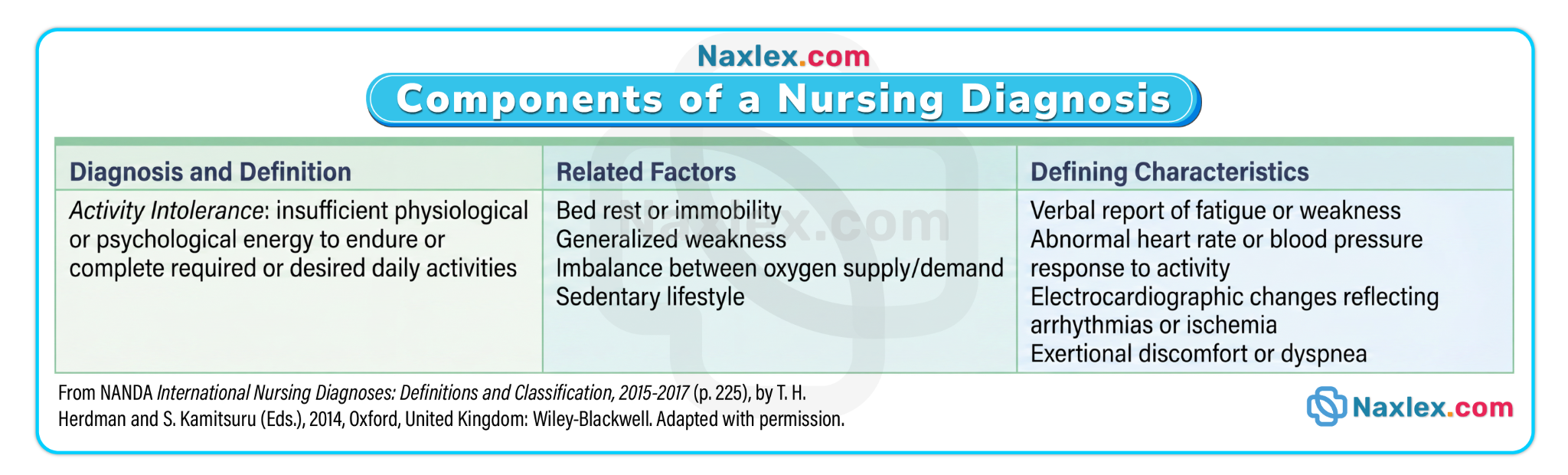
II. The Etiology (Related & Risk Factors)
Identifies the probable causes of the health problem. Differentiating the etiology is crucial because the cause directly dictates the independent nursing interventions needed to individualize care.
Note on Risk Diagnoses: Because risk diagnoses do not have active signs or symptoms, the vulnerability/risk factors themselves serve as the etiology.
III. Defining Characteristics
The specific cluster of signs and symptoms (subjective and objective data) that prove an actual diagnostic label is present.
Critical Differentiations: Nursing vs. Medical vs. Collaborative
To practice safely and within legal boundaries, a nurse must cleanly differentiate human responses from pathophysiologic processes and complications.
Nursing Diagnosis vs. Medical Diagnosis
- Medical Diagnosis: Made by a physician; targets a uniform disease process or specific pathophysiologic response (e.g., Rheumatoid Arthritis). It remains static as long as the disease is present.
- Nursing Diagnosis: Focuses on the human response (physical, sociocultural, psychological, and spiritual) to an illness or health problem. These are highly individualized and change dynamically as the patient's response changes.
- Functional Scope: Covers the nurse's independent functions (areas of unique, autonomous nursing care). However, nurses still hold dependent functions (carrying out physician-prescribed medical therapies).
Collaborative Problems
Potential physiological complications that nurses manage using both independent monitoring and physician-prescribed interventions.
- Nature: They are inherently tied to a specific medical condition or treatment. If a disease is present, certain collaborative problems are automatically expected (e.g., Potential Complication of pneumonia: atelectasis, respiratory failure).
- Contrast with nursing diagnoses: While every patient with pneumonia shares the same potential collaborative complications, they will not share the same nursing diagnoses, because their individual human responses (e.g., anxiety, coping, knowledge levels) differ entirely.
Comparison of Nursing Diagnoses, Medical Diagnoses, and Collaborative Problems
|
Feature |
Nursing Diagnosis |
Medical Diagnosis |
Collaborative Problem |
|
Primary Focus |
Human response to illness or life processes. |
Specific, uniform disease process / pathophysiology. |
Potential physiological complications of a disease or treatment. |
|
Duration |
Changes dynamically as the client's response alters. |
Remains constant as long as the pathology exists. |
Present as long as the associated disease/treatment is present. |
|
Nursing Role |
Independent actions (nursing-prescribed interventions). |
Dependent actions (carrying out physician orders). |
Joint actions (independent monitoring + medical treatments). |
|
Individualization |
Highly individualized to the unique person. |
Uniform from one client to another. |
|
The Diagnostic Process
The Three Steps of the Diagnostic Process
The diagnostic process relies heavily on critical thinking skills: Analysis (deductive reasoning; breaking down the whole into parts) and Synthesis (inductive reasoning; combining components to form a meaningful whole).
Step 1: Analyzing Data ➔ Step 2: Identifying Health Problems/Strengths ➔ Step 3: Formulating Statements
Step 1: Analyzing Data
Data analysis is an ongoing, fluid process for expert clinicians, though it requires systematic progression for novices:
I. Comparing data with standards (Identifying cues)
Nurses draw on baseline knowledge to compare client data against standards and norms (e.g., normal lab values, vital signs, developmental milestones). A cue is considered significant if it:
- Points to a negative or positive change in health status/patterns (e.g., new-onset dyspnea on exertion or successful smoking cessation).
- Varies from the norms of that specific client population (even if the client views the abnormal pattern as their personal "normal").
- Indicates a developmental delay (e.g., a 9-month-old infant unable to sit unsupported).
II. Clustering Cues (Synthesis)
The process of determining the relatedness of facts to identify hidden patterns rather than treating data as isolated incidents.
- Inductive Clustering: Combining independent, raw observations across different assessment areas to form a overarching diagnostic pattern.
- Deductive Clustering: Using an established structural framework (such as Gordon's Functional Health Patterns) to deliberately categorize subjective and objective data.
III. Identifying gaps and inconsistencies
A final check to resolve conflicting data before establishing a valid pattern. Inconsistencies may stem from measurement errors, provider expectations, or unreliable client reports (e.g., stating they haven't seen a doctor in 15 years, but later claiming their doctor checks their blood pressure annually). Gaps must be resolved via clinical validation.
Step 2: Identifying Health Problems, Risks, and Strengths
Once data is analyzed, the nurse determines the clinical path forward:
- Determining problems and risks: Isolating tentative diagnoses and filtering out false leads.
Clinical Example: A client presents with decreased urinary frequency and amount x 2 days. While this initially suggests a primary urinary elimination problem, analyzing it alongside systemic data reveals it is a physiological response to a different problem: Deficient Fluid Volume. The tentative urinary diagnosis is therefore eliminated.
- Determining strengths: Inventorying the client's intact resources, healthy coping mechanisms, and physiological assets (e.g., being a nonsmoker, having weight within normal limits, or possessing a strong support system). Strengths are mobilized to aid health restoration and recovery.
Step 3: Formulating Diagnostic Statements
Diagnostic statements must avoid phrases like "due to" (which implies strict, legally binding causality) and instead use "related to" (r/t) to signify an associative relationship.
|
Format Type |
Structural Composition |
Best Used For |
Clinical Example |
|
One-Part |
Diagnostic Label Only |
Health Promotion & Syndrome Diagnoses. |
Readiness for Enhanced Parenting
Risk for Disuse Syndrome |
|
Two-Part |
Problem + Etiology |
Risk Diagnoses (no active signs/symptoms exist yet) or clear-cut responses. |
Constipation r/t prolonged laxative use |
|
Three-Part (PES) |
Problem + Etiology + Signs/Symptoms |
Actual Diagnoses. Highly recommended for beginners to validate choices. |
Anxiety r/t threat to physiological integrity secondary to possible cancer diagnosis AMF client stating "I feel terrified," tachycardia, and restlessness. |
Format variations & modifications
To maximize clinical accuracy, basic formats can be expanded using specific linguistic tools:
- Specifiers: Modifying NANDA labels containing the instruction (Specify) to designate the exact area of concern (e.g., Deficient Knowledge [Diabetic Diet]).
- Secondary To (s/t): Dividing the etiology into two distinct parts, placing a medical diagnosis or pathophysiological process after the phrase to ground the diagnosis (e.g., Risk for Impaired Skin Integrity r/t decreased peripheral circulation s/t diabetes).
- Unknown etiology / complex factors: Used when defining characteristics are fully present but the precise cause cannot be identified, or when the causes are too convoluted to express briefly (e.g., Chronic Low Self-Esteem r/t complex factors).
- "Possible": Inserted when the nurse requires additional assessment data to confidently confirm either the primary problem statement or its exact etiology (e.g., Possible Low Self-Esteem r/t loss of job).
- Anatomical descriptors: Adding a localized descriptor to a general NANDA label to pinpoint the problem (e.g., Impaired Skin Integrity [Left Lateral Ankle]).
Collaborative problems format
All collaborative problems should begin with the standardized label Potential Complication (PC), identifying both the systemic threat and the underlying medical cause or treatment producing it.
- Example 1: Potential Complication of Head Injury: increased intracranial pressure
- Example 2: Potential Complication of Pregnancy-Induced Hypertension: seizures, fetal distress, pulmonary edema
Preventing Errors in Diagnostic Reasoning
Evolution and Taxonomy of NANDA
The classification of nursing diagnoses has evolved from a simple alphabetical list into a sophisticated, scientifically backed taxonomy.
The Historical Shift
- Initial System: Organized purely alphabetically, which was critiqued as unscientific and lacking clinical depth.
- 1982–1984 (Human Response Patterns): NANDA adopted a hierarchical system based on structural nursing models (Roy, Rogers, and Gordon) comprised of nine core Human Response Patterns:
- Exchanging (mutual giving/receiving)
- Communicating (sending messages)
- Relating (establishing bonds)
- Valuing (assigning relative worth)
- Choosing (selecting alternatives)
- Moving (activity)
- Perceiving (reception of info)
- Knowing (meaning of info)
- Feeling (subjective awareness)
Modern Taxonomy II Structure
Today, NANDA utilizes Taxonomy II, which abandons the older human response patterns and organizes diagnoses across three strict structural layers: Domains 🡪 Classes 🡪 Nursing Diagnoses.
- The 7 Multiaxial Axes: Diagnoses are now systematically coded according to seven specific axes to guarantee precision:
- Diagnostic Concept
- Subject
- Judgment
- Location
- Age
- Time
- Status
- Alphabetical by concept: Labels are alphabetized by their core clinical concept rather than their first descriptor (e.g., Infection, Risk for is listed under "I" for Infection in indexing, but written conversationally as Risk for Infection).
Standardized Language & The DRC Process
Nursing diagnoses are dynamic, evolving labels rather than static, finished products.
- The Approval Process: Nurses submit newly proposed or modified diagnoses to the Diagnostic Review Committee (DRC). The DRC evaluates and "stages" the proposal based on its underlying research and clinical evidence. Final inclusion into the official registry requires formal approval from the NANDA Board of Directors.
- The NNN Alliance Context: Nursing diagnoses do not stand alone; they form one part of a unified, standardized electronic health language designed for modern computerized records (the Nursing Minimum Data Set). They link directly with:
- NIC: Nursing Interventions Classification (what the nurse does).
- NOC: Nursing Outcomes Classification (what the client achieves).
Lifespan Considerations in Diagnosing
I. Pediatrics (Children & Families)
- Developmental milestones and transitions are not pathologies or illnesses, yet they frequently benefit from structured nursing support.
- Diagnoses in pediatrics heavily favor health promotion and wellness states, targeting family readiness to adapt to normal growth trajectories.
- Clinical Example: Eager parents of a healthy newborn demonstrating a desire to optimize their home environment warrant a diagnosis of Readiness for Enhanced Family Processes, shifting the nursing focus to education, anticipatory guidance, and validation.
II. Geriatrics (Older Adults)
- Ill older adults typically present with multisystem, complex physical and psychosocial needs that manifest as multiple overlapping diagnoses stemming from a single underlying medical condition.
- Dynamic Prioritization: The nurse must systematically sequence diagnoses based on acute physiological survival needs, shifting focus to secondary diagnoses as the client stabilizes.
|
Diagnostic accuracy requires active critical thinking to avoid cognitive traps like overgeneralization, stereotyping, and unvalidated assumptions.
Clinical Distinction: If a client is acutely anxious on admission day about arranging temporary childcare, do not write a permanent diagnosis of Interrupted Family Processes. Instead, use Risk for Interrupted Family Processes, as the issue is highly likely to resolve autonomously within 24 hours.
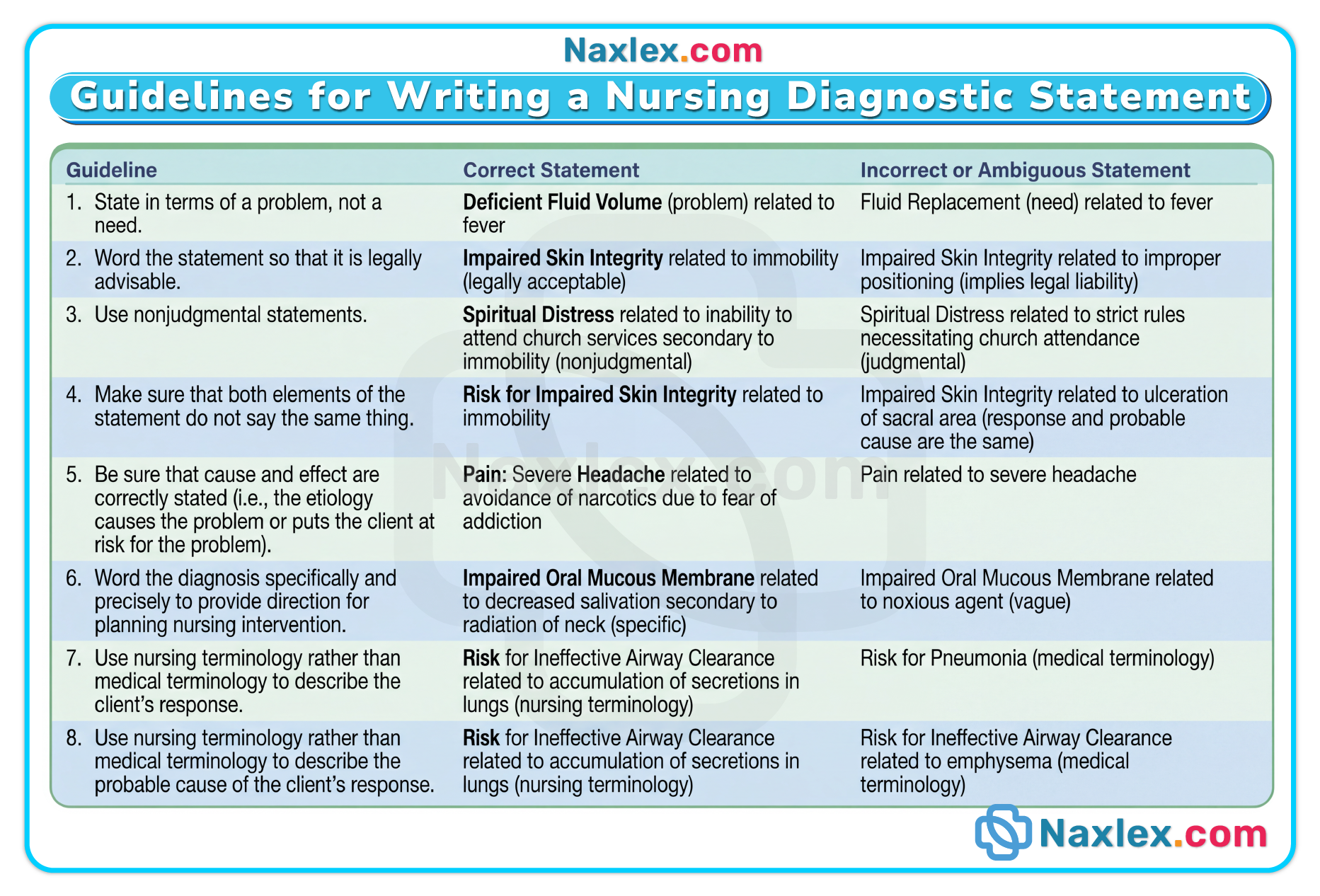
|
||
- Asset Mapping: Even amidst complex multi-system failure, the older adult's remaining intrinsic strengths and functional assets must be factored into every phase of the care plan to optimize recovery.
Ongoing Development of Nursing Diagnoses
Evolution and Taxonomy of NANDA
The classification of nursing diagnoses has evolved from a simple alphabetical list into a sophisticated, scientifically backed taxonomy.
The Historical Shift
- Initial System: Organized purely alphabetically, which was critiqued as unscientific and lacking clinical depth.
- 1982–1984 (Human Response Patterns): NANDA adopted a hierarchical system based on structural nursing models (Roy, Rogers, and Gordon) comprised of nine core Human Response Patterns:
- Exchanging (mutual giving/receiving)
- Communicating (sending messages)
- Relating (establishing bonds)
- Valuing (assigning relative worth)
- Choosing (selecting alternatives)
- Moving (activity)
- Perceiving (reception of info)
- Knowing (meaning of info)
- Feeling (subjective awareness)
Modern Taxonomy II Structure
Today, NANDA utilizes Taxonomy II, which abandons the older human response patterns and organizes diagnoses across three strict structural layers: Domains 🡪 Classes 🡪 Nursing Diagnoses.
- The 7 Multiaxial Axes: Diagnoses are now systematically coded according to seven specific axes to guarantee precision:
- Diagnostic Concept
- Subject
- Judgment
- Location
- Age
- Time
- Status
- Alphabetical by concept: Labels are alphabetized by their core clinical concept rather than their first descriptor (e.g., Infection, Risk for is listed under "I" for Infection in indexing, but written conversationally as Risk for Infection).
Standardized Language & The DRC Process
Nursing diagnoses are dynamic, evolving labels rather than static, finished products.
- The Approval Process: Nurses submit newly proposed or modified diagnoses to the Diagnostic Review Committee (DRC). The DRC evaluates and "stages" the proposal based on its underlying research and clinical evidence. Final inclusion into the official registry requires formal approval from the NANDA Board of Directors.
- The NNN Alliance Context: Nursing diagnoses do not stand alone; they form one part of a unified, standardized electronic health language designed for modern computerized records (the Nursing Minimum Data Set). They link directly with:
- NIC: Nursing Interventions Classification (what the nurse does).
- NOC: Nursing Outcomes Classification (what the client achieves).
Lifespan Considerations in Diagnosing
I. Pediatrics (Children & Families)
- Developmental milestones and transitions are not pathologies or illnesses, yet they frequently benefit from structured nursing support.
- Diagnoses in pediatrics heavily favor health promotion and wellness states, targeting family readiness to adapt to normal growth trajectories.
- Clinical Example: Eager parents of a healthy newborn demonstrating a desire to optimize their home environment warrant a diagnosis of Readiness for Enhanced Family Processes, shifting the nursing focus to education, anticipatory guidance, and validation.
II. Geriatrics (Older Adults)
- Ill older adults typically present with multisystem, complex physical and psychosocial needs that manifest as multiple overlapping diagnoses stemming from a single underlying medical condition.
- Dynamic Prioritization: The nurse must systematically sequence diagnoses based on acute physiological survival needs, shifting focus to secondary diagnoses as the client stabilizes.
|
Acute Phase: Life Threats |
|
Resolution Phase: Functional Recovery |
|
Decreased Cardiac Output Excess Fluid Volume |
───► |
Activity Intolerance Deficient Knowledge (New Med Regimen) |
- Asset Mapping: Even amidst complex multi-system failure, the older adult's remaining intrinsic strengths and functional assets must be factored into every phase of the care plan to optimize recovery.
Summary
- A diagnosis is a statement or conclusion regarding the nature of a phenomenon.
- Professional standards of care hold that registered nurses are responsible for making nursing diagnoses, even though others may contribute data or implement care.
- A nursing diagnosis is a clinical judgment about the client’s responses to actual and potential processes.
- A nursing diagnosis has three components: the problem (and its definition), the etiology, and the defining characteristics. Each component serves a specific purpose.
- The three phases of the diagnostic process are data analysis; identification of the client’s health problems, health risks, and strengths; and formulation of diagnostic statements.
- The organizing principles for the NANDA Taxonomy II are the seven axes: diagnostic concept, subject of diagnosis, judgment, location, age, time, and status of diagnosis.
Naxlex
Videos
Login to View Video
Click here to loginTake Notes on Nursing diagnosis
This filled cannot be empty
Join Naxlex Nursing for nursing questions & guides! Sign Up Now