






 Video Library


Practice Exercise 2
Total Questions : 10
Showing 10 questions, Sign in for moreWhat should the nurse reading the monitor strip call a rhythm with a regular PR interval but a blocked QRS complex?
A client has undergone defibrillation, and the advanced cardiac life support (ACLS) nurse identifies pulseless electrical activity (PEA). Which characteristic should the nurse understand about this rhythm?
A client with no history of heart disease has a rhythm strip showing an occasional distorted P wave followed by normal atrioventricular and ventricular conduction. Which question should the nurse ask the client?
A client’s rhythm strip shows a normal heart rate and rhythm with normal P waves and QRS complexes, but the PR interval measures 0.26 second. What action should the nurse take?
Which rhythm pattern finding is indicative of PVCs?
The nurse is reviewing an ECG that demonstrates regular “sawtooth” atrial waves occurring at a rapid rate. Which dysrhythmia is most consistent with this finding?
The nurse in the telemetry unit observes the following pattern on the client’s monitor. The client is unresponsive and has no palpable pulse. Which action is the priority?
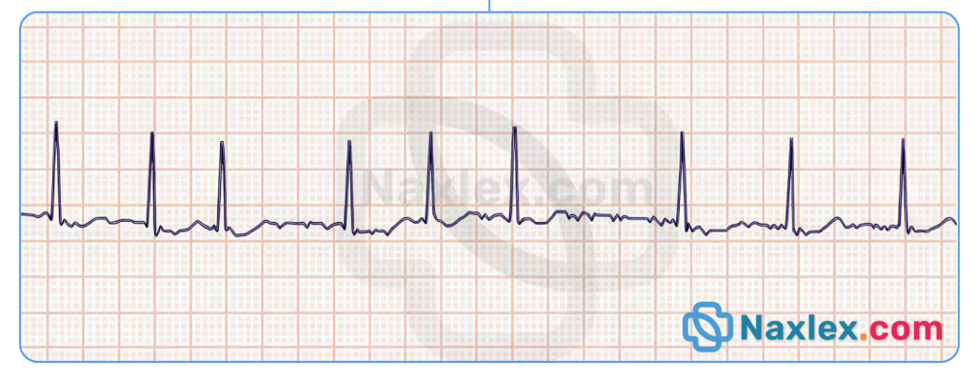
The nurse is caring for a client whose ECG tracing is as shown below. The nurse should recognize the tracing as?
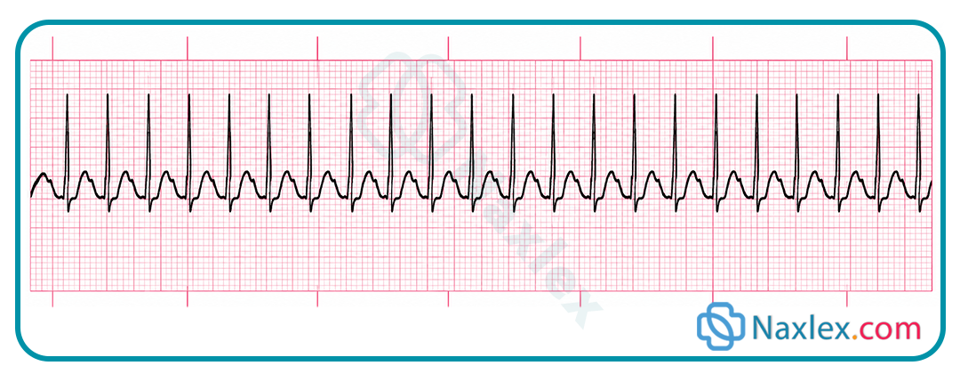
The nurse reviews an ECG and observes that every P wave is followed by a QRS complex. The PR interval is consistently prolonged at 0.24 seconds. Which conduction abnormality does this finding indicate?
The nurse is evaluating a client with acute chest pressure. The ECG demonstrates ST-segment elevation in contiguous leads. Which interpretation is accurate?
Sign Up or Login to view all the 10 Questions on this Exam
Join over 100,000+ nursing students using Naxlex’s science-backend flashcards, practice tests and expert solutions to improve their grades and reach their goals.
Sign Up Now