




 Video Library


Exam Review
Comprehensive Questions
Total Questions : 15
Showing 15 questions, Sign in for moreA nurse is planning care for a client with chronic lung disease who is receiving oxygen through a nasal cannula. What does the nurse expect?
A nurse is caring for a client who is breathing spontaneously. Which oxygen delivery device would the nurse expect to use to provide the highest concentration of oxygen to this client?
A nurse is performing oropharyngeal suctioning on a client. Which action would the nurse include?
A nurse is educating a client about inhalers. Effective use of a metered-dose inhaler requires that the client accomplish which action?
A client has chronic obstructive pulmonary disease (COPD). The nurse has taught the client that pursed-lip breathing helps them by:
A client develops sudden cardiac arrest. It is imperative to begin CPR as soon as possible. What is the critical time that the nurse must keep in mind before irreversible brain damage occurs?
A client is in the hospital with a medical diagnosis of viral pneumonia. They are receiving oxygen through a simple face mask. The nurse ensures that the mask fits snugly over the client’s face for which reason?
A nurse suctioning a client through a tracheostomy tube was careful not to occlude the Y port when inserting the suction catheter because this would do which of the following?
A nurse is preparing to administer oxygen to a client. Which action does the nurse use to follow safe technique when using a portable oxygen cylinder?
A nurse is performing tracheal suctioning for a client. Which of the following assessments should the nurse consider when performing tracheal suctioning? Select all that apply
The nurse is preparing to perform nasotracheal suctioning on a client. Arrange the steps in order.
Explanation
1. Perform hand hygiene (Step 7)
Hand hygiene reduces the risk of introducing pathogens into the airway and prevents cross-contamination. It is always the first step before any invasive procedure.
2. Assist client to semi-Fowler’s or high Fowler’s position, if able (Step 2)
Upright positioning promotes lung expansion, improves oxygenation, and makes insertion of the catheter easier by aligning the airway.
3. Apply sterile gloves (Step 6)
Sterile gloves maintain asepsis during suctioning, which is a sterile procedure. This protects both the patient and nurse from infection.
4. Have client take deep breaths (Step 4)
Deep breathing increases oxygen reserves and reduces the risk of hypoxia during suctioning, since suctioning temporarily interrupts airflow.
5. Lubricate catheter with water-soluble lubricant (Step 5)
Lubrication minimizes trauma to the nasal mucosa and facilitates smooth passage of the catheter through the nares.
6. Advance catheter through nares and into trachea (Step 3)
The catheter is gently inserted until resistance or coughing indicates entry into the trachea. This ensures secretions are accessed at the source.
7. Apply suction (Step 1)
Suction is applied while withdrawing the catheter, not during insertion, to avoid mucosal damage and hypoxia. Suction removes secretions effectively.
8. Withdraw catheter (Step 8)
The catheter is withdrawn while rotating to maximize secretion removal. This completes the suctioning cycle safely.
Test-taking strategy
- Standardize the start: Nearly every nursing procedure begins with hand hygiene (7).
- Prioritize preparation: You must position the patient (2) and prepare the sterile field/gloves (6) before touching the patient or equipment.
- Avoid trauma: Always lubricate (5) before you insert (3).
- Apply the safety rule: You must hyperoxygenate (4) before you suction, and you must never apply suction (1) while pushing the tube in; it only happens during withdrawal (8).
Take home points
- Water-soluble lubricant is mandatory to prevent lipid pneumonia and facilitate smooth passage through the nares.
- Semi-Fowler's or high Fowler's position helps the patient hyperventilate and facilitates the anatomical passage of the catheter.
A nurse is caring for a client with a chest tube in situ. Which number corresponds to the spot where the nurse would assess for an air leak?
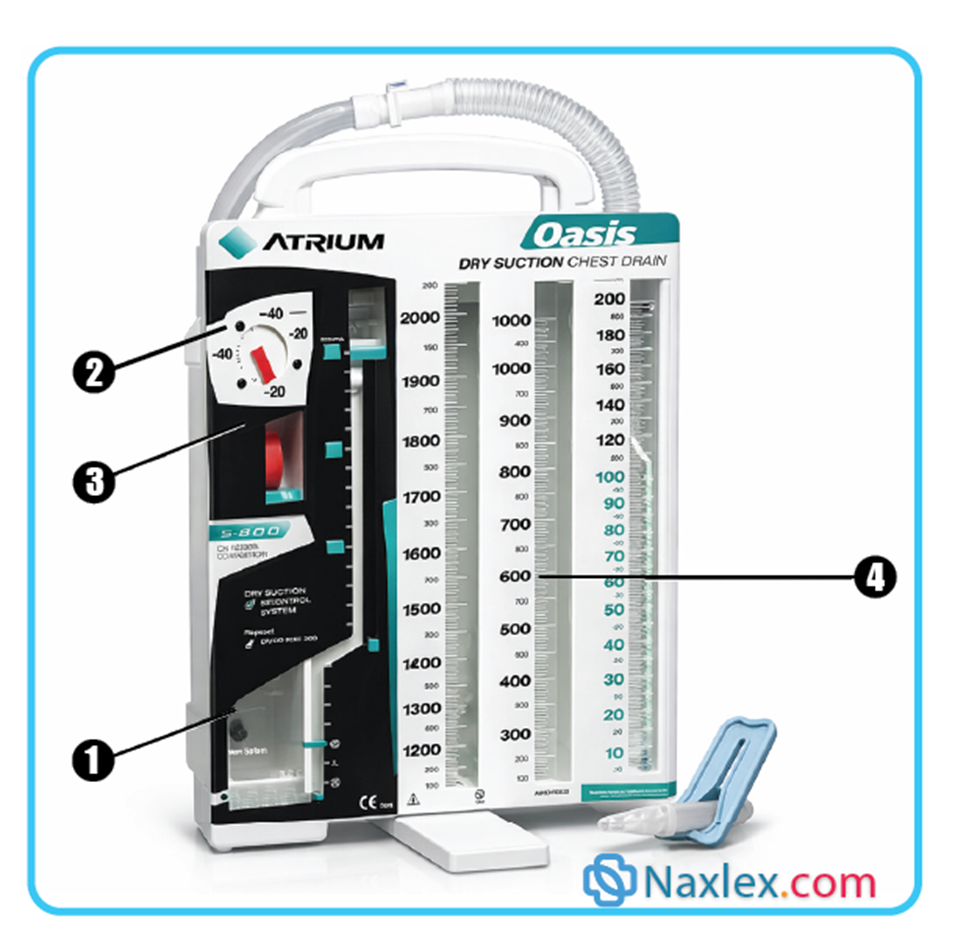
A portable chest tube drainage system shows four labels marked 1 to 4 as:
The nurse is caring for a client with a chest tube for treatment of a right pneumothorax. Which assessment finding necessitates immediate notification of the health care provider?
The nurse is caring for a client with pneumonia. On entering the room, the nurse finds the client lying in bed, coughing, and unable to clear secretions. What should the nurse do first?
The nurse is caring for a client with an artificial airway. Which of the following are reasons to suction the client? Select all that apply
Sign Up or Login to view all the 15 Questions on this Exam
Join over 100,000+ nursing students using Naxlex’s science-backend flashcards, practice tests and expert solutions to improve their grades and reach their goals.
Sign Up Now