






 Video Library


Comprehensive Questions
Total Questions : 15
Showing 15 questions, Sign in for moreWhich is a normal finding on auscultation of the lungs?
The nurse positions the client sitting upright during palpation of which area?
After auscultating the abdomen, the nurse should report which finding to the primary care provider?
If unable to locate the client’s popliteal pulse during a routine examination, what should the nurse do next?
Which of the following is an expected finding during assessment of the older adult?
If the client reports loss of short-term memory, the nurse would assess this using which one of the following?
To palpate lymph nodes, the nurse uses which technique?
A patient has been admitted from the emergency department (ED) with a primary problem of abdominal pain. Diagnostic tests performed in the ED are pending. The nurse focuses an examination on the abdomen and uses the following techniques. Which technique is correct?
Which number corresponds to the area of the chest where you would auscultate for the tricuspid valve?
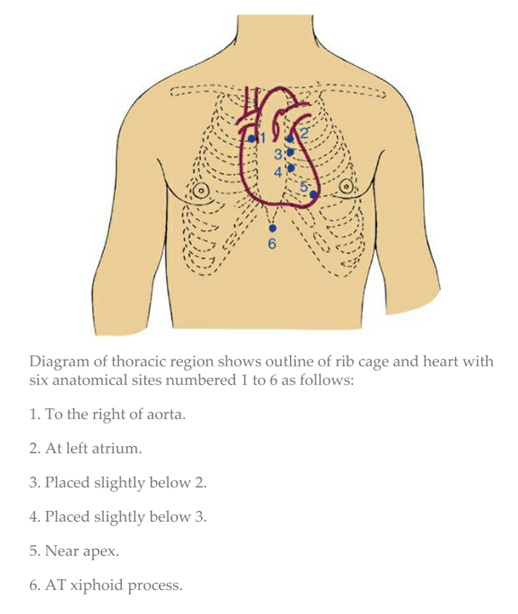
The nurse is teaching a patient to prevent heart disease. Which information should the nurse include? Select all that apply
The nurse is assessing the cranial nerves. Match the cranial nerve with its related function.
Explanation
The cranial nerves (CN I–XII) emerge directly from the brain and brainstem and control various motor, sensory, and parasympathetic functions of the head, neck, and some thoracic organs. During a comprehensive neurological assessment, the nurse must test these nerves to identify signs of neurologic dysfunction.
Rationale for correct answers:
1.XII Hypoglossal -e. Position of the tongue
The hypoglossal nerve controls the motor movement of the tongue. During assessment, the client is asked to stick out the tongue, and deviation or weakness indicates impairment of CN XII.
2. V Trigeminal -a. Motor innervation to the jaw
The trigeminal nerve has both motor and sensory components. Motor function includes muscles of mastication (chewing). The nurse assesses jaw movement and strength.
3. VI Abducens -b. Lateral movement of the eyeballs
The abducens nerve controls the lateral rectus muscle, which moves the eye laterally (abduction). Inability to look outward may suggest CN VI palsy.
4. IV Trochlear -d. Downward, inward eye movements
The trochlear nerve controls the superior oblique muscle, responsible for downward and inward eye movement. Difficulty with this motion may lead to vertical diplopia (double vision).
5. X Vagus -c. Sensation of the pharynx
The vagus nerve provides sensory innervation to the pharynx and larynx, and also has motor and parasympathetic functions. It plays a role in swallowing, speech, and the gag reflex.
Take home points
Each cranial nerve has specific motor, sensory, or both functions, and testing them individually helps identify the location and extent of neurological impairment.
- Cranial nerves IV (Trochlear), VI (Abducens), and III (Oculomotor) are especially important for eye movement coordination.
- CN V (Trigeminal) and XII (Hypoglossal) focus on facial sensation/mastication and tongue movement, respectively.
The nurse is observing the patient for general appearance and behavior. What assessments might indicate that the patient is in pain? Select all that apply
A patient has undergone surgery for a femoral artery bypass. The surgeon’s orders include assessment of dorsalis pedis pulses. The nurse will use which of the following techniques to assess the pulses? Select all that apply
Which of the following are normal findings you should find during a physical exam? Select all that apply
The nurse is assessing a patient who returned 1 hour ago from surgery for an abdominal hysterectomy. Which assessment finding would require immediate follow-up?
Sign Up or Login to view all the 15 Questions on this Exam
Join over 100,000+ nursing students using Naxlex’s science-backend flashcards, practice tests and expert solutions to improve their grades and reach their goals.
Sign Up Now