
A nurse fails to monitor vital signs in accordance with the policy's of the hospital for a post- operative client. As a result, complications occur. On what basis might a lawsuit be successful? The nurse:
was negligent, resulting in harm to the client.
was acting on the principle of nonmaleficence.
committed a misdemeanor.
was unethical in her practice.
The Correct Answer is A
A. Negligence in nursing refers to the failure to provide care that meets established standards, resulting in harm to the patient. In this case, if the nurse failed to monitor vital signs as per hospital policies and this failure led to complications for the post-operative client, it could constitute negligence. Negligence involves breaching the duty of care owed to the patient, causing harm that could have been reasonably prevented.
B. Nonmaleficence is the principle of doing no harm. While it is an ethical principle guiding healthcare practice, it does not justify or excuse negligence. Negligence involves a failure to uphold the duty of care owed to the patient, resulting in harm due to substandard practice.
C. A misdemeanor typically refers to a lesser criminal offense. Negligence in healthcare generally does not rise to the level of a criminal offense like a misdemeanor unless there is gross negligence or willful misconduct. In most cases, negligence leading to harm is addressed through civil litigation rather than criminal charges.
D. While negligence can certainly be considered unethical behavior in the context of healthcare, negligence itself is a legal concept related to professional malpractice rather than solely an ethical breach. Ethical violations may involve different aspects of professional conduct not directly related to negligence, such as breaches of confidentiality or conflicts of interest.
Nursing Test Bank
Naxlex Comprehensive Predictor Exams
Related Questions
Correct Answer is C
Explanation
C. Chvostek's sign is assessed by tapping or lightly percussing the facial nerve (facial muscles) at the angle of the jaw, just in front of the earlobe. A positive Chvostek's sign is indicated by facial twitching, especially around the mouth, nose, and eye, in response to this percussion. It indicates neuromuscular irritability due to low calcium levels.
A. Straining urine is typically done to collect urine for analysis or to detect urinary stones. It does not relate to the assessment of neuromuscular irritability, which is what Chvostek's sign evaluates.
B. This option does not pertain to assessing Chvostek's sign either. Inflating a blood pressure cuff above systolic measurement is a technique used to assess for Trousseau's sign, which is another clinical indicator of hypocalcemia but involves different physiological mechanisms than Chvostek's sign.
D. This option is unrelated to assessing Chvostek's sign or hypocalcemia. Baseline height and weight are typically obtained for nutritional assessment, growth monitoring, or as part of a general health assessment. They do not help in evaluating neuromuscular irritability associated with calcium levels.
Correct Answer is C
Explanation
C. If the stressor persists for a prolonged period and the body is unable to adapt or cope effectively, it enters the exhaustion phase. During this phase, the body's resources become depleted. The client experiences decreased energy, reduced ability to cope with stress, and may develop stress-related illnesses or complications.
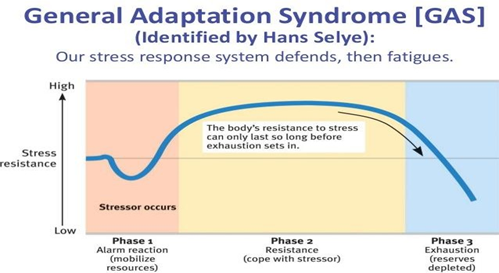
A. It is characterized by the body's immediate response to a stressor, where physiological changes occur such as increased heart rate, heightened senses, and activation of the fight-or-flight response.
B. After the initial alarm reaction, if the stressor persists, the body enters the resistance phase. In this phase, physiological changes stabilize as the body attempts to cope with the stressor.
D. This phase occurs if the stressor is removed or successfully managed, allowing the body to recover and return to a state of homeostasis. During recovery, the body repairs any damage caused by the stress response and replenishes its energy and resources.
Whether you are a student looking to ace your exams or a practicing nurse seeking to enhance your expertise , our nursing education contents will empower you with the confidence and competence to make a difference in the lives of patients and become a respected leader in the healthcare field.
Visit Naxlex, invest in your future and unlock endless possibilities with our unparalleled nursing education contents today