
The nurse explains to parents of school-age children that according to Kohlberg's theory of moral development, their child is at the conventional stage of moral development. Which is the nurse's best explanation for the motivation for school-age children to follow rules?
They follow rules out of a sense of being a "good person."
They follow rules out of fear of being punished.
They follow rules in order to receive praise from caretakers.
They follow rules because it is in their nature to do so.
The Correct Answer is A
A. They follow rules out of a sense of being a "good person.": According to Kohlberg, at the conventional stage of moral development, individuals are motivated to follow rules and laws to maintain social order and to be perceived as good members of society.
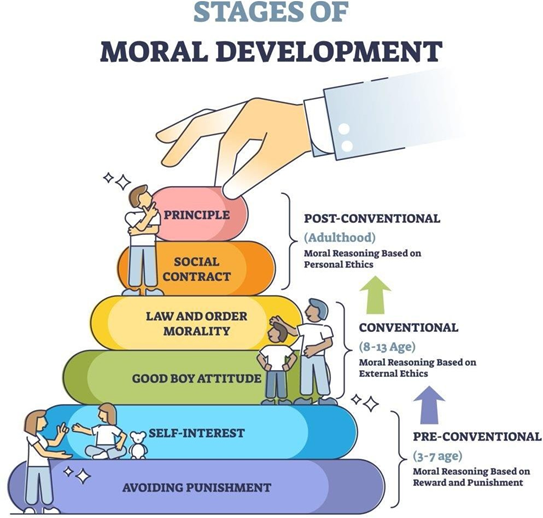
B. They follow rules out of fear of being punisheD. Fear of punishment is more characteristic of the preconventional stage of moral development, where individuals make moral decisions based on avoiding punishment or seeking reward.
C. They follow rules in order to receive praise from caretakers: Seeking praise from caretakers may influence behavior, but it does not reflect the underlying motivation for following rules according to Kohlberg's theory.
D. They follow rules because it is in their nature to do so: While some individuals may have a predisposition to follow rules, Kohlberg's theory focuses on the moral reasoning behind rule- following rather than inherent tendencies
Nursing Test Bank
Naxlex Comprehensive Predictor Exams
Related Questions
Correct Answer is A
Explanation
A. A child whose parents answer questions for the child. This behavior may indicate that the child's parents are controlling or dominating, possibly preventing the child from expressing their own thoughts or feelings. It could be a sign of emotional or psychological abuse, where the child's autonomy and voice are suppressed.
B. A child who has frequent visitors: While frequent visitors may raise concerns about the child's social environment, it does not necessarily indicate abuse. Further assessment would be needed to determine the nature of these visits and their impact on the child's well-being.
C. A child who uses the call light frequently: Frequent use of the call light may indicate physical discomfort, illness, or anxiety, but it does not inherently suggest abuse. It could be related to the child's medical condition or emotional state.
D. A child who has a BMI indicating obesity: Obesity alone is not indicative of abuse. While it may raise concerns about the child's health and well-being, it does not directly point to abuse unless there are additional signs or symptoms suggestive of neglect or mistreatment.
Correct Answer is C
Explanation
A. The child exhibits plantar grasp reflex: The presence of the plantar grasp reflex at 10 months
is appropriate and not cause for concern. This reflex typically diminishes by around 9 months but can persist slightly longer in premature infants.
B. The child has doubled his birth weight: Doubling birth weight by around 6 months is a normal developmental milestone, and achieving this by 10 months is appropriate, indicating healthy growth.
C. No primary teeth have erupted yet: The absence of primary teeth by 10 months, especially in a preterm infant, may indicate a delay in dental development and should prompt further evaluation by a healthcare provider.
D. The child's head circumference is 49.53 cm: The head circumference of 49.53 cm falls within the typical range for a 10-month-old infant and is not inherently concerning.
Whether you are a student looking to ace your exams or a practicing nurse seeking to enhance your expertise , our nursing education contents will empower you with the confidence and competence to make a difference in the lives of patients and become a respected leader in the healthcare field.
Visit Naxlex, invest in your future and unlock endless possibilities with our unparalleled nursing education contents today