
A nurse is assessing a client who is admitted for elective surgery and has a history of Addison's disease. Which of the following findings should the nurse expect?
Intention tremors
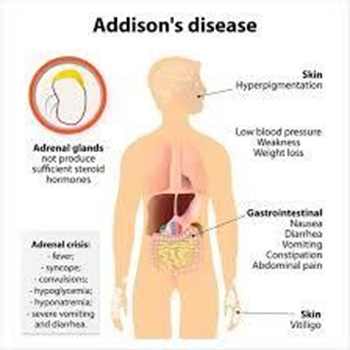
Hyperpigmentation
Purple striations
Hirsutism
The Correct Answer is B
A. Intention tremors are not typically associated with Addison's disease.
B. Hyperpigmentation, particularly in sun-exposed areas and pressure points, is a characteristic finding in Addison's disease due to increased melanocyte-stimulating hormone (MSH) production.
C. Purple striations are typically associated with Cushing's syndrome, not Addison's disease.
D. Hirsutism (excessive hair growth) is not a common manifestation of Addison's disease. It is more associated with Cushing’s disease.
Nursing Test Bank
Naxlex Comprehensive Predictor Exams
Related Questions
Correct Answer is B
Explanation
A. Intention tremors are not typically associated with Addison's disease.
B. Hyperpigmentation, particularly in sun-exposed areas and pressure points, is a characteristic finding in Addison's disease due to increased melanocyte-stimulating hormone (MSH) production.
C. Purple striations are typically associated with Cushing's syndrome, not Addison's disease.
D. Hirsutism (excessive hair growth) is not a common manifestation of Addison's disease. It is more associated with Cushing’s disease.
Correct Answer is C
Explanation
A. The pH is alkalotic, and the PaCO2 is within the normal range, indicating respiratory alkalosis, which is not typically seen in chronic kidney disease.
B. The pH is alkalotic, and the HCO3 level is lower than normal, indicating metabolic acidosis, which can occur in chronic kidney disease, but the PaCO2 is not typically decreased in metabolic acidosis.
C. This choice fits the pattern of metabolic acidosis commonly seen in CKD patients. In patients with chronic kidney disease (CKD), the kidneys are less able to excrete acid, leading to metabolic acidosis. Therefore, the expected arterial blood gas values would show a lower pH indicating acidemia, a decreased bicarbonate (HCO3-) level, and a normal or low partial pressure of carbon dioxide (PaCO2) as the lungs try to compensate by blowing off CO2.
D. The pH is acidic, and the HCO3 level is within the normal range, indicating respiratory acidosis, which is not typically seen in chronic kidney disease.
Whether you are a student looking to ace your exams or a practicing nurse seeking to enhance your expertise , our nursing education contents will empower you with the confidence and competence to make a difference in the lives of patients and become a respected leader in the healthcare field.
Visit Naxlex, invest in your future and unlock endless possibilities with our unparalleled nursing education contents today