
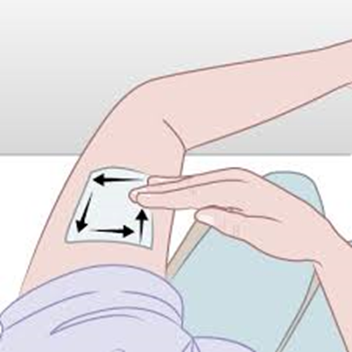
A nurse is assisting with the plan of care for an older adult client who has a new prescription for transdermal clonidine. Which of the following information should the nurse include in the plan of care?
Inform the client of the adverse effect of diarrhea.
Monitor the client for weight loss.
Advise the client about increased dry mouth.
Check the client for increased hypopigmentation under the patch.
The Correct Answer is C
Choice A Reason:
Informing the client of the adverse effect of diarrhea is less common with clonidine use, especially in comparison to other side effects like dry mouth or skin irritation.
Choice B Reason:
Monitoring for weight loss isn't a primary concern specifically associated with transdermal clonidine use.
Choice C Reason:
Advise the client about increased dry mouth. Dry mouth is a common adverse effect of clonidine, including the transdermal form. Patients should be informed about this so they can manage it effectively, for example, by drinking plenty of water or using sugar-free gum or candy to stimulate saliva production.
Choice D Reason:
Hypopigmentation is not a commonly reported issue with transdermal clonidine patches. However, local skin irritation or rash can occur at the site of the patch.
Nursing Test Bank
Naxlex Comprehensive Predictor Exams
Related Questions
Correct Answer is C
Explanation
Choice A Reason:
Digoxin is a cardiac medication used to treat heart conditions such as heart failure and certain arrhythmias. There's no direct chemical relationship between digoxin and sulfa compounds. Generally, digoxin does not contain sulfa components, so it's less likely to cause an allergic reaction in individuals with sulfa allergies. This medication does not typically require clarification for someone with a sulfa allergy.
Choice B Reason:
Prednisone is a corticosteroid used to treat a variety of conditions, including inflammation, allergies, and autoimmune disorders. It does not contain sulfonamide groups in its structure. As a corticosteroid, prednisone is distinct from sulfonamide drugs and is generally considered safe for individuals with sulfa allergies. There is typically no need to clarify this medication for a sulfa-allergic client.
Choice C Reason:
Celecoxib is a nonsteroidal anti-inflammatory drug (NSAID) that belongs to the sulfonamide class. While it is not the same as sulfonamide antibiotics, it contains a sulfonamide moiety in its chemical structure. There's a possibility of cross-reactivity or allergic reactions in individuals with sulfa allergies due to the structural similarity, making it essential to clarify this prescription for someone with a sulfa allergy.
Choice D Reason:
Atorvastatin is a statin medication used to lower cholesterol levels. It does not contain a sulfonamide group in its structure. Statins belong to a different drug class and do not typically pose a risk of cross-reactivity in individuals with sulfa allergies. Therefore, atorvastatin is generally considered safe and does not usually require clarification for a sulfa-allergic client.
Correct Answer is A
Explanation
Choice A Reason:
"I will use a skin sealant before I apply the bag." This statement is appropriate. Using a skin sealant before applying the ostomy bag helps protect the skin around the stoma, creating a barrier against irritation and potential leaks from the stool. It demonstrates the client's understanding of preventive measures to maintain skin integrity.
Choice B Reason:
"I will use moisturizing soap to clean around the stoma before applying the bag." This statement is inappropriate. While keeping the area around the stoma clean is important, using moisturizing soap might not be recommended as it can leave residue and interfere with the adhesive properties of the bag. Typically, mild soap and water are recommended for cleansing.
Choice C Reason:
"I will cut the wafer opening one-fourth of an inch larger than the stoma." This statement is incorrect. Cutting the wafer opening one-fourth of an inch larger than the stoma might result in an excessively large opening, potentially leading to leaks or irritation. The ideal size is generally recommended to be as close to the stoma size as possible without causing pressure on the stoma.
Choice D Reason:
"I will need to empty the bag every 4 to 6 hours." This statement is incorrect. While regular emptying of the ostomy bag is necessary, the frequency can vary based on individual needs and stoma output. Some individuals might need to empty it more frequently or less often, depending on their stool output and comfort level.
Whether you are a student looking to ace your exams or a practicing nurse seeking to enhance your expertise , our nursing education contents will empower you with the confidence and competence to make a difference in the lives of patients and become a respected leader in the healthcare field.
Visit Naxlex, invest in your future and unlock endless possibilities with our unparalleled nursing education contents today