
A one-day post-operative client complains of having a lot of mucus in his throat and is having a difficult time moving it to his mouth so he can spit it out. The client is reluctant to perform coughing and deep breathing due to pain. Based on the data, the priority problem that the nurse could assign to this patient is:
activity intolerance.
ineffective breathing pattern.
ineffective gas exchange.
ineffective airway clearance.
The Correct Answer is D
D. This refers to the inability to clear secretions or obstructions from the respiratory tract to maintain airway patency. Based on the client's complaint of difficulty moving mucus from the throat to the mouth for expectoration, ineffective airway clearance is the priority problem. The client's reluctance to cough and deep breathe due to pain further exacerbates this issue, as effective airway clearance is crucial for preventing complications such as respiratory infections or atelectasis post-operatively.
A. Activity intolerance refers to insufficient physiological or psychological energy to endure or complete required or desired daily activities. In the case of a one-day post-operative client experiencing difficulty clearing mucus, activity intolerance is not the priority problem. The client's main issue is related to respiratory function and airway clearance rather than overall activity tolerance.
B. This refers to abnormal respiratory rate, depth, or rhythm that does not provide adequate ventilation. While the client's complaint of difficulty moving mucus and reluctance to cough or deep breathe suggests some respiratory discomfort, the main issue appears to be the inability to effectively clear airway secretions rather than an overall ineffective breathing pattern.
C. This refers to the inability to exchange oxygen and carbon dioxide across the alveolar-capillary membranes. While mucus in the throat can potentially affect gas exchange if it obstructs airflow significantly, the client's primary complaint is about difficulty clearing mucus rather than signs and symptoms of inadequate oxygenation or ventilation.
Nursing Test Bank
Naxlex Comprehensive Predictor Exams
Related Questions
Correct Answer is A
Explanation
A. The pulmonic valve is best auscultated at the second intercostal space (ICS) on the left sternal border. This is where the area corresponding to the pulmonic valve is most accurately heard due to the anatomical positioning of the heart.
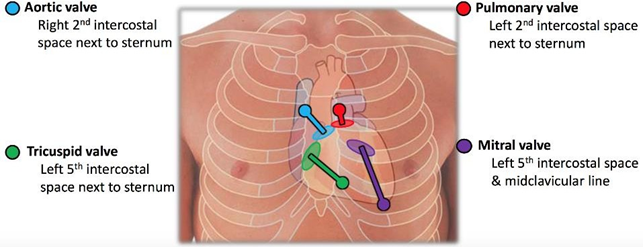
B. This area does not correspond to any valvular area.
C. This location corresponds to the aortic valve, not the pulmonic valve. The aortic valve is best auscultated at the second ICS, right sternal border.
D. This location corresponds to the tricuspid valve, not the pulmonic valve. The tricuspid valve is best auscultated at the fourth or fifth ICS along the left sternal border.
Correct Answer is B
Explanation
B. Activating a code blue or the facility's emergency response system will bring immediate assistance and resources to the client's bedside. This is crucial to initiate prompt resuscitative measures if indicated and to involve additional healthcare providers in the management of the emergency.
A. While it might be appropriate in some situations to provide privacy or support to the partner, in this urgent scenario where the client is unresponsive and not breathing, the priority should be immediate assessment and intervention for the client's condition.
C. While notifying the physician is important, especially to inform them of the client's condition and potentially discuss the DNR status, it is not the most immediate action in this urgent situation where the client is unresponsive and not breathing. Direct intervention and assessment are needed first.
D. Asking the partner to make a DNR decision immediately is not appropriate as the first action in this scenario. It is crucial to focus first on the client's immediate needs for assessment and potentially resuscitative measures if indicated. The discussion about the DNR order should occur in a timely manner but is secondary to addressing the client's current medical emergency.
Whether you are a student looking to ace your exams or a practicing nurse seeking to enhance your expertise , our nursing education contents will empower you with the confidence and competence to make a difference in the lives of patients and become a respected leader in the healthcare field.
Visit Naxlex, invest in your future and unlock endless possibilities with our unparalleled nursing education contents today