
A nurse is contributing to the plan of care for a client who has a prescription for elastic bandages to the lower extremities. Which of the following actions should the nurse recommend for the plan of care?
Check the capillary refill every 4 hrs
Compare the pedal pulses every 4 hrs
The Correct Answer is B
A. Check the capillary refill every 4 hrs Incorrect
The nurse should check capillary refill distally every 4 hr for a client whops elastic bandages on their lower extremities.
B. Compare the pedal pulses every 4 hrs CORRECT
The nurse should compare the pedal pulses bilaterally every week to check for adequate circulation for a client who has elastic bandages on their
lower extremities.
Nursing Test Bank
Naxlex Comprehensive Predictor Exams
Related Questions
Correct Answer is C
Explanation
A: Allowing the client to continue taking medications as they did at home without verifying the prescriptions can be unsafe and is not within the scope of nursing practice.
B: Taking the medications from the client and discarding them is inappropriate. The nurse should not dispose of the client's medications without proper assessment and verification.
C: Correct. The nurse should compare the medications the provider has prescribed with the medications the client brought from home to ensure accuracy and safety. This is a crucial step during admission to prevent errors or omissions in the medication regimen.
D: Placing the medications in the medication cart and administering them without verification is unsafe and against best practices for medication administration.
Correct Answer is D
Explanation
A. Bone pain: Bone pain is not a characteristic finding of hypomagnesemia. Hypomagnesemia is an electrolyte imbalance, and bone pain is not a typical symptom associated with it.
B. Drowsiness: Drowsiness may occur in hypomagnesemia, but it is not a specific or characteristic sign of this condition. Other electrolyte imbalances and medical conditions can also cause drowsiness.
C. Bowel hypomotility: Hypomagnesemia can cause bowel hypomotility (decreased bowel movements), but it is not the most specific finding associated with this condition.
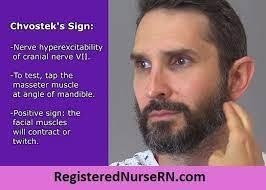
D. Positive Chvostek's sign: Correct. Hypomagnesemia can lead to neuromuscular irritability, and a positive Chvostek's sign is a clinical manifestation of this condition. A positive Chvostek's sign is elicited by tapping the facial nerve (at the level of the zygomatic arch) and observing a
twitching of the facial muscles, which indicates increased neuromuscular excitability.
Whether you are a student looking to ace your exams or a practicing nurse seeking to enhance your expertise , our nursing education contents will empower you with the confidence and competence to make a difference in the lives of patients and become a respected leader in the healthcare field.
Visit Naxlex, invest in your future and unlock endless possibilities with our unparalleled nursing education contents today