
The nurse is caring for a client with chronic pancreatitis who reports persistent gnawing abdominal pain. To help the client manage the pain, which assessment data is most important for the nurse to obtain?
Activity level of bowel sounds
Eating patterns of dietary intake
Level and amount of physical activity.
Color and consistency of feces.
The Correct Answer is B
A. Activity level of bowel sounds:
Bowel sounds are important to assess, but they may not directly influence or be influenced by the abdominal pain associated with chronic pancreatitis.
B. Eating patterns and dietary intake.
Clients with chronic pancreatitis often experience abdominal pain exacerbated by the intake of food, especially fatty meals. Monitoring the client's eating patterns and dietary intake is crucial for identifying triggers that may worsen the abdominal pain. By understanding the relationship between food intake and pain, the nurse can provide guidance on dietary modifications to help manage the symptoms.
C. Level and amount of physical activity:
While physical activity is important for overall health, it may not be the primary factor contributing to or alleviating the abdominal pain in a client with chronic pancreatitis.
D. Color and consistency of feces:
Monitoring the color and consistency of feces is important for assessing pancreatic function, but it may not be the most immediate factor to address in the context of managing abdominal pain. Dietary patterns are more directly related to pain management in this case.
Nursing Test Bank
Naxlex Comprehensive Predictor Exams
Related Questions
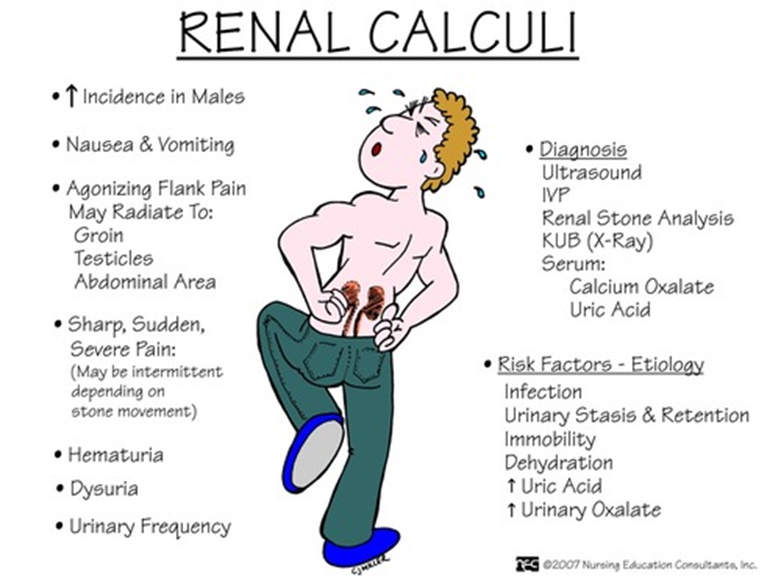
Correct Answer is D
Explanation
A. Jogs more frequently than usual daily routine:
Exercise, including jogging, is generally not associated with an increased risk of renal calculi. In fact, regular physical activity can have health benefits.
B. Eats a vegetarian diet with cheese 2 to 3 times a day:
A vegetarian diet alone is not necessarily a risk factor for renal calculi. However, the inclusion of high-oxalate foods, such as certain types of cheese, may contribute to the formation of kidney stones.
C. Experiences additional stress since adopting a child:
Stress is not a direct risk factor for renal calculi. However, certain dietary and lifestyle factors play a more significant role in stone formation.
D. Drinks several bottles of carbonated water daily:
This is the correct answer. Consuming large amounts of carbonated water, especially if it is high in phosphoric acid, can contribute to the formation of kidney stones. Carbonated beverages may increase the excretion of calcium in the urine, potentially leading to stone formation.
Correct Answer is C
Explanation
A. Evaluate upper and lower extremities for perfusion, pulse volume, and pitting edema:
This option focuses on assessing perfusion and circulation in the extremities. While it's important in certain situations, in the context of a client who recently underwent cardiac stent placement and is now experiencing chest pressure and shortness of breath, the priority is to assess the cardiac status more directly.
B. Listen for extra heart sounds, murmurs, and rhythm with the bell of the stethoscope:
This option involves auscultating the heart for abnormal sounds or rhythms. While it's a valuable assessment in general, in this particular scenario, obtaining an electrocardiogram (ECG) and initiating continuous cardiac monitoring would provide a more comprehensive and immediate evaluation of the cardiac status.
C. Obtain a 12-lead electrocardiogram and begin continuous cardiac monitoring:
This is the correct choice. Obtaining a 12-lead ECG and initiating continuous cardiac monitoring is crucial in assessing the client's cardiac function. It allows for the detection of any acute changes in the heart's electrical activity or rhythm, which is essential for timely intervention and management.
D. Verify troponin level assessments are scheduled every 3-6 hours for a series of three:
Monitoring troponin levels is important in assessing cardiac damage, but in this acute situation, obtaining an immediate ECG and initiating continuous cardiac monitoring take precedence for a more real-time evaluation of the client's cardiac status. Troponin levels may be monitored subsequently based on the initial findings.
Whether you are a student looking to ace your exams or a practicing nurse seeking to enhance your expertise , our nursing education contents will empower you with the confidence and competence to make a difference in the lives of patients and become a respected leader in the healthcare field.
Visit Naxlex, invest in your future and unlock endless possibilities with our unparalleled nursing education contents today