
The nurse is caring for a client who is having difficulty sleeping in the hospital environment. How can the nurse intervene? (SELECT ALL THAT APPLY)
Offer the client a few pieces of chocolate before bedtime.
Monitor the temperature in the client's room.
Make certain bed linens are clean and dry.
Assess the client for any issues with discomfort.
Move the client closer to the nursing station.
Correct Answer : B,C,D
B. Temperature can significantly affect sleep quality. Ensuring the room is kept at a comfortable temperature (not too hot or cold) can promote better sleep. This intervention is appropriate.
C. Clean and dry bed linens contribute to comfort, which is essential for promoting sleep. This intervention is appropriate.
D. Discomfort can be a major barrier to sleep. Addressing any discomfort, such as pain, anxiety, or positioning issues, can help improve the client's ability to fall and stay asleep. This intervention is appropriate.
A. Offering chocolate, which contains caffeine, close to bedtime is not recommended as caffeine can interfere with sleep. Therefore, this option is not appropriate.
E. Moving the client closer to the nursing station may increase noise and disrupt sleep, especially if there are frequent activities or conversations near the nursing station. Therefore, this option is not typically recommended unless the client requires closer monitoring due to medical reasons.
Nursing Test Bank
Naxlex Comprehensive Predictor Exams
Related Questions
Correct Answer is A
Explanation
A. The pulmonic valve is best auscultated at the second intercostal space (ICS) on the left sternal border. This is where the area corresponding to the pulmonic valve is most accurately heard due to the anatomical positioning of the heart.
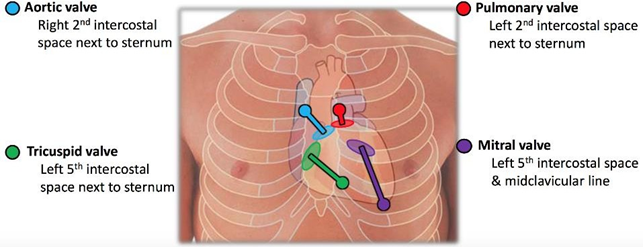
B. This area does not correspond to any valvular area.
C. This location corresponds to the aortic valve, not the pulmonic valve. The aortic valve is best auscultated at the second ICS, right sternal border.
D. This location corresponds to the tricuspid valve, not the pulmonic valve. The tricuspid valve is best auscultated at the fourth or fifth ICS along the left sternal border.
Correct Answer is ["B","C","E"]
Explanation
B. According to Medicare and The Joint Commission guidelines, the use of patient restraints requires a physician's order. The order should specify the reason for the restraint, the type of restraint, and the duration or conditions for its use.
C. Before using restraints, healthcare providers must exhaust all alternative, less restrictive measures to manage the patient's behavior or condition. This could include environmental modifications, reassurance techniques, or pharmacological interventions.
E. Restraints should be removed or released every 2 hours for reevaluation and to provide opportunities for range of motion exercises, toileting, hydration, and skin care. Restraints should not be used continuously without periodic assessment and reevaluation.
A. Punitive measures are not appropriate or effective in the use of patient restraints. Restraints should only be used for medical reasons to ensure patient safety, not as a form of punishment.
D. Inadequate staffing is not a criterion specified for using patient restraints. Restraints should not be used as a substitute for sufficient staffing levels to monitor and manage patient care.
Whether you are a student looking to ace your exams or a practicing nurse seeking to enhance your expertise , our nursing education contents will empower you with the confidence and competence to make a difference in the lives of patients and become a respected leader in the healthcare field.
Visit Naxlex, invest in your future and unlock endless possibilities with our unparalleled nursing education contents today