
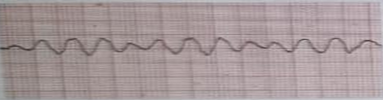
The nurse is caring for a client in the telemetry unit and notices the rhythm below. The client is unresponsive and pulseless. After calling for assistance, what should be the nurse's next action?
Cardiovert in the synchronized mode.
Defibrillate immediately with a biphasic machine.
Take a full set of vital signs.
Initiate cardiopulmonary resuscitation.
The Correct Answer is B
A. Cardiovert in the synchronized mode: Synchronized cardioversion is used for hemodynamically unstable but conscious patients with rhythms like atrial fibrillation or supraventricular tachycardia. It is not appropriate for a pulseless patient with ventricular fibrillation, as synchronization requires detectable R-waves.
B. Defibrillate immediately with a biphasic machine: The rhythm strip shows ventricular fibrillation (VF) a life-threatening arrhythmia characterized by chaotic, irregular waveform with no identifiable PQRST and no effective cardiac output. The patient is unresponsive and pulseless, making immediate defibrillation the priority action, as per Advanced Cardiac Life Support (ACLS) guidelines.
C. Take a full set of vital signs: The client is already unresponsive and pulseless, making a full set of vitals irrelevant at this moment. Immediate resuscitation efforts, including defibrillation and CPR, take priority.
D. Initiate cardiopulmonary resuscitation: While CPR is a critical part of the algorithm for pulseless rhythms, defibrillation is the first priority in ventricular fibrillation when a defibrillator is available and ready. CPR should be started immediately after the shock if no pulse returns.
Nursing Test Bank
Naxlex Comprehensive Predictor Exams
Related Questions
Correct Answer is A
Explanation
A. Pulmonic: The pulmonic valve is best auscultated at the second left intercostal space along the left sternal border. A murmur heard in this location is most likely associated with pulmonic valve abnormalities such as pulmonary stenosis or pulmonary regurgitation.
B. Aortic: The aortic valve is auscultated at the second right intercostal space at the right sternal border. A murmur at this site may indicate aortic stenosis or regurgitation, but not when heard on the left side as in this scenario.
C. Tricuspid: Tricuspid valve murmurs are typically heard best at the lower left sternal border, around the fourth or fifth intercostal space. This location is more inferior than where the nurse auscultated the murmur in the current assessment.
D. Mitral: The mitral valve is best heard at the fifth intercostal space at the midclavicular line (the cardiac apex). Murmurs related to mitral stenosis or regurgitation would not typically be heard at the second intercostal space near the sternum.
Correct Answer is C
Explanation
A. Increase in systolic blood pressure 10 mmHg above client's norm: A mild increase in systolic blood pressure is not a specific indicator of mitral stenosis progression. Blood pressure fluctuations may occur due to various factors and are not typically used as a primary marker of worsening valve disease.
B. reports dyspnea after walking up 2 flights of stairs: Exertional dyspnea is a common early symptom of mitral stenosis due to reduced left atrial emptying and pulmonary congestion. However, this does not necessarily indicate worsening unless the symptom becomes more severe or occurs with minimal exertion.
C. Jugular vein distention and +3 peripheral edema: These are signs of right-sided heart failure, which may result from long-standing mitral stenosis leading to pulmonary hypertension and subsequent right ventricular hypertrophy and failure. This indicates disease progression and worsening cardiac function.
D. Complaints of epigastric pain after eating a large meal: Epigastric discomfort is not a typical symptom of mitral stenosis and is more likely related to gastrointestinal issues. It does not reflect the status or progression of the cardiac condition.
Whether you are a student looking to ace your exams or a practicing nurse seeking to enhance your expertise , our nursing education contents will empower you with the confidence and competence to make a difference in the lives of patients and become a respected leader in the healthcare field.
Visit Naxlex, invest in your future and unlock endless possibilities with our unparalleled nursing education contents today