
During auscultation, the nurse hears fine rales in the patient's lower lobes bilaterally. Fine rales are described as
A sonorous wheeze upon inspiration.
Musical or whistling sounds with respirations.
Noisy, snoring sounds during respirations.
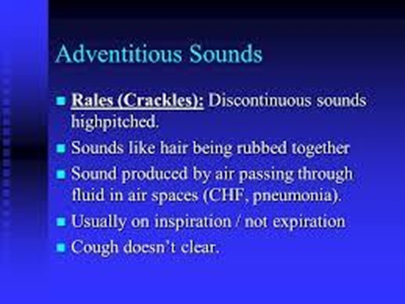
Sounding like hair being rubbed between the thumb and index fingers.
The Correct Answer is D
A: Sonorous wheezes are low-pitched sounds and do not describe fine rales.
B: Musical or whistling sounds typically describe wheezes which are continuous and not the discontinuous sound of rales.
C: Noisy, snoring sounds are characteristic of rhonchi, not rales.
D: Fine rales are high-pitched, brief, and discontinuous crackling sounds that are often likened to the sound of hair being rubbed between fingers, indicative of fluid in the small airways.
Nursing Test Bank
Naxlex Comprehensive Predictor Exams
Related Questions
Correct Answer is D
Explanation
A: Bradycardia is typically not associated with acute pain; instead, pain usually triggers a sympathetic response, leading to tachycardia.
B: Hypoglycemia has no direct correlation with acute pain levels.
C: Pain tends to increase, not decrease, the respiratory rate due to stress and increased metabolic demand.
D: Acute pain can lead to elevated blood pressure as part of the body's stress response, which includes activation of the sympathetic nervous system.
Correct Answer is D
Explanation
A: Sonorous wheezes are low-pitched sounds and do not describe fine rales.
B: Musical or whistling sounds typically describe wheezes which are continuous and not the discontinuous sound of rales.
C: Noisy, snoring sounds are characteristic of rhonchi, not rales.
D: Fine rales are high-pitched, brief, and discontinuous crackling sounds that are often likened to the sound of hair being rubbed between fingers, indicative of fluid in the small airways.
Whether you are a student looking to ace your exams or a practicing nurse seeking to enhance your expertise , our nursing education contents will empower you with the confidence and competence to make a difference in the lives of patients and become a respected leader in the healthcare field.
Visit Naxlex, invest in your future and unlock endless possibilities with our unparalleled nursing education contents today