
Complete the following sentence from the list of options
Monitor
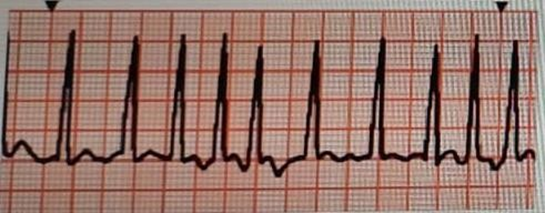
The nurse is caring for a client who is admitted to the telemetry unit with a new onset of the following rhythm. The nurse assesses the rhythm as
The Correct Answer is {"dropdown-group-1":"C","dropdown-group-2":"D","dropdown-group-3":"D"}
Atrial fibrillation: This is a common arrhythmia where the atria quiver instead of contracting normally, leading to irregular heart rhythms.
Amiodarone- an antiarrhythmic medication may be used to control the heart rate or rhythm in atrial fibrillation.
Heparin-an anticoagulant prevent thromboembolic events, such as stroke, anticoagulants like heparin, enoxaparin, or newer agents like rivaroxaban are used.
Nursing Test Bank
Naxlex Comprehensive Predictor Exams
Related Questions
Correct Answer is A
Explanation
A. Giving away valued possessions - This is a classic sign of suicidal ideation, as individuals may feel they no longer need their belongings or want to say goodbye to loved ones in a symbolic way.
B. Engaging in high-risk behaviors - While high-risk behaviors can be a sign of depression, they are not necessarily indicative of suicidal thoughts.
C. Talkative, with pressured speech - This could be indicative of a manic episode or high anxiety, but it is not a common sign of suicidal behavior.
D. Guilt, decreased self-esteem - Although guilt and low self-esteem are symptoms of depression, they do not directly indicate suicidal thoughts or behaviors.
Correct Answer is D
Explanation
A. Reporting the findings and anticipating a prescription for amiodarone may be necessary later, but the first step is to assess the patient's immediate condition (unresponsiveness, pulse status, etc.).
B. Although increasing monitor sensitivity and initiating a rapid response call might be helpful, these actions come after assessing the patient’s condition. If the patient is in distress or unresponsive, the nurse needs to check for a pulse and intervene right away.
C. This is a crucial action if the patient is unresponsive and pulseless (cardiac arrest). If the patient is found to be unresponsive and pulseless, starting chest compressions immediately and preparing for defibrillation is the next step. However, the first action is to check for pulse and responsiveness.
Why it's incorrect: Compressions and defibrillation are correct actions if the patient is pulseless, but before taking these steps, the nurse must assess the patient for responsiveness and check the carotid pulse. Starting CPR and preparing defibrillation without verifying the patient's condition could delay appropriate care.
D. Checking responsiveness and pulse is the most immediate and critical action because VT may be asymptomatic or cause deterioration, including cardiac arrest. Once pulse and responsiveness are determined, appropriate interventions (such as defibrillation or CPR) can be initiated quickly.
Whether you are a student looking to ace your exams or a practicing nurse seeking to enhance your expertise , our nursing education contents will empower you with the confidence and competence to make a difference in the lives of patients and become a respected leader in the healthcare field.
Visit Naxlex, invest in your future and unlock endless possibilities with our unparalleled nursing education contents today