
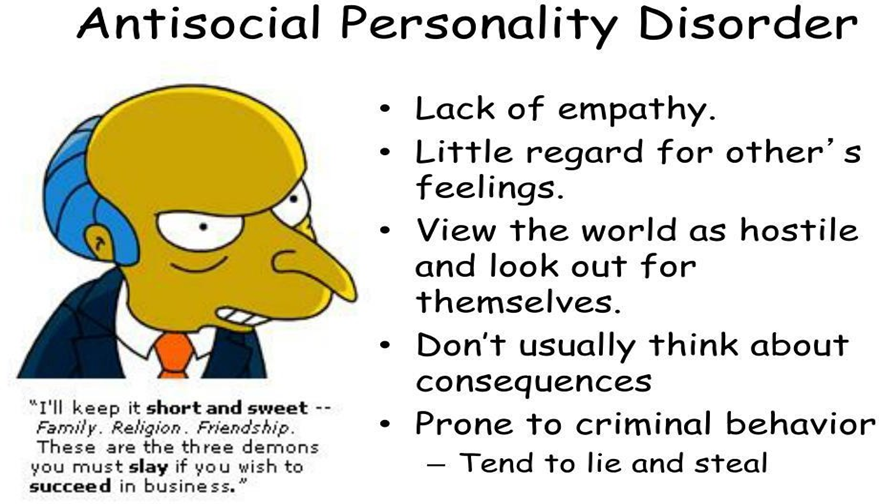
An individual with a history of antisocial personality disorder was arrested for driving under the influence of alcohol and causing a serious car accident. Which comment on this behavior would be expected?
"I'm too ashamed to talk about it."
"I'm really sorry about all the people I've hurt."
"I just don't remember doing it."
"It's not my fault."
The Correct Answer is D
D. This response is consistent with the characteristics of antisocial personality disorder, which include a lack of remorse, as well as a tendency to rationalize behavior or blame others. Individuals with this disorder often fail to accept responsibility for their actions and may exhibit behaviors that are impulsive, reckless, and violate the rights of others without feeling guilty.
A. Individuals with antisocial personality disorder often lack remorse or empathy for the consequences of their actions and may not experience feelings of shame or guilt, even when their behavior results in harm to others.
B. Expressing genuine remorse or empathy for the harm caused to others is uncommon in individuals with antisocial personality disorder.
C. Claiming to have no memory of the behavior or the events leading up to it is a common defense mechanism used. This may serve to avoid accountability or responsibility for their actions, rather than indicating genuine memory impairment. However, it is not characteristic for antisocial personality disorder.
Nursing Test Bank
Naxlex Comprehensive Predictor Exams
Related Questions
Correct Answer is B
Explanation
B. Children with ASD may show reduced interest in social interactions, have difficulty understanding social cues, and may not engage in typical play with peers or caregivers. They might also exhibit challenges with nonverbal communication, such as making eye contact or using gestures.
A. While hyperactivity and attention deficits can be present in children with ASD, they are not as specific to the diagnosis as impaired social skills.
C. High levels of anxiety when separated from the mother could be seen in many conditions and are not particularly indicative of ASD.
D. A history of disobedience and destructive acts could be seen in many conditions and are not particularly indicative of ASD.
Correct Answer is A
Explanation
A. Neglect occurs when a caregiver fails to provide for a child's basic needs, such as food, shelter, clothing, medical care, education, or emotional support. In this scenario, the child's statement about not eating for days and feeling worried because their parents are away suggests a lack of provision for basic needs, indicating possible neglect.
B. Sexual abuse involves inappropriate sexual behavior or contact imposed upon a child by an adult or older child. There is no indication of sexual abuse in the child's statement about not eating for days and feeling worried because their parents are away.
C. Financial abuse typically involves the misuse or withholding of a child's financial resources by a caregiver. While financial abuse can manifest in various forms, such as stealing a child's money or preventing access to resources, there is no direct mention of financial abuse in the child's statement.
D. Bullying involves repeated aggressive behavior intended to intimidate, harm, or exert control over another individual. There is no indication of bullying in the child's statement to the school nurse.
Whether you are a student looking to ace your exams or a practicing nurse seeking to enhance your expertise , our nursing education contents will empower you with the confidence and competence to make a difference in the lives of patients and become a respected leader in the healthcare field.
Visit Naxlex, invest in your future and unlock endless possibilities with our unparalleled nursing education contents today