
A nurse is reinforcing teaching with a client who is to start subcutaneous heparin.
Which of the following information should the nurse include in the teaching?
Use a soft-bristled toothbrush.
Inject the medication deep into the thigh muscle.
Expect stools to become black and tarry.
Easy bruising indicates the medication is effective.
The Correct Answer is A
The nurse should include in the teaching that the client should use a soft-bristled toothbrush.
Heparin is an anticoagulant that decreases the clotting ability of the blood 1.
Using a soft-bristled toothbrush can help prevent bleeding of the gums while brushing teeth.

Choice B is incorrect because heparin should not be injected deep into the thigh muscle.
Instead, it should be given subcutaneously (under the skin) 2.
Choice C is incorrect because black and tarry stools are not an expected side effect of heparin.
Choice D is incorrect because easy bruising does not indicate that the medication is effective.
Instead, easy bruising may be a side effect of heparin and should be reported to the healthcare provider 1.
Nursing Test Bank
Naxlex Comprehensive Predictor Exams
Related Questions
Correct Answer is ["94"]
Explanation
To calculate the flow rate in mL/hr, you need to divide the total volume to be infused by the total infusion time in hours (750 mL / 8 hr = 93.75 mL/hr).
Rounded to the nearest whole number, this is 94 mL/hr.
Correct Answer is A
Explanation
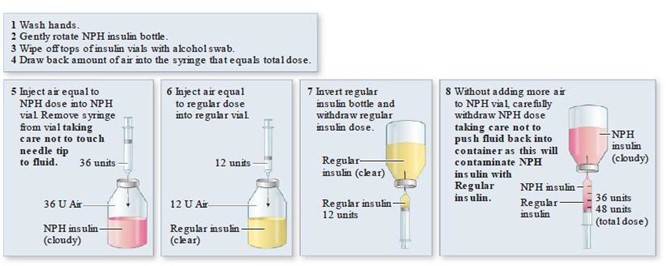
“Inject air into the regular insulin first.” When mixing regular insulin and NPH insulin in the same syringe, the nurse should instruct the client to inject air into the NPH insulin vial first, then inject air into the regular insulin vial.
After that, the client should draw up the regular insulin into the syringe first, followed by the NPH insulin.
Choice B is not correct because NPH insulin should not be shaken vigorously as it can damage the insulin molecules.
Choice C is not correct because the regular insulin should be drawn up into the syringe first.
Choice D is not correct because regular insulin is a clear solution and should not appear cloudy.
Whether you are a student looking to ace your exams or a practicing nurse seeking to enhance your expertise , our nursing education contents will empower you with the confidence and competence to make a difference in the lives of patients and become a respected leader in the healthcare field.
Visit Naxlex, invest in your future and unlock endless possibilities with our unparalleled nursing education contents today