
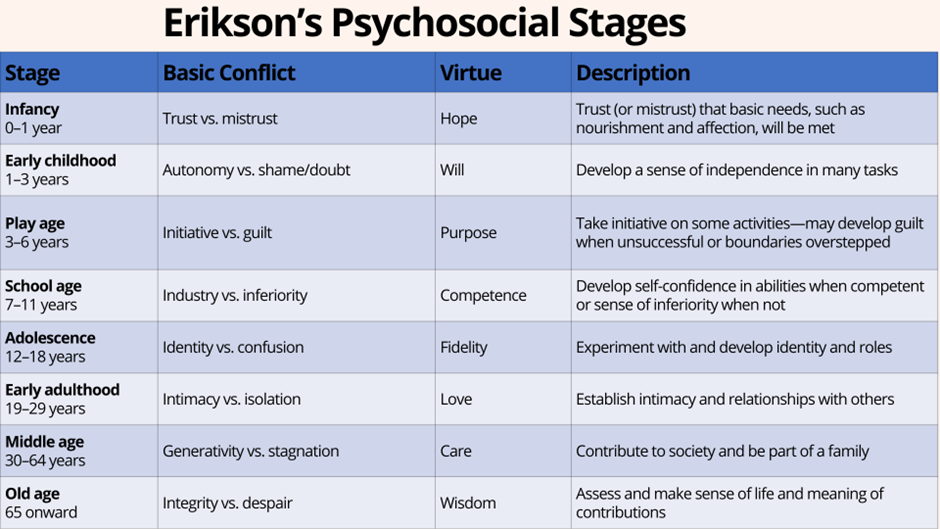
A nurse is caring for an adolescent. The nurse should expect that the adolescent is working on which of the following developmental tasks?
Defining a sense of self
Learning to perform tasks independently
Learning to use creative energies
Building a sense of trust
The Correct Answer is A
A. Defining a sense of self: Adolescence is characterized by the search for identity and defining a sense of self. Erikson identifies this stage as "Identity vs. Role Confusion," where individuals explore and form their own identity separate from their family and childhood roles.
B. Learning to perform tasks independently: This is more typical of early childhood (Erikson's "Autonomy vs. Shame and Doubt"). During this stage, children are learning basic independence, such as dressing and feeding themselves.
C. Learning to use creative energies: This task is more relevant to the preschool age group (Erikson's "Initiative vs. Guilt"), where children engage in imaginative play and begin exploring their own ideas and creativity.
D. Building a sense of trust: Building a sense of trust is the primary task in infancy (Erikson's "Trust vs. Mistrust"), where infants develop trust in their caregivers and the world around them.
Nursing Test Bank
Naxlex Comprehensive Predictor Exams
Related Questions
Correct Answer is A
Explanation
A. Pain: This is the most common and significant symptom of a vaso-occlusive crisis in sickle cell disease. The sickled cells block blood flow, leading to intense pain and tissue ischemia.
B. Vomiting: Vomiting is not a typical finding associated with a vaso-occlusive crisis. While it may occur due to other complications or treatments, it is not directly related to the crisis itself.
C. Constipation: Constipation is not a typical symptom of a vaso-occlusive crisis. It may occur due to decreased activity or medication side effects, but it is not directly linked to the sickle cell crisis.
D. Bradycardia: Bradycardia is not expected in a vaso-occlusive crisis. The crisis usually involves pain and stress, which might increase the heart rate rather than decrease it.
Correct Answer is B
Explanation
A. The parent reports the child will not keep the arm elevated on the pillow: Not a priority. While elevation is important, it is not immediately concerning.
B. The fingers on the right hand have a capillary refill of 4 seconds: Correct. A capillary refill time of more than 2 seconds indicates poor perfusion, which can be a sign of compartment syndrome, a serious complication.
C. The fingertips of the right hand are swollen and bruised: Concerning, but swelling and bruising can be normal post-injury. Immediate concern is perfusion.
D. The child is not attempting to move her right arm or fingers: Concerning, but can be due to pain or fear. Poor perfusion (B) is a more immediate threat.
Whether you are a student looking to ace your exams or a practicing nurse seeking to enhance your expertise , our nursing education contents will empower you with the confidence and competence to make a difference in the lives of patients and become a respected leader in the healthcare field.
Visit Naxlex, invest in your future and unlock endless possibilities with our unparalleled nursing education contents today