
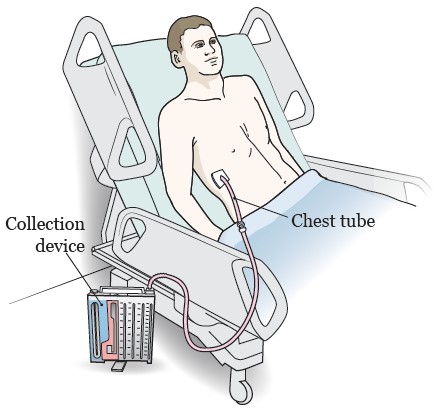
A nurse is caring for a client who has a newly inserted chest tube. The nurse should clarify which of the following prescriptions with the provider?
Vigorously strip the chest tube twice daily.
Assist the client out of bed three times daily.
Notify the provider when tiddling ceases.
Administer morphine 2 mg IV bolus every 3 hr. PRN for pain.
The Correct Answer is A
Choice A Reason:
Vigorously strip the chest tube twice daily. The nurse should clarify the prescription to "vigorously strip the chest tube twice daily" with the provider. Stripping or milking a chest tube is generally not recommended, as it can cause damage to the tube and lead to complications. The movement of fluid and air in the chest tube should be allowed to occur naturally based on the patient's own respiratory effort.
Choice B Reason:
Assist the client out of bed three times daily - This is a reasonable activity for a client with a chest tube, as mobility and deep breathing can help prevent complications.
Choice C Reason:
Notify the provider when tiddling ceases - Monitoring for tiddling (fluctuations in the water seal chamber with respiration) and notifying the provider when tiddling stops is important, as it might indicate a potential issue with the chest tube placement or functioning.
Choice D Reason:
Administer morphine 2 mg IV bolus every 3 hr PRN for pain - Administering pain relief for the client is appropriate and helps manage their comfort. Pain control is important to encourage deep breathing and prevent complications related to shallow breathing due to pain.
Nursing Test Bank
Naxlex Comprehensive Predictor Exams
Related Questions
Correct Answer is A
Explanation
Choice A Reason:
Vigorously strip the chest tube twice daily. The nurse should clarify the prescription to "vigorously strip the chest tube twice daily" with the provider. Stripping or milking a chest tube is generally not recommended, as it can cause damage to the tube and lead to complications. The movement of fluid and air in the chest tube should be allowed to occur naturally based on the patient's own respiratory effort.
Choice B Reason:
Assist the client out of bed three times daily - This is a reasonable activity for a client with a chest tube, as mobility and deep breathing can help prevent complications.
Choice C Reason:
Notify the provider when tiddling ceases - Monitoring for tiddling (fluctuations in the water seal chamber with respiration) and notifying the provider when tiddling stops is important, as it might indicate a potential issue with the chest tube placement or functioning.
Choice D Reason:
Administer morphine 2 mg IV bolus every 3 hr PRN for pain - Administering pain relief for the client is appropriate and helps manage their comfort. Pain control is important to encourage deep breathing and prevent complications related to shallow breathing due to pain.
Correct Answer is C
Explanation
Choice A Reason:
Diplopia is incorrect. Diplopia is double vision and is not a specific sign of malnutrition.
Choice B Reason:
Hyperproteinemia is incorrect - Malnutrition often leads to hypoalbuminemia (low levels of albumin, a protein), not hyperproteinemia.
Choice C Reason:
Cachexia is correct. Cachexia refers to a state of severe malnutrition and muscle wasting that can occur in individuals with chronic illnesses, especially advanced cancer, heart failure, or certain inflammatory conditions. It is characterized by significant weight loss, muscle atrophy, weakness, and fatigue. Cachexia goes beyond simple malnutrition and is a more severe manifestation of nutritional deficiency.
Choice D Reason:
Hypermagnesemia is incorrect - Malnutrition is more likely to cause deficiencies in minerals like magnesium, not excess levels (hypermagnesemia).
Whether you are a student looking to ace your exams or a practicing nurse seeking to enhance your expertise , our nursing education contents will empower you with the confidence and competence to make a difference in the lives of patients and become a respected leader in the healthcare field.
Visit Naxlex, invest in your future and unlock endless possibilities with our unparalleled nursing education contents today