
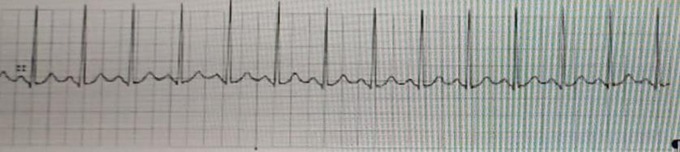
A client presents to the Emergency Department (ED) complaining of a "racing" heart and nervousness. The client also admits to a history of cocaine abuse. The cardiac monitor displays the rhythm below. Which nursing intervention should the nurse perform?
Perform carotid massage on the client
Administer adenosine 12mg IV push STAT
Prepare the client for electrical cardioversion
Assess patient and obtain vital signs
The Correct Answer is D
A. Carotid massage can be used as a vagal maneuver for certain types of supraventricular tachycardia (SVT), particularly in stable patients. However, it is not recommended in cases where the patient has a history of cocaine use or is showing signs of instability because of the potential for triggering a serious event, like a stroke.
B. Adenosine is a medication commonly used for the treatment of SVT. However, it should be given with caution and only after assessing the patient's condition. In this case, the patient needs to be assessed first, including vital signs, level of consciousness, and overall stability, before any medications are administered.
C. Electrical cardioversion is indicated for unstable SVT (e.g., signs of hemodynamic instability such as hypotension, chest pain, or altered mental status). However, this patient is only reporting a "racing heart" and nervousness and has not yet been assessed for vital signs or other clinical symptoms.
D. The first step in this case should be to assess the patient's condition. This includes checking the vital signs, level of consciousness, and overall stability. Once this initial assessment is performed, the nurse can then determine whether medications or other interventions (like adenosine or cardioversion) are needed.
Nursing Test Bank
Naxlex Comprehensive Predictor Exams
Related Questions
Correct Answer is C
Explanation
A. Counting the number of large squares between R-R intervals and dividing by 30 is not the correct method for estimating the ventricular rate on an ECG strip.
B. Printing a 1-minute ECG strip and counting the QRS complexes (option B) is accurate but unnecessary for a quick estimation.
C. The most common and efficient method for estimating the ventricular rate quickly is to count the number of QRS complexes in a 6-second strip (often marked by two dashed lines) and multiply by 10. This gives an estimate of the heart rate per minute.
D. Counting the number of small squares between QRS complexes and dividing by 1500 is the most accurate method but requires more time and precision than counting QRS complexes in 6 seconds.
Correct Answer is D
Explanation
A. This would be concerning, but it is not the correct choice. If a pacemaker is functioning abnormally, it would require an assessment and troubleshooting, not simply a routine rhythm.
B. This is typical for biventricular pacemakers used in heart failure patients, but it would not apply to a patient with a standard pacemaker unless specified. A recent pacemaker placement does not necessarily indicate biventricular pacing.
C. This is correct if only the atrium is paced; however, in the case of a typical pacemaker like DDD (dual- chamber pacemaker), both the atrium and ventricle are paced.
D. This is correct for dual-chamber pacemakers (like DDD), which pace both the atrium and the ventricle to coordinate the heart's rhythm.
Whether you are a student looking to ace your exams or a practicing nurse seeking to enhance your expertise , our nursing education contents will empower you with the confidence and competence to make a difference in the lives of patients and become a respected leader in the healthcare field.
Visit Naxlex, invest in your future and unlock endless possibilities with our unparalleled nursing education contents today