
Which of the following statements indicates that the client understands the effects of warfarin (coumadin)?
"I'll use my electric razor for shaving.".
"I'll take aspirin for my headaches.".
"I'll be sure to eat foods with lots of vitamin K.".
"It's okay to have a couple of glasses of wine with dinner.".
The Correct Answer is A
A nurse should never share her password for access to the facility’s computer system with anyone.
Sharing passwords can compromise the security and confidentiality of patient information.
For the second question you asked, the correct answer is choice A.
“I’ll use my electric razor for shaving.” This statement indicates that the client understands that warfarin (coumadin) can increase the risk of bleeding and that using an electric razor can help reduce the risk of cuts and bleeding while shaving.
Choice B is not the best answer because taking aspirin while on warfarin (coumadin) can increase the risk of bleeding.
Choice C is not the best answer because eating foods high in vitamin K can interfere with the effectiveness of warfarin (Coumadin).
Choice D is not the best answer because drinking alcohol while on warfarin (coumadin) can increase the risk of bleeding.
Nursing Test Bank
Naxlex Comprehensive Predictor Exams
Related Questions
Correct Answer is A
Explanation
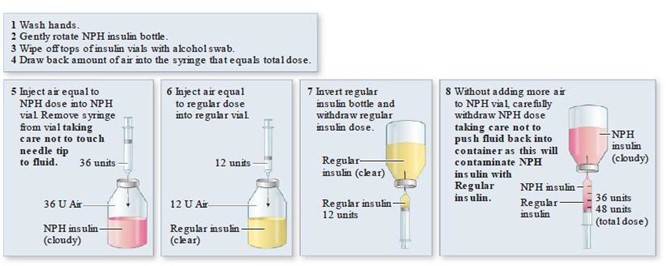
“Inject air into the regular insulin first.” When mixing regular insulin and NPH insulin in the same syringe, the nurse should instruct the client to inject air into the NPH insulin vial first, then inject air into the regular insulin vial.
After that, the client should draw up the regular insulin into the syringe first, followed by the NPH insulin.
Choice B is not correct because NPH insulin should not be shaken vigorously as it can damage the insulin molecules.
Choice C is not correct because the regular insulin should be drawn up into the syringe first.
Choice D is not correct because regular insulin is a clear solution and should not appear cloudy.
Correct Answer is A
Explanation
The client’s symptoms of confusion, flushed appearance, and acetone odor on their breath suggest that they may be experiencing diabetic ketoacidosis (DKA), a serious complication of diabetes that occurs when the body produces high levels of ketones.
Treatment for DKA typically involves administering intravenous fluids and insulin to lower blood sugar levels and suppress ketone production 1.
Regular insulin is a fast-acting insulin that can be given intravenously to quickly lower blood sugar levels 1.
Choice B is incorrect because NPH insulin is an intermediate-acting insulin that takes longer to start working and would not be appropriate for treating DKA.
Choice C is incorrect because lispro insulin is a rapid-acting insulin but it is not typically given intravenously.
Choice D is incorrect because glargine insulin is a long-acting insulin that takes several hours to start working and would not be appropriate for treating DKA.
Whether you are a student looking to ace your exams or a practicing nurse seeking to enhance your expertise , our nursing education contents will empower you with the confidence and competence to make a difference in the lives of patients and become a respected leader in the healthcare field.
Visit Naxlex, invest in your future and unlock endless possibilities with our unparalleled nursing education contents today