
Which information about the patient who had a subarachnoid hemorrhage is most important to communicate to the health care provider?
The patient reports having a stiff neck.
The cerebrospinal fluid (CSF) report shows red blood cells (RBCs).
The patient reports a severe and unrelenting headache.
The patient's blood pressure (BP) is 90/50 mm Hg
The Correct Answer is D
A. The patient reports having a stiff neck: While a stiff neck may indicate meningeal irritation, which can be associated with a subarachnoid hemorrhage, it is not as immediately concerning as hypotension, which can indicate hypovolemic shock or complications such as vasospasm.
B. The cerebrospinal fluid (CSF) report shows red blood cells (RBCs): The presence of red blood cells in the cerebrospinal fluid is expected in a subarachnoid hemorrhage and is an important diagnostic finding but may not require immediate intervention.
C. The patient reports a severe and unrelenting headache: While a severe and unrelenting headache is a common symptom of subarachnoid hemorrhage, it is not as urgent as addressing hypotension, which can indicate hemodynamic instability and compromise perfusion to vital organs.
D. The patient's blood pressure (BP) is 90/50 mm Hg: Hypotension in a patient with a subarachnoid hemorrhage can indicate hypovolemic shock, vasospasm, or other complications. It is important to communicate this finding promptly to the healthcare provider for further
evaluation and management.
Nursing Test Bank
Naxlex Comprehensive Predictor Exams
Related Questions
Correct Answer is A
Explanation
A. Patient has slight elevations in liver function test results: Phenytoin is primarily metabolized by the liver, and elevated liver function tests may indicate impaired liver function, potentially affecting the metabolism and clearance of phenytoin. Consultation with the healthcare provider is warranted to assess the risk-benefit ratio of administering phenytoin in the presence of liver function abnormalities.
B. Patient's most recent blood pressure is 156/92 mm Hg: While hypertension is not a contraindication for phenytoin administration, it is important to monitor blood pressure, especially considering the potential cardiovascular side effects of the medication. However, elevated blood pressure alone does not typically warrant consultation before administering phenytoin.
C. Patient experiences an aura before seizures: Experiencing an aura before seizures is a common phenomenon in patients with epilepsy and does not necessarily contraindicate the use of phenytoin. In fact, phenytoin is commonly prescribed to prevent seizures, including those preceded by an aura.
D. Patient has tonic-clonic seizures: Phenytoin is indicated for the treatment and prevention of tonic-clonic seizures, among other seizure types. Therefore, the presence of tonic-clonic seizures would not typically warrant consultation before administering phenytoin.
Correct Answer is B
Explanation
A. Catheterize the patient every 3 to 4 hours: Catheterization may be necessary for urinary retention, which is common in cauda equina syndrome, but it should not be done routinely every 3 to 4 hours. Indwelling catheters increase the risk of urinary tract infections and should be avoided unless necessary.
B. Administer medications to reduce bladder spasm: Bladder spasm is a common complication of cauda equina syndrome and can lead to urinary retention. Medications such as anticholinergics or alpha-adrenergic blockers may be prescribed to reduce bladder spasm and facilitate urine elimination.
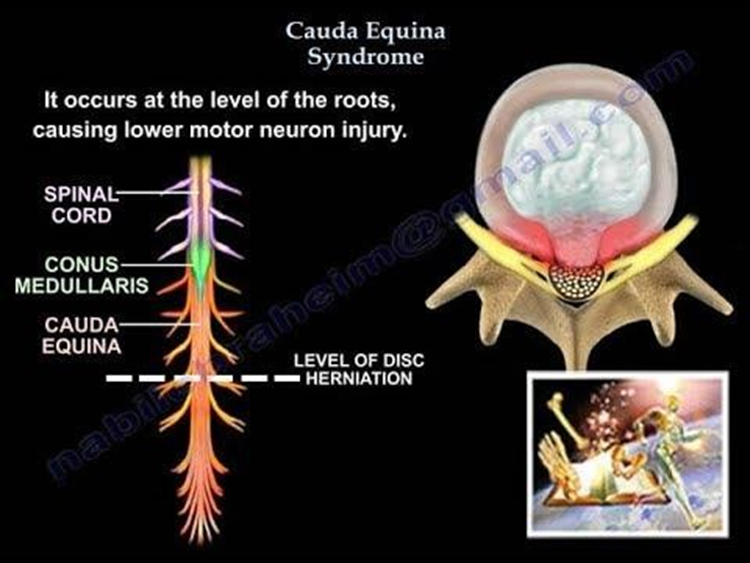
C. Assist the patient to ambulate 4 times daily: Ambulation may not be appropriate for a patient with cauda equina syndrome, especially if they have significant motor or sensory deficits. Ambulation should be assessed on an individual basis and may require assistance or adaptive devices.
D. Stabilize the neck when repositioning the patient: Cauda equina syndrome affects the lower spinal cord and does not typically involve the cervical spine. Stabilizing the neck is important in patients with cervical spine injuries but is not directly related to cauda equina syndrome.
Whether you are a student looking to ace your exams or a practicing nurse seeking to enhance your expertise , our nursing education contents will empower you with the confidence and competence to make a difference in the lives of patients and become a respected leader in the healthcare field.
Visit Naxlex, invest in your future and unlock endless possibilities with our unparalleled nursing education contents today