
The nurse working in a critical care unit (CCU) is assigned the care of two clients, one with pneumonia who is being mechanically ventilated, and the other who had a thoracotomy yesterday and is reporting incisional pain. Which action(s) should the nurse perform first?
Assess the level of consciousness and vital signs for both clients.
Review the plan of care and the medications that are due for both clients.
Complete a head-to-toe assessment of the client with pneumonia.
Change the surgical dressing to observe the appearance of the incision.
The Correct Answer is A
A. Assess the level of consciousness and vital signs for both clients: Assessing vital signs and mental status identifies immediate changes in condition, particularly in critically ill clients. This is a priority because it helps detect life-threatening complications early.
B. Review the plan of care and the medications that are due for both clients: While important for planning interventions, reviewing the plan does not address immediate client safety and physiological status, which takes priority.
C. Complete a head-to-toe assessment of the client with pneumonia: A comprehensive assessment is valuable, but initial priority is rapid evaluation of vital signs and consciousness to identify urgent issues in the mechanically ventilated client.
D. Change the surgical dressing to observe the appearance of the incision: Dressing changes are important for infection prevention, but they are not emergent unless there are signs of acute bleeding or infection. Immediate physiologic assessment takes precedence.
Nursing Test Bank
Naxlex Comprehensive Predictor Exams
Related Questions
Correct Answer is "{\"xRanges\":[24.75253686935637,42.04549690532573],\"yRanges\":[62.826215561361366,80.16865945855535]}"
Explanation
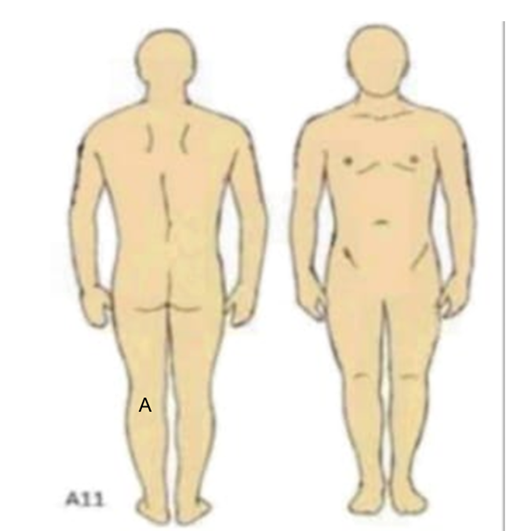
To measure blood pressure from the left thigh, the diaphragm of the stethoscope should be placed over the popliteal artery, which is located behind the knee. This placement allows you to auscultate the Korotkoff sounds accurately when measuring thigh blood pressure.
Correct Answer is {"A":{"answers":"A"},"B":{"answers":"A"},"C":{"answers":"B"},"D":{"answers":"B"},"E":{"answers":"A"},"F":{"answers":"A"}}
Explanation
• Palpate and compare radial pulses: Assessing radial pulses bilaterally is essential after humeral fracture and surgical repair because neurovascular compromise is a major complication. Detecting differences in pulse quality can help identify impaired circulation or compartment syndrome early.
• Administer ondansetron 4 mg IV: The client reports nausea postoperatively, which can increase discomfort and risk for aspiration. Ondansetron is prescribed and effective in controlling nausea by blocking serotonin receptors in the gut and brain, making it an appropriate intervention.
• Perform range of motion: With a displaced humeral head/neck fracture and immediate postoperative status, range-of-motion exercises are contraindicated. Movement of the joint could disrupt fixation, increase bleeding, or worsen pain. Immobilization and stabilization are priorities.
• Provide morphine 2 mg IV push (IVP): The client currently reports a pain level of 0/10 due to the preoperative nerve block. The order is PRN for pain > 7. Administering it now would be inappropriate and increase the risk of respiratory depression.
• Inspect the bandage for drainage: Checking the surgical bandage is necessary to monitor for bleeding or excessive drainage, which may indicate complications such as hemorrhage or infection. Since the order specifies not to remove the dressing, visual inspection only is the correct approach.
• Check capillary refill on bilateral upper extremities: Capillary refill helps evaluate peripheral perfusion, which is critical after orthopedic surgery. Comparing both extremities provides baseline data and helps detect vascular compromise that could threaten limb viability.
Whether you are a student looking to ace your exams or a practicing nurse seeking to enhance your expertise , our nursing education contents will empower you with the confidence and competence to make a difference in the lives of patients and become a respected leader in the healthcare field.
Visit Naxlex, invest in your future and unlock endless possibilities with our unparalleled nursing education contents today