
At what age is sexual development in boys and girls considered to be precocious?
Boys. 11 years; girls, 9 years
Boys. 12 years: girls, 10 years
Boys, 10 years: girls, 9 1/2 years
Boys. 9 years: girls. 8 years
The Correct Answer is B
Precocious puberty is defined as the onset of puberty before the age of 8 in girls and before the age of 9 in boys. However, it is important to note that the exact age at which puberty is considered precocious can vary slightly based on different guidelines and individual variations.
Boys: 11 years; girls: 9 years in (option A) is incorrect because it, is close to the general age range, but it is slightly earlier than what is commonly considered precocious puberty.
Boys: 10 years; girls: 9 1/2 years in (option C) is incorrect because it, is also close to the general age range, but it is not as commonly recognized as the age for precocious puberty.
Boys: 9 years; girls: 8 years in (option D) is incorrect because it, is significantly earlier than the usual age for precocious puberty. Puberty occurring at this age would be considered very early and may warrant further evaluation.
Nursing Test Bank
Naxlex Comprehensive Predictor Exams
Related Questions
Correct Answer is A
Explanation
The statement that accurately describes the difference between the central nervous system (CNS) of a child and an adult is option A. The brain of a term infant weighs less than half of the weight of the adult brain. The brain undergoes significant growth and development during childhood and continues to develop until early adulthood. At birth, the brain is only a fraction of its adult weight, and it continues to grow and mature over time.
infant has 150 mL of cerebrospinal fluid (CSF) compared with 50 mL in the adult in (option B), is incorrect. The volume of CSF in the CNS is not a significant difference between children and adults.
coordination and fine motor skills develop as myelination of peripheral nerves progresses in (option C), is an incorrect statement. Myelination is an ongoing process that occurs throughout childhood and contributes to the development of coordination and fine motor skills.
papilledema is a common manifestation of increased intracranial pressure (ICP) in the very young child in (option D), is not correct. Papilledema refers to swelling of the optic disc and is not commonly seen in very young children. Signs of increased ICP in young children may present differently compared to adults and can include altered mental status, irritability, vomiting, and changes in vital signs.
Correct Answer is D
Explanation
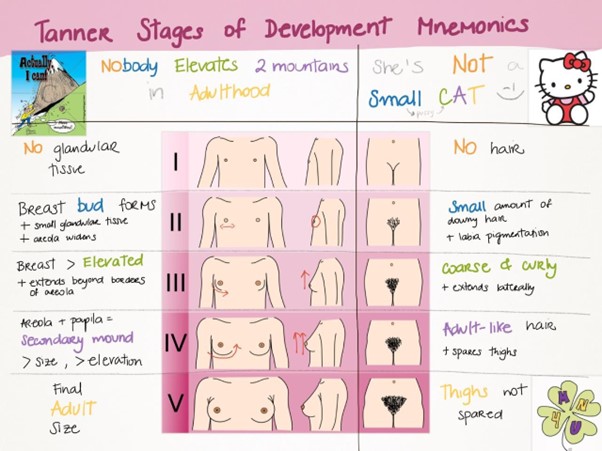
Tanner staging is a method used to assess and describe the development of secondary sexcharacteristics during puberty. It is primarily focused on the physical changes that occur asindividuals transition from childhood to adulthood. The Tanner scale consists of differentstages(ItoV)that describethedevelopmentofspecificsecondarysexcharacteristicssuchasbreastdevelopment, pubichairgrowth,genital development,and facialhair growth.
Growthhormonesecretionin(optionA)isincorrectbecauseWhilegrowthhormonedoesplay a role in the overall growth and development of individuals during puberty, Tannerstagingdoes not specificallymeasureor assessgrowth hormone secretion.
Hormone levels in (option B) is incorrect because While hormone levels, including sexhormonessuchas estrogenandtestosterone, doplayasignificantrolein thedevelopmentofsecondary sex characteristics, Tanner staging itself does not involve measuring or assessinghormone levels. Hormone levels can be assessed through laboratory testing, but this is aseparateprocess from Tanner staging
Hyperthyroidism in (option C) is incorrect because Hyperthyroidism, on the other hand, is amedical condition characterized by an overactive thyroid gland that produces an excessivenumberofthyroidhormones.Itisnotdirectlyrelatedtothedevelopmentofsecondarysexcharacteristics. Diagnosing hyperthyroidism typically involves assessing symptoms,conductingphysicalexaminations,andperformingspecificbloodteststomeasurethyroidhormone levelsandevaluatethyroidfunction.
Whether you are a student looking to ace your exams or a practicing nurse seeking to enhance your expertise , our nursing education contents will empower you with the confidence and competence to make a difference in the lives of patients and become a respected leader in the healthcare field.
Visit Naxlex, invest in your future and unlock endless possibilities with our unparalleled nursing education contents today