
A nurse is providing discharge teaching to a client who is at risk for falls. Which of the following information should the nurse include in the teaching?
"Ensure carpeting on stairs is secured with tacks."
"Secure extension cords to the floor with paper tape."
"Place furniture in the hallway to hold onto when walking."
"Place a small rug on the floor next to the bathtub."
The Correct Answer is A
A. " Loose or uneven carpeting on stairs can increase the risk of falls for clients who have impaired balance or mobility. The nurse should instruct the client to secure carpeting on stairs with tacks or other fasteners to prevent slipping or tripping.
B. Securing extension cords with paper tape may not provide sufficient support and can pose a tripping hazard. It is better to use cable covers or secure them along the baseboard.
C. Placing furniture strategically in hallways increases the risk of falls. Furniture should be placed away from hallways.
D. Rugs in bathrooms can become slippery when wet, increasing the risk of falls. It is safer to use non-slip mats or rugs with rubber backing.
Nursing Test Bank
Naxlex Comprehensive Predictor Exams
Related Questions
Correct Answer is ["A","C","E"]
Explanation
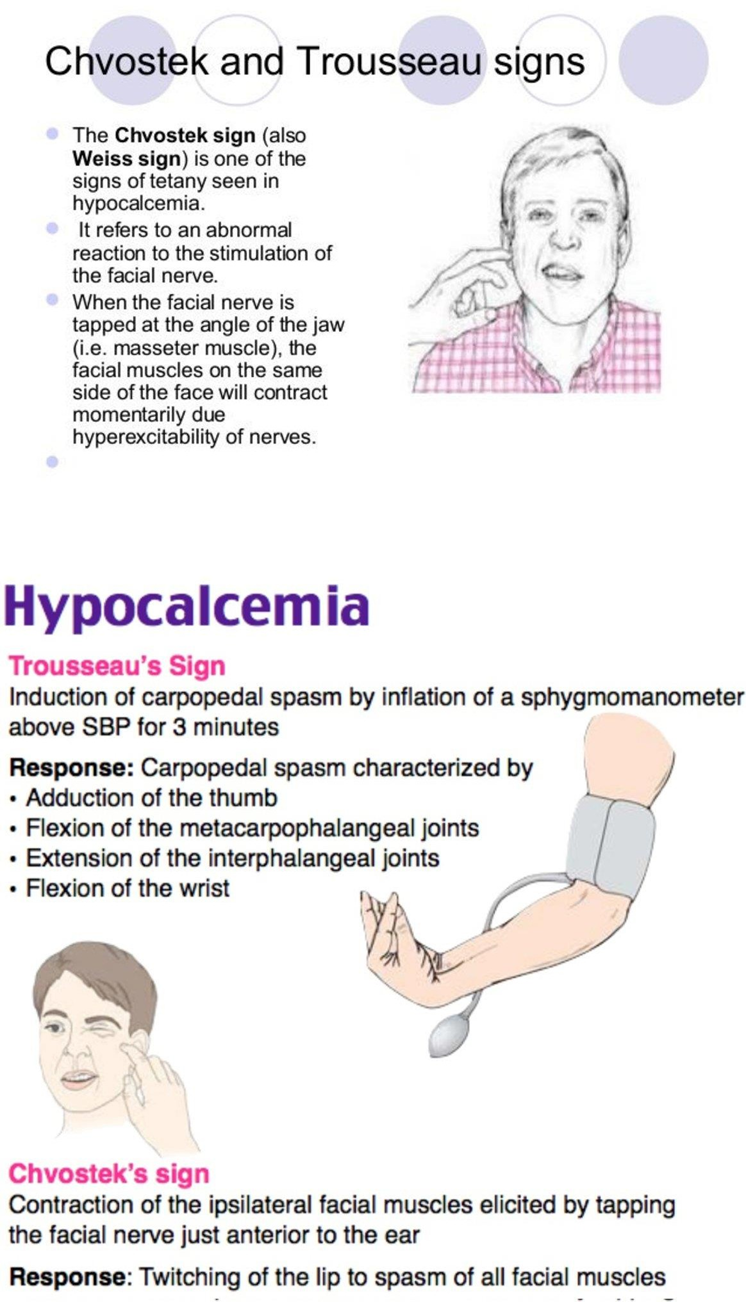
A. Hypocalcemia can lead to paresthesia, including tingling sensations around the lips.
B. Abdominal distention is not typically associated with hypocalcemia.
C. Hypocalcemia can result in a positive Trousseau's sign, where carpal spasm is induced by inflating a blood pressure cuff above the systolic pressure for a few minutes.
D. Chvostek's sign is typically positive in hypocalcemia, not negative.
E. Hypocalcemia can cause muscle cramps due to increased neuromuscular excitability.
Correct Answer is ["A","C","D"]
Explanation
A. This abbreviation can be misinterpreted as "units," "cc," or "you." It is recommended to avoid its use to prevent misinterpretation.
B. This abbreviation stands for intake and output, which is commonly used in healthcare documentation and is not on The Joint Commission's Do Not Use list.
C. IU can be mistaken for intravenous or international unit.
D. This abbreviation stands for once daily and is prone to misinterpretation, as it can be mistaken for qid (four times daily). It is recommended to avoid its use to prevent dosing errors.
E. This abbreviation stands for pro re nata, indicating "as needed" medication administration, and is not on The Joint Commission's Do Not Use list.
Whether you are a student looking to ace your exams or a practicing nurse seeking to enhance your expertise , our nursing education contents will empower you with the confidence and competence to make a difference in the lives of patients and become a respected leader in the healthcare field.
Visit Naxlex, invest in your future and unlock endless possibilities with our unparalleled nursing education contents today