
A nurse is conducting Weber's test on a client.
Which of the following is an appropriate action for the nurse to take?
Deliver a series of high-pitched sounds at random intervals.
Hold an activated tuning fork against the client's mastoid process.
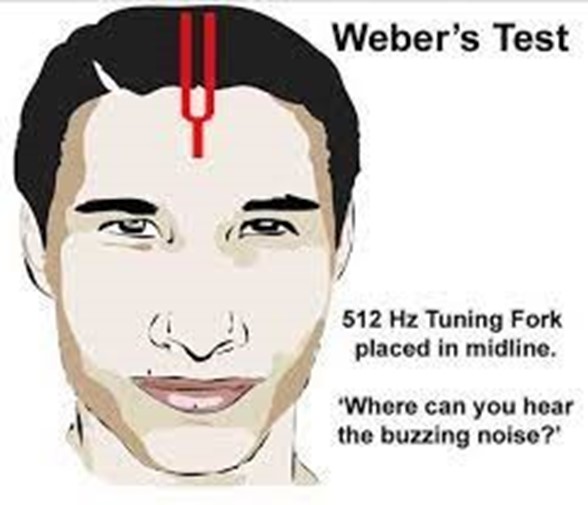
Place an activated tuning fork in the middle of the client's forehead.
Whisper a series of words softly into one ear.
The Correct Answer is C
The Weber test is a screening test for hearing performed with a tuning fork that can detect unilateral conductive hearing loss and unilateral sensorineural hearing loss.
To perform Weber’s test, strike the fork against your knee or elbow, then place the base of the fork in the midline, high on the patient’s forehead.
Choice A is wrong because delivering a series of high-pitched sounds at random intervals is not part of Weber’s test.
Choice B is wrong because holding an activated tuning fork against the client’s mastoid process is part of Rinne’s test, not Weber’s test.
Choice D is wrong because whispering a series of words softly into one ear is not part of Weber’s test.
Nursing Test Bank
Naxlex Comprehensive Predictor Exams
Related Questions
Correct Answer is B
Explanation
The nurse should first auscultate the client’s bowel sounds.
This will provide important information about the client’s gastrointestinal function and can help determine the cause of the client’s symptoms.
Choice A is wrong because while offering pain medication may provide temporary relief, it does not address the underlying cause of the client’s symptoms.
Choice C is wrong because palpating the abdomen before auscultating bowel sounds can alter the bowel sounds and make it more difficult to accurately assess the client’s condition.
Choice D is wrong because administering an antiemetic may provide temporary relief from nausea and vomiting, but it does not address the underlying cause of the client’s symptoms.
Correct Answer is C
Explanation
This statement indicates that the client will be provided with information about advance directives before making a decision.
Advance directives are legal documents that allow individuals to communicate their wishes for medical treatment in the event that they are unable to make decisions for themselves.
Choice A is wrong because signing advance directives is not a requirement for undergoing surgery.
Choice B is wrong because the provider does not need to sign the advance directives.
Choice D is wrong because the presence of a partner is not required when signing advance directives.
Whether you are a student looking to ace your exams or a practicing nurse seeking to enhance your expertise , our nursing education contents will empower you with the confidence and competence to make a difference in the lives of patients and become a respected leader in the healthcare field.
Visit Naxlex, invest in your future and unlock endless possibilities with our unparalleled nursing education contents today