
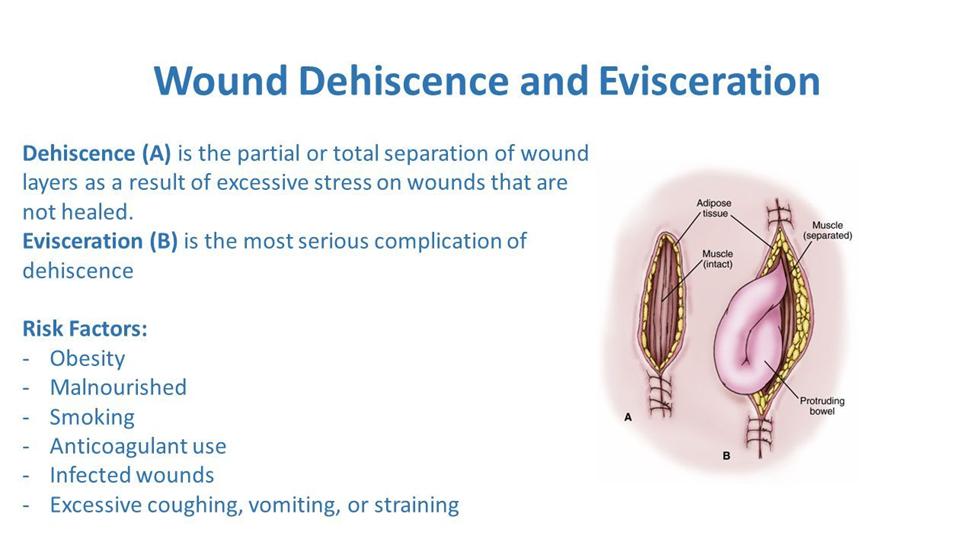
A client who had colon surgery 3 days ago is anxious and requesting assistance to reposition. While the nurse is turning the client, the wound dehiscences and eviscerates. The nurse moistens an available sterile dressing and places it over the wound. Which intervention should the nurse implement next?
Prepare the client to return to the operating room.
Obtain a sample of the drainage to send to the lab.
Bring additional sterile dressing supplies to the room.
Auscultate the abdomen for bowel sound activity.
The Correct Answer is A
A. Prepare the client to return to the operating room:
This is the correct and immediate priority. Evisceration, where internal organs protrude through the surgical incision, is a surgical emergency. Returning the client to the operating room is necessary to assess the extent of the complication, address the wound dehiscence, and protect the exposed organs. This intervention aims to prevent further complications and provide necessary surgical interventions.
B. Obtain a sample of the drainage to send to the lab:
While obtaining samples for laboratory analysis can be important for infection control, in the context of a client with evisceration, the primary concern is the surgical emergency. The priority is to address the wound complication by returning to the operating room rather than focusing on laboratory analysis at this immediate moment.
C. Bring additional sterile dressing supplies to the room:
While bringing additional supplies may be necessary, the priority in this situation is to prepare for the client's return to the operating room. Once the client is in a controlled surgical environment, additional dressing changes and wound care can be performed as needed.
D. Auscultate the abdomen for bowel sound activity:
While monitoring bowel sounds is a routine nursing assessment, in the context of evisceration, the immediate concern is the exposure of internal organs and the risk of infection. Preparing for the operating room takes precedence over routine assessments.
Nursing Test Bank
Naxlex Comprehensive Predictor Exams
Related Questions
Correct Answer is B
Explanation
A. Carcinogens are substances that contain cancerous cells:
This statement is incorrect. Carcinogens are substances that have the potential to cause cancer, but they do not necessarily contain cancerous cells themselves.
B. Substances that change a cell so that it becomes cancerous are potential sources of cancer:
This is the correct answer. Carcinogens are agents that can induce changes in the genetic material of cells, leading to the development of cancer. They can initiate or promote the process of carcinogenesis.
C. Environmental factors such as sunlight and chemicals can cause cancer to spread:
This statement is not accurate. Carcinogens can contribute to the initiation or promotion of cancer, but the spread of cancer (metastasis) involves complex biological processes and is not directly caused by environmental factors.
D. Carcinogens are in the environment and cannot be avoided:
This statement is not accurate. While carcinogens may be present in the environment, efforts can be made to minimize exposure and adopt preventive measures. Avoidance of known carcinogens and the promotion of a healthy lifestyle can contribute to cancer prevention.
Correct Answer is C
Explanation
A. Facial puffiness and periorbital edema:
These are common signs of hypothyroidism but may not require immediate action unless accompanied by severe symptoms.
B. Cold and dry skin:
Cold and dry skin is a characteristic feature of hypothyroidism, but a further decline in the level of consciousness is a more urgent issue.
C. Further decline in the level of consciousness.
A decline in the level of consciousness is a critical sign that requires immediate attention, as it may indicate worsening hypothyroidism, myxedema coma, or other serious complications. Myxedema coma is a life-threatening condition associated with severe hypothyroidism, and it requires prompt medical intervention.
D. Hematocrit of 30% (0.30):
While anemia is a potential complication of hypothyroidism, a hematocrit of 30% alone may not be the most immediate concern compared to a decline in the level of consciousness.
Whether you are a student looking to ace your exams or a practicing nurse seeking to enhance your expertise , our nursing education contents will empower you with the confidence and competence to make a difference in the lives of patients and become a respected leader in the healthcare field.
Visit Naxlex, invest in your future and unlock endless possibilities with our unparalleled nursing education contents today