
A client comes to the Urgent Care center complaining of urinary frequency accompanied by pain when voiding. Which clinical manifestation would make the nurse suspect acute pyelonephritis rather than cystitis?
Urinary urgency
Increased WBCs in urinalysis
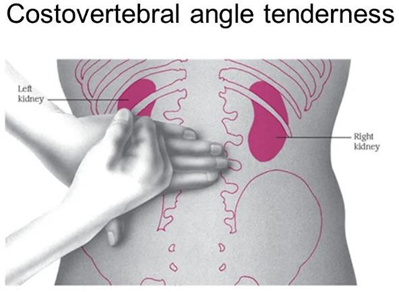
Costovertebral tenderness
Hematuria
The Correct Answer is C
C. Costovertebral tenderness, which is tenderness over the costovertebral angle (where the ribs meet the vertebral column) on palpation, is more indicative of acute pyelonephritis rather than cystitis. In acute pyelonephritis, inflammation of the kidney parenchyma and surrounding tissues can lead to tenderness in this area.
A. Both acute pyelonephritis and cystitis can present with urinary urgency, as it is a common symptom of urinary tract infections (UTIs) in general.
B. Increased WBCs in urinalysis: While an increased number of white blood cells (WBCs) in the urinalysis can indicate a urinary tract infection, it is not specific to either acute pyelonephritis or cystitis.
D. Hematuria can occur in both acute pyelonephritis and cystitis.
Nursing Test Bank
Naxlex Comprehensive Predictor Exams
Related Questions
Correct Answer is B
Explanation
A. Alpha adrenergic blockers are medications commonly used to help control symptoms of benign prostatic hyperplasia (BPH) by relaxing the muscles of the prostate and bladder neck, thereby improving urine flow and reducing urinary symptoms such as hesitancy, urgency, and frequency.
B. Benign prostatic hyperplasia (BPH) is not cancerous and does not typically progress to prostate cancer. While both BPH and prostate cancer involve growth of the prostate gland, they are distinct conditions with different risk factors, symptoms, and treatment approaches.
C. In some cases, if symptoms of BPH are severe or do not respond to medication, surgical management may be necessary. Common surgical procedures for BPH include transurethral resection of the prostate (TURP) or laser prostatectomy.
D. There are several nonsurgical treatment options available for BPH, including alpha adrenergic blockers, 5-alpha reductase inhibitors, combination therapy, and minimally invasive procedures such as transurethral microwave thermotherapy (TUMT) or prostatic artery embolization (PAE).
Correct Answer is C
Explanation
C. Costovertebral tenderness, which is tenderness over the costovertebral angle (where the ribs meet the vertebral column) on palpation, is more indicative of acute pyelonephritis rather than cystitis. In acute pyelonephritis, inflammation of the kidney parenchyma and surrounding tissues can lead to tenderness in this area.
A. Both acute pyelonephritis and cystitis can present with urinary urgency, as it is a common symptom of urinary tract infections (UTIs) in general.
B. Increased WBCs in urinalysis: While an increased number of white blood cells (WBCs) in the urinalysis can indicate a urinary tract infection, it is not specific to either acute pyelonephritis or cystitis.
D. Hematuria can occur in both acute pyelonephritis and cystitis.
Whether you are a student looking to ace your exams or a practicing nurse seeking to enhance your expertise , our nursing education contents will empower you with the confidence and competence to make a difference in the lives of patients and become a respected leader in the healthcare field.
Visit Naxlex, invest in your future and unlock endless possibilities with our unparalleled nursing education contents today