
A charge nurse overhears a newly licensed nurse providing instructions to a female client on the proper steps to collect a midstream urine specimen. Which of the following statements made by the newly licensed nurse requires the charge nurse to intervene?
"Use the provided towelette to cleanse the area by moving in a back-and-forth motion."
"Start the flow of urine before passing the container under the stream to collect the specimen."
"It will be easier to use your nondominant hand to spread the labia."
"Remove the specimen container before stopping the stream of urine”
The Correct Answer is B
This statement is incorrect and requires correction because it suggests starting the flow of urine before positioning the collection container, which can result in contamination of the specimen. The correct procedure for collecting a midstream urine specimen involves the following steps:
1. Provide the client with a clean urine specimen container.
2. Instruct the client to cleanse the genital area using a provided towelette or antiseptic wipes, wiping from front to back.
3. Instruct the client to start urinating into the toilet or bedpan.
4. As the urine stream continues, the client should pass the collection container into the stream to collect the midstream specimen.
5. Once an adequate amount of urine has been collected (as per the laboratory's instructions), the client should remove the container from the stream of urine. 6. The client can then complete urinating into the toilet or bedpan.
The other statements made by the newly licensed nurse are correct:
"Use the provided towelette to cleanse the area by moving in a back-and-forth motion": This statement correctly instructs the client to cleanse the genital area before collecting the urine specimen.
"It will be easier to use your nondominant hand to spread the labia": This statement is correct as it suggests using the nondominant hand to facilitate the collection process.
"Remove the specimen container before stopping the stream of urine": This statement is correct as it indicates that the container should be removed before completing urination.
Nursing Test Bank
Naxlex Comprehensive Predictor Exams
Related Questions
Correct Answer is D
Explanation
When the client experiences cramping during the enema administration, it indicates that the colon is becoming distended. By allowing the client to expel some of the fluid, the pressure in the colon is reduced, which can help alleviate the discomfort and cramping. The nurse should pause the administration of the enema and allow the client to release some fluid before continuing.
The other options mentioned are not appropriate or effective actions to relieve the client's discomfort:
Lowering the height of the solution container: Lowering the height of the solution container will decrease the force of the fluid flow but may not address the underlying cause of the cramping. Allowing the client to expel some fluid is a more appropriate intervention.
Stopping the enema and documenting that the client did not tolerate the procedure: While it is important to monitor the client's tolerance during the procedure, abruptly stopping the enema and documenting intolerance may not be necessary if the discomfort can be relieved by allowing the client to expel some fluid. The nurse should prioritize relieving the discomfort before deciding to stop the procedure.
Encouraging the client to bear down: Bearing down or pushing can increase intra-abdominal pressure and exacerbate the cramping. This action is not recommended in this situation.
Correct Answer is D
Explanation
The nurse should measure the gastric residual before administering a feeding to identify delayed gastric emptying. Gastric residual refers to the volume of formula or contents remaining in the stomach from the previous feeding. Measuring gastric residual helps assess how well the client's stomach is emptying and can indicate if there is delayed gastric emptying.
By measuring gastric residual, the nurse can:
● Determine if the stomach has adequately emptied from the previous feeding. ● Assess the client's tolerance to enteral feedings.
● Detect signs of delayed gastric emptying, which can be indicative of gastrointestinal motility issues or other complications.
● Adjust the feeding rate or make other modifications to the enteral feeding plan based on the amount of residual volume.
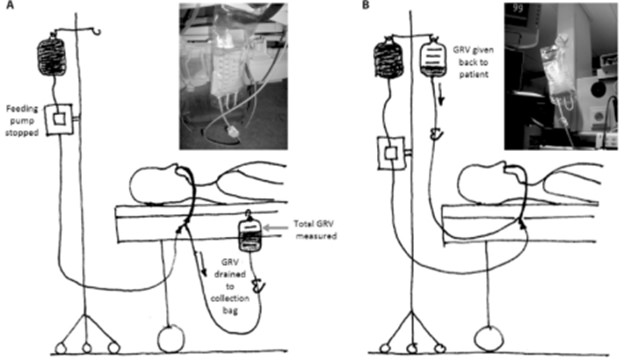
Confirming the placement of the NG tube is typically done using other methods, such as an X-ray, pH testing, or auscultation of air insufflation. Gastric residual measurement primarily serves the purpose of assessing gastric emptying, rather than confirming tube placement.
While electrolyte imbalances can be monitored in the overall care of a client receiving enteral feedings, measuring gastric residual specifically focuses on assessing gastric emptying and feeding tolerance, rather than determining the client's electrolyte balance.
Removing gastric acid that might cause dyspepsia is not the primary purpose of measuring gastric residual. Gastric residual measurement aims to evaluate the volume of the previous feeding and assess gastric emptying, rather than focusing on dyspepsia specifically.
Whether you are a student looking to ace your exams or a practicing nurse seeking to enhance your expertise , our nursing education contents will empower you with the confidence and competence to make a difference in the lives of patients and become a respected leader in the healthcare field.
Visit Naxlex, invest in your future and unlock endless possibilities with our unparalleled nursing education contents today