
Musculoskeletal Changes in pregnancy
- The musculoskeletal system undergoes significant changes to support weight gain, posture change, and fetal growth during pregnancy
- The main musculoskeletal changes include:
- Increased joint laxity: The looseness of the joints increases during pregnancy. This is due to increased relaxin levels that relax the ligaments (the bands of tissue that connect bones) and increase the range of motion of the joints. The joint laxity increases progressively throughout pregnancy and reaches its highest point at term.
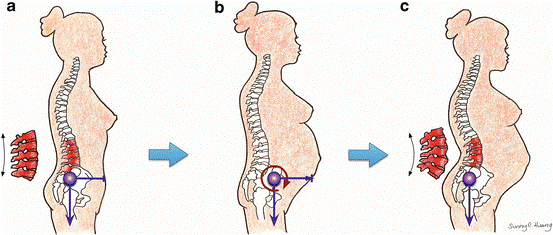
- Increased spinal curvature: The shape of the spine changes during pregnancy. This is due to increased weight gain, breast size, abdominal protrusion, and decreased abdominal muscle tone that alters the center of gravity and posture of the body. The spinal curvature increases progressively throughout pregnancy and reaches its highest point at term.
-
- Increased muscle strain: The stress on the muscles increases during pregnancy. This is due to increased weight gain, joint laxity, spinal curvature, and decreased muscle strength that affect the balance and stability of the body. The muscle strain increases progressively throughout pregnancy and reaches its highest point at term.
- The musculoskeletal changes result in increased mobility (the ability to move freely) and decreased stability (the ability to maintain balance) that support weight gain, posture change, and fetal growth during pregnancy
- The musculoskeletal changes may cause symptoms such as back pain, pelvic pain, leg cramps, or carpal tunnel syndrome (numbness or tingling in the hand) that are normal or abnormal depending on the severity, duration, and frequency
Nursing Test Bank
Test Bank #1: RN Pharmacology Exams
Test Bank #2: RN Medical-Surgical Exams
Test Bank #3: RN Fundamentals Exams
Test Bank #4: RN Maternal-Newborn Exams
Test Bank #5: RN Anatomy and Physiology Exams
Test Bank #6: RN Obstetrics and Pediatrics Exams
Test Bank #7: RN Fluid and Electrolytes Exams
Test Bank #9: RN Adult Health
Test Bank #10: RN Dosage Calculation
Test Bank #11: RN Community Health Exams
Test Bank #12: RN Psychology Exams
Test Bank #13: RN Nursing Care Of Children
Test Bank #14: RN Foundations of Nursing Exams
Naxlex Comprehensive Predictor Exams
Exam #1: RN Comprehensive predictor 2023 proctored exam
Exam #2: Ati rn vati comprehensive predictor proctored exam
Exam #3: Ati Rn Comprehensive Predictor Proctored Exam 2023
Exam #4: Rn Comprehensive Predictor 2023 Proctored Exam - St. Joseph
Exam #5: RN Comprehensive Predictor Proctored Exam (National U CA San Diego)
Exam #6: Ati rn comprehensive predictor 2023 retake proctored exam
Exam #7: RN Hesi Exit Proctored Exam
Exam #8: Hesi RN Exit proctored exam
Exam #9: Hesi rn exit proctored exam
Exam #10: Hesi Rn compass exit B proctored exam
Questions on Musculoskeletal Changes in pregnancy
Correct Answer is B
Explanation
muscle strength is not a musculoskeletal change, but a factor that can influence the ability to cope with the changes in weight and posture that occur during pregnancy. Muscle strength can vary depending on the exercise regimen and nutrition of the woman.
Correct Answer is C
Explanation
No explanation