
The nurse observes the following rhythm of a client on the telemetry unit.
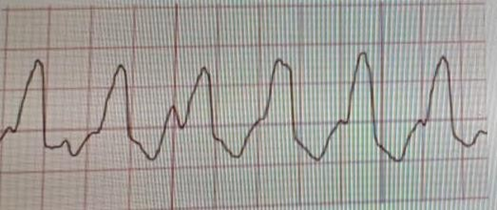
Which action should be completed first?
Report the findings and anticipate a medical prescription for amiodarone
Initiate a rapid response call and increase the monitor's sensitivity
Start compressions and prepare for defibrillation
Establish unresponsiveness and check the carotid pulse
The Correct Answer is D
A. Reporting the findings and anticipating a prescription for amiodarone may be necessary later, but the first step is to assess the patient's immediate condition (unresponsiveness, pulse status, etc.).
B. Although increasing monitor sensitivity and initiating a rapid response call might be helpful, these actions come after assessing the patient’s condition. If the patient is in distress or unresponsive, the nurse needs to check for a pulse and intervene right away.
C. This is a crucial action if the patient is unresponsive and pulseless (cardiac arrest). If the patient is found to be unresponsive and pulseless, starting chest compressions immediately and preparing for defibrillation is the next step. However, the first action is to check for pulse and responsiveness.
Why it's incorrect: Compressions and defibrillation are correct actions if the patient is pulseless, but before taking these steps, the nurse must assess the patient for responsiveness and check the carotid pulse. Starting CPR and preparing defibrillation without verifying the patient's condition could delay appropriate care.
D. Checking responsiveness and pulse is the most immediate and critical action because VT may be asymptomatic or cause deterioration, including cardiac arrest. Once pulse and responsiveness are determined, appropriate interventions (such as defibrillation or CPR) can be initiated quickly.
Nursing Test Bank
Naxlex Comprehensive Predictor Exams
Related Questions
Correct Answer is B
Explanation
A. The pacemaker wire for a DDD device is placed in the right atrium and right ventricle, not the left ventricle.
B. This is the correct description of a DDD pacemaker, which has wires in both the right atrium and right ventricle to monitor and pace both chambers when needed.
C. This is incorrect because a DDD pacemaker does not pace both ventricles.
D. This is inaccurate because a DDD pacemaker does not fire with every heartbeat; it only fires when the heart’s natural electrical activity is insufficient.
Correct Answer is A
Explanation
A. This question assesses the client's level of orthopnea, which is a condition where the client experiences difficulty breathing when lying flat. People with heart failure may need to use multiple pillows to prop themselves up to breathe more easily at night, making it an important question to assess respiratory status.
B. Chest pain with exertion can be indicative of cardiovascular issues but this question does not directly assess the client's respiratory status.
C. Tight rings and shoes can indicate fluid retention and edema, but it does not provide specific information about respiratory status.
D. Frequent nighttime voiding (nocturia) is common in heart failure, but it relates more to kidney function and fluid retention rather than respiratory function.
Whether you are a student looking to ace your exams or a practicing nurse seeking to enhance your expertise , our nursing education contents will empower you with the confidence and competence to make a difference in the lives of patients and become a respected leader in the healthcare field.
Visit Naxlex, invest in your future and unlock endless possibilities with our unparalleled nursing education contents today