
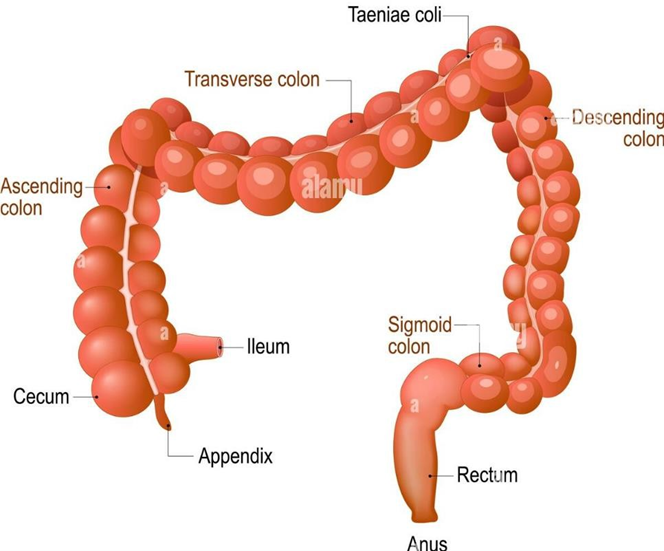
The nurse knows the fecal output will be more solid from a stoma created from which area of the bowel?
transverse colon
ascending colon
Ileum
sigmoid colon
The Correct Answer is D
D. The sigmoid colon is the last part of the large intestine before the rectum. It functions to store fecal material and absorb water and electrolytes. Fecal material passing through the sigmoid colon tends to become more solid as water is absorbed, resulting in a more formed stool compared to other parts of the colon.
A. The transverse colon is located in the upper abdomen and is responsible for further absorption of water and electrolytes from the stool. Fecal material passing through the transverse colon tends to become more solid as water is absorbed, but it may not be as solid as stool from the descending colon or sigmoid colon.
B. The ascending colon is where stool is in a more liquid form as it moves up from the cecum. It undergoes further absorption of water and electrolytes as it travels through the colon, but it typically does not produce solid fecal output.
C. The ileum is the final portion of the small intestine and connects to the large intestine (colon). Stool passing through the ileum is still in a relatively liquid state as it contains undigested food particles, bile salts, and digestive enzymes. The primary function of the ileum is absorption of nutrients rather than water reabsorption, so fecal output from an ileostomy is usually more liquid.
Nursing Test Bank
Naxlex Comprehensive Predictor Exams
Related Questions
Correct Answer is C
Explanation
C. Full compensation typically occurs within 2 to 3 days (approximately 72 hours) after the onset of an acid-base disturbance. During full compensation, the primary acid-base disorder (e.g., respiratory acidosis or alkalosis, metabolic acidosis or alkalosis) is still present, but the compensatory mechanisms have effectively brought the pH, pCO2, and bicarbonate (pHCO3) levels back towards normal range.
A. Full compensation occurs when both the primary disorder (respiratory or metabolic) and the compensatory mechanism (renal or respiratory) are functioning to return the pH towards normal. In this option, while the pO2 is within the normal range, the pH, pCO2, and bicarbonate (pHCO3) are all abnormal, indicating an ongoing imbalance.
B. Full compensation occurs when all components of the ABG are within or approaching normal range, indicating that the body's compensatory mechanisms have effectively counteracted the primary acid- base disturbance. In this option, the bicarbonate (pHCO3) is mentioned as starting to change, indicating incomplete compensation.
D. While the pH is within the normal range, both the pCO2 and pO2 are abnormal, indicating a primary respiratory disturbance. In the case of full compensation, the pH, pCO2, and bicarbonate (pHCO3) levels would all be within or approaching normal range, indicating that the compensatory mechanisms have effectively counteracted the primary acid-base disturbance.
Correct Answer is ["A","C","E"]
Explanation
A. This action could pose a significant liability risk as it violates the standard of care, which includes providing thorough and accurate handoff communication to ensure continuity of care. Failing to provide a report before transferring a client to ICU could lead to miscommunication, errors in treatment, and compromised patient safety.
C. Documenting vital signs taken by another nurse is generally acceptable as long as the nurse ensures the accuracy of the information and documents according to institutional policies and standards. However, if the nurse knowingly documents false or inaccurate vital signs, it could pose a liability risk.
E. Using equipment with a frayed cord poses a significant liability risk as it could lead to electrical hazards, equipment malfunction, or patient injury. Nurses have a duty to ensure the safety and integrity of equipment used in patient care and should promptly report any defects or safety concerns to prevent harm to patients.
B. Completing the admission assessment is a standard nursing responsibility and is not inherently a liability risk. However, liability could arise if the assessment is incomplete, inaccurate, or not documented appropriately, leading to errors in care or failure to identify and address the client's needs
D. Calling the physician to request an order for pain medication is a routine nursing responsibility and is not inherently a liability risk. However, liability could arise if the nurse fails to communicate important information about the client's condition or medication history, resulting in inappropriate or unsafe prescribing practices.
Whether you are a student looking to ace your exams or a practicing nurse seeking to enhance your expertise , our nursing education contents will empower you with the confidence and competence to make a difference in the lives of patients and become a respected leader in the healthcare field.
Visit Naxlex, invest in your future and unlock endless possibilities with our unparalleled nursing education contents today