
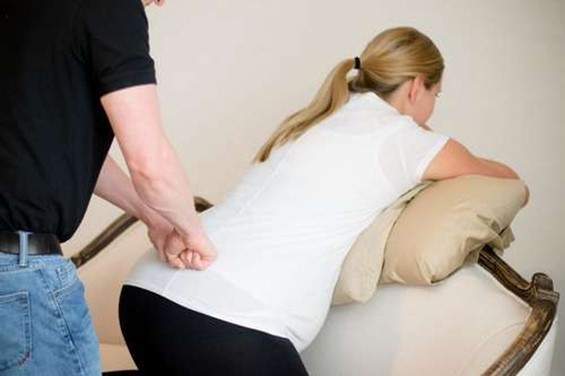
A nurse is teaching a client and her partner about the technique of counterpressure during labor.
Which of the following statements by the nurse is appropriate?
"Your partner will apply continuous, firm pressure between your thumb and index finger.”
"Your partner will apply pressure to the top of your uterus during contractions
"Your partner will apply steady pressure with a tennis ball to your finger.”
"Your partner will apply upward pressure on you.”
The Correct Answer is D
Answer: D
Rationale:
(A) "Your partner will apply continuous, firm pressure between your thumb and index finger": This statement is not appropriate for describing counterpressure during labor. Counterpressure typically involves applying pressure to areas such as the lower back or sacrum, not between the thumb and index finger.
(B) "Your partner will apply pressure to the top of your uterus during contractions": This statement is not appropriate. Applying pressure to the top of the uterus during contractions could be harmful and is not recommended as a counterpressure technique during labor. Counterpressure is generally applied to the lower back or hips to alleviate pain.
(C) "Your partner will apply steady pressure with a tennis ball to your finger": This statement is not correct. Counterpressure during labor involves applying pressure to the lower back or hips, not to the fingers. A tennis ball may be used, but it is applied to the lower back or sacral area, not the fingers.
(D) "Your partner will apply upward pressure on you": This statement is appropriate. During labor, counterpressure is often applied by the partner to the lower back or hips, pressing upward or in a direction that helps alleviate the pain caused by contractions, particularly in cases of back labor. This technique can help relieve discomfort by counteracting the pressure from the baby's head against the mother's spine.
Nursing Test Bank
Naxlex Comprehensive Predictor Exams
Related Questions
Correct Answer is A
Explanation
A nuchal cord occurs when the umbilical cord wraps around the fetal neck completely or for 360 degrees.
In some cases, a tight nuchal cord can cause conjunctival hemorrhage and petechiae.
Choice B) is not correct because erythema toxicum is a common rash seen in newborns and is not related to a nuchal cord.
Choice C) is not correct because periauricular papillomas are benign skin growths near the ear and are not related to a nuchal cord.
Choice D) is not correct because telangiectatic nevi, also known as stork bites or salmon patches, are common birthmarks seen in newborns and are not related to a nuchal cord.
Correct Answer is C
Explanation
Hyperemesis gravidarum is a severe form of nausea and vomiting during pregnancy that can result in dehydration, weight loss, and ketosis.
Clinicians suspect hyperemesis gravidarum based on symptoms and can support the diagnosis by measuring urine ketones.
Choice A, Rapid plasma reagin, is a blood test used to screen for syphilis.
Choice B, Prothrombin time, is a blood test that measures how long it takes for blood to clot.
Choice D, Urine culture, may be indicated because urinary tract infection is common in pregnancy and can be associated with nausea and vomiting.
However, urine ketones would be a more specific test for hyperemesis gravidarum.
Whether you are a student looking to ace your exams or a practicing nurse seeking to enhance your expertise , our nursing education contents will empower you with the confidence and competence to make a difference in the lives of patients and become a respected leader in the healthcare field.
Visit Naxlex, invest in your future and unlock endless possibilities with our unparalleled nursing education contents today