
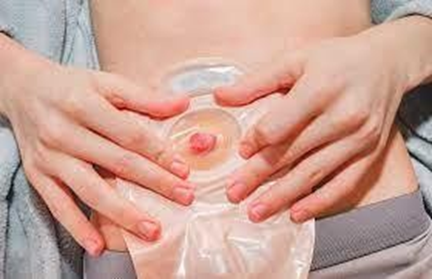
A nurse is completing discharge teaching about ostomy care with a client who has a new stoma. Which of the following instructions should the nurse include in the teaching? (Select all that apply.)
"Use povidone-iodine to clean around the stoma."
"Cut the opening of the pouch / of an inch larger than the stoma."
"Empty the ostomy pouch when it becomes one-third full of contents."
"Place a piece of gauze over the stoma while changing the pouch."
"Expect the stoma to turn a purple-blue color as it heals."
Correct Answer : B,C,D
A. Povidone-iodine is not recommended for cleaning around the stoma as it may cause irritation.
B. Ensuring the pouch opening is slightly larger than the stoma helps prevent irritation and ensures proper fit.
C. Regular emptying of the ostomy pouch prevents leakage and skin irritation. It also prevents it from becoming too heavy and pulling away from the skin.
D. The nurse should advise the client to place a piece of gauze over the stoma while changing the pouch to protect it from injury and contamination.
E. A purplish-blue change in the stoma is an indication of impaired blood supply to the stoma and should be promptly reported to the healthcare provider.
Nursing Test Bank
Naxlex Comprehensive Predictor Exams
Related Questions
Correct Answer is B
Explanation
A. Active bleeding with significant blood is characterized by weak and thread pulses and not bounding pulses.
B. Restlessness can be a sign of hypovolemia and decreased tissue perfusion, which may occur with active bleeding.
C. Warm skin may not necessarily indicate active bleeding but rather normal thermoregulation or vasodilation.
D. Brisk capillary refill is a sign of adequate peripheral perfusion and is not typically associated with active bleeding which is characterized by delayed capillary refill.
Correct Answer is D
Explanation
A. With the Z-track method, the skin is pulled laterally or to the side before the needle is inserted and released after the injection is administered to ensure the medication remains within the muscle and does not leak into the subcutaneous tissue.
B. The angle of insertion for intramuscular injections can vary depending on factors such as the client's body habitus and the length of the needle but is typically 90 degrees.
C. The needle should be withdrawn slowly and steadily to minimize tissue trauma and prevent medication leakage.
D. The Z-track method involves pulling the skin laterally or to the side before inserting the needle to create a zigzag pathway for the medication. This helps seal the needle track after the injection, reducing the risk of medication leakage into subcutaneous tissues.

Whether you are a student looking to ace your exams or a practicing nurse seeking to enhance your expertise , our nursing education contents will empower you with the confidence and competence to make a difference in the lives of patients and become a respected leader in the healthcare field.
Visit Naxlex, invest in your future and unlock endless possibilities with our unparalleled nursing education contents today