
Which of the following actions should a phlebotomist identify as an acceptable HIPAA practice?
Leaving a patient's record on a countertop while assisting other patients
Discarding patient contact information in the trash
Sharing passwords with a new coworker who has a stat laboratory value to report
Discussing patient information with an assisting coworker
The Correct Answer is D
Choice A reason:
Leaving a patient's record on a countertop while assisting other patients is not an acceptable HIPAA practice. Patient records contain sensitive information and should be kept secure at all times to maintain confidentiality. Leaving them in a place where unauthorized individuals could potentially access them violates HIPAA regulations.
Choice B reason:
Discarding patient contact information in the trash is a violation of HIPAA rules. Any documents containing patient information must be disposed of through secure methods, such as shredding, to ensure that the information cannot be retrieved or used improperly.
Choice C reason:
Sharing passwords with anyone, including coworkers, is against HIPAA guidelines and general security best practices. Each staff member should have a unique login credential to ensure that access can be tracked and that each person is accountable for their actions within the system.
Choice D reason:
Discussing patient information with an assisting coworker is acceptable under HIPAA, provided that the coworker has a legitimate need to know the information for treatment, payment, or healthcare operations purposes. This type of sharing is necessary for collaborative care and is permitted as long as it is done in a manner that protects the patient's privacy.
Nursing Test Bank
Naxlex Comprehensive Predictor Exams
Related Questions
Correct Answer is A
Explanation
Choice A Reason:
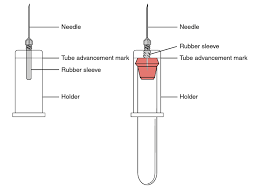
The evacuated tube system is designed for the collection of multiple blood specimens using interchangeable tubes. This system utilizes a double-pointed needle, one end of which goes into the patient's vein and the other into a vacuum tube. As the blood is drawn, it automatically fills the tube until the vacuum is exhausted. The phlebotomist can then easily replace the filled tube with another without removing the needle from the patient's vein, allowing for multiple samples to be taken during a single venipuncture.
Choice B Reason:
The hypodermic needle and syringe system is typically used for manual blood draws when the evacuated tube system is not suitable, such as with small or fragile veins. This system does not use interchangeable tubes; instead, the blood is drawn into a syringe and then transferred into the appropriate tubes, which can be time-consuming and increase the risk of hemolysis or contamination.
Choice C Reason:
A winged infusion set, also known as a butterfly needle, is often used for patients with difficult veins. Like the hypodermic needle and syringe system, it does not inherently allow for the use of interchangeable multi-sample tubes. Blood is collected into a syringe or a single tube attached to the butterfly needle, and changing tubes usually requires a new puncture for each sample.
Choice D Reason:
The lancet microcollection system is used for capillary blood collection, typically from a fingerstick or heelstick. It is used for small volume samples and does not accommodate interchangeable multi-sample tubes. This method is commonly used for pediatric patients or when only a small amount of blood is needed.
Correct Answer is D
Explanation
Choice A reason:
Turning the patient's hand palm down is not typically recommended as it can make the veins less accessible and may cause discomfort to the patient. The veins on the back of the hand are more superficial and can be more easily accessed when the hand is palm up.
Choice B reason:
Placing the patient in a supine position is not necessary for all venipuncture procedures and is usually reserved for patients who have a history of fainting or for those who are already lying down due to their medical condition. It is not a position that specifically increases comfort during the procedure.
Choice C reason:
Bending the patient's arm at the elbow can actually hinder the blood draw process as it may cause the veins to be less prominent and can lead to discomfort or movement during the venipuncture, potentially causing injury or an unsuccessful draw.
Choice D reason:
Positioning the patient's hand at waist level is the correct choice as it allows the arm to be in a natural, relaxed position, which can help the veins to be more prominent and accessible. It also helps in reducing the patient's anxiety as the arm is not in an awkward or strained position.
Whether you are a student looking to ace your exams or a practicing nurse seeking to enhance your expertise , our nursing education contents will empower you with the confidence and competence to make a difference in the lives of patients and become a respected leader in the healthcare field.
Visit Naxlex, invest in your future and unlock endless possibilities with our unparalleled nursing education contents today