
The following two graphic loops show which of the following conditions?
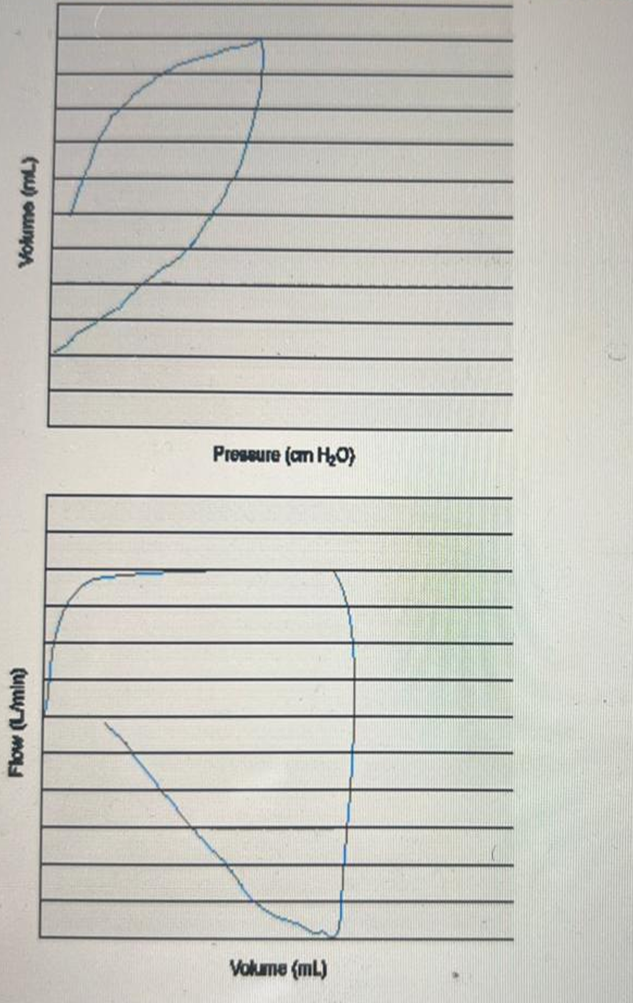
COPD
Atelectasis
Pneumothorax
Pulmonary oedema
The Correct Answer is A
The pressure–volume loop shows a "beaking" pattern (upper inflection point, where the loop flattens and bends back). This indicates overdistention of the alveoli from excessive tidal volume or high inspiratory pressure. The flow–volume loop shows a scooped-out appearance during expiration, which is typical of airflow obstruction such as COPD or asthma. These loops are most consistent with obstructive lung disease with overdistention such as in COPD.
Nursing Test Bank
Naxlex Comprehensive Predictor Exams
Related Questions
Correct Answer is B
Explanation
A. Insertion of an endotracheal tube: Endotracheal intubation is outside the scope of practice for registered nurses. This procedure is performed by providers such as anesthesiologists, respiratory therapists, or specially trained advanced practice nurses.
B. Monitoring a continuous intra-arterial infusion of a thrombolytic medication: Nurses are responsible for closely monitoring patients receiving high-risk infusions. This includes assessing for complications such as bleeding, changes in vital signs, and effectiveness of therapy, which falls within an RN’s scope of practice.
C. Placement of nylon sutures: Suturing is a procedure performed by providers or advanced practice nurses, not registered nurses. Performing sutures is outside the RN’s scope of practice in most care settings.
D. Administering a bolus dose of medication through an epidural catheter: Epidural bolus administration requires advanced training and is usually limited to anesthesiologists, certified registered nurse anesthetists (CRNAs), or pain specialists.
Correct Answer is D
Explanation
A. A client who needs assistance when ambulating: Difficulty ambulating increases fall risk and requires physical therapy, but it is not immediately life-threatening. This client needs support but does not take priority over airway or aspiration concerns.
B. A client who consistently has difficulty using utensils while eating: This reflects impaired motor coordination and may require occupational therapy. While important for independence, it does not present an urgent safety or health threat.
C. A client who has expressive aphasia: Expressive aphasia affects communication but does not compromise airway or physical safety directly. Speech therapy is beneficial, but it is not the most urgent referral.
D. A client who consistently coughs after drinking liquids: Coughing after drinking indicates possible aspiration due to impaired swallowing reflex. Aspiration can lead to pneumonia and respiratory compromise, making this client the highest priority for immediate referral to a speech-language pathologist for swallowing evaluation.
Whether you are a student looking to ace your exams or a practicing nurse seeking to enhance your expertise , our nursing education contents will empower you with the confidence and competence to make a difference in the lives of patients and become a respected leader in the healthcare field.
Visit Naxlex, invest in your future and unlock endless possibilities with our unparalleled nursing education contents today