
A nurse is caring for a client who is undergoing an oxytocin-stimulated contraction stress test (CST).
The nurse observes three contractions in 10 minutes with no late decelerations of the fetal heart rate (FHR).
Which of the following actions should the nurse take?
Discontinue oxytocin infusion and monitor the client for another 10 minutes
Increase oxytocin infusion and monitor the client until four contractions occur in 10 minutes
Stop oxytocin infusion and notify the provider of a positive CST result
Maintain oxytocin infusion and monitor the client until a negative CST result is confirmed
The Correct Answer is D
Maintain oxytocin infusion and monitor the client until a negative CST result is confirmed.
A negative CST result means that there are no late decelerations of the FHR after three contractions in 10 minutes. This indicates that the fetus can tolerate the stress of labor and has adequate oxygenation.
Choice A is wrong because discontinuing oxytocin infusion and monitoring the client for another 10 minutes will not provide enough information about the fetal response to contractions. The test requires at least three contractions in 10 minutes to be valid.
Choice B is wrong because increasing oxytocin infusion and monitoring the client until four contractions occur in 10 minutes may cause uterine hyperstimulation, which can compromise fetal oxygenation and lead to fetal distress.
Choice C is wrong because stopping oxytocin infusion and notifying the provider of a positive CST result is not appropriate. A positive CST result means that there are late decelerations of the FHR after more than half of the contractions, indicating fetal hypoxia and placental insufficiency.
In this case, there are no late decelerations, so the test result is not positive.
Nursing Test Bank
Naxlex Comprehensive Predictor Exams
Related Questions
Correct Answer is ["A","B","C","D"]
Explanation
The correct answer is choice A, B, C and D.These are the four components of a biophysical profile (BPP) that are scored as 2 (normal) or 0 (abnormal) based on ultrasound examination.The fifth component is the nonstress test (NST) that measures the fetal heart rate reactivity.A total score of 8 or 10 is normal, 6 is equivocal, and 4 or less is abnormal.
Choice E is wrong because fetal position is not a part of the BPP score.Fetal position is determined by ultrasound but it does not affect the score.
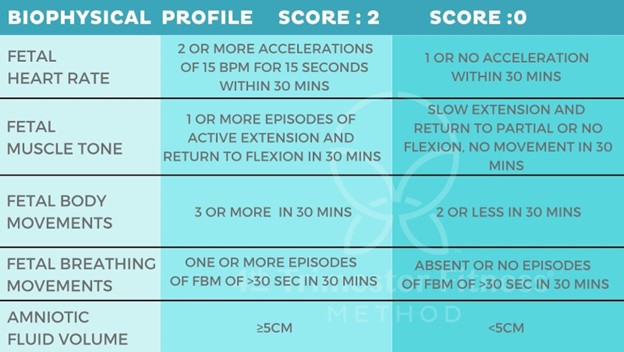
Normal ranges for each component are:
• Fetal breathing movement: One or more episodes of fetal breathing lasting at least 30 seconds within 30 minutes.
• Fetal tone: One or more episodes of active extension and flexion of a fetal extremity or opening and closing of the hand within 30 minutes.
• Reactive fetal heart rate: Two or more fetal heart rate accelerations that peak at least 15 beats per minute above the baseline and last at least 15 seconds from baseline to baseline during 20 minutes of observation.
• Amniotic fluid volume: A single deepest vertical pocket of amniotic fluid that measures at least 2 centimeters.
• Gross body movement: Three or more discrete body or limb movements within 30 minutes.
Correct Answer is B
Explanation
The client should count the baby’s kicks every day to monitor fetal well-being.A nonreactive nonstress test (NST) indicates that the fetal heart rate did not increase adequately with fetal movement, which may suggest fetal hypoxia or distress.A biophysical profile (BPP) is a combination of NST and ultrasound that assesses five parameters: fetal breathing, movement, tone, amniotic fluid volume, and NST.
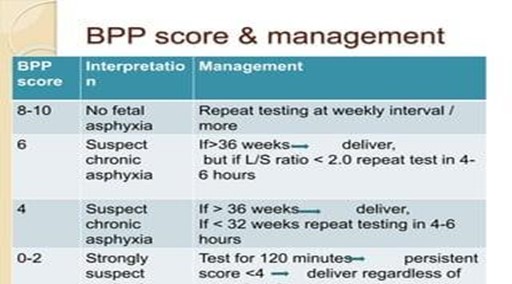
Each parameter is scored 0 or 2, and the total score ranges from 0 to 10.A score of 8/10 or 10/10 is considered normal, while a score of 6/10 is equivocal and ≤ 4/10 is abnormal.A BPP score of 8/10 with a nonreactive NST means that the fetus has normal biophysical activities but may have chronic hypoxia.
Choice A is wrong because the client does not need to have another BPP in a week unless there are other indications of fetal compromise.The BPP may be repeated once or twice a week depending on the clinical situation.
Choice C is wrong because the client does not need to have an amniocentesis as soon as possible.
Amniocentesis is an invasive procedure that involves inserting a needle into the uterus to obtain amniotic fluid for analysis.It is usually done for prenatal diagnosis of genetic disorders or fetal lung maturity, not for fetal well-being.
Choice D is wrong because the client does not need to deliver the baby by cesarean section.Cesarean section is a surgical delivery that may be indicated for various maternal or fetal conditions, such as placenta previa, breech presentation, fetal distress, or failure to progress in labor.A BPP score of 8/10 with a nonreactive NST does not warrant a cesarean section unless there are other risk factors or complications.
Whether you are a student looking to ace your exams or a practicing nurse seeking to enhance your expertise , our nursing education contents will empower you with the confidence and competence to make a difference in the lives of patients and become a respected leader in the healthcare field.
Visit Naxlex, invest in your future and unlock endless possibilities with our unparalleled nursing education contents today